"c68a05d5e51405b3"{"id":"1001902","slug":"old-gramophones-pack","title":"Old Gramophones pack","category":"Furniture \u0026 Fixtures","engine":"4.26+,5.0+","assetVersion":"","engineVersion":"Engine Version: 4.26+,5.0+","tag":"Furniture","accent":"blue","visual":"mech","summary":"Explore the Old Gramophones pack featuring antique European, British, and Soviet gramophones, open and closed states, disk models, and a dedicated disk cabinet.","platform":"Unreal Engine","publishedAt":"2026-10-22T11:41:03.408Z","updatedAt":"2026-10-22T11:41:03.408Z","sourceNotes":[],"fileContents":[],"compatibility":["Unreal Engine","Engine Version: 4.26+,5.0+"],"featuredImage":{"alt":"Old Gramophones pack","src":"/wp-content/uploads/published/2026/10/44de8eef29fe-090cca9d-eab9-4a89-9338-bed85a0d9eb8-a85f51cff1.webp"},"hasDownloadLink":true,"downloads":0,"terms":[{"taxonomy":"category","slug":"furniture-and-fixtures","name":"Furniture \u0026 Fixtures"}],"galleryImages":[{"src":"/wp-content/uploads/published/2026/10/5d8a12a5cf30-3bd677b2-c6c9-4197-aab8-29770edcf2f3-3937d48ec8.webp","alt":"Old Gramophones pack"},{"src":"/wp-content/uploads/published/2026/10/19f7c447a832-f583e085-4e5f-4360-b275-671652700e23-174ac08545.webp","alt":"Old Gramophones pack"},{"src":"/wp-content/uploads/published/2026/10/4647f499b813-6c5e7327-128b-4874-9235-e25eedfe7db7-66a911a779.webp","alt":"Old Gramophones pack"},{"src":"/wp-content/uploads/published/2026/10/2db8087375fb-70b6eb6f-4d83-43cf-914b-6d39ca65773f-5a7d5b791a.webp","alt":"Old Gramophones pack"},{"src":"/wp-content/uploads/published/2026/10/1c7dd2f6fa7d-9a93c10b-4c99-48f6-a556-07e6e45de5be-2fff70e16d.webp","alt":"Old Gramophones pack"},{"src":"/wp-content/uploads/published/2026/10/1eb1185cce07-c2626668-827c-4063-a27f-11f09abb4472-94a43873b5.webp","alt":"Old Gramophones pack"}],"accessPanel":{"kind":"resource","title":"Download this resource","eyebrow":"Free Download","message":"Log in or create a free account to start your download.","fileName":"Content.7z","safetyNote":"Resources are manually reviewed before listing to improve quality and reduce obvious risks.","actionLabel":"Download Free","resourceType":"Resource archive"},"contentHtml":"\u003ch2\u003eHistorical Interiors and Period Audio Staging\u003c/h2\u003e\u003cp\u003eHistorical environments rely heavily on authentic focal props to anchor an era. Audio playback equipment in particular marks temporal and geographic boundaries clearly. The Old Gramophones pack provides a collection of vintage sound-reproduction props spanning distinct design traditions, from ornate stationary European showpieces to utilitarian twentieth-century field players. Placing an antique European gramophone in an opulent late nineteenth-century salon immediately establishes a sense of aristocratic luxury, while deploying British or Soviet portable gramophones grounds an environment in early-to-mid twentieth-century daily life, wartime communications, or domestic quarters.\u003c/p\u003e\u003cp\u003eAudio props do more than decorate a room; they imply sound, atmosphere, and human presence. A gramophone positioned beside an armchair invites the viewer to imagine crackling music echoing through an otherwise silent space. Because historical settings often require specific geographical nuances, having access to hardware originating from European, British, and Soviet contexts allows artists to dress spaces with regional fidelity rather than resorting to generic vintage equipment.\u003c/p\u003e\u003ch2\u003eAntique European Gramophone and Dedicated Disk Cabinet Staging\u003c/h2\u003e\u003cp\u003eThe antique European gramophone represents the classic phonograph silhouette, suited for stately manors, formal study desks, and prominent parlor tables. Its presence communicates age, craftsmanship, and traditional mechanical engineering. In period room designs, such equipment serves as an immediate visual anchor, drawing the eye toward seating clusters, reading corners, or grand drawing room displays.\u003c/p\u003e\u003cp\u003eTo support believable interior layouts, the collection includes a matching disk cabinet. Furniture pieces designed specifically for media storage give an environment functional coherence, demonstrating where records are safely housed and how an owner organized their collection. Setting the antique European gramophone on or adjacent to this disk cabinet creates a self-contained listening parlor. Rather than scattering props randomly across unrelated tables, dressing a scene with dedicated phonograph furniture gives the architecture purposeful, lived-in context.\u003c/p\u003e\u003cp\u003eLevel decorators can use the disk cabinet as an anchoring piece against long interior walls, in corridor recesses, or beside grand fireplaces. Staging the cabinet with doors closed or integrating it alongside other classical furnishings ensures that the European gramophone feels permanently installed in its setting rather than treated as an afterthought.\u003c/p\u003e\u003ch2\u003eBritish and Soviet Portable Gramophones Across Open and Closed States\u003c/h2\u003e\u003cp\u003ePortable gramophones transformed how music was experienced by moving mechanical playback out of stationary parlors and into travel compartments, military stations, and modest urban dwellings. This package provides distinct British and Soviet portable gramophones, each built in two functional states: opened and closed. Having separate models for both configurations allows creators to match prop presentation directly to the immediate narrative state of a room.\u003c/p\u003e\u003cp\u003eA closed portable gramophone conveys transit, storage, or tidy containment. Placed on an overhead train rack, packed inside a footlocker, or resting beside bundled luggage on a loading platform, a closed British or Soviet unit signals that a character has traveled or is preparing to depart. In cramped wartime bunkers or austere mid-century apartments, a closed casing resting beneath a desk or in a closet shelf respects limited living space.\u003c/p\u003e\u003cp\u003eAn opened model instantly turns the scene into an active or recently interrupted listening event. Displaying the interior turntable platter, tone arm, and casing mechanism brings mechanical complexity to a desk or tabletop. In narrative projects, an opened player can suggest an abandoned rehearsal, an evening spent listening to records before an abrupt departure, or a relaxed gathering in a field camp.\u003c/p\u003e\u003cp\u003eBoth the British and Soviet portable models feature two distinct skins each. These surface variations allow scene builders to differentiate wear, material finish, or manufacturing batches. In scenes requiring multiple players across a single facility, alternating between available skins avoids the artificial uniformity common when duplicating prop models.\u003c/p\u003e\u003ch2\u003eVinyl Disk Models and Surface Skins for Musical Props\u003c/h2\u003e\u003cp\u003eA turntable requires media to justify its existence within an environment. The collection provides a dedicated disk model complete with three distinct skins. Incorporating varied disk skins allows creators to depict record collections with authentic visual diversity, preventing duplicate vinyl props from looking identical when laid out side by side.\u003c/p\u003e\u003cp\u003ePlacing a disk directly onto the turntable platter of an opened British or Soviet portable gramophone, or mounting it onto the antique European gramophone, delivers an immediate visual cue that sound was recently playing or is ready to spin. Scattering alternative disks across side tables, balancing them against the disk cabinet, or leaving one half-propped on a shelf produces a casual, human touch that softens rigid environment geometry.\u003c/p\u003e\u003cp\u003eUsing the three disk skins across a scene creates a believable rotation of musical titles. One disk might rest ready on the turntable spindle, while another rests flat on a desk, and a third remains propped beside the cabinet. This variety reinforces environmental storytelling by showing an active household or studio where music is actively selected, played, and stored.\u003c/p\u003e\u003ch2\u003eCreative Applications in Period and Thematic Environments\u003c/h2\u003e\u003cp\u003eThe variety contained within the pack accommodates several distinct world-building scenarios. Victorian and Edwardian manors benefit directly from the antique European gramophone, which matches rich wood paneling, velvet drapes, and antique desks. Its ornate silhouette fits historical murder mysteries, detective offices, and museum exhibits.\u003c/p\u003e\u003cp\u003eTwentieth-century settings, particularly mid-century conflict, espionage, or historical drama, find immediate utility in the British and Soviet portable units. A British portable gramophone placed inside an officer's tent or an underground shelter evokes a specific cultural touchstone of wartime morale. Similarly, a Soviet portable gramophone placed within a communal apartment, factory recreation hall, or military post delivers historical precision suited to eastern European or Cold War environments.\u003c/p\u003e\u003cp\u003eProp artists, historical world builders, and narrative adventure designers who need cohesive, multi-state vintage music equipment gain flexible options from this set. The inclusion of open and closed states, paired furniture, multiple skins, and modular disks provides the building blocks needed to craft detailed period audio installations.\u003c/p\u003e\n\n\u003ch2\u003eRelated Resources Worth Checking\u003c/h2\u003e\n\u003cul\u003e\n\u003cli\u003e\u003ca href=\"https://3dcghub.com/industry-props-pack-3-office/\" title=\"Industry Props Pack 3 Office\"\u003eIndustry Props Pack 3 Office\u003c/a\u003e\u003c/li\u003e\n\u003cli\u003e\u003ca href=\"https://3dcghub.com/victorian-furniture-living-room/\" title=\"Victorian Furniture - Living Room\"\u003eVictorian Furniture - Living Room\u003c/a\u003e\u003c/li\u003e\n\u003cli\u003e\u003ca href=\"https://3dcghub.com/stylized-interior-set/\" title=\"Stylized Interior Set\"\u003eStylized Interior Set\u003c/a\u003e\u003c/li\u003e\n\u003cli\u003e\u003ca href=\"https://3dcghub.com/post-soviet-furniture/\" title=\"Post Soviet Furniture\"\u003ePost Soviet Furniture\u003c/a\u003e\u003c/li\u003e\n\u003cli\u003e\u003ca href=\"https://3dcghub.com/abandoned-post-apoc-apartment-props/\" title=\"Abandoned Post Apoc Apartment Props\"\u003eAbandoned Post Apoc Apartment Props\u003c/a\u003e\u003c/li\u003e\n\u003c/ul\u003e","contentTextLength":7003,"navigation":{"current":23,"total":3860,"previous":{"id":"1001903","slug":"omniwalk-planetary-antigravity-magne-boots-hovercraft-traversal-system","title":"OmniWalk: Planetary AntiGravity, Magne-Boots, Hovercraft Traversal System","category":"Game Mechanics","platform":"Unreal Engine","updatedAt":"2026-10-22T11:41:48.786Z"},"next":{"id":"1001901","slug":"office-scene","title":"Office Scene","category":"Buildings \u0026 Architecture","platform":"Unreal Engine","updatedAt":"2026-10-22T11:40:25.616Z"}},"relatedResources":[{"id":"1001639","slug":"industry-props-pack-3-office","title":"Industry Props Pack 3 Office","category":"Furniture \u0026 Fixtures","engine":"4.16+,5.0+","assetVersion":"","engineVersion":"Engine Version: 4.16+,5.0+","tag":"Furniture","accent":"blue","visual":"mech","summary":"Construct realistic workspaces within industrial settings using Industry Props Pack 3 Office, featuring desks, monitors, computers, and bulletin board decals.","platform":"Unreal Engine","publishedAt":"2026-10-13T02:21:07.307Z","updatedAt":"2026-10-13T02:21:07.307Z","sourceNotes":[],"fileContents":[],"compatibility":["Unreal Engine","Engine Version: 4.16+,5.0+"],"featuredImage":{"alt":"Industry Props Pack 3 Office","src":"/wp-content/uploads/published/2026/10/6c39804c7d12-1394ea70-fcd3-43bd-901d-55431e102658-766d42f7b4.webp"},"hasDownloadLink":true,"downloads":1},{"id":"1001568","slug":"victorian-furniture-living-room","title":"Victorian Furniture - Living Room","category":"Furniture \u0026 Fixtures","engine":"4.22+,5.0+","assetVersion":"","engineVersion":"Engine Version: 4.22+,5.0+","tag":"Furniture","accent":"blue","visual":"mech","summary":"Create authentic period interiors with Victorian Furniture - Living Room, featuring low-poly optimized models, 4K PBR textures, and a presentation scene.","platform":"Unreal Engine","publishedAt":"2026-10-10T04:02:23.566Z","updatedAt":"2026-10-10T04:02:23.566Z","sourceNotes":[],"fileContents":[],"compatibility":["Unreal Engine","Engine Version: 4.22+,5.0+"],"featuredImage":{"alt":"Victorian Furniture - Living Room","src":"/wp-content/uploads/published/2026/10/6455d49d6b03-29b5c27e-5244-4178-aff9-ef0aaa6e97bd-dfcbac4a43.webp"},"hasDownloadLink":true,"downloads":1},{"id":"1001920","slug":"wood-assets-kit","title":"Wood Assets Kit","category":"Furniture \u0026 Fixtures","engine":"4.25+,5.0+","assetVersion":"","engineVersion":"Engine Version: 4.25+,5.0+","tag":"Furniture","accent":"blue","visual":"mech","summary":"Explore the Wood Assets Kit, featuring modular wooden fences, benches, tables, barrels, and Nordic-inspired props for medieval and rural game environments.","platform":"Unreal Engine","publishedAt":"2026-10-22T11:56:18.370Z","updatedAt":"2026-10-22T11:56:18.370Z","sourceNotes":[],"fileContents":[],"compatibility":["Unreal Engine","Engine Version: 4.25+,5.0+"],"featuredImage":{"alt":"Wood Assets Kit","src":"/wp-content/uploads/published/2026/10/fea3108d6c74-c381d253-e782-4a27-88e9-0ad514c80c61-6631ce54bd.webp"},"hasDownloadLink":true,"downloads":0}]}
Furniture
Old Gramophones pack
Explore the Old Gramophones pack featuring antique European, British, and Soviet gramophones, open and closed states, disk models, and a dedicated disk cabinet.
Historical environments rely heavily on authentic focal props to anchor an era. Audio playback equipment in particular marks temporal and geographic boundaries clearly. The Old Gramophones pack provides a collection of vintage sound-reproduction props spanning distinct design traditions, from ornate stationary European showpieces to utilitarian twentieth-century field players. Placing an antique European gramophone in an opulent late nineteenth-century salon immediately establishes a sense of aristocratic luxury, while deploying British or Soviet portable gramophones grounds an environment in early-to-mid twentieth-century daily life, wartime communications, or domestic quarters.
Audio props do more than decorate a room; they imply sound, atmosphere, and human presence. A gramophone positioned beside an armchair invites the viewer to imagine crackling music echoing through an otherwise silent space. Because historical settings often require specific geographical nuances, having access to hardware originating from European, British, and Soviet contexts allows artists to dress spaces with regional fidelity rather than resorting to generic vintage equipment.
Antique European Gramophone and Dedicated Disk Cabinet Staging
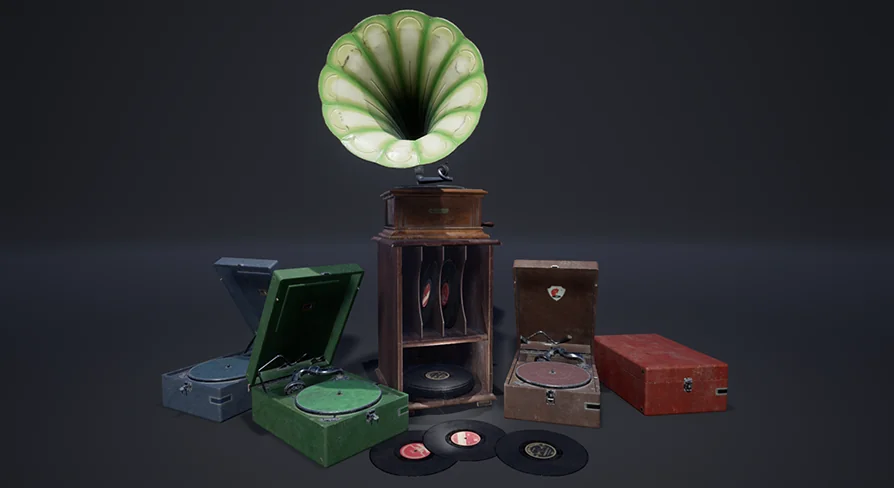
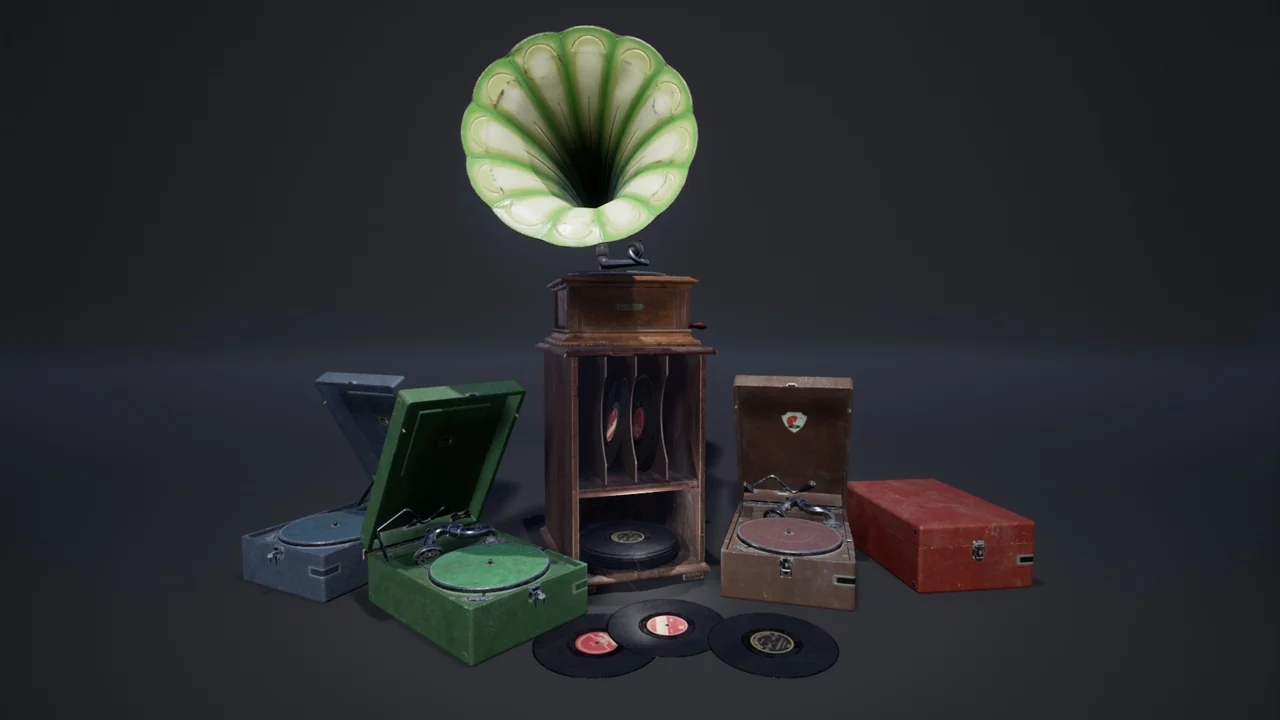
The antique European gramophone represents the classic phonograph silhouette, suited for stately manors, formal study desks, and prominent parlor tables. Its presence communicates age, craftsmanship, and traditional mechanical engineering. In period room designs, such equipment serves as an immediate visual anchor, drawing the eye toward seating clusters, reading corners, or grand drawing room displays.
To support believable interior layouts, the collection includes a matching disk cabinet. Furniture pieces designed specifically for media storage give an environment functional coherence, demonstrating where records are safely housed and how an owner organized their collection. Setting the antique European gramophone on or adjacent to this disk cabinet creates a self-contained listening parlor. Rather than scattering props randomly across unrelated tables, dressing a scene with dedicated phonograph furniture gives the architecture purposeful, lived-in context.
Level decorators can use the disk cabinet as an anchoring piece against long interior walls, in corridor recesses, or beside grand fireplaces. Staging the cabinet with doors closed or integrating it alongside other classical furnishings ensures that the European gramophone feels permanently installed in its setting rather than treated as an afterthought.
British and Soviet Portable Gramophones Across Open and Closed States
Portable gramophones transformed how music was experienced by moving mechanical playback out of stationary parlors and into travel compartments, military stations, and modest urban dwellings. This package provides distinct British and Soviet portable gramophones, each built in two functional states: opened and closed. Having separate models for both configurations allows creators to match prop presentation directly to the immediate narrative state of a room.
A closed portable gramophone conveys transit, storage, or tidy containment. Placed on an overhead train rack, packed inside a footlocker, or resting beside bundled luggage on a loading platform, a closed British or Soviet unit signals that a character has traveled or is preparing to depart. In cramped wartime bunkers or austere mid-century apartments, a closed casing resting beneath a desk or in a closet shelf respects limited living space.
An opened model instantly turns the scene into an active or recently interrupted listening event. Displaying the interior turntable platter, tone arm, and casing mechanism brings mechanical complexity to a desk or tabletop. In narrative projects, an opened player can suggest an abandoned rehearsal, an evening spent listening to records before an abrupt departure, or a relaxed gathering in a field camp.
Both the British and Soviet portable models feature two distinct skins each. These surface variations allow scene builders to differentiate wear, material finish, or manufacturing batches. In scenes requiring multiple players across a single facility, alternating between available skins avoids the artificial uniformity common when duplicating prop models.
Vinyl Disk Models and Surface Skins for Musical Props
A turntable requires media to justify its existence within an environment. The collection provides a dedicated disk model complete with three distinct skins. Incorporating varied disk skins allows creators to depict record collections with authentic visual diversity, preventing duplicate vinyl props from looking identical when laid out side by side.
Placing a disk directly onto the turntable platter of an opened British or Soviet portable gramophone, or mounting it onto the antique European gramophone, delivers an immediate visual cue that sound was recently playing or is ready to spin. Scattering alternative disks across side tables, balancing them against the disk cabinet, or leaving one half-propped on a shelf produces a casual, human touch that softens rigid environment geometry.
Using the three disk skins across a scene creates a believable rotation of musical titles. One disk might rest ready on the turntable spindle, while another rests flat on a desk, and a third remains propped beside the cabinet. This variety reinforces environmental storytelling by showing an active household or studio where music is actively selected, played, and stored.
Creative Applications in Period and Thematic Environments
The variety contained within the pack accommodates several distinct world-building scenarios. Victorian and Edwardian manors benefit directly from the antique European gramophone, which matches rich wood paneling, velvet drapes, and antique desks. Its ornate silhouette fits historical murder mysteries, detective offices, and museum exhibits.
Twentieth-century settings, particularly mid-century conflict, espionage, or historical drama, find immediate utility in the British and Soviet portable units. A British portable gramophone placed inside an officer's tent or an underground shelter evokes a specific cultural touchstone of wartime morale. Similarly, a Soviet portable gramophone placed within a communal apartment, factory recreation hall, or military post delivers historical precision suited to eastern European or Cold War environments.
Prop artists, historical world builders, and narrative adventure designers who need cohesive, multi-state vintage music equipment gain flexible options from this set. The inclusion of open and closed states, paired furniture, multiple skins, and modular disks provides the building blocks needed to craft detailed period audio installations.
 Furniture
 Furniture
 Furniture
 Furniture