"514d387a195911ce"{"id":"1002120","slug":"motion-scanner-lidar-detection-and-radar-system-with-audio-feedback","title":"Motion Scanner - LiDAR Detection \u0026 Radar System with Audio Feedback","category":"Gameplay Features","engine":"5.1","assetVersion":"Asset Version: 1.0.1","engineVersion":"Engine Version: 5.1","tag":"Gameplay Features","accent":"blue","visual":"audio","summary":"Add dynamic LiDAR mapping, pulse-based motion tracking, and reactive distance audio to Unreal Engine horror, sci-fi, and tactical shooter projects.","platform":"Unreal Engine","publishedAt":"2026-10-29T09:01:49.298Z","updatedAt":"2026-10-29T09:01:49.298Z","sourceNotes":[],"fileContents":[],"compatibility":["Unreal Engine","Asset Version: 1.0.1","Engine Version: 5.1"],"featuredImage":{"alt":"Motion Scanner - LiDAR Detection \u0026 Radar System with Audio Feedback","src":"/wp-content/uploads/published/2026/10/39e2fb98b1ef-348d7261-7cd4-47ec-a2a9-e2d28fcab510-b6242bfe00.webp"},"hasDownloadLink":true,"downloads":0,"terms":[{"taxonomy":"category","slug":"gameplay-features-tools-and-plugins","name":"Gameplay Features"}],"galleryImages":[{"src":"/wp-content/uploads/published/2026/10/a0bd4ad5031d-b02baac8-ae31-4562-85bc-e91396b4c545-c882ddcc79.webp","alt":"Motion Scanner - LiDAR Detection \u0026 Radar System with Audio Feedback"},{"src":"/wp-content/uploads/published/2026/10/ed88d00fddc2-4b3b8e23-6777-4c2d-9fcd-9490c427d44d-c5e86c2562.webp","alt":"Motion Scanner - LiDAR Detection \u0026 Radar System with Audio Feedback"},{"src":"/wp-content/uploads/published/2026/10/8e1beb038d6c-38fe0563-14b6-4020-8642-8803ed6a3b12-580ec8728d.webp","alt":"Motion Scanner - LiDAR Detection \u0026 Radar System with Audio Feedback"},{"src":"/wp-content/uploads/published/2026/10/f515baf08dec-47762eed-6bd4-4137-a3a6-c015b9c9e532-67dc24671b.webp","alt":"Motion Scanner - LiDAR Detection \u0026 Radar System with Audio Feedback"},{"src":"/wp-content/uploads/published/2026/10/1f5ae7ba5c7b-7806217a-e65e-4911-b1be-e5f4ea56afa5-15fbf79e2e.webp","alt":"Motion Scanner - LiDAR Detection \u0026 Radar System with Audio Feedback"},{"src":"/wp-content/uploads/published/2026/10/23b346748c75-a8684c83-6340-4520-a18b-288bbc51c2e7-9a7e3aad41.webp","alt":"Motion Scanner - LiDAR Detection \u0026 Radar System with Audio Feedback"},{"src":"/wp-content/uploads/published/2026/10/965b0cbb5b52-8333f978-b898-43b6-9a3f-8625e464c09f-25e394dda6.webp","alt":"Motion Scanner - LiDAR Detection \u0026 Radar System with Audio Feedback"},{"src":"/wp-content/uploads/published/2026/10/263affb21715-2f6a9ce0-903a-49d3-9744-4517f99f736f-441273fd5e.webp","alt":"Motion Scanner - LiDAR Detection \u0026 Radar System with Audio Feedback"},{"src":"/wp-content/uploads/published/2026/10/a1d4de136092-0d9f7422-3103-4b4a-a0aa-a8d69a7eb0eb-f27f5a749b.webp","alt":"Motion Scanner - LiDAR Detection \u0026 Radar System with Audio Feedback"}],"accessPanel":{"kind":"resource","title":"Download this resource","eyebrow":"Free Download","message":"Log in or create a free account to start your download.","fileName":"Motion Scanner - LiDAR Detection \u0026 Radar System with Audio Feedback.7z","safetyNote":"Resources are manually reviewed before listing to improve quality and reduce obvious risks.","actionLabel":"Download Free","resourceType":"Resource archive"},"contentHtml":"\u003ch2\u003eConstructing Tension Across Horror and Sci-Fi Environments\u003c/h2\u003e\u003cp\u003eIn horror survival games, tactical shooters, and sci-fi dungeon crawls, direct line of sight is rarely guaranteed. Tight corridors, unlit hulls, dense fog, and subterranean facilities force players to rely on auxiliary sensing tools to understand immediate threats. Motion Scanner addresses this dynamic directly by placing a dedicated detection device in the character's hands, transforming spatial awareness into an active, suspenseful mechanic rather than a static UI minimap.\u003c/p\u003e\u003cp\u003eRather than revealing everything within a radius instantly, the system treats information as a scarce resource. Players sweep an area, emit a pulse, and parse brief bursts of visual and acoustic data. This loop makes the scanner an active piece of survival gear, forcing players to balance the need to check their surroundings against the vulnerability of monitoring a handheld screen in hostile terrain.\u003c/p\u003e\u003ch2\u003eDynamic LiDAR Scanner for Live Environment Mapping\u003c/h2\u003e\u003cp\u003eA primary pillar of the system is its dynamic LiDAR scanner, which continuously samples static geometry in the world to construct a live map of surrounding architecture. In pitch-black chambers or obscuring environmental conditions, this live surface scan provides immediate navigation feedback, revealing walls, corridors, doorways, and physical obstacles without relying on standard level lighting.\u003c/p\u003e\u003cp\u003eBecause the LiDAR mechanic traces physical boundaries in real time, navigation becomes viable in zero-visibility scenarios. Designers can build sequences where standard vision is entirely compromised, requiring characters to traverse structural hazards solely through the topography rendered on the scanner screen. The spatial point representation translates complex geometric layouts into readable, functional tactical readouts on the fly.\u003c/p\u003e\u003ch2\u003eRealistic Motion Detection and Dynamic Audio Feedback\u003c/h2\u003e\u003cp\u003eUnlike conventional radars that instantly paint enemy dots on a screen, the motion detection system operates on physical pulse propagation. Targets do not register until the scanning wave travels outward through world space and intersects them. If an entity sits outside the advancing wave, it remains hidden until the crest makes direct contact.\u003c/p\u003e\u003cp\u003eTarget sensitivity relies on adjustable movement thresholds. Designers can define a minimum movement speed required to register a contact. An adversary creeping slowly beneath that threshold or remaining stationary can evade the radar sweep entirely, opening room for cat-and-mouse stealth gameplay. Once a moving target is pinged, its visualization can be customized on a per-entity basis:\u003c/p\u003e\u003cul\u003e\u003cli\u003eIndividual target shapes mapped per NPC, player, or neutral actor\u003c/li\u003e\u003cli\u003eUnique target colors assigned to distinguish factions, creature types, or squadmates\u003c/li\u003e\u003cli\u003eAdjustable visual scale for marker visibility at varying ranges\u003c/li\u003e\u003cli\u003eReal-time shortest-distance indicators displayed directly on the scanner screen\u003c/li\u003e\u003c/ul\u003e\u003cp\u003eAudio cues work hand-in-hand with the visual radar. Interactive sound effects adjust dynamically based on target proximity, altering frequency and intensity as threats close the gap. Combined with the numeric distance readout on the display, players can judge an advancing enemy's velocity and proximity by sound alone without dropping their visual guard.\u003c/p\u003e\u003ch2\u003eNetworked Radar Operations and C++ Architecture\u003c/h2\u003e\u003cp\u003eMultiplayer projects demand that gameplay detection tools run efficiently across client-server architectures without incurring latency spikes or desynchronization. Motion Scanner is authored in native C++ to deliver maximum runtime efficiency during rapid spatial sweeps and distance calculations across active entities.\u003c/p\u003e\u003cp\u003eAlthough built on a C++ foundation, using and customizing the scanner requires no C++ knowledge. All operational variables are exposed for high-level interaction, allowing gameplay designers to modify scan behaviors directly within editor workflows. The system is fully optimized for online gameplay, ensuring consistent target synchronization between host and remote players during fast-paced firefights or co-op horror encounters.\u003c/p\u003e\u003cp\u003eFor massive-scale simulations, the system integrates smoothly alongside World Director NPC PRO, allowing large volumes of simulated actors and ambient AI populations to interact with scanner logic without crippling performance budgets.\u003c/p\u003e\u003ch2\u003eCalibrating Parameters and Using the Scanner Model\u003c/h2\u003e\u003cp\u003eEvery element of the scan cycle is customizable to fit different mechanical tempos. Designers can configure the speed at which the detection wave travels outward, cap the maximum detection range, and adjust the refresh intervals to match the pacing of their game. A slow, wide-reaching pulse establishes a steady, anxious rhythm suited to survival horror, while a rapid, short-range sweep favors quick target acquisition in close-quarters tactical shooters.\u003c/p\u003e\u003cp\u003eThe package includes a ready-to-use 3D scanner asset, enabling quick implementation into character inventories or first-person rig setups. Developers can attach the hardware model directly to character sockets, hook the detection parameters into existing gameplay states, and begin tuning sensor ranges immediately.\u003c/p\u003e\u003ch2\u003eWho Benefits Most from Scanner-Driven Mechanics\u003c/h2\u003e\u003cp\u003eTeams building atmospheric horror titles, tactical squad shooters, or sci-fi survival projects will find the greatest utility in this framework. By combining wave-dependent motion pings, geometric LiDAR mapping, and distance-reactive audio, it provides a cohesive sensory toolkit that turns environmental reconnaissance into an engaging core mechanic.\u003c/p\u003e\n\n\u003ch2\u003eMore From The Same Workflow\u003c/h2\u003e\n\u003cul\u003e\n\u003cli\u003e\u003ca href=\"https://3dcghub.com/customizable-interaction-plugin/\" title=\"Customizable Interaction Plugin\"\u003eCustomizable Interaction Plugin\u003c/a\u003e\u003c/li\u003e\n\u003cli\u003e\u003ca href=\"https://3dcghub.com/virtual-animation-tools-v6/\" title=\"Virtual Animation Tools V6\"\u003eVirtual Animation Tools V6\u003c/a\u003e\u003c/li\u003e\n\u003cli\u003e\u003ca href=\"https://3dcghub.com/line-of-sight-dynamic-mesh/\" title=\"Line Of Sight. Dynamic mesh.\"\u003eLine Of Sight. Dynamic mesh.\u003c/a\u003e\u003c/li\u003e\n\u003cli\u003e\u003ca href=\"https://3dcghub.com/audio-analysis-tools-beat-detection/\" title=\"Audio Analysis Tools (Beat Detection)\"\u003eAudio Analysis Tools (Beat Detection)\u003c/a\u003e\u003c/li\u003e\n\u003cli\u003e\u003ca href=\"https://3dcghub.com/customizable-bodycam-component/\" title=\"Customizable Bodycam Component\"\u003eCustomizable Bodycam Component\u003c/a\u003e\u003c/li\u003e\n\u003c/ul\u003e","contentTextLength":5727,"navigation":{"current":92,"total":4137,"previous":{"id":"1002121","slug":"motorcycles","title":"Motorcycles","category":"Bicycles \u0026 Motorcycles","platform":"Unreal Engine","updatedAt":"2026-10-29T09:02:39.320Z"},"next":{"id":"1002119","slug":"mosin-nagant-m1891","title":"Mosin Nagant M1891","category":"3D","platform":"Unreal Engine","updatedAt":"2026-10-29T09:00:55.653Z"}},"relatedResources":[{"id":"14999","slug":"customizable-interaction-plugin","title":"Customizable Interaction Plugin","category":"Gameplay Features","engine":"5.2 - 5.7","assetVersion":"Asset Version:1.0.1 - 2.0.4","engineVersion":"Engine version: 5.2 - 5.7","tag":"Gameplay Features","accent":"blue","visual":"character","summary":"The Customizable Interaction Plugin is a high-performance C++ tool designed for easy implementation. It features various interaction modes, detection settings, and full network replication.","platform":"Unreal Engine","publishedAt":"2026-03-12T07:22:15.000Z","updatedAt":"2026-09-30T04:21:56.258Z","sourceNotes":[],"fileContents":[],"compatibility":["Unreal Engine","Asset Version:1.0.1 - 2.0.4","Engine version: 5.2 - 5.7"],"featuredImage":{"alt":"Customizable Interaction Plugin","src":"https://3dcghub.com/wp-content/uploads/2026/03/61633308-c75d-4c5d-99bd-54efe2e0d535.webp"},"hasDownloadLink":true,"downloads":4},{"id":"13523","slug":"virtual-animation-tools-v6","title":"Virtual Animation Tools V6","category":"Animations","engine":"5.5 - 5.6","assetVersion":"Engine version: 5.5 - 5.6","engineVersion":"Asset Version:6.5.0","tag":"Animations","accent":"blue","visual":"animation","summary":"Virtual Animation Tools V6 is a powerful utility designed to eliminate repetitive manual configurations in large animation datasets. It offers advanced bone management, automatic footstep notifies, and seamless motion data conversion.","platform":"Unreal Engine","publishedAt":"2026-03-10T17:29:07.000Z","updatedAt":"2026-04-19T15:46:26.000Z","sourceNotes":[],"fileContents":[],"compatibility":["Unreal Engine","Engine version: 5.5 - 5.6","Asset Version: 6.5.0"],"featuredImage":{"alt":"Virtual Animation Tools V6","src":"https://3dcghub.com/wp-content/uploads/2026/03/edd72256-8c33-4840-92ac-abdb69fc6afe.webp"},"hasDownloadLink":true,"downloads":0},{"id":"15042","slug":"line-of-sight-dynamic-mesh","title":"Line Of Sight. Dynamic mesh.","category":"Gameplay Features","engine":"4.26 - 5.8","assetVersion":"Asset Version:1.1 - 1.2","engineVersion":"Engine version: 4.26 - 5.8","tag":"Gameplay Features","accent":"blue","visual":"city","summary":"Enhance your game's visibility mechanics with Line Of Sight. Dynamic mesh., a high-performance C++ component designed for object detection and pseudo-lighting effects in both 2D and 3D environments.","platform":"Unreal Engine","publishedAt":"2026-03-12T07:35:31.000Z","updatedAt":"2026-09-30T04:27:29.697Z","sourceNotes":[],"fileContents":[],"compatibility":["Unreal Engine","Asset Version:1.1 - 1.2","Engine version: 4.26 - 5.8"],"featuredImage":{"alt":"Line Of Sight. Dynamic mesh.","src":"https://3dcghub.com/wp-content/uploads/2026/03/93d0eb38-da16-45d6-8884-d0fb25a29b10.webp"},"hasDownloadLink":true,"downloads":1}]}
Gameplay Features
Motion Scanner - LiDAR Detection & Radar System with Audio Feedback
Add dynamic LiDAR mapping, pulse-based motion tracking, and reactive distance audio to Unreal Engine horror, sci-fi, and tactical shooter projects.
Constructing Tension Across Horror and Sci-Fi Environments
In horror survival games, tactical shooters, and sci-fi dungeon crawls, direct line of sight is rarely guaranteed. Tight corridors, unlit hulls, dense fog, and subterranean facilities force players to rely on auxiliary sensing tools to understand immediate threats. Motion Scanner addresses this dynamic directly by placing a dedicated detection device in the character's hands, transforming spatial awareness into an active, suspenseful mechanic rather than a static UI minimap.
Rather than revealing everything within a radius instantly, the system treats information as a scarce resource. Players sweep an area, emit a pulse, and parse brief bursts of visual and acoustic data. This loop makes the scanner an active piece of survival gear, forcing players to balance the need to check their surroundings against the vulnerability of monitoring a handheld screen in hostile terrain.
Dynamic LiDAR Scanner for Live Environment Mapping
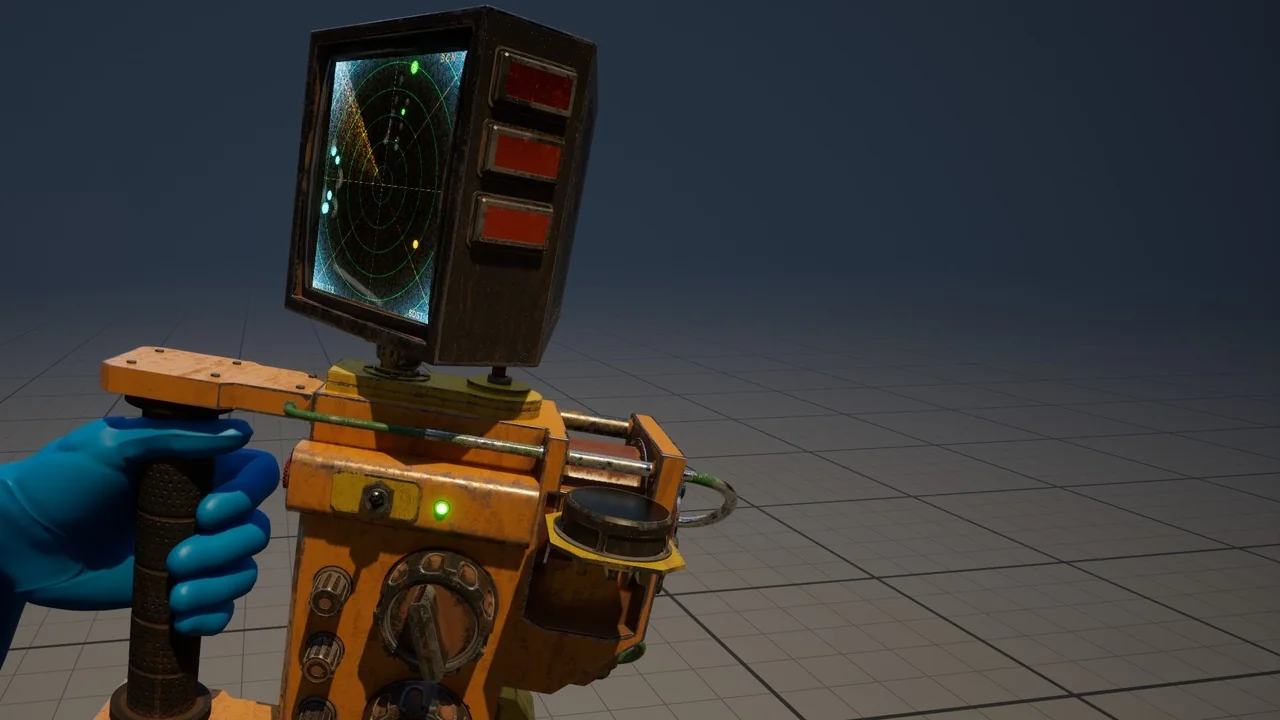
A primary pillar of the system is its dynamic LiDAR scanner, which continuously samples static geometry in the world to construct a live map of surrounding architecture. In pitch-black chambers or obscuring environmental conditions, this live surface scan provides immediate navigation feedback, revealing walls, corridors, doorways, and physical obstacles without relying on standard level lighting.
Because the LiDAR mechanic traces physical boundaries in real time, navigation becomes viable in zero-visibility scenarios. Designers can build sequences where standard vision is entirely compromised, requiring characters to traverse structural hazards solely through the topography rendered on the scanner screen. The spatial point representation translates complex geometric layouts into readable, functional tactical readouts on the fly.
Realistic Motion Detection and Dynamic Audio Feedback
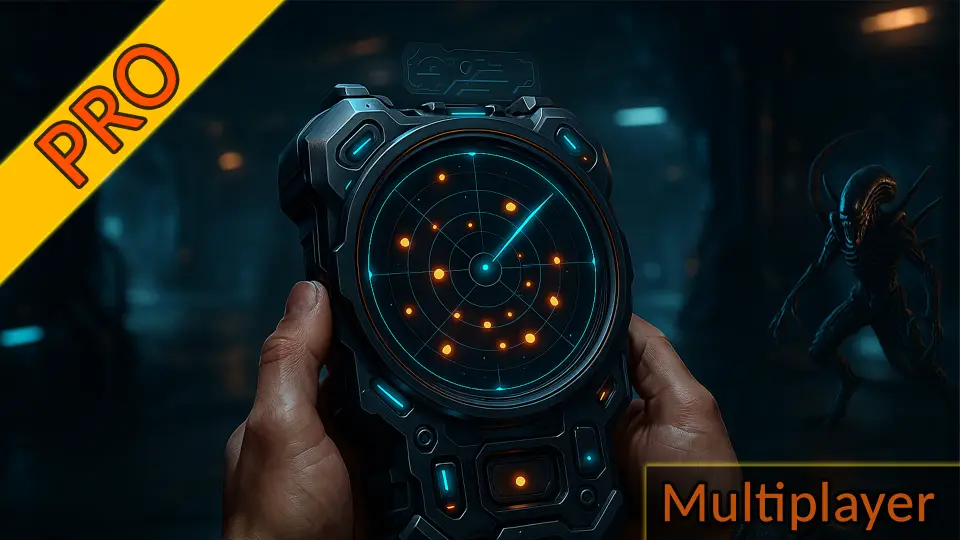
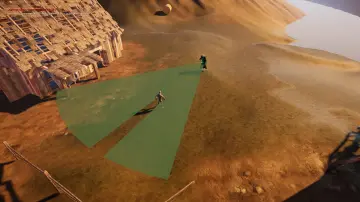
Unlike conventional radars that instantly paint enemy dots on a screen, the motion detection system operates on physical pulse propagation. Targets do not register until the scanning wave travels outward through world space and intersects them. If an entity sits outside the advancing wave, it remains hidden until the crest makes direct contact.
Target sensitivity relies on adjustable movement thresholds. Designers can define a minimum movement speed required to register a contact. An adversary creeping slowly beneath that threshold or remaining stationary can evade the radar sweep entirely, opening room for cat-and-mouse stealth gameplay. Once a moving target is pinged, its visualization can be customized on a per-entity basis:
Individual target shapes mapped per NPC, player, or neutral actor
Unique target colors assigned to distinguish factions, creature types, or squadmates
Adjustable visual scale for marker visibility at varying ranges
Real-time shortest-distance indicators displayed directly on the scanner screen
Audio cues work hand-in-hand with the visual radar. Interactive sound effects adjust dynamically based on target proximity, altering frequency and intensity as threats close the gap. Combined with the numeric distance readout on the display, players can judge an advancing enemy's velocity and proximity by sound alone without dropping their visual guard.
Networked Radar Operations and C++ Architecture
Multiplayer projects demand that gameplay detection tools run efficiently across client-server architectures without incurring latency spikes or desynchronization. Motion Scanner is authored in native C++ to deliver maximum runtime efficiency during rapid spatial sweeps and distance calculations across active entities.
Although built on a C++ foundation, using and customizing the scanner requires no C++ knowledge. All operational variables are exposed for high-level interaction, allowing gameplay designers to modify scan behaviors directly within editor workflows. The system is fully optimized for online gameplay, ensuring consistent target synchronization between host and remote players during fast-paced firefights or co-op horror encounters.
For massive-scale simulations, the system integrates smoothly alongside World Director NPC PRO, allowing large volumes of simulated actors and ambient AI populations to interact with scanner logic without crippling performance budgets.
Calibrating Parameters and Using the Scanner Model
Every element of the scan cycle is customizable to fit different mechanical tempos. Designers can configure the speed at which the detection wave travels outward, cap the maximum detection range, and adjust the refresh intervals to match the pacing of their game. A slow, wide-reaching pulse establishes a steady, anxious rhythm suited to survival horror, while a rapid, short-range sweep favors quick target acquisition in close-quarters tactical shooters.
The package includes a ready-to-use 3D scanner asset, enabling quick implementation into character inventories or first-person rig setups. Developers can attach the hardware model directly to character sockets, hook the detection parameters into existing gameplay states, and begin tuning sensor ranges immediately.
Who Benefits Most from Scanner-Driven Mechanics
Teams building atmospheric horror titles, tactical squad shooters, or sci-fi survival projects will find the greatest utility in this framework. By combining wave-dependent motion pings, geometric LiDAR mapping, and distance-reactive audio, it provides a cohesive sensory toolkit that turns environmental reconnaissance into an engaging core mechanic.
 Gameplay Features
 Gameplay Features
 Animations
 Gameplay Features