"dcdab3159cf15695"{"id":"1002119","slug":"mosin-nagant-m1891","title":"Mosin Nagant M1891","category":"3D","engine":"5.0+","assetVersion":"","engineVersion":"Engine Version: 5.0+","tag":"3D","accent":"blue","visual":"mech","summary":"Explore the Mosin Nagant M1891 WW2 sniper rifle asset, featuring dual skeletal and vertex animations, realistic PBR materials, and dedicated shooter mechanics.","platform":"Unreal Engine","publishedAt":"2026-10-29T09:00:55.653Z","updatedAt":"2026-10-29T09:00:55.653Z","sourceNotes":[],"fileContents":[],"compatibility":["Unreal Engine","Engine Version: 5.0+"],"featuredImage":{"alt":"Mosin Nagant M1891","src":"/wp-content/uploads/published/2026/10/4dfee80d27ce-18524303-ae49-46c2-9ea2-0de44502610b-5eb5b82cc9.webp"},"hasDownloadLink":true,"downloads":0,"terms":[{"taxonomy":"category","slug":"3d","name":"3D"}],"galleryImages":[{"src":"/wp-content/uploads/published/2026/10/a5c1b1765d7b-afcade35-8608-4cc1-b4f6-2cb077a2a22c-7c049fb80f.webp","alt":"Mosin Nagant M1891"},{"src":"/wp-content/uploads/published/2026/10/7df596559566-6e9b07f6-fd77-44ff-8a60-52b62890f34c-b2e8d7b326.webp","alt":"Mosin Nagant M1891"},{"src":"/wp-content/uploads/published/2026/10/1bd683cf188c-e73407f5-b0df-45c0-80fb-0e0ad51f6c42-18af9b8eb4.webp","alt":"Mosin Nagant M1891"},{"src":"/wp-content/uploads/published/2026/10/77abea0499e4-dfa94943-84de-49b7-8b09-ace9f58ff81d-60e686ba31.webp","alt":"Mosin Nagant M1891"},{"src":"/wp-content/uploads/published/2026/10/4e72c18b822e-c54be630-79d9-43a3-97ae-726ede99ee44-91cfa25a06.webp","alt":"Mosin Nagant M1891"},{"src":"/wp-content/uploads/published/2026/10/2d098252d51b-b206ee7c-1071-403b-b77b-983d312fb738-cd947def03.webp","alt":"Mosin Nagant M1891"},{"src":"/wp-content/uploads/published/2026/10/7e38026b3bd3-2ef7347c-e973-43db-9c36-451a91c9077a-4528603808.webp","alt":"Mosin Nagant M1891"},{"src":"/wp-content/uploads/published/2026/10/e76000488165-e454726a-bd8a-4199-a757-e29a69f9b6b3-5347f189d0.webp","alt":"Mosin Nagant M1891"},{"src":"/wp-content/uploads/published/2026/10/3aa756a68a38-1b4e0fc3-e9ae-438f-94fb-89f3d42f1963-b4b9c511fb.webp","alt":"Mosin Nagant M1891"}],"accessPanel":{"kind":"resource","title":"Download this resource","eyebrow":"Free Download","message":"Log in or create a free account to start your download.","fileName":"Content.7z","safetyNote":"Resources are manually reviewed before listing to improve quality and reduce obvious risks.","actionLabel":"Download Free","resourceType":"Resource archive"},"contentHtml":"\u003ch2\u003eLong-Range Ballistics and the WW2 Mosin Nagant M1891 Profile\u003c/h2\u003e\n\u003cp\u003eStationary marksmen, defensive trench lines, and calculated firing positions define historical wartime combat, where firearm reliability dictates survival. The Mosin Nagant M1891 captures this operational reality as a dedicated high-quality sniper rifle modeled for World War 2 settings. In historical warfare contexts, long-range engagements demand assets that hold visual credibility under close scrutiny, especially when players look down the length of the barrel or track targets across expansive environments. Because weapon geometry serves as the primary visual anchor in first-person and third-person shooters, maintaining realistic proportions across the receiver, barrel, and stock is fundamental to authentic combat representation.\u003c/p\u003e\n\u003cp\u003eAs a core military implement, the rifle functions as the centerpiece for infantry combat setups. The silhouette communicates deliberate, bolt-action marksmanship rather than rapid automatic fire, shaping how gameplay paces player movement, target acquisition, and stamina management. Whether deployed in scripted military campaigns or competitive skirmishes, the weapon conveys weight and historical purpose throughout active gameplay sequences.\u003c/p\u003e \u003ch2\u003eDual Animation Pipelines: Skeletal Animation and Vertex Animation\u003c/h2\u003e\n\u003cp\u003eInteractive firearms rely heavily on responsive motion to ground player actions during high-stakes shootouts. The Mosin Nagant M1891 addresses interactive mechanics directly by delivering both vertex animation and skeletal animation structures. Having two distinct technical animation methods gives developers considerable latitude in how they assemble their gameplay and rendering pipelines, allowing teams to choose the implementation best matched to their performance targets.\u003c/p\u003e \u003ch3\u003eSkeletal Rigging for Mechanical Shooter Precision\u003c/h3\u003e\n\u003cp\u003eSkeletal animation provides a conventional joint hierarchy suitable for intricate weapon handling. By anchoring mechanical sub-assemblies—such as the bolt, trigger, and internal feed systems—to dedicated bones, technical animators can execute complex, multi-stage interaction sequences. In a dedicated sniper game, standard firing loops demand distinct phases: striking the primer, drawing the bolt backward to eject spent brass, chambering a fresh cartridge, and locking the mechanism back down into firing position.\u003c/p\u003e\n\u003cp\u003eBone-based setups allow character hands to align cleanly through inverse kinematics, locking wrists and fingers to weapon components during reload or inspection routines. This precision prevents visual clipping during first-person view displays where weapon actions sit directly in front of the camera frustum.\u003c/p\u003e \u003ch3\u003eVertex Animation for Dynamic Mesh Efficiency\u003c/h3\u003e\n\u003cp\u003eComplementing skeletal bone rigs, the inclusion of vertex animation expands workflow flexibility across scenarios where standard bone transformations may introduce unnecessary processing overhead. Vertex animation captures per-vertex spatial transitions over time, making it valuable for specific visual deformations, rapid secondary movement, or background actors in large-scale war games where dozens of armed soldiers share the screen.\u003c/p\u003e\n\u003cp\u003eBy offering both systems, the package remains straightforward to use, eliminating the need to construct secondary deformation solutions from scratch. Creators can direct skeletal animation toward player-controlled viewports while taking advantage of alternative animation paths to optimize resource budgets across complex war scenarios.\u003c/p\u003e \u003ch2\u003eMechanical Readiness for Sniper and Shooter Game Design\u003c/h2\u003e\n\u003cp\u003eCreating an immersive long-range combat encounter involves more than visual fidelity; it requires functional tools that slide smoothly into existing game logic. The asset is built to serve everything necessary for a polished sniper game or quality shooter project. Because the underlying design prioritizes ease of use, implementation times drop significantly when setting up firing scripts, camera recoils, and interaction colliders.\u003c/p\u003e\n\u003cp\u003eIn standard shooter mechanics, snipers fulfill a distinct tactical niche: precision target elimination, area denial, and reconnaissance. Implementing the Mosin Nagant M1891 allows designers to construct systems around calculated trigger pulls, breathing stabilization mechanics, and steady weapon cycling. Its mechanical clarity ensures that visual cycles align precisely with audio cues, muzzle flash particles, and trajectory calculations without cumbersome rigging reconfigurations.\u003c/p\u003e \u003ch2\u003eRealistic PBR Material Definition for War Scenarios\u003c/h2\u003e\n\u003cp\u003eVisual authenticity in wartime environments relies extensively on accurate surface reactions. Built with Physically Based Rendering (PBR) workflows, the rifle interacts naturally with shifting dynamic lighting, whether positioned beneath clear exterior sunlight, dim bunker interiors, or harsh muzzle flares during nighttime engagements. The realistic treatment ensures that variations in wood grain, machined metal, and structural fittings maintain appropriate specular and roughness values under different environmental conditions.\u003c/p\u003e\n\u003cp\u003eWartime weapons inevitably accumulate dirt, field grime, and weathering over extended campaigns. PBR mapping supports cohesive visual depth across these varied conditions, ensuring that metal surfaces avoid excessive artificial gloss while retaining true-to-life light scattering. When viewed through tactical weapon scopes or inspected up close during chambering sequences, these realistic material qualities maintain their integrity, keeping the player fully immersed in the historical setting.\u003c/p\u003e \u003ch2\u003eAsset Ecosystems and Destructible Prop Compatibility\u003c/h2\u003e\n\u003cp\u003eA weapon model rarely exists in a visual vacuum; it operates within environmental layers comprising defensive barricades, vintage fortifications, and destructible clutter. In broader production contexts, the Mosin Nagant M1891 pairs naturally alongside systems like Destroyable Medieval Themed Props. While differing in primary historical eras, the shared emphasis on natural wood grains, forged iron components, and structural degradation creates functional synergy across environmental design.\u003c/p\u003e\n\u003cp\u003eLevel artists building rustic redoubts, improvised barricades, or weathered frontline garrisons can position the rifle against destructible terrain without aesthetic friction. Splintering timbers, fractured stone masonry, and vintage military armaments work together to establish convincing cover zones during volatile fire exchanges. This interoperability ensures the weapon integrates effortlessly into broader tactical encounters where dynamic prop destruction complements intense, precision marksmanship.\u003c/p\u003e\n\n\u003ch2\u003eExplore Similar Assets\u003c/h2\u003e\n\u003cul\u003e\n\u003cli\u003e\u003ca href=\"https://3dcghub.com/feral-girl-roca/\" title=\"Feral Girl Roca\"\u003eFeral Girl Roca\u003c/a\u003e\u003c/li\u003e\n\u003cli\u003e\u003ca href=\"https://3dcghub.com/mediterranean-island-town-and-army-base/\" title=\"Mediterranean Island Town and Army base\"\u003eMediterranean Island Town and Army base\u003c/a\u003e\u003c/li\u003e\n\u003cli\u003e\u003ca href=\"https://3dcghub.com/ancient-temple-ruins-mountains-environment/\" title=\"Ancient Temple Ruins - Mountains Environment\"\u003eAncient Temple Ruins - Mountains Environment\u003c/a\u003e\u003c/li\u003e\n\u003cli\u003e\u003ca href=\"https://3dcghub.com/high-tech-pack-1/\" title=\"High-Tech Pack 1\"\u003eHigh-Tech Pack 1\u003c/a\u003e\u003c/li\u003e\n\u003cli\u003e\u003ca href=\"https://3dcghub.com/modular-hospital-abandoned-hospital-horror-hospital-modular-hospital-asylum-2/\" title=\"Modular Hospital (Abandoned Hospital, Horror Hospital, Modular Hospital, Asylum)\"\u003eModular Hospital (Abandoned Hospital, Horror Hospital, Modular Hospital, Asylum)\u003c/a\u003e\u003c/li\u003e\n\u003c/ul\u003e","contentTextLength":6834,"navigation":{"current":57,"total":4101,"previous":{"id":"1002120","slug":"motion-scanner-lidar-detection-and-radar-system-with-audio-feedback","title":"Motion Scanner - LiDAR Detection \u0026 Radar System with Audio Feedback","category":"Gameplay Features","platform":"Unreal Engine","updatedAt":"2026-10-29T09:01:49.298Z"},"next":{"id":"1002118","slug":"more-doors","title":"More Doors","category":"Tools, Objects \u0026 Decor","platform":"Unreal Engine","updatedAt":"2026-10-29T09:00:06.885Z"}},"relatedResources":[{"id":"1001408","slug":"feral-girl-roca","title":"Feral Girl Roca","category":"3D","engine":"4.19+,5.0+","assetVersion":"","engineVersion":"Engine Version: 4.19+,5.0+","tag":"3D","accent":"blue","visual":"mech","summary":"Modular 3D character Feral Girl Roca features 52 Apple blendshapes, an Epic Skeleton rig, sliced body geometry, and customizable 4K Material ID maps.","platform":"Unreal Engine","publishedAt":"2026-10-05T06:09:44.911Z","updatedAt":"2026-10-05T06:09:44.911Z","sourceNotes":[],"fileContents":[],"compatibility":["Unreal Engine","Engine Version: 4.19+,5.0+"],"featuredImage":{"alt":"Feral Girl Roca","src":"/wp-content/uploads/published/2026/10/ce6051cce858-f1e48cc2-1394-4d80-b1df-601e978d6a7a-bf8dfa076f.webp"},"hasDownloadLink":true,"downloads":0},{"id":"1001410","slug":"mediterranean-island-town-and-army-base","title":"Mediterranean Island Town and Army base","category":"3D","engine":"5.1+","assetVersion":"","engineVersion":"Engine Version: 5.1+","tag":"3D","accent":"blue","visual":"mech","summary":"Explore the layout, plugin requirements, and tactical gameplay zones of the Mediterranean Island Town and Army base environment.","platform":"Unreal Engine","publishedAt":"2026-10-05T06:17:01.933Z","updatedAt":"2026-10-05T06:17:01.933Z","sourceNotes":[],"fileContents":[],"compatibility":["Unreal Engine","Engine Version: 5.1+"],"featuredImage":{"alt":"Mediterranean Island Town and Army base","src":"/wp-content/uploads/published/2026/10/bb94ec49e0fd-23267c5d-78f6-4f55-9968-81a8657e9845-8fbfbb3ced.webp"},"hasDownloadLink":true,"downloads":2},{"id":"1001401","slug":"ancient-temple-ruins-mountains-environment","title":"Ancient Temple Ruins - Mountains Environment","category":"3D","engine":"5.0+","assetVersion":"","engineVersion":"Engine Version: 5.0+","tag":"3D","accent":"blue","visual":"city","summary":"Explore Ancient Temple Ruins - Mountains Environment, featuring 810+ photogrammetry assets, blueprint prefabs, day-night lighting, and hidden dungeon chambers.","platform":"Unreal Engine","publishedAt":"2026-10-05T05:48:42.070Z","updatedAt":"2026-10-05T05:48:42.070Z","sourceNotes":[],"fileContents":[],"compatibility":["Unreal Engine","Engine Version: 5.0+"],"featuredImage":{"alt":"Ancient Temple Ruins - Mountains Environment","src":"/wp-content/uploads/published/2026/10/a4e689158e78-bf8c8b1f-7ff7-41b8-bb15-64355c84458a-bf73db5f43.webp"},"hasDownloadLink":true,"downloads":1}]}
3D
Mosin Nagant M1891
Explore the Mosin Nagant M1891 WW2 sniper rifle asset, featuring dual skeletal and vertex animations, realistic PBR materials, and dedicated shooter mechanics.
Category:Unreal Engine,3DPlatform: Unreal EngineEngine Version: 5.0+Published: Oct 29, 2026
3D
Resource overview
Long-Range Ballistics and the WW2 Mosin Nagant M1891 Profile
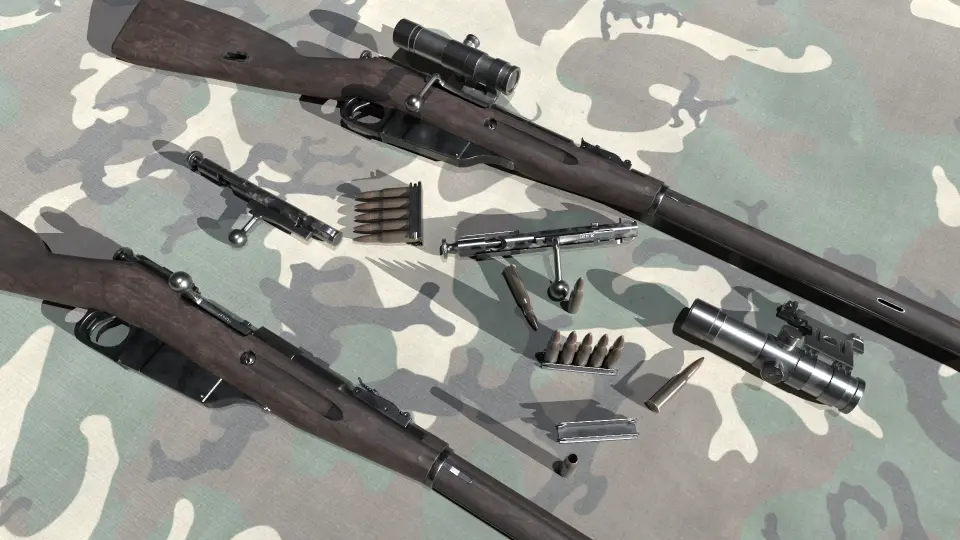
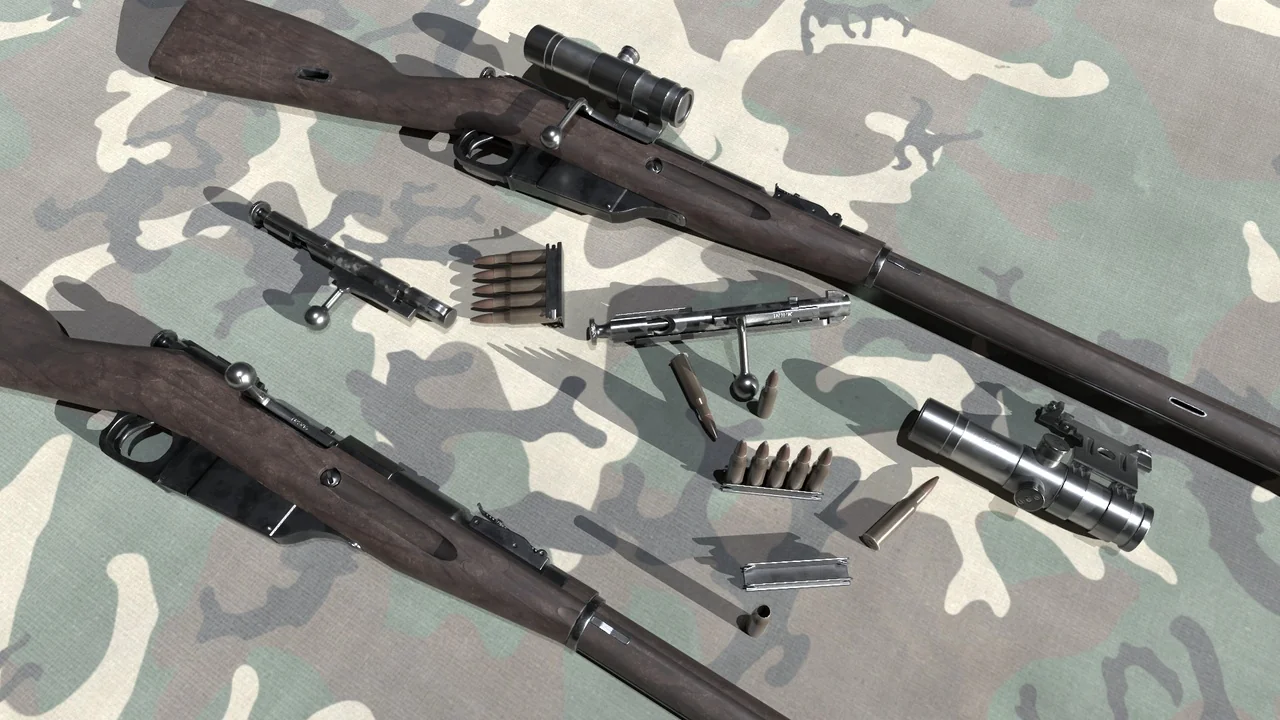
Stationary marksmen, defensive trench lines, and calculated firing positions define historical wartime combat, where firearm reliability dictates survival. The Mosin Nagant M1891 captures this operational reality as a dedicated high-quality sniper rifle modeled for World War 2 settings. In historical warfare contexts, long-range engagements demand assets that hold visual credibility under close scrutiny, especially when players look down the length of the barrel or track targets across expansive environments. Because weapon geometry serves as the primary visual anchor in first-person and third-person shooters, maintaining realistic proportions across the receiver, barrel, and stock is fundamental to authentic combat representation.
As a core military implement, the rifle functions as the centerpiece for infantry combat setups. The silhouette communicates deliberate, bolt-action marksmanship rather than rapid automatic fire, shaping how gameplay paces player movement, target acquisition, and stamina management. Whether deployed in scripted military campaigns or competitive skirmishes, the weapon conveys weight and historical purpose throughout active gameplay sequences.
Dual Animation Pipelines: Skeletal Animation and Vertex Animation
Interactive firearms rely heavily on responsive motion to ground player actions during high-stakes shootouts. The Mosin Nagant M1891 addresses interactive mechanics directly by delivering both vertex animation and skeletal animation structures. Having two distinct technical animation methods gives developers considerable latitude in how they assemble their gameplay and rendering pipelines, allowing teams to choose the implementation best matched to their performance targets.
Skeletal Rigging for Mechanical Shooter Precision
Skeletal animation provides a conventional joint hierarchy suitable for intricate weapon handling. By anchoring mechanical sub-assemblies—such as the bolt, trigger, and internal feed systems—to dedicated bones, technical animators can execute complex, multi-stage interaction sequences. In a dedicated sniper game, standard firing loops demand distinct phases: striking the primer, drawing the bolt backward to eject spent brass, chambering a fresh cartridge, and locking the mechanism back down into firing position.
Bone-based setups allow character hands to align cleanly through inverse kinematics, locking wrists and fingers to weapon components during reload or inspection routines. This precision prevents visual clipping during first-person view displays where weapon actions sit directly in front of the camera frustum.
Vertex Animation for Dynamic Mesh Efficiency
Complementing skeletal bone rigs, the inclusion of vertex animation expands workflow flexibility across scenarios where standard bone transformations may introduce unnecessary processing overhead. Vertex animation captures per-vertex spatial transitions over time, making it valuable for specific visual deformations, rapid secondary movement, or background actors in large-scale war games where dozens of armed soldiers share the screen.
By offering both systems, the package remains straightforward to use, eliminating the need to construct secondary deformation solutions from scratch. Creators can direct skeletal animation toward player-controlled viewports while taking advantage of alternative animation paths to optimize resource budgets across complex war scenarios.
Mechanical Readiness for Sniper and Shooter Game Design
Creating an immersive long-range combat encounter involves more than visual fidelity; it requires functional tools that slide smoothly into existing game logic. The asset is built to serve everything necessary for a polished sniper game or quality shooter project. Because the underlying design prioritizes ease of use, implementation times drop significantly when setting up firing scripts, camera recoils, and interaction colliders.
In standard shooter mechanics, snipers fulfill a distinct tactical niche: precision target elimination, area denial, and reconnaissance. Implementing the Mosin Nagant M1891 allows designers to construct systems around calculated trigger pulls, breathing stabilization mechanics, and steady weapon cycling. Its mechanical clarity ensures that visual cycles align precisely with audio cues, muzzle flash particles, and trajectory calculations without cumbersome rigging reconfigurations.
Realistic PBR Material Definition for War Scenarios
Visual authenticity in wartime environments relies extensively on accurate surface reactions. Built with Physically Based Rendering (PBR) workflows, the rifle interacts naturally with shifting dynamic lighting, whether positioned beneath clear exterior sunlight, dim bunker interiors, or harsh muzzle flares during nighttime engagements. The realistic treatment ensures that variations in wood grain, machined metal, and structural fittings maintain appropriate specular and roughness values under different environmental conditions.
Wartime weapons inevitably accumulate dirt, field grime, and weathering over extended campaigns. PBR mapping supports cohesive visual depth across these varied conditions, ensuring that metal surfaces avoid excessive artificial gloss while retaining true-to-life light scattering. When viewed through tactical weapon scopes or inspected up close during chambering sequences, these realistic material qualities maintain their integrity, keeping the player fully immersed in the historical setting.
Asset Ecosystems and Destructible Prop Compatibility
A weapon model rarely exists in a visual vacuum; it operates within environmental layers comprising defensive barricades, vintage fortifications, and destructible clutter. In broader production contexts, the Mosin Nagant M1891 pairs naturally alongside systems like Destroyable Medieval Themed Props. While differing in primary historical eras, the shared emphasis on natural wood grains, forged iron components, and structural degradation creates functional synergy across environmental design.
Level artists building rustic redoubts, improvised barricades, or weathered frontline garrisons can position the rifle against destructible terrain without aesthetic friction. Splintering timbers, fractured stone masonry, and vintage military armaments work together to establish convincing cover zones during volatile fire exchanges. This interoperability ensures the weapon integrates effortlessly into broader tactical encounters where dynamic prop destruction complements intense, precision marksmanship.
 3D
 3D
 3D
 3D