"07a32e720bd988c8"{"id":"1002489","slug":"mongol","title":"Mongol","category":"Characters \u0026 Creatures","engine":"4.18+,5.0+","assetVersion":"","engineVersion":"Engine Version: 4.18+,5.0+","tag":"Characters","accent":"blue","visual":"character","summary":"Examine the Mongol low-poly medieval warrior character, equipped with sword, shield, helmet, animation blueprint, and third-person battle functionality.","platform":"Unreal Engine","indexPolicy":"index","publishedAt":"2026-11-12T03:54:07.741Z","updatedAt":"2026-11-12T03:54:07.741Z","sourceNotes":[],"fileContents":[],"compatibility":["Unreal Engine","Engine Version: 4.18+,5.0+"],"featuredImage":{"alt":"Mongol","src":"/wp-content/uploads/published/2026/11/bf0687ac7c63-3fdcb0af-3c3a-4e80-a7e1-2e5d4072bbe5-36b632a020.webp"},"hasDownloadLink":true,"downloads":0,"terms":[{"taxonomy":"category","slug":"characters-and-creatures","name":"Characters \u0026 Creatures"}],"galleryImages":[{"src":"/wp-content/uploads/published/2026/11/b2534fc44bad-b4baa5c5-0d9e-4ac6-ba27-075d14676944-476eabccb1.webp","alt":"Mongol"},{"src":"/wp-content/uploads/published/2026/11/bfa9c43bb639-abc79e13-b77c-42ff-a871-1f842d2b8e02-1c91595e1e.webp","alt":"Mongol"},{"src":"/wp-content/uploads/published/2026/11/e524877ae37b-1c951267-f3a4-4413-8b10-ec2b5541d22d-04109457b1.webp","alt":"Mongol"},{"src":"/wp-content/uploads/published/2026/11/7f2a89b482d5-5ffcee37-3908-4dac-b0e9-8abbc8bc3a12-8e65f6ec6f.webp","alt":"Mongol"},{"src":"/wp-content/uploads/published/2026/11/2d6ef2e6596e-18b81376-6d7d-42d2-8285-94cdce8a79a8-7d20653b09.webp","alt":"Mongol"}],"accessPanel":{"kind":"resource","title":"Get this resource","eyebrow":"Free resource","message":"Download this resource in your browser.","fileName":"Content.7z","safetyNote":"Resources are manually reviewed before listing to improve quality and reduce obvious risks.","actionLabel":"Get this resource","resourceType":"Resource archive","versions":[]},"contentHtml":"\u003ch2\u003eFraming the Mongol in Third-Person Battlefields\u003c/h2\u003e\u003cp\u003eVast steppe expanses, besieged fortress perimeters, and rugged mountain passes provide the natural backdrop for the Mongol character. Designed specifically to operate within games viewed from a third-person camera perspective, the warrior occupies the screen with an emphasis on readable posture and ready-to-fight staging. In third-person combat setups, a character must present strong silhouettes and clear physical transitions so players can track movement, defense, and weapon swings during chaotic encounters. The warrior is built directly to participate in battles, serving equally well as a frontline player avatar or as an aggressive combatant confronting the player in hostile territory.\u003c/p\u003e\u003cp\u003eBecause the character targets third-person play, spatial awareness drives the visual arrangement. Camera placement behind the shoulder or elevated above the fighter demands that armor contours, headwear, and wielded gear remain distinct against terrain of varying contrast. Whether marching through wide open plains under harsh sunlight or clashing in dense fantasy ruins, the character maintains the unmistakable visual weight of a grounded warrior prepared for combat.\u003c/p\u003e\u003ch2\u003eCombat Loadout with Helmet, Shield, and Sword\u003c/h2\u003e\u003cp\u003eDirect engagement defines this warrior, supported by a classic three-piece equipment set composed of a helmet, a sword, and a shield. Each piece shapes how combat plays out mechanically and visually on screen. The helmet anchors the head profile, reinforcing defensive readiness and preserving identity during combat sequences where the camera focuses on the upper torso. Head protection acts as a staple visual cue in medieval and fantasy combat, signaling resilience and martial standing without cluttering the screen with unnecessary cosmetic elements.\u003c/p\u003e\u003cp\u003eOffense and defense balance through the paired sword and shield. In third-person games, shield-and-sword configurations require distinct hand offsets and responsive timing. The shield provides forward-facing guard capability, ready to absorb incoming impacts, parry strikes, or lead into shield-bash maneuvers. Meanwhile, the sword represents immediate offensive reach, suited for disciplined slashes, thrusts, and counterattacks. Because both armament pieces are present alongside the warrior, scenes can showcase continuous tactical interplay between raising guard posture and unleashing rapid close-quarters strikes in the heat of a skirmish.\u003c/p\u003e\u003ch2\u003eTechnical Control Through the Mongol Animation Blueprint and Scripts\u003c/h2\u003e\u003cp\u003eSustaining fluid movement on the battlefield requires robust animation infrastructure, which this asset supports through an Animation Blueprint and integrated script components. An Animation Blueprint serves as the central hub for managing locomotion, posture blending, and combat state changes. In third-person titles, an effective setup evaluates character velocity, directional input, and active combat states to seamlessly blend between idle stances, weapon-drawn maneuvers, defensive guards, and direct attacks.\u003c/p\u003e\u003cp\u003eLocomotion handling forms the foundation of this setup. When patrolling, sprinting, or strafing to circle an adversary, the Animation Blueprint ensures that footwork aligns with directional velocity while keeping the upper body oriented toward targets. Combat transitions demand even tighter control. Transitioning from a free run into an active sword draw or raising the shield requires precise state machine logic so the motion neither hitches nor delays player input. Script integration complements this workflow, providing the necessary hooks to govern combat actions, link weapon collisions, trigger defensive frames, and communicate character states across game systems.\u003c/p\u003e\u003cp\u003eBy unifying movement trees and attack branching under an Animation Blueprint, combat remains responsive. Actions such as blocking a blow with the shield, staggering under impact, or following up with a decisive sword stroke resolve cleanly. This scripted and blueprint-driven pipeline allows the warrior to engage in skirmishes with minimal technical overhead, functioning as a reliable template for melee mechanics.\u003c/p\u003e\u003ch2\u003eLow-Poly Styling Across Fantasy and Medieval Arenas\u003c/h2\u003e\u003cp\u003eCrafted with a low-poly construction while retaining realistic stylistic treatment, the warrior bridges performance efficiency and believable visual representation. Low-poly topology keeps processing demands light, which proves essential when populating larger battlefields with multiple combatants simultaneously. Rendering ranks of soldiers or multiple simultaneous opponents in intense action scenes requires asset optimization that does not sacrifice martial readability.\u003c/p\u003e\u003cp\u003eThe tag profile connects the character across both realistic medieval contexts and fantasy settings. While historically grounded equipment—such as the helmet, straight or curved blade, and protective shield—fits authentic medieval conflicts, the stylized low-poly treatment adapts comfortably to high-fantasy worlds. In fantasy settings, the warrior can portray mercenary fighters, nomadic skirmishers, border guards, or factional footmen defending distant frontiers. The balanced balance between realistic proportions and clean polygonal surfaces ensures that lighting engines render clear highlights along armor edges, sword steel, and shield faces without excessive geometry overhead.\u003c/p\u003e\u003ch2\u003eAlignment with Greek Warrior Pipelines\u003c/h2\u003e\u003cp\u003eA notable technical dimension of this asset is its verified compatibility with the Greek Warrior asset. Compatibility between different character models within an asset library or engine project offers tangible structural benefits. It typically indicates shared skeletal structures, compatible rigging alignments, or interchangeable animation logic, allowing developers to expand their roster of combatants without creating separate animation systems from scratch.\u003c/p\u003e\u003cp\u003eWhen a project requires diverse factions, pitting eastern-styled fighters against classical Mediterranean warriors becomes straightforward. Developers can direct both archetypes through shared combat mechanics, exchanging attack clips, hit reactions, and shield blocks across the shared skeletal framework. This interoperability streamlines staging historical clashes, mythological tournaments, or multi-faction fantasy arenas where diverse cultures collide under a singular combat system.\u003c/p\u003e\u003ch2\u003eFit-for-Purpose Battlefield Deployment\u003c/h2\u003e\u003cp\u003eThe Mongol stands as a functional combat character suited for immediate deployment in action-oriented, third-person titles. Outfitted with sword, shield, and helmet, backed by an Animation Blueprint and script components, and optimized through low-poly geometry, the asset handles the rigors of real-time melee battles efficiently across medieval and fantasy settings.\u003c/p\u003e\n\n\u003ch2\u003eExplore Similar Assets\u003c/h2\u003e\n\u003cul\u003e\n\u003cli\u003e\u003ca href=\"https://3dcghub.com/soldier-future-01/\" rel=\"noopener noreferrer\"\u003eSoldier Future 01\u003c/a\u003e\u003c/li\u003e\n\u003cli\u003e\u003ca href=\"https://3dcghub.com/modern-character/\" rel=\"noopener noreferrer\"\u003eModern character\u003c/a\u003e\u003c/li\u003e\n\u003cli\u003e\u003ca href=\"https://3dcghub.com/defender-girl/\" rel=\"noopener noreferrer\"\u003eDefender Girl\u003c/a\u003e\u003c/li\u003e\n\u003cli\u003e\u003ca href=\"https://3dcghub.com/monster-beetle-pack/\" rel=\"noopener noreferrer\"\u003eMonster_Beetle_Pack\u003c/a\u003e\u003c/li\u003e\n\u003cli\u003e\u003ca href=\"https://3dcghub.com/camel-fantasy/\" rel=\"noopener noreferrer\"\u003eCamel Fantasy\u003c/a\u003e\u003c/li\u003e\n\u003c/ul\u003e","contentTextLength":6867,"navigation":{"current":10,"total":4421,"previous":{"id":"1002490","slug":"mr-plague-doctor","title":"mr. Plague Doctor","category":"Characters \u0026 Creatures","platform":"Unreal Engine","updatedAt":"2026-11-12T03:55:35.329Z"},"next":{"id":"1002488","slug":"modular-male-mannequin-on-standard-skeleton","title":"Modular Male Mannequin on Standard Skeleton","category":"Characters \u0026 Creatures","platform":"Unreal Engine","updatedAt":"2026-11-12T03:53:25.002Z"}},"relatedResources":[{"id":"1001835","slug":"soldier-future-01","title":"Soldier Future 01","category":"Characters \u0026 Creatures","engine":"4.18+,5.0+","assetVersion":"","engineVersion":"Engine Version: 4.18+,5.0+","tag":"Characters","accent":"blue","visual":"character","summary":"Soldier Future 01 provides a low-poly realistic sci-fi combat character assembled from modular parts, equipped with an automatic weapon and animation blueprint.","platform":"Unreal Engine","indexPolicy":"index","publishedAt":"2026-10-21T08:26:14.117Z","updatedAt":"2026-10-21T08:26:14.117Z","sourceNotes":[],"fileContents":[],"compatibility":["Unreal Engine","Engine Version: 4.18+,5.0+"],"featuredImage":{"alt":"Soldier Future 01","src":"/wp-content/uploads/published/2026/10/a7b58c437d4d-ba5b2986-bad8-4bcf-9231-53a880a7afd0-07255488eb.webp"},"hasDownloadLink":true,"downloads":0},{"id":"1002490","slug":"mr-plague-doctor","title":"mr. Plague Doctor","category":"Characters \u0026 Creatures","engine":"4.18+,5.0+","assetVersion":"","engineVersion":"Engine Version: 4.18+,5.0+","tag":"Characters","accent":"blue","visual":"character","summary":"Technical analysis of mr. Plague Doctor, covering its low-poly geometry, Epic Skeleton v4 rig, 39 animations, and 2048x2048 PBR metallic texture workflow.","platform":"Unreal Engine","indexPolicy":"index","publishedAt":"2026-11-12T03:55:35.329Z","updatedAt":"2026-11-12T03:55:35.329Z","sourceNotes":[],"fileContents":[],"compatibility":["Unreal Engine","Engine Version: 4.18+,5.0+"],"featuredImage":{"alt":"mr. Plague Doctor","src":"/wp-content/uploads/published/2026/11/640616c0ad64-a2624ca2-2168-47eb-b4a4-cdcc8a3a16a3-a60fbb70df.webp"},"hasDownloadLink":true,"downloads":0},{"id":"1002486","slug":"modern-character","title":"Modern character","category":"Characters \u0026 Creatures","engine":"4.18+,5.0+","assetVersion":"","engineVersion":"Engine Version: 4.18+,5.0+","tag":"Characters","accent":"blue","visual":"character","summary":"A low-poly male character asset with an Epic skeleton, firearm mesh, modular outfit textures, and two-sided shader support for multiple game genres.","platform":"Unreal Engine","indexPolicy":"index","publishedAt":"2026-11-12T03:51:41.314Z","updatedAt":"2026-11-12T03:51:41.314Z","sourceNotes":[],"fileContents":[],"compatibility":["Unreal Engine","Engine Version: 4.18+,5.0+"],"featuredImage":{"alt":"Modern character","src":"/wp-content/uploads/published/2026/11/12f2b0e8163d-3ca52942-b1a7-4fc0-8362-a5915c0b2c24-c02fa3d7d6.webp"},"hasDownloadLink":true,"downloads":0}]}
Characters
Mongol
Examine the Mongol low-poly medieval warrior character, equipped with sword, shield, helmet, animation blueprint, and third-person battle functionality.
Vast steppe expanses, besieged fortress perimeters, and rugged mountain passes provide the natural backdrop for the Mongol character. Designed specifically to operate within games viewed from a third-person camera perspective, the warrior occupies the screen with an emphasis on readable posture and ready-to-fight staging. In third-person combat setups, a character must present strong silhouettes and clear physical transitions so players can track movement, defense, and weapon swings during chaotic encounters. The warrior is built directly to participate in battles, serving equally well as a frontline player avatar or as an aggressive combatant confronting the player in hostile territory.
Because the character targets third-person play, spatial awareness drives the visual arrangement. Camera placement behind the shoulder or elevated above the fighter demands that armor contours, headwear, and wielded gear remain distinct against terrain of varying contrast. Whether marching through wide open plains under harsh sunlight or clashing in dense fantasy ruins, the character maintains the unmistakable visual weight of a grounded warrior prepared for combat.
Combat Loadout with Helmet, Shield, and Sword
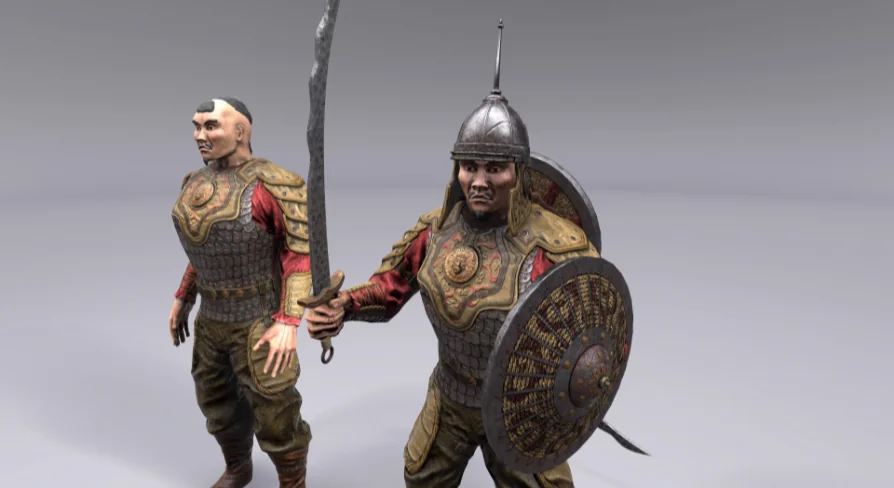
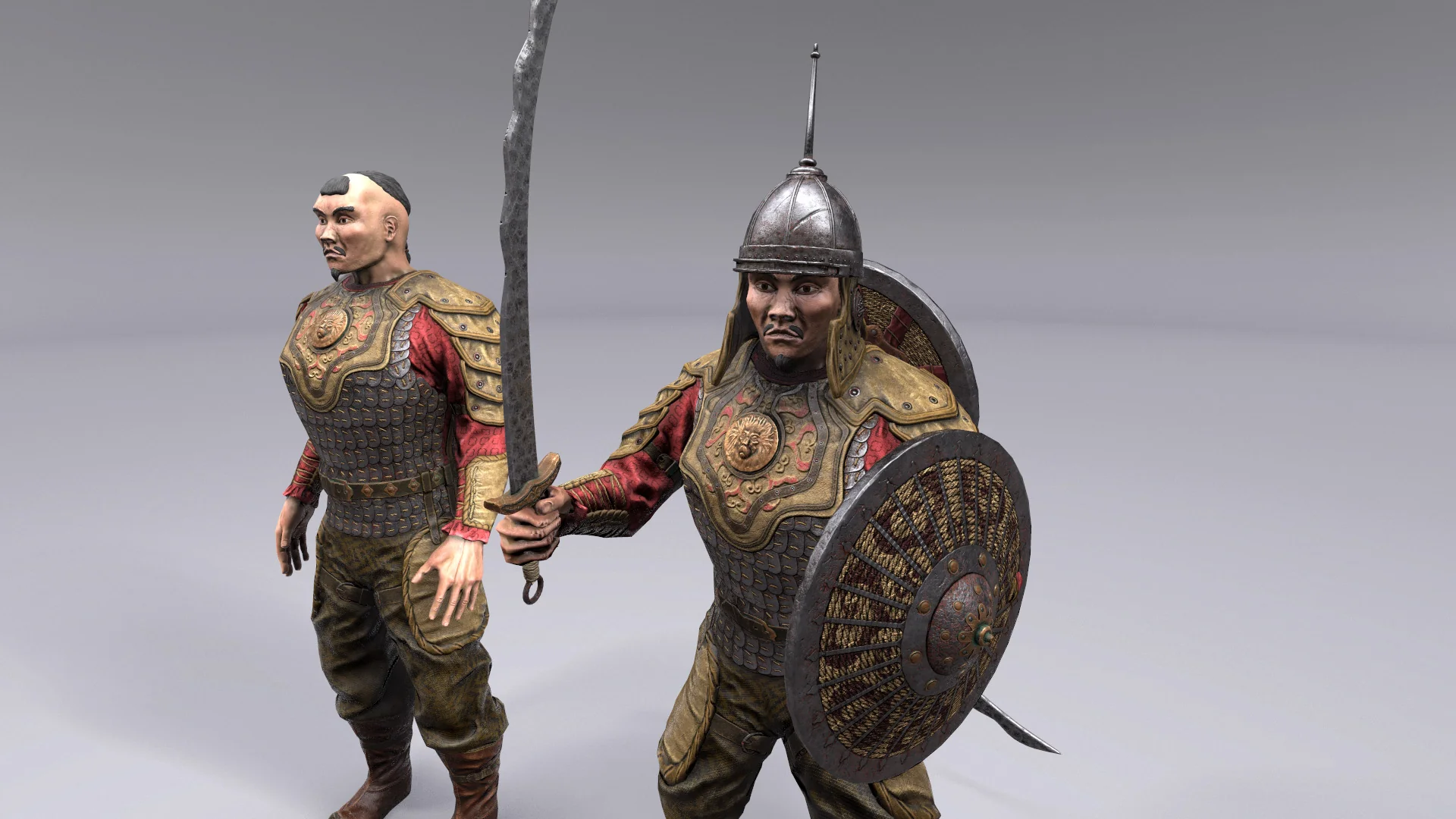
Direct engagement defines this warrior, supported by a classic three-piece equipment set composed of a helmet, a sword, and a shield. Each piece shapes how combat plays out mechanically and visually on screen. The helmet anchors the head profile, reinforcing defensive readiness and preserving identity during combat sequences where the camera focuses on the upper torso. Head protection acts as a staple visual cue in medieval and fantasy combat, signaling resilience and martial standing without cluttering the screen with unnecessary cosmetic elements.
Offense and defense balance through the paired sword and shield. In third-person games, shield-and-sword configurations require distinct hand offsets and responsive timing. The shield provides forward-facing guard capability, ready to absorb incoming impacts, parry strikes, or lead into shield-bash maneuvers. Meanwhile, the sword represents immediate offensive reach, suited for disciplined slashes, thrusts, and counterattacks. Because both armament pieces are present alongside the warrior, scenes can showcase continuous tactical interplay between raising guard posture and unleashing rapid close-quarters strikes in the heat of a skirmish.
Technical Control Through the Mongol Animation Blueprint and Scripts
Sustaining fluid movement on the battlefield requires robust animation infrastructure, which this asset supports through an Animation Blueprint and integrated script components. An Animation Blueprint serves as the central hub for managing locomotion, posture blending, and combat state changes. In third-person titles, an effective setup evaluates character velocity, directional input, and active combat states to seamlessly blend between idle stances, weapon-drawn maneuvers, defensive guards, and direct attacks.
Locomotion handling forms the foundation of this setup. When patrolling, sprinting, or strafing to circle an adversary, the Animation Blueprint ensures that footwork aligns with directional velocity while keeping the upper body oriented toward targets. Combat transitions demand even tighter control. Transitioning from a free run into an active sword draw or raising the shield requires precise state machine logic so the motion neither hitches nor delays player input. Script integration complements this workflow, providing the necessary hooks to govern combat actions, link weapon collisions, trigger defensive frames, and communicate character states across game systems.
By unifying movement trees and attack branching under an Animation Blueprint, combat remains responsive. Actions such as blocking a blow with the shield, staggering under impact, or following up with a decisive sword stroke resolve cleanly. This scripted and blueprint-driven pipeline allows the warrior to engage in skirmishes with minimal technical overhead, functioning as a reliable template for melee mechanics.
Low-Poly Styling Across Fantasy and Medieval Arenas
Crafted with a low-poly construction while retaining realistic stylistic treatment, the warrior bridges performance efficiency and believable visual representation. Low-poly topology keeps processing demands light, which proves essential when populating larger battlefields with multiple combatants simultaneously. Rendering ranks of soldiers or multiple simultaneous opponents in intense action scenes requires asset optimization that does not sacrifice martial readability.
The tag profile connects the character across both realistic medieval contexts and fantasy settings. While historically grounded equipment—such as the helmet, straight or curved blade, and protective shield—fits authentic medieval conflicts, the stylized low-poly treatment adapts comfortably to high-fantasy worlds. In fantasy settings, the warrior can portray mercenary fighters, nomadic skirmishers, border guards, or factional footmen defending distant frontiers. The balanced balance between realistic proportions and clean polygonal surfaces ensures that lighting engines render clear highlights along armor edges, sword steel, and shield faces without excessive geometry overhead.
Alignment with Greek Warrior Pipelines
A notable technical dimension of this asset is its verified compatibility with the Greek Warrior asset. Compatibility between different character models within an asset library or engine project offers tangible structural benefits. It typically indicates shared skeletal structures, compatible rigging alignments, or interchangeable animation logic, allowing developers to expand their roster of combatants without creating separate animation systems from scratch.
When a project requires diverse factions, pitting eastern-styled fighters against classical Mediterranean warriors becomes straightforward. Developers can direct both archetypes through shared combat mechanics, exchanging attack clips, hit reactions, and shield blocks across the shared skeletal framework. This interoperability streamlines staging historical clashes, mythological tournaments, or multi-faction fantasy arenas where diverse cultures collide under a singular combat system.
Fit-for-Purpose Battlefield Deployment
The Mongol stands as a functional combat character suited for immediate deployment in action-oriented, third-person titles. Outfitted with sword, shield, and helmet, backed by an Animation Blueprint and script components, and optimized through low-poly geometry, the asset handles the rigors of real-time melee battles efficiently across medieval and fantasy settings.
 Characters
 Characters
 Characters
 Characters