"7aa4acc705f0d80b"{"id":"1001972","slug":"camel-fantasy","title":"Camel Fantasy","category":"Characters \u0026 Creatures","engine":"4.18+,5.0+","assetVersion":"","engineVersion":"Engine Version: 4.18+,5.0+","tag":"Characters","accent":"blue","visual":"character","summary":"Examine the Camel Fantasy character, featuring super boss capabilities, modular bags, Animation Blueprint integration, and desert RPG styling.","platform":"Unreal Engine","publishedAt":"2026-10-24T13:56:22.541Z","updatedAt":"2026-10-24T13:56:22.541Z","sourceNotes":[],"fileContents":[],"compatibility":["Unreal Engine","Engine Version: 4.18+,5.0+"],"featuredImage":{"alt":"Camel Fantasy","src":"/wp-content/uploads/published/2026/10/82135a2497a5-a9b1abf0-65b8-40b3-82b6-7fa209d8eb0a-86e7f30c67.webp"},"hasDownloadLink":true,"downloads":0,"terms":[{"taxonomy":"category","slug":"characters-and-creatures","name":"Characters \u0026 Creatures"}],"galleryImages":[{"src":"/wp-content/uploads/published/2026/10/a9006b32387f-71e76864-d6a8-4dd0-bc3b-6786de64f688-00a553b244.webp","alt":"Camel Fantasy"},{"src":"/wp-content/uploads/published/2026/10/da28e016bfcc-bdd2e076-3822-4f7e-97d1-669f53901003-d3b7965ee6.webp","alt":"Camel Fantasy"},{"src":"/wp-content/uploads/published/2026/10/379a43ebe394-c6482d1a-1655-4d76-ac87-48bf7ece4f4f-10cd88cef6.webp","alt":"Camel Fantasy"}],"accessPanel":{"kind":"resource","title":"Download this resource","eyebrow":"Free Download","message":"Log in or create a free account to start your download.","fileName":"Content.7z","safetyNote":"Resources are manually reviewed before listing to improve quality and reduce obvious risks.","actionLabel":"Download Free","resourceType":"Resource archive"},"contentHtml":"\u003ch2\u003eStaging Encounters with the Fantasy Camel in Arid Worlds\u003c/h2\u003e\u003cp\u003eVast desert reaches, sun-scorched trade routes, and medieval fantasy outposts demand creatures that reflect both survival and martial presence. The Fantasy Camel brings an animal archetype into the realm of RPG fantasy, presenting a distinct visual profile tailored for harsh expanses and dunes. Unlike ordinary beasts of burden, this character is tuned to function as a focal point within fantasy campaign structures, bridging the gap between natural wildlife and heightened, stylized combat encounters.\u003c/p\u003e\u003cp\u003eDesert environments naturally challenge game pacing by presenting wide, open sightlines where standard-sized enemies can easily lose visual impact. Integrating a creature of this scale creates immediate tension in open expanses. Whether positioned at the end of a long canyon crossing or guarding ancient ruins buried under sand, the creature anchors arid biomes with clear narrative weight, ensuring that expansive environments maintain an active sense of danger.\u003c/p\u003e\u003ch2\u003eThe Super Boss Dynamic in RPG Fantasy Combat\u003c/h2\u003e\u003cp\u003eCentral to the design of the character is its defined identity as a super boss. In fantasy RPG mechanics, a super boss demands presence, resilience, and visual hierarchy above standard mob encounters. The creature commands the arena, providing developers with a heavy animal encounter that shifts combat away from humanoid knights or standard mythical beasts.\u003c/p\u003e\u003cp\u003eConstructing a super boss fight around a quadrupedal beast introduces distinct gameplay spacing. Players must track wide sweeps, sudden charges, and heavy stomps across broad battle arenas. Its role as a major encounter allows it to serve as the climax of desert expeditions, an optional late-game trial hidden in remote wastes, or a catastrophic threat disrupting medieval trade routes. Because super boss battles rely on distinct combat stages, the character provides an imposing silhouette that remains readable even when players navigate complex terrain or manage rapid dodging maneuvers.\u003c/p\u003e\u003ch2\u003eModular Equipment and the Role of Toggleable Bags\u003c/h2\u003e\u003cp\u003eVisual versatility plays a crucial role in adapting an asset across different stages of a game. The character includes bags that can be hidden depending on the context of the scene. This modular configuration directly changes the narrative function of the beast, giving creators control over how domestic or feral the creature appears in any given encounter.\u003c/p\u003e\u003cp\u003eEquipping the bags presents the Fantasy Camel as a beast tied directly to logistical operations, merchant expeditions, or caravan trains. In this configuration, the creature works seamlessly as an objective—such as a heavily defended supply transport or a valuable asset moving through bandit-controlled medieval territories. When the bags are hidden, the silhouette clears, stripping away signs of civilization. Without the bags, the creature presents cleanly as an untamed apex monster, an unencumbered combatant, or a wild guardian encountered deep within untracked desert wastes.\u003c/p\u003e\u003ch2\u003eRider Mechanics and Animation Blueprint Control\u003c/h2\u003e\u003cp\u003eMovement logic and behavior systems are supported through an integrated animation blueprint and specialized scripts. Quadrupedal locomotion requires coordinated state transitions, whether a creature is pacing through heavy sand, pivoting to track a player, or unleashing attacks during high-intensity combat. The presence of the animation blueprint allows the model to process motion states cleanly, handling the interplay between idle routines, traversal speed, and strike mechanics.\u003c/p\u003e\u003cp\u003eThe inclusion of rider tags extends the operational range of the character beyond an independent monster. Accommodating a rider opens distinct gameplay configurations, enabling mounted boss encounters where an enemy commander or champion directs the beast in battle. Scripting hooks interface with these systems to manage interaction logic, allowing the creature to pivot between standalone AI monster routines and mounted cavalry dynamics. This technical pairing gives developers a reliable framework to balance movement responsiveness against the heavy weight of an animal boss.\u003c/p\u003e\u003ch2\u003eTechnical Footprint for FPS Devices and Desert Environments\u003c/h2\u003e\u003cp\u003ePerformance budgeting requires careful attention when introducing large, animated entities into intensive action titles. The asset is configured with compatibility for FPS devices, ensuring that the computational overhead of the character—including its animation updates and script logic—remains stable during active combat sequences where frame rate stability is critical.\u003c/p\u003e\u003cp\u003eIn action setups viewed from first-person or close third-person perspectives, creature scale becomes much more visceral. The proximity of the player highlights ground-level stomps and sudden changes in direction. Maintaining strong execution performance ensures that combat remains fluid even when particle effects, sandstorms, and multiple combat systems run simultaneously alongside the boss's animation blueprint.\u003c/p\u003e\u003ch2\u003eProject Suitability and Production Fit\u003c/h2\u003e\u003cp\u003eProjects focused on medieval fantasy, desert survival, or structured RPG campaign progression benefit most from the character. Its ability to pivot between a pack-laden expedition beast and an aggressive, unencumbered super boss solves two distinct production needs with a single model. Teams building tactical boss arenas in arid biomes or implementing dynamic caravan defence sequences will find the character ready to integrate directly into active combat pipelines.\u003c/p\u003e\n\n\u003ch2\u003eMore From The Same Workflow\u003c/h2\u003e\n\u003cul\u003e\n\u003cli\u003e\u003ca href=\"https://3dcghub.com/heroic-fantasy-villains-vol-1/\" title=\"Heroic Fantasy Villains Vol 1\"\u003eHeroic Fantasy Villains Vol 1\u003c/a\u003e\u003c/li\u003e\n\u003cli\u003e\u003ca href=\"https://3dcghub.com/fantasy-armour-caster-mage-sorcerer-wizard-metahuman/\" title=\"Fantasy Armour - Caster / Mage / Sorcerer / Wizard - Metahuman\"\u003eFantasy Armour - Caster / Mage / Sorcerer / Wizard - Metahuman\u003c/a\u003e\u003c/li\u003e\n\u003cli\u003e\u003ca href=\"https://3dcghub.com/rk-fantasy-archer/\" title=\"RK Fantasy Archer\"\u003eRK Fantasy Archer\u003c/a\u003e\u003c/li\u003e\n\u003cli\u003e\u003ca href=\"https://3dcghub.com/fantasy-elephant/\" title=\"Fantasy Elephant\"\u003eFantasy Elephant\u003c/a\u003e\u003c/li\u003e\n\u003cli\u003e\u003ca href=\"https://3dcghub.com/fantasy-girls-pack/\" title=\"Fantasy Girls Pack\"\u003eFantasy Girls Pack\u003c/a\u003e\u003c/li\u003e\n\u003c/ul\u003e","contentTextLength":5666,"navigation":{"current":18,"total":3925,"previous":{"id":"1001973","slug":"carcasses","title":"Carcasses","category":"Tools, Objects \u0026 Decor","platform":"Unreal Engine","updatedAt":"2026-10-24T14:02:45.788Z"},"next":{"id":"1001971","slug":"bunny","title":"Bunny","category":"Characters \u0026 Creatures","platform":"Unreal Engine","updatedAt":"2026-10-24T13:55:11.648Z"}},"relatedResources":[{"id":"1000621","slug":"heroic-fantasy-villains-vol-1","title":"Heroic Fantasy Villains Vol 1","category":"Characters \u0026 Creatures","engine":"4.26+,5.0+","assetVersion":"","engineVersion":"Engine Version: 4.26+,5.0+","tag":"Characters","accent":"blue","visual":"character","summary":"Heroic Fantasy Villains Vol 1 provides rigged, lowpoly 3D characters including a Darkness Warlord, Dark Elf, and Cyclops, with animation blueprints for PC and c","platform":"Unreal Engine","publishedAt":"2026-07-21T08:21:40.237Z","updatedAt":"2026-07-21T08:21:40.237Z","sourceNotes":[],"fileContents":[],"compatibility":["Unreal Engine","Engine Version: 4.26+,5.0+"],"featuredImage":{"alt":"Heroic Fantasy Villains Vol 1","src":"/wp-content/uploads/published/2026/07/5615f21dbe99-8ef8be67-b751-4c3e-8034-cf0651eaab64-6d4d89e5cb.webp"},"hasDownloadLink":true,"downloads":1},{"id":"1000601","slug":"fantasy-armour-caster-mage-sorcerer-wizard-metahuman","title":"Fantasy Armour - Caster / Mage / Sorcerer / Wizard - Metahuman","category":"Characters \u0026 Creatures","engine":"4.26+,5.0+","assetVersion":"","engineVersion":"Engine Version: 4.26+,5.0+","tag":"Characters","accent":"blue","visual":"character","summary":"Customizable fantasy caster armor pack for Unreal Engine with ~60 skeletal meshes, Master Material control, UE5 Mannequin rigging, and MetaHuman parametric clot","platform":"Unreal Engine","publishedAt":"2026-07-20T07:27:01.397Z","updatedAt":"2026-07-20T07:27:01.397Z","sourceNotes":[],"fileContents":[],"compatibility":["Unreal Engine","Engine Version: 4.26+,5.0+"],"featuredImage":{"alt":"Fantasy Armour - Caster / Mage / Sorcerer / Wizard - Metahuman","src":"/wp-content/uploads/published/2026/07/d94e74d93cde-a805533d-c1f4-44d5-a295-e5fc68bc62cf-494b58e3ee.webp"},"hasDownloadLink":true,"downloads":1},{"id":"1000875","slug":"rk-fantasy-archer","title":"RK Fantasy Archer","category":"Characters \u0026 Creatures","engine":"4.26+,5.0+","assetVersion":"","engineVersion":"Engine Version: 4.26+,5.0+","tag":"Characters","accent":"blue","visual":"character","summary":"RK Fantasy Archer is a ready-to-use archer character with CharacterBP, AnimBP, and Attack commands for realistic medieval fantasy games. Includes planned free u","platform":"Unreal Engine","publishedAt":"2026-08-05T15:08:23.949Z","updatedAt":"2026-08-05T15:08:23.949Z","sourceNotes":[],"fileContents":[],"compatibility":["Unreal Engine","Engine Version: 4.26+,5.0+"],"featuredImage":{"alt":"RK Fantasy Archer","src":"/wp-content/uploads/published/2026/08/0c2e85565464-dc47c95e-ff6c-4692-aa9a-17f1db95ce4e-4cfe18670b.webp"},"hasDownloadLink":true,"downloads":0}]}
Characters
Camel Fantasy
Examine the Camel Fantasy character, featuring super boss capabilities, modular bags, Animation Blueprint integration, and desert RPG styling.
Staging Encounters with the Fantasy Camel in Arid Worlds
Vast desert reaches, sun-scorched trade routes, and medieval fantasy outposts demand creatures that reflect both survival and martial presence. The Fantasy Camel brings an animal archetype into the realm of RPG fantasy, presenting a distinct visual profile tailored for harsh expanses and dunes. Unlike ordinary beasts of burden, this character is tuned to function as a focal point within fantasy campaign structures, bridging the gap between natural wildlife and heightened, stylized combat encounters.
Desert environments naturally challenge game pacing by presenting wide, open sightlines where standard-sized enemies can easily lose visual impact. Integrating a creature of this scale creates immediate tension in open expanses. Whether positioned at the end of a long canyon crossing or guarding ancient ruins buried under sand, the creature anchors arid biomes with clear narrative weight, ensuring that expansive environments maintain an active sense of danger.
The Super Boss Dynamic in RPG Fantasy Combat
Central to the design of the character is its defined identity as a super boss. In fantasy RPG mechanics, a super boss demands presence, resilience, and visual hierarchy above standard mob encounters. The creature commands the arena, providing developers with a heavy animal encounter that shifts combat away from humanoid knights or standard mythical beasts.
Constructing a super boss fight around a quadrupedal beast introduces distinct gameplay spacing. Players must track wide sweeps, sudden charges, and heavy stomps across broad battle arenas. Its role as a major encounter allows it to serve as the climax of desert expeditions, an optional late-game trial hidden in remote wastes, or a catastrophic threat disrupting medieval trade routes. Because super boss battles rely on distinct combat stages, the character provides an imposing silhouette that remains readable even when players navigate complex terrain or manage rapid dodging maneuvers.
Modular Equipment and the Role of Toggleable Bags
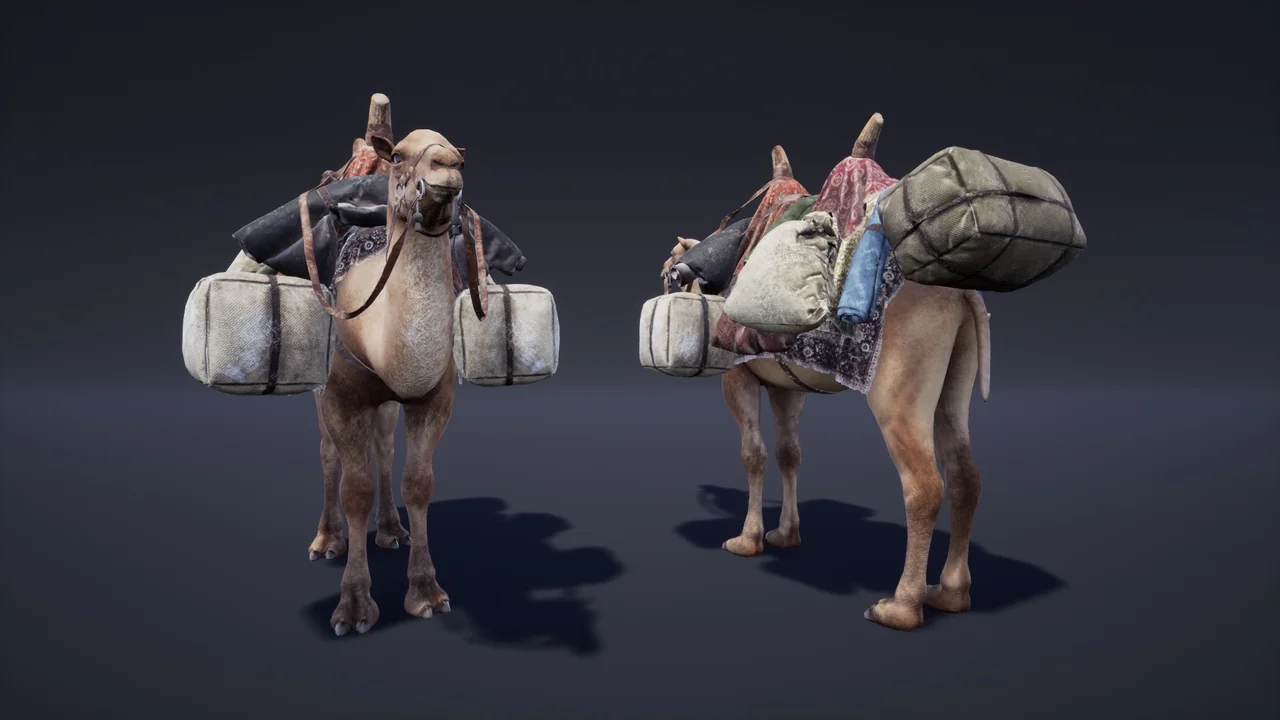
Visual versatility plays a crucial role in adapting an asset across different stages of a game. The character includes bags that can be hidden depending on the context of the scene. This modular configuration directly changes the narrative function of the beast, giving creators control over how domestic or feral the creature appears in any given encounter.
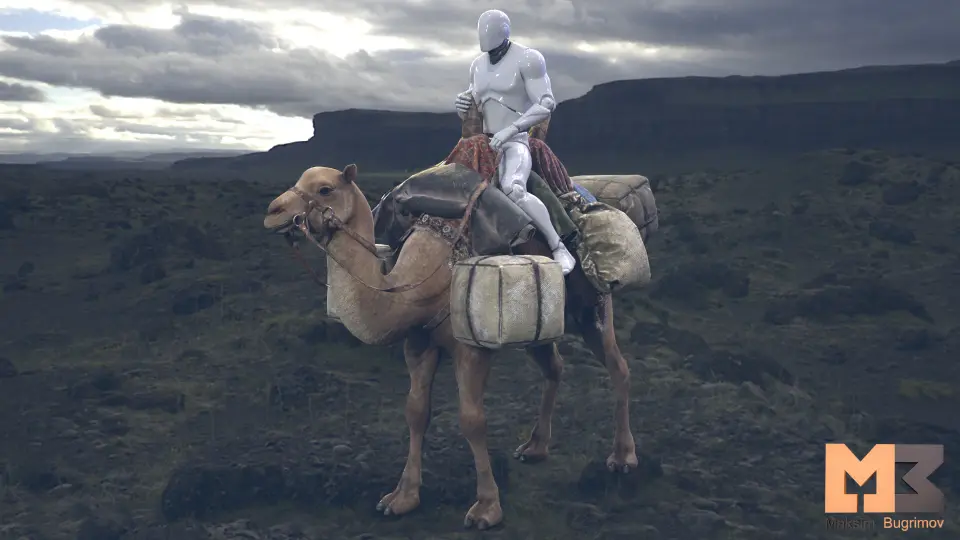
Equipping the bags presents the Fantasy Camel as a beast tied directly to logistical operations, merchant expeditions, or caravan trains. In this configuration, the creature works seamlessly as an objective—such as a heavily defended supply transport or a valuable asset moving through bandit-controlled medieval territories. When the bags are hidden, the silhouette clears, stripping away signs of civilization. Without the bags, the creature presents cleanly as an untamed apex monster, an unencumbered combatant, or a wild guardian encountered deep within untracked desert wastes.
Rider Mechanics and Animation Blueprint Control
Movement logic and behavior systems are supported through an integrated animation blueprint and specialized scripts. Quadrupedal locomotion requires coordinated state transitions, whether a creature is pacing through heavy sand, pivoting to track a player, or unleashing attacks during high-intensity combat. The presence of the animation blueprint allows the model to process motion states cleanly, handling the interplay between idle routines, traversal speed, and strike mechanics.
The inclusion of rider tags extends the operational range of the character beyond an independent monster. Accommodating a rider opens distinct gameplay configurations, enabling mounted boss encounters where an enemy commander or champion directs the beast in battle. Scripting hooks interface with these systems to manage interaction logic, allowing the creature to pivot between standalone AI monster routines and mounted cavalry dynamics. This technical pairing gives developers a reliable framework to balance movement responsiveness against the heavy weight of an animal boss.
Technical Footprint for FPS Devices and Desert Environments
Performance budgeting requires careful attention when introducing large, animated entities into intensive action titles. The asset is configured with compatibility for FPS devices, ensuring that the computational overhead of the character—including its animation updates and script logic—remains stable during active combat sequences where frame rate stability is critical.
In action setups viewed from first-person or close third-person perspectives, creature scale becomes much more visceral. The proximity of the player highlights ground-level stomps and sudden changes in direction. Maintaining strong execution performance ensures that combat remains fluid even when particle effects, sandstorms, and multiple combat systems run simultaneously alongside the boss's animation blueprint.
Project Suitability and Production Fit
Projects focused on medieval fantasy, desert survival, or structured RPG campaign progression benefit most from the character. Its ability to pivot between a pack-laden expedition beast and an aggressive, unencumbered super boss solves two distinct production needs with a single model. Teams building tactical boss arenas in arid biomes or implementing dynamic caravan defence sequences will find the character ready to integrate directly into active combat pipelines.
 Characters
 Characters
 Characters
 Characters