"7aa4acc705f0d80b"{"id":"1001971","slug":"bunny","title":"Bunny","category":"Characters \u0026 Creatures","engine":"5.0+","assetVersion":"","engineVersion":"Engine Version: 5.0+","tag":"Characters","accent":"blue","visual":"character","summary":"A technical look at integrating the modular Bunny character, covering mesh structure, rig functionality, Animation Blueprints, and Undead Pack compatibility.","platform":"Unreal Engine","publishedAt":"2026-10-24T13:55:11.648Z","updatedAt":"2026-10-24T13:55:11.648Z","sourceNotes":[],"fileContents":[],"compatibility":["Unreal Engine","Engine Version: 5.0+"],"featuredImage":{"alt":"Bunny","src":"/wp-content/uploads/published/2026/10/7b0187b7975f-b2499a82-8d2e-4790-8f01-6c1df68136c2-661c8b52be.webp"},"hasDownloadLink":true,"downloads":0,"terms":[{"taxonomy":"category","slug":"characters-and-creatures","name":"Characters \u0026 Creatures"}],"galleryImages":[{"src":"/wp-content/uploads/published/2026/10/b27e2db5cc9f-1b40c5a2-1fe3-4da6-8fa3-426255c60670-b680300165.webp","alt":"Bunny"},{"src":"/wp-content/uploads/published/2026/10/226ac580799a-f4695ffb-9ae2-40bf-9d6e-50a6f37a910c-83d12f170c.webp","alt":"Bunny"},{"src":"/wp-content/uploads/published/2026/10/ada9d74a4e8a-5f19be53-cdcf-4e8d-a5ea-6ade868bdd0a-ed1920b899.webp","alt":"Bunny"},{"src":"/wp-content/uploads/published/2026/10/3440fafe74b7-c5c2ab9d-1c69-49a1-9d36-3dad490204a3-4725bb0531.webp","alt":"Bunny"},{"src":"/wp-content/uploads/published/2026/10/c86dedcc87f1-012bc4f5-e7c2-4cc5-a2a7-76ba7c7db42a-744b53b54e.webp","alt":"Bunny"},{"src":"/wp-content/uploads/published/2026/10/e06907271df9-9907617a-cdea-4b54-87fd-fdcd6d07e7cf-f9b067ccef.webp","alt":"Bunny"},{"src":"/wp-content/uploads/published/2026/10/57501a20e92b-959379fa-695e-4755-81b7-563db5969990-618ce49251.webp","alt":"Bunny"},{"src":"/wp-content/uploads/published/2026/10/2d473f433e3d-8d02e746-0345-4413-afe8-de388a8ffc45-86d6bca9ad.webp","alt":"Bunny"},{"src":"/wp-content/uploads/published/2026/10/b2bdda0ce8ec-148fceca-939f-43be-823d-fb4fccfffe52-629374317b.webp","alt":"Bunny"},{"src":"/wp-content/uploads/published/2026/10/70d73bc850cc-7303cba5-b4ba-4791-8abc-828bc3e36df0-439cd7ed48.webp","alt":"Bunny"}],"accessPanel":{"kind":"resource","title":"Download this resource","eyebrow":"Free Download","message":"Log in or create a free account to start your download.","fileName":"Content.7z","safetyNote":"Resources are manually reviewed before listing to improve quality and reduce obvious risks.","actionLabel":"Download Free","resourceType":"Resource archive"},"contentHtml":"\u003ch2\u003eSeparating Body and Clothes Mesh Components\u003c/h2\u003e\u003cp\u003eWorking with the Bunny character starts at the component level, where the geometry is isolated into two distinct modular elements: the body and the clothes. Separating the main torso and limbs from the external outfit allows the mesh to fulfill multiple roles across a game project. In practice, having independent body geometry means the character can be deployed as an unadorned animal creature or equipped with its clothing layers depending on the narrative scenario.\u003c/p\u003e\u003cp\u003eThis modular division directly influences how character pipelines manage skeletal mesh attachments. Rather than dealing with a single collapsed mesh where garments are permanently merged into the underlying skin, the modular structure lets developers link the clothes directly to the primary body skeleton using master pose or shared bone hierarchies. This approach prevents mesh penetration during extreme ranges of motion, as individual clothing elements deform alongside the primary body structure without requiring duplicate bone weights.\u003c/p\u003e\u003cp\u003eFor projects requiring visual variety among groups of units, separating the body from the apparel offers practical flexibility. A single base creature can populate an environment as a simple woodland animal, while instances equipped with the clothing assets step into roles as stylized fantasy combatants or quest givers. Managing the character across multiple scenes becomes a matter of toggling component visibility or swapping mesh references in the character configuration.\u003c/p\u003e\u003ch2\u003eDriving the Bunny Rig with Animation Blueprints and Scripts\u003c/h2\u003e\u003cp\u003eMotion for the model relies on the dedicated Bunny rig, which serves as the skeletal framework for all translations, rotations, and deformations. Because the character includes both an Animation Blueprint and script components, the mechanical movement and logic systems are tied together from the start of integration. The Animation Blueprint governs the state transitions between idle postures, directional running, leaping, and combat interactions.\u003c/p\u003e\u003cp\u003eSetting up locomotion inside an Animation Blueprint requires mapping the rig's bone channels to blend spaces and state machines. Because the Bunny balances animalistic features with humanoid apparel, the underlying rig handles transitions between bipedal posturing and rapid creature locomotion. Script hooks communicate directly with this graph, transmitting parameters such as movement speed, grounded states, and action triggers to ensure responsive real-time feedback during gameplay.\u003c/p\u003e\u003cp\u003eThe inclusion of scripting support bridges the gap between player input or enemy artificial intelligence and the skeletal response. Whether the character is driven by autonomous navigation routines or user-directed movement vectors, the scripting layer drives variables directly into the animation pipeline. This architecture keeps the visual playback tightly synchronized with gameplay mechanics, avoiding stutter or desynchronization when sudden state changes occur.\u003c/p\u003e\u003ch2\u003eAdapting Lowpoly Stylized Forms for Heroes and Enemies\u003c/h2\u003e\u003cp\u003eThe visual execution of the character balances lowpoly simplicity with a stylized, cartoon fantasy aesthetic. Clean edge flow and simplified geometric volumes ensure that silhouettes remain readable even at a distance or against chaotic scene geometry. This lowpoly design profile significantly reduces rendering overhead, making it practical to maintain high frame rates even when rendering multiple instances across an active level.\u003c/p\u003e\u003cp\u003eThe thematic profile of the asset spans contradictory archetypes, allowing it to function as a cute protagonist or an opposing enemy unit. In a hero role, the stylized proportions and bright, expressive exterior emphasize character charm, fitting cleanly into whimsical adventure games or cartoon platformers. The distinct shapes ensure that player actions, gestures, and equipped items remain instantly identifiable on screen.\u003c/p\u003e\u003cp\u003eInverted into an enemy role, the character introduces unexpected variety into combat encounters. Within fantasy settings, transforming an otherwise harmless creature into a hostile mob subverts traditional monster tropes. The combination of cartoon styling and agile movement allows designers to build encounters around quick, evasive adversaries that harass players with swift strikes before retreating out of reach.\u003c/p\u003e\u003ch2\u003eEvaluating Motion Through the Bunny Demo and Showcase\u003c/h2\u003e\u003cp\u003eReviewing the character prior to full production deployment is streamlined through the Bunny showcase and demo environments. The showcase environment functions as an isolated presentation space where the static and moving qualities of the model can be inspected. It provides an immediate look at surface deformation around joints, texture mapping across the separated body and clothing pieces, and the neutral stance of the Bunny rig.\u003c/p\u003e\u003cp\u003eThe Bunny demo takes verification a step further by placing the asset into active execution. Within the demo context, developers can observe the Animation Blueprint processing transitions under simulated runtime conditions. This functional environment displays how the modular clothing handles dynamic motion, how the script logic coordinates with user input, and how cleanly the locomotion states blend during sharp direction changes.\u003c/p\u003e\u003cp\u003eTesting through these dedicated evaluation tools eliminates guesswork during setup. By assessing the behavior of the rig and the execution of the animation scripts inside a controlled demonstration, technical artists can confirm that performance metrics, mesh bindings, and state transitions meet project standards before merging the character into larger game levels.\u003c/p\u003e\u003ch2\u003eCompatibility Across Other Characters and the Undead Pack\u003c/h2\u003e\u003cp\u003eThe character is designed to sit alongside broader entity rosters, maintaining compatibility with other characters and specifically integrating with the Undead Pack. This cross-pack compatibility opens specific design pathways where stylized, living creatures confront dark or reanimated opponents within the same visual universe.\u003c/p\u003e\u003cp\u003eMaintaining pipeline consistency with the Undead Pack ensures that skeletal structures, scale conventions, and animation data exchange smoothly between friendly and hostile factions. In scenarios where the Bunny functions as a lone hero facing hordes of stylized undead foes, the shared structural foundation prevents visual and technical friction. Both character sets can populate the same combat encounters, interact through standardized hitboxes, and share environment spaces without discrepancies in artistic direction.\u003c/p\u003e\u003cp\u003eThis shared compatibility also supports hybrid creative ideas, such as designing infected variations or building asymmetric combat scenarios. Because the assets align across rigging paradigms and modular conventions, integrating the Bunny alongside diverse characters expands the operational scale of fantasy projects while preserving architectural consistency across character classes.\u003c/p\u003e\n\n\u003ch2\u003eExplore Similar Assets\u003c/h2\u003e\n\u003cul\u003e\n\u003cli\u003e\u003ca href=\"https://3dcghub.com/bunny-girl/\" title=\"Bunny Girl\"\u003eBunny Girl\u003c/a\u003e\u003c/li\u003e\n\u003cli\u003e\u003ca href=\"https://3dcghub.com/scifi-beasts-pack/\" title=\"SciFi Beasts Pack\"\u003eSciFi Beasts Pack\u003c/a\u003e\u003c/li\u003e\n\u003cli\u003e\u003ca href=\"https://3dcghub.com/cyberpunk-goth-nun-raven/\" title=\"Cyberpunk Goth Nun - Raven\"\u003eCyberpunk Goth Nun - Raven\u003c/a\u003e\u003c/li\u003e\n\u003cli\u003e\u003ca href=\"https://3dcghub.com/post-apocalyptic-characters-pack/\" title=\"Post-Apocalyptic Characters (Pack)\"\u003ePost-Apocalyptic Characters (Pack)\u003c/a\u003e\u003c/li\u003e\n\u003cli\u003e\u003ca href=\"https://3dcghub.com/modular-medieval-npc-metahuman-male-female/\" title=\"Modular Medieval NPC - Metahuman - Male/Female\"\u003eModular Medieval NPC - Metahuman - Male/Female\u003c/a\u003e\u003c/li\u003e\n\u003c/ul\u003e","contentTextLength":7095,"navigation":{"current":19,"total":3925,"previous":{"id":"1001972","slug":"camel-fantasy","title":"Camel Fantasy","category":"Characters \u0026 Creatures","platform":"Unreal Engine","updatedAt":"2026-10-24T13:56:22.541Z"},"next":{"id":"1001970","slug":"brutal-butcher","title":"Brutal Butcher","category":"Characters \u0026 Creatures","platform":"Unreal Engine","updatedAt":"2026-10-24T13:54:10.485Z"}},"relatedResources":[{"id":"1825","slug":"bunny-girl","title":"Bunny Girl","category":"Characters \u0026 Creatures","engine":"4.26+,5.0+","assetVersion":"Engine version: 4.26+,5.0+","engineVersion":"4.19","tag":"Characters","accent":"blue","visual":"character","summary":"Enhance your game with this modular Bunny Girl character. Features 4K PBR textures, Epic Skeleton rigging, and Apple Blendshapes for face mocap.","platform":"Unreal Engine","publishedAt":"2026-02-06T22:03:45.000Z","updatedAt":"2026-04-19T15:58:28.000Z","sourceNotes":[],"fileContents":[],"compatibility":["Unreal Engine","Engine version: 4.26+,5.0+"],"featuredImage":{"alt":"Bunny Girl","src":"https://3dcghub.com/wp-content/uploads/2026/02/27933bd8-c1fb-4c8e-a764-cdde1f5e2fef.webp"},"hasDownloadLink":true,"downloads":1},{"id":"1001554","slug":"scifi-beasts-pack","title":"SciFi Beasts Pack","category":"Characters \u0026 Creatures","engine":"5.0+","assetVersion":"","engineVersion":"Engine Version: 5.0+","tag":"Characters","accent":"blue","visual":"character","summary":"Examine the technical layout, mesh specifications, and locomotion sets across the six characters and variants in the SciFi Beasts Pack.","platform":"Unreal Engine","publishedAt":"2026-10-10T03:41:56.863Z","updatedAt":"2026-10-10T03:41:56.863Z","sourceNotes":[],"fileContents":[],"compatibility":["Unreal Engine","Engine Version: 5.0+"],"featuredImage":{"alt":"SciFi Beasts Pack","src":"/wp-content/uploads/published/2026/10/e0956e8ba346-d65658bc-8d6e-461e-b2a2-84650a321346-9a948e76a3.webp"},"hasDownloadLink":true,"downloads":0},{"id":"1001800","slug":"cyberpunk-goth-nun-raven","title":"Cyberpunk Goth Nun - Raven","category":"Characters \u0026 Creatures","engine":"5.1+","assetVersion":"","engineVersion":"Engine Version: 5.1+","tag":"Characters","accent":"blue","visual":"character","summary":"Explore Cyberpunk Goth Nun - Raven for Unreal Engine 5, featuring over 200 ARKit morphs, dynamic physics blueprints, and full Control Rig support.","platform":"Unreal Engine","publishedAt":"2026-10-21T07:52:45.839Z","updatedAt":"2026-10-21T07:52:45.839Z","sourceNotes":[],"fileContents":[],"compatibility":["Unreal Engine","Engine Version: 5.1+"],"featuredImage":{"alt":"Cyberpunk Goth Nun - Raven","src":"/wp-content/uploads/published/2026/10/a4e89e597aec-3340779f-a2e9-424e-b229-809bb83f351b-62d0f9d877.webp"},"hasDownloadLink":true,"downloads":0}]}
Characters
Bunny
A technical look at integrating the modular Bunny character, covering mesh structure, rig functionality, Animation Blueprints, and Undead Pack compatibility.
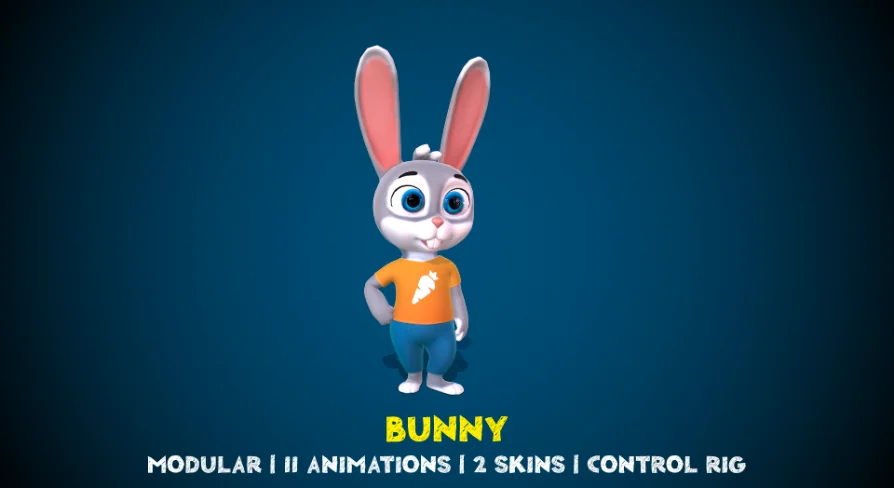
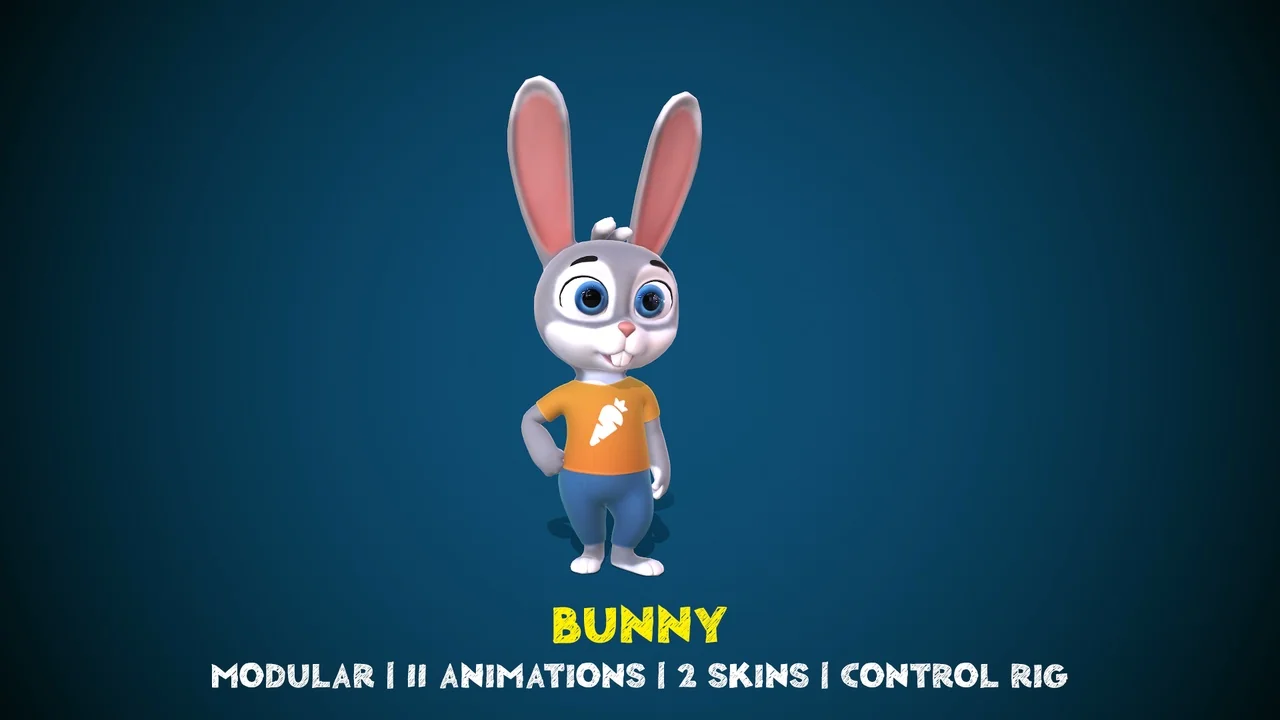
Working with the Bunny character starts at the component level, where the geometry is isolated into two distinct modular elements: the body and the clothes. Separating the main torso and limbs from the external outfit allows the mesh to fulfill multiple roles across a game project. In practice, having independent body geometry means the character can be deployed as an unadorned animal creature or equipped with its clothing layers depending on the narrative scenario.
This modular division directly influences how character pipelines manage skeletal mesh attachments. Rather than dealing with a single collapsed mesh where garments are permanently merged into the underlying skin, the modular structure lets developers link the clothes directly to the primary body skeleton using master pose or shared bone hierarchies. This approach prevents mesh penetration during extreme ranges of motion, as individual clothing elements deform alongside the primary body structure without requiring duplicate bone weights.
For projects requiring visual variety among groups of units, separating the body from the apparel offers practical flexibility. A single base creature can populate an environment as a simple woodland animal, while instances equipped with the clothing assets step into roles as stylized fantasy combatants or quest givers. Managing the character across multiple scenes becomes a matter of toggling component visibility or swapping mesh references in the character configuration.
Driving the Bunny Rig with Animation Blueprints and Scripts
Motion for the model relies on the dedicated Bunny rig, which serves as the skeletal framework for all translations, rotations, and deformations. Because the character includes both an Animation Blueprint and script components, the mechanical movement and logic systems are tied together from the start of integration. The Animation Blueprint governs the state transitions between idle postures, directional running, leaping, and combat interactions.
Setting up locomotion inside an Animation Blueprint requires mapping the rig's bone channels to blend spaces and state machines. Because the Bunny balances animalistic features with humanoid apparel, the underlying rig handles transitions between bipedal posturing and rapid creature locomotion. Script hooks communicate directly with this graph, transmitting parameters such as movement speed, grounded states, and action triggers to ensure responsive real-time feedback during gameplay.
The inclusion of scripting support bridges the gap between player input or enemy artificial intelligence and the skeletal response. Whether the character is driven by autonomous navigation routines or user-directed movement vectors, the scripting layer drives variables directly into the animation pipeline. This architecture keeps the visual playback tightly synchronized with gameplay mechanics, avoiding stutter or desynchronization when sudden state changes occur.
Adapting Lowpoly Stylized Forms for Heroes and Enemies
The visual execution of the character balances lowpoly simplicity with a stylized, cartoon fantasy aesthetic. Clean edge flow and simplified geometric volumes ensure that silhouettes remain readable even at a distance or against chaotic scene geometry. This lowpoly design profile significantly reduces rendering overhead, making it practical to maintain high frame rates even when rendering multiple instances across an active level.
The thematic profile of the asset spans contradictory archetypes, allowing it to function as a cute protagonist or an opposing enemy unit. In a hero role, the stylized proportions and bright, expressive exterior emphasize character charm, fitting cleanly into whimsical adventure games or cartoon platformers. The distinct shapes ensure that player actions, gestures, and equipped items remain instantly identifiable on screen.
Inverted into an enemy role, the character introduces unexpected variety into combat encounters. Within fantasy settings, transforming an otherwise harmless creature into a hostile mob subverts traditional monster tropes. The combination of cartoon styling and agile movement allows designers to build encounters around quick, evasive adversaries that harass players with swift strikes before retreating out of reach.
Evaluating Motion Through the Bunny Demo and Showcase
Reviewing the character prior to full production deployment is streamlined through the Bunny showcase and demo environments. The showcase environment functions as an isolated presentation space where the static and moving qualities of the model can be inspected. It provides an immediate look at surface deformation around joints, texture mapping across the separated body and clothing pieces, and the neutral stance of the Bunny rig.
The Bunny demo takes verification a step further by placing the asset into active execution. Within the demo context, developers can observe the Animation Blueprint processing transitions under simulated runtime conditions. This functional environment displays how the modular clothing handles dynamic motion, how the script logic coordinates with user input, and how cleanly the locomotion states blend during sharp direction changes.
Testing through these dedicated evaluation tools eliminates guesswork during setup. By assessing the behavior of the rig and the execution of the animation scripts inside a controlled demonstration, technical artists can confirm that performance metrics, mesh bindings, and state transitions meet project standards before merging the character into larger game levels.
Compatibility Across Other Characters and the Undead Pack
The character is designed to sit alongside broader entity rosters, maintaining compatibility with other characters and specifically integrating with the Undead Pack. This cross-pack compatibility opens specific design pathways where stylized, living creatures confront dark or reanimated opponents within the same visual universe.
Maintaining pipeline consistency with the Undead Pack ensures that skeletal structures, scale conventions, and animation data exchange smoothly between friendly and hostile factions. In scenarios where the Bunny functions as a lone hero facing hordes of stylized undead foes, the shared structural foundation prevents visual and technical friction. Both character sets can populate the same combat encounters, interact through standardized hitboxes, and share environment spaces without discrepancies in artistic direction.
This shared compatibility also supports hybrid creative ideas, such as designing infected variations or building asymmetric combat scenarios. Because the assets align across rigging paradigms and modular conventions, integrating the Bunny alongside diverse characters expands the operational scale of fantasy projects while preserving architectural consistency across character classes.
 Characters
 Characters
 Characters
 Characters