"07a32e720bd988c8"{"id":"1002488","slug":"modular-male-mannequin-on-standard-skeleton","title":"Modular Male Mannequin on Standard Skeleton","category":"Characters \u0026 Creatures","engine":"4.24+,5.0+","assetVersion":"","engineVersion":"Engine Version: 4.24+,5.0+","tag":"Characters","accent":"blue","visual":"character","summary":"A deep look at the Modular Male Mannequin on Standard Skeleton, featuring UE4 and UE5 Epic Skeleton compatibility, static mesh socketing, and modular parts.","platform":"Unreal Engine","indexPolicy":"index","publishedAt":"2026-11-12T03:53:25.002Z","updatedAt":"2026-11-12T03:53:25.002Z","sourceNotes":[],"fileContents":[],"compatibility":["Unreal Engine","Engine Version: 4.24+,5.0+"],"featuredImage":{"alt":"Modular Male Mannequin on Standard Skeleton","src":"/wp-content/uploads/published/2026/11/348223e2684f-6874d64c-bba7-4d1f-a016-9d3ede2c617f-e6e2d3fb40.webp"},"hasDownloadLink":true,"downloads":0,"terms":[{"taxonomy":"category","slug":"characters-and-creatures","name":"Characters \u0026 Creatures"}],"galleryImages":[{"src":"/wp-content/uploads/published/2026/11/5d04f2c0b520-f4bc9750-0847-49f8-a9c7-f5a4418f8ee3-e523a61950.webp","alt":"Modular Male Mannequin on Standard Skeleton"},{"src":"/wp-content/uploads/published/2026/11/27fca16cac9e-e3ccb48f-e0d3-488f-a3d3-467ce1a59d69-41dee65a1c.webp","alt":"Modular Male Mannequin on Standard Skeleton"},{"src":"/wp-content/uploads/published/2026/11/77db4dfa0694-bc13f6c8-5002-4f34-8bb9-74743c7bd353-6a7200eafb.webp","alt":"Modular Male Mannequin on Standard Skeleton"},{"src":"/wp-content/uploads/published/2026/11/b8148ff4ca02-77eda16e-6445-4471-aac0-451219100442-aad30b534a.webp","alt":"Modular Male Mannequin on Standard Skeleton"},{"src":"/wp-content/uploads/published/2026/11/7644ec32db3f-eee4a568-f479-4262-b25d-1dd975579b7f-3d61a39170.webp","alt":"Modular Male Mannequin on Standard Skeleton"},{"src":"/wp-content/uploads/published/2026/11/f35c8e73bbd4-2156f5e3-b323-4620-a24b-463c1e27c737-9fb089fa30.webp","alt":"Modular Male Mannequin on Standard Skeleton"},{"src":"/wp-content/uploads/published/2026/11/ad12a2dac2b3-18096c33-6fa5-43af-97ee-3a44ac65c866-af0180ed52.webp","alt":"Modular Male Mannequin on Standard Skeleton"},{"src":"/wp-content/uploads/published/2026/11/781d58822405-ea7489df-d1fc-4809-9226-350d8cbbf90a-126359883f.webp","alt":"Modular Male Mannequin on Standard Skeleton"},{"src":"/wp-content/uploads/published/2026/11/183600b9cc00-d05056aa-dada-415c-9017-a26dd585ab4c-d2e672ae5f.webp","alt":"Modular Male Mannequin on Standard Skeleton"},{"src":"/wp-content/uploads/published/2026/11/6b2358fa062e-99483b5c-1a01-4415-9c73-564233d7c9de-1825dae9f5.webp","alt":"Modular Male Mannequin on Standard Skeleton"}],"accessPanel":{"kind":"resource","title":"Get this resource","eyebrow":"Free resource","message":"Download this resource in your browser.","fileName":"Content.7z","safetyNote":"Resources are manually reviewed before listing to improve quality and reduce obvious risks.","actionLabel":"Get this resource","resourceType":"Resource archive","versions":[]},"contentHtml":"\u003ch2\u003eModular Male Mannequin Architecture and Mesh Division\u003c/h2\u003e\u003cp\u003eWorking with character frameworks often requires balancing rigid mechanical parts against deformable organic anatomy. The Modular Male Mannequin on Standard Skeleton addresses this challenge by providing two separate assembly approaches built directly on the Epic Skeleton standard. Delivered with native setups for both Unreal Engine 4 and Unreal Engine 5 skeletal hierarchies, the resource ensures immediate alignment with standard animation logic, shared locomotion sequences, and marketplace-compatible character workflows.\u003c/p\u003e\u003cp\u003eThe first core approach relies on standard modular skeletal meshes divided along predictable anatomical boundaries. The male physique is sliced into five distinct interchangeable segments: head, upper body, hands, lower body, and feet. Because each piece is bound to the standard underlying rig, artists and developers can interchange specific body segments without breaking bone weights or introducing alignment seams at the joints. This division makes it possible to strip away portions of the mesh that would normally clip through layered garments, or to isolate specific regions for localized aesthetic tweaks.\u003c/p\u003e\u003cp\u003ePhysical variation is handled through two distinct body shapes: a regular male build and a buff male build. Both variations retain the underlying Epic Skeleton structure, allowing projects to feature varying physical profiles across non-player characters or playable heroes while drawing from identical animation sets. The standard division between head, upper body, lower torso, hands, and feet applies across both physical scales, creating a consistent structural logic when assembling characters.\u003c/p\u003e\u003ch2\u003eStatic Armor Sockets on the Skeletal Inner Frame\u003c/h2\u003e\u003cp\u003eBeyond traditional skinned meshes, the package introduces an alternative integration model: a socketed static mesh system attached to an internal skeletal frame. In standard character production, adding armor plates, mechanical gear, or structural accessories requires continuous skin weighting in dedicated digital content creation tools. Rigging rigid surfaces to organic skin weights often introduces unnatural deformation around the knees, elbows, and clavicles, or demands extensive troubleshooting to keep hard surfaces from flexing.\u003c/p\u003e\u003cp\u003eThe socketed approach bypasses skin weighting entirely by parented attachments to an underlying skeletal frame. Hard-surface plates, modular guards, and rigid accessories can be imported directly as static meshes and mounted to matching sockets established on the internal skeleton. This framework opens the modeling pipeline to software suites that do not specialize in vertex skinning or organic bone assignments, such as SketchUp, MoI3D, or Asset Forge.\u003c/p\u003e\u003cp\u003eBy treating armor elements as static objects parented to specific transform points on the inner skeleton, conceptual work and rapid modular testing can happen without ever opening a skin-binding workspace. Hard-surface models created in lightweight CAD or blockout tools snap directly into position. For projects utilizing Stylized Male and Female character assets, this system provides a baseline where external static elements sit securely on the moving frame without bending during run cycles, jumps, or combat maneuvers.\u003c/p\u003e\u003ch2\u003eStandard Skeleton Retargeting Across UE4 and UE5\u003c/h2\u003e\u003cp\u003eThe decision to build on the standard Epic Skeleton provides direct continuity across both the UE4 and UE5 iterations of Unreal Engine. Because the skeleton follows standard bone naming conventions, joint orientations, and hierarchical nesting, the mannequin can immediately ingest existing standard animations without complex retargeting graphs. Turn-in-place sequences, idle stances, combat blends, and locomotion systems developed for standard engine assets drop straight onto the mannequin frame.\u003c/p\u003e\u003cp\u003eThis compatibility extends to cross-asset integration. The regular modular skeletal meshes can be mixed with compatible parts from third-party marketplace packages that adhere to the standard bone hierarchy. If an existing package contains specialized gauntlets, boots, or alternative torso pieces, those components can snap alongside the mannequin's native parts. Furthermore, the modular skeletal system natively accepts any male head from the broader PO-Art character line, allowing visual changes to facial features and hairstyles while maintaining uniform neck seams and matching bone weights.\u003c/p\u003e\u003cp\u003eThe inclusion of dedicated UE4 and UE5 versions removes the friction of converting legacy rigs or untangling altered mannequin hierarchies when upgrading project versions. Developers targeting Unreal Engine 4 retain the exact reference poses and bone structures familiar from previous generation projects, while teams operating in Unreal Engine 5 can take advantage of the updated engine-level mannequin standards without running into joint roll errors or axis misalignment.\u003c/p\u003e\u003ch2\u003eController Setup and Assembling Multi-Part Mannequin Characters\u003c/h2\u003e\u003cp\u003eDeploying a segmented character involves more than just placing geometry into an engine viewport; it requires coordinating multiple skeletal meshes within a unified character controller blueprint so animations drive every piece synchronously. To address the mechanics of assembling disparate parts, the package provides comprehensive documentation alongside a video demonstration and a specialized integration tutorial.\u003c/p\u003e\u003cp\u003eThe instructional materials detail the process of taking a custom character model, combining its separate parts, and tying them directly into a playable character controller. Central to this process is the synchronization of modular skeletal meshes using master-pose or copy-pose techniques, ensuring that the head, upper torso, hands, lower legs, and boots follow the master component without phase discrepancies or skeletal lag. The tutorial workflow walks through the steps required to instantiate the separate components, assign their corresponding skeletal assets, and guarantee that animation blueprints propagate down through every sub-mesh.\u003c/p\u003e\u003cp\u003eFor the socketed static mesh system, the guidance explains how the inner frame functions as the central motion carrier, maintaining transform references for the socketed hard-surface meshes. This workflow establishes clear guidelines for positioning attachment points, assigning reference sockets to major limb bones, and configuring collision or visibility toggles on both the regular and buff variants. By mapping out both the static-attachment and modular-skeletal paths, the documentation ensures that developers can select the specific integration strategy that best matches their asset pipeline.\u003c/p\u003e\u003ch2\u003ePipeline Versatility for Stylized Character Assembly\u003c/h2\u003e\u003cp\u003eThe combined feature set serves projects that need rapid prototyping capabilities alongside production-ready modularity. Because the package is built with a stylized aesthetic, it functions cleanly in stylized game environments without requiring texture downgrades or material overhauls. The underlying proportions align naturally with stylized assets while preserving the mechanical precision of standard engine bones.\u003c/p\u003e\u003cp\u003eBy pairing traditional modular skeletal breakdowns with a socketed static system, the asset bridges the gap between complex character rigging and fast, accessible asset creation. Whether a project calls for standard modular clothing swaps using the regular and buff male variations, cross-pollination with existing marketplace skeletal assets, or rapid hard-surface armor creation via CAD tools, the mannequin acts as a stable, predictable foundation across the entire character development pipeline.\u003c/p\u003e\n\n\u003ch2\u003eContinue Browsing Similar Packs\u003c/h2\u003e\n\u003cul\u003e\n\u003cli\u003e\u003ca href=\"https://3dcghub.com/modern-male-pack/\" rel=\"noopener noreferrer\"\u003eModern Male Pack\u003c/a\u003e\u003c/li\u003e\n\u003cli\u003e\u003ca href=\"https://3dcghub.com/human-base-male/\" rel=\"noopener noreferrer\"\u003eHuman Base Male\u003c/a\u003e\u003c/li\u003e\n\u003cli\u003e\u003ca href=\"https://3dcghub.com/styled-characters-pack-military-male-female/\" rel=\"noopener noreferrer\"\u003eStyled Characters Pack: Military Male/Female\u003c/a\u003e\u003c/li\u003e\n\u003cli\u003e\u003ca href=\"https://3dcghub.com/male-realistic-character-pack-01/\" rel=\"noopener noreferrer\"\u003eMale Realistic Character Pack 01\u003c/a\u003e\u003c/li\u003e\n\u003cli\u003e\u003ca href=\"https://3dcghub.com/stylized-male-and-female-characters-assets-only/\" rel=\"noopener noreferrer\"\u003eStylized Male and Female characters (assets only)\u003c/a\u003e\u003c/li\u003e\n\u003c/ul\u003e","contentTextLength":7793,"navigation":{"current":11,"total":4421,"previous":{"id":"1002489","slug":"mongol","title":"Mongol","category":"Characters \u0026 Creatures","platform":"Unreal Engine","updatedAt":"2026-11-12T03:54:07.741Z"},"next":{"id":"1002487","slug":"modern-male-pack","title":"Modern Male Pack","category":"Characters \u0026 Creatures","platform":"Unreal Engine","updatedAt":"2026-11-12T03:52:34.691Z"}},"relatedResources":[{"id":"1002487","slug":"modern-male-pack","title":"Modern Male Pack","category":"Characters \u0026 Creatures","engine":"4.24+,5.0+","assetVersion":"","engineVersion":"Engine Version: 4.24+,5.0+","tag":"Characters","accent":"blue","visual":"character","summary":"Explore the Modern Male Pack, featuring modular body parts, Epic skeleton animation compatibility, customizable materials, and military character setups.","platform":"Unreal Engine","indexPolicy":"index","publishedAt":"2026-11-12T03:52:34.691Z","updatedAt":"2026-11-12T03:52:34.691Z","sourceNotes":[],"fileContents":[],"compatibility":["Unreal Engine","Engine Version: 4.24+,5.0+"],"featuredImage":{"alt":"Modern Male Pack","src":"/wp-content/uploads/published/2026/11/e7522bfe2457-3bbf7789-3d97-45b5-a9a1-cf6982a8b594-0bc3232e1a.webp"},"hasDownloadLink":true,"downloads":0},{"id":"1002482","slug":"human-base-male","title":"Human Base Male","category":"Characters \u0026 Creatures","engine":"4.25+,5.0+","assetVersion":"","engineVersion":"Engine Version: 4.25+,5.0+","tag":"Characters","accent":"blue","visual":"character","summary":"Explore the Human Base Male asset featuring a muscular realistic anatomy, modular mannequin setup, Animationblueprint logic, and Cyberpunk Metalhead support.","platform":"Unreal Engine","indexPolicy":"index","publishedAt":"2026-11-12T03:45:27.330Z","updatedAt":"2026-11-12T03:45:27.330Z","sourceNotes":[],"fileContents":[],"compatibility":["Unreal Engine","Engine Version: 4.25+,5.0+"],"featuredImage":{"alt":"Human Base Male","src":"/wp-content/uploads/published/2026/11/d4a7a94ee192-b7f650b2-fb81-4119-9fb1-cf21360ec28b-80605c940a.webp"},"hasDownloadLink":true,"downloads":0},{"id":"1001842","slug":"styled-characters-pack-military-male-female","title":"Styled Characters Pack: Military Male/Female","category":"Characters \u0026 Creatures","engine":"4.19+,5.0+","assetVersion":"","engineVersion":"Engine Version: 4.19+,5.0+","tag":"Characters","accent":"blue","visual":"character","summary":"Stylized modular military male and female characters for third person shooters, rigged to the Epic Skeleton with extra bones, morph targets, and blueprints.","platform":"Unreal Engine","indexPolicy":"index","publishedAt":"2026-10-21T08:33:25.353Z","updatedAt":"2026-10-21T08:33:25.353Z","sourceNotes":[],"fileContents":[],"compatibility":["Unreal Engine","Engine Version: 4.19+,5.0+"],"featuredImage":{"alt":"Styled Characters Pack: Military Male/Female","src":"/wp-content/uploads/published/2026/10/98e5fee8073c-dc48ba2c-9c83-4906-825f-7249c0032428-07b9eb71e5.webp"},"hasDownloadLink":true,"downloads":0}]}
Characters
Modular Male Mannequin on Standard Skeleton
A deep look at the Modular Male Mannequin on Standard Skeleton, featuring UE4 and UE5 Epic Skeleton compatibility, static mesh socketing, and modular parts.
Modular Male Mannequin Architecture and Mesh Division
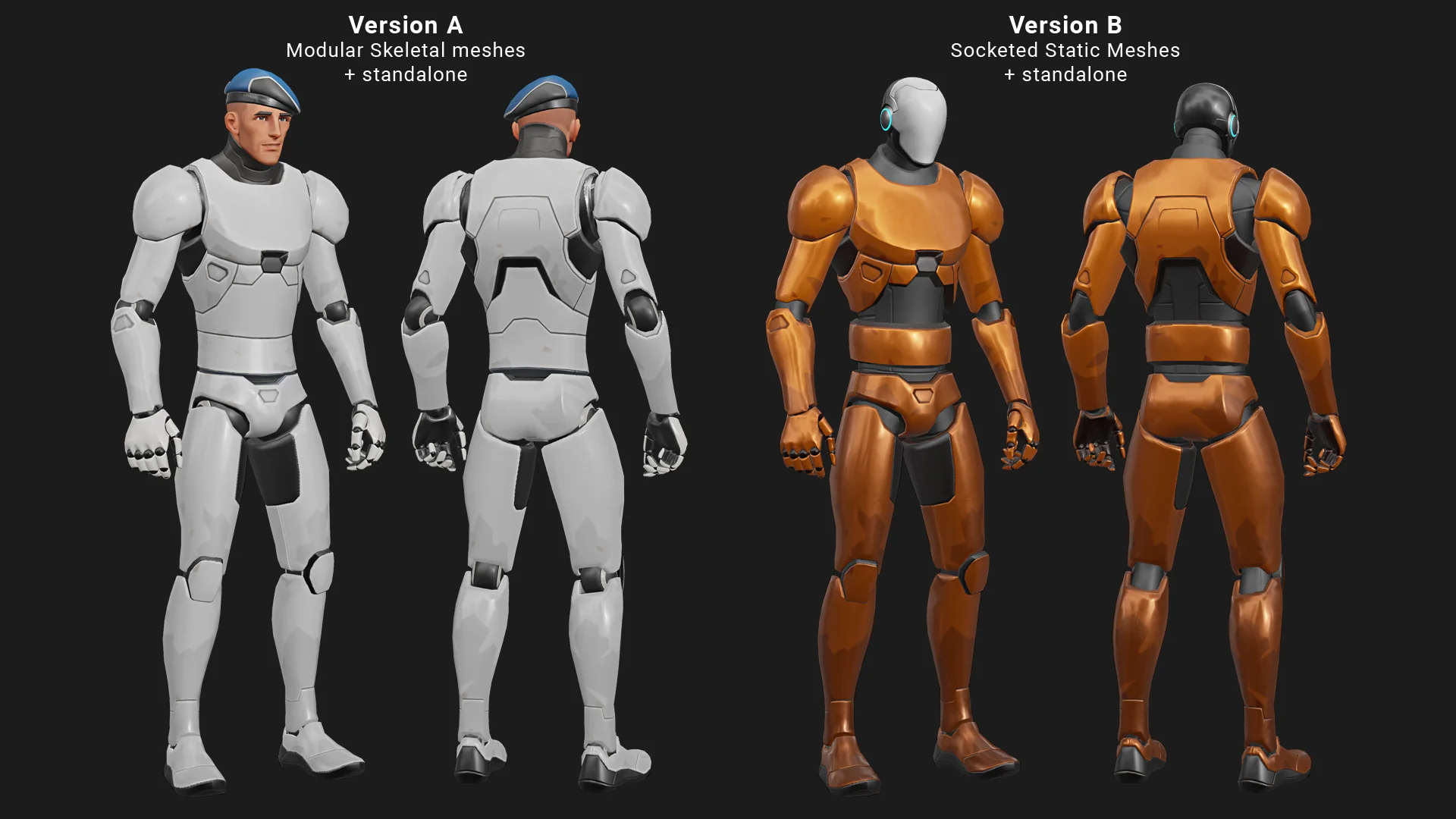
Working with character frameworks often requires balancing rigid mechanical parts against deformable organic anatomy. The Modular Male Mannequin on Standard Skeleton addresses this challenge by providing two separate assembly approaches built directly on the Epic Skeleton standard. Delivered with native setups for both Unreal Engine 4 and Unreal Engine 5 skeletal hierarchies, the resource ensures immediate alignment with standard animation logic, shared locomotion sequences, and marketplace-compatible character workflows.
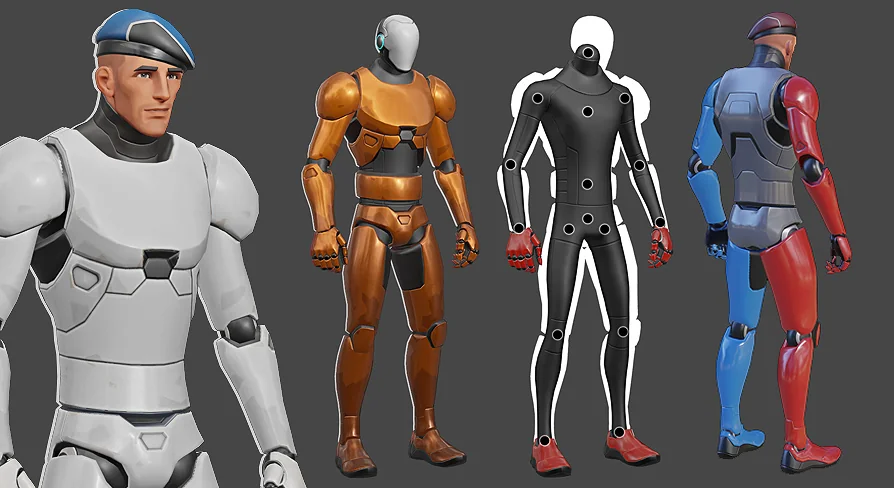
The first core approach relies on standard modular skeletal meshes divided along predictable anatomical boundaries. The male physique is sliced into five distinct interchangeable segments: head, upper body, hands, lower body, and feet. Because each piece is bound to the standard underlying rig, artists and developers can interchange specific body segments without breaking bone weights or introducing alignment seams at the joints. This division makes it possible to strip away portions of the mesh that would normally clip through layered garments, or to isolate specific regions for localized aesthetic tweaks.
Physical variation is handled through two distinct body shapes: a regular male build and a buff male build. Both variations retain the underlying Epic Skeleton structure, allowing projects to feature varying physical profiles across non-player characters or playable heroes while drawing from identical animation sets. The standard division between head, upper body, lower torso, hands, and feet applies across both physical scales, creating a consistent structural logic when assembling characters.
Static Armor Sockets on the Skeletal Inner Frame
Beyond traditional skinned meshes, the package introduces an alternative integration model: a socketed static mesh system attached to an internal skeletal frame. In standard character production, adding armor plates, mechanical gear, or structural accessories requires continuous skin weighting in dedicated digital content creation tools. Rigging rigid surfaces to organic skin weights often introduces unnatural deformation around the knees, elbows, and clavicles, or demands extensive troubleshooting to keep hard surfaces from flexing.
The socketed approach bypasses skin weighting entirely by parented attachments to an underlying skeletal frame. Hard-surface plates, modular guards, and rigid accessories can be imported directly as static meshes and mounted to matching sockets established on the internal skeleton. This framework opens the modeling pipeline to software suites that do not specialize in vertex skinning or organic bone assignments, such as SketchUp, MoI3D, or Asset Forge.
By treating armor elements as static objects parented to specific transform points on the inner skeleton, conceptual work and rapid modular testing can happen without ever opening a skin-binding workspace. Hard-surface models created in lightweight CAD or blockout tools snap directly into position. For projects utilizing Stylized Male and Female character assets, this system provides a baseline where external static elements sit securely on the moving frame without bending during run cycles, jumps, or combat maneuvers.
Standard Skeleton Retargeting Across UE4 and UE5
The decision to build on the standard Epic Skeleton provides direct continuity across both the UE4 and UE5 iterations of Unreal Engine. Because the skeleton follows standard bone naming conventions, joint orientations, and hierarchical nesting, the mannequin can immediately ingest existing standard animations without complex retargeting graphs. Turn-in-place sequences, idle stances, combat blends, and locomotion systems developed for standard engine assets drop straight onto the mannequin frame.
This compatibility extends to cross-asset integration. The regular modular skeletal meshes can be mixed with compatible parts from third-party marketplace packages that adhere to the standard bone hierarchy. If an existing package contains specialized gauntlets, boots, or alternative torso pieces, those components can snap alongside the mannequin's native parts. Furthermore, the modular skeletal system natively accepts any male head from the broader PO-Art character line, allowing visual changes to facial features and hairstyles while maintaining uniform neck seams and matching bone weights.
The inclusion of dedicated UE4 and UE5 versions removes the friction of converting legacy rigs or untangling altered mannequin hierarchies when upgrading project versions. Developers targeting Unreal Engine 4 retain the exact reference poses and bone structures familiar from previous generation projects, while teams operating in Unreal Engine 5 can take advantage of the updated engine-level mannequin standards without running into joint roll errors or axis misalignment.
Controller Setup and Assembling Multi-Part Mannequin Characters
Deploying a segmented character involves more than just placing geometry into an engine viewport; it requires coordinating multiple skeletal meshes within a unified character controller blueprint so animations drive every piece synchronously. To address the mechanics of assembling disparate parts, the package provides comprehensive documentation alongside a video demonstration and a specialized integration tutorial.
The instructional materials detail the process of taking a custom character model, combining its separate parts, and tying them directly into a playable character controller. Central to this process is the synchronization of modular skeletal meshes using master-pose or copy-pose techniques, ensuring that the head, upper torso, hands, lower legs, and boots follow the master component without phase discrepancies or skeletal lag. The tutorial workflow walks through the steps required to instantiate the separate components, assign their corresponding skeletal assets, and guarantee that animation blueprints propagate down through every sub-mesh.
For the socketed static mesh system, the guidance explains how the inner frame functions as the central motion carrier, maintaining transform references for the socketed hard-surface meshes. This workflow establishes clear guidelines for positioning attachment points, assigning reference sockets to major limb bones, and configuring collision or visibility toggles on both the regular and buff variants. By mapping out both the static-attachment and modular-skeletal paths, the documentation ensures that developers can select the specific integration strategy that best matches their asset pipeline.
Pipeline Versatility for Stylized Character Assembly
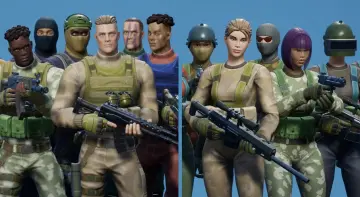
The combined feature set serves projects that need rapid prototyping capabilities alongside production-ready modularity. Because the package is built with a stylized aesthetic, it functions cleanly in stylized game environments without requiring texture downgrades or material overhauls. The underlying proportions align naturally with stylized assets while preserving the mechanical precision of standard engine bones.
By pairing traditional modular skeletal breakdowns with a socketed static system, the asset bridges the gap between complex character rigging and fast, accessible asset creation. Whether a project calls for standard modular clothing swaps using the regular and buff male variations, cross-pollination with existing marketplace skeletal assets, or rapid hard-surface armor creation via CAD tools, the mannequin acts as a stable, predictable foundation across the entire character development pipeline.
 Characters
 Characters
 Characters
 Characters