"7ad89cffa44984cf"{"id":"1002548","slug":"modern-soldier-camo-pack","title":"Modern Soldier Camo Pack","category":"Characters \u0026 Creatures","engine":"4.26+,5.0+","assetVersion":"","engineVersion":"Engine Version: 4.26+,5.0+","tag":"Characters","accent":"blue","visual":"character","summary":"Configure the Modern Soldier Camo Pack featuring six distinct camouflage styles, script integration, and an Animation Blueprint for tactical game environments.","platform":"Unreal Engine","indexPolicy":"index","publishedAt":"2026-11-13T09:57:24.415Z","updatedAt":"2026-11-13T09:57:24.415Z","sourceNotes":[],"fileContents":[],"compatibility":["Unreal Engine","Engine Version: 4.26+,5.0+"],"featuredImage":{"alt":"Modern Soldier Camo Pack","src":"/wp-content/uploads/published/2026/11/690067e04bfd-3fc4941a-a60e-4fd2-a01d-29bf04b404db-8e58822236.webp"},"hasDownloadLink":true,"downloads":0,"terms":[{"taxonomy":"category","slug":"characters-and-creatures","name":"Characters \u0026 Creatures"}],"galleryImages":[{"src":"/wp-content/uploads/published/2026/11/21d40a79683f-23d329aa-d7a6-4d90-b527-071822723f8c-6d36fb7f8a.webp","alt":"Modern Soldier Camo Pack"},{"src":"/wp-content/uploads/published/2026/11/cef0b8494d53-627b00bd-1357-4155-bc6e-028902057d3e-52e82c3c9d.webp","alt":"Modern Soldier Camo Pack"},{"src":"/wp-content/uploads/published/2026/11/bf83aa8d29b9-b3142af8-eb45-4729-8fa9-178e1f273900-a0b8410ac5.webp","alt":"Modern Soldier Camo Pack"},{"src":"/wp-content/uploads/published/2026/11/8b5b3e504941-ac51f29a-e595-49aa-b237-516d7778a572-9dc1235ffa.webp","alt":"Modern Soldier Camo Pack"},{"src":"/wp-content/uploads/published/2026/11/7e649b4752f4-e67c26ef-50f2-4610-9d37-4cf240564503-1c946f1174.webp","alt":"Modern Soldier Camo Pack"},{"src":"/wp-content/uploads/published/2026/11/6d5efdfeb2f3-9cd9b7ad-96a7-471d-b875-27de9d46c7c6-ef231a4a0d.webp","alt":"Modern Soldier Camo Pack"}],"accessPanel":{"kind":"resource","title":"Get this resource","eyebrow":"Free resource","message":"Download this resource in your browser.","fileName":"Content.7z","safetyNote":"Resources are manually reviewed before listing to improve quality and reduce obvious risks.","actionLabel":"Get this resource","resourceType":"Resource archive","versions":[]},"contentHtml":"\u003ch2\u003eDeploying the Modern Soldier Character Setup\u003c/h2\u003e\u003cp\u003eIntegrating a modern tactical operative into an interactive project begins with binding the character mesh to its runtime logic. The Modern Soldier Camo Pack provides a single military character foundation paired with multiple specialized surface variants and pre-built motion graphs. Bringing this asset into a scene requires establishing the character actor, linking the skeletal structure to the included Animation Blueprint, and establishing the baseline material configurations.\u003c/p\u003e\u003cp\u003eBecause the character is constructed with lowpoly geometry while retaining a realistic visual target, setup remains straightforward. The mesh imports cleanly into standard actor pipelines, avoiding heavy computational overhead right out of the box. Placing the base character into a staging scene allows quick verification of default poses, bone hierarchies, and initial skinning integrity before attaching any procedural logic or state transitions.\u003c/p\u003e\u003cp\u003eMaterial instancing or assignment comes next. The pack supplies six distinct camouflage themes that allow a single character asset to fulfill multiple tactical roles across different branches, biomes, and factions. Setting up an organized structure in your project folders ensures that texture switches remain fast and reliable, whether swaps occur in the editor viewport or dynamically through scripting during gameplay.\u003c/p\u003e\u003ch2\u003eAnimation Blueprint and Script Execution for Soldier Control\u003c/h2\u003e\u003cp\u003eMovement and responsiveness depend heavily on the provided Animation Blueprint and script components. Rather than requiring developers to map state trees and blend spaces entirely from scratch, the included Animation Blueprint provides a direct framework for handling locomotion, direction changes, and transition rules. Hooking this blueprint into your standard input handlers gives the lowpoly soldier an immediate set of functional behaviors.\u003c/p\u003e\u003cp\u003eThe script element works alongside the Animation Blueprint to control state management. Depending on project needs, the script can govern uniform selection, manage stance flags, or handle the parameter communication needed to drive locomotion states. Having both a dedicated script and an Animation Blueprint standardizes character behavior, reducing the need for custom glue code between the mesh components and player controllers.\u003c/p\u003e\u003cp\u003eRefining these systems involves adjusting parameters within the animation graph to match your target game speed. Transition thresholds between walking, running, and aiming stances can be tuned within the blueprint settings. The realistic styling ensures that animations read naturally on the mesh, with limb proportions and equipment placement holding their visual credibility across typical tactical movements.\u003c/p\u003e\u003ch2\u003eEvaluating the Modern Soldier Camo Patterns\u003c/h2\u003e\u003cp\u003eThe core versatility of the pack lies in its six distinct camouflage variants: Digital, Jungle, Spec-ops, SWAT, Winter, and Desert. Each variation adapts the soldier's surface appearance to match specific geographical theaters, operational contexts, and mission parameters without altering the underlying character geometry.\u003c/p\u003e\u003cul\u003e\u003cli\u003e\u003cstrong\u003eDigital:\u003c/strong\u003e Utilizes a pixelated military disruption pattern intended for contemporary front-line engagements, offering a versatile camouflage profile suitable for mixed-terrain zones.\u003c/li\u003e\u003cli\u003e\u003cstrong\u003eJungle:\u003c/strong\u003e Incorporates rich organic greens, deep browns, and broken tones designed to blend into dense foliage, rainforest canopies, and heavily vegetated operational areas.\u003c/li\u003e\u003cli\u003e\u003cstrong\u003eSpec-ops:\u003c/strong\u003e Features a low-visibility, subdued palette that minimizes light reflection, tailored for covert nighttime operations and black-budget tactical scenarios.\u003c/li\u003e\u003cli\u003e\u003cstrong\u003eSWAT:\u003c/strong\u003e Implements law-enforcement tactical colors, using dark, cohesive tones suited for urban breach operations, building clearings, and close-quarters domestic defense scenes.\u003c/li\u003e\u003cli\u003e\u003cstrong\u003eWinter:\u003c/strong\u003e Employs high-contrast white and pale gray schemes engineered for sub-zero zones, snow-covered mountain passes, and frozen tundra deployments.\u003c/li\u003e\u003cli\u003e\u003cstrong\u003eDesert:\u003c/strong\u003e Applies arid earth tones, tan gradients, and sun-baked rock coloring built specifically for dry steppes, sand plains, and barren desert combat zones.\u003c/li\u003e\u003c/ul\u003e\u003cp\u003eBy leveraging these six distinct patterns, development teams can build squad variety from a single base soldier. Applying different variants across multiple spawned instances prevents visual monotony during large-scale firefights, while allowing clear differentiation between opposing forces or specialized unit roles within a single mission.\u003c/p\u003e\u003ch2\u003eLowpoly Geometry with Realistic Visual Standards\u003c/h2\u003e\u003cp\u003eBalancing visual realism against engine performance is an ongoing challenge in real-time production. The Modern Soldier Camo Pack addresses this by pairing lowpoly geometry with realistic surface design. This combination ensures that the character retains a sharp, grounded military silhouette without overloading rendering budgets with unnecessary edge counts.\u003c/p\u003e\u003cp\u003eThe lowpoly structure makes the character exceptionally well-suited for scenarios that demand high instance counts. Populating an outpost, staging an assault convoy, or managing background squad members in a real-time strategy or tactical shooter context becomes significantly less demanding on frame rates. The economy of the geometry does not detract from the character's tactical posture; key anatomical landmarks and equipment forms remain clearly defined under dynamic lighting.\u003c/p\u003e\u003cp\u003eBecause the realistic aesthetic avoids exaggerated proportions, the character fits seamlessly alongside realistic weaponry, tactical props, and authentic environment kits. The texture maps carry the burden of surface definition, projecting fabric weaves, gear straps, and camouflage breaks across the optimized lowpoly polygons.\u003c/p\u003e\u003ch2\u003eBunker Compatibility and Runtime Maintenance\u003c/h2\u003e\u003cp\u003eIn addition to standard field deployments across jungle, desert, and snow biomes, the Modern Soldier Camo Pack features compatibility with Bunker environments. Hardened military shelters, concrete tunnels, subterranean command posts, and reinforced defense works demand character assets that hold up under close-quarters interior lighting.\u003c/p\u003e\u003cp\u003eThe SWAT and Spec-ops variants integrate naturally into subterranean installations, representing interior security details, covert infiltration teams, or defense personnel guarding high-value checkpoints. In contrast, assigning the Jungle or Desert patterns within a bunker setting provides immediate narrative context, such as field troops staging inside an underground shelter before deploying to exterior combat zones.\u003c/p\u003e\u003cp\u003eLong-term maintenance of the asset inside an active production pipeline remains straightforward. Because the variant system is confined to surface materials and coordinated by the included script and Animation Blueprint, updates to game logic or migration between level environments can be executed without refactoring the character's base rig or skeletal hierarchy. The asset delivers an efficient, dependable modern soldier ready for immediate deployment across diverse tactical scenarios.\u003c/p\u003e\n\n\u003ch2\u003eContinue Browsing Similar Packs\u003c/h2\u003e\n\u003cul\u003e\n\u003cli\u003e\u003ca href=\"https://3dcghub.com/modular-russian-soldier/\" rel=\"noopener noreferrer\"\u003emodular russian soldier\u003c/a\u003e\u003c/li\u003e\n\u003cli\u003e\u003ca href=\"https://3dcghub.com/customized-alien-soldier/\" rel=\"noopener noreferrer\"\u003eCustomized Alien Soldier\u003c/a\u003e\u003c/li\u003e\n\u003cli\u003e\u003ca href=\"https://3dcghub.com/sci-fi-space-soldier/\" rel=\"noopener noreferrer\"\u003eSci Fi Space Soldier\u003c/a\u003e\u003c/li\u003e\n\u003cli\u003e\u003ca href=\"https://3dcghub.com/modern-male-pack/\" rel=\"noopener noreferrer\"\u003eModern Male Pack\u003c/a\u003e\u003c/li\u003e\n\u003cli\u003e\u003ca href=\"https://3dcghub.com/modern-character/\" rel=\"noopener noreferrer\"\u003eModern character\u003c/a\u003e\u003c/li\u003e\n\u003c/ul\u003e","contentTextLength":7126,"navigation":{"current":29,"total":4499,"previous":{"id":"1002549","slug":"modular-survival-hero","title":"Modular Survival Hero","category":"Characters \u0026 Creatures","platform":"Unreal Engine","updatedAt":"2026-11-13T10:01:07.524Z"},"next":{"id":"1002547","slug":"mistic","title":"Mistic","category":"Humans","platform":"Unreal Engine","updatedAt":"2026-11-13T09:56:17.654Z"}},"relatedResources":[{"id":"1002114","slug":"modular-russian-soldier","title":"modular russian soldier","category":"Characters \u0026 Creatures","engine":"4.27+,5.0+","assetVersion":"","engineVersion":"Engine Version: 4.27+,5.0+","tag":"Characters","accent":"blue","visual":"character","summary":"Explore the modular russian soldier asset featuring realistic tactical armor, groom hair settings, material customization, and CORPSE compatibility.","platform":"Unreal Engine","indexPolicy":"index","publishedAt":"2026-10-29T08:57:07.985Z","updatedAt":"2026-10-29T08:57:07.985Z","sourceNotes":[],"fileContents":[],"compatibility":["Unreal Engine","Engine Version: 4.27+,5.0+"],"featuredImage":{"alt":"modular russian soldier","src":"/wp-content/uploads/published/2026/10/e4444c1f147e-90addc23-97a4-4406-b204-db1ac87d0390-63948fc1dc.webp"},"hasDownloadLink":true,"downloads":1},{"id":"1002563","slug":"russian-soldier-military-and-police-customizable","title":"Russian Soldier, Military and Police, Customizable","category":"Characters \u0026 Creatures","engine":"4.26+,5.0+","assetVersion":"","engineVersion":"Engine Version: 4.26+,5.0+","tag":"Characters","accent":"blue","visual":"character","summary":"Customizable Russian soldier asset featuring eight camouflage schemes, police and security uniforms, Epic skeleton rigging, and bunker compatibility.","platform":"Unreal Engine","indexPolicy":"index","publishedAt":"2026-11-13T11:51:18.227Z","updatedAt":"2026-11-13T11:51:18.227Z","sourceNotes":[],"fileContents":[],"compatibility":["Unreal Engine","Engine Version: 4.26+,5.0+"],"featuredImage":{"alt":"Russian Soldier, Military and Police, Customizable","src":"/wp-content/uploads/published/2026/11/310c539a8400-5263065b-769e-4aaa-bf02-13c0002debf4-26539e3b6d.webp"},"hasDownloadLink":true,"downloads":0},{"id":"1002518","slug":"customized-alien-soldier","title":"Customized Alien Soldier","category":"Characters \u0026 Creatures","engine":"4.26+,5.0+","assetVersion":"","engineVersion":"Engine Version: 4.26+,5.0+","tag":"Characters","accent":"blue","visual":"character","summary":"Explore practical deployment of the Customized Alien Soldier, covering head customization, clothing textures, Epic Skeleton rigging, and TPS inventory setups.","platform":"Unreal Engine","indexPolicy":"index","publishedAt":"2026-11-13T09:01:27.266Z","updatedAt":"2026-11-13T09:01:27.266Z","sourceNotes":[],"fileContents":[],"compatibility":["Unreal Engine","Engine Version: 4.26+,5.0+"],"featuredImage":{"alt":"Customized Alien Soldier","src":"/wp-content/uploads/published/2026/11/a41d3ed9784d-75a52f70-3a85-4bbd-a7d9-7e6daa6e1586-be52a9786d.webp"},"hasDownloadLink":true,"downloads":0}]}
Characters
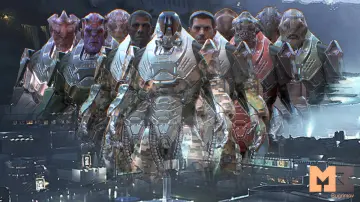
Modern Soldier Camo Pack
Configure the Modern Soldier Camo Pack featuring six distinct camouflage styles, script integration, and an Animation Blueprint for tactical game environments.
Integrating a modern tactical operative into an interactive project begins with binding the character mesh to its runtime logic. The Modern Soldier Camo Pack provides a single military character foundation paired with multiple specialized surface variants and pre-built motion graphs. Bringing this asset into a scene requires establishing the character actor, linking the skeletal structure to the included Animation Blueprint, and establishing the baseline material configurations.
Because the character is constructed with lowpoly geometry while retaining a realistic visual target, setup remains straightforward. The mesh imports cleanly into standard actor pipelines, avoiding heavy computational overhead right out of the box. Placing the base character into a staging scene allows quick verification of default poses, bone hierarchies, and initial skinning integrity before attaching any procedural logic or state transitions.
Material instancing or assignment comes next. The pack supplies six distinct camouflage themes that allow a single character asset to fulfill multiple tactical roles across different branches, biomes, and factions. Setting up an organized structure in your project folders ensures that texture switches remain fast and reliable, whether swaps occur in the editor viewport or dynamically through scripting during gameplay.
Animation Blueprint and Script Execution for Soldier Control
Movement and responsiveness depend heavily on the provided Animation Blueprint and script components. Rather than requiring developers to map state trees and blend spaces entirely from scratch, the included Animation Blueprint provides a direct framework for handling locomotion, direction changes, and transition rules. Hooking this blueprint into your standard input handlers gives the lowpoly soldier an immediate set of functional behaviors.
The script element works alongside the Animation Blueprint to control state management. Depending on project needs, the script can govern uniform selection, manage stance flags, or handle the parameter communication needed to drive locomotion states. Having both a dedicated script and an Animation Blueprint standardizes character behavior, reducing the need for custom glue code between the mesh components and player controllers.
Refining these systems involves adjusting parameters within the animation graph to match your target game speed. Transition thresholds between walking, running, and aiming stances can be tuned within the blueprint settings. The realistic styling ensures that animations read naturally on the mesh, with limb proportions and equipment placement holding their visual credibility across typical tactical movements.
Evaluating the Modern Soldier Camo Patterns
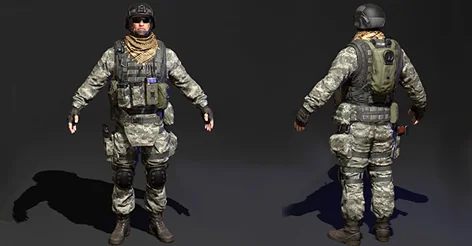
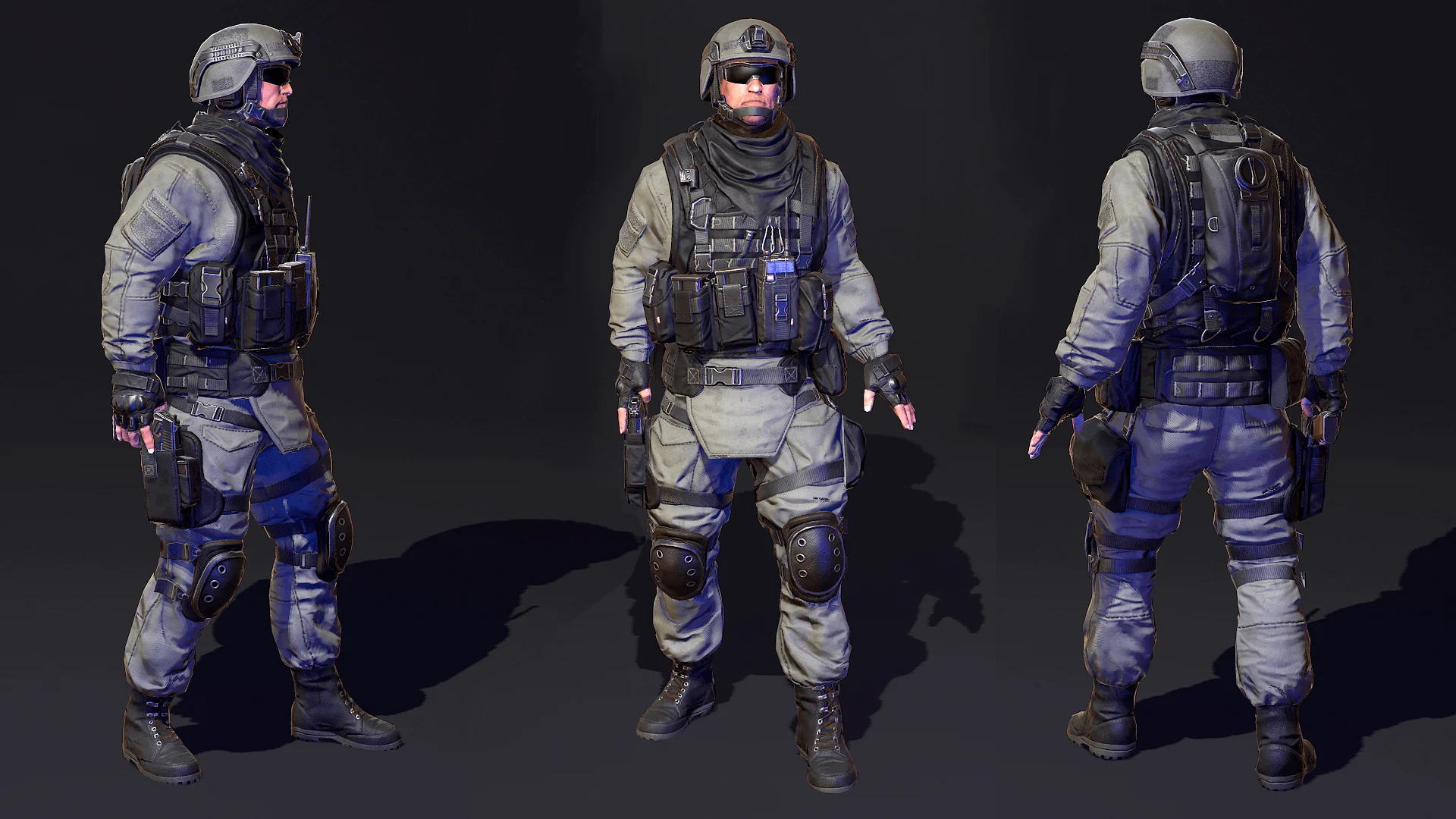
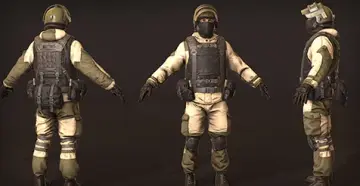
The core versatility of the pack lies in its six distinct camouflage variants: Digital, Jungle, Spec-ops, SWAT, Winter, and Desert. Each variation adapts the soldier's surface appearance to match specific geographical theaters, operational contexts, and mission parameters without altering the underlying character geometry.
Digital: Utilizes a pixelated military disruption pattern intended for contemporary front-line engagements, offering a versatile camouflage profile suitable for mixed-terrain zones.
Jungle: Incorporates rich organic greens, deep browns, and broken tones designed to blend into dense foliage, rainforest canopies, and heavily vegetated operational areas.
Spec-ops: Features a low-visibility, subdued palette that minimizes light reflection, tailored for covert nighttime operations and black-budget tactical scenarios.
SWAT: Implements law-enforcement tactical colors, using dark, cohesive tones suited for urban breach operations, building clearings, and close-quarters domestic defense scenes.
Winter: Employs high-contrast white and pale gray schemes engineered for sub-zero zones, snow-covered mountain passes, and frozen tundra deployments.
Desert: Applies arid earth tones, tan gradients, and sun-baked rock coloring built specifically for dry steppes, sand plains, and barren desert combat zones.
By leveraging these six distinct patterns, development teams can build squad variety from a single base soldier. Applying different variants across multiple spawned instances prevents visual monotony during large-scale firefights, while allowing clear differentiation between opposing forces or specialized unit roles within a single mission.
Lowpoly Geometry with Realistic Visual Standards
Balancing visual realism against engine performance is an ongoing challenge in real-time production. The Modern Soldier Camo Pack addresses this by pairing lowpoly geometry with realistic surface design. This combination ensures that the character retains a sharp, grounded military silhouette without overloading rendering budgets with unnecessary edge counts.
The lowpoly structure makes the character exceptionally well-suited for scenarios that demand high instance counts. Populating an outpost, staging an assault convoy, or managing background squad members in a real-time strategy or tactical shooter context becomes significantly less demanding on frame rates. The economy of the geometry does not detract from the character's tactical posture; key anatomical landmarks and equipment forms remain clearly defined under dynamic lighting.
Because the realistic aesthetic avoids exaggerated proportions, the character fits seamlessly alongside realistic weaponry, tactical props, and authentic environment kits. The texture maps carry the burden of surface definition, projecting fabric weaves, gear straps, and camouflage breaks across the optimized lowpoly polygons.
Bunker Compatibility and Runtime Maintenance
In addition to standard field deployments across jungle, desert, and snow biomes, the Modern Soldier Camo Pack features compatibility with Bunker environments. Hardened military shelters, concrete tunnels, subterranean command posts, and reinforced defense works demand character assets that hold up under close-quarters interior lighting.
The SWAT and Spec-ops variants integrate naturally into subterranean installations, representing interior security details, covert infiltration teams, or defense personnel guarding high-value checkpoints. In contrast, assigning the Jungle or Desert patterns within a bunker setting provides immediate narrative context, such as field troops staging inside an underground shelter before deploying to exterior combat zones.
Long-term maintenance of the asset inside an active production pipeline remains straightforward. Because the variant system is confined to surface materials and coordinated by the included script and Animation Blueprint, updates to game logic or migration between level environments can be executed without refactoring the character's base rig or skeletal hierarchy. The asset delivers an efficient, dependable modern soldier ready for immediate deployment across diverse tactical scenarios.
 Characters
 Characters
 Characters
 Characters