"d6d582562459a019"{"id":"1002100","slug":"maskedrockshader","title":"MaskedRockShader","category":"Variety","engine":"4.26+,5.0+","assetVersion":"","engineVersion":"Engine Version: 4.26+,5.0+","tag":"Variety","accent":"blue","visual":"mech","summary":"Create instant rock and cliff variations using MaskedRockShader's two-texture material instance workflow, RGB masking, and baked normals.","platform":"Unreal Engine","publishedAt":"2026-10-29T08:45:44.720Z","updatedAt":"2026-10-29T08:45:44.720Z","sourceNotes":[],"fileContents":[],"compatibility":["Unreal Engine","Engine Version: 4.26+,5.0+"],"featuredImage":{"alt":"MaskedRockShader","src":"https://media.fab.com/image_previews/gallery_images/757b8d58-2033-4501-a0ca-c72594c909ec/53dcb716-f33f-441a-89a7-b0e97341332b.png"},"hasDownloadLink":true,"downloads":0,"terms":[{"taxonomy":"category","slug":"variety","name":"Variety"}],"galleryImages":[{"src":"/wp-content/uploads/published/2026/10/448d56a2ca2e-79023b05-d1ad-4df4-bfba-38927f8a0950-45cd7b6d35.webp","alt":"MaskedRockShader"},{"src":"/wp-content/uploads/published/2026/10/c7ef0e4e2dc9-962d8337-8098-417a-865a-0c2bdd4e5340-bb52e91d72.webp","alt":"MaskedRockShader"},{"src":"/wp-content/uploads/published/2026/10/d000c401be59-b7ad025a-9a5b-4a76-b0bd-65fd4c8227e2-9535bc3adf.webp","alt":"MaskedRockShader"},{"src":"/wp-content/uploads/published/2026/10/221f21f1b25b-ac3c2076-b1d8-48b6-8a95-67e13701e9fa-79ddc9def6.webp","alt":"MaskedRockShader"},{"src":"/wp-content/uploads/published/2026/10/50c0b35839a5-70310b19-f256-4195-8484-feff322120cd-378b94d2e3.webp","alt":"MaskedRockShader"}],"accessPanel":{"kind":"resource","title":"Download this resource","eyebrow":"Free Download","message":"Log in or create a free account to start your download.","fileName":"Content.7z","safetyNote":"Resources are manually reviewed before listing to improve quality and reduce obvious risks.","actionLabel":"Download Free","resourceType":"Resource archive"},"contentHtml":"\u003ch2\u003eDeploying MaskedRockShader via Two-Texture Material Instances\u003c/h2\u003e\u003cp\u003eIntegrating environment shaders into an active scene often involves balancing asset variety against memory limits and setup complexity. MaskedRockShader approaches this challenge by structuring rock texturing around a lean, instance-driven pipeline. Setting up a new variation does not demand building a novel shading graph or re-importing multi-channel texture sets for every unique prop. Instead, the implementation path focuses directly on creating material instances where only two primary texture slots require assignment.\u003c/p\u003e\u003cp\u003eThis two-texture workflow is rooted in standard texture baking technology. By reducing the per-asset texture burden down to a baked normal map and an accompanying mask, artists can establish a fast production loop. A parent master shader handles the internal logic, while each material instance exposes just the critical inputs needed to customize individual geological surfaces. When dressing expansive game landscapes with repeated formations, updating these two parameters allows distinct stone props, rugged ledges, and sculpted outcrops to take on fresh characteristics without bogging down the material pipeline.\u003c/p\u003e\u003ch2\u003eSurface Modulation Using the RGB Texture Mask\u003c/h2\u003e\u003cp\u003eThe central driver of variation across individual rock assets is the RGB texture mask. Rather than relying on separate grayscale texture files that increase draw call complexity and texture memory usage, the shader packages distribution data directly into discrete red, green, and blue color channels. This masking strategy dictates how surface attributes blend across the mesh, providing targeted control over localized features.\u003c/p\u003e\u003cp\u003eBy adjusting how the material instance reads and balances these color channels, environment artists can steer variation across different zones of a rock formation. The mask controls the distribution of varied surface states across the geometry within the built-in bounds of the shader. One channel can dictate surface wear on exposed upper facets, another can modulate roughness or stone color transitions, and a third can define crevices, sediment layers, or recessed details. Manipulating these values inside an instance creates immediate visual shifts, allowing a single sculpted stone asset to serve multiple visual roles across a scene simply by adjusting the mask response.\u003c/p\u003e\u003ch2\u003eBaked Normals Across Sculpted Formations and Cliffs\u003c/h2\u003e\u003cp\u003eWhile the RGB mask handles surface color and localized material variation, structural fidelity is preserved through the baked normals texture. High-poly rock sculpts feature complex indentations, sharp cleavage planes, fractured edges, and undulating strata. The baked normal map carries this geometric relief from high-resolution source sculpts onto optimized real-time geometry.\u003c/p\u003e\u003cp\u003eBecause the shader is engineered around baked texture technology, the baked normal texture grounds every surface change directly in the asset's physical shape. The shading calculations respect the specific curvature, crevices, and ledges established during the sculpt phase. When paired with the RGB texture mask, the normal data prevents the material variations from feeling disconnected from the rock's physical contours. Highlights, contact points, and shadowed cavities align with the sculpted forms, maintaining a realistic, tactile presentation whether applied to standalone boulders, modular cliff sections, or sprawling stone walls.\u003c/p\u003e\u003ch2\u003eModular Scene Building for Rocks, Stones, and Ledges\u003c/h2\u003e\u003cp\u003eEnvironmental design in real-time engines relies heavily on modularity, where a limited library of 3D meshes is combined, rotated, and scaled to construct vast terrains. When assets are repeated frequently, visible tiling and identical surface traits can break visual immersion. MaskedRockShader functions as a lightweight solution specifically tailored to prevent repetitive patterns across modular formations.\u003c/p\u003e\u003cp\u003eBecause updating a material instance requires swapping only two maps, level designers can rapidly generate bespoke variants for duplicate rock meshes placed adjacent to each other. A primary cliff model can present a dry, weathered appearance on one side of a pass, while a rotated duplicate of the same mesh uses an alternate instance to emphasize dark, pitted striations. This lightweight nature keeps the shader efficient for dense environmental staging, ensuring that modular stone clusters and irregular ledges retain distinct surface identities across the entire game space.\u003c/p\u003e\u003ch2\u003eIntegration with the Pines Forest Winter-Summer Pack\u003c/h2\u003e\u003cp\u003eNatural landscapes demand materials that coexist cleanly with broader environmental asset packs. MaskedRockShader is directly compatible with the Pines Forest Winter-Summer Pack, allowing its rock shading workflow to slot into existing forest scenes and seasonal landscape arrangements. In woodland environments where stone formations frame trails, support riverbeds, and form massive cliff backdrops, consistent visual behavior between vegetation and geology is essential.\u003c/p\u003e\u003cp\u003eUsing the shader alongside the Pines Forest Winter-Summer Pack enables smooth asset cohesion across seasonal variations. The ability to retune surface variations within the material instance helps artists match the tone, moisture, and wear of forest rocks to either lush summer woods or frost-bitten winter environments. The combination of lightweight processing, baked sculpting support, and responsive masking provides a reliable base for maintaining consistent visual standards across complex natural biomes.\u003c/p\u003e\n\n\u003ch2\u003eExplore Similar Assets\u003c/h2\u003e\n\u003cul\u003e\n\u003cli\u003e\u003ca href=\"https://3dcghub.com/exland/\" title=\"EXLAND\"\u003eEXLAND\u003c/a\u003e\u003c/li\u003e\n\u003cli\u003e\u003ca href=\"https://3dcghub.com/ground-mix-vol-22-hand-painted-textures/\" title=\"Ground Mix Vol.22 - Hand Painted Textures\"\u003eGround Mix Vol.22 - Hand Painted Textures\u003c/a\u003e\u003c/li\u003e\n\u003cli\u003e\u003ca href=\"https://3dcghub.com/1000-mega-decal-package-ai-sources/\" title=\"1000+ Mega Decal Package / AI SOURCES\"\u003e1000+ Mega Decal Package / AI SOURCES\u003c/a\u003e\u003c/li\u003e\n\u003cli\u003e\u003ca href=\"https://3dcghub.com/09-cloth-materials/\" title=\"09 Cloth Materials\"\u003e09 Cloth Materials\u003c/a\u003e\u003c/li\u003e\n\u003cli\u003e\u003ca href=\"https://3dcghub.com/ascii-post-process-material/\" title=\"ASCII Post Process Material\"\u003eASCII Post Process Material\u003c/a\u003e\u003c/li\u003e\n\u003c/ul\u003e","contentTextLength":5681,"navigation":{"current":40,"total":4065,"previous":{"id":"1002101","slug":"matrix-rain-of-symbols-vfx","title":"Matrix / Rain of Symbols - VFX","category":"Variety","platform":"Unreal Engine","updatedAt":"2026-10-29T08:46:24.158Z"},"next":{"id":"1002099","slug":"magiccircle-decal-30","title":"MagicCircle Decal 30","category":"Variety","platform":"Unreal Engine","updatedAt":"2026-10-29T08:45:04.738Z"}},"relatedResources":[{"id":"1002015","slug":"exland","title":"EXLAND","category":"Variety","engine":"4.26+,5.0+","assetVersion":"","engineVersion":"Engine Version: 4.26+,5.0+","tag":"Variety","accent":"blue","visual":"mech","summary":"Exland delivers an auto landscape material system with procedural and painted blending, Extile noise algorithms, RVT support, and multi-layered setups.","platform":"Unreal Engine","publishedAt":"2026-10-26T12:54:33.246Z","updatedAt":"2026-10-26T12:54:33.246Z","sourceNotes":[],"fileContents":[],"compatibility":["Unreal Engine","Engine Version: 4.26+,5.0+"],"featuredImage":{"alt":"EXLAND","src":"/wp-content/uploads/published/2026/10/ee5252dfa362-c544e796-d568-4b52-ace9-99ed32bb3a30-78d3c8d768.webp"},"hasDownloadLink":true,"downloads":0},{"id":"1002044","slug":"ground-mix-vol-22-hand-painted-textures","title":"Ground Mix Vol.22 - Hand Painted Textures","category":"Variety","engine":"4.26+,5.0+","assetVersion":"","engineVersion":"Engine Version: 4.26+,5.0+","tag":"Variety","accent":"blue","visual":"luts","summary":"Five tileable hand-painted ground textures featuring snow, aquatic, and fantasy surfaces with full PBR map sets in 2048px TGA format.","platform":"Unreal Engine","publishedAt":"2026-10-26T14:36:30.033Z","updatedAt":"2026-10-26T14:36:30.033Z","sourceNotes":[],"fileContents":[],"compatibility":["Unreal Engine","Engine Version: 4.26+,5.0+"],"featuredImage":{"alt":"Ground Mix Vol.22 - Hand Painted Textures","src":"/wp-content/uploads/published/2026/10/4f63ad75fa84-897c2762-04a1-46bb-998c-d8783474c492-41535dadfe.webp"},"hasDownloadLink":true,"downloads":0},{"id":"1000144","slug":"1000-mega-decal-package-ai-sources","title":"1000+ Mega Decal Package / AI SOURCES","category":"Variety","engine":"4.26+,5.0+","assetVersion":"","engineVersion":"Engine Version: 4.26+,5.0+","tag":"Variety","accent":"blue","visual":"mech","summary":"A high-quality customizable decal pack with texture-driven flexibility, combined or separate use, and access to main vector drawing files.","platform":"Unreal Engine","publishedAt":"2026-06-12T18:37:30.067Z","updatedAt":"2026-10-03T14:08:24.863Z","sourceNotes":[],"fileContents":[],"compatibility":["Unreal Engine","Engine Version: 4.26+,5.0+"],"featuredImage":{"alt":"1000+ Mega Decal Package / AI SOURCES","src":"/wp-content/uploads/published/2026/06/c65003b15164-8cfb9e15-1251-4bec-a5db-4031508b2f53-10a82d485f.webp"},"hasDownloadLink":true,"downloads":1}]}
Variety
MaskedRockShader
Create instant rock and cliff variations using MaskedRockShader's two-texture material instance workflow, RGB masking, and baked normals.
Category:Unreal Engine,VarietyPlatform: Unreal EngineEngine Version: 4.26+,5.0+Published: Oct 29, 2026
Variety
Resource overview
Deploying MaskedRockShader via Two-Texture Material Instances
Integrating environment shaders into an active scene often involves balancing asset variety against memory limits and setup complexity. MaskedRockShader approaches this challenge by structuring rock texturing around a lean, instance-driven pipeline. Setting up a new variation does not demand building a novel shading graph or re-importing multi-channel texture sets for every unique prop. Instead, the implementation path focuses directly on creating material instances where only two primary texture slots require assignment.
This two-texture workflow is rooted in standard texture baking technology. By reducing the per-asset texture burden down to a baked normal map and an accompanying mask, artists can establish a fast production loop. A parent master shader handles the internal logic, while each material instance exposes just the critical inputs needed to customize individual geological surfaces. When dressing expansive game landscapes with repeated formations, updating these two parameters allows distinct stone props, rugged ledges, and sculpted outcrops to take on fresh characteristics without bogging down the material pipeline.
Surface Modulation Using the RGB Texture Mask
The central driver of variation across individual rock assets is the RGB texture mask. Rather than relying on separate grayscale texture files that increase draw call complexity and texture memory usage, the shader packages distribution data directly into discrete red, green, and blue color channels. This masking strategy dictates how surface attributes blend across the mesh, providing targeted control over localized features.
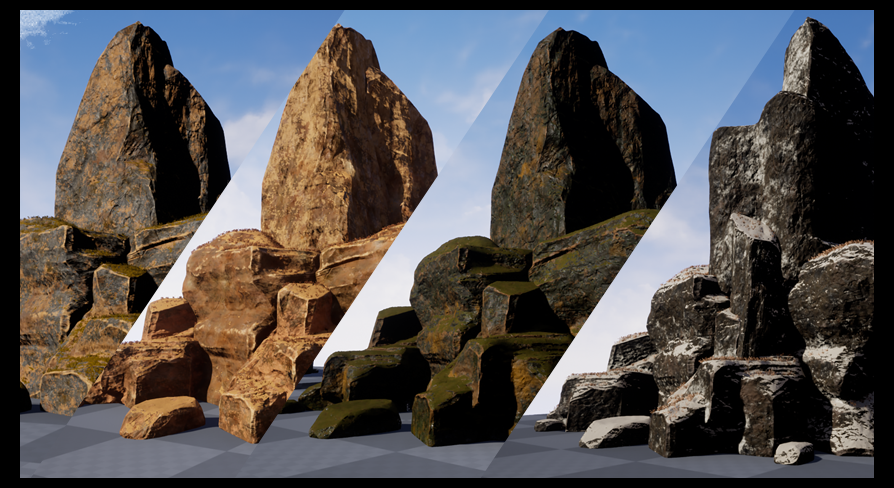
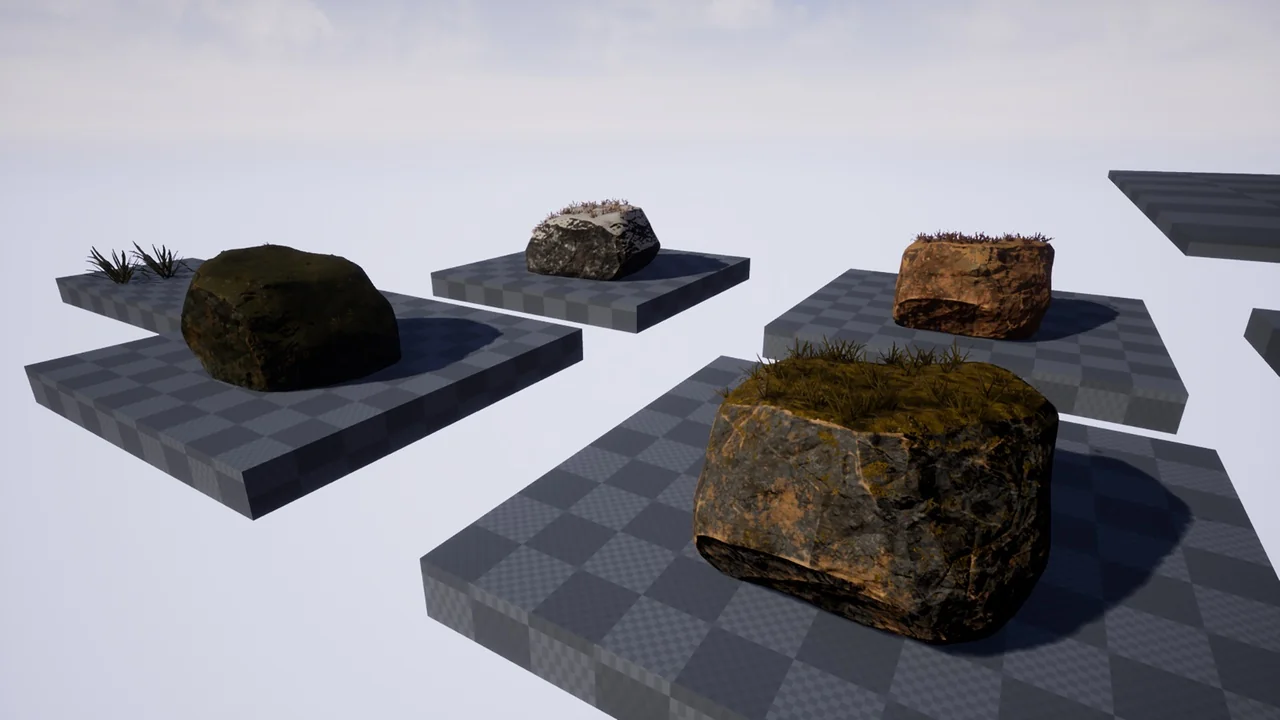
By adjusting how the material instance reads and balances these color channels, environment artists can steer variation across different zones of a rock formation. The mask controls the distribution of varied surface states across the geometry within the built-in bounds of the shader. One channel can dictate surface wear on exposed upper facets, another can modulate roughness or stone color transitions, and a third can define crevices, sediment layers, or recessed details. Manipulating these values inside an instance creates immediate visual shifts, allowing a single sculpted stone asset to serve multiple visual roles across a scene simply by adjusting the mask response.
Baked Normals Across Sculpted Formations and Cliffs
While the RGB mask handles surface color and localized material variation, structural fidelity is preserved through the baked normals texture. High-poly rock sculpts feature complex indentations, sharp cleavage planes, fractured edges, and undulating strata. The baked normal map carries this geometric relief from high-resolution source sculpts onto optimized real-time geometry.
Because the shader is engineered around baked texture technology, the baked normal texture grounds every surface change directly in the asset's physical shape. The shading calculations respect the specific curvature, crevices, and ledges established during the sculpt phase. When paired with the RGB texture mask, the normal data prevents the material variations from feeling disconnected from the rock's physical contours. Highlights, contact points, and shadowed cavities align with the sculpted forms, maintaining a realistic, tactile presentation whether applied to standalone boulders, modular cliff sections, or sprawling stone walls.
Modular Scene Building for Rocks, Stones, and Ledges
Environmental design in real-time engines relies heavily on modularity, where a limited library of 3D meshes is combined, rotated, and scaled to construct vast terrains. When assets are repeated frequently, visible tiling and identical surface traits can break visual immersion. MaskedRockShader functions as a lightweight solution specifically tailored to prevent repetitive patterns across modular formations.
Because updating a material instance requires swapping only two maps, level designers can rapidly generate bespoke variants for duplicate rock meshes placed adjacent to each other. A primary cliff model can present a dry, weathered appearance on one side of a pass, while a rotated duplicate of the same mesh uses an alternate instance to emphasize dark, pitted striations. This lightweight nature keeps the shader efficient for dense environmental staging, ensuring that modular stone clusters and irregular ledges retain distinct surface identities across the entire game space.
Integration with the Pines Forest Winter-Summer Pack
Natural landscapes demand materials that coexist cleanly with broader environmental asset packs. MaskedRockShader is directly compatible with the Pines Forest Winter-Summer Pack, allowing its rock shading workflow to slot into existing forest scenes and seasonal landscape arrangements. In woodland environments where stone formations frame trails, support riverbeds, and form massive cliff backdrops, consistent visual behavior between vegetation and geology is essential.
Using the shader alongside the Pines Forest Winter-Summer Pack enables smooth asset cohesion across seasonal variations. The ability to retune surface variations within the material instance helps artists match the tone, moisture, and wear of forest rocks to either lush summer woods or frost-bitten winter environments. The combination of lightweight processing, baked sculpting support, and responsive masking provides a reliable base for maintaining consistent visual standards across complex natural biomes.
 Variety
 Variety
 Variety
 Variety