"b00678cacce53329"{"id":"1002796","slug":"ky-magic-chant-fx","title":"KY Magic Chant FX","category":"Spells \u0026 Combat","engine":"4.12+,5.0+","assetVersion":"","engineVersion":"Engine Version: 4.12+,5.0+","tag":"Spells \u0026 Combat","accent":"blue","visual":"mech","summary":"A detailed technical breakdown of KY Magic Chant FX, featuring 33 magic chant circle effects across Niagara and Cascade pipelines.","platform":"Unreal Engine","indexPolicy":"index","publishedAt":"2026-11-20T07:20:53.760Z","updatedAt":"2026-11-20T07:20:53.760Z","sourceNotes":[],"fileContents":[],"compatibility":["Unreal Engine","Engine Version: 4.12+,5.0+"],"featuredImage":{"alt":"KY Magic Chant FX","src":"/wp-content/uploads/published/2026/11/a9c693298b3d-459e9b4f-a1e9-427b-a42e-788f325a9537-a725cd44e2.webp"},"fileSizeBytes":54725656,"hasDownloadLink":true,"downloads":0,"terms":[{"taxonomy":"category","slug":"spells-and-combat","name":"Spells \u0026 Combat"}],"galleryImages":[{"src":"/wp-content/uploads/published/2026/11/4fcdae3ac42b-daadc4cd-91fd-4462-8a2f-e3e23a3882a6-c5f59301ef.webp","alt":"KY Magic Chant FX"},{"src":"/wp-content/uploads/published/2026/11/7419ecca2f87-52a608cd-e9f3-4092-88f4-f10ebe5d09dd-a0bc4a7753.webp","alt":"KY Magic Chant FX"},{"src":"/wp-content/uploads/published/2026/11/c8e5de3402e8-db65dfcd-a3f5-4025-a48e-9587203d23bb-7105989fcd.webp","alt":"KY Magic Chant FX"},{"src":"/wp-content/uploads/published/2026/11/bd5f3ba5bc20-b62bdb35-5b43-45d6-b3b6-6a78f4202dce-f8f7749bdc.webp","alt":"KY Magic Chant FX"}],"accessPanel":{"kind":"resource","title":"Get this resource","safetyNote":"Resources are manually reviewed before listing to improve quality and reduce obvious risks.","fileName":"Content.7z","resourceType":"Resource archive","versions":[]},"contentHtml":"\u003cp\u003eIn real-time action titles, role-playing games, and tactical fantasy arenas, the buildup to a spell often carries as much tactical weight as the impact itself. Visual signaling during a spellcasting phase establishes the spatial footprint of an attack, conveys the intensity of an incoming incantation, and gives players the vital window needed to react, dodge, or interrupt an opponent. Magic circles and runic chant graphics form the foundational visual language for these channeled actions, projecting glyphs, radiant lines, and arcane rings directly beneath or around a character.\u003c/p\u003e \u003cp\u003eKY Magic Chant FX addresses this precise phase of gameplay combat. Based on geometric spell circles and mystical chant motifs, the package supplies targeted visual components designed to anchor characters during spell preparation, charging sequences, ritual summons, and sudden magical releases.\u003c/p\u003e \u003ch2\u003eDeploying Magic Chant Visuals in Combat Encounters\u003c/h2\u003e \u003cp\u003eSpellcasting mechanics in video games rely on distinct visual tiers. A quick, low-tier cantrip demands a subtle, rapid visual signature, while high-level battlefield ultimates require expansive, intricate runic geometry that radiates outward across the terrain. With 33 magic chant effects provided, developers have access to a substantial spectrum of visual configurations suitable for different spell schools, character classes, and power levels.\u003c/p\u003e \u003cp\u003eThese magic circle designs excel in several key game environments:\u003c/p\u003e \u003cul\u003e \u003cli\u003e\u003cstrong\u003eChanneled Mage Abilities:\u003c/strong\u003e Anchoring a caster to the ground with complex circular runes while an energy meter charges or an incantation completes.\u003c/li\u003e \u003cli\u003e\u003cstrong\u003eSummoning Circles:\u003c/strong\u003e Generating distinct mystical boundaries that denote where a familiar, monster, or allied unit will materialize into the arena.\u003c/li\u003e \u003cli\u003e\u003cstrong\u003eArea-of-Effect Hazard Warnings:\u003c/strong\u003e Providing clear visual telegraphing on the ground to indicate the blast radius of an incoming hostile strike before detonation occurs.\u003c/li\u003e \u003cli\u003e\u003cstrong\u003eBoss Phase Rituals:\u003c/strong\u003e Illuminating large sections of an encounter space during multi-stage boss fights to indicate invulnerability states, arena-wide channel phases, or battlefield transitions.\u003c/li\u003e\n\u003c/ul\u003e \u003cp\u003eBecause the collection concentrates specifically on the chant and circle aesthetic, the effects can be assigned systematically across character abilities to create a cohesive magical style. Rather than relying on mismatched particle bursts for pre-cast telegraphing, a project can maintain visual unity across player rosters and enemy ranks alike.\u003c/p\u003e \u003ch2\u003eTiming Logic: Balancing LoopFX and OnceFX\u003c/h2\u003e \u003cp\u003eGameplay animation systems handle magical abilities in stages, separating the startup windup from the release and follow-through. Implementing particle effects into these state-driven systems requires precise control over playback behavior. A particle designed solely to fire once will vanish prematurely if a player holds a cast button to charge an attack. Conversely, an emitter that loops indefinitely cannot handle a spell with an instantaneous cast time without awkward manual termination.\u003c/p\u003e \u003cp\u003eTo support responsive input schemes, the package provides its visual assets in two explicit structural forms: loopFX and onceFX.\u003c/p\u003e \u003cp\u003eThe loopFX variations cater directly to indefinite states. When an ability requires sustained channel time, continuous resource drain, or a charging mechanic that the player can hold at will, loopFX maintains the magic circle active in the scene. The circular runes persist seamlessly under the caster for as long as the state machine permits, terminating only when the game logic sends a deactivation signal. This setup is equally suitable for passive aura buffs, persistent ritual altars, or sustained shields that remain active over extended gameplay intervals.\u003c/p\u003e \u003cp\u003eThe onceFX variations, on the other hand, accommodate instantaneous activations and definitive transitions. These assets execute a complete lifecycle from appearance to dissipation without repeating. In practice, developers can trigger a onceFX variant for rapid-fire spell casts that skip any charge-up phase, or utilize it as the conclusive resolution that plays immediately as a loopFX channel finishes. By offering both modes, the pack allows technical artists and gameplay programmers to synchronize spell visuals tightly with character animation montages without having to manually deconstruct particle loop points.\u003c/p\u003e \u003ch2\u003eIntegrating KY Magic Chant FX Across Cascade and Niagara\u003c/h2\u003e \u003cp\u003eEngine visual effects architectures have transitioned significantly over recent production cycles. Unreal Engine projects developed on older frameworks relied on the Cascade particle editor, whereas modern production pipelines have standardized around the programmable, node-based Niagara system. Bridging projects between these paradigms often presents technical hurdles when integrating legacy visual effects into updated engines.\u003c/p\u003e \u003cp\u003eThe asset package addresses this pipeline divergence by providing dual support for both Cascade and Niagara frameworks. The Niagara implementation, added specifically for Unreal Engine 4.26 and onward, allows teams targeting modern engine features to adopt the assets natively within modern VFX workflows. For productions running on older configurations or legacy pipelines that continue to utilize Cascade, the original Cascade versions remain intact and functional.\u003c/p\u003e \u003cp\u003eWhen working with the NiagaraFX assets, developers should ensure the Cascade To Niagara plugin is active in the project environment. This plugin dependency ensures that particle structures, emitter modules, and parameter bindings translate correctly across the runtime environment, preventing missing emitters or incorrect shader hookups during deployment.\u003c/p\u003e \u003cp\u003eHaving access to both systems offers tangible production advantages:\u003c/p\u003e \u003cul\u003e \u003cli\u003e\u003cstrong\u003ePipeline Continuity:\u003c/strong\u003e Projects that began in earlier engine iterations and subsequently upgraded to Unreal Engine 4.26 or higher can transition from the Cascade effects to the Niagara assets without redesigning their spell art from scratch.\u003c/li\u003e \u003cli\u003e\u003cstrong\u003eShader and Particle Consistency:\u003c/strong\u003e The visual intent of the 33 chant effects remains faithful regardless of whether a team implements the Cascade or Niagara iteration.\u003c/li\u003e \u003cli\u003e\u003cstrong\u003eWorkflow Flexibility:\u003c/strong\u003e Teams with specialized tools based on Niagara can inspect, modify, and adjust emitter parameters directly in the newer editor, while teams maintaining older game branches can deploy the Cascade variants directly.\u003c/li\u003e\n\u003c/ul\u003e \u003ch2\u003eTarget Users and Practical Applications\u003c/h2\u003e \u003cp\u003eIndie game developers, solo technical artists, and combat designers working within the Unreal Engine ecosystem benefit most directly from this collection. Building 33 intricate magic circle animations from scratch requires substantial production time, encompassing texture generation for runic glyphs, geometric alignment, particle timing curves, and dual-system setup across Cascade and Niagara.\u003c/p\u003e \u003cp\u003eBy offering ready-to-deploy assets split into continuous loops and discrete one-shot triggers, the package allows combat teams to bypass the initial VFX construction phase and focus on game mechanics, ability timing, and spell balance. For any project needing defined runic indicators, ritual summoning graphics, or clear area-of-effect spell telegraphs, the package provides a focused, technically flexible toolkit.\u003c/p\u003e\n\n\u003ch2\u003eContinue Browsing Similar Packs\u003c/h2\u003e\n\u003cul\u003e\n\u003cli\u003e\u003ca href=\"https://3dcghub.com/ky-barrier-shield-fx/\" rel=\"noopener noreferrer\"\u003eKY Barrier Shield FX\u003c/a\u003e\u003c/li\u003e\n\u003cli\u003e\u003ca href=\"https://3dcghub.com/advancedmagicfx18/\" rel=\"noopener noreferrer\"\u003eAdvancedMagicFX18\u003c/a\u003e\u003c/li\u003e\n\u003cli\u003e\u003ca href=\"https://3dcghub.com/advanced-magic-fx-17/\" rel=\"noopener noreferrer\"\u003eAdvanced Magic FX 17\u003c/a\u003e\u003c/li\u003e\n\u003cli\u003e\u003ca href=\"https://3dcghub.com/advanced-magic-fx-11/\" rel=\"noopener noreferrer\"\u003eAdvanced Magic FX 11\u003c/a\u003e\u003c/li\u003e\n\u003cli\u003e\u003ca href=\"https://3dcghub.com/advanced-magic-fx-10/\" rel=\"noopener noreferrer\"\u003eAdvanced Magic FX 10\u003c/a\u003e\u003c/li\u003e\n\u003c/ul\u003e","contentTextLength":7312,"navigation":{"current":84,"total":4797,"previous":{"id":"1002797","slug":"laser-show-system","title":"Laser Show System","category":"Variety","platform":"Unreal Engine","updatedAt":"2026-11-20T07:21:53.047Z"},"next":{"id":"1002795","slug":"ky-barrier-shield-fx","title":"KY Barrier Shield FX","category":"Spells \u0026 Combat","platform":"Unreal Engine","updatedAt":"2026-11-20T07:20:16.091Z"}},"relatedResources":[{"id":"1002869","slug":"advanced-magic-fx-14","title":"Advanced Magic FX 14","category":"Spells \u0026 Combat","engine":"4.26+,5.0+","assetVersion":"","engineVersion":"Engine Version: 4.26+,5.0+","tag":"Spells \u0026 Combat","accent":"blue","visual":"mech","summary":"Explore Advanced Magic FX 14, featuring Niagara and Cascade magic spells, elemental fire vortexes, lasers, healing, lightning, and built-in particle LODs.","platform":"Unreal Engine","indexPolicy":"index","publishedAt":"2026-11-20T16:32:06.460Z","updatedAt":"2026-11-20T16:32:06.460Z","sourceNotes":[],"fileContents":[],"compatibility":["Unreal Engine","Engine Version: 4.26+,5.0+"],"featuredImage":{"alt":"Advanced Magic FX 14","src":"/wp-content/uploads/published/2026/11/33641332d289-27e981bf-72b2-4c5e-86dc-4b4d536e5221-8a43b3a7ca.webp"},"fileSizeBytes":112659794,"hasDownloadLink":true,"downloads":0},{"id":"1002795","slug":"ky-barrier-shield-fx","title":"KY Barrier Shield FX","category":"Spells \u0026 Combat","engine":"4.12+,5.0+","assetVersion":"","engineVersion":"Engine Version: 4.12+,5.0+","tag":"Spells \u0026 Combat","accent":"blue","visual":"mech","summary":"An analysis of KY Barrier Shield FX, featuring 23 magic barrier and shield effects across Cascade and Niagara systems for Unreal Engine 4.27 and beyond.","platform":"Unreal Engine","indexPolicy":"index","publishedAt":"2026-11-20T07:20:16.091Z","updatedAt":"2026-11-20T07:20:16.091Z","sourceNotes":[],"fileContents":[],"compatibility":["Unreal Engine","Engine Version: 4.12+,5.0+"],"featuredImage":{"alt":"KY Barrier Shield FX","src":"/wp-content/uploads/published/2026/11/8eec687c10a4-4676e615-caf5-46c3-98b5-7c22b166dcb3-250a86cf35.webp"},"fileSizeBytes":63393790,"hasDownloadLink":true,"downloads":0},{"id":"1002769","slug":"advancedmagicfx18","title":"AdvancedMagicFX18","category":"Spells \u0026 Combat","engine":"4.18+,5.0+","assetVersion":"","engineVersion":"Engine Version: 4.18+,5.0+","tag":"Spells \u0026 Combat","accent":"blue","visual":"mech","summary":"Explore the dual Cascade and Niagara particle setup, elemental types, and combat FX in AdvancedMagicFX18, covering energy, shock, wind, water, and dark magic.","platform":"Unreal Engine","indexPolicy":"index","publishedAt":"2026-11-20T06:47:54.152Z","updatedAt":"2026-11-20T06:47:54.152Z","sourceNotes":[],"fileContents":[],"compatibility":["Unreal Engine","Engine Version: 4.18+,5.0+"],"featuredImage":{"alt":"AdvancedMagicFX18","src":"/wp-content/uploads/published/2026/11/ebaa5340dbe6-8221ab8d-dae3-4962-b075-9e4fd073eccb-ef53dd8079.webp"},"fileSizeBytes":66272652,"hasDownloadLink":true,"downloads":0}]}
Resource screenshots
1 / 4
Join our channel
Follow 3DCGHUB on Telegram for new resource drops, migration updates, and community notices.
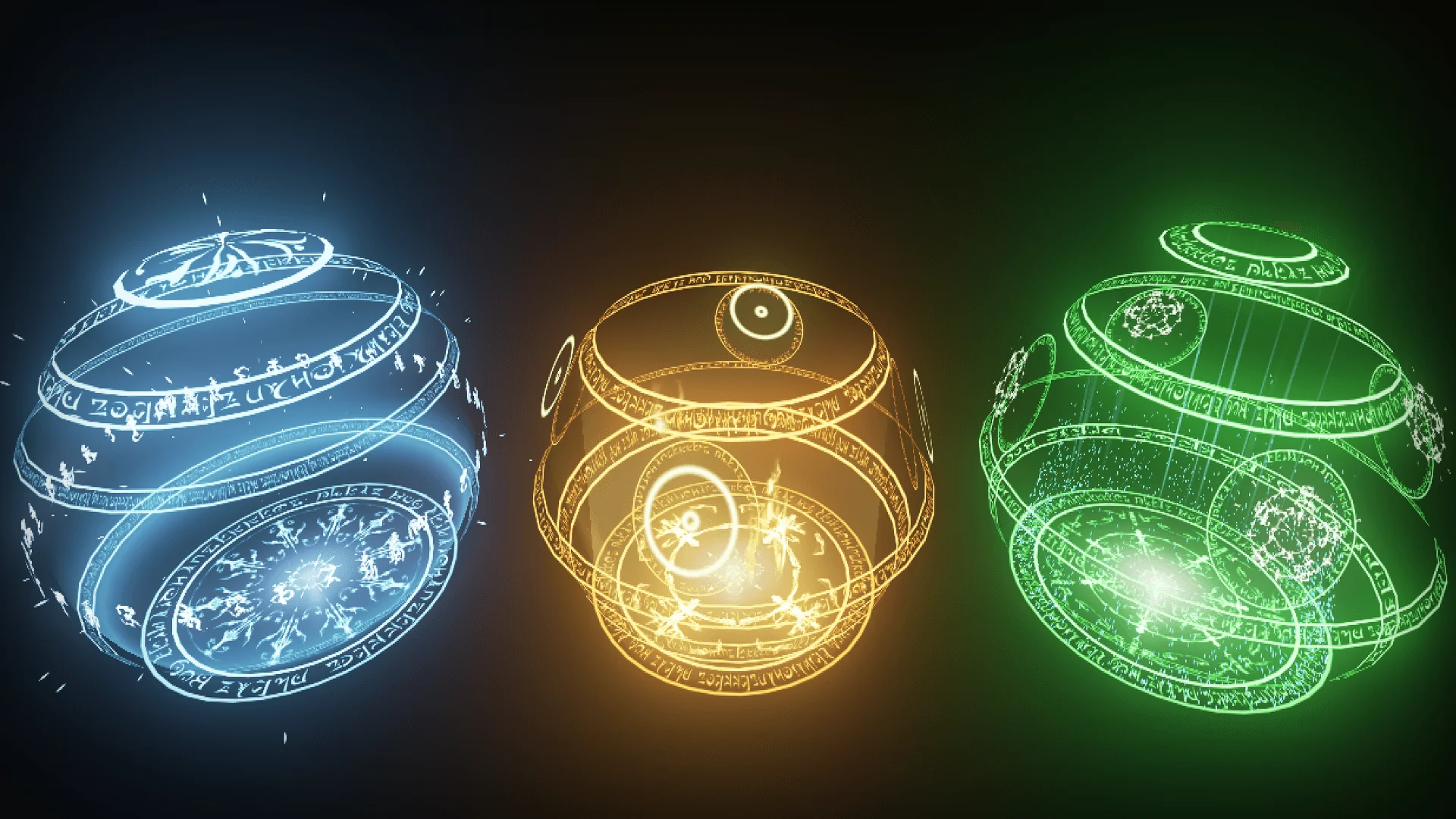
In real-time action titles, role-playing games, and tactical fantasy arenas, the buildup to a spell often carries as much tactical weight as the impact itself. Visual signaling during a spellcasting phase establishes the spatial footprint of an attack, conveys the intensity of an incoming incantation, and gives players the vital window needed to react, dodge, or interrupt an opponent. Magic circles and runic chant graphics form the foundational visual language for these channeled actions, projecting glyphs, radiant lines, and arcane rings directly beneath or around a character.
KY Magic Chant FX addresses this precise phase of gameplay combat. Based on geometric spell circles and mystical chant motifs, the package supplies targeted visual components designed to anchor characters during spell preparation, charging sequences, ritual summons, and sudden magical releases.
Deploying Magic Chant Visuals in Combat Encounters
Spellcasting mechanics in video games rely on distinct visual tiers. A quick, low-tier cantrip demands a subtle, rapid visual signature, while high-level battlefield ultimates require expansive, intricate runic geometry that radiates outward across the terrain. With 33 magic chant effects provided, developers have access to a substantial spectrum of visual configurations suitable for different spell schools, character classes, and power levels.
These magic circle designs excel in several key game environments:
Channeled Mage Abilities: Anchoring a caster to the ground with complex circular runes while an energy meter charges or an incantation completes.
Summoning Circles: Generating distinct mystical boundaries that denote where a familiar, monster, or allied unit will materialize into the arena.
Area-of-Effect Hazard Warnings: Providing clear visual telegraphing on the ground to indicate the blast radius of an incoming hostile strike before detonation occurs.
Boss Phase Rituals: Illuminating large sections of an encounter space during multi-stage boss fights to indicate invulnerability states, arena-wide channel phases, or battlefield transitions.
Because the collection concentrates specifically on the chant and circle aesthetic, the effects can be assigned systematically across character abilities to create a cohesive magical style. Rather than relying on mismatched particle bursts for pre-cast telegraphing, a project can maintain visual unity across player rosters and enemy ranks alike.
Timing Logic: Balancing LoopFX and OnceFX
Gameplay animation systems handle magical abilities in stages, separating the startup windup from the release and follow-through. Implementing particle effects into these state-driven systems requires precise control over playback behavior. A particle designed solely to fire once will vanish prematurely if a player holds a cast button to charge an attack. Conversely, an emitter that loops indefinitely cannot handle a spell with an instantaneous cast time without awkward manual termination.
To support responsive input schemes, the package provides its visual assets in two explicit structural forms: loopFX and onceFX.
The loopFX variations cater directly to indefinite states. When an ability requires sustained channel time, continuous resource drain, or a charging mechanic that the player can hold at will, loopFX maintains the magic circle active in the scene. The circular runes persist seamlessly under the caster for as long as the state machine permits, terminating only when the game logic sends a deactivation signal. This setup is equally suitable for passive aura buffs, persistent ritual altars, or sustained shields that remain active over extended gameplay intervals.
The onceFX variations, on the other hand, accommodate instantaneous activations and definitive transitions. These assets execute a complete lifecycle from appearance to dissipation without repeating. In practice, developers can trigger a onceFX variant for rapid-fire spell casts that skip any charge-up phase, or utilize it as the conclusive resolution that plays immediately as a loopFX channel finishes. By offering both modes, the pack allows technical artists and gameplay programmers to synchronize spell visuals tightly with character animation montages without having to manually deconstruct particle loop points.
Integrating KY Magic Chant FX Across Cascade and Niagara
Engine visual effects architectures have transitioned significantly over recent production cycles. Unreal Engine projects developed on older frameworks relied on the Cascade particle editor, whereas modern production pipelines have standardized around the programmable, node-based Niagara system. Bridging projects between these paradigms often presents technical hurdles when integrating legacy visual effects into updated engines.
The asset package addresses this pipeline divergence by providing dual support for both Cascade and Niagara frameworks. The Niagara implementation, added specifically for Unreal Engine 4.26 and onward, allows teams targeting modern engine features to adopt the assets natively within modern VFX workflows. For productions running on older configurations or legacy pipelines that continue to utilize Cascade, the original Cascade versions remain intact and functional.
When working with the NiagaraFX assets, developers should ensure the Cascade To Niagara plugin is active in the project environment. This plugin dependency ensures that particle structures, emitter modules, and parameter bindings translate correctly across the runtime environment, preventing missing emitters or incorrect shader hookups during deployment.
Having access to both systems offers tangible production advantages:
Pipeline Continuity: Projects that began in earlier engine iterations and subsequently upgraded to Unreal Engine 4.26 or higher can transition from the Cascade effects to the Niagara assets without redesigning their spell art from scratch.
Shader and Particle Consistency: The visual intent of the 33 chant effects remains faithful regardless of whether a team implements the Cascade or Niagara iteration.
Workflow Flexibility: Teams with specialized tools based on Niagara can inspect, modify, and adjust emitter parameters directly in the newer editor, while teams maintaining older game branches can deploy the Cascade variants directly.
Target Users and Practical Applications
Indie game developers, solo technical artists, and combat designers working within the Unreal Engine ecosystem benefit most directly from this collection. Building 33 intricate magic circle animations from scratch requires substantial production time, encompassing texture generation for runic glyphs, geometric alignment, particle timing curves, and dual-system setup across Cascade and Niagara.
By offering ready-to-deploy assets split into continuous loops and discrete one-shot triggers, the package allows combat teams to bypass the initial VFX construction phase and focus on game mechanics, ability timing, and spell balance. For any project needing defined runic indicators, ritual summoning graphics, or clear area-of-effect spell telegraphs, the package provides a focused, technically flexible toolkit.
 Spells & Combat
 Spells & Combat
 Spells & Combat