"b00678cacce53329"{"id":"1002765","slug":"advanced-magic-fx-11","title":"Advanced Magic FX 11","category":"Spells \u0026 Combat","engine":"4.12+,5.0+","assetVersion":"","engineVersion":"Engine Version: 4.12+,5.0+","tag":"Spells \u0026 Combat","accent":"blue","visual":"mech","summary":"Explore the elemental spell systems, particle LODs, and dual Cascade and Niagara setups in Advanced Magic FX 11 for real-time Unreal Engine projects.","platform":"Unreal Engine","indexPolicy":"index","publishedAt":"2026-11-20T06:44:02.661Z","updatedAt":"2026-11-20T06:44:02.661Z","sourceNotes":[],"fileContents":[],"compatibility":["Unreal Engine","Engine Version: 4.12+,5.0+"],"featuredImage":{"alt":"Advanced Magic FX 11","src":"/wp-content/uploads/published/2026/11/a6189a01e6cc-2e1af1b9-b67a-47d6-92ec-f3858bf4d369-0c659f2b64.webp"},"fileSizeBytes":81013688,"hasDownloadLink":true,"downloads":0,"terms":[{"taxonomy":"category","slug":"spells-and-combat","name":"Spells \u0026 Combat"}],"galleryImages":[{"src":"/wp-content/uploads/published/2026/11/3c79ba9a4cbc-6cfaadc5-3d11-4ea4-9d35-352c841475ac-95c8a9b261.webp","alt":"Advanced Magic FX 11"},{"src":"/wp-content/uploads/published/2026/11/0d4e6a83d298-3389680e-be1f-4603-b73f-c47c3034f0ee-3bb35f060a.webp","alt":"Advanced Magic FX 11"},{"src":"/wp-content/uploads/published/2026/11/c1b9fd1a5279-c33f4853-1c0a-4bfa-882a-e91d63d064f7-f30ee81fef.webp","alt":"Advanced Magic FX 11"},{"src":"/wp-content/uploads/published/2026/11/bdabf21a6dd1-5ee8bdf4-e41e-4ccd-880a-464fa7a509da-2c59f54d6b.webp","alt":"Advanced Magic FX 11"}],"accessPanel":{"kind":"resource","title":"Get this resource","safetyNote":"Resources are manually reviewed before listing to improve quality and reduce obvious risks.","fileName":"Content.7z","resourceType":"Resource archive","versions":[]},"contentHtml":"\u003cp\u003eA burst of jagged rock erupts from a fractured floor, followed instantly by swirling wind vortexes, crackling lightning discharges, and sharp crystalline frost radiating across a magic circle. Real-time combat encounters depend heavily on instantaneous visual communication, where the visual weight, silhouette, and movement of a spell convey elemental affinity, area of effect, and danger levels. Advanced Magic FX 11 approaches real-time spellcraft by packaging a wide suite of elemental disciplines into ready-to-deploy particle emitters, offering visual consistency across distinct schools of combat magic.\u003c/p\u003e \u003ch2\u003eElemental Systems in Advanced Magic FX 11\u003c/h2\u003e\n\u003cp\u003eCombat visual effects need clear thematic separation so players can parse distinct spells in the middle of active gameplay. This collection delivers separate behaviors tailored to wind, ice, rock, thunder, and circular cast formations, along with various supplementary magical effects. Each elemental grouping relies on distinct timing, motion profiles, and visual characteristics.\u003c/p\u003e \u003cp\u003eRock effects emphasize mass, grounding, and physical rupture. Emitters simulating earth magic utilize dense, sharp-edged silhouettes and burst-oriented timing, creating the impression of solid stone breaking through the terrain or launching forward as heavy projectiles. These earth systems work well for ground pounds, projectile spikes, defensive barriers, and shatter impacts where weight is paramount.\u003c/p\u003e \u003cp\u003eIce components shift focus toward sharp geometric crystals, sharp color gradients, and crystalline frost dispersal. Rather than relying entirely on fluid movement, ice emitters feature rigid expansion and freezing pulses, giving encounters an immediate sense of cold and immobilization. The contrasting sharp shards and softer misty vapor balance hard impacts against lingering environmental frost.\u003c/p\u003e \u003cp\u003eWind effects bring rotational turbulence and rapid velocity vectors into the mix. Swirling vortices, air spirals, and slicing gusts provide visual coverage for kinetic magic, evasion maneuvers, or vortex-style crowd-control abilities. Because wind lacks the solid mass of earth or the distinct geometry of ice, these emitters utilize subtle luminance shifts, ribbon trails, and directional velocity patterns to trace the flow of air across the play area.\u003c/p\u003e \u003cp\u003eThunder and lightning systems rely on sudden erratic strikes, extreme contrast, and brief, high-energy flashes. Unlike the continuous circulation of wind or the persistence of ice crystals, thunder emitters employ rapid strobe-like dissipation and branching arcs that slice through darkness. These high-voltage bursts serve heavy direct-damage strikes, counter-attacks, and electric status fields that demand the player's immediate attention.\u003c/p\u003e \u003cp\u003eCircle-based magic effects tie these disparate elements back to traditional spellcasting motifs. Incorporating ground sigils, concentric rings, and radiating boundaries, the circle assets establish precise boundaries for area-of-effect spells. Whether telegraphing an incoming strike from above or outlining a persistent hazard field, these circular elements give elemental bursts clear spatial framing inside the game environment.\u003c/p\u003e \u003ch2\u003eTransitioning Architectures: Magic FX Across Cascade and Niagara\u003c/h2\u003e\n\u003cp\u003eUnreal Engine has undergone an architectural transformation in its particle pipelines, shifting from the longstanding Cascade emitter framework to the programmable Niagara visual effects system. Advanced Magic FX 11 supports both sides of this divide, bridging legacy project structures with modern particle pipelines.\u003c/p\u003e \u003cp\u003eThe collection was initially constructed within the Cascade framework, which organizes emitters into fixed procedural stacks. This classic setup remains immediately viable for ongoing productions rooted in earlier engine builds or pipelines that have maintained existing Cascade libraries. Emitters authored within this structure can be dropped directly into character blueprints, animation notifies, and sequence tracks without requiring architectural refactoring.\u003c/p\u003e \u003cp\u003eTo align with newer engine pipelines, the package expanded to include a dedicated NiagaraFX version tailored for Unreal Engine 4.27 and newer revisions. Niagara introduces unified execution graphs, custom data interfaces, and parallel simulation capabilities, allowing particle systems to respond dynamically to scene parameters and character skeletons. Creators working across these systems can also utilize the Cascade to Niagara plugin when translating, updating, or maintaining particle data between the two modules.\u003c/p\u003e \u003cp\u003eHaving access to both implementations grants flexibility to mid-production workflows. Projects maintaining an established Cascade baseline avoid the overhead of forced conversions, while teams running newer production builds can deploy the Niagara assets directly to take full advantage of current particle architecture.\u003c/p\u003e \u003ch2\u003eParticle Level of Detail and Real-Time Performance\u003c/h2\u003e\n\u003cp\u003eComplex spell effects with multiple overlapping emitters, ribbon trails, and volumetric bursts can quickly inflate frame times if left unchecked. A heavy visual effects pass that looks pristine in an isolated preview viewport can easily bottleneck performance when multiple characters cast elemental spells simultaneously inside an active combat scenario.\u003c/p\u003e \u003cp\u003eAdvanced Magic FX 11 addresses rendering load through built-in particle LODs across its systems. Level of detail scaling ensures that the visual complexity of an emitter dynamically scales down as the camera distance increases. Nearby effects preserve every sub-emitter, ground decal, spark element, and mist layer for maximum fidelity, while distant instances strip away non-essential micro-particles and reduce overall spawn rates.\u003c/p\u003e \u003cp\u003eThis automated optimization minimizes overdraw, which occurs when multiple transparent particle planes stack on top of one another and repeatedly shade the same screen pixels. By systematically dialing back emitter density and reducing texture fill requirements at distance, the included particle LODs help sustain stable frame rates during large-scale battles where multiple ice fields, thunder strikes, and earth eruptions overlap on screen.\u003c/p\u003e \u003ch2\u003ePractical Asset Allocation in Combat Pipelines\u003c/h2\u003e\n\u003cp\u003eIntegrating third-party combat effects into an existing project requires evaluating both aesthetic consistency and technical adaptability. Because the package encompasses such a diverse array of elemental schools, it serves cleanly as a foundational VFX library for action role-playing games, arena brawlers, dungeon crawlers, and tactical strategy titles.\u003c/p\u003e \u003cp\u003eAnimators and combat designers can tie distinct emitter states directly to animation notifies within montage assets. The sharp initiation frames of the lightning strikes can snap directly to weapon contact frames, while the lingering vapor of the ice magic or the settling dust of the rock bursts can play out across recovery animations. Because the circular ground effects are distinct, they can be spawned independently as telegraph indicators during enemy attack windups, warning players before the primary rock or thunder burst triggers.\u003c/p\u003e \u003cp\u003eTeams balancing legacy engine maintenance against forward-looking updates gain the specific advantage of dual-pipeline support. Whether bound to a stable Cascade environment or deployed into modern Niagara workflows from Unreal Engine 4.27 forward, the collection provides a structured, optimized suite of elemental combat effects ready for active production deployment.\u003c/p\u003e\n\n\u003ch2\u003eContinue Browsing Similar Packs\u003c/h2\u003e\n\u003cul\u003e\n\u003cli\u003e\u003ca href=\"https://3dcghub.com/advanced-magic-fx-10/\" rel=\"noopener noreferrer\"\u003eAdvanced Magic FX 10\u003c/a\u003e\u003c/li\u003e\n\u003cli\u003e\u003ca href=\"https://3dcghub.com/advanced-magic-fx-09/\" rel=\"noopener noreferrer\"\u003eAdvanced Magic FX 09\u003c/a\u003e\u003c/li\u003e\n\u003cli\u003e\u003ca href=\"https://3dcghub.com/advanced-magic-fx-07/\" rel=\"noopener noreferrer\"\u003eAdvanced Magic FX 07\u003c/a\u003e\u003c/li\u003e\n\u003cli\u003e\u003ca href=\"https://3dcghub.com/advanced-magic-fx-13/\" rel=\"noopener noreferrer\"\u003eAdvanced Magic FX 13\u003c/a\u003e\u003c/li\u003e\n\u003cli\u003e\u003ca href=\"https://3dcghub.com/advanced-magic-fx-12/\" rel=\"noopener noreferrer\"\u003eAdvanced Magic FX 12\u003c/a\u003e\u003c/li\u003e\n\u003c/ul\u003e","contentTextLength":7600,"navigation":{"current":115,"total":4797,"previous":{"id":"1002766","slug":"advanced-magic-fx-15","title":"Advanced Magic FX 15","category":"Game Development Resource","platform":"Unreal Engine","updatedAt":"2026-11-20T06:45:09.419Z"},"next":{"id":"1002764","slug":"advanced-magic-fx-10","title":"Advanced Magic FX 10","category":"Spells \u0026 Combat","platform":"Unreal Engine","updatedAt":"2026-11-20T06:42:37.005Z"}},"relatedResources":[{"id":"1002869","slug":"advanced-magic-fx-14","title":"Advanced Magic FX 14","category":"Spells \u0026 Combat","engine":"4.26+,5.0+","assetVersion":"","engineVersion":"Engine Version: 4.26+,5.0+","tag":"Spells \u0026 Combat","accent":"blue","visual":"mech","summary":"Explore Advanced Magic FX 14, featuring Niagara and Cascade magic spells, elemental fire vortexes, lasers, healing, lightning, and built-in particle LODs.","platform":"Unreal Engine","indexPolicy":"index","publishedAt":"2026-11-20T16:32:06.460Z","updatedAt":"2026-11-20T16:32:06.460Z","sourceNotes":[],"fileContents":[],"compatibility":["Unreal Engine","Engine Version: 4.26+,5.0+"],"featuredImage":{"alt":"Advanced Magic FX 14","src":"/wp-content/uploads/published/2026/11/33641332d289-27e981bf-72b2-4c5e-86dc-4b4d536e5221-8a43b3a7ca.webp"},"fileSizeBytes":112659794,"hasDownloadLink":true,"downloads":0},{"id":"1002796","slug":"ky-magic-chant-fx","title":"KY Magic Chant FX","category":"Spells \u0026 Combat","engine":"4.12+,5.0+","assetVersion":"","engineVersion":"Engine Version: 4.12+,5.0+","tag":"Spells \u0026 Combat","accent":"blue","visual":"mech","summary":"A detailed technical breakdown of KY Magic Chant FX, featuring 33 magic chant circle effects across Niagara and Cascade pipelines.","platform":"Unreal Engine","indexPolicy":"index","publishedAt":"2026-11-20T07:20:53.760Z","updatedAt":"2026-11-20T07:20:53.760Z","sourceNotes":[],"fileContents":[],"compatibility":["Unreal Engine","Engine Version: 4.12+,5.0+"],"featuredImage":{"alt":"KY Magic Chant FX","src":"/wp-content/uploads/published/2026/11/a9c693298b3d-459e9b4f-a1e9-427b-a42e-788f325a9537-a725cd44e2.webp"},"fileSizeBytes":54725656,"hasDownloadLink":true,"downloads":0},{"id":"1002795","slug":"ky-barrier-shield-fx","title":"KY Barrier Shield FX","category":"Spells \u0026 Combat","engine":"4.12+,5.0+","assetVersion":"","engineVersion":"Engine Version: 4.12+,5.0+","tag":"Spells \u0026 Combat","accent":"blue","visual":"mech","summary":"An analysis of KY Barrier Shield FX, featuring 23 magic barrier and shield effects across Cascade and Niagara systems for Unreal Engine 4.27 and beyond.","platform":"Unreal Engine","indexPolicy":"index","publishedAt":"2026-11-20T07:20:16.091Z","updatedAt":"2026-11-20T07:20:16.091Z","sourceNotes":[],"fileContents":[],"compatibility":["Unreal Engine","Engine Version: 4.12+,5.0+"],"featuredImage":{"alt":"KY Barrier Shield FX","src":"/wp-content/uploads/published/2026/11/8eec687c10a4-4676e615-caf5-46c3-98b5-7c22b166dcb3-250a86cf35.webp"},"fileSizeBytes":63393790,"hasDownloadLink":true,"downloads":0}]}
Resource screenshots
1 / 4
Join our channel
Follow 3DCGHUB on Telegram for new resource drops, migration updates, and community notices.
A burst of jagged rock erupts from a fractured floor, followed instantly by swirling wind vortexes, crackling lightning discharges, and sharp crystalline frost radiating across a magic circle. Real-time combat encounters depend heavily on instantaneous visual communication, where the visual weight, silhouette, and movement of a spell convey elemental affinity, area of effect, and danger levels. Advanced Magic FX 11 approaches real-time spellcraft by packaging a wide suite of elemental disciplines into ready-to-deploy particle emitters, offering visual consistency across distinct schools of combat magic.
Elemental Systems in Advanced Magic FX 11
Combat visual effects need clear thematic separation so players can parse distinct spells in the middle of active gameplay. This collection delivers separate behaviors tailored to wind, ice, rock, thunder, and circular cast formations, along with various supplementary magical effects. Each elemental grouping relies on distinct timing, motion profiles, and visual characteristics.
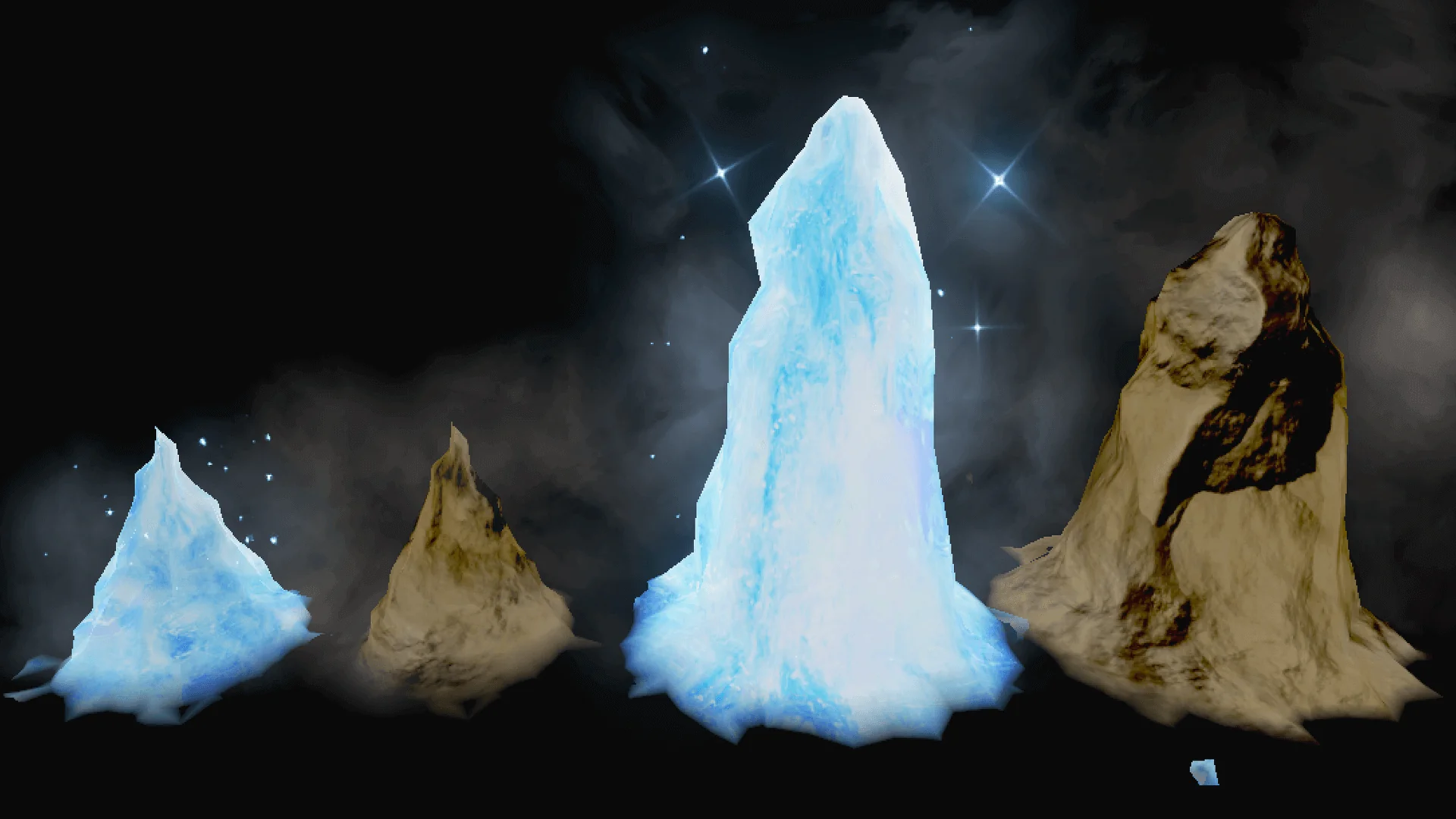
Rock effects emphasize mass, grounding, and physical rupture. Emitters simulating earth magic utilize dense, sharp-edged silhouettes and burst-oriented timing, creating the impression of solid stone breaking through the terrain or launching forward as heavy projectiles. These earth systems work well for ground pounds, projectile spikes, defensive barriers, and shatter impacts where weight is paramount.
Ice components shift focus toward sharp geometric crystals, sharp color gradients, and crystalline frost dispersal. Rather than relying entirely on fluid movement, ice emitters feature rigid expansion and freezing pulses, giving encounters an immediate sense of cold and immobilization. The contrasting sharp shards and softer misty vapor balance hard impacts against lingering environmental frost.
Wind effects bring rotational turbulence and rapid velocity vectors into the mix. Swirling vortices, air spirals, and slicing gusts provide visual coverage for kinetic magic, evasion maneuvers, or vortex-style crowd-control abilities. Because wind lacks the solid mass of earth or the distinct geometry of ice, these emitters utilize subtle luminance shifts, ribbon trails, and directional velocity patterns to trace the flow of air across the play area.
Thunder and lightning systems rely on sudden erratic strikes, extreme contrast, and brief, high-energy flashes. Unlike the continuous circulation of wind or the persistence of ice crystals, thunder emitters employ rapid strobe-like dissipation and branching arcs that slice through darkness. These high-voltage bursts serve heavy direct-damage strikes, counter-attacks, and electric status fields that demand the player's immediate attention.
Circle-based magic effects tie these disparate elements back to traditional spellcasting motifs. Incorporating ground sigils, concentric rings, and radiating boundaries, the circle assets establish precise boundaries for area-of-effect spells. Whether telegraphing an incoming strike from above or outlining a persistent hazard field, these circular elements give elemental bursts clear spatial framing inside the game environment.
Transitioning Architectures: Magic FX Across Cascade and Niagara
Unreal Engine has undergone an architectural transformation in its particle pipelines, shifting from the longstanding Cascade emitter framework to the programmable Niagara visual effects system. Advanced Magic FX 11 supports both sides of this divide, bridging legacy project structures with modern particle pipelines.
The collection was initially constructed within the Cascade framework, which organizes emitters into fixed procedural stacks. This classic setup remains immediately viable for ongoing productions rooted in earlier engine builds or pipelines that have maintained existing Cascade libraries. Emitters authored within this structure can be dropped directly into character blueprints, animation notifies, and sequence tracks without requiring architectural refactoring.
To align with newer engine pipelines, the package expanded to include a dedicated NiagaraFX version tailored for Unreal Engine 4.27 and newer revisions. Niagara introduces unified execution graphs, custom data interfaces, and parallel simulation capabilities, allowing particle systems to respond dynamically to scene parameters and character skeletons. Creators working across these systems can also utilize the Cascade to Niagara plugin when translating, updating, or maintaining particle data between the two modules.
Having access to both implementations grants flexibility to mid-production workflows. Projects maintaining an established Cascade baseline avoid the overhead of forced conversions, while teams running newer production builds can deploy the Niagara assets directly to take full advantage of current particle architecture.
Particle Level of Detail and Real-Time Performance
Complex spell effects with multiple overlapping emitters, ribbon trails, and volumetric bursts can quickly inflate frame times if left unchecked. A heavy visual effects pass that looks pristine in an isolated preview viewport can easily bottleneck performance when multiple characters cast elemental spells simultaneously inside an active combat scenario.
Advanced Magic FX 11 addresses rendering load through built-in particle LODs across its systems. Level of detail scaling ensures that the visual complexity of an emitter dynamically scales down as the camera distance increases. Nearby effects preserve every sub-emitter, ground decal, spark element, and mist layer for maximum fidelity, while distant instances strip away non-essential micro-particles and reduce overall spawn rates.
This automated optimization minimizes overdraw, which occurs when multiple transparent particle planes stack on top of one another and repeatedly shade the same screen pixels. By systematically dialing back emitter density and reducing texture fill requirements at distance, the included particle LODs help sustain stable frame rates during large-scale battles where multiple ice fields, thunder strikes, and earth eruptions overlap on screen.
Practical Asset Allocation in Combat Pipelines
Integrating third-party combat effects into an existing project requires evaluating both aesthetic consistency and technical adaptability. Because the package encompasses such a diverse array of elemental schools, it serves cleanly as a foundational VFX library for action role-playing games, arena brawlers, dungeon crawlers, and tactical strategy titles.
Animators and combat designers can tie distinct emitter states directly to animation notifies within montage assets. The sharp initiation frames of the lightning strikes can snap directly to weapon contact frames, while the lingering vapor of the ice magic or the settling dust of the rock bursts can play out across recovery animations. Because the circular ground effects are distinct, they can be spawned independently as telegraph indicators during enemy attack windups, warning players before the primary rock or thunder burst triggers.
Teams balancing legacy engine maintenance against forward-looking updates gain the specific advantage of dual-pipeline support. Whether bound to a stable Cascade environment or deployed into modern Niagara workflows from Unreal Engine 4.27 forward, the collection provides a structured, optimized suite of elemental combat effects ready for active production deployment.
 Spells & Combat
 Spells & Combat
 Spells & Combat