"b00678cacce53329"{"id":"1002763","slug":"advanced-magic-fx-09","title":"Advanced Magic FX 09","category":"Spells \u0026 Combat","engine":"4.12+,5.0+","assetVersion":"","engineVersion":"Engine Version: 4.12+,5.0+","tag":"Spells \u0026 Combat","accent":"blue","visual":"mech","summary":"Explore the 30 particle systems of Advanced Magic FX 09, featuring Niagara and Cascade support, particle LODs, Apex Destruction, and elemental magic.","platform":"Unreal Engine","indexPolicy":"index","publishedAt":"2026-11-20T06:41:21.476Z","updatedAt":"2026-11-20T06:41:21.476Z","sourceNotes":[],"fileContents":[],"compatibility":["Unreal Engine","Engine Version: 4.12+,5.0+"],"featuredImage":{"alt":"Advanced Magic FX 09","src":"/wp-content/uploads/published/2026/11/e21e9555784b-07644691-a5a9-40aa-ada9-d6c16e7e9241-39cb9055ed.webp"},"fileSizeBytes":113733411,"hasDownloadLink":true,"downloads":0,"terms":[{"taxonomy":"category","slug":"spells-and-combat","name":"Spells \u0026 Combat"}],"galleryImages":[{"src":"/wp-content/uploads/published/2026/11/1ee7050ccb6b-b5aedca7-505f-457f-bbea-17401fcefde4-8aa63714eb.webp","alt":"Advanced Magic FX 09"},{"src":"/wp-content/uploads/published/2026/11/925e065ebe23-1968382c-fb10-4e1a-ab0e-c84700531e69-e95d36e81f.webp","alt":"Advanced Magic FX 09"},{"src":"/wp-content/uploads/published/2026/11/a85bf6302698-d3c5af2e-7dc7-456d-a8ff-590300fbe6df-8d3ccf8df3.webp","alt":"Advanced Magic FX 09"},{"src":"/wp-content/uploads/published/2026/11/843fd36f1bd4-9aac4809-3ddc-4e24-a7b7-27c2941cadc4-03387a8550.webp","alt":"Advanced Magic FX 09"},{"src":"/wp-content/uploads/published/2026/11/38c7414ad4d4-a0b6e1d0-bf97-4c15-bc0f-ea4363cf66a9-3c48d3d5f5.webp","alt":"Advanced Magic FX 09"},{"src":"/wp-content/uploads/published/2026/11/0afc0a1261e0-0b2b57be-e941-436f-b129-91b857a10165-f5405043a8.webp","alt":"Advanced Magic FX 09"},{"src":"/wp-content/uploads/published/2026/11/3ec4420eb6fa-c63c4dda-594d-4386-a3a0-eb8c189035ed-e00044006b.webp","alt":"Advanced Magic FX 09"},{"src":"/wp-content/uploads/published/2026/11/de8db6358295-0c172dbd-0fc0-4660-a2f6-8dd3877a8fb9-250d765151.webp","alt":"Advanced Magic FX 09"}],"accessPanel":{"kind":"resource","title":"Get this resource","safetyNote":"Resources are manually reviewed before listing to improve quality and reduce obvious risks.","fileName":"Content.7z","resourceType":"Resource archive","versions":[]},"contentHtml":"\u003ch2\u003eVisual Typologies and Spell Motion in Advanced Magic FX 09\u003c/h2\u003e\n\u003cp\u003eSpells deployed in combat require distinct kinetic language so players can immediately recognize threat levels, casting directions, and elemental alignments. Advanced Magic FX 09 is structured around thirty individual particle systems that encompass a broad spectrum of combat motions, including directed shots, expanding bursts, focused beams, sweeping waves, and vertical rising energies. Each motion profile serves a deliberate tactical role within gameplay, allowing developers to craft an expansive arcane vocabulary from a unified collection.\u003c/p\u003e\n\u003cp\u003eLinear shot emitters function as the primary ranged projectiles in combat encounters. These systems carry high forward momentum, giving missile attacks clear trajectories before terminating on impact. Once a shot reaches its destination, burst-type particle systems handle the rapid dispersion of force outward from the point of contact. These burst effects generate sharp radial shockwaves that communicate kinetic power, whether applied as localized single-target impacts or wide-area spell detonations.\u003c/p\u003e\n\u003cp\u003eFor channeled spellcraft and continuous area control, beam and wave formations provide sustained visual clarity. Beams establish unbroken tethers between the caster and the target, offering clean visual tracking during continuous damage phases. Waves spread energy across horizontal planes, making them practical for ground-skimming sweeps, defensive perimeter clearing, or shockwave rings. Rising effects deliver the opposite vertical motion, pulling embers, arcane light, and mystical vapors upward from the floor to suggest subterranean eruptions, thermal updrafts, or persistent summoning zones.\u003c/p\u003e \u003ch2\u003eElemental Palettes: Fire, Ice, and Circle Geometries\u003c/h2\u003e\n\u003cp\u003eVisual magic gains clarity through unmistakable elemental themes. The thirty particle systems within the package cover distinct elemental behaviors, prominently featuring fire, flame, and ice motifs alongside pure geometric arcane constructs. These distinct visual identities allow for clear combat contrasts, distinguishing fast, high-temperature offensive abilities from rigid, crystallizing freeze spells.\u003c/p\u003e\n\u003cp\u003eFlame and fire effects utilize fluid, chaotic simulation properties that mimic natural combustion. Fiery bursts and rising embers produce warm, volatile silhouettes that convey ongoing burn damage, explosive pressure, or atmospheric ignition. When layered into combat arenas, these fiery systems create immediate spatial pressure by marking zones of lingering environmental heat.\u003c/p\u003e\n\u003cp\u003eIce effects provide a cold, structured counterpoint to the fluidity of fire. Frost-based systems emphasize angular shapes, freezing mists, and the sudden cessation of movement, giving physical substance to defensive barriers, freezing blasts, and chilling projectile strikes. Alongside natural elements, ritual circle formations introduce formal geometry to magical execution. Magic circles establish precise boundaries on the ground or in mid-air, framing casting animations, marking area-of-effect limits for incoming strikes, or signaling the activation of complex cooperative spells.\u003c/p\u003e \u003ch2\u003ePipeline Integration Across Cascade and Niagara Systems\u003c/h2\u003e\n\u003cp\u003eThe collection provides dual support across Unreal Engine particle pipelines, containing dedicated implementations for both the legacy Cascade editor and the modern Niagara visual effects framework. This architectural duality ensures that teams maintaining ongoing long-term productions on older engine versions can continue working without disruption, while teams building on modern platforms can leverage modern node-based emitter logic.\u003c/p\u003e\n\u003cp\u003eThe Niagara version was introduced starting in Unreal Engine 4.27 and extends forward into Unreal Engine 5. Niagara workflows grant technical artists access to advanced simulation controls, centralized parameter adjustments, and unified particle physics. This allows individual components of an effect—such as trailing sparks, main projectile bodies, and ground decals—to communicate seamlessly within a single system. Projects running Unreal Engine 5 can utilize these Niagara systems directly within modern rendering pipelines without needing conversion.\u003c/p\u003e\n\u003cp\u003eTo use the Niagara versions of these effects, developers must ensure that the Niagara plugin is active within project settings. If starting from an older configuration where Niagara is disabled by default, opening the plugin manager and activating the module unlocks the complete library of modernized systems for placement in levels, sequencing tracks, and gameplay blueprints.\u003c/p\u003e \u003ch2\u003eAdvanced Magic FX Plugin Setup and Apex Destruction Dependencies\u003c/h2\u003e\n\u003cp\u003eCertain dynamic effects within the collection interact directly with destructible world elements, bridging the gap between visual particle bursts and physical environment reactions. For projects running Unreal Engine versions from 4.18 through 4.27, specific Cascade effects utilize the Apex Destruction plugin to produce physical fracture and shatter behaviors alongside the primary particle simulation.\u003c/p\u003e\n\u003cp\u003eEnabling Apex Destruction requires a short setup sequence inside the engine. Within the editor interface, navigate to Edit, open Plugins, locate Apex Destruction, and toggle the plugin to enabled. After enabling the setting, restart the editor to load the underlying PhysX destruction libraries. Once initialized, the effects that depend on Apex Destruction can spawn fracture elements, sending physical debris flying outward alongside particle sparks and arcane smoke when spells detonate against surfaces.\u003c/p\u003e\n\u003cp\u003eThis integration of destruction mechanics transforms simple particle impacts into reactive environmental events. A heavy arcane burst does not merely flash light on a static surface; it shatters local collision geometry, reinforcing the perceived weight and lethality of advanced spell tiers.\u003c/p\u003e \u003ch2\u003eManaging Scene Performance with Particle Levels of Detail\u003c/h2\u003e\n\u003cp\u003eDense combat sequences featuring multiple simultaneous spellcasters can rapidly saturate the rendering pipeline with high-density overdraw and excessive particle counts. To maintain steady frame rates across variable gameplay situations, the effects in this collection include built-in particle Levels of Detail (LODs).\u003c/p\u003e\n\u003cp\u003eParticle LODs automatically adjust the density, complexity, and simulation overhead of individual emitters based on their screen space and camera distance. When a spell detonates adjacent to the player camera, the system renders at full visual fidelity, displaying dense ember fields, complex smoke sheets, and fine debris. As the distance between the camera and the spell emitter increases, lower LOD stages step in to reduce total particle counts, drop non-essential sub-emitters, and simplify shader evaluations.\u003c/p\u003e\n\u003cp\u003eThis distance-based scaling protects baseline rendering performance during massive encounters where dozens of burst, wave, and beam effects overlap on screen. Background combatants can unleash full offensive rotations involving circles, rising pillars, and elemental shots without incurring the full performance penalty of close-range cinematic effects, keeping frame times predictable across diverse PC and console targets.\u003c/p\u003e\n\n\u003ch2\u003eContinue Browsing Similar Packs\u003c/h2\u003e\n\u003cul\u003e\n\u003cli\u003e\u003ca href=\"https://3dcghub.com/advanced-magic-fx-07/\" rel=\"noopener noreferrer\"\u003eAdvanced Magic FX 07\u003c/a\u003e\u003c/li\u003e\n\u003cli\u003e\u003ca href=\"https://3dcghub.com/advanced-magic-fx-13/\" rel=\"noopener noreferrer\"\u003eAdvanced Magic FX 13\u003c/a\u003e\u003c/li\u003e\n\u003cli\u003e\u003ca href=\"https://3dcghub.com/advanced-magic-fx-12/\" rel=\"noopener noreferrer\"\u003eAdvanced Magic FX 12\u003c/a\u003e\u003c/li\u003e\n\u003cli\u003e\u003ca href=\"https://3dcghub.com/sky-open-vfx/\" rel=\"noopener noreferrer\"\u003eSky Open VFX\u003c/a\u003e\u003c/li\u003e\n\u003cli\u003e\u003ca href=\"https://3dcghub.com/ice-magic-spells-niagara-fx/\" rel=\"noopener noreferrer\"\u003eIce Magic Spells Niagara FX\u003c/a\u003e\u003c/li\u003e\n\u003c/ul\u003e","contentTextLength":7301,"navigation":{"current":117,"total":4797,"previous":{"id":"1002764","slug":"advanced-magic-fx-10","title":"Advanced Magic FX 10","category":"Spells \u0026 Combat","platform":"Unreal Engine","updatedAt":"2026-11-20T06:42:37.005Z"},"next":{"id":"1002762","slug":"advanced-magic-fx-08","title":"Advanced Magic FX 08","category":"Spells \u0026 Combat","platform":"Unreal Engine","updatedAt":"2026-11-20T06:40:32.610Z"}},"relatedResources":[{"id":"1002869","slug":"advanced-magic-fx-14","title":"Advanced Magic FX 14","category":"Spells \u0026 Combat","engine":"4.26+,5.0+","assetVersion":"","engineVersion":"Engine Version: 4.26+,5.0+","tag":"Spells \u0026 Combat","accent":"blue","visual":"mech","summary":"Explore Advanced Magic FX 14, featuring Niagara and Cascade magic spells, elemental fire vortexes, lasers, healing, lightning, and built-in particle LODs.","platform":"Unreal Engine","indexPolicy":"index","publishedAt":"2026-11-20T16:32:06.460Z","updatedAt":"2026-11-20T16:32:06.460Z","sourceNotes":[],"fileContents":[],"compatibility":["Unreal Engine","Engine Version: 4.26+,5.0+"],"featuredImage":{"alt":"Advanced Magic FX 14","src":"/wp-content/uploads/published/2026/11/33641332d289-27e981bf-72b2-4c5e-86dc-4b4d536e5221-8a43b3a7ca.webp"},"fileSizeBytes":112659794,"hasDownloadLink":true,"downloads":0},{"id":"1002796","slug":"ky-magic-chant-fx","title":"KY Magic Chant FX","category":"Spells \u0026 Combat","engine":"4.12+,5.0+","assetVersion":"","engineVersion":"Engine Version: 4.12+,5.0+","tag":"Spells \u0026 Combat","accent":"blue","visual":"mech","summary":"A detailed technical breakdown of KY Magic Chant FX, featuring 33 magic chant circle effects across Niagara and Cascade pipelines.","platform":"Unreal Engine","indexPolicy":"index","publishedAt":"2026-11-20T07:20:53.760Z","updatedAt":"2026-11-20T07:20:53.760Z","sourceNotes":[],"fileContents":[],"compatibility":["Unreal Engine","Engine Version: 4.12+,5.0+"],"featuredImage":{"alt":"KY Magic Chant FX","src":"/wp-content/uploads/published/2026/11/a9c693298b3d-459e9b4f-a1e9-427b-a42e-788f325a9537-a725cd44e2.webp"},"fileSizeBytes":54725656,"hasDownloadLink":true,"downloads":0},{"id":"1002795","slug":"ky-barrier-shield-fx","title":"KY Barrier Shield FX","category":"Spells \u0026 Combat","engine":"4.12+,5.0+","assetVersion":"","engineVersion":"Engine Version: 4.12+,5.0+","tag":"Spells \u0026 Combat","accent":"blue","visual":"mech","summary":"An analysis of KY Barrier Shield FX, featuring 23 magic barrier and shield effects across Cascade and Niagara systems for Unreal Engine 4.27 and beyond.","platform":"Unreal Engine","indexPolicy":"index","publishedAt":"2026-11-20T07:20:16.091Z","updatedAt":"2026-11-20T07:20:16.091Z","sourceNotes":[],"fileContents":[],"compatibility":["Unreal Engine","Engine Version: 4.12+,5.0+"],"featuredImage":{"alt":"KY Barrier Shield FX","src":"/wp-content/uploads/published/2026/11/8eec687c10a4-4676e615-caf5-46c3-98b5-7c22b166dcb3-250a86cf35.webp"},"fileSizeBytes":63393790,"hasDownloadLink":true,"downloads":0}]}
Resource screenshots
1 / 8
Join our channel
Follow 3DCGHUB on Telegram for new resource drops, migration updates, and community notices.
Visual Typologies and Spell Motion in Advanced Magic FX 09
Spells deployed in combat require distinct kinetic language so players can immediately recognize threat levels, casting directions, and elemental alignments. Advanced Magic FX 09 is structured around thirty individual particle systems that encompass a broad spectrum of combat motions, including directed shots, expanding bursts, focused beams, sweeping waves, and vertical rising energies. Each motion profile serves a deliberate tactical role within gameplay, allowing developers to craft an expansive arcane vocabulary from a unified collection.
Linear shot emitters function as the primary ranged projectiles in combat encounters. These systems carry high forward momentum, giving missile attacks clear trajectories before terminating on impact. Once a shot reaches its destination, burst-type particle systems handle the rapid dispersion of force outward from the point of contact. These burst effects generate sharp radial shockwaves that communicate kinetic power, whether applied as localized single-target impacts or wide-area spell detonations.
For channeled spellcraft and continuous area control, beam and wave formations provide sustained visual clarity. Beams establish unbroken tethers between the caster and the target, offering clean visual tracking during continuous damage phases. Waves spread energy across horizontal planes, making them practical for ground-skimming sweeps, defensive perimeter clearing, or shockwave rings. Rising effects deliver the opposite vertical motion, pulling embers, arcane light, and mystical vapors upward from the floor to suggest subterranean eruptions, thermal updrafts, or persistent summoning zones.
Elemental Palettes: Fire, Ice, and Circle Geometries
Visual magic gains clarity through unmistakable elemental themes. The thirty particle systems within the package cover distinct elemental behaviors, prominently featuring fire, flame, and ice motifs alongside pure geometric arcane constructs. These distinct visual identities allow for clear combat contrasts, distinguishing fast, high-temperature offensive abilities from rigid, crystallizing freeze spells.
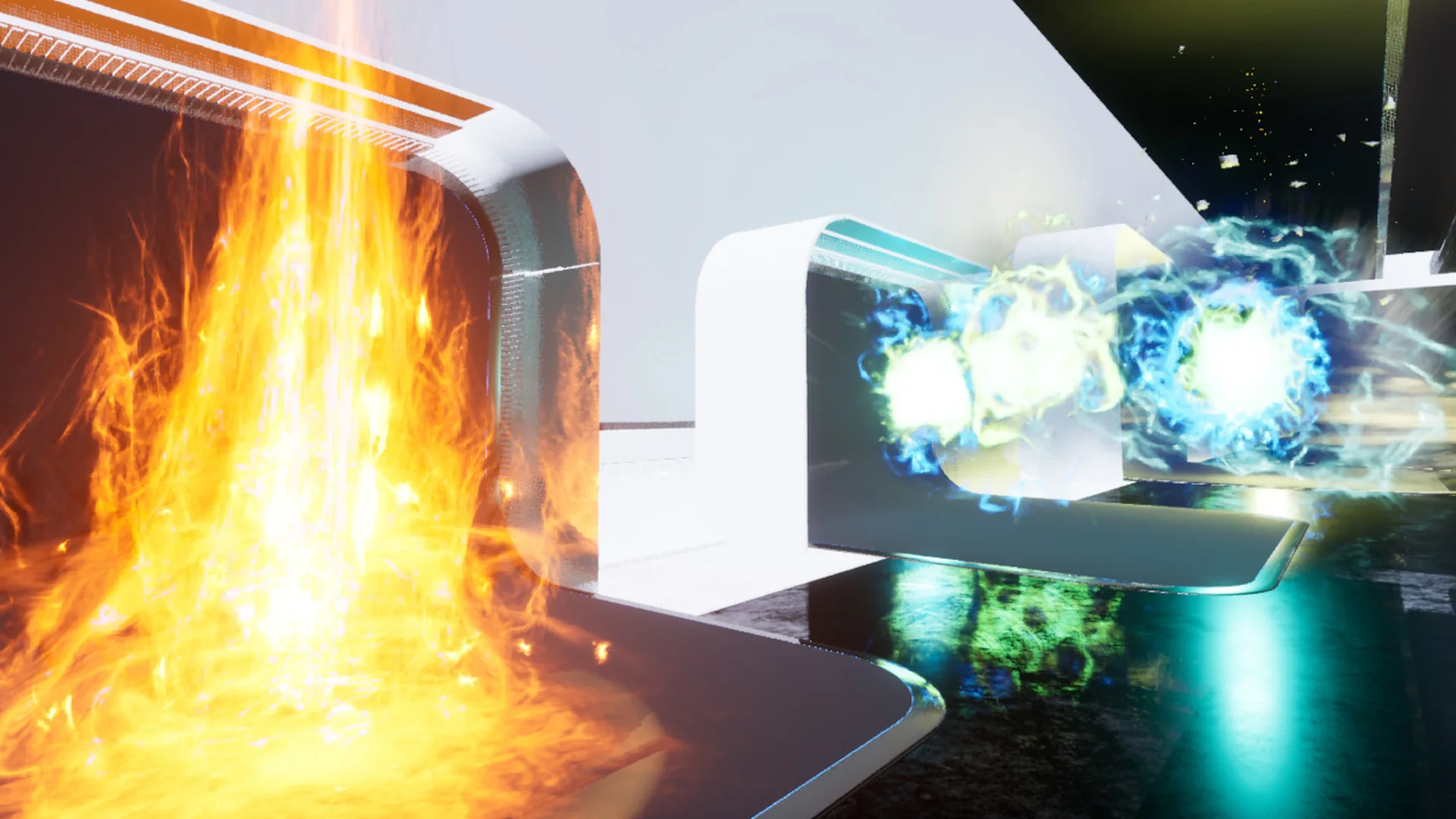
Flame and fire effects utilize fluid, chaotic simulation properties that mimic natural combustion. Fiery bursts and rising embers produce warm, volatile silhouettes that convey ongoing burn damage, explosive pressure, or atmospheric ignition. When layered into combat arenas, these fiery systems create immediate spatial pressure by marking zones of lingering environmental heat.
Ice effects provide a cold, structured counterpoint to the fluidity of fire. Frost-based systems emphasize angular shapes, freezing mists, and the sudden cessation of movement, giving physical substance to defensive barriers, freezing blasts, and chilling projectile strikes. Alongside natural elements, ritual circle formations introduce formal geometry to magical execution. Magic circles establish precise boundaries on the ground or in mid-air, framing casting animations, marking area-of-effect limits for incoming strikes, or signaling the activation of complex cooperative spells.
Pipeline Integration Across Cascade and Niagara Systems
The collection provides dual support across Unreal Engine particle pipelines, containing dedicated implementations for both the legacy Cascade editor and the modern Niagara visual effects framework. This architectural duality ensures that teams maintaining ongoing long-term productions on older engine versions can continue working without disruption, while teams building on modern platforms can leverage modern node-based emitter logic.
The Niagara version was introduced starting in Unreal Engine 4.27 and extends forward into Unreal Engine 5. Niagara workflows grant technical artists access to advanced simulation controls, centralized parameter adjustments, and unified particle physics. This allows individual components of an effect—such as trailing sparks, main projectile bodies, and ground decals—to communicate seamlessly within a single system. Projects running Unreal Engine 5 can utilize these Niagara systems directly within modern rendering pipelines without needing conversion.
To use the Niagara versions of these effects, developers must ensure that the Niagara plugin is active within project settings. If starting from an older configuration where Niagara is disabled by default, opening the plugin manager and activating the module unlocks the complete library of modernized systems for placement in levels, sequencing tracks, and gameplay blueprints.
Advanced Magic FX Plugin Setup and Apex Destruction Dependencies
Certain dynamic effects within the collection interact directly with destructible world elements, bridging the gap between visual particle bursts and physical environment reactions. For projects running Unreal Engine versions from 4.18 through 4.27, specific Cascade effects utilize the Apex Destruction plugin to produce physical fracture and shatter behaviors alongside the primary particle simulation.
Enabling Apex Destruction requires a short setup sequence inside the engine. Within the editor interface, navigate to Edit, open Plugins, locate Apex Destruction, and toggle the plugin to enabled. After enabling the setting, restart the editor to load the underlying PhysX destruction libraries. Once initialized, the effects that depend on Apex Destruction can spawn fracture elements, sending physical debris flying outward alongside particle sparks and arcane smoke when spells detonate against surfaces.
This integration of destruction mechanics transforms simple particle impacts into reactive environmental events. A heavy arcane burst does not merely flash light on a static surface; it shatters local collision geometry, reinforcing the perceived weight and lethality of advanced spell tiers.
Managing Scene Performance with Particle Levels of Detail
Dense combat sequences featuring multiple simultaneous spellcasters can rapidly saturate the rendering pipeline with high-density overdraw and excessive particle counts. To maintain steady frame rates across variable gameplay situations, the effects in this collection include built-in particle Levels of Detail (LODs).
Particle LODs automatically adjust the density, complexity, and simulation overhead of individual emitters based on their screen space and camera distance. When a spell detonates adjacent to the player camera, the system renders at full visual fidelity, displaying dense ember fields, complex smoke sheets, and fine debris. As the distance between the camera and the spell emitter increases, lower LOD stages step in to reduce total particle counts, drop non-essential sub-emitters, and simplify shader evaluations.
This distance-based scaling protects baseline rendering performance during massive encounters where dozens of burst, wave, and beam effects overlap on screen. Background combatants can unleash full offensive rotations involving circles, rising pillars, and elemental shots without incurring the full performance penalty of close-range cinematic effects, keeping frame times predictable across diverse PC and console targets.
 Spells & Combat
 Spells & Combat
 Spells & Combat