"1f00f67f9253451b"{"id":"1001276","slug":"http-requests-for-blueprints","title":"HTTP Requests for Blueprints","category":"Network \u0026 Multiplayer","engine":"4.27 - 5.7","assetVersion":"Asset Version: 4.0 - 5.0","engineVersion":"Engine Version: 4.27 - 5.7","tag":"Network","accent":"blue","visual":"mech","summary":"A single-node solution for HTTP requests in Blueprints, supporting REST operations like Post, Patch, Update, and Firebase Blueprint Plugin Library workflows.","platform":"Unreal Engine","publishedAt":"2026-09-30T06:08:29.849Z","updatedAt":"2026-09-30T06:08:29.849Z","sourceNotes":[],"fileContents":[],"compatibility":["Unreal Engine","Asset Version: 4.0 - 5.0","Engine Version: 4.27 - 5.7"],"featuredImage":{"alt":"HTTP Requests for Blueprints","src":"/wp-content/uploads/published/2026/09/478970c6959b-1b247fe7-cecd-4a38-9746-ea940704ae37-4d097fc191.webp"},"hasDownloadLink":true,"downloads":0,"terms":[{"taxonomy":"category","slug":"network-and-multiplayer-tools-and-plugins","name":"Network \u0026 Multiplayer"}],"galleryImages":[{"src":"/wp-content/uploads/published/2026/09/c450a1d09538-fdc87d8b-e13b-474f-b2ac-76b4f604d8f0-62ec5d2fcf.webp","alt":"HTTP Requests for Blueprints"},{"src":"/wp-content/uploads/published/2026/09/65d6b9de9416-86dfd277-44d6-49ae-aad0-d6e2e36ac4dc-0d9389e426.webp","alt":"HTTP Requests for Blueprints"},{"src":"/wp-content/uploads/published/2026/09/f4a71ab5e1cb-9ba77947-c281-424c-9b49-593efad69ee5-d1a8a2f07b.webp","alt":"HTTP Requests for Blueprints"},{"src":"/wp-content/uploads/published/2026/09/23dfab167a76-e02ef8c7-73d8-4c3e-aea3-888bdac1e2b3-68fa7b5017.webp","alt":"HTTP Requests for Blueprints"}],"accessPanel":{"kind":"resource","title":"Download this resource","eyebrow":"Free Download","message":"Log in or create a free account to start your download.","fileName":"HTTP Requests for Blueprints.7z","safetyNote":"Resources are manually reviewed before listing to improve quality and reduce obvious risks.","actionLabel":"Download Free","resourceType":"Resource archive"},"contentHtml":"\u003ch2\u003eSimplifying HTTP Requests for Blueprints into a Single Node\u003c/h2\u003e\u003cp\u003eCommunicating with remote servers inside Unreal Engine visual scripting often introduces complex node graphs. Routine web queries can clutter graph workspaces with disparate setup pins, header configurations, and fragmented callback routines.\u003c/p\u003e\u003cp\u003eHTTP Requests for Blueprints tackles this structural friction directly. The core design aims to condense the standard web transaction lifecycle into a single node. Consolidating the request triggers, target endpoints, and return parsing into an individual execution point keeps blueprint graphs legible while maintaining reliable web connectivity. Instead of threading multiple latent events and object bindings across the graph, developers can trigger an HTTP call from one central node and directly consume the output data within their gameplay or application logic.\u003c/p\u003e\u003ch2\u003eREST Methods: Post, Patch, Update, and Push Operations\u003c/h2\u003e\u003cp\u003eModern web infrastructure relies heavily on Representational State Transfer (REST) protocols to manage database records, cloud saves, and server-side operations. This plugin targets those standards by covering fundamental web methods including Post, Patch, Update, and Push.\u003c/p\u003e\u003cp\u003eEach of these operations serves a distinct role in online interactions. Post commands allow the client graph to generate new data payloads on an external server, such as logging a new match result, creating user credentials, or submitting leaderboard scores. Patch actions accommodate targeted updates, modifying specific data fields on a remote entity without requiring the entire object to be resent over the wire. Similarly, update and push capabilities provide structured ways to sync local game states with persistent online instances. Gathering these distinct request modes into unified blueprint nodes allows developers to interact with custom backend APIs or external web platforms using standard REST architecture patterns without custom C++ boilerplate.\u003c/p\u003e\u003ch2\u003eWorking Alongside the Firebase Blueprint Plugin Library\u003c/h2\u003e\u003cp\u003eCompatibility with broader cloud environments is an important factor when planning game backends. HTTP Requests for Blueprints is identified as compatible with the Firebase Blueprint Plugin Library, opening a practical bridge to established cloud database patterns.\u003c/p\u003e\u003cp\u003eFirebase-driven architectures typically depend on constant, lightweight communication to verify authorization tokens, write document records, or retrieve remote configurations. Because this plugin operates within the same ecosystem as the Firebase Blueprint Plugin Library, developers can pair custom HTTP calls alongside specialized Firebase tasks. An interactive project might query a dedicated cloud function via an HTTP Post, modify real-time database elements through an Update call, and rely on the companion Firebase library to validate the broader application layer. This operational overlap eliminates the need to rely exclusively on distinct SDK integrations for simple online tasks.\u003c/p\u003e\u003ch2\u003eStreamlining Visual Script Architecture\u003c/h2\u003e\u003cp\u003eComplex visual scripts frequently suffer from performance and readability bottlenecks when network logic expands across several UI widgets, gamemodes, and player controllers. Sprawling execution wires make debugging network issues difficult, especially when tracking failed responses or dropped connection states.\u003c/p\u003e\u003cp\u003eRestructuring external calls into a single-node format radically changes the layout of a project event graph. Input parameters such as the endpoint address, method selection, and payload can be provided directly at the source pin, while response statuses and output payloads branch cleanly from the execution outputs. This compact footprint allows network-heavy components—such as matchmaking panels, remote profile viewers, or live in-game inventory monitors—to maintain self-contained, modular logic. If an endpoint payload schema updates, changes remain localized to the single node rather than rippling across complex event chains.\u003c/p\u003e\u003ch2\u003eImplementation Through Video Tutorial Documentation\u003c/h2\u003e\u003cp\u003eAdopting any networking tool requires understanding its node inputs, parameter expectations, and output structure. The developer provides video tutorial documentation to guide users through the initial integration and practical execution of these network calls.\u003c/p\u003e\u003cp\u003eVideo-based guidance offers a visual breakdown of how the node interacts with incoming string data, handles payload formats, and connects within typical Blueprint graphs. Watching the node operate inside real engine editor environments helps developers quickly identify how to wire REST commands, inspect outbound and inbound traffic, and verify connections against online endpoints. This direct walkthrough reduces setup troubleshooting when integrating web calls into live projects.\u003c/p\u003e\u003ch2\u003eProduction Takeaway\u003c/h2\u003e\u003cp\u003eHTTP Requests for Blueprints fills a distinct operational role for teams seeking straightforward web integration without heavy programming overhead. By unifying REST actions—including Post, Patch, Update, and Push—into single-node executions and pairing cleanly with the Firebase Blueprint Plugin Library, it provides a lightweight pipeline for external web communication directly from visual scripts.\u003c/p\u003e\n\n\u003ch2\u003eMore From The Same Workflow\u003c/h2\u003e\n\u003cul\u003e\n\u003cli\u003e\u003ca href=\"https://3dcghub.com/blueprint-web-communication-helper-http-websocket/\" title=\"[Blueprint] Web Communication Helper (Http / Websocket)\"\u003e[Blueprint] Web Communication Helper (Http / Websocket)\u003c/a\u003e\u003c/li\u003e\n\u003cli\u003e\u003ca href=\"https://3dcghub.com/quest-editor-plugin/\" title=\"Quest Editor Plugin\"\u003eQuest Editor Plugin\u003c/a\u003e\u003c/li\u003e\n\u003cli\u003e\u003ca href=\"https://3dcghub.com/http-and-json/\" title=\"HTTP AND JSON\"\u003eHTTP AND JSON\u003c/a\u003e\u003c/li\u003e\n\u003cli\u003e\u003ca href=\"https://3dcghub.com/mysql-and-mariadb-integration/\" title=\"MySQL and MariaDB Integration\"\u003eMySQL and MariaDB Integration\u003c/a\u003e\u003c/li\u003e\n\u003cli\u003e\u003ca href=\"https://3dcghub.com/le-http-request/\" title=\"LE Http Request\"\u003eLE Http Request\u003c/a\u003e\u003c/li\u003e\n\u003c/ul\u003e","contentTextLength":5356,"navigation":{"current":5,"total":3222,"previous":{"id":"1001277","slug":"http-request","title":"Http Request","category":"Network \u0026 Multiplayer","platform":"Unreal Engine","updatedAt":"2026-09-30T06:10:41.021Z"},"next":{"id":"1001275","slug":"android-win-offline-speech-recognition","title":"Android Win Offline Speech Recognition","category":"Gameplay Features","platform":"Unreal Engine","updatedAt":"2026-09-30T06:05:42.538Z"}},"relatedResources":[{"id":"1001277","slug":"http-request","title":"Http Request","category":"Network \u0026 Multiplayer","engine":"4.27 - 5.8","assetVersion":"Asset Version: 1.1","engineVersion":"Engine Version: 4.27 - 5.8","tag":"Network","accent":"blue","visual":"mech","summary":"Implement HTTP request sending with GET, POST, PUT, and DELETE methods across JSON, XML, and form-urlencoded content types, compatible with Mqtt Client.","platform":"Unreal Engine","publishedAt":"2026-09-30T06:10:41.021Z","updatedAt":"2026-09-30T06:10:41.021Z","sourceNotes":[],"fileContents":[],"compatibility":["Unreal Engine","Asset Version: 1.1","Engine Version: 4.27 - 5.8"],"featuredImage":{"alt":"Http Request","src":"/wp-content/uploads/published/2026/09/45d2746b540e-4fbda408-4442-4c3f-8b23-18cb993992e5-cd6e3c4b58.webp"},"hasDownloadLink":true,"downloads":0},{"id":"15174","slug":"blueprint-web-communication-helper-http-websocket","title":"[Blueprint] Web Communication Helper (Http / Websocket)","category":"Network \u0026 Multiplayer","engine":"4.26 - 4.27,5.0 - 5.4","assetVersion":"Engine version: 4.26 - 4.27,5.0 - 5.4","engineVersion":"Asset Version:2.0.4 - 2.1.4","tag":"Network","accent":"blue","visual":"animation","summary":"Enhance your project's networking capabilities with the [Blueprint] Web Communication Helper (Http / Websocket). This plugin offers easy-to-use functions for HTTP requests, secure websockets, and real-time data tracking.","platform":"Unreal Engine","publishedAt":"2026-03-12T08:10:27.000Z","updatedAt":"2026-04-19T15:44:53.000Z","sourceNotes":[],"fileContents":[],"compatibility":["Unreal Engine","Engine version: 4.26 - 4.27,5.0 - 5.4","Asset Version: 2.0.4 - 2.1.4"],"featuredImage":{"alt":"[Blueprint] Web Communication Helper (Http / Websocket)","src":"https://3dcghub.com/wp-content/uploads/2026/03/29dcf012-1c98-414b-8994-1d16b2f0978c.webp"},"hasDownloadLink":true,"downloads":0},{"id":"15157","slug":"quest-editor-plugin","title":"Quest Editor Plugin","category":"Network \u0026 Multiplayer","engine":"4.25 - 5.7","assetVersion":"Asset Version:8.0 - 10.14","engineVersion":"Engine version: 4.25 - 5.7","tag":"Network","accent":"blue","visual":"audio","summary":"Enhance your game development workflow with the Quest Editor Plugin. This modular system allows for customizable quests and dialogue with full multiplayer support for various project types.","platform":"Unreal Engine","publishedAt":"2026-03-12T08:06:14.000Z","updatedAt":"2026-09-30T04:38:07.422Z","sourceNotes":[],"fileContents":[],"compatibility":["Unreal Engine","Asset Version:8.0 - 10.14","Engine version: 4.25 - 5.7"],"featuredImage":{"alt":"Quest Editor Plugin","src":"https://3dcghub.com/wp-content/uploads/2026/03/8ecd90ae-2d23-4d68-850e-88eeca768f45.webp"},"hasDownloadLink":true,"downloads":0}]}
Network
HTTP Requests for Blueprints
A single-node solution for HTTP requests in Blueprints, supporting REST operations like Post, Patch, Update, and Firebase Blueprint Plugin Library workflows.
Simplifying HTTP Requests for Blueprints into a Single Node
Communicating with remote servers inside Unreal Engine visual scripting often introduces complex node graphs. Routine web queries can clutter graph workspaces with disparate setup pins, header configurations, and fragmented callback routines.
HTTP Requests for Blueprints tackles this structural friction directly. The core design aims to condense the standard web transaction lifecycle into a single node. Consolidating the request triggers, target endpoints, and return parsing into an individual execution point keeps blueprint graphs legible while maintaining reliable web connectivity. Instead of threading multiple latent events and object bindings across the graph, developers can trigger an HTTP call from one central node and directly consume the output data within their gameplay or application logic.
REST Methods: Post, Patch, Update, and Push Operations
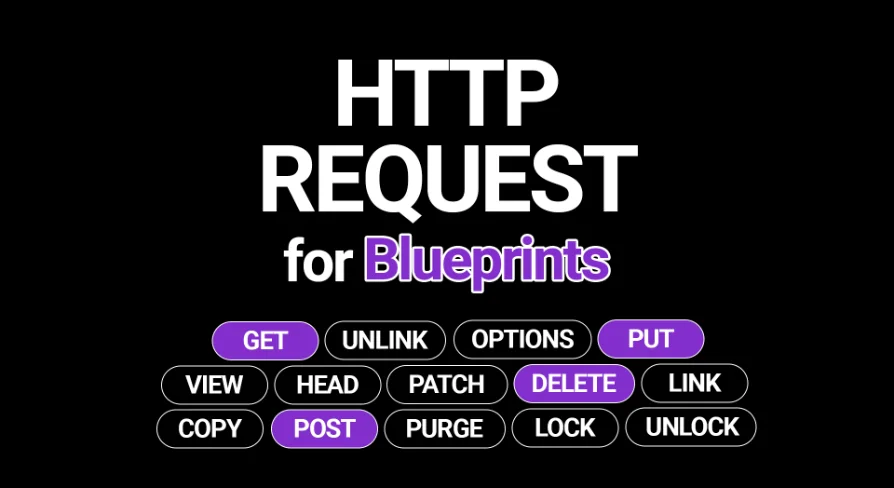
Modern web infrastructure relies heavily on Representational State Transfer (REST) protocols to manage database records, cloud saves, and server-side operations. This plugin targets those standards by covering fundamental web methods including Post, Patch, Update, and Push.
Each of these operations serves a distinct role in online interactions. Post commands allow the client graph to generate new data payloads on an external server, such as logging a new match result, creating user credentials, or submitting leaderboard scores. Patch actions accommodate targeted updates, modifying specific data fields on a remote entity without requiring the entire object to be resent over the wire. Similarly, update and push capabilities provide structured ways to sync local game states with persistent online instances. Gathering these distinct request modes into unified blueprint nodes allows developers to interact with custom backend APIs or external web platforms using standard REST architecture patterns without custom C++ boilerplate.
Working Alongside the Firebase Blueprint Plugin Library
Compatibility with broader cloud environments is an important factor when planning game backends. HTTP Requests for Blueprints is identified as compatible with the Firebase Blueprint Plugin Library, opening a practical bridge to established cloud database patterns.
Firebase-driven architectures typically depend on constant, lightweight communication to verify authorization tokens, write document records, or retrieve remote configurations. Because this plugin operates within the same ecosystem as the Firebase Blueprint Plugin Library, developers can pair custom HTTP calls alongside specialized Firebase tasks. An interactive project might query a dedicated cloud function via an HTTP Post, modify real-time database elements through an Update call, and rely on the companion Firebase library to validate the broader application layer. This operational overlap eliminates the need to rely exclusively on distinct SDK integrations for simple online tasks.
Streamlining Visual Script Architecture
Complex visual scripts frequently suffer from performance and readability bottlenecks when network logic expands across several UI widgets, gamemodes, and player controllers. Sprawling execution wires make debugging network issues difficult, especially when tracking failed responses or dropped connection states.
Restructuring external calls into a single-node format radically changes the layout of a project event graph. Input parameters such as the endpoint address, method selection, and payload can be provided directly at the source pin, while response statuses and output payloads branch cleanly from the execution outputs. This compact footprint allows network-heavy components—such as matchmaking panels, remote profile viewers, or live in-game inventory monitors—to maintain self-contained, modular logic. If an endpoint payload schema updates, changes remain localized to the single node rather than rippling across complex event chains.
Implementation Through Video Tutorial Documentation
Adopting any networking tool requires understanding its node inputs, parameter expectations, and output structure. The developer provides video tutorial documentation to guide users through the initial integration and practical execution of these network calls.
Video-based guidance offers a visual breakdown of how the node interacts with incoming string data, handles payload formats, and connects within typical Blueprint graphs. Watching the node operate inside real engine editor environments helps developers quickly identify how to wire REST commands, inspect outbound and inbound traffic, and verify connections against online endpoints. This direct walkthrough reduces setup troubleshooting when integrating web calls into live projects.
Production Takeaway
HTTP Requests for Blueprints fills a distinct operational role for teams seeking straightforward web integration without heavy programming overhead. By unifying REST actions—including Post, Patch, Update, and Push—into single-node executions and pairing cleanly with the Firebase Blueprint Plugin Library, it provides a lightweight pipeline for external web communication directly from visual scripts.
 Network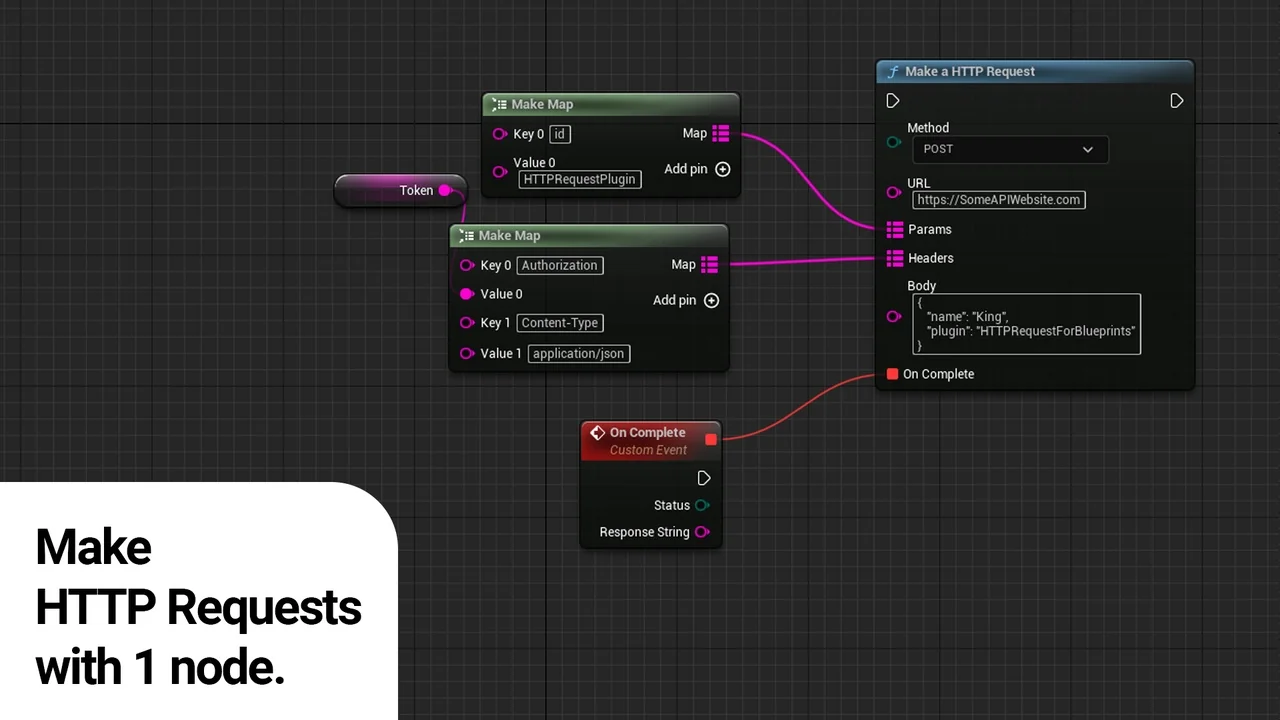
 Network
![[Blueprint] Web Communication Helper (Http / Websocket)](/_img/360/wp-content/uploads/2026/03/29dcf012-1c98-414b-8994-1d16b2f0978c.webp) Network
Network Network