"a338a1d501976271"{"id":"1001344","slug":"fish-for-fish-school-system","title":"Fish for Fish School System","category":"Animals","engine":"4.15+,5.0+","assetVersion":"","engineVersion":"Engine Version: 4.15+,5.0+","tag":"Animals","accent":"blue","visual":"mech","summary":"Add 12 fish species to your underwater scenes with Fish for Fish School System, featuring shared skeletons, LODs, and vertex-animated meshes.","platform":"Unreal Engine","publishedAt":"2026-10-04T10:08:32.373Z","updatedAt":"2026-10-04T10:08:32.373Z","sourceNotes":[],"fileContents":[],"compatibility":["Unreal Engine","Engine Version: 4.15+,5.0+"],"featuredImage":{"alt":"Fish for Fish School System","src":"/wp-content/uploads/published/2026/10/36496abcb187-d2fdfdba-52ea-413f-9d5b-4a0fbe3dcfcc-347d6a23b7.webp"},"hasDownloadLink":true,"downloads":0,"terms":[{"taxonomy":"category","slug":"animals","name":"Animals"}],"galleryImages":[{"src":"/wp-content/uploads/published/2026/10/2c511e879dcd-56756fef-4ebf-4be9-8c78-3b6c44bf054b-93c40dc75d.webp","alt":"Fish for Fish School System"},{"src":"/wp-content/uploads/published/2026/10/ef3ab1f6b291-bbbd8278-5c33-46a8-8bbe-08c4d19c466f-c354c5c68f.webp","alt":"Fish for Fish School System"},{"src":"/wp-content/uploads/published/2026/10/88ebae95b6cd-572b585b-ed08-4db2-aadd-8b4b71637df1-a1516dbd94.webp","alt":"Fish for Fish School System"},{"src":"/wp-content/uploads/published/2026/10/9405fb75d3d8-d5913129-179b-4de3-9bd8-7cdb91f09dae-b94b54c7b6.webp","alt":"Fish for Fish School System"},{"src":"/wp-content/uploads/published/2026/10/b950760ec93d-236322c7-5c9a-44f0-a022-37ac419a103a-bda8ab89b7.webp","alt":"Fish for Fish School System"},{"src":"/wp-content/uploads/published/2026/10/fdb2c0610d16-4ae58158-bb2b-4682-8f05-d7bb60344b34-d5976b9633.webp","alt":"Fish for Fish School System"},{"src":"/wp-content/uploads/published/2026/10/2fcbf2b49dd7-150a2136-108c-4fd3-ab4a-7e41995d7818-57cf3a6c83.webp","alt":"Fish for Fish School System"},{"src":"/wp-content/uploads/published/2026/10/d8ad47625007-3f66f46e-dd5c-49c4-8e2e-438a205df941-f6c3d8bfa8.webp","alt":"Fish for Fish School System"},{"src":"/wp-content/uploads/published/2026/10/6cc31ef4c276-b304911a-93d5-48aa-9459-36c8dfb1ab9b-2cdc18bb8b.webp","alt":"Fish for Fish School System"},{"src":"/wp-content/uploads/published/2026/10/987f6a9e5a02-b9f36445-c75f-4657-86e6-b3b5799690ee-770ac41f75.webp","alt":"Fish for Fish School System"}],"accessPanel":{"kind":"resource","title":"Download this resource","eyebrow":"Free Download","message":"Log in or create a free account to start your download.","fileName":"Content.7z","safetyNote":"Resources are manually reviewed before listing to improve quality and reduce obvious risks.","actionLabel":"Download Free","resourceType":"Resource archive"},"contentHtml":"\u003ch2\u003eIntegrating with Fish School System V1 and V2 via MF_LowPoly_VertexAnimation\u003c/h2\u003e\n\u003cp\u003eDeploying this package starts with determining how movement will be handled in the scene. Designed as a downloadable content asset, it acts as a direct companion to both Fish School System and Fish School System V2, while retaining the capacity to operate completely independently. When utilized alongside schooling blueprints, the asset relies heavily on vertex animation rather than CPU-bound skeletal updates for vast shoals.\u003c/p\u003e\n\u003cp\u003eOut of the box, the vertex animation pipeline is preconfigured to link directly with Fish School System V2. Connecting these assets to the older Fish School System V1 requires a single material-level adjustment. Developers must open the material function designated as \u003ccode\u003eMF_LowPoly_VertexAnimation\u003c/code\u003e Within the project structure. Inside this function graph lies a static switch parameter named \u003ccode\u003eFishSchoolSystemV2\u003c/code\u003e. Clearing or unchecking this switch toggles the underlying math to read data formatted for the initial iteration of the school system, restoring behavioral alignment without rewriting shading logic or modifying the geometry.\u003c/p\u003e \u003ch2\u003eShared Skeleton Structure and Standalone Skeletal Meshes\u003c/h2\u003e\n\u003cp\u003eBeyond massive flocking behaviors driven by materials, every fish in the package is equipped to function as an independent actor. Each creature provides three distinct core asset representations: a Vertex Animated Static Mesh, a Skeletal Mesh, and a dedicated Physics Asset. This dual representation lets developers pick between high-performance vertex-driven static meshes for distant background shoals and fully articulated skeletal meshes for hero encounters, physics interactions, or custom AI controllers.\u003c/p\u003e\n\u003cp\u003eA central technical advantage across the entire roster is the unified rigging scheme. All fish share the exact same Skeleton asset. By avoiding proprietary bone hierarchies for individual aquatic species, the shared skeleton removes the overhead of maintaining divergent animation graphs. A swim cycle, turn additive, or flinch motion mapped to this unified hierarchy can instantly drive any fish in the collection, drastically reducing the time required to set up Animation Blueprints across mixed marine environments.\u003c/p\u003e \u003ch2\u003eSpecies Coverage and Diffuse Material Blending\u003c/h2\u003e\n\u003cp\u003eThe collection supplies nine base fish meshes, expanded into a total roster of 12 distinct varieties through specialized texturing passes. The available species include:\u003c/p\u003e\n\u003cul\u003e \u003cli\u003eMarlin\u003c/li\u003e \u003cli\u003eArcherfish\u003c/li\u003e \u003cli\u003eCobia\u003c/li\u003e \u003cli\u003eBarracuda\u003c/li\u003e \u003cli\u003eBatfish\u003c/li\u003e \u003cli\u003eGold Spotted Sweetlips and Black Spotted Sweetlips\u003c/li\u003e \u003cli\u003eYellowFin Tuna\u003c/li\u003e \u003cli\u003eEmperor Angelfish\u003c/li\u003e \u003cli\u003eButterfly Fish (Black and Yellow variations)\u003c/li\u003e \u003cli\u003eSweetlips (dual species treatment)\u003c/li\u003e\n\u003c/ul\u003e\n\u003cp\u003eTo avoid repetitive visuals when spawning dense groups of the same animal, several species include material setups made for runtime visual diversity. The Sweetlips, Butterfly Fish, Batfish, and Archerfish feature optionally blended materials. These graphs introduce subtle or distinct variation directly across the diffuse channel, allowing developers to break up visual uniformities across a single school without generating additional unique texture maps.\u003c/p\u003e \u003ch2\u003eLOD Optimization Down to Low-Poly Counts\u003c/h2\u003e\n\u003cp\u003eHigh actor counts in open-water environments demand aggressive polygonal scaling, particularly when rendering hundreds of moving targets concurrently. Every fish asset is authored with a minimum of three Level of Detail (LOD) steps. Across the entire collection, mesh complexity ranges from detailed foreground targets around 1,800 triangles down to extreme low-poly baselines measuring fewer than 50 triangles.\u003c/p\u003e\n\u003cp\u003eAt base resolution (LOD0), the average geometric density rests at roughly 1,000 triangles per fish. This mid-to-low polycount ensures that individual creatures maintain recognizable silhouettes, fin definitions, and biological profiles during close passes by the camera. As schooling actors drift into midground distances and open water depths, the rapid transition to sub-50-triangle LODs frees rendering budgets to handle volumetric scene elements and expansive camera views.\u003c/p\u003e \u003ch2\u003eUnderwater Caustics and Post-Processing Integration\u003c/h2\u003e\n\u003cp\u003eRendering convincing underwater environments requires atmospheric lighting to anchor swimming meshes into the volume. Included alongside the character assets is a dedicated collection of visual effects components built to establish aquatic scenes immediately.\u003c/p\u003e\n\u003cp\u003eThe package contains an underwater caustic lighting setup, projecting dynamic light patterns across the seabed and over the moving fish meshes. To complement the light distribution, scene-level underwater fog and tailored depth of field post-processing effects are incorporated. When paired with the vertex animation shaders, these post-process and lighting elements create believable light attenuation and water clarity layers without requiring secondary environment asset integration.\u003c/p\u003e \u003ch2\u003eAsset Readiness and Multi-System Compatibility\u003c/h2\u003e\n\u003cp\u003eFish for Fish School System functions effectively as either a specialized expansion module or a flexible standalone library. By packing Physics Assets alongside vertex-animated static assets and unified-skeleton skeletal meshes, the collection bridges the gap between lightweight procedural ambient life and interactive wildlife actors. Whether toggled for Fish School System V1, running standard in V2, or populated into custom gameplay scenes via individual skeletal rigs, the assets provide an immediate, optimized foundation for diverse marine biomes.\u003c/p\u003e\n\n\u003ch2\u003eRelated Resources Worth Checking\u003c/h2\u003e\n\u003cul\u003e\n\u003cli\u003e\u003ca href=\"https://3dcghub.com/advanced-flock-system-multithreaded-fish-ai-and-reactive-school-behavior/\" title=\"Advanced Flock System – Multithreaded Fish AI and Reactive School Behavior\"\u003eAdvanced Flock System – Multithreaded Fish AI and Reactive School Behavior\u003c/a\u003e\u003c/li\u003e\n\u003cli\u003e\u003ca href=\"https://3dcghub.com/alien-fish-for-school-system-scifi-fantasy-creatures/\" title=\"Alien Fish for School System - Scifi Fantasy Creatures\"\u003eAlien Fish for School System - Scifi Fantasy Creatures\u003c/a\u003e\u003c/li\u003e\n\u003cli\u003e\u003ca href=\"https://3dcghub.com/fish-a-i-fish-school-system-v2/\" title=\"Fish A.I - Fish School System V2\"\u003eFish A.I - Fish School System V2\u003c/a\u003e\u003c/li\u003e\n\u003cli\u003e\u003ca href=\"https://3dcghub.com/raptor-dinosaur-animated/\" title=\"Raptor Dinosaur Animated\"\u003eRaptor Dinosaur Animated\u003c/a\u003e\u003c/li\u003e\n\u003cli\u003e\u003ca href=\"https://3dcghub.com/sea-animals-12-meshes/\" title=\"Sea Animals / 12 Meshes\"\u003eSea Animals / 12 Meshes\u003c/a\u003e\u003c/li\u003e\n\u003c/ul\u003e","contentTextLength":5687,"navigation":{"current":58,"total":3338,"previous":{"id":"1001345","slug":"fps-rocket-launcher-animations","title":"FPS Rocket Launcher Animations","category":"Combat","platform":"Unreal Engine","updatedAt":"2026-10-04T10:08:57.563Z"},"next":{"id":"1001343","slug":"dynamic-first-person-template","title":"Dynamic First Person Template","category":"Shooter","platform":"Unreal Engine","updatedAt":"2026-10-04T10:07:41.991Z"}},"relatedResources":[{"id":"14974","slug":"advanced-flock-system-multithreaded-fish-ai-and-reactive-school-behavior","title":"Advanced Flock System – Multithreaded Fish AI and Reactive School Behavior","category":"Gameplay Features","engine":"4.25 - 5.8","assetVersion":"Asset Version:1.3 - 1.3.8","engineVersion":"Engine version: 4.25 - 5.8","tag":"Gameplay Features","accent":"blue","visual":"character","summary":"Create realistic aquatic ecosystems with the Advanced Flock System. This multithreaded tool supports thousands of fish with reactive AI and obstacle avoidance.","platform":"Unreal Engine","publishedAt":"2026-03-12T07:12:35.000Z","updatedAt":"2026-09-30T03:55:08.761Z","sourceNotes":[],"fileContents":[],"compatibility":["Unreal Engine","Asset Version:1.3 - 1.3.8","Engine version: 4.25 - 5.8"],"featuredImage":{"alt":"Advanced Flock System – Multithreaded Fish AI and Reactive School Behavior","src":"https://3dcghub.com/wp-content/uploads/2026/03/9e2ee2df-b190-425e-bfdd-816e1f1cb4f1.webp"},"hasDownloadLink":true,"downloads":0},{"id":"1000270","slug":"alien-fish-for-school-system-scifi-fantasy-creatures","title":"Alien Fish for School System - Scifi Fantasy Creatures","category":"Characters \u0026 Creatures","engine":"4.26+,5.0+","assetVersion":"","engineVersion":"Engine Version: 4.26+,5.0+","tag":"Characters","accent":"blue","visual":"character","summary":"A detailed look at a collection of 11 alien fish models built for sci-fi and fantasy underwater scenes, featuring vertex animations and ragdoll physics.","platform":"Unreal Engine","publishedAt":"2026-07-02T16:20:03.507Z","updatedAt":"2026-07-02T16:20:03.507Z","sourceNotes":[],"fileContents":[],"compatibility":["Unreal Engine","Engine Version: 4.26+,5.0+"],"featuredImage":{"alt":"Alien Fish for School System - Scifi Fantasy Creatures","src":"/wp-content/uploads/published/2026/07/4a2deb272a93-72358cf9-0b31-4504-816a-4c9315511ad8-efad13f3d0.webp"},"hasDownloadLink":true,"downloads":0},{"id":"2419","slug":"fish-a-i-fish-school-system-v2","title":"Fish A.I - Fish School System V2","category":"Characters \u0026 Creatures","engine":"4.26+,5.0+","assetVersion":"Engine version: 4.26+,5.0+","engineVersion":"4.25","tag":"Characters","accent":"blue","visual":"character","summary":"Enhance your Unreal Engine projects with Fish School System V2. Use Niagara AI for optimized, high-performance fish schools with smart avoidance and custom beha","platform":"Unreal Engine","publishedAt":"2026-02-07T09:45:03.000Z","updatedAt":"2026-04-19T15:58:02.000Z","sourceNotes":[],"fileContents":[],"compatibility":["Unreal Engine"],"featuredImage":{"alt":"Fish A.I - Fish School System V2","src":"https://3dcghub.com/wp-content/uploads/2026/02/0b459325-d208-4f41-9e67-3dca98335a59.webp"},"hasDownloadLink":true,"downloads":0}]}
Animals
Fish for Fish School System
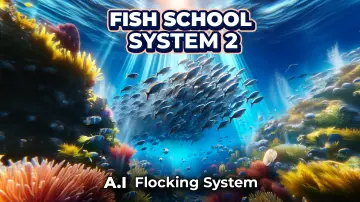
Add 12 fish species to your underwater scenes with Fish for Fish School System, featuring shared skeletons, LODs, and vertex-animated meshes.
Category:Unreal Engine,AnimalsPlatform: Unreal EngineEngine Version: 4.15+,5.0+Published: Oct 4, 2026
Animals
Resource overview
Integrating with Fish School System V1 and V2 via MF_LowPoly_VertexAnimation
Deploying this package starts with determining how movement will be handled in the scene. Designed as a downloadable content asset, it acts as a direct companion to both Fish School System and Fish School System V2, while retaining the capacity to operate completely independently. When utilized alongside schooling blueprints, the asset relies heavily on vertex animation rather than CPU-bound skeletal updates for vast shoals.
Out of the box, the vertex animation pipeline is preconfigured to link directly with Fish School System V2. Connecting these assets to the older Fish School System V1 requires a single material-level adjustment. Developers must open the material function designated as MF_LowPoly_VertexAnimation Within the project structure. Inside this function graph lies a static switch parameter named FishSchoolSystemV2. Clearing or unchecking this switch toggles the underlying math to read data formatted for the initial iteration of the school system, restoring behavioral alignment without rewriting shading logic or modifying the geometry.
Shared Skeleton Structure and Standalone Skeletal Meshes
Beyond massive flocking behaviors driven by materials, every fish in the package is equipped to function as an independent actor. Each creature provides three distinct core asset representations: a Vertex Animated Static Mesh, a Skeletal Mesh, and a dedicated Physics Asset. This dual representation lets developers pick between high-performance vertex-driven static meshes for distant background shoals and fully articulated skeletal meshes for hero encounters, physics interactions, or custom AI controllers.
A central technical advantage across the entire roster is the unified rigging scheme. All fish share the exact same Skeleton asset. By avoiding proprietary bone hierarchies for individual aquatic species, the shared skeleton removes the overhead of maintaining divergent animation graphs. A swim cycle, turn additive, or flinch motion mapped to this unified hierarchy can instantly drive any fish in the collection, drastically reducing the time required to set up Animation Blueprints across mixed marine environments.
Species Coverage and Diffuse Material Blending
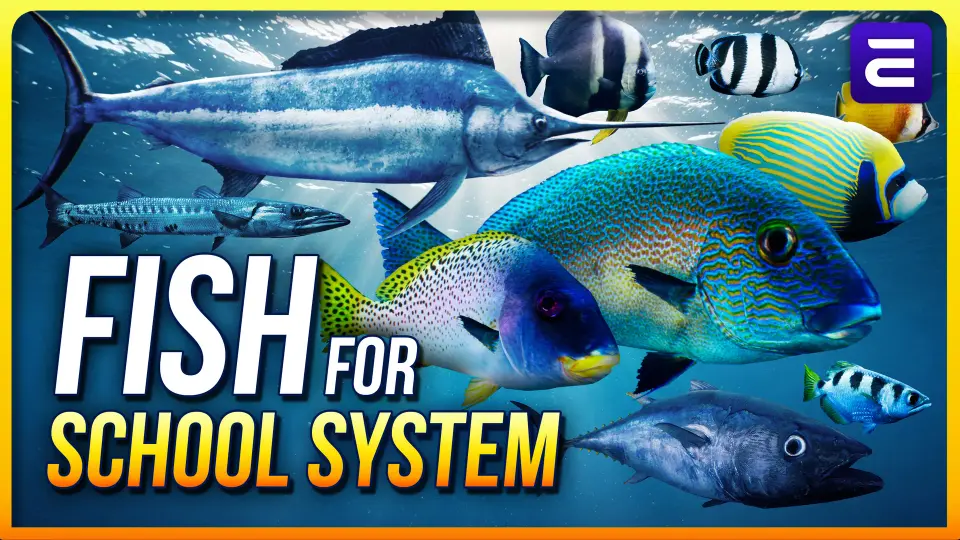
The collection supplies nine base fish meshes, expanded into a total roster of 12 distinct varieties through specialized texturing passes. The available species include:
Marlin
Archerfish
Cobia
Barracuda
Batfish
Gold Spotted Sweetlips and Black Spotted Sweetlips
YellowFin Tuna
Emperor Angelfish
Butterfly Fish (Black and Yellow variations)
Sweetlips (dual species treatment)
To avoid repetitive visuals when spawning dense groups of the same animal, several species include material setups made for runtime visual diversity. The Sweetlips, Butterfly Fish, Batfish, and Archerfish feature optionally blended materials. These graphs introduce subtle or distinct variation directly across the diffuse channel, allowing developers to break up visual uniformities across a single school without generating additional unique texture maps.
LOD Optimization Down to Low-Poly Counts
High actor counts in open-water environments demand aggressive polygonal scaling, particularly when rendering hundreds of moving targets concurrently. Every fish asset is authored with a minimum of three Level of Detail (LOD) steps. Across the entire collection, mesh complexity ranges from detailed foreground targets around 1,800 triangles down to extreme low-poly baselines measuring fewer than 50 triangles.
At base resolution (LOD0), the average geometric density rests at roughly 1,000 triangles per fish. This mid-to-low polycount ensures that individual creatures maintain recognizable silhouettes, fin definitions, and biological profiles during close passes by the camera. As schooling actors drift into midground distances and open water depths, the rapid transition to sub-50-triangle LODs frees rendering budgets to handle volumetric scene elements and expansive camera views.
Underwater Caustics and Post-Processing Integration
Rendering convincing underwater environments requires atmospheric lighting to anchor swimming meshes into the volume. Included alongside the character assets is a dedicated collection of visual effects components built to establish aquatic scenes immediately.
The package contains an underwater caustic lighting setup, projecting dynamic light patterns across the seabed and over the moving fish meshes. To complement the light distribution, scene-level underwater fog and tailored depth of field post-processing effects are incorporated. When paired with the vertex animation shaders, these post-process and lighting elements create believable light attenuation and water clarity layers without requiring secondary environment asset integration.
Asset Readiness and Multi-System Compatibility
Fish for Fish School System functions effectively as either a specialized expansion module or a flexible standalone library. By packing Physics Assets alongside vertex-animated static assets and unified-skeleton skeletal meshes, the collection bridges the gap between lightweight procedural ambient life and interactive wildlife actors. Whether toggled for Fish School System V1, running standard in V2, or populated into custom gameplay scenes via individual skeletal rigs, the assets provide an immediate, optimized foundation for diverse marine biomes.
 Animals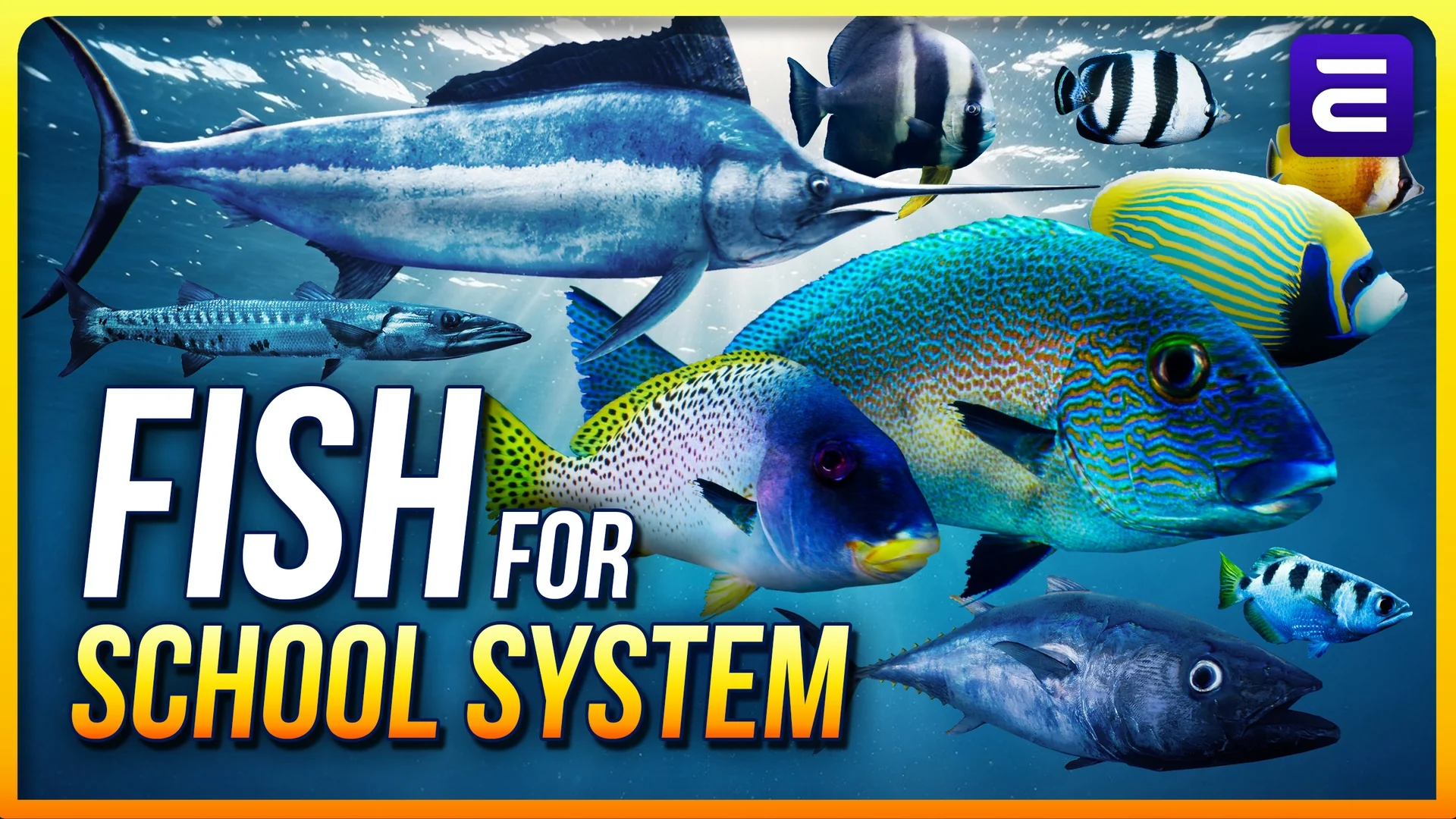
 Gameplay Features
 Characters
 Characters