"7066dd76da796369"{"id":"27661","slug":"first-person-shooter-template-pack-fpstp-3-4-advanced-fps-kit-for-ue5","title":"First Person Shooter Template Pack (FPSTP) 3.4 — Advanced FPS Kit for UE5","category":"Shooter","engine":"5.1+","assetVersion":"Engine version: 5.1+","engineVersion":"Asset Version:3.4","tag":"Shooter","accent":"blue","visual":"animation","summary":"First Person Shooter Template Pack (FPSTP) 3.4 is an advanced FPS foundation for UE5 with replicated gameplay systems, modular weapon handling, and physical bullets and grenades. It fits teams that want to work on shooter feel, progression, and expansion wi...","platform":"Unreal Engine","publishedAt":"2026-04-27T17:39:25.000Z","updatedAt":"2026-04-27T17:39:27.000Z","sourceNotes":[],"fileContents":[],"compatibility":["Unreal Engine","Engine version: 5.1+","Asset Version: 3.4"],"featuredImage":{"alt":"First Person Shooter Template Pack (FPSTP) 3.4 — Advanced FPS Kit for UE5","src":"https://3dcghub.com/wp-content/uploads/2026/04/1a211ae9f4af_df9e3a1c-da3e-4924-be65-bec590b5d0c7.webp"},"hasDownloadLink":true,"downloads":7,"terms":[{"taxonomy":"category","slug":"shooter","name":"Shooter"},{"taxonomy":"post_tag","slug":"templates","name":"Templates"},{"taxonomy":"post_tag","slug":"unreal-engine-5","name":"Unreal Engine 5"},{"taxonomy":"post_tag","slug":"weapons","name":"Weapons"}],"galleryImages":[{"src":"https://3dcghub.com/wp-content/uploads/2026/04/ba73004102de_30f38896-d984-4df0-a27a-e2aab9744a8b.webp","alt":"First Person Shooter Template Pack (FPSTP) 3.4 — Advanced FPS Kit for UE5"},{"src":"https://3dcghub.com/wp-content/uploads/2026/04/c710285a9e9c_c9ebff91-47d1-4bb8-ba44-da4a0a77b2bb.webp","alt":"First Person Shooter Template Pack (FPSTP) 3.4 — Advanced FPS Kit for UE5"},{"src":"https://3dcghub.com/wp-content/uploads/2026/04/4da31d96e180_908dc5c6-50dc-4524-9f1e-b04cf3834fff.webp","alt":"First Person Shooter Template Pack (FPSTP) 3.4 — Advanced FPS Kit for UE5"},{"src":"https://3dcghub.com/wp-content/uploads/2026/04/b3a03c46d59e_4e81a8a2-f6d7-43b5-a02a-58a2b131ca51.webp","alt":"First Person Shooter Template Pack (FPSTP) 3.4 — Advanced FPS Kit for UE5"},{"src":"https://3dcghub.com/wp-content/uploads/2026/04/3e0288937051_528461ef-c36f-4d0c-87bc-51925c4f1d45.webp","alt":"First Person Shooter Template Pack (FPSTP) 3.4 — Advanced FPS Kit for UE5"},{"src":"https://3dcghub.com/wp-content/uploads/2026/04/84e85e6fca39_ec394c88-4e39-4469-828d-69a53520bc07.webp","alt":"First Person Shooter Template Pack (FPSTP) 3.4 — Advanced FPS Kit for UE5"},{"src":"https://3dcghub.com/wp-content/uploads/2026/04/162d56bb9254_a1d4173c-ba1e-4ee6-b5de-e0532ad0b1e1.webp","alt":"First Person Shooter Template Pack (FPSTP) 3.4 — Advanced FPS Kit for UE5"},{"src":"https://3dcghub.com/wp-content/uploads/2026/04/14a12b4f8f64_fbdf1707-84c6-4cc8-8b46-f5fba72b4bc9.webp","alt":"First Person Shooter Template Pack (FPSTP) 3.4 — Advanced FPS Kit for UE5"},{"src":"https://3dcghub.com/wp-content/uploads/2026/04/5d66e64cf648_bb9b7e2b-b85a-49b9-b38a-5594ac1f0f64.webp","alt":"First Person Shooter Template Pack (FPSTP) 3.4 — Advanced FPS Kit for UE5"},{"src":"https://3dcghub.com/wp-content/uploads/2026/04/469cecfaabfb_a21578b1-b0c8-4bed-800a-f5899d2ec9d6.webp","alt":"First Person Shooter Template Pack (FPSTP) 3.4 — Advanced FPS Kit for UE5"}],"accessPanel":{"kind":"resource","title":"Access this resource","eyebrow":"Free Download","message":"Log in or create a free account to start your download.","fileName":"FirstPersonShooterTemplat.7z","safetyNote":"All resources are 100% manually reviewed to eliminate all risks.","actionLabel":"Download Free","resourceType":"Resource archive"},"contentHtml":"\u003cp\u003eFirst Person Shooter Template Pack (FPSTP) 3.4 brings together a replicated FPS framework, seven weapon types, four grenade types, procedural hand animation, physical ballistics, a save and load system, a skill system, a workbench for weapon repair, and a basic AI enemy. In plain production terms, it is a starting point for a shooter project where the hard parts of weapon handling, grenade behavior, and player control are already in place.\u003c/p\u003e\n\u003cp\u003eThe package is aimed at projects where shooting feel matters as much as raw feature count. Recoil, weapon response, and world reaction are treated as core parts of the experience. It can serve as a base for a full game or as a learning platform for studying more advanced FPS mechanics without first assembling every system from scratch.\u003c/p\u003e \u003ch2\u003eFPSTP 3.4 covers the core FPS loop\u003c/h2\u003e\n\u003cp\u003eAt the character level, the template includes the movement and control features expected from a modern first-person shooter: leaning, crouching, sprinting, jumping, leg IK, free look, and turn in place. These systems are modular and customizable, which is important in a workflow where teams often need to adjust movement rules early and then keep refining them as level design and weapon balance evolve.\u003c/p\u003e\n\u003cp\u003eCombat starts with a weapon system that already spans multiple roles. The included set covers assault rifle, handgun, sniper rifle, shotgun, double-barreled shotgun, SMG, and melee. That gives a project room to test close-range, mid-range, and long-range combat patterns inside the same framework instead of proving the template with only one gun archetype.\u003c/p\u003e\n\u003cp\u003eOn top of that base, the weapon mechanics go beyond simple firing and reloading. The system includes aiming, reloading, inspecting, breath holding, weapon jams, and fire mode switching with animation. Those details push the template closer to a production-ready gameplay layer rather than a minimal prototype. A team can start testing timing, combat pacing, and handling differences between weapons without first writing the interaction rules from zero.\u003c/p\u003e \u003ch2\u003eWeapon System, Attachments, and Procedural IK\u003c/h2\u003e\n\u003cp\u003eOne of the stronger production-facing parts of FPSTP 3.4 is the attachment system. It supports six attachment types, with optics offering reticle switching, reticle brightness adjustment, and two forms of zeroing. Other attachment categories include muzzle brakes, compensators, suppressors, laser attachments with beam color switching, flashlights, and a combined laser plus flashlight attachment.\u003c/p\u003e\n\u003cp\u003eThat structure matters because it gives a shooter project a way to test weapon variation through modular parts instead of treating every gun as a fixed setup. In development, that can shorten the path between a combat idea and a playable result. A designer can tune handling, visibility, and role differences through attachments while staying inside the same weapon logic.\u003c/p\u003e\n\u003cp\u003eThe advanced weapon parameters add another layer. Durability causes weapons to wear over time, and high wear increases the chance of jams during combat, forcing the player to clear malfunctions with animation. Ergonomics affects aim speed and weapon sway during camera movement. These are not cosmetic stats. They directly influence how a weapon feels in motion and under pressure, which ties back to the template’s focus on gameplay depth rather than generic shooting.\u003c/p\u003e\n\u003cp\u003eMost of the weapon interaction work is supported by procedural hand animation and IK systems instead of relying only on baked animation sets. The included implementation covers IK-based movement animations, IK aiming with weapon interaction, procedural recoil, weapon interaction while sprinting, camera-based weapon sway, and weapon blocking near walls. A practical advantage is stated clearly: adding new weapons does not require creating a full animation set. For teams expanding a shooter over time, that can make iteration much less rigid.\u003c/p\u003e \u003ch2\u003eGrenade System and Ballistics System as physical gameplay\u003c/h2\u003e\n\u003cp\u003eFPSTP 3.4 treats both grenades and bullets as physical objects rather than reducing them to simple radial damage or abstract hit events. The grenade system includes frag grenade, smoke grenade, flash grenade, and contact grenade. It also supports two throw types, strong and weak, with each throw type having its own animation.\u003c/p\u003e\n\u003cp\u003eThe more interesting part is how grenade behavior affects player response. If a grenade explodes nearby but behind cover, the result is not just a pass-or-fail damage check. The player can experience screen blur, ear ringing, and sound muffling, creating temporary disorientation instead of direct damage. That gives level cover and grenade placement more gameplay meaning, especially in close fights where blast effects are part of battlefield pressure rather than just a health subtraction event.\u003c/p\u003e\n\u003cp\u003eGrenades also use a fragments system, producing numerous fragments in addition to simple radial damage. Combined with the physical bullet model, the template leans toward a more grounded combat simulation. The ballistics system uses independent physical bullets with penetration based on material thickness and impact angle, plus ricochets at shallow angles. Those mechanics open up more tactical interactions with surfaces and cover, and they make environment materials part of combat behavior rather than just visual dressing.\u003c/p\u003e\n\u003cp\u003eMelee combat is also present when no weapon is equipped, allowing the player to fight with bare hands. That helps round out the full combat loop instead of limiting the project to armed states only.\u003c/p\u003e \u003ch2\u003eMultiplayer-ready FPS workflow for PvP, Co-op, and long-term iteration\u003c/h2\u003e\n\u003cp\u003eFor production use, the broader project fit comes from the networking and support structure around the gameplay systems. Core gameplay systems are fully replicated, and the weapon logic was created with networking in mind from the start. The template is suitable for both PvP and co-op shooters, which makes it useful for teams still deciding where their combat format will land.\u003c/p\u003e\n\u003cp\u003eOutside the firefight itself, there are several surrounding systems that help a project move beyond a firing range demo. A save and load system with unlimited save slots supports ongoing testing and progress tracking. The skill system adds character progression and gradual gameplay customization. The workbench lets players repair worn weapons after combat to restore durability. A basic AI enemy is included, along with flexible equipment customization, which gives developers something to test weapons and progression against even before a larger enemy roster exists.\u003c/p\u003e\n\u003cp\u003eThe package has been on the market for over three years and is actively maintained. Hundreds of developers are already using it. Documentation is detailed and regularly updated, and Blender animation source files are available for developers with animation experience. That combination places the template in a practical spot within a real workflow: not just as a visual sample, but as a longer-term FPS foundation that can keep evolving while a team focuses on level design, combat tuning, progression, and game-specific identity.\u003c/p\u003e\n\u003cp\u003eFor teams trying to get to playable shooter systems quickly, FPSTP 3.4 is set up to handle the heavy lifting around movement, weapon logic, grenade behavior, ballistics, and replication, leaving more room to shape the actual game.\u003c/p\u003e\n\n\u003ch2\u003eMore From The Same Workflow\u003c/h2\u003e\n\u003cul\u003e\n\u003cli\u003e\u003ca href=\"https://3dcghub.com/post-apocalyptic-melee-weapons/\" title=\"Post Apocalyptic Melee Weapons\"\u003ePost Apocalyptic Melee Weapons\u003c/a\u003e\u003c/li\u003e\n\u003cli\u003e\u003ca href=\"https://3dcghub.com/stylized-staves-rpg-weapons/\" title=\"Stylized Staves – RPG Weapons\"\u003eStylized Staves – RPG Weapons\u003c/a\u003e\u003c/li\u003e\n\u003c/ul\u003e","contentTextLength":7389,"navigation":{"current":2242,"total":4016,"previous":{"id":"27674","slug":"foliage-vol-6-broom-bushes-nanite-and-low-poly","title":"Foliage VOL.6 - Broom Bushes (Nanite and Low Poly)","category":"Trees","platform":"Unreal Engine","updatedAt":"2026-04-28T08:13:58.000Z"},"next":{"id":"27648","slug":"fantasy-weapon-pack","title":"Fantasy Weapon Pack","category":"Weapons \u0026 Combat","platform":"Unreal Engine","updatedAt":"2026-04-27T17:02:23.000Z"}},"relatedResources":[{"id":"24840","slug":"realistic-assault-rifle-fps-template","title":"Realistic Assault Rifle FPS Template","category":"Shooter","engine":"5.4+","assetVersion":"Engine version: 5.4+","engineVersion":"","tag":"Shooter","accent":"blue","visual":"city","summary":"This Unreal Engine 5 FPS template gives you a ready-made assault rifle setup with modular attachments, first-person arms, movement controls, and a full weapon blueprint system. It also includes grenade throwing, a playable demo map with destructible props,...","platform":"Unreal Engine","publishedAt":"2026-04-17T09:56:48.000Z","updatedAt":"2026-04-20T06:12:36.000Z","sourceNotes":[],"fileContents":[],"compatibility":["Unreal Engine","Engine version: 5.4+"],"featuredImage":{"alt":"Realistic Assault Rifle FPS Template","src":"https://3dcghub.com/wp-content/uploads/2026/04/675453222186_1756711820-Media-1-for-listing-Realistic-Assault-R.webp"},"hasDownloadLink":true,"downloads":6},{"id":"11974","slug":"definitive-fps-kit","title":"DEFINITIVE FPS KIT","category":"Shooter","engine":"5.5+","assetVersion":"Asset Version: 0.0.3","engineVersion":"Engine version: 5.5+","tag":"Shooter","accent":"blue","visual":"luts","summary":"The DEFINITIVE FPS KIT provides a solid foundation for creating professional first-person shooters. It features high-quality animations, customizable loadouts, and diverse game modes like round-based zombies and multiplayer.","platform":"Unreal Engine","publishedAt":"2026-03-06T16:27:47.000Z","updatedAt":"2026-10-16T06:54:06.998Z","sourceNotes":[],"fileContents":[],"compatibility":["Unreal Engine","Asset Version: 0.0.3","Engine version: 5.5+"],"featuredImage":{"alt":"DEFINITIVE FPS KIT","src":"https://3dcghub.com/wp-content/uploads/2026/03/6ad028e1-885c-4980-aa89-7ecea094d867.webp"},"hasDownloadLink":true,"downloads":24},{"id":"25145","slug":"shootlikeme-unreal-engine-third-person-shooter-template","title":"ShootLikeMe - Unreal Engine Third Person Shooter Template","category":"Shooter","engine":"5.5+","assetVersion":"Engine version: 5.5+","engineVersion":"","tag":"Shooter","accent":"blue","visual":"audio","summary":"This third-person shooter template brings together working firearms, grenades, enemy AI, and battlefield systems in one Unreal Engine project. It is shaped for projects that need more than a basic character setup and already includes the pieces for faction-...","platform":"Unreal Engine","publishedAt":"2026-04-19T11:43:36.000Z","updatedAt":"2026-04-20T06:12:32.000Z","sourceNotes":[],"fileContents":[],"compatibility":["Unreal Engine","Engine version: 5.5+"],"featuredImage":{"alt":"ShootLikeMe - Unreal Engine Third Person Shooter Template","src":"https://3dcghub.com/wp-content/uploads/2026/04/b068b2952629_1.webp"},"hasDownloadLink":true,"downloads":9}]}
Shooter
First Person Shooter Template Pack (FPSTP) 3.4 — Advanced FPS Kit for UE5
First Person Shooter Template Pack (FPSTP) 3.4 is an advanced FPS foundation for UE5 with replicated gameplay systems, modular weapon handling, and physical bullets and grenades. It fits teams that want to work on shooter feel, progression, and expansion wi...
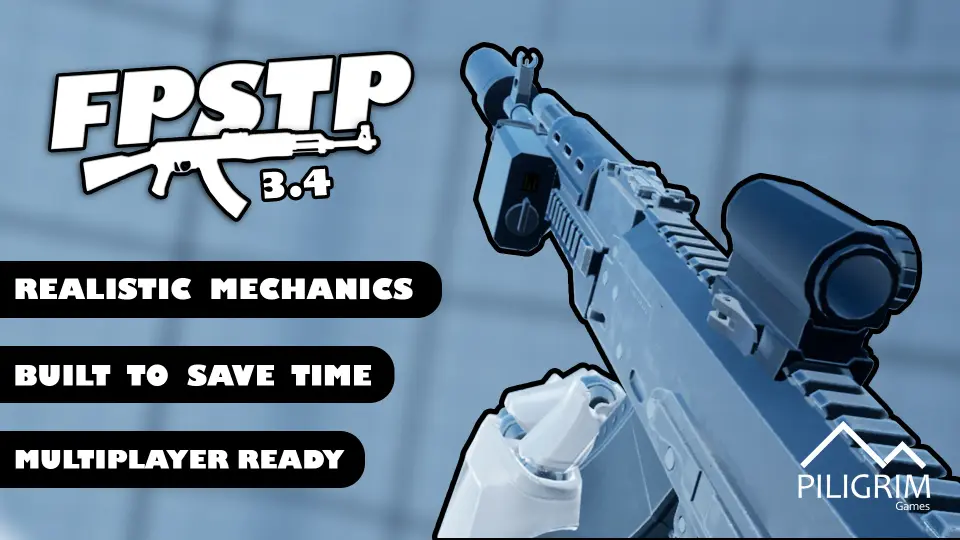
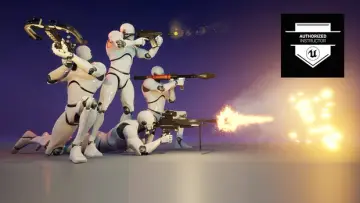
First Person Shooter Template Pack (FPSTP) 3.4 brings together a replicated FPS framework, seven weapon types, four grenade types, procedural hand animation, physical ballistics, a save and load system, a skill system, a workbench for weapon repair, and a basic AI enemy. In plain production terms, it is a starting point for a shooter project where the hard parts of weapon handling, grenade behavior, and player control are already in place.
The package is aimed at projects where shooting feel matters as much as raw feature count. Recoil, weapon response, and world reaction are treated as core parts of the experience. It can serve as a base for a full game or as a learning platform for studying more advanced FPS mechanics without first assembling every system from scratch.
FPSTP 3.4 covers the core FPS loop
At the character level, the template includes the movement and control features expected from a modern first-person shooter: leaning, crouching, sprinting, jumping, leg IK, free look, and turn in place. These systems are modular and customizable, which is important in a workflow where teams often need to adjust movement rules early and then keep refining them as level design and weapon balance evolve.
Combat starts with a weapon system that already spans multiple roles. The included set covers assault rifle, handgun, sniper rifle, shotgun, double-barreled shotgun, SMG, and melee. That gives a project room to test close-range, mid-range, and long-range combat patterns inside the same framework instead of proving the template with only one gun archetype.
On top of that base, the weapon mechanics go beyond simple firing and reloading. The system includes aiming, reloading, inspecting, breath holding, weapon jams, and fire mode switching with animation. Those details push the template closer to a production-ready gameplay layer rather than a minimal prototype. A team can start testing timing, combat pacing, and handling differences between weapons without first writing the interaction rules from zero.
Weapon System, Attachments, and Procedural IK
One of the stronger production-facing parts of FPSTP 3.4 is the attachment system. It supports six attachment types, with optics offering reticle switching, reticle brightness adjustment, and two forms of zeroing. Other attachment categories include muzzle brakes, compensators, suppressors, laser attachments with beam color switching, flashlights, and a combined laser plus flashlight attachment.
That structure matters because it gives a shooter project a way to test weapon variation through modular parts instead of treating every gun as a fixed setup. In development, that can shorten the path between a combat idea and a playable result. A designer can tune handling, visibility, and role differences through attachments while staying inside the same weapon logic.
The advanced weapon parameters add another layer. Durability causes weapons to wear over time, and high wear increases the chance of jams during combat, forcing the player to clear malfunctions with animation. Ergonomics affects aim speed and weapon sway during camera movement. These are not cosmetic stats. They directly influence how a weapon feels in motion and under pressure, which ties back to the template’s focus on gameplay depth rather than generic shooting.
Most of the weapon interaction work is supported by procedural hand animation and IK systems instead of relying only on baked animation sets. The included implementation covers IK-based movement animations, IK aiming with weapon interaction, procedural recoil, weapon interaction while sprinting, camera-based weapon sway, and weapon blocking near walls. A practical advantage is stated clearly: adding new weapons does not require creating a full animation set. For teams expanding a shooter over time, that can make iteration much less rigid.
Grenade System and Ballistics System as physical gameplay
FPSTP 3.4 treats both grenades and bullets as physical objects rather than reducing them to simple radial damage or abstract hit events. The grenade system includes frag grenade, smoke grenade, flash grenade, and contact grenade. It also supports two throw types, strong and weak, with each throw type having its own animation.
The more interesting part is how grenade behavior affects player response. If a grenade explodes nearby but behind cover, the result is not just a pass-or-fail damage check. The player can experience screen blur, ear ringing, and sound muffling, creating temporary disorientation instead of direct damage. That gives level cover and grenade placement more gameplay meaning, especially in close fights where blast effects are part of battlefield pressure rather than just a health subtraction event.
Grenades also use a fragments system, producing numerous fragments in addition to simple radial damage. Combined with the physical bullet model, the template leans toward a more grounded combat simulation. The ballistics system uses independent physical bullets with penetration based on material thickness and impact angle, plus ricochets at shallow angles. Those mechanics open up more tactical interactions with surfaces and cover, and they make environment materials part of combat behavior rather than just visual dressing.
Melee combat is also present when no weapon is equipped, allowing the player to fight with bare hands. That helps round out the full combat loop instead of limiting the project to armed states only.
Multiplayer-ready FPS workflow for PvP, Co-op, and long-term iteration
For production use, the broader project fit comes from the networking and support structure around the gameplay systems. Core gameplay systems are fully replicated, and the weapon logic was created with networking in mind from the start. The template is suitable for both PvP and co-op shooters, which makes it useful for teams still deciding where their combat format will land.
Outside the firefight itself, there are several surrounding systems that help a project move beyond a firing range demo. A save and load system with unlimited save slots supports ongoing testing and progress tracking. The skill system adds character progression and gradual gameplay customization. The workbench lets players repair worn weapons after combat to restore durability. A basic AI enemy is included, along with flexible equipment customization, which gives developers something to test weapons and progression against even before a larger enemy roster exists.
The package has been on the market for over three years and is actively maintained. Hundreds of developers are already using it. Documentation is detailed and regularly updated, and Blender animation source files are available for developers with animation experience. That combination places the template in a practical spot within a real workflow: not just as a visual sample, but as a longer-term FPS foundation that can keep evolving while a team focuses on level design, combat tuning, progression, and game-specific identity.
For teams trying to get to playable shooter systems quickly, FPSTP 3.4 is set up to handle the heavy lifting around movement, weapon logic, grenade behavior, ballistics, and replication, leaving more room to shape the actual game.
 Shooter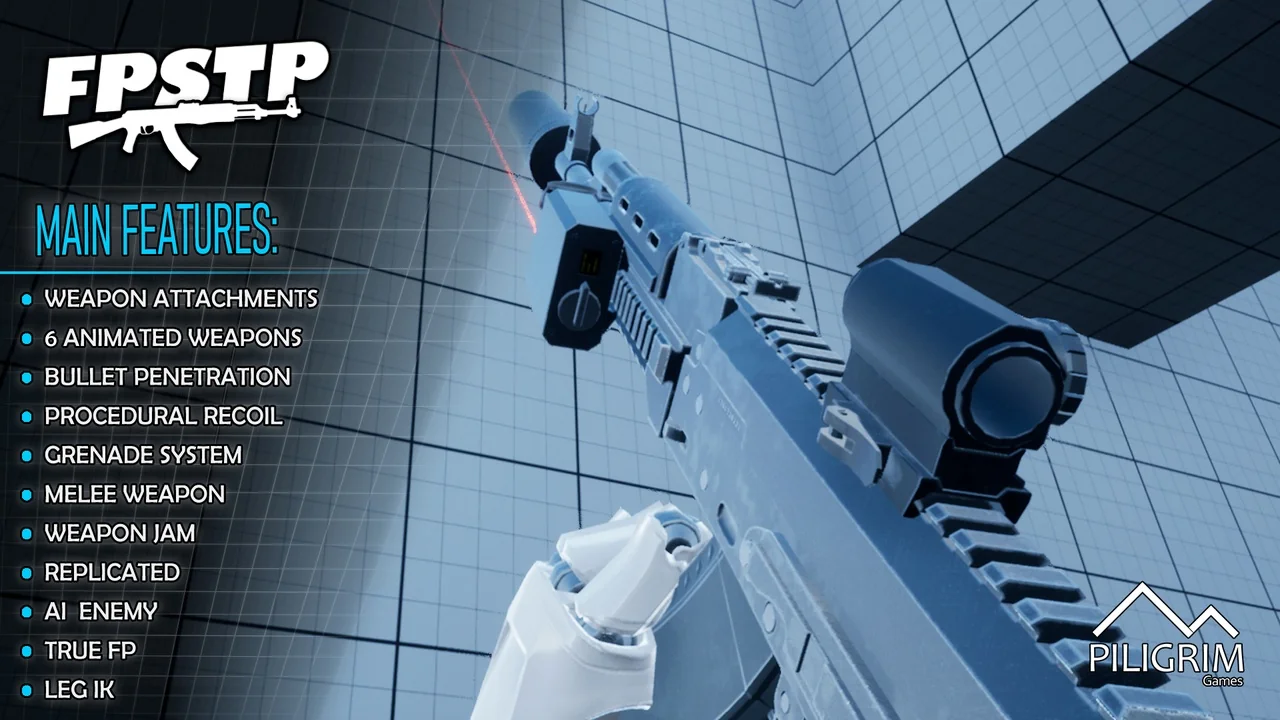
 Shooter
 Shooter
 Shooter