"c68a05d5e51405b3"{"id":"27084","slug":"defender-top-down-shooter-v3-3","title":"Defender: Top-Down Shooter v3.3","category":"Shooter","engine":"5.6+","assetVersion":"Engine version: 5.6+","engineVersion":"Asset Version:3.0","tag":"Shooter","accent":"blue","visual":"city","summary":"Defender is a modular twin-stick action RPG framework built in Blueprints for single-player or local co-op top-down shooters. The v3.3 update adds Chaos Destructibles, a settings menu, broader localization support, new Niagara VFX, and camera and loot refin...","platform":"Unreal Engine","publishedAt":"2026-04-21T08:45:51.000Z","updatedAt":"2026-04-21T08:45:52.000Z","sourceNotes":[],"fileContents":[],"compatibility":["Unreal Engine","Engine version: 5.6+"],"featuredImage":{"alt":"Defender: Top-Down Shooter v3.3","src":"https://3dcghub.com/wp-content/uploads/2026/04/9d6a76e610b3_a7f6f336-a646-4f95-b616-48b1d2c83b76.webp"},"hasDownloadLink":true,"downloads":3,"terms":[{"taxonomy":"category","slug":"shooter","name":"Shooter"},{"taxonomy":"post_tag","slug":"game-systems","name":"Game Systems"},{"taxonomy":"post_tag","slug":"templates","name":"Templates"},{"taxonomy":"post_tag","slug":"unreal-engine-5","name":"Unreal Engine 5"}],"galleryImages":[{"src":"https://3dcghub.com/wp-content/uploads/2026/04/fe6311ceaab7_17f69de4-d526-48a1-9b9d-852a002d7539.webp","alt":"Defender: Top-Down Shooter v3.3"},{"src":"https://3dcghub.com/wp-content/uploads/2026/04/b1c9cd27df1a_58a9e543-c9b9-40f8-a401-afabe827921d.webp","alt":"Defender: Top-Down Shooter v3.3"},{"src":"https://3dcghub.com/wp-content/uploads/2026/04/54e86b5f3f51_3fb0e8cb-cf89-42f4-8102-9cbcc214bc00.webp","alt":"Defender: Top-Down Shooter v3.3"},{"src":"https://3dcghub.com/wp-content/uploads/2026/04/a2c5c4cb6e7a_48521f88-b218-4dad-a536-e74833fa3406.webp","alt":"Defender: Top-Down Shooter v3.3"},{"src":"https://3dcghub.com/wp-content/uploads/2026/04/771655909876_5bc6de85-ce3c-421d-baf3-ee1f9e5799be.webp","alt":"Defender: Top-Down Shooter v3.3"},{"src":"https://3dcghub.com/wp-content/uploads/2026/04/6f2e84ef104b_d6cd3dff-06b3-4eca-8dd5-65c0b0aae138.webp","alt":"Defender: Top-Down Shooter v3.3"},{"src":"https://3dcghub.com/wp-content/uploads/2026/04/1ff945164fec_d488366e-808b-4020-b924-efcf7fa16e1d.webp","alt":"Defender: Top-Down Shooter v3.3"},{"src":"https://3dcghub.com/wp-content/uploads/2026/04/ce11902ada73_14489ae4-5e49-4611-86f7-cee2d6691595.webp","alt":"Defender: Top-Down Shooter v3.3"},{"src":"https://3dcghub.com/wp-content/uploads/2026/04/a3ee2be53846_bf4e7c84-8cf1-4c12-b925-432b3dea815e.webp","alt":"Defender: Top-Down Shooter v3.3"},{"src":"https://3dcghub.com/wp-content/uploads/2026/04/4605358d1a34_d74dfccb-ac04-4c04-9295-d1287692c9e5.webp","alt":"Defender: Top-Down Shooter v3.3"}],"accessPanel":{"kind":"resource","title":"Access this resource","eyebrow":"Free Download","message":"Log in or create a free account to start your download.","fileName":"DefenderCoOpTopDownShoo.7z","safetyNote":"All resources are 100% manually reviewed to eliminate all risks.","actionLabel":"Download Free","resourceType":"Resource archive"},"contentHtml":"\u003ch2\u003eSet up a playable foundation, not just a collection of assets\u003c/h2\u003e\u003cp\u003eDefender: Top-Down Shooter v3.3 is a modular twin-stick action RPG framework built for Unreal Engine projects that need a working top-down shooter foundation. It is made entirely in Blueprints and includes over 575 well-commented Blueprints, so the project is structured as a hands-on framework rather than a loose pack of isolated systems.\u003c/p\u003e\u003cp\u003eThe workflow fits both solo experiments and larger production planning. It supports single-player and local co-op play, and the local co-op setup is plug-and-play for up to three players with full UI and input support. That makes it a practical starting point for a prototype, a game jam build, or a more complete top-down action project that needs player interaction working early.\u003c/p\u003e\u003cp\u003eAll assets seen in trailers and screenshots are included in the project file, so the package is intended to be used as a full working base. It is also presented as a fully modular and highly educational framework, with step-by-step video tutorials that help add new characters, weapons, objectives, and related systems.\u003c/p\u003e\u003ch2\u003eCombat, progression, and world interaction\u003c/h2\u003e\u003cp\u003eThe core gameplay systems cover a broad range of action-RPG needs. Combat includes firearms and melee with an upgrade system, while AI uses Behavior Trees. The project also includes a dialogue system with branching, stats, and cinematic control, along with player stats and progression such as XP, critical hit, and toughness.\u003c/p\u003e\u003cp\u003eThe runtime UI and feedback layer is built around clear in-game communication. On-screen messages, HP bars, damage text, and interaction indicators are included, which helps the framework support moment-to-moment readability in a top-down view.\u003c/p\u003e\u003cp\u003eSeveral structural systems extend the framework beyond basic combat:\u003c/p\u003e\u003cul\u003e\u003cli\u003eModular character setup with swappable torso, legs, and head parts\u003c/li\u003e\u003cli\u003ePartitioned save and load system\u003c/li\u003e\u003cli\u003eVehicle possession system\u003c/li\u003e\u003cli\u003e9+ weapon types, grenades, laser sights, and an ability system\u003c/li\u003e\u003c/ul\u003e\u003cp\u003eThat combination makes Defender useful for projects that want to move between combat encounters, dialogue, progression, and vehicle use without rebuilding each layer separately. The modular character system also makes it easier to extend a character’s visuals and stats while keeping the framework organized.\u003c/p\u003e\u003ch2\u003eWhat changed in v3.3\u003c/h2\u003e\u003cp\u003eThe v3.3 update focuses on presentation, control, and broader accessibility. Chaos Destructibles are now part of the update, alongside a Settings Menu that covers Video, Audio, Gameplay, and Controls. Localization support has also been expanded across many languages, which gives the project a wider path for production use beyond a single-language build.\u003c/p\u003e\u003cp\u003eSeveral visual and feel-related updates reshape how encounters and deaths play out. The update adds a vanishing death type, cinematic slow-motion deaths with improved camera behavior, and a smoother co-op camera. Loot spawning has been refined as well, which helps the overall pacing feel more controlled during play.\u003c/p\u003e\u003cp\u003eRendering and effects get a noticeable push through new Niagara VFX, including Niagara-based shell, hit, loot, and explosion effects. Level Selection and Loading Screens have also been updated, which supports a more polished presentation between gameplay spaces. Together, these changes push the framework toward a more scalable and globally accessible experience.\u003c/p\u003e\u003ch2\u003eCompatibility and project use\u003c/h2\u003e\u003cp\u003eDefender is described as UE4 and UE5 skeleton compatible, which means you can import your own animations and meshes freely. Version support is stated for UE 4.27 in project versions v1.0 to v3.0.1, while UE 5.x from 5.0 to 5.7 is supported in all project versions. That compatibility range matters when a project needs to move between engine generations or keep a consistent character setup across different content passes.\u003c/p\u003e\u003cp\u003eThe framework is also positioned for rapid prototyping and scalable game development, from game jams to commercial releases. It is presented as a full game framework if needed, but individual systems can also be cherry-picked into another project. That makes the package useful whether the goal is to stand up an entire top-down shooter or to pull in only the combat, dialogue, co-op, or progression layers that fit an existing build.\u003c/p\u003e\u003cp\u003eSupport materials are part of the production story too. There are step-by-step video tutorials, a growing community for feedback and help, and documentation for implementation. It has also been showcased twice by Epic Games, reinforcing its place as a framework that was built to be used, extended, and maintained rather than kept as a static demo.\u003c/p\u003e\u003cp\u003eFor teams working on a top-down shooter, Defender fits best when a project needs a structured Blueprint foundation, local co-op support, and a wider systems layer already wired together. The v3.3 update adds the kind of polish that helps a framework move from prototype into something ready for steady production work.\u003c/p\u003e\n\n\u003ch2\u003eMore From The Same Workflow\u003c/h2\u003e\n\u003cul\u003e\n\u003cli\u003e\u003ca href=\"https://3dcghub.com/shootlikeme-unreal-engine-third-person-shooter-template/\" title=\"ShootLikeMe – Unreal Engine Third Person Shooter Template\"\u003eShootLikeMe – Unreal Engine Third Person Shooter Template\u003c/a\u003e\u003c/li\u003e\n\u003cli\u003e\u003ca href=\"https://3dcghub.com/advanced-unreal-engine-5-multiplayer-gameplay-programming/\" title=\"Advanced Unreal Engine 5 Multiplayer Gameplay Programming\"\u003eAdvanced Unreal Engine 5 Multiplayer Gameplay Programming\u003c/a\u003e\u003c/li\u003e\n\u003cli\u003e\u003ca href=\"https://3dcghub.com/niagara-beginners-to-advanced-in-unreal-engine-5/\" title=\"Niagara Beginners to advanced in Unreal Engine 5\"\u003eNiagara Beginners to advanced in Unreal Engine 5\u003c/a\u003e\u003c/li\u003e\n\u003cli\u003e\u003ca href=\"https://3dcghub.com/create-zelda-like-skills-with-c-in-unreal-engine-5-2/\" title=\"Create Zelda-like skills with C++ in unreal engine 5\"\u003eCreate Zelda-like skills with C++ in unreal engine 5\u003c/a\u003e\u003c/li\u003e\n\u003cli\u003e\u003ca href=\"https://3dcghub.com/main-menus-beginner-class-unreal-engine-5/\" title=\"Main Menus Beginner Class – Unreal Engine 5\"\u003eMain Menus Beginner Class – Unreal Engine 5\u003c/a\u003e\u003c/li\u003e\n\u003c/ul\u003e\n\n\u003ch2\u003eAsset Gallery\u003c/h2\u003e","contentTextLength":5227,"navigation":{"current":2125,"total":3860,"previous":{"id":"27100","slug":"ogs-dialogue-quest-master","title":"OGS - Dialogue \u0026 Quest Master","category":"Dialog Systems","platform":"Unreal Engine","updatedAt":"2026-04-21T10:12:25.000Z"},"next":{"id":"27061","slug":"ue5-character-absorb-vfx","title":"UE5 Character Absorb VFX","category":"Spells \u0026 Combat","platform":"Unreal Engine","updatedAt":"2026-04-21T08:24:22.000Z"}},"relatedResources":[{"id":"1000017","slug":"multiplayer-top-down-shooter-template","title":"Multiplayer Top Down Shooter Template","category":"Shooter","engine":"5.6+","assetVersion":"","engineVersion":"5.6+","tag":"Shooter","accent":"blue","visual":"mech","summary":"A fully replicated Unreal Engine top-down shooter template with CommonUI menus, Blueprint systems, Data Asset weapons, AI, inventory, and extraction flow.","platform":"Unreal Engine","publishedAt":"2026-05-20T05:15:14.777Z","updatedAt":"2026-05-20T05:16:19.037Z","sourceNotes":[],"fileContents":[],"compatibility":["Unreal Engine","Engine version: 5.6+"],"featuredImage":{"alt":"Multiplayer Top Down Shooter Template","src":"/wp-content/uploads/published/2026/05/628e19ac7f6c-f5f74f7a-553a-4b1b-a68f-c192a9f2c3b9-16d99edf05.webp"},"hasDownloadLink":true,"downloads":4},{"id":"1001127","slug":"ultimate-shooter-kit","title":"Ultimate Shooter Kit","category":"Shooter","engine":"5.3+","assetVersion":"Asset Version: v2","engineVersion":"Engine Version: 5.3+","tag":"Shooter","accent":"blue","visual":"mech","summary":"Ultimate Shooter Kit is a multiplayer-ready shooter template with menu, quest, inventory/weapon systems, and respawn support for Blueprint users.","platform":"Unreal Engine","publishedAt":"2026-09-07T13:39:36.666Z","updatedAt":"2026-09-07T13:39:36.666Z","sourceNotes":[],"fileContents":[],"compatibility":["Unreal Engine","Asset Version: v2","Engine Version: 5.3+"],"featuredImage":{"alt":"Ultimate Shooter Kit","src":"/wp-content/uploads/published/2026/09/f05ddf518181-a408d89b-9e9a-4002-9eec-3901d33e8fc9-157b96f106.webp"},"hasDownloadLink":true,"downloads":3},{"id":"1000522","slug":"low-poly-shooter-pack-v6-0","title":"Low Poly Shooter Pack v6.0","category":"Shooter","engine":"5.4+","assetVersion":"Asset Version: 6.0","engineVersion":"Engine Version: 5.4+","tag":"Shooter","accent":"blue","visual":"mech","summary":"Unreal Engine template with 18 rigged low poly weapons, multiplayer replication, AI enemies, pickups, VFX, and Blender source files for stylized FPS games.","platform":"Unreal Engine","publishedAt":"2026-07-14T13:23:42.771Z","updatedAt":"2026-07-14T13:23:42.771Z","sourceNotes":[],"fileContents":[],"compatibility":["Unreal Engine","Asset Version: 6.0","Engine Version: 5.4+"],"featuredImage":{"alt":"Low Poly Shooter Pack v6.0","src":"/wp-content/uploads/published/2026/07/db9964bb45d9-78552331-4d0e-4f90-bf5a-b2dd4d1035dd-10fd74fe33.webp"},"hasDownloadLink":true,"downloads":5}]}
Shooter
Defender: Top-Down Shooter v3.3
Defender is a modular twin-stick action RPG framework built in Blueprints for single-player or local co-op top-down shooters. The v3.3 update adds Chaos Destructibles, a settings menu, broader localization support, new Niagara VFX, and camera and loot refin...
Set up a playable foundation, not just a collection of assets
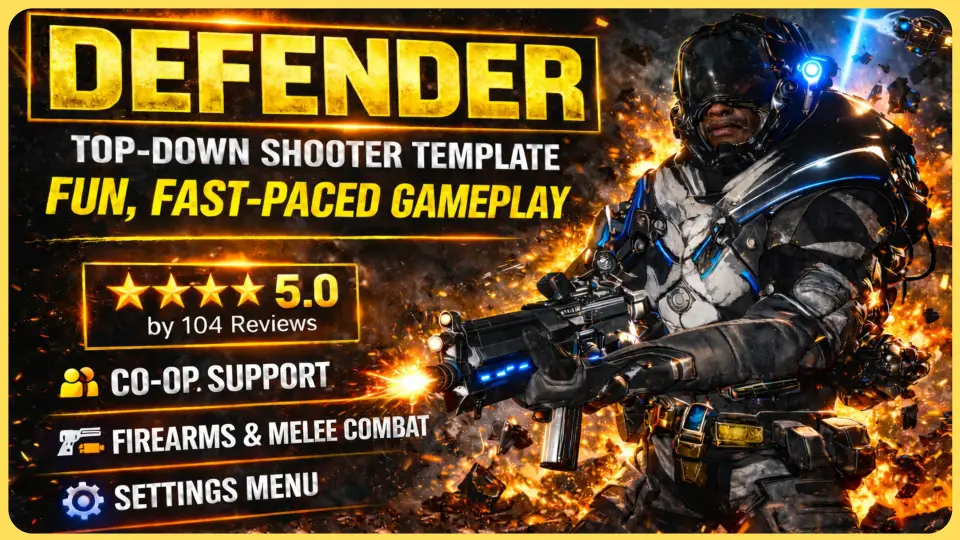
Defender: Top-Down Shooter v3.3 is a modular twin-stick action RPG framework built for Unreal Engine projects that need a working top-down shooter foundation. It is made entirely in Blueprints and includes over 575 well-commented Blueprints, so the project is structured as a hands-on framework rather than a loose pack of isolated systems.
The workflow fits both solo experiments and larger production planning. It supports single-player and local co-op play, and the local co-op setup is plug-and-play for up to three players with full UI and input support. That makes it a practical starting point for a prototype, a game jam build, or a more complete top-down action project that needs player interaction working early.
All assets seen in trailers and screenshots are included in the project file, so the package is intended to be used as a full working base. It is also presented as a fully modular and highly educational framework, with step-by-step video tutorials that help add new characters, weapons, objectives, and related systems.
Combat, progression, and world interaction
The core gameplay systems cover a broad range of action-RPG needs. Combat includes firearms and melee with an upgrade system, while AI uses Behavior Trees. The project also includes a dialogue system with branching, stats, and cinematic control, along with player stats and progression such as XP, critical hit, and toughness.
The runtime UI and feedback layer is built around clear in-game communication. On-screen messages, HP bars, damage text, and interaction indicators are included, which helps the framework support moment-to-moment readability in a top-down view.
Several structural systems extend the framework beyond basic combat:
Modular character setup with swappable torso, legs, and head parts
Partitioned save and load system
Vehicle possession system
9+ weapon types, grenades, laser sights, and an ability system
That combination makes Defender useful for projects that want to move between combat encounters, dialogue, progression, and vehicle use without rebuilding each layer separately. The modular character system also makes it easier to extend a character’s visuals and stats while keeping the framework organized.
What changed in v3.3
The v3.3 update focuses on presentation, control, and broader accessibility. Chaos Destructibles are now part of the update, alongside a Settings Menu that covers Video, Audio, Gameplay, and Controls. Localization support has also been expanded across many languages, which gives the project a wider path for production use beyond a single-language build.
Several visual and feel-related updates reshape how encounters and deaths play out. The update adds a vanishing death type, cinematic slow-motion deaths with improved camera behavior, and a smoother co-op camera. Loot spawning has been refined as well, which helps the overall pacing feel more controlled during play.
Rendering and effects get a noticeable push through new Niagara VFX, including Niagara-based shell, hit, loot, and explosion effects. Level Selection and Loading Screens have also been updated, which supports a more polished presentation between gameplay spaces. Together, these changes push the framework toward a more scalable and globally accessible experience.
Compatibility and project use
Defender is described as UE4 and UE5 skeleton compatible, which means you can import your own animations and meshes freely. Version support is stated for UE 4.27 in project versions v1.0 to v3.0.1, while UE 5.x from 5.0 to 5.7 is supported in all project versions. That compatibility range matters when a project needs to move between engine generations or keep a consistent character setup across different content passes.
The framework is also positioned for rapid prototyping and scalable game development, from game jams to commercial releases. It is presented as a full game framework if needed, but individual systems can also be cherry-picked into another project. That makes the package useful whether the goal is to stand up an entire top-down shooter or to pull in only the combat, dialogue, co-op, or progression layers that fit an existing build.
Support materials are part of the production story too. There are step-by-step video tutorials, a growing community for feedback and help, and documentation for implementation. It has also been showcased twice by Epic Games, reinforcing its place as a framework that was built to be used, extended, and maintained rather than kept as a static demo.
For teams working on a top-down shooter, Defender fits best when a project needs a structured Blueprint foundation, local co-op support, and a wider systems layer already wired together. The v3.3 update adds the kind of polish that helps a framework move from prototype into something ready for steady production work.
 Shooter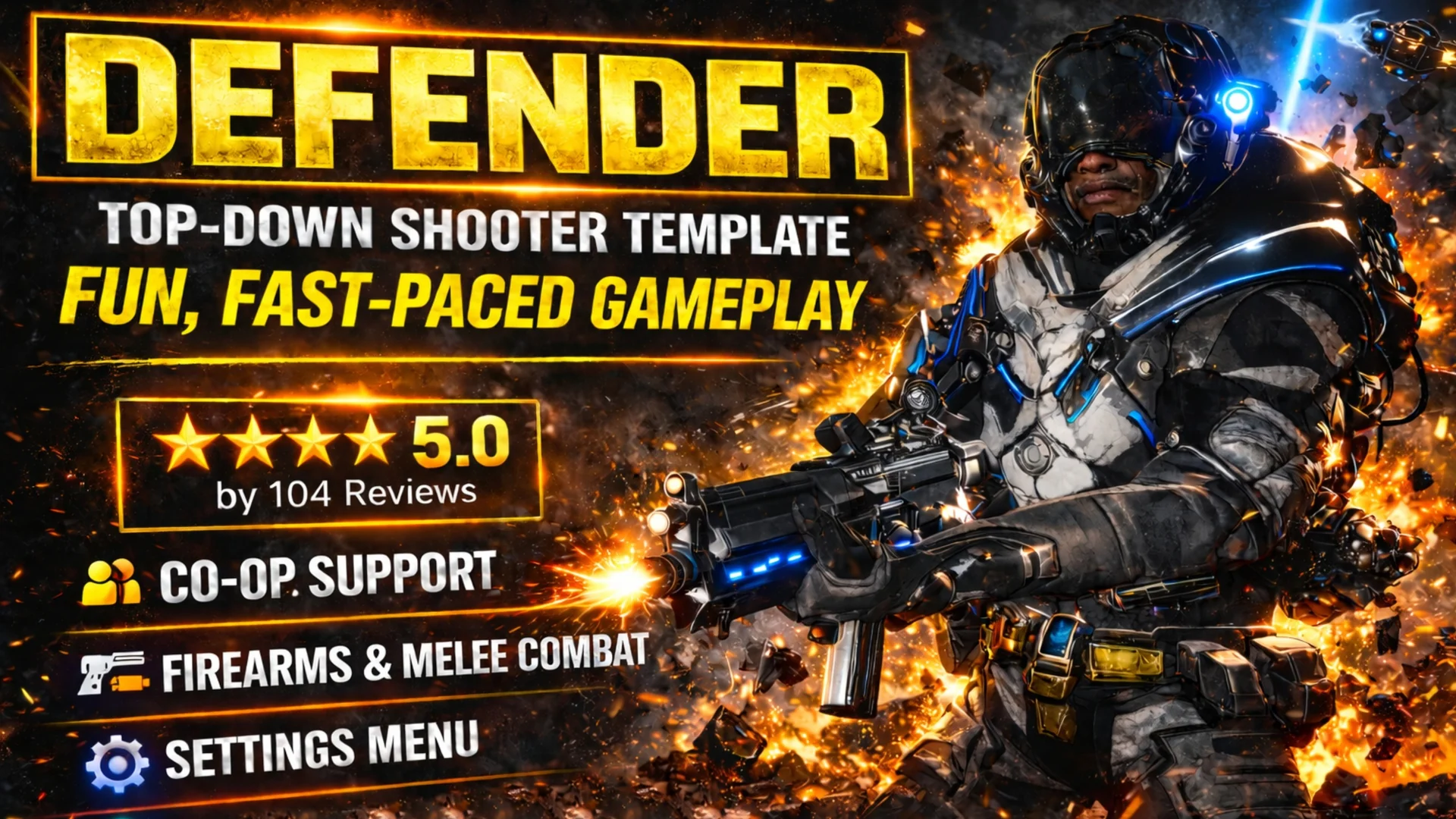
 Shooter
 Shooter
 Shooter