"f813c18d2170b1f6"{"id":"1000058","slug":"fast-food-restaurant","title":"Fast Food Restaurant","category":"Interior","engine":"4.26+,5.0+","assetVersion":"","engineVersion":"4.26+,5.0+","tag":"Interior","accent":"blue","visual":"mech","summary":"A realistic fast food restaurant package with furniture, kitchen equipment, food, customizable Blueprints, material instances, and game-ready optimization.","platform":"Unreal Engine","publishedAt":"2026-05-26T16:32:43.627Z","updatedAt":"2026-05-26T16:32:43.627Z","sourceNotes":[],"fileContents":[],"compatibility":["Unreal Engine","Engine version: 4.26+,5.0+"],"featuredImage":{"alt":"Fast Food Restaurant","src":"/wp-content/uploads/published/2026/05/d6e1aabdc0fc-a1a3bca7-5bef-47cd-aba9-8a5dcd2a5364-f9a526a9e2.webp"},"hasDownloadLink":true,"downloads":3,"terms":[{"taxonomy":"category","slug":"interior","name":"Interior"}],"galleryImages":[{"src":"/wp-content/uploads/published/2026/05/1995323742b4-0ccf570e-b795-4e8f-ad77-d8e6dd048258-9521f2f02d.webp","alt":"Fast Food Restaurant"},{"src":"/wp-content/uploads/published/2026/05/6044599dd9dc-e243246e-5da9-49e5-9cf1-9b4bd37826ad-e0de64a2b7.webp","alt":"Fast Food Restaurant"},{"src":"/wp-content/uploads/published/2026/05/fd37f2ff675c-1258654f-2e2b-46de-b23c-7899ef1c03cc-469993e284.webp","alt":"Fast Food Restaurant"},{"src":"/wp-content/uploads/published/2026/05/c5916ff12cba-b9b304d9-483e-45aa-bfab-114b7ffd29ba-d4737b3ae3.webp","alt":"Fast Food Restaurant"},{"src":"/wp-content/uploads/published/2026/05/8a4a3ccc8c24-86e52bb9-e7a2-46a5-b855-abc8e44a4928-c89bbf337c.webp","alt":"Fast Food Restaurant"},{"src":"/wp-content/uploads/published/2026/05/6707bee35878-ca4d9578-3819-4e38-9df4-95382083c77c-408b8301bd.webp","alt":"Fast Food Restaurant"},{"src":"/wp-content/uploads/published/2026/05/00b86e859fb5-2eedc056-bd07-4178-982e-fa5911fe0bd6-c6c83eb0a5.webp","alt":"Fast Food Restaurant"},{"src":"/wp-content/uploads/published/2026/05/32b23a4b6d9e-69e3968d-c60a-422e-ba43-470d60ec343b-2cd0bff74a.webp","alt":"Fast Food Restaurant"},{"src":"/wp-content/uploads/published/2026/05/80bd382bce26-edf2ab6c-b15a-44db-936c-43cc3d079cc1-4410f24059.webp","alt":"Fast Food Restaurant"},{"src":"/wp-content/uploads/published/2026/05/4a44cf89b5df-09291dad-c142-43a1-8688-4880c32525b6-fe76645dc2.webp","alt":"Fast Food Restaurant"}],"accessPanel":{"kind":"resource","title":"Access this resource","eyebrow":"Free Download","message":"Log in or create a free account to start your download.","fileName":"Content.7z","safetyNote":"Resources are manually reviewed before listing to improve quality and reduce obvious risks.","actionLabel":"Download Free","resourceType":"Resource archive"},"contentHtml":"\u003cp\u003eA fast food interior only feels convincing when the small pieces hold up alongside the larger environment. Seating, service areas, kitchen equipment, storage pieces, and food all need to read as part of the same place, while still being flexible enough to fit different layouts. This package approaches that need with a large collection of highly detailed and authentic assets aimed at creating a complete fast food restaurant scene.\u003c/p\u003e\u003cp\u003eThe scope is not limited to one corner of the restaurant. It covers a wide range of furniture, kitchen equipment, and food, which makes it practical for scenes that need both customer-facing spaces and back-of-house areas. Tags connected to the package also point toward restaurant, kitchen, freezer, toilet, realistic, customizable, modular, and level-focused use, suggesting a set that can support more than a single hero shot.\u003c/p\u003e\u003ch2\u003eFast Food Restaurant assets across the whole scene\u003c/h2\u003e\u003cp\u003eThe most concrete strength here is variety across the kinds of objects a restaurant environment needs. Furniture handles the public side of the location, where tables, seating, and related pieces shape the identity of the space. Kitchen equipment pushes the set into preparation and service areas, helping the restaurant function as more than a decorated shell. Food assets add another layer, giving the scene the visual cues people immediately associate with a fast food setting.\u003c/p\u003e\u003cp\u003eThat combination is useful for environment work that needs continuity from one room to the next. A restaurant can move from entry or dining space into kitchen zones, cold storage, and utility areas without relying on mismatched assets from different collections. The presence of tags such as freezer and toilet also points toward a broader environment package rather than a narrow collection focused only on dining tables or countertop props.\u003c/p\u003e\u003cp\u003eThe realistic direction matters because fast food spaces tend to be visually familiar. If the furniture feels too generic or the food lacks detail, the illusion breaks quickly. Here, the emphasis stays on highly detailed and authentic assets, which makes the pack better suited to scenes that need to look recognizable at a glance.\u003c/p\u003e\u003ch2\u003eCustomizable Blueprints and material instances in active use\u003c/h2\u003e\u003cp\u003eBeyond the asset count and theme, the package includes customizable Blueprints and material instances. That shifts it from being only a static set of props into something more adjustable inside production. Instead of treating every object as fixed, certain assets can be altered directly during scene work.\u003c/p\u003e\u003cp\u003eThe editable properties called out most clearly are color, dirtiness, and edge wear. Those three controls can change how clean, old, or heavily used parts of the restaurant appear. A brighter, cleaner setup can suit a freshly maintained chain interior, while more dirt or edge wear can push the same location toward a busier, more worn-in look. Color adjustment also helps unify different sections of a restaurant or create visual distinction between branded areas, equipment groups, or interior accents.\u003c/p\u003e\u003cp\u003eBecause these changes can be made on the fly, the package supports iteration rather than forcing artists to settle for one locked version of an object. That is especially useful in restaurant scenes, where repeating furniture or fixtures can become too uniform if every piece shares the exact same finish. Variation in wear and cleanliness can make the environment feel more lived in without changing the underlying set.\u003c/p\u003e\u003cp\u003eThe modular and customizable tags reinforce that workflow. Even without introducing unstated technical claims, the package clearly leans toward flexible scene building rather than one-off placement.\u003c/p\u003e\u003ch2\u003eGame-ready performance with LOD distances and collision meshes\u003c/h2\u003e\u003cp\u003eRestaurant environments often place many assets in view at the same time. Seating, counters, kitchen surfaces, containers, food items, and utility pieces can quickly add up, so optimization becomes part of the package’s practical value. All assets here are optimized for games, with hand-picked LOD distances and custom collision meshes.\u003c/p\u003e\u003cp\u003eThat tells you the pack is not only chasing visual density. It also accounts for in-engine use where objects must perform well enough to function in an interactive scene. Hand-picked LOD distances suggest attention to how assets transition across viewing ranges rather than relying on a one-size-fits-all setup. In a restaurant, this helps because some pieces stay in the background while others sit close to the camera near serving areas, tables, or kitchen stations.\u003c/p\u003e\u003cp\u003eCustom collision meshes also strengthen the package for playable spaces. Fast food interiors are usually navigated tightly, with lots of objects packed into limited floor area. Collision that matches the environment well is important when players move around counters, doors, furniture, and back-room equipment. The package is also noted as featuring high resolution textures suitable for first person games, which places extra emphasis on close viewing conditions. In first person scenes, surfaces and props are often examined from short distances, so texture quality has a direct impact on believability.\u003c/p\u003e\u003ch2\u003eWhere the food details become more useful\u003c/h2\u003e\u003cp\u003eFood assets can easily become throwaway dressing in restaurant scenes, but the update details here make them more specific. Update 1.1 adds 10 meshes with textures and material instances. The added items are not broad categories but individual pieces that can help with more granular food assembly and visual variation.\u003c/p\u003e\u003cp\u003eThe update includes:\u003c/p\u003e\u003cul\u003e\u003cli\u003e3 individual single french fries\u003c/li\u003e\u003cli\u003e3 individual single chicken nuggets\u003c/li\u003e\u003cli\u003e1 separate melted cheese for the patties\u003c/li\u003e\u003cli\u003e1 cheese slice\u003c/li\u003e\u003cli\u003e1 uncooked beef patty\u003c/li\u003e\u003cli\u003e1 precooked chicken patty\u003c/li\u003e\u003c/ul\u003e\u003cp\u003eThese additions stand out because they support scenes at a smaller scale than a general food prop set would. Individual fries and nuggets can help break up repetition when arranging trays, countertops, preparation surfaces, or floor-level mess. Separate cheese and patty elements suggest more control over burger-related setup rather than depending on one fully combined model.\u003c/p\u003e\u003cp\u003eThe difference between an uncooked beef patty and a precooked chicken patty also points toward kitchen-side staging, not just final serving presentation. That makes the food set useful in both customer-facing and preparation-focused scenes. A dining area, a service counter, and a kitchen workspace can all benefit from different states of food detail.\u003c/p\u003e\u003cp\u003eSince the added meshes come with textures and material instances, they stay aligned with the broader package workflow instead of feeling like isolated extras. They expand the restaurant’s visual storytelling through very specific components rather than through generic filler.\u003c/p\u003e\u003ch2\u003eRestaurant, kitchen, freezer, and toilet scenes\u003c/h2\u003e\u003cp\u003eThe tag set helps clarify the kinds of environments this package can support. Restaurant and kitchen are the obvious center, but freezer and toilet broaden the likely footprint of the location. That suggests usefulness for teams building a complete fast food venue with multiple functional spaces instead of only a front counter and seating area.\u003c/p\u003e\u003cp\u003eFor level work, that wider coverage matters. A believable restaurant often needs transitions between public and staff-only zones. The modular label also fits that kind of assembly, where the environment may be arranged to suit different layouts or scene scales. Some projects might need a compact interior, while others may benefit from a larger level that includes service rooms and support areas.\u003c/p\u003e\u003cp\u003eThe realistic style keeps all of this grounded in a recognizable fast food setting rather than pushing toward stylization. Combined with first-person-suitable textures and game-focused optimization, the package fits projects where players are expected to move through the space, inspect surfaces up close, and notice how food, fixtures, and equipment relate to one another.\u003c/p\u003e\u003cp\u003eTeams that need a fast food restaurant with authentic detail, editable wear and color variation, and support for both broad environment building and close-up food placement will get the clearest benefit from this set.\u003c/p\u003e\n\n\u003ch2\u003eExplore Similar Assets\u003c/h2\u003e\n\u003cul\u003e\n\u003cli\u003e\u003ca href=\"https://3dcghub.com/luxury-restaurant-pack/\" title=\"Luxury Restaurant Pack\"\u003eLuxury Restaurant Pack\u003c/a\u003e\u003c/li\u003e\n\u003cli\u003e\u003ca href=\"https://3dcghub.com/hospital-environment-modular/\" title=\"Hospital environment (MODULAR)\"\u003eHospital environment (MODULAR)\u003c/a\u003e\u003c/li\u003e\n\u003cli\u003e\u003ca href=\"https://3dcghub.com/modular-hotel/\" title=\"Modular Hotel\"\u003eModular Hotel\u003c/a\u003e\u003c/li\u003e\n\u003cli\u003e\u003ca href=\"https://3dcghub.com/clean-horror-school-environment/\" title=\"Clean/Horror School Environment\"\u003eClean/Horror School Environment\u003c/a\u003e\u003c/li\u003e\n\u003cli\u003e\u003ca href=\"https://3dcghub.com/courtroom-environment/\" title=\"Courtroom - Environment\"\u003eCourtroom - Environment\u003c/a\u003e\u003c/li\u003e\n\u003c/ul\u003e","contentTextLength":8237,"navigation":{"current":1736,"total":3651,"previous":{"id":"1000059","slug":"florence-cathedral-pack-cathedral-environment-cathedral-cathedral-church-old","title":"Florence Cathedral Pack ( Cathedral Environment Cathedral Cathedral Church Old )","category":"Historical","platform":"Unreal Engine","updatedAt":"2026-05-26T17:01:35.352Z"},"next":{"id":"1000057","slug":"fantasy-dungeon","title":"Fantasy Dungeon","category":"Dungeon","platform":"Unreal Engine","updatedAt":"2026-05-24T15:58:40.717Z"}},"relatedResources":[{"id":"1001388","slug":"restaurant-american-restaurant-cafe-diner-retro-diner-kitchen-restaurant","title":"Restaurant (American Restaurant, Cafe, Diner, Retro Diner, Kitchen, Restaurant)","category":"Interior","engine":"5.0+","assetVersion":"","engineVersion":"Engine Version: 5.0+","tag":"Interior","accent":"blue","visual":"mech","summary":"Examine the 139 modular diner and kitchen assets, customizable materials, and Niagara atmospheric systems in this retro American restaurant environment.","platform":"Unreal Engine","publishedAt":"2026-10-04T15:27:34.804Z","updatedAt":"2026-10-04T15:27:34.804Z","sourceNotes":[],"fileContents":[],"compatibility":["Unreal Engine","Engine Version: 5.0+"],"featuredImage":{"alt":"Restaurant (American Restaurant, Cafe, Diner, Retro Diner, Kitchen, Restaurant)","src":"/wp-content/uploads/published/2026/10/01dbceef50da-b1f8c625-4b74-4f5b-a525-e9ca90425212-5e3e7e2d75.webp"},"hasDownloadLink":true,"downloads":0},{"id":"8900","slug":"luxury-restaurant-pack","title":"Luxury Restaurant Pack","category":"Interior","engine":"5.0+","assetVersion":"Engine version: 5.0+","engineVersion":"5.0","tag":"Interior","accent":"blue","visual":"city","summary":"Elevate your game environments with the Luxury Restaurant Pack. This comprehensive collection features modular components and high-fidelity 4K textures for stunning interior realism.","platform":"Unreal Engine","publishedAt":"2026-02-25T17:55:42.000Z","updatedAt":"2026-04-19T15:51:19.000Z","sourceNotes":[],"fileContents":[],"compatibility":["Unreal Engine","Engine version: 5.0+"],"featuredImage":{"alt":"Luxury Restaurant Pack","src":"https://3dcghub.com/wp-content/uploads/2026/02/39b2e6ae-bdf2-4bc4-99d5-cb68ff352438.webp"},"hasDownloadLink":true,"downloads":2},{"id":"1000665","slug":"restaurant-vol-3-dining-decor-nanite-and-low-poly","title":"Restaurant VOL.3 - Dining Decor (Nanite and Low Poly)","category":"Food \u0026 Drink","engine":"5.1+","assetVersion":"","engineVersion":"Engine Version: 5.1+","tag":"Food \u0026 Drink","accent":"blue","visual":"mech","summary":"Dekogon's restaurant dining decor pack delivers 84 unique meshes with Nanite and low-poly variants, 4K textures, master materials, and modular kitchen counters","platform":"Unreal Engine","publishedAt":"2026-07-22T06:58:56.056Z","updatedAt":"2026-07-22T06:58:56.056Z","sourceNotes":[],"fileContents":[],"compatibility":["Unreal Engine","Engine Version: 5.1+"],"featuredImage":{"alt":"Restaurant VOL.3 - Dining Decor (Nanite and Low Poly)","src":"/wp-content/uploads/published/2026/07/e265c8e860ac-c8e7e4f7-03dc-4e5a-ab92-08af6e43d331-6718232a29.webp"},"hasDownloadLink":true,"downloads":0}]}
Interior
Fast Food Restaurant
A realistic fast food restaurant package with furniture, kitchen equipment, food, customizable Blueprints, material instances, and game-ready optimization.
Category:Unreal Engine,InteriorPlatform: Unreal EngineEngine version: 4.26+,5.0+Published: May 26, 2026
Interior
Resource overview
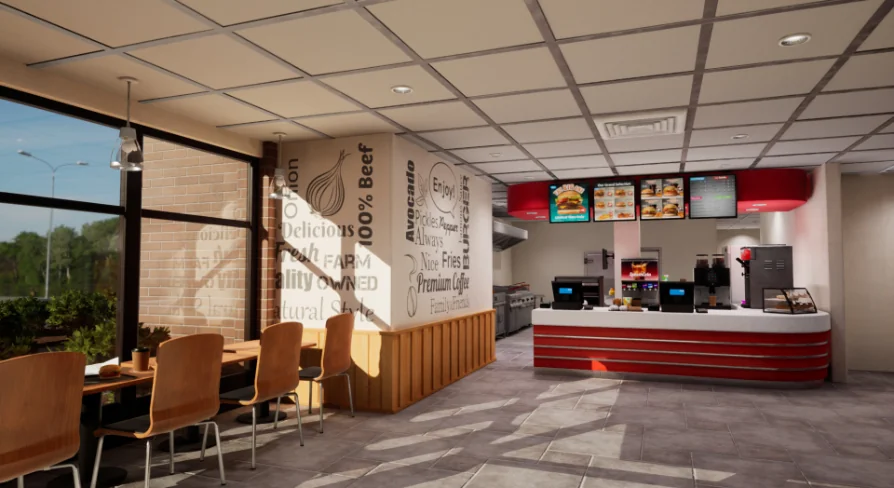
A fast food interior only feels convincing when the small pieces hold up alongside the larger environment. Seating, service areas, kitchen equipment, storage pieces, and food all need to read as part of the same place, while still being flexible enough to fit different layouts. This package approaches that need with a large collection of highly detailed and authentic assets aimed at creating a complete fast food restaurant scene.
The scope is not limited to one corner of the restaurant. It covers a wide range of furniture, kitchen equipment, and food, which makes it practical for scenes that need both customer-facing spaces and back-of-house areas. Tags connected to the package also point toward restaurant, kitchen, freezer, toilet, realistic, customizable, modular, and level-focused use, suggesting a set that can support more than a single hero shot.
Fast Food Restaurant assets across the whole scene
The most concrete strength here is variety across the kinds of objects a restaurant environment needs. Furniture handles the public side of the location, where tables, seating, and related pieces shape the identity of the space. Kitchen equipment pushes the set into preparation and service areas, helping the restaurant function as more than a decorated shell. Food assets add another layer, giving the scene the visual cues people immediately associate with a fast food setting.
That combination is useful for environment work that needs continuity from one room to the next. A restaurant can move from entry or dining space into kitchen zones, cold storage, and utility areas without relying on mismatched assets from different collections. The presence of tags such as freezer and toilet also points toward a broader environment package rather than a narrow collection focused only on dining tables or countertop props.
The realistic direction matters because fast food spaces tend to be visually familiar. If the furniture feels too generic or the food lacks detail, the illusion breaks quickly. Here, the emphasis stays on highly detailed and authentic assets, which makes the pack better suited to scenes that need to look recognizable at a glance.
Customizable Blueprints and material instances in active use
Beyond the asset count and theme, the package includes customizable Blueprints and material instances. That shifts it from being only a static set of props into something more adjustable inside production. Instead of treating every object as fixed, certain assets can be altered directly during scene work.
The editable properties called out most clearly are color, dirtiness, and edge wear. Those three controls can change how clean, old, or heavily used parts of the restaurant appear. A brighter, cleaner setup can suit a freshly maintained chain interior, while more dirt or edge wear can push the same location toward a busier, more worn-in look. Color adjustment also helps unify different sections of a restaurant or create visual distinction between branded areas, equipment groups, or interior accents.
Because these changes can be made on the fly, the package supports iteration rather than forcing artists to settle for one locked version of an object. That is especially useful in restaurant scenes, where repeating furniture or fixtures can become too uniform if every piece shares the exact same finish. Variation in wear and cleanliness can make the environment feel more lived in without changing the underlying set.
The modular and customizable tags reinforce that workflow. Even without introducing unstated technical claims, the package clearly leans toward flexible scene building rather than one-off placement.
Game-ready performance with LOD distances and collision meshes
Restaurant environments often place many assets in view at the same time. Seating, counters, kitchen surfaces, containers, food items, and utility pieces can quickly add up, so optimization becomes part of the package’s practical value. All assets here are optimized for games, with hand-picked LOD distances and custom collision meshes.
That tells you the pack is not only chasing visual density. It also accounts for in-engine use where objects must perform well enough to function in an interactive scene. Hand-picked LOD distances suggest attention to how assets transition across viewing ranges rather than relying on a one-size-fits-all setup. In a restaurant, this helps because some pieces stay in the background while others sit close to the camera near serving areas, tables, or kitchen stations.
Custom collision meshes also strengthen the package for playable spaces. Fast food interiors are usually navigated tightly, with lots of objects packed into limited floor area. Collision that matches the environment well is important when players move around counters, doors, furniture, and back-room equipment. The package is also noted as featuring high resolution textures suitable for first person games, which places extra emphasis on close viewing conditions. In first person scenes, surfaces and props are often examined from short distances, so texture quality has a direct impact on believability.
Where the food details become more useful
Food assets can easily become throwaway dressing in restaurant scenes, but the update details here make them more specific. Update 1.1 adds 10 meshes with textures and material instances. The added items are not broad categories but individual pieces that can help with more granular food assembly and visual variation.
The update includes:
3 individual single french fries
3 individual single chicken nuggets
1 separate melted cheese for the patties
1 cheese slice
1 uncooked beef patty
1 precooked chicken patty
These additions stand out because they support scenes at a smaller scale than a general food prop set would. Individual fries and nuggets can help break up repetition when arranging trays, countertops, preparation surfaces, or floor-level mess. Separate cheese and patty elements suggest more control over burger-related setup rather than depending on one fully combined model.
The difference between an uncooked beef patty and a precooked chicken patty also points toward kitchen-side staging, not just final serving presentation. That makes the food set useful in both customer-facing and preparation-focused scenes. A dining area, a service counter, and a kitchen workspace can all benefit from different states of food detail.
Since the added meshes come with textures and material instances, they stay aligned with the broader package workflow instead of feeling like isolated extras. They expand the restaurant’s visual storytelling through very specific components rather than through generic filler.
Restaurant, kitchen, freezer, and toilet scenes
The tag set helps clarify the kinds of environments this package can support. Restaurant and kitchen are the obvious center, but freezer and toilet broaden the likely footprint of the location. That suggests usefulness for teams building a complete fast food venue with multiple functional spaces instead of only a front counter and seating area.
For level work, that wider coverage matters. A believable restaurant often needs transitions between public and staff-only zones. The modular label also fits that kind of assembly, where the environment may be arranged to suit different layouts or scene scales. Some projects might need a compact interior, while others may benefit from a larger level that includes service rooms and support areas.
The realistic style keeps all of this grounded in a recognizable fast food setting rather than pushing toward stylization. Combined with first-person-suitable textures and game-focused optimization, the package fits projects where players are expected to move through the space, inspect surfaces up close, and notice how food, fixtures, and equipment relate to one another.
Teams that need a fast food restaurant with authentic detail, editable wear and color variation, and support for both broad environment building and close-up food placement will get the clearest benefit from this set.
 Interior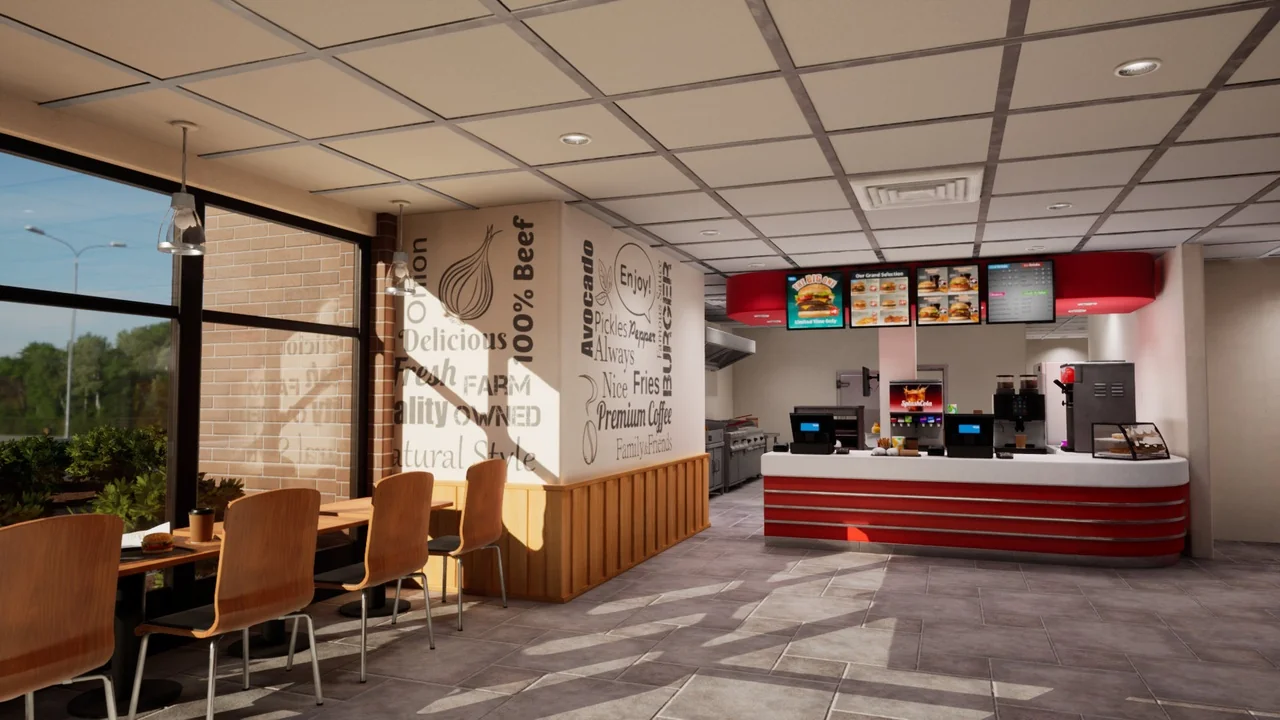
 Interior
 Interior
 Food & Drink