"7aa4acc705f0d80b"{"id":"1000088","slug":"restaurant-vol-1-food-prep-nanite-and-low-poly","title":"Restaurant VOL.1 - Food Prep (Nanite and Low Poly)","category":"Food \u0026 Drink","engine":"Engine Version: 5.1+","assetVersion":"Engine Version: 5.1+","engineVersion":"","tag":"Food \u0026 Drink","accent":"blue","visual":"mech","summary":"A realistic Unreal Engine restaurant food prep set with 180 meshes, Nanite and low poly versions, 4K textures, Lumen support, and modular counters.","platform":"Unreal Engine","publishedAt":"2026-06-06T17:49:02.444Z","updatedAt":"2026-06-06T17:49:02.444Z","sourceNotes":[],"fileContents":[],"compatibility":["Unreal Engine","Engine Version: 5.1+"],"featuredImage":{"alt":"Restaurant VOL.1 - Food Prep (Nanite and Low Poly)","src":"/wp-content/uploads/published/2026/06/3f8082a2808a-36a5da3b-8432-4840-b6d8-73a93fc71ef1-051d0587e9.webp"},"hasDownloadLink":true,"downloads":0,"terms":[{"taxonomy":"category","slug":"food-and-drink","name":"Food \u0026 Drink"}],"galleryImages":[{"src":"/wp-content/uploads/published/2026/06/681bf50eeb62-96bfb4db-226b-4173-8af8-6f483882e875-c13dc4f9d1.webp","alt":"Restaurant VOL.1 - Food Prep (Nanite and Low Poly)"},{"src":"/wp-content/uploads/published/2026/06/b23f277b1201-e68f7cf8-ba9f-4f7a-8c2b-a35f69f344ec-528ade7b20.webp","alt":"Restaurant VOL.1 - Food Prep (Nanite and Low Poly)"},{"src":"/wp-content/uploads/published/2026/06/134b42f24bc9-0858d3a1-de2e-418d-a6f8-542cb0a41556-2e6b36d9a4.webp","alt":"Restaurant VOL.1 - Food Prep (Nanite and Low Poly)"},{"src":"/wp-content/uploads/published/2026/06/c3ee423c13d9-7e52a072-65bf-4230-9f4d-de00159a1b27-999919c904.webp","alt":"Restaurant VOL.1 - Food Prep (Nanite and Low Poly)"},{"src":"/wp-content/uploads/published/2026/06/b413a10bbbc0-bc79b3ee-f004-453d-a185-e9bf5ef1875f-a863b175d3.webp","alt":"Restaurant VOL.1 - Food Prep (Nanite and Low Poly)"},{"src":"/wp-content/uploads/published/2026/06/0e12122b12c9-587844bf-bf89-45fb-9fa2-0887588736ce-7cbf2a6bd4.webp","alt":"Restaurant VOL.1 - Food Prep (Nanite and Low Poly)"},{"src":"/wp-content/uploads/published/2026/06/ba2c749cb746-55dcf81c-24bc-4026-ba00-6386edeb26f1-0f066650ee.webp","alt":"Restaurant VOL.1 - Food Prep (Nanite and Low Poly)"},{"src":"/wp-content/uploads/published/2026/06/4f00f1438f75-91768572-b43d-4a6c-a3a1-a0e25910c3d0-10b140d349.webp","alt":"Restaurant VOL.1 - Food Prep (Nanite and Low Poly)"},{"src":"/wp-content/uploads/published/2026/06/93dcc603d232-5414d812-bc89-4e74-a130-18353d81b31c-d1dadc2dfb.webp","alt":"Restaurant VOL.1 - Food Prep (Nanite and Low Poly)"},{"src":"/wp-content/uploads/published/2026/06/61ec83c78e88-6a0acd7d-47c1-4cc3-9a73-b5338e874b4e-5d479a2a09.webp","alt":"Restaurant VOL.1 - Food Prep (Nanite and Low Poly)"}],"accessPanel":{"kind":"resource","title":"Access this resource","eyebrow":"Free Download","message":"Log in or create a free account to start your download.","fileName":"Content.7z","safetyNote":"Resources are manually reviewed before listing to improve quality and reduce obvious risks.","actionLabel":"Download Free","resourceType":"Resource archive"},"contentHtml":"\u003cp\u003eA food prep area only works when it feels active from every angle. Refrigerators, shelves, pans, dishes, counters, and cooking-side utility pieces need to hold up not just in a still image, but across a playable space where the camera may move close, cut across surfaces, or look behind equipment. Restaurant VOL.1 - Food Prep (Nanite and Low Poly) approaches that kind of environment work as a complete Unreal Engine project element, with assets, maps, and materials created in the engine and aimed at realistic AAA quality visuals, style, and budget.\u003c/p\u003e \u003cp\u003eThe set covers a restaurant preparation theme with tags that point directly to its working environment: preparation, diner, restaurant, refrigerator, dishes, refrigeration, meal, pan, freezer, kitchen, food, cooking, and shelf. That makes it read less like a decorative collection and more like a production-ready group of props and scene pieces for the service side of a restaurant or commercial kitchen. The inclusion of everything pictured, together with the materials and maps, reinforces that this is meant to function as a cohesive scene set rather than a disconnected assortment.\u003c/p\u003e \u003ch2\u003eFood Prep scenes that hold up under close inspection\u003c/h2\u003e\n\u003cp\u003eThe visual target here is clearly realism. Each asset was created for realistic AAA quality visuals, and the pack leans on high-fidelity geometry through Nanite construction while also including low poly versions of the same meshes. That dual approach matters in food prep scenes because these spaces are often dense with objects. A refrigerator bank, stacked dishes, shelves, prep counters, and cookware can fill the frame quickly. Having both Nanite and low poly versions of each mesh gives teams a practical way to choose how each part of the environment is represented inside a project.\u003c/p\u003e \u003cp\u003eThe models are also fully detailed from all sides. In a restaurant prep area, that changes how assets can be placed. A shelf or refrigerator does not need to be treated as a one-direction backdrop piece, and a counter setup can be staged in more exposed layouts without immediately revealing unfinished surfaces. For teams blocking scenes in first-person, cinematic, or free-camera contexts, that all-around detail gives more flexibility when placing assets in open kitchen arrangements or service corridors.\u003c/p\u003e \u003cp\u003eAnother grounded detail is that all branding and labels are custom made by the studio. Inside a project, that removes the problem of recognizable real-world packaging or signage clashing with the rest of an original environment. It keeps the scene visually consistent while avoiding legal issues tied to branding.\u003c/p\u003e \u003ch2\u003eNanite and low poly versions across 180 meshes\u003c/h2\u003e\n\u003cp\u003eScale is one of the clearest strengths of the set. It includes 180 meshes, split between Nanite and low poly versions of each mesh. That number suggests a broad enough range to dress a substantial prep area with more than a handful of repeated hero assets. Since both versions are included, the collection is not locked into a single rendering approach.\u003c/p\u003e \u003cp\u003eNanite construction is used for high-quality fidelity polycounts. In scenes where the camera needs to capture the wear, silhouette, and physical presence of restaurant equipment and prep props at close range, that fidelity supports the realistic visual direction of the pack. At the same time, the low poly versions create another route for implementation. The set is explicitly optimized for games, and the presence of low poly alternatives aligns with that goal without forcing a single answer for every object in a level.\u003c/p\u003e \u003cp\u003eThat split is especially useful in a kitchen environment because not every asset carries the same visual burden. A foreground refrigerator or food prep station may justify the highest fidelity representation, while background shelf items or less critical layout pieces may be handled differently. The pack does not prescribe one rigid setup. It provides both versions of each mesh, leaving room for scene-specific choices.\u003c/p\u003e \u003ch2\u003eMaterial controls for Restaurant VOL.1 - Food Prep\u003c/h2\u003e\n\u003cp\u003eThe material side is set up to support broad scene management rather than one-off tweaking object by object. A master material setup controls the majority of props and models, which is important in an environment where many assets share a common visual language. If a team wants to tune surface response across a prep area, centralized material control is far easier to work with than isolated shader setups on every asset.\u003c/p\u003e \u003cp\u003eThere are also additional controls for roughness, albedo, normals, and more. Those controls give room to adjust how surfaces read under lighting without stepping away from the pack’s realistic look. In a kitchen or food prep scene, the balance of reflectivity and surface detail can heavily affect the result. Metal equipment, storage pieces, dish surfaces, and work counters all depend on believable material response. Roughness control in particular can make a major difference when trying to keep the scene grounded under bright practical lighting or a more cinematic setup.\u003c/p\u003e \u003cp\u003eThe texture sets are described as high quality and fidelity, with 4K textures included. That matches the pack’s emphasis on realistic presentation and all-around model detailing. The material pipeline also uses channel-packed Roughness, Metalness, and Ambient Occlusion. For teams evaluating how the set is structured inside Unreal Engine, that is a useful technical note because it points to an organized texture workflow instead of a loose collection of unrelated maps.\u003c/p\u003e \u003ch2\u003eModular kitchen counters and scene assembly\u003c/h2\u003e\n\u003cp\u003eOne of the most production-relevant pieces in the set is the modular kitchen counter collection. Food prep spaces are rarely convincing when they are built from a single static arrangement. Counters define workflow, movement, and line of sight inside the environment, so modularity matters. A modular kitchen counter set gives artists a way to shape the prep area to fit different layouts while keeping a consistent style across the scene.\u003c/p\u003e \u003cp\u003eThat flexibility pairs well with the wider object theme suggested by the included tags: refrigeration, freezer units, dishes, pans, shelves, and cooking-related items. Instead of treating the environment as a single showcase composition, the set supports assembly. Counters can establish the main working surfaces while surrounding equipment and props fill out the restaurant prep logic around them.\u003c/p\u003e \u003cp\u003eBecause the assets are fully detailed from all sides, modular placement becomes more forgiving. Counter islands, exposed back sections, and more open floor plans are easier to support when the pieces are not only built for front-facing presentation. In practical scene construction, that opens up more layouts for restaurant interiors that need to be walked through or filmed from multiple positions.\u003c/p\u003e \u003ch2\u003eLumen support, post process, and the final scene look\u003c/h2\u003e\n\u003cp\u003eThe pack supports Lumen for Unreal Engine 5.0+, which places it squarely inside a modern Unreal lighting workflow. For realistic restaurant interiors, lighting does much of the heavy lifting. Reflective kitchen materials, enclosed service spaces, refrigeration surfaces, and the layered depth of shelves and counters all benefit from a lighting solution that can carry subtle material variation and interior bounce.\u003c/p\u003e \u003cp\u003eVisual presentation is also reinforced with a realistic post process and a Look Up Table. That means the set is not only concerned with object creation, but also with the final scene read. In a food prep environment, the difference between a collection of accurate props and a convincing kitchen often comes down to how lighting, tone, and surface response work together. The included post process direction helps the assets land inside that realistic target.\u003c/p\u003e \u003cp\u003eSince the project includes assets, maps, and materials created in Unreal Engine, the implementation side stays closely tied to that engine workflow. The combination of Lumen support, master material controls, channel-packed texture inputs, and dual mesh versions gives teams several concrete hooks for bringing the set into a working scene rather than treating it as static content.\u003c/p\u003e \u003ch2\u003eWhat teams can evaluate quickly\u003c/h2\u003e\n\u003cp\u003eRestaurant VOL.1 - Food Prep (Nanite and Low Poly) is most useful when a project needs a realistic restaurant preparation space with enough depth to support close views, flexible layout work, and game-oriented scene building. The strongest practical points are easy to identify: 180 meshes, both Nanite and low poly versions of each mesh, 4K texture sets, a master material setup with additional surface controls, a modular kitchen counter set, full model detail from all sides, and Lumen support for Unreal Engine 5.0+.\u003c/p\u003e \u003cp\u003eFor teams comparing environment sets, the clearest takeaway is that this pack is not limited to a few hero props. It is structured as a fuller food prep scene resource, with the modular counters, rendering options, and realistic material workflow doing much of the heavy lifting.\u003c/p\u003e\n\n\u003ch2\u003eExplore Similar Assets\u003c/h2\u003e\n\u003cul\u003e\n\u003cli\u003e\u003ca href=\"https://3dcghub.com/food-scans/\" title=\"Food Scans\"\u003eFood Scans\u003c/a\u003e\u003c/li\u003e\n\u003cli\u003e\u003ca href=\"https://3dcghub.com/suburbs-vol-2-couches-and-sofas-nanite-and-low-poly/\" title=\"Suburbs VOL.2 - Couches and Sofas (Nanite and Low Poly)\"\u003eSuburbs VOL.2 - Couches and Sofas (Nanite and Low Poly)\u003c/a\u003e\u003c/li\u003e\n\u003cli\u003e\u003ca href=\"https://3dcghub.com/foliage-vol-24-farming-plants-low-poly/\" title=\"Foliage VOL.24 - Farming Plants (Low Poly)\"\u003eFoliage VOL.24 - Farming Plants (Low Poly)\u003c/a\u003e\u003c/li\u003e\n\u003cli\u003e\u003ca href=\"https://3dcghub.com/foliage-vol-6-broom-bushes-nanite-and-low-poly/\" title=\"Foliage VOL.6 - Broom Bushes (Nanite and Low Poly)\"\u003eFoliage VOL.6 - Broom Bushes (Nanite and Low Poly)\u003c/a\u003e\u003c/li\u003e\n\u003cli\u003e\u003ca href=\"https://3dcghub.com/foliage-vol-13-southern-oak-trees-nanite-and-low-poly/\" title=\"Foliage VOL.13 - Southern Oak Trees (Nanite and Low Poly)\"\u003eFoliage VOL.13 - Southern Oak Trees (Nanite and Low Poly)\u003c/a\u003e\u003c/li\u003e\n\u003c/ul\u003e","contentTextLength":9153,"navigation":{"current":1982,"total":3925,"previous":{"id":"1000089","slug":"retropunk-saloon-environment-post-apocalyptic-bar-post-apo-abandoned-saloon","title":"Retropunk Saloon Environment ( Post Apocalyptic Bar Post apo Abandoned Saloon )","category":"Desert","platform":"Unreal Engine","updatedAt":"2026-06-06T18:19:17.471Z"},"next":{"id":"1000087","slug":"ramen-restaurant-environment-ramen-restaurant-ramen-inter-or-exterior-cafe","title":"Ramen Restaurant Environment ( Ramen Restaurant Ramen Interıor Exterior Cafe )","category":"Streets \u0026 Construction","platform":"Unreal Engine","updatedAt":"2026-06-05T17:02:16.923Z"}},"relatedResources":[{"id":"1000665","slug":"restaurant-vol-3-dining-decor-nanite-and-low-poly","title":"Restaurant VOL.3 - Dining Decor (Nanite and Low Poly)","category":"Food \u0026 Drink","engine":"5.1+","assetVersion":"","engineVersion":"Engine Version: 5.1+","tag":"Food \u0026 Drink","accent":"blue","visual":"mech","summary":"Dekogon's restaurant dining decor pack delivers 84 unique meshes with Nanite and low-poly variants, 4K textures, master materials, and modular kitchen counters","platform":"Unreal Engine","publishedAt":"2026-07-22T06:58:56.056Z","updatedAt":"2026-07-22T06:58:56.056Z","sourceNotes":[],"fileContents":[],"compatibility":["Unreal Engine","Engine Version: 5.1+"],"featuredImage":{"alt":"Restaurant VOL.3 - Dining Decor (Nanite and Low Poly)","src":"/wp-content/uploads/published/2026/07/e265c8e860ac-c8e7e4f7-03dc-4e5a-ab92-08af6e43d331-6718232a29.webp"},"hasDownloadLink":true,"downloads":0},{"id":"3973","slug":"food-scans","title":"Food Scans","category":"Food \u0026 Drink","engine":"5.0+","assetVersion":"Engine version: 5.0+","engineVersion":"5.0","tag":"Food \u0026 Drink","accent":"blue","visual":"audio","summary":"Boost your project realism with 49 high-quality 3D food scans. Fully compatible with Unreal Engine 5.4, Nanite, and Lumen for professional results.","platform":"Unreal Engine","publishedAt":"2026-02-09T12:53:03.000Z","updatedAt":"2026-04-19T15:57:31.000Z","sourceNotes":[],"fileContents":[],"compatibility":["Unreal Engine","Engine version: 5.0+"],"featuredImage":{"alt":"Food Scans","src":"https://3dcghub.com/wp-content/uploads/2026/02/3f76e7cc-92a9-4af5-8fea-e81675886413.webp"},"hasDownloadLink":true,"downloads":0},{"id":"1000709","slug":"vehicles-vol-9-future-cars-low-poly","title":"Vehicles VOL.9- Future Cars (Low Poly)","category":"Cars \u0026 Trucks","engine":"5.3+","assetVersion":"","engineVersion":"Engine Version: 5.3+","tag":"Cars \u0026 Trucks","accent":"blue","visual":"mech","summary":"Seven futuristic low-poly car props with 4K textures, channel-packed maps, tintable paint, and Lumen support for Unreal Engine 5.0+.","platform":"Unreal Engine","publishedAt":"2026-07-24T02:11:02.648Z","updatedAt":"2026-10-21T04:23:37.954Z","sourceNotes":[],"fileContents":[],"compatibility":["Unreal Engine","Engine Version: 5.3+"],"featuredImage":{"alt":"Vehicles VOL.9- Future Cars (Low Poly)","src":"/wp-content/uploads/published/2026/07/1299c7959656-ce73ca95-e379-4b7d-9098-f38abd0ef20e-72885a4f92.webp"},"hasDownloadLink":true,"downloads":2}]}
Food & Drink
Restaurant VOL.1 - Food Prep (Nanite and Low Poly)
A realistic Unreal Engine restaurant food prep set with 180 meshes, Nanite and low poly versions, 4K textures, Lumen support, and modular counters.
A food prep area only works when it feels active from every angle. Refrigerators, shelves, pans, dishes, counters, and cooking-side utility pieces need to hold up not just in a still image, but across a playable space where the camera may move close, cut across surfaces, or look behind equipment. Restaurant VOL.1 - Food Prep (Nanite and Low Poly) approaches that kind of environment work as a complete Unreal Engine project element, with assets, maps, and materials created in the engine and aimed at realistic AAA quality visuals, style, and budget.
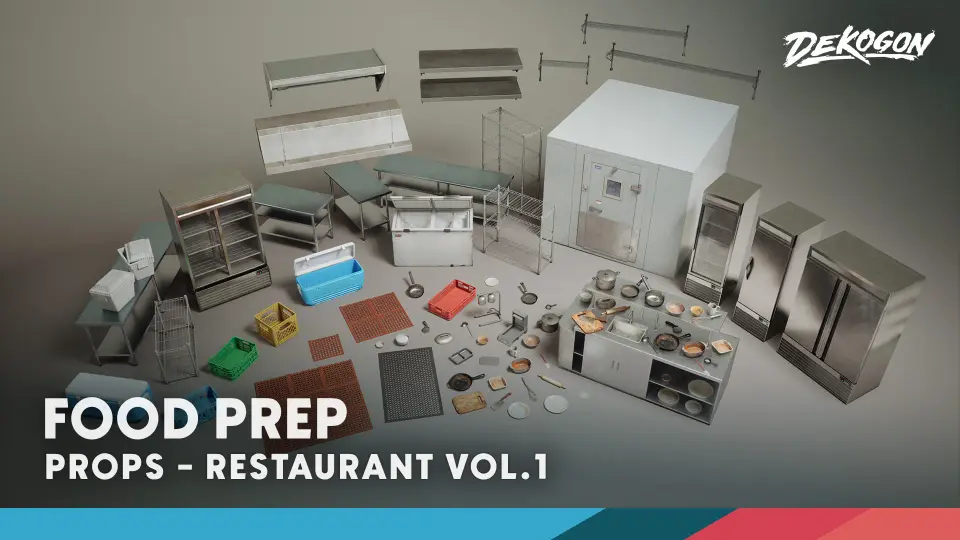
The set covers a restaurant preparation theme with tags that point directly to its working environment: preparation, diner, restaurant, refrigerator, dishes, refrigeration, meal, pan, freezer, kitchen, food, cooking, and shelf. That makes it read less like a decorative collection and more like a production-ready group of props and scene pieces for the service side of a restaurant or commercial kitchen. The inclusion of everything pictured, together with the materials and maps, reinforces that this is meant to function as a cohesive scene set rather than a disconnected assortment.
Food Prep scenes that hold up under close inspection
The visual target here is clearly realism. Each asset was created for realistic AAA quality visuals, and the pack leans on high-fidelity geometry through Nanite construction while also including low poly versions of the same meshes. That dual approach matters in food prep scenes because these spaces are often dense with objects. A refrigerator bank, stacked dishes, shelves, prep counters, and cookware can fill the frame quickly. Having both Nanite and low poly versions of each mesh gives teams a practical way to choose how each part of the environment is represented inside a project.
The models are also fully detailed from all sides. In a restaurant prep area, that changes how assets can be placed. A shelf or refrigerator does not need to be treated as a one-direction backdrop piece, and a counter setup can be staged in more exposed layouts without immediately revealing unfinished surfaces. For teams blocking scenes in first-person, cinematic, or free-camera contexts, that all-around detail gives more flexibility when placing assets in open kitchen arrangements or service corridors.
Another grounded detail is that all branding and labels are custom made by the studio. Inside a project, that removes the problem of recognizable real-world packaging or signage clashing with the rest of an original environment. It keeps the scene visually consistent while avoiding legal issues tied to branding.
Nanite and low poly versions across 180 meshes
Scale is one of the clearest strengths of the set. It includes 180 meshes, split between Nanite and low poly versions of each mesh. That number suggests a broad enough range to dress a substantial prep area with more than a handful of repeated hero assets. Since both versions are included, the collection is not locked into a single rendering approach.
Nanite construction is used for high-quality fidelity polycounts. In scenes where the camera needs to capture the wear, silhouette, and physical presence of restaurant equipment and prep props at close range, that fidelity supports the realistic visual direction of the pack. At the same time, the low poly versions create another route for implementation. The set is explicitly optimized for games, and the presence of low poly alternatives aligns with that goal without forcing a single answer for every object in a level.
That split is especially useful in a kitchen environment because not every asset carries the same visual burden. A foreground refrigerator or food prep station may justify the highest fidelity representation, while background shelf items or less critical layout pieces may be handled differently. The pack does not prescribe one rigid setup. It provides both versions of each mesh, leaving room for scene-specific choices.
Material controls for Restaurant VOL.1 - Food Prep
The material side is set up to support broad scene management rather than one-off tweaking object by object. A master material setup controls the majority of props and models, which is important in an environment where many assets share a common visual language. If a team wants to tune surface response across a prep area, centralized material control is far easier to work with than isolated shader setups on every asset.
There are also additional controls for roughness, albedo, normals, and more. Those controls give room to adjust how surfaces read under lighting without stepping away from the pack’s realistic look. In a kitchen or food prep scene, the balance of reflectivity and surface detail can heavily affect the result. Metal equipment, storage pieces, dish surfaces, and work counters all depend on believable material response. Roughness control in particular can make a major difference when trying to keep the scene grounded under bright practical lighting or a more cinematic setup.
The texture sets are described as high quality and fidelity, with 4K textures included. That matches the pack’s emphasis on realistic presentation and all-around model detailing. The material pipeline also uses channel-packed Roughness, Metalness, and Ambient Occlusion. For teams evaluating how the set is structured inside Unreal Engine, that is a useful technical note because it points to an organized texture workflow instead of a loose collection of unrelated maps.
Modular kitchen counters and scene assembly
One of the most production-relevant pieces in the set is the modular kitchen counter collection. Food prep spaces are rarely convincing when they are built from a single static arrangement. Counters define workflow, movement, and line of sight inside the environment, so modularity matters. A modular kitchen counter set gives artists a way to shape the prep area to fit different layouts while keeping a consistent style across the scene.
That flexibility pairs well with the wider object theme suggested by the included tags: refrigeration, freezer units, dishes, pans, shelves, and cooking-related items. Instead of treating the environment as a single showcase composition, the set supports assembly. Counters can establish the main working surfaces while surrounding equipment and props fill out the restaurant prep logic around them.
Because the assets are fully detailed from all sides, modular placement becomes more forgiving. Counter islands, exposed back sections, and more open floor plans are easier to support when the pieces are not only built for front-facing presentation. In practical scene construction, that opens up more layouts for restaurant interiors that need to be walked through or filmed from multiple positions.
Lumen support, post process, and the final scene look
The pack supports Lumen for Unreal Engine 5.0+, which places it squarely inside a modern Unreal lighting workflow. For realistic restaurant interiors, lighting does much of the heavy lifting. Reflective kitchen materials, enclosed service spaces, refrigeration surfaces, and the layered depth of shelves and counters all benefit from a lighting solution that can carry subtle material variation and interior bounce.
Visual presentation is also reinforced with a realistic post process and a Look Up Table. That means the set is not only concerned with object creation, but also with the final scene read. In a food prep environment, the difference between a collection of accurate props and a convincing kitchen often comes down to how lighting, tone, and surface response work together. The included post process direction helps the assets land inside that realistic target.
Since the project includes assets, maps, and materials created in Unreal Engine, the implementation side stays closely tied to that engine workflow. The combination of Lumen support, master material controls, channel-packed texture inputs, and dual mesh versions gives teams several concrete hooks for bringing the set into a working scene rather than treating it as static content.
What teams can evaluate quickly
Restaurant VOL.1 - Food Prep (Nanite and Low Poly) is most useful when a project needs a realistic restaurant preparation space with enough depth to support close views, flexible layout work, and game-oriented scene building. The strongest practical points are easy to identify: 180 meshes, both Nanite and low poly versions of each mesh, 4K texture sets, a master material setup with additional surface controls, a modular kitchen counter set, full model detail from all sides, and Lumen support for Unreal Engine 5.0+.
For teams comparing environment sets, the clearest takeaway is that this pack is not limited to a few hero props. It is structured as a fuller food prep scene resource, with the modular counters, rendering options, and realistic material workflow doing much of the heavy lifting.
 Food & Drink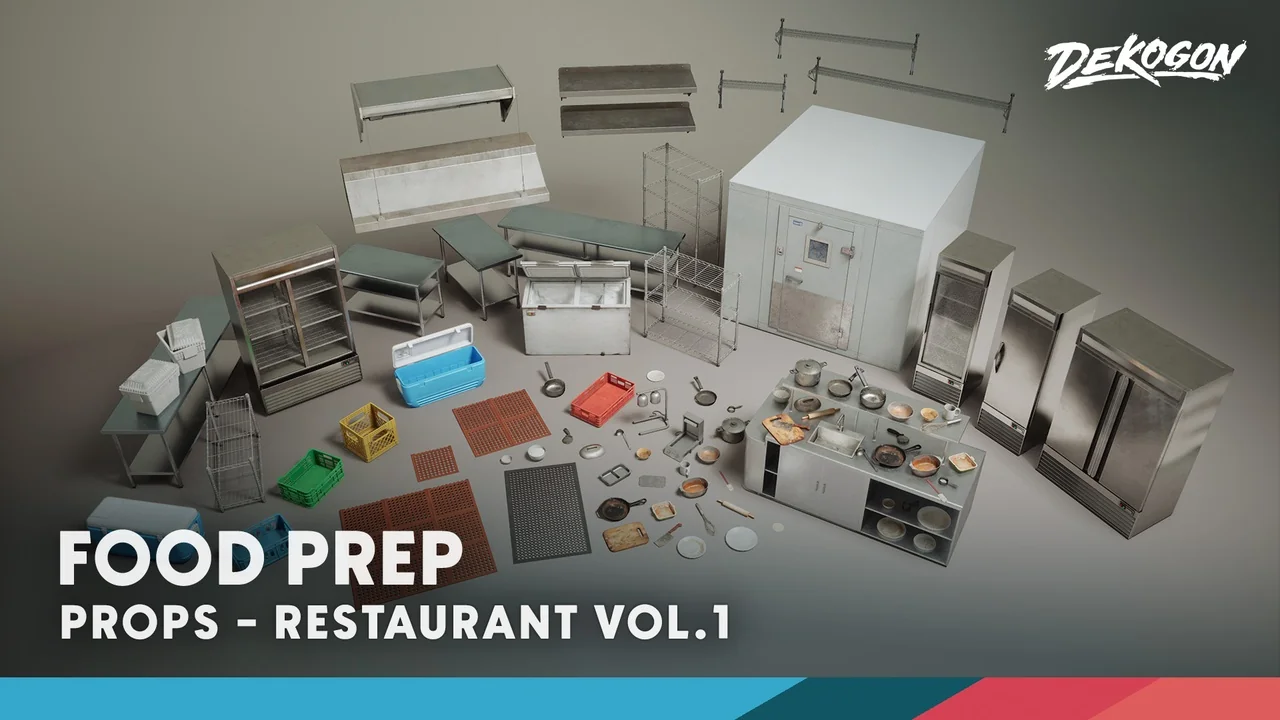
 Food & Drink
 Food & Drink
 Cars & Trucks