"f813c18d2170b1f6"{"id":"1000057","slug":"fantasy-dungeon","title":"Fantasy Dungeon","category":"Dungeon","engine":"4.26+,5.0+","assetVersion":"","engineVersion":"4.26+,5.0+","tag":"Dungeon","accent":"blue","visual":"mech","summary":"Fantasy Dungeon is a modular dungeon environment pack with more than 250 models for walls, doors, floors, roofs, columns, webs, bones, and sewage.","platform":"Unreal Engine","publishedAt":"2026-05-24T15:58:40.717Z","updatedAt":"2026-05-24T15:58:40.717Z","sourceNotes":[],"fileContents":[],"compatibility":["Unreal Engine","Engine version: 4.26+,5.0+"],"featuredImage":{"alt":"Fantasy Dungeon","src":"/wp-content/uploads/published/2026/05/4309900271c6-fc8ce794-915a-4be9-a88c-b073c63cf306-bf03fe4958.webp"},"hasDownloadLink":true,"downloads":2,"terms":[{"taxonomy":"category","slug":"dungeon","name":"Dungeon"}],"galleryImages":[{"src":"/wp-content/uploads/published/2026/05/479beeb83128-a25a82c1-d16e-4bc4-862e-732c847db288-c6963da920.webp","alt":"Fantasy Dungeon"},{"src":"/wp-content/uploads/published/2026/05/234427f8d60c-ed0acc85-42a8-4530-b88e-d97ba478ad41-b628730279.webp","alt":"Fantasy Dungeon"},{"src":"/wp-content/uploads/published/2026/05/67070d701c75-def93386-0899-4c7e-852c-4b3b9f62b9a8-0dfa21dddd.webp","alt":"Fantasy Dungeon"},{"src":"/wp-content/uploads/published/2026/05/9055de2f949c-fc774bd8-8db0-4334-ba25-abec3b8c1728-d1f9f69c46.webp","alt":"Fantasy Dungeon"},{"src":"/wp-content/uploads/published/2026/05/311e20c0a29f-b76cc716-bf1b-4439-8808-9ee9e16dbb01-7b337b325d.webp","alt":"Fantasy Dungeon"},{"src":"/wp-content/uploads/published/2026/05/ce0355e140ce-101b3591-4984-4853-a581-a3b13022eb4d-6abb84b99d.webp","alt":"Fantasy Dungeon"},{"src":"/wp-content/uploads/published/2026/05/ede1d1282f8b-1cc5d388-86e2-4763-bb9d-ded9b0af1f6d-581d967a64.webp","alt":"Fantasy Dungeon"},{"src":"/wp-content/uploads/published/2026/05/71c38b77ce26-0e294f32-777a-4f76-9b4d-d943d0d0da0c-142f457895.webp","alt":"Fantasy Dungeon"}],"accessPanel":{"kind":"resource","title":"Access this resource","eyebrow":"Free Download","message":"Log in or create a free account to start your download.","fileName":"Content.7z","safetyNote":"Resources are manually reviewed before listing to improve quality and reduce obvious risks.","actionLabel":"Download Free","resourceType":"Resource archive"},"contentHtml":"\u003cp\u003eFantasy Dungeon is aimed at the kind of scene work where a project needs dark interior spaces quickly: dungeon corridors, catacomb rooms, medieval chambers, and gothic level layouts assembled from repeatable parts. The pack centers on modular construction, giving environment work a clear starting point through a broad set of structural pieces and themed details rather than a small showcase selection.\u003c/p\u003e \u003cp\u003eThe set includes more than 250 high-quality models. Its range covers the basic shell of a dungeon environment with walls, doors, columns, floors, and roofs, then pushes further into mood-setting pieces such as web, bones, sewage, and more. That mix makes the pack useful not just for blocking out a space, but for carrying the same visual language into the details that make a dungeon feel inhabited, abandoned, or hostile.\u003c/p\u003e \u003ch2\u003eFantasy Dungeon as a modular level-building set\u003c/h2\u003e\n\u003cp\u003eThe strongest practical angle here is modular level assembly. The tags attached to the pack point toward modular workflows, fantasy themes, dungeon settings, gothic atmosphere, medieval styling, interior scenes, and catacomb-like spaces. In use, that means the resource is not limited to one hero room or one fixed environment. It is better understood as a collection of reusable parts that can be combined into different room sizes, hallways, connecting chambers, and layered interior arrangements.\u003c/p\u003e \u003cp\u003eWalls, floors, roofs, columns, and doors are the backbone of that approach. They define routes, vertical rhythm, entrances, and room boundaries. Once those are in place, secondary elements such as web, bones, and sewage help shift a layout away from clean modular construction and toward a more atmospheric dungeon look. The pack’s model selection supports both the structural and decorative sides of environment assembly, which is often the difference between a playable blockout and a scene that already carries its theme while still in active development.\u003c/p\u003e \u003cp\u003eThe gothic and medieval tags also help frame the kind of visual direction this set supports. Rather than a neutral stone kit, it is positioned for fantasy interiors with a darker tone. Catacomb scenes fit naturally into that range, but the same pieces can also serve prison-like passages, underground sanctuaries, crypt-adjacent rooms, and other enclosed fantasy locations where stone surfaces, repeated modules, and distressed detail all contribute to the setting.\u003c/p\u003e \u003ch2\u003eWhat the 250+ models cover in practice\u003c/h2\u003e\n\u003cp\u003eMore than 250 models is a meaningful number in a modular environment pack because coverage matters as much as theme. Here, the item types named directly are broad enough to suggest a full scene-building toolkit: walls for boundaries and corridor runs, doors for transitions and points of access, columns for support and visual breakup, floors for repeated surface coverage, roofs for enclosed spaces, and smaller thematic pieces such as web, bones, and sewage for environmental storytelling.\u003c/p\u003e \u003cp\u003eThat combination gives the pack a practical setup path. A creator can begin with the large architectural pieces to establish the footprint of a dungeon section, then work inward by adding columns to control silhouette repetition and door elements to define movement through the space. From there, the supporting props can be introduced to create signs of decay, age, infestation, or neglect. Webs and bones immediately shift the tone of a room, while sewage suggests harsher underground conditions and helps reinforce the idea that these spaces are not clean decorative halls but lived-in or abandoned understructures.\u003c/p\u003e \u003cp\u003eThe phrase “and much more” indicates the set extends beyond the named categories, but the reliable take is that the named pieces already form a complete enough group to start building without waiting for missing basics. The pack is presented as containing what is needed to begin, and the listed categories support that claim through a balanced spread of architecture and scene detail.\u003c/p\u003e \u003ch2\u003eUpdate01 and the move to geometry walls\u003c/h2\u003e\n\u003cp\u003eAn important implementation detail comes from Update01, which adds mesh walls with geometry. This was introduced in response to requests, and it changes how wall surfaces can be approached inside a project. The practical result is straightforward: beautiful walls can now be achieved without using Parallax Occlusion.\u003c/p\u003e \u003cp\u003eThat matters most for creators who want the wall look to come directly from the mesh variation itself instead of relying on that particular surface technique. In a modular dungeon set, walls carry much of the environment’s visual weight. They are repeated heavily, they are often close to the camera in interior scenes, and they do a lot of work in establishing whether a dungeon feels flat, heavy, carved, or layered. Adding geometry-based wall options gives builders another route for assembling those spaces while staying within the same asset pack.\u003c/p\u003e \u003cp\u003eBecause this change is specifically called out as an update, it stands as one of the clearest workflow-facing details in the pack. It is not just an extra model drop; it directly affects how users can construct visible wall surfaces and how they may choose to handle depth in those modular sections.\u003c/p\u003e \u003ch2\u003ePlacement notes that affect setup\u003c/h2\u003e\n\u003cp\u003eTwo cautions are explicitly attached to the pack, and both are worth treating as real setup considerations rather than minor footnotes.\u003c/p\u003e \u003cp\u003eFirst, some pivot points are not centered for easier placement. That means object origins are intentionally not always in the geometric middle of a mesh. In practice, this can be helpful during assembly because modules often need pivots placed where snapping, stacking, or edge alignment is more convenient. For creators laying out rooms and corridors, non-centered pivots can speed up placement when the pivot location matches how a piece is meant to connect to adjacent modules.\u003c/p\u003e \u003cp\u003eSecond, some meshes do not have polygons on the back side. The note specifically calls out walls, floors, roofs, and some props as examples. These can only be used as modules. This is a significant usage detail because it defines how the pieces should be handled in a scene: they are intended to form part of a larger constructed space, not to be treated as fully enclosed objects visible from every side.\u003c/p\u003e \u003cp\u003eIn a dungeon workflow, that limitation is not unusual for modular building pieces, but it does shape scene planning. If a wall section lacks a back side, it needs to be placed where that unseen side is not exposed. The same thinking applies to floors and roofs. The pack supports modular level construction most directly when pieces are used in the directional, assembled manner they were made for.\u003c/p\u003e \u003ch2\u003eWhere Fantasy Dungeon fits best\u003c/h2\u003e\n\u003cp\u003eFantasy Dungeon fits projects that need enclosed fantasy environments with a strong dungeon identity and enough variation to move from layout to atmosphere using one consistent set. Its tags point to modular level work, lowpoly styling, fantasy and dungeon themes, gothic and medieval mood, and interior or catacomb settings. Taken together, that makes the pack a natural fit for underground routes, chamber networks, and other interior-heavy spaces where architecture and dressing need to work together.\u003c/p\u003e \u003cp\u003eThe resource is especially suitable when the goal is not a single decorative room, but a system of connected spaces assembled from repeatable modules. The broad model count supports that kind of repeated use, while the added geometry walls offer a direct path for users who want strong wall surfaces without relying on Parallax Occlusion. The main practical point to keep in mind is how the modules are meant to be placed: some pivots are offset intentionally, and some pieces are open on the back side, so the pack works best when treated as a structured modular kit rather than a collection of all-angle standalone props.\u003c/p\u003e\n\n\u003ch2\u003eMore From The Same Workflow\u003c/h2\u003e\n\u003cul\u003e\n\u003cli\u003e\u003ca href=\"https://3dcghub.com/ancient-cave-ruins-ancient-temple-ruins-ancient-valley/\" title=\"Ancient Cave Ruins (Ancient Temple Ruins, Ancient Valley )\"\u003eAncient Cave Ruins (Ancient Temple Ruins, Ancient Valley )\u003c/a\u003e\u003c/li\u003e\n\u003cli\u003e\u003ca href=\"https://3dcghub.com/fantasy-cave-ruins/\" title=\"Fantasy Cave Ruins\"\u003eFantasy Cave Ruins\u003c/a\u003e\u003c/li\u003e\n\u003cli\u003e\u003ca href=\"https://3dcghub.com/modular-medieval-underground-prison-kit/\" title=\"Modular Medieval Underground Prison Kit\"\u003eModular Medieval Underground Prison Kit\u003c/a\u003e\u003c/li\u003e\n\u003cli\u003e\u003ca href=\"https://3dcghub.com/sharurs-gothic-dungeon/\" title=\"Sharur\u0026#039;s Gothic Dungeon\"\u003eSharur\u0026#039;s Gothic Dungeon\u003c/a\u003e\u003c/li\u003e\n\u003cli\u003e\u003ca href=\"https://3dcghub.com/the-caves/\" title=\"The Caves\"\u003eThe Caves\u003c/a\u003e\u003c/li\u003e\n\u003c/ul\u003e","contentTextLength":7949,"navigation":{"current":1737,"total":3651,"previous":{"id":"1000058","slug":"fast-food-restaurant","title":"Fast Food Restaurant","category":"Interior","platform":"Unreal Engine","updatedAt":"2026-05-26T16:32:43.627Z"},"next":{"id":"1000055","slug":"european-alleys","title":"European Alleys","category":"Cities","platform":"Unreal Engine","updatedAt":"2026-05-24T15:49:10.937Z"}},"relatedResources":[{"id":"1001465","slug":"old-catacombs","title":"Old Catacombs","category":"Dungeon","engine":"4.17+,5.0+","assetVersion":"","engineVersion":"Engine Version: 4.17+,5.0+","tag":"Dungeon","accent":"blue","visual":"mech","summary":"A modular 3D environment featuring rooms, stairs, doorways, and crypt props for first-person and top-down fantasy horror games.","platform":"Unreal Engine","publishedAt":"2026-10-08T07:55:21.087Z","updatedAt":"2026-10-08T07:55:21.087Z","sourceNotes":[],"fileContents":[],"compatibility":["Unreal Engine","Engine Version: 4.17+,5.0+"],"featuredImage":{"alt":"Old Catacombs","src":"/wp-content/uploads/published/2026/10/9f0cfba51da9-eae603c3-8946-4fb1-b475-5477d9704223-8afe798460.webp"},"hasDownloadLink":true,"downloads":0},{"id":"1000378","slug":"merlins-cave-environment-fantasy-dungeon-cave-fantasy-dungeon-cave-cave-cave","title":"Merlins Cave Environment ( Fantasy Dungeon Cave Fantasy Dungeon Cave Cave Cave )","category":"Dungeon","engine":"4.26+,5.0+","assetVersion":"","engineVersion":"Engine Version: 4.26+,5.0+","tag":"Dungeon","accent":"blue","visual":"city","summary":"A detailed breakdown of the Merlins Cave Environment, featuring 135 unique meshes, world-aligned materials, and the Ultimate Level Art Tool for modular level de","platform":"Unreal Engine","publishedAt":"2026-07-06T18:41:47.502Z","updatedAt":"2026-07-06T18:41:47.502Z","sourceNotes":[],"fileContents":[],"compatibility":["Unreal Engine","Engine Version: 4.26+,5.0+"],"featuredImage":{"alt":"Merlins Cave Environment ( Fantasy Dungeon Cave Fantasy Dungeon Cave Cave Cave )","src":"/wp-content/uploads/published/2026/07/87649763adde-a91ad985-ca50-4949-a2bd-274c7f9ed342-b848070cb4.webp"},"hasDownloadLink":true,"downloads":1},{"id":"27336","slug":"ancient-cave-ruins-ancient-temple-ruins-ancient-valley","title":"Ancient Cave Ruins (Ancient Temple Ruins, Ancient Valley )","category":"Dungeon","engine":"4.26+,5.0+","assetVersion":"Engine version: 4.26+,5.0+","engineVersion":"","tag":"Dungeon","accent":"blue","visual":"city","summary":"Ancient Cave Ruins focuses on stone-heavy cave and ruin pieces for fantasy spaces above or below ground. Its mix of cliffs, rocks, columns, slabs, Blueprint meshes, and landscape handling gives the scene a practical starting point.","platform":"Unreal Engine","publishedAt":"2026-04-24T06:21:26.000Z","updatedAt":"2026-04-24T06:21:28.000Z","sourceNotes":[],"fileContents":[],"compatibility":["Unreal Engine","Engine version: 4.26+,5.0+"],"featuredImage":{"alt":"Ancient Cave Ruins (Ancient Temple Ruins, Ancient Valley )","src":"https://3dcghub.com/wp-content/uploads/2026/04/df0c90184d5e_562c282a-fccc-4389-bd9c-084caf5e1f98.webp"},"hasDownloadLink":true,"downloads":0}]}
Dungeon
Fantasy Dungeon
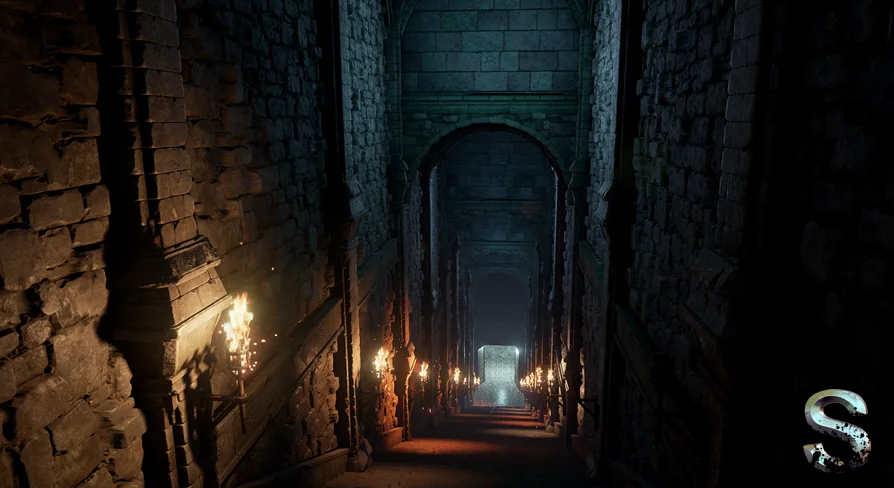
Fantasy Dungeon is a modular dungeon environment pack with more than 250 models for walls, doors, floors, roofs, columns, webs, bones, and sewage.
Category:Unreal Engine,DungeonPlatform: Unreal EngineEngine version: 4.26+,5.0+Published: May 24, 2026
Dungeon
Resource overview
Fantasy Dungeon is aimed at the kind of scene work where a project needs dark interior spaces quickly: dungeon corridors, catacomb rooms, medieval chambers, and gothic level layouts assembled from repeatable parts. The pack centers on modular construction, giving environment work a clear starting point through a broad set of structural pieces and themed details rather than a small showcase selection.
The set includes more than 250 high-quality models. Its range covers the basic shell of a dungeon environment with walls, doors, columns, floors, and roofs, then pushes further into mood-setting pieces such as web, bones, sewage, and more. That mix makes the pack useful not just for blocking out a space, but for carrying the same visual language into the details that make a dungeon feel inhabited, abandoned, or hostile.
Fantasy Dungeon as a modular level-building set
The strongest practical angle here is modular level assembly. The tags attached to the pack point toward modular workflows, fantasy themes, dungeon settings, gothic atmosphere, medieval styling, interior scenes, and catacomb-like spaces. In use, that means the resource is not limited to one hero room or one fixed environment. It is better understood as a collection of reusable parts that can be combined into different room sizes, hallways, connecting chambers, and layered interior arrangements.
Walls, floors, roofs, columns, and doors are the backbone of that approach. They define routes, vertical rhythm, entrances, and room boundaries. Once those are in place, secondary elements such as web, bones, and sewage help shift a layout away from clean modular construction and toward a more atmospheric dungeon look. The pack’s model selection supports both the structural and decorative sides of environment assembly, which is often the difference between a playable blockout and a scene that already carries its theme while still in active development.
The gothic and medieval tags also help frame the kind of visual direction this set supports. Rather than a neutral stone kit, it is positioned for fantasy interiors with a darker tone. Catacomb scenes fit naturally into that range, but the same pieces can also serve prison-like passages, underground sanctuaries, crypt-adjacent rooms, and other enclosed fantasy locations where stone surfaces, repeated modules, and distressed detail all contribute to the setting.
What the 250+ models cover in practice
More than 250 models is a meaningful number in a modular environment pack because coverage matters as much as theme. Here, the item types named directly are broad enough to suggest a full scene-building toolkit: walls for boundaries and corridor runs, doors for transitions and points of access, columns for support and visual breakup, floors for repeated surface coverage, roofs for enclosed spaces, and smaller thematic pieces such as web, bones, and sewage for environmental storytelling.
That combination gives the pack a practical setup path. A creator can begin with the large architectural pieces to establish the footprint of a dungeon section, then work inward by adding columns to control silhouette repetition and door elements to define movement through the space. From there, the supporting props can be introduced to create signs of decay, age, infestation, or neglect. Webs and bones immediately shift the tone of a room, while sewage suggests harsher underground conditions and helps reinforce the idea that these spaces are not clean decorative halls but lived-in or abandoned understructures.
The phrase “and much more” indicates the set extends beyond the named categories, but the reliable take is that the named pieces already form a complete enough group to start building without waiting for missing basics. The pack is presented as containing what is needed to begin, and the listed categories support that claim through a balanced spread of architecture and scene detail.
Update01 and the move to geometry walls
An important implementation detail comes from Update01, which adds mesh walls with geometry. This was introduced in response to requests, and it changes how wall surfaces can be approached inside a project. The practical result is straightforward: beautiful walls can now be achieved without using Parallax Occlusion.
That matters most for creators who want the wall look to come directly from the mesh variation itself instead of relying on that particular surface technique. In a modular dungeon set, walls carry much of the environment’s visual weight. They are repeated heavily, they are often close to the camera in interior scenes, and they do a lot of work in establishing whether a dungeon feels flat, heavy, carved, or layered. Adding geometry-based wall options gives builders another route for assembling those spaces while staying within the same asset pack.
Because this change is specifically called out as an update, it stands as one of the clearest workflow-facing details in the pack. It is not just an extra model drop; it directly affects how users can construct visible wall surfaces and how they may choose to handle depth in those modular sections.
Placement notes that affect setup
Two cautions are explicitly attached to the pack, and both are worth treating as real setup considerations rather than minor footnotes.
First, some pivot points are not centered for easier placement. That means object origins are intentionally not always in the geometric middle of a mesh. In practice, this can be helpful during assembly because modules often need pivots placed where snapping, stacking, or edge alignment is more convenient. For creators laying out rooms and corridors, non-centered pivots can speed up placement when the pivot location matches how a piece is meant to connect to adjacent modules.
Second, some meshes do not have polygons on the back side. The note specifically calls out walls, floors, roofs, and some props as examples. These can only be used as modules. This is a significant usage detail because it defines how the pieces should be handled in a scene: they are intended to form part of a larger constructed space, not to be treated as fully enclosed objects visible from every side.
In a dungeon workflow, that limitation is not unusual for modular building pieces, but it does shape scene planning. If a wall section lacks a back side, it needs to be placed where that unseen side is not exposed. The same thinking applies to floors and roofs. The pack supports modular level construction most directly when pieces are used in the directional, assembled manner they were made for.
Where Fantasy Dungeon fits best
Fantasy Dungeon fits projects that need enclosed fantasy environments with a strong dungeon identity and enough variation to move from layout to atmosphere using one consistent set. Its tags point to modular level work, lowpoly styling, fantasy and dungeon themes, gothic and medieval mood, and interior or catacomb settings. Taken together, that makes the pack a natural fit for underground routes, chamber networks, and other interior-heavy spaces where architecture and dressing need to work together.
The resource is especially suitable when the goal is not a single decorative room, but a system of connected spaces assembled from repeatable modules. The broad model count supports that kind of repeated use, while the added geometry walls offer a direct path for users who want strong wall surfaces without relying on Parallax Occlusion. The main practical point to keep in mind is how the modules are meant to be placed: some pivots are offset intentionally, and some pieces are open on the back side, so the pack works best when treated as a structured modular kit rather than a collection of all-angle standalone props.
 Dungeon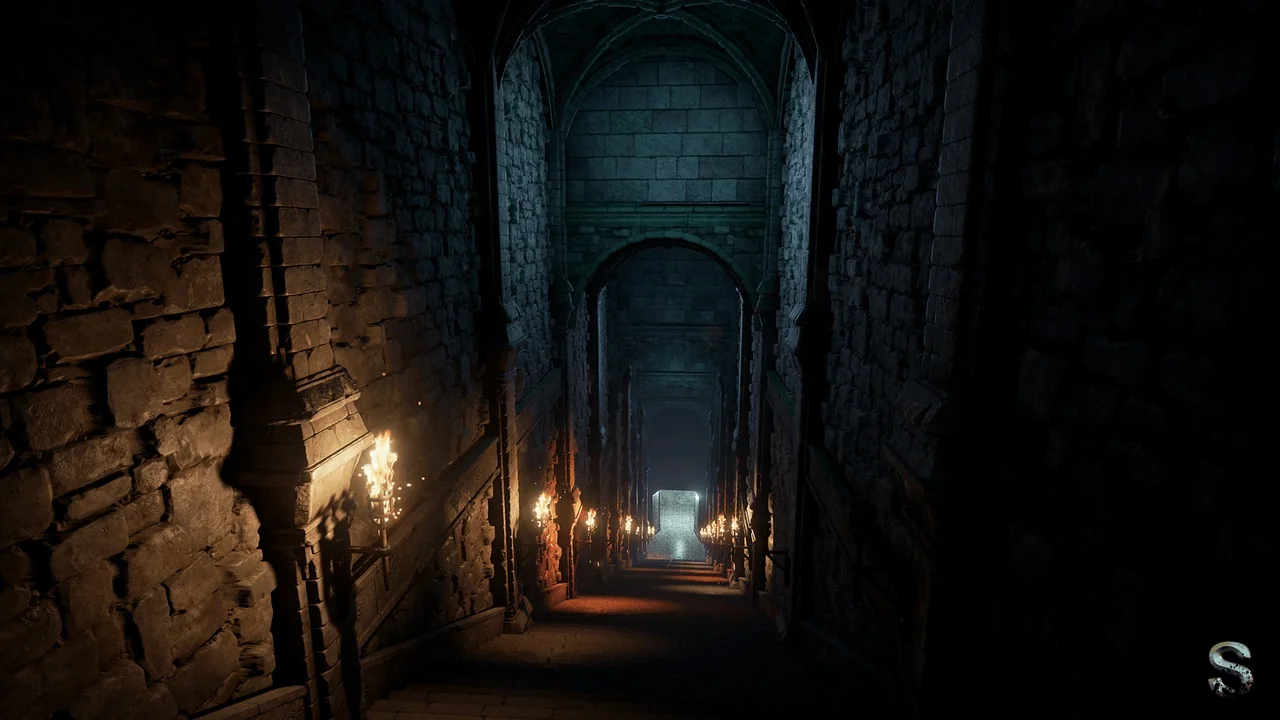
 Dungeon
 Dungeon
 Dungeon