"6c6413bef81af556"{"id":"1000817","slug":"easy-nameplate","title":"Easy Nameplate","category":"Characters \u0026 Creatures","engine":"5.0+","assetVersion":"","engineVersion":"Engine Version: 5.0+","tag":"Characters","accent":"blue","visual":"character","summary":"Easy Nameplate is a network-replicated nameplate display system for multiplayer and NPC scenes, optimized to skip event ticks and support custom distance cullin","platform":"Unreal Engine","publishedAt":"2026-07-31T11:25:26.400Z","updatedAt":"2026-07-31T11:25:26.400Z","sourceNotes":[],"fileContents":[],"compatibility":["Unreal Engine","Engine Version: 5.0+"],"featuredImage":{"alt":"Easy Nameplate","src":"/wp-content/uploads/published/2026/07/8f13e5f54944-b04bb91d-f6d7-4305-be8c-931c89b38f3a-71777a83d0.webp"},"hasDownloadLink":true,"downloads":1,"terms":[{"taxonomy":"category","slug":"characters-and-creatures","name":"Characters \u0026 Creatures"}],"galleryImages":[{"src":"/wp-content/uploads/published/2026/07/9d5ff03664b8-353408f3-9f81-44ef-be05-2d2275856ccd-17942f943c.webp","alt":"Easy Nameplate"},{"src":"/wp-content/uploads/published/2026/07/684d35e99109-71105f1d-82b8-485f-92da-330a7cb7c244-01422f1502.webp","alt":"Easy Nameplate"},{"src":"/wp-content/uploads/published/2026/07/471bc1e39b33-6f45cd67-c8e1-492b-925f-dd984ffdf180-42601162e5.webp","alt":"Easy Nameplate"}],"accessPanel":{"kind":"resource","title":"Download this resource","eyebrow":"Free Download","message":"Log in or create a free account to start your download.","fileName":"Content.7z","safetyNote":"Resources are manually reviewed before listing to improve quality and reduce obvious risks.","actionLabel":"Download Free","resourceType":"Resource archive"},"contentHtml":"\u003cp\u003eMultiplayer RPG projects and densely populated NPC scenes live or die by how cleanly identity information is delivered to the player. A name floating above a character seems small, but in a networked environment with dozens of Actors it becomes a question of replication overhead, visibility logic, and update frequency. \u003cem\u003eEasy Nameplate\u003c/em\u003e addresses that problem at the system level rather than treating labels as a decoration stapled onto characters after the fact.\u003c/p\u003e\n\n\u003ch2\u003eWhere Easy Nameplate Fits in a Scene or Server\u003c/h2\u003e\n\u003cp\u003eThe resource is a nameplate display system intended for multiplayer games or NPC setups. That positioning matters because most lightweight label plugins assume a single-player context where the Client can draw text without worrying about authoritative state. \u003cem\u003eEasy Nameplate\u003c/em\u003e is structured through the idea that the Server and connected Clients need to agree on which name belongs to which Actor, which means the display logic has to respect Network Replication rather than fight it.\u003c/p\u003e\n\n\u003cp\u003eFor RPG scenes, this covers the obvious cases: guards standing at gate posts, vendors in a marketplace, party members moving through a dungeon, and hostile mobs whose names should communicate faction or rank. It also covers any situation where a player needs to read identity at a glance without pulling up a tooltip or targeting reticle. Because the system ties into Steam Gametags, the identity layer can lean on platform-level player metadata instead of requiring a custom name-resolution pipeline that runs in parallel.\u003c/p\u003e\n\n\u003ch2\u003eNo Event Tick and the Performance Reasoning Behind It\u003c/h2\u003e\n\u003cp\u003eOne of the defining technical choices is that the project runs with no \u003ccode\u003eEvent Tick\u003c/code\u003e. Inside a project, the nameplate does not spin a per-frame update loop to check distance, toggle visibility, or refresh text. \u003ccode\u003eEvent Tick\u003c/code\u003e nodes are often the first thing that creeps into a nameplate implementation because it feels straightforward to poll each frame: Is the player close enough? Is the Actor on screen? Should the text shrink or fade? \u003cem\u003eEasy Nameplate\u003c/em\u003e avoids that pattern entirely.\u003c/p\u003e\n\n\u003cp\u003eThe payoff is most visible in scenes with a high Actor count. A town square filled with NPCs, a raid boss encounter with multiple named enemies, or a social hub with dozens of players milling around can all generate enough per-frame checks to register on a Profiler. By removing the \u003ccode\u003eEvent Tick\u003c/code\u003e, the system pushes distance and visibility logic onto event-driven or engine-native mechanisms rather than a manual polling loop. That keeps the nameplate display from compounding into a performance bottleneck as a scene grows.\u003c/p\u003e\n\n\u003ch2\u003eCustom Distance Display and Readability Control\u003c/h2\u003e\n\u003cp\u003eBeyond \u003ccode\u003eEvent Tick\u003c/code\u003e avoidance, the system exposes custom distance display. That gives a designer direct control over how close a viewer needs to be before a nameplate appears or becomes relevant. In an open-world RPG, this can be set so that distant NPCs do not clutter the horizon with floating text. In a tighter multiplayer arena, the distance can be tuned so that opponents are readable across the playable space without overwhelming the screen.\u003c/p\u003e\n\n\u003cp\u003eDistance-based display is particularly useful for scenes where the player needs to parse a crowd selectively. A market vendor the player is actively trading with might warrant a nameplate at a longer range than a background NPC walking past. The custom distance parameter lets that tuning happen without rewriting the underlying display logic for each Actor class. It also reinforces the no-tick philosophy: the visibility threshold is checked against a configured value through a mechanism that is not a manual per-frame poll.\u003c/p\u003e\n\n\u003ch3\u003eNetwork Replication and Steam Gametags\u003c/h3\u003e\n\u003cp\u003eThe project is Network Replicated, which is the non-negotiable core for any multiplayer label system. Replication here means that the authoritative state behind a nameplate—the Actor it is attached to and the identity it should display—is consistent across the Server and Clients. A Client does not independently invent a name, and the Server does not need to manually push a text string every frame. The replicated design keeps the display state synchronized without the traffic overhead that a naive implementation would generate.\u003c/p\u003e\n\n\u003cp\u003eTying into Steam Gametags adds a platform-specific identity layer. For projects shipping on Steam, this means the nameplate can reflect the player's platform identity rather than an internally stored string that has to be maintained separately. That integration is narrow and deliberate: it does not claim generic Online Subsystem support across every platform, but it does provide a clear path for projects already using Steam as their multiplayer backend. The Gametag linkage is what turns the nameplate from a generic label into a representation of an actual connected player.\u003c/p\u003e\n\n\u003ch2\u003eBlueprint Composition and Tags That Signal Scope\u003c/h2\u003e\n\u003cp\u003e\u003cem\u003eEasy Nameplate\u003c/em\u003e is delivered as a Blueprint-based project, with the associated tags pointing to how it is meant to be used and extended. The relevant tags—\u003cem\u003eCharacter\u003c/em\u003e, \u003cem\u003eMultiplayer\u003c/em\u003e, \u003cem\u003eName\u003c/em\u003e, \u003cem\u003eScript\u003c/em\u003e, \u003cem\u003eOrnament\u003c/em\u003e, \u003cem\u003eRPG\u003c/em\u003e, \u003cem\u003eNameplate\u003c/em\u003e, \u003cem\u003eBlueprint\u003c/em\u003e, and \u003ccode\u003eAnimation Blueprint\u003c/code\u003e—describe a resource that sits at the intersection of character presentation and scripted display logic. The \u003cem\u003eBlueprint\u003c/em\u003e tag signals that the system is composable inside an existing Unreal Engine project rather than being a compiled plugin that requires a rebuild. The \u003ccode\u003eAnimation Blueprint\u003c/code\u003e tag in the same set indicates that the nameplate logic is meant to coexist with character animation graphs rather than operate as an isolated UI element.\u003c/p\u003e\n\n\u003cp\u003eFor a workflow, that means a developer can integrate the system into a character Blueprint or Animation Blueprint setup without pulling in a heavy dependency. The nameplate becomes part of the character's presentation layer, tied to replicated state and distance logic, while the animation graph continues to handle movement and locomotion. The \u003cem\u003eOrnament\u003c/em\u003e tag reinforces that the nameplate is treated as a presentational element attached to the character, not a separate HUD Widget that floats in screen space and has to be manually repositioned.\u003c/p\u003e\n\n\u003ch3\u003eWhat an RPG or Multiplayer Team Gets Out of It\u003c/h3\u003e\n\u003cp\u003eAn RPG or multiplayer team evaluating this resource gets a few specific things:\u003c/p\u003e\n\u003cul\u003e\n \u003cli\u003e\u003cstrong\u003eNetworked correctness:\u003c/strong\u003e A nameplate system designed from the ground up for multiplayer replication, solving the hardest part before implementation.\u003c/li\u003e\n \u003cli\u003e\u003cstrong\u003eNo-\u003ccode\u003eEvent Tick\u003c/code\u003e design:\u003c/strong\u003e Keeps the display logic from becoming a per-frame performance cost as Actor counts rise.\u003c/li\u003e\n \u003cli\u003e\u003cstrong\u003eConfigurable distance display:\u003c/strong\u003e Lets scene designers tune readability and view distances without touching code.\u003c/li\u003e\n \u003cli\u003e\u003cstrong\u003eSteam Gametag integration:\u003c/strong\u003e Connects displayed names directly to the player's platform identity rather than an arbitrary string.\u003c/li\u003e\n\u003c/ul\u003e\n\n\u003cp\u003eThe practical takeaway is that \u003cem\u003eEasy Nameplate\u003c/em\u003e is not a visual label widget or a text-rendering aesthetic pack. It is a systems-level nameplate implementation aimed at projects where replication, distance culling, and platform identity are the actual problems. Teams building a multiplayer RPG, a social hub, or any NPC-driven scene where names matter at scale can use it as the display backbone and then tune the distance and visibility parameters to fit their specific environment.\u003c/p\u003e\n\n\u003ch2\u003eContinue Browsing Similar Packs\u003c/h2\u003e\n\u003cul\u003e\n\u003cli\u003e\u003ca href=\"https://3dcghub.com/modular-medieval-npc-metahuman-male-female/\" title=\"Modular Medieval NPC - Metahuman - Male/Female\"\u003eModular Medieval NPC - Metahuman - Male/Female\u003c/a\u003e\u003c/li\u003e\n\u003cli\u003e\u003ca href=\"https://3dcghub.com/western-npc-metahuman/\" title=\"Western NPC - Metahuman\"\u003eWestern NPC - Metahuman\u003c/a\u003e\u003c/li\u003e\n\u003cli\u003e\u003ca href=\"https://3dcghub.com/goofy-npc/\" title=\"Goofy NPC\"\u003eGoofy NPC\u003c/a\u003e\u003c/li\u003e\n\u003cli\u003e\u003ca href=\"https://3dcghub.com/hydra/\" title=\"Hydra\"\u003eHydra\u003c/a\u003e\u003c/li\u003e\n\u003cli\u003e\u003ca href=\"https://3dcghub.com/ue5-rigged-npc-creator/\" title=\"UE5 Rigged NPC Creator\"\u003eUE5 Rigged NPC Creator\u003c/a\u003e\u003c/li\u003e\n\u003c/ul\u003e","contentTextLength":7293,"navigation":{"current":407,"total":3140,"previous":{"id":"1000818","slug":"easyxmlparser","title":"EasyXMLParser","category":"Engine Tools","platform":"Unreal Engine","updatedAt":"2026-07-31T11:29:36.777Z"},"next":{"id":"1000816","slug":"easy-decal-roads-rvt","title":"Easy Decal Roads RVT","category":"Procedural Systems","platform":"Unreal Engine","updatedAt":"2026-07-31T11:21:41.063Z"}},"relatedResources":[{"id":"1000904","slug":"visai-companion-modern-ai-framework","title":"VisAI - Companion - Modern AI Framework","category":"Characters \u0026 Creatures","engine":"4.26+,5.0+","assetVersion":"","engineVersion":"Engine Version: 4.26+,5.0+","tag":"Characters","accent":"blue","visual":"character","summary":"Modern multiplayer-ready AI framework for RPGs with relationship-driven companion behavior, command UI, interaction system, and detailed example map.","platform":"Unreal Engine","publishedAt":"2026-08-06T05:14:19.512Z","updatedAt":"2026-08-06T05:14:19.512Z","sourceNotes":[],"fileContents":[],"compatibility":["Unreal Engine","Engine Version: 4.26+,5.0+"],"featuredImage":{"alt":"VisAI - Companion - Modern AI Framework","src":"/wp-content/uploads/published/2026/08/f36621fe8598-3cb25636-0a21-4666-aa5a-30c1a53d8a4a-1dee5f108d.webp"},"hasDownloadLink":true,"downloads":0},{"id":"1000853","slug":"multiplayer-ready-wallrunning-third-person-template","title":"Multiplayer ready wallrunning Third person Template","category":"Characters \u0026 Creatures","engine":"4.27,5.0+","assetVersion":"","engineVersion":"Engine Version: 4.27,5.0+","tag":"Characters","accent":"blue","visual":"character","summary":"Third person wallrunning template, multiplayer-ready. Blueprints scan surfaces ahead and beside the character, applying animation and movement impulses.","platform":"Unreal Engine","publishedAt":"2026-08-04T16:50:53.294Z","updatedAt":"2026-08-04T16:50:53.294Z","sourceNotes":[],"fileContents":[],"compatibility":["Unreal Engine","Engine Version: 4.27,5.0+"],"featuredImage":{"alt":"Multiplayer ready wallrunning Third person Template","src":"/wp-content/uploads/published/2026/08/e4a7d50a2561-9b0c8a30-0715-4c39-95ae-c03ab28ba455-0c3465b874.webp"},"hasDownloadLink":true,"downloads":0},{"id":"1000651","slug":"modular-medieval-npc-metahuman-male-female","title":"Modular Medieval NPC - Metahuman - Male/Female","category":"Characters \u0026 Creatures","engine":"5.0+","assetVersion":"","engineVersion":"Engine Version: 5.0+","tag":"Characters","accent":"blue","visual":"character","summary":"Modular medieval NPC system with MetaHuman support, parametric clothing, UE5 Mannequin rig conversion, and Blueprints for NPCs, player characters, and an in-gam","platform":"Unreal Engine","publishedAt":"2026-07-21T19:10:45.900Z","updatedAt":"2026-07-21T19:10:45.900Z","sourceNotes":[],"fileContents":[],"compatibility":["Unreal Engine","Engine Version: 5.0+"],"featuredImage":{"alt":"Modular Medieval NPC - Metahuman - Male/Female","src":"/wp-content/uploads/published/2026/07/b9a07620d89f-a159ceef-b6c6-4ed0-b507-e0154e526184-0f8e05b036.webp"},"hasDownloadLink":true,"downloads":4}]}
Characters
Easy Nameplate
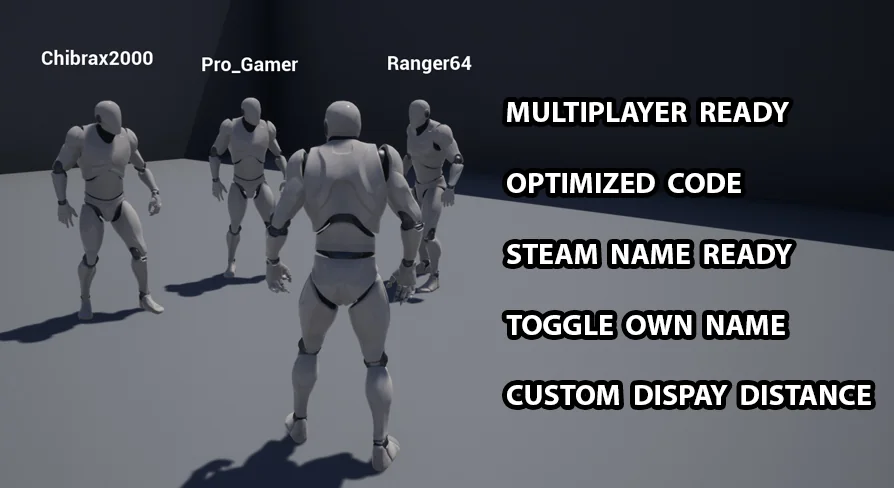
Easy Nameplate is a network-replicated nameplate display system for multiplayer and NPC scenes, optimized to skip event ticks and support custom distance cullin
Multiplayer RPG projects and densely populated NPC scenes live or die by how cleanly identity information is delivered to the player. A name floating above a character seems small, but in a networked environment with dozens of Actors it becomes a question of replication overhead, visibility logic, and update frequency. Easy Nameplate addresses that problem at the system level rather than treating labels as a decoration stapled onto characters after the fact.
Where Easy Nameplate Fits in a Scene or Server
The resource is a nameplate display system intended for multiplayer games or NPC setups. That positioning matters because most lightweight label plugins assume a single-player context where the Client can draw text without worrying about authoritative state. Easy Nameplate is structured through the idea that the Server and connected Clients need to agree on which name belongs to which Actor, which means the display logic has to respect Network Replication rather than fight it.
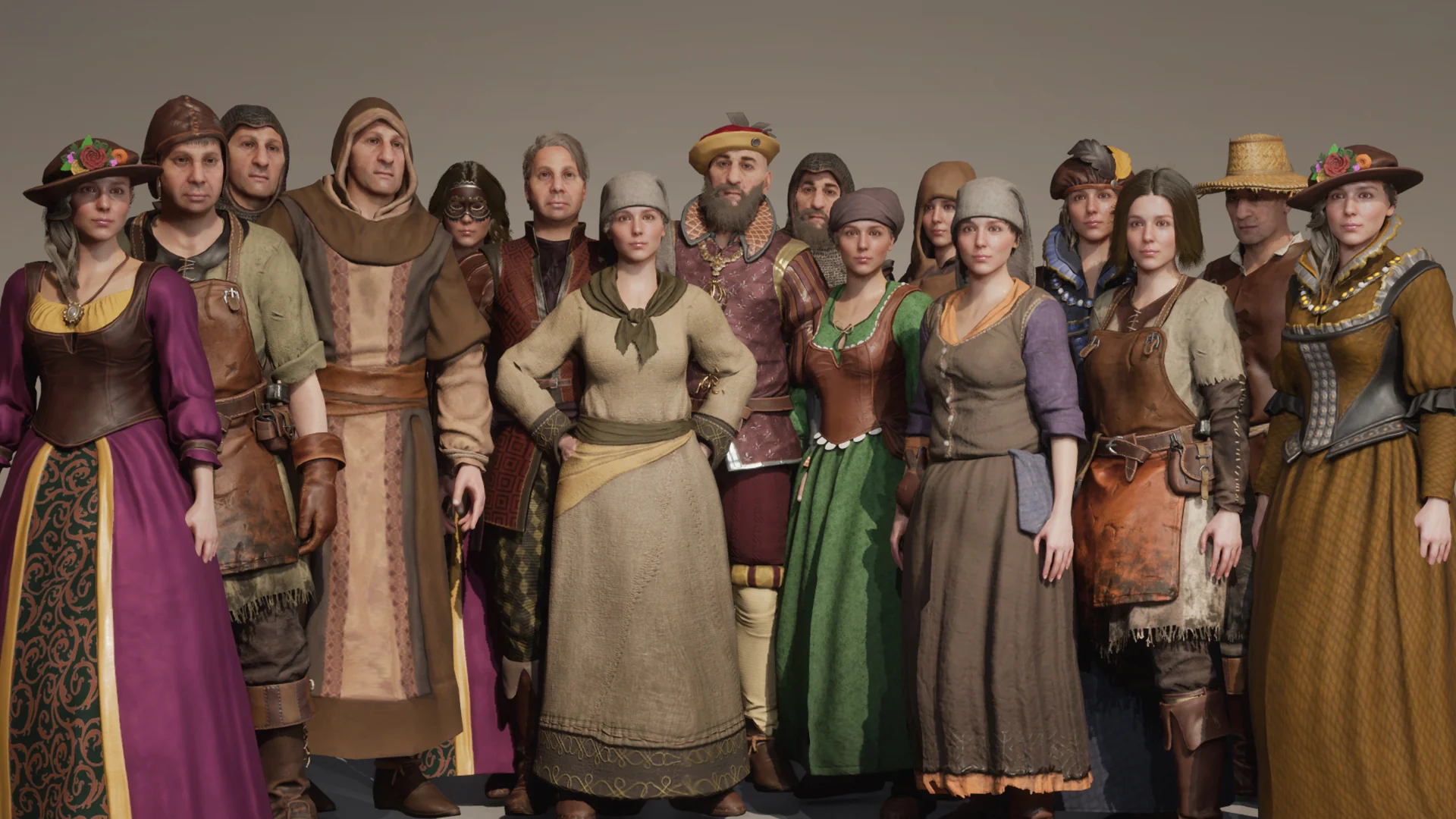
For RPG scenes, this covers the obvious cases: guards standing at gate posts, vendors in a marketplace, party members moving through a dungeon, and hostile mobs whose names should communicate faction or rank. It also covers any situation where a player needs to read identity at a glance without pulling up a tooltip or targeting reticle. Because the system ties into Steam Gametags, the identity layer can lean on platform-level player metadata instead of requiring a custom name-resolution pipeline that runs in parallel.
No Event Tick and the Performance Reasoning Behind It
One of the defining technical choices is that the project runs with no Event Tick. Inside a project, the nameplate does not spin a per-frame update loop to check distance, toggle visibility, or refresh text. Event Tick nodes are often the first thing that creeps into a nameplate implementation because it feels straightforward to poll each frame: Is the player close enough? Is the Actor on screen? Should the text shrink or fade? Easy Nameplate avoids that pattern entirely.
The payoff is most visible in scenes with a high Actor count. A town square filled with NPCs, a raid boss encounter with multiple named enemies, or a social hub with dozens of players milling around can all generate enough per-frame checks to register on a Profiler. By removing the Event Tick, the system pushes distance and visibility logic onto event-driven or engine-native mechanisms rather than a manual polling loop. That keeps the nameplate display from compounding into a performance bottleneck as a scene grows.
Custom Distance Display and Readability Control
Beyond Event Tick avoidance, the system exposes custom distance display. That gives a designer direct control over how close a viewer needs to be before a nameplate appears or becomes relevant. In an open-world RPG, this can be set so that distant NPCs do not clutter the horizon with floating text. In a tighter multiplayer arena, the distance can be tuned so that opponents are readable across the playable space without overwhelming the screen.
Distance-based display is particularly useful for scenes where the player needs to parse a crowd selectively. A market vendor the player is actively trading with might warrant a nameplate at a longer range than a background NPC walking past. The custom distance parameter lets that tuning happen without rewriting the underlying display logic for each Actor class. It also reinforces the no-tick philosophy: the visibility threshold is checked against a configured value through a mechanism that is not a manual per-frame poll.
Network Replication and Steam Gametags
The project is Network Replicated, which is the non-negotiable core for any multiplayer label system. Replication here means that the authoritative state behind a nameplate—the Actor it is attached to and the identity it should display—is consistent across the Server and Clients. A Client does not independently invent a name, and the Server does not need to manually push a text string every frame. The replicated design keeps the display state synchronized without the traffic overhead that a naive implementation would generate.
Tying into Steam Gametags adds a platform-specific identity layer. For projects shipping on Steam, this means the nameplate can reflect the player's platform identity rather than an internally stored string that has to be maintained separately. That integration is narrow and deliberate: it does not claim generic Online Subsystem support across every platform, but it does provide a clear path for projects already using Steam as their multiplayer backend. The Gametag linkage is what turns the nameplate from a generic label into a representation of an actual connected player.
Blueprint Composition and Tags That Signal Scope
Easy Nameplate is delivered as a Blueprint-based project, with the associated tags pointing to how it is meant to be used and extended. The relevant tags—Character, Multiplayer, Name, Script, Ornament, RPG, Nameplate, Blueprint, and Animation Blueprint—describe a resource that sits at the intersection of character presentation and scripted display logic. The Blueprint tag signals that the system is composable inside an existing Unreal Engine project rather than being a compiled plugin that requires a rebuild. The Animation Blueprint tag in the same set indicates that the nameplate logic is meant to coexist with character animation graphs rather than operate as an isolated UI element.
For a workflow, that means a developer can integrate the system into a character Blueprint or Animation Blueprint setup without pulling in a heavy dependency. The nameplate becomes part of the character's presentation layer, tied to replicated state and distance logic, while the animation graph continues to handle movement and locomotion. The Ornament tag reinforces that the nameplate is treated as a presentational element attached to the character, not a separate HUD Widget that floats in screen space and has to be manually repositioned.
What an RPG or Multiplayer Team Gets Out of It
An RPG or multiplayer team evaluating this resource gets a few specific things:
Networked correctness: A nameplate system designed from the ground up for multiplayer replication, solving the hardest part before implementation.
No-Event Tick design: Keeps the display logic from becoming a per-frame performance cost as Actor counts rise.
Configurable distance display: Lets scene designers tune readability and view distances without touching code.
Steam Gametag integration: Connects displayed names directly to the player's platform identity rather than an arbitrary string.
The practical takeaway is that Easy Nameplate is not a visual label widget or a text-rendering aesthetic pack. It is a systems-level nameplate implementation aimed at projects where replication, distance culling, and platform identity are the actual problems. Teams building a multiplayer RPG, a social hub, or any NPC-driven scene where names matter at scale can use it as the display backbone and then tune the distance and visibility parameters to fit their specific environment.
 Characters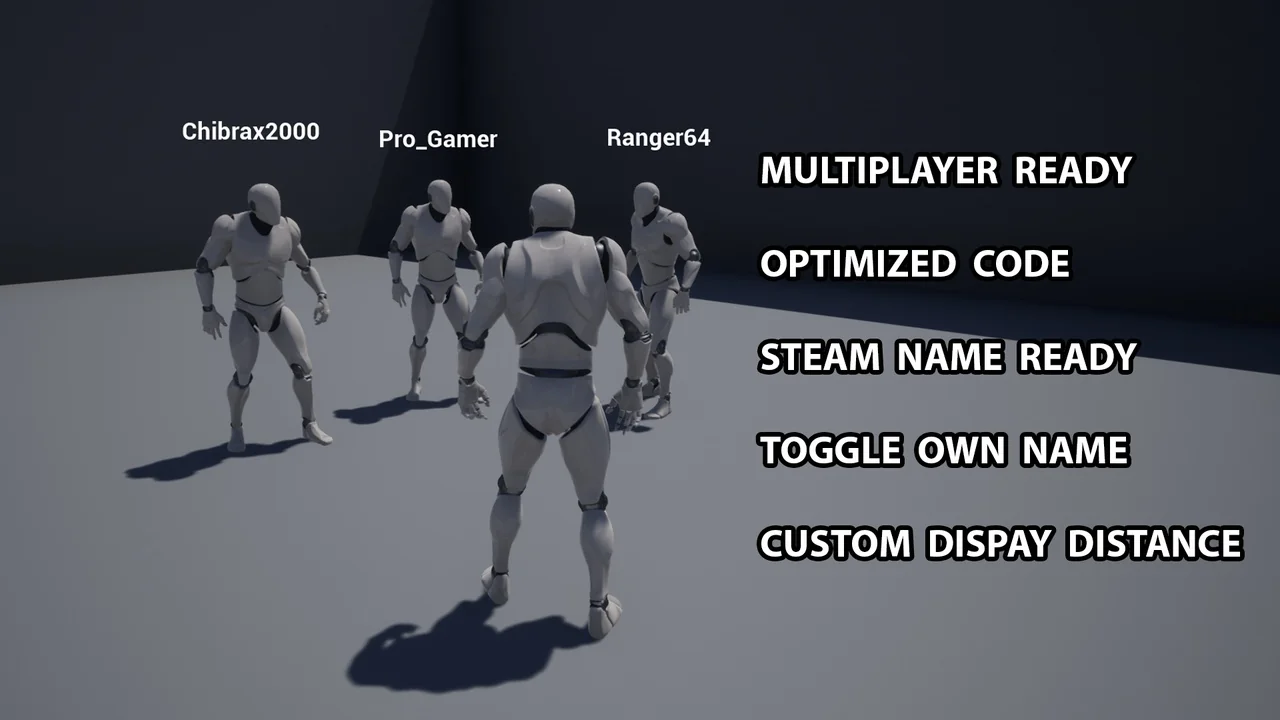
 Characters
 Characters
 Characters