"e9c335e082208b17"{"id":"1002891","slug":"dynamic-surface-navigation","title":"Dynamic Surface Navigation","category":"Game Mechanics","engine":"5.1 - 5.5","assetVersion":"Asset Version: 1.1.8 - 1.3.5","engineVersion":"Engine Version: 5.1 - 5.5","tag":"Game Mechanics","accent":"blue","visual":"mech","summary":"Generate dynamic 3D surface navigation across floors, walls, and ceilings in Unreal Engine with support for voxel worlds and native navigation tools.","platform":"Unreal Engine","indexPolicy":"index","publishedAt":"2026-11-21T02:00:38.202Z","updatedAt":"2026-11-21T02:00:38.202Z","sourceNotes":[],"fileContents":[],"compatibility":["Unreal Engine","Asset Version: 1.1.8 - 1.3.5","Engine Version: 5.1 - 5.5"],"featuredImage":{"alt":"Dynamic Surface Navigation","src":"/wp-content/uploads/published/2026/11/1a19ab6aeac4-4952b7bc-460e-4d5d-9a83-427b32825501-84ecfb531b.webp"},"fileSizeBytes":145404294,"hasDownloadLink":true,"downloads":0,"terms":[{"taxonomy":"category","slug":"game-mechanics-tools-and-plugins","name":"Game Mechanics"}],"galleryImages":[{"src":"/wp-content/uploads/published/2026/11/f2ce733d117a-0c9707e1-7dc9-4f67-a82d-d6f12a3c5a1f-c309d114a4.webp","alt":"Dynamic Surface Navigation"},{"src":"/wp-content/uploads/published/2026/11/f508d3386580-28316654-b1e4-4706-b318-9abb02c9a4b4-da9d3f0249.webp","alt":"Dynamic Surface Navigation"},{"src":"/wp-content/uploads/published/2026/11/78772c4e6d1a-4877386b-90c7-4a10-8c42-cf6dacb686f1-18af7fa28b.webp","alt":"Dynamic Surface Navigation"},{"src":"/wp-content/uploads/published/2026/11/e908116fc268-dd199333-7450-43df-a7db-58c057b1378b-f77f9411bd.webp","alt":"Dynamic Surface Navigation"},{"src":"/wp-content/uploads/published/2026/11/519baa7493da-0d8cebeb-650c-4103-971e-0ad89454aac5-e6fbb43ec9.webp","alt":"Dynamic Surface Navigation"},{"src":"/wp-content/uploads/published/2026/11/20a02eed02cf-2b40757c-fe47-4757-bff5-da7d17fc44ac-cc83d3ec5b.webp","alt":"Dynamic Surface Navigation"},{"src":"/wp-content/uploads/published/2026/11/824ce1f7e3ab-e1a3113d-5e0b-42c8-be85-1040b1c1d923-c190cacd71.webp","alt":"Dynamic Surface Navigation"},{"src":"/wp-content/uploads/published/2026/11/6969a2b43317-9ce3ab65-e296-4e6d-b65a-5d0dfae71fbd-59a7b347d6.webp","alt":"Dynamic Surface Navigation"},{"src":"/wp-content/uploads/published/2026/11/0b48db937201-65e3c387-b930-4e82-a881-7c490f269861-96b7438d79.webp","alt":"Dynamic Surface Navigation"}],"contentHtml":"\u003cp\u003eStandard game navigation systems typically presuppose that AI agents exist on horizontal planes, stepping along flat grounds or modest inclines while treating verticality as an impassable obstacle. Dynamic Surface Navigation alters this baseline by constructing full three-dimensional surface pathfinding directly across level geometry. Agents are no longer tethered strictly to the floor. Instead, path networks generate across ground planes, vertical walls, and inverted ceilings, allowing characters and pawns to scale structures and traverse fully inverted environments without losing spatial continuity.\u003c/p\u003e \u003ch2\u003eDynamic Navigation Across Walls, Ceilings, and Uneven Meshes\u003c/h2\u003e\n\u003cp\u003eThe core mechanism of the system revolves around generating navigable surfaces regardless of orientation. Whether an entity is moving over jagged rock faces, horizontal flooring, or along the underside of an interior ceiling, the path network evaluates the surface as valid transit space. The generation adapts quickly as the surrounding environment changes, updating surfaces on the fly when obstacles appear or geometry shifts.\u003c/p\u003e \u003cp\u003ePath calculation occurs asynchronously. By offloading path queries away from the main game thread, asynchronous pathfinding prevents performance hitches when multiple agents calculate complex routes simultaneously across expansive or convoluted spaces. The system functions with actors deriving from either the standard Pawn class or the Character class, giving developers flexibility when choosing their AI movement foundations.\u003c/p\u003e \u003cp\u003eTo prevent agents from attempting paths through spaces too narrow for their collision volumes, the pathfinding logic includes automated size tests. During route evaluation, the solver checks agent clearance against the surrounding geometry, keeping oversized pawns from selecting paths through crevices, doorways, or structural overhangs where their physical bodies cannot fit.\u003c/p\u003e \u003ch2\u003eCorner Control and Avoidance in Dynamic Surface Navigation\u003c/h2\u003e\n\u003cp\u003eNavigating along flat planes is mechanically straightforward, but transitioning between planes oriented at perpendicular or acute angles introduces distinct kinematic challenges. When an agent moves from a flat floor up a vertical wall, or crosses over an exposed ledge to descend on the other side, standard pathfinding routines often break, causing actors to detach or stutter awkwardly.\u003c/p\u003e \u003cp\u003eTo maintain smooth movement through geometry changes, the plugin incorporates specialized corner assistance for both inside and outside corners. Inside corner assist guides pawns through interior seams, such as the junction where a room floor meets an upright wall. Outside corner assist handles the reverse condition, keeping the agent grounded and aligned as it crests an edge to traverse down a precipice or wrap around an exterior corner.\u003c/p\u003e \u003cp\u003eCoupled with corner assistance is configurable dynamic corner deceleration. In natural locomotion, abrupt changes in surface normal require speed modulation to prevent agents from overshooting turns or launching off geometry. Deceleration can be tuned dynamically to slow agents down as they approach sharp directional transitions, producing realistic velocity adjustments before they accelerate back to full speed along the subsequent flat surface.\u003c/p\u003e \u003cp\u003eLocal steering and obstacle avoidance are handled by a custom RVO (Reciprocal Velocity Obstacle) avoidance solution. Standard two-dimensional avoidance algorithms fail when agents occupy different angular planes or maneuver across multi-angle geometry. The custom RVO implementation ensures that multiple agents navigating nearby walls, floors, or ceilings recognize each other's trajectories and make mutual avoidance adjustments in three dimensions.\u003c/p\u003e \u003ch2\u003eConfiguring Movement Expenses and Surface Angles\u003c/h2\u003e\n\u003cp\u003eNot every creature or mechanical unit in a game should navigate all surfaces equally. A human soldier might be restricted to walking on gentle slopes, while an insectoid creature or robotic drone should freely crawl across shear cliffs and metal ceilings. The system provides granular per-pawn angle limits to control precisely which surface slopes a given agent can step onto.\u003c/p\u003e \u003cp\u003eBeyond strict angle limits, the pathfinding cost system can be weighted using per-pawn angle expense multipliers. Navigating an inverted ceiling or scaling a vertical barrier can be assigned a higher pathing cost than traveling along an adjacent flat floor. When calculating a route, the AI solver evaluates these multipliers against the distance traveled. If a flat path is available, an agent configured with high wall-traversal costs will naturally prefer the ground. If that floor route is blocked, destroyed, or substantially longer, the solver will then accept the higher cost of climbing walls or crossing overhead geometry to reach the destination.\u003c/p\u003e \u003ch2\u003eUnreal Engine Navigation Features and Hybrid Setups\u003c/h2\u003e\n\u003cp\u003eAdopting custom surface navigation does not require discarding Unreal Engine's built-in navigation framework. The system functions directly alongside native engine navigation, permitting developers to run hybrid setups where ground-based infantry utilize standard nav meshes while wall-crawling units rely simultaneously on the dynamic surface system.\u003c/p\u003e \u003cp\u003eGenerating native Unreal Engine nav mesh is not a prerequisite for the dynamic surface system to function. It operates fully independently when desired. However, when native features are utilized in a project, the plugin provides broad compatibility with them:\u003c/p\u003e\n\u003cul\u003e \u003cli\u003e\u003cstrong\u003eNav Mesh Bounds Volumes:\u003c/strong\u003e Define and constrain regions where surface generation should take place.\u003c/li\u003e \u003cli\u003e\u003cstrong\u003eNav Modifiers and Nav Areas:\u003c/strong\u003e Adjust pathfinding weights, apply customized traversal costs, or mark zones as restricted.\u003c/li\u003e \u003cli\u003e\u003cstrong\u003eNav Filters:\u003c/strong\u003e Filter out specific path types or surface categories on a per-query basis.\u003c/li\u003e \u003cli\u003e\u003cstrong\u003eSimple and Smart Nav Links:\u003c/strong\u003e Connect disparate surface areas, enabling scripted transitions, jumps, or custom traversals between surfaces that do not physically touch.\u003c/li\u003e \u003cli\u003e\u003cstrong\u003eEnvironment Query System (EQS):\u003c/strong\u003e Use native EQS queries to evaluate surface locations for tactical positioning, cover searches, and target acquisition.\u003c/li\u003e\n\u003c/ul\u003e \u003cp\u003eFor projects built on modular grids or cubic voxel layouts, alignment between the surface mesh and the navigation network is critical. The plugin allows developers to offset the generated navigation layer, tuning the exact standoff distance or alignment relative to the level's underlying block structures.\u003c/p\u003e \u003ch2\u003ePlanetary Scales and Complex World Integration\u003c/h2\u003e\n\u003cp\u003eLarge-scale and procedural environments introduce surface orientations that rotate continuously across 360 degrees. The system supports full spherical geometry and planetary setups, having undergone testing on dedicated spherical planet bodies and large static sphere meshes. This makes the tool directly applicable to space titles, sci-fi installations, and gravity-defying environments where down is relative to the center of a celestial body.\u003c/p\u003e \u003cp\u003eCompatibility extends to major third-party procedural generation and terrain plugins. It integrates with Voxel Plugin, tested against both the v1.2 free release and recent builds of v2.0. It also works with WorldScape, validated against version 2.5.0a, ensuring continuous surface calculation across expansive procedural landscapes.\u003c/p\u003e \u003cp\u003eModern level streaming and network architectures are fully supported. The navigation workflows operate within World Partition setups, standard level streaming setups, and persist across Server Travel events in networked multiplayer configurations. From an operating platform standpoint, the system is officially validated on Windows and Linux, with user confirmations verifying that it also compiles and runs on PlayStation 5 and Android systems.\u003c/p\u003e\n\n\u003ch2\u003eRelated Resources Worth Checking\u003c/h2\u003e\n\u003cul\u003e\n\u003cli\u003e\u003ca href=\"https://3dcghub.com/compassy-mini-big-maps-compass-navigation-system/\" rel=\"noopener noreferrer\"\u003eCompassy (Mini \u0026amp; Big Maps + Compass Navigation System)\u003c/a\u003e\u003c/li\u003e\n\u003cli\u003e\u003ca href=\"https://3dcghub.com/flexpath-smooth-navigation/\" rel=\"noopener noreferrer\"\u003eFlexPath – Smooth Navigation\u003c/a\u003e\u003c/li\u003e\n\u003cli\u003e\u003ca href=\"https://3dcghub.com/ar-navigation/\" rel=\"noopener noreferrer\"\u003eAR Navigation\u003c/a\u003e\u003c/li\u003e\n\u003cli\u003e\u003ca href=\"https://3dcghub.com/engore-procedural-dismemberment/\" rel=\"noopener noreferrer\"\u003eEnGore: Procedural Dismemberment\u003c/a\u003e\u003c/li\u003e\n\u003cli\u003e\u003ca href=\"https://3dcghub.com/ninja-input/\" rel=\"noopener noreferrer\"\u003eNinja Input\u003c/a\u003e\u003c/li\u003e\n\u003c/ul\u003e","contentTextLength":7834,"navigation":{"current":44,"total":4839,"previous":{"id":"1002892","slug":"easyfirebase-pro","title":"EasyFirebase Pro","category":"Engine Tools","platform":"Unreal Engine","updatedAt":"2026-11-21T02:01:18.104Z"},"next":{"id":"1002890","slug":"discord-rich-presence","title":"Discord Rich Presence","category":"Engine Tools","platform":"Unreal Engine","updatedAt":"2026-11-21T01:59:27.383Z"}},"relatedResources":[{"id":"14858","slug":"compassy-mini-big-maps-compass-navigation-system","title":"Compassy (Mini \u0026 Big Maps + Compass Navigation System)","category":"Game Mechanics","engine":"5.3","assetVersion":"Engine version: 5.3","engineVersion":"5.1","tag":"Game Mechanics","accent":"blue","visual":"city","summary":"Compassy is a comprehensive navigation suite designed to upgrade game maps. It features mini maps, big maps, and a dynamic compass system with mission markers.","platform":"Unreal Engine","indexPolicy":"noindex","publishedAt":"2026-03-11T19:40:18.000Z","updatedAt":"2026-04-19T15:45:39.000Z","sourceNotes":[],"fileContents":[],"compatibility":["Unreal Engine","Engine version: 5.3"],"featuredImage":{"alt":"Compassy (Mini \u0026 Big Maps + Compass Navigation System)","src":"https://3dcghub.com/wp-content/uploads/2026/03/94d133fb-ac1b-45f9-a3c7-d8cc5f2a2e22.webp"},"fileSizeBytes":328894598,"hasDownloadLink":true,"downloads":1},{"id":"1000292","slug":"flexpath-smooth-navigation","title":"FlexPath – Smooth Navigation","category":"Gameplay Features","engine":"5.5 - 5.7","assetVersion":"Asset Version: 1.4","engineVersion":"Engine Version: 5.5 - 5.7","tag":"Gameplay Features","accent":"blue","visual":"mech","summary":"Enhance Unreal Engine AI movement with FlexPath. Implement corridor-aware path smoothing, dynamic look-ahead rotation, and stable path following via Blueprint a","platform":"Unreal Engine","indexPolicy":"index","publishedAt":"2026-07-03T17:29:22.212Z","updatedAt":"2026-07-03T17:29:22.212Z","sourceNotes":[],"fileContents":[],"compatibility":["Unreal Engine","Asset Version: 1.4","Engine Version: 5.5 - 5.7"],"featuredImage":{"alt":"FlexPath – Smooth Navigation","src":"/wp-content/uploads/published/2026/07/7a1e8c39629e-c2db16de-e4d3-4301-b7d0-376bc8b73da5-5b5ffba9f2.webp"},"fileSizeBytes":44038172,"hasDownloadLink":true,"downloads":1},{"id":"1000165","slug":"ar-navigation","title":"AR Navigation","category":"Characters \u0026 Creatures","engine":"5.0+","assetVersion":"","engineVersion":"Engine Version: 5.0+","tag":"Characters","accent":"blue","visual":"character","summary":"AR Navigation combines route calculation, a dynamic 3D minimap, destination UI, floating POI icons, surface-snapped markers, and QRCode detection.","platform":"Unreal Engine","indexPolicy":"index","publishedAt":"2026-06-18T23:57:25.352Z","updatedAt":"2026-06-18T23:57:25.352Z","sourceNotes":[],"fileContents":[],"compatibility":["Unreal Engine","Engine Version: 5.0+"],"featuredImage":{"alt":"AR Navigation","src":"/wp-content/uploads/published/2026/06/5ac94a1bc661-70c0c4e3-194e-4d2d-b853-561258b283a9-e8c66a7ca2.webp"},"fileSizeBytes":4403015,"hasDownloadLink":true,"downloads":0}]}
Resource screenshots
1 / 9
Join our channel
Follow 3DCGHUB on Telegram for new resource drops, migration updates, and community notices.
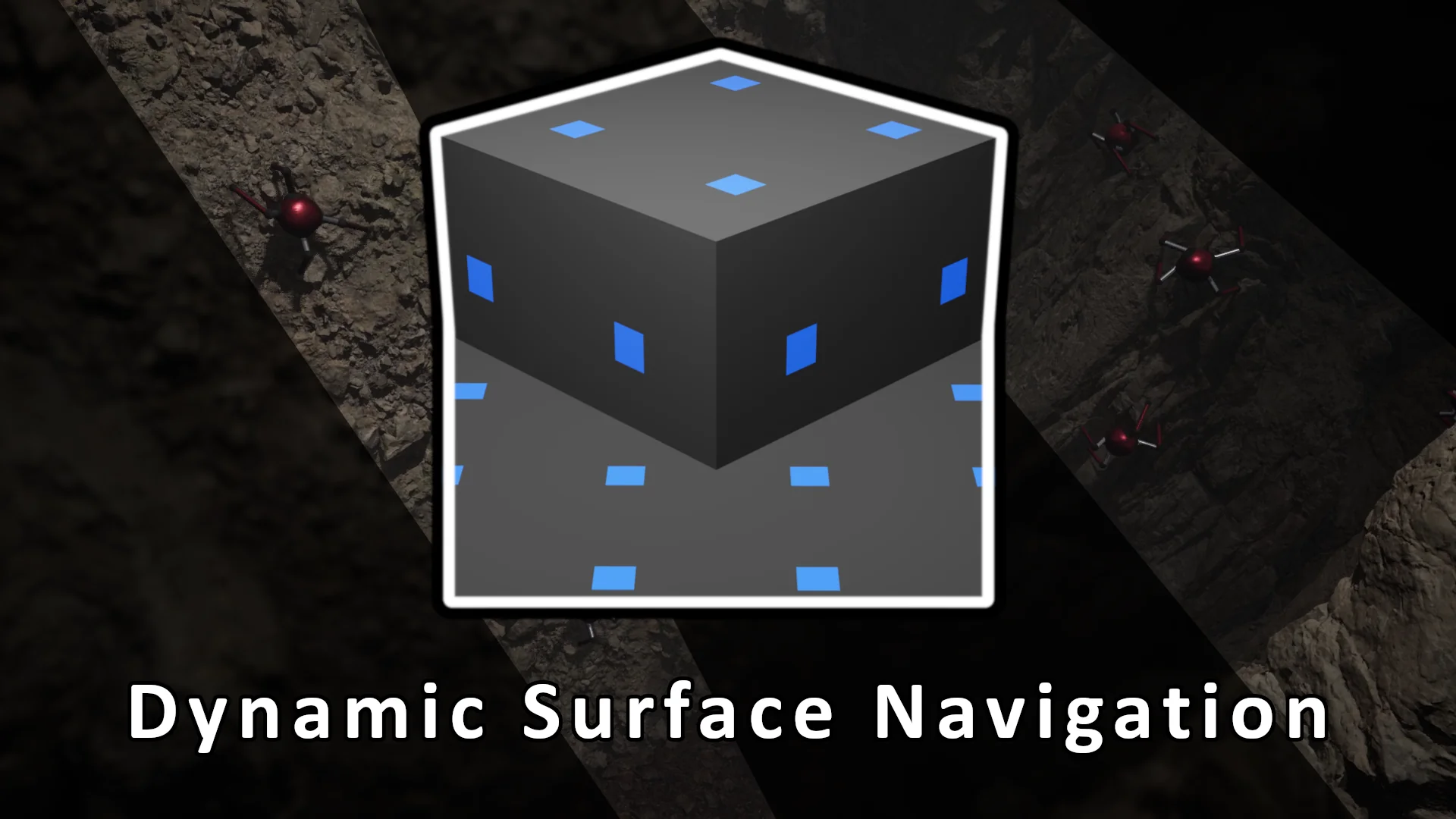
Standard game navigation systems typically presuppose that AI agents exist on horizontal planes, stepping along flat grounds or modest inclines while treating verticality as an impassable obstacle. Dynamic Surface Navigation alters this baseline by constructing full three-dimensional surface pathfinding directly across level geometry. Agents are no longer tethered strictly to the floor. Instead, path networks generate across ground planes, vertical walls, and inverted ceilings, allowing characters and pawns to scale structures and traverse fully inverted environments without losing spatial continuity.
Dynamic Navigation Across Walls, Ceilings, and Uneven Meshes
The core mechanism of the system revolves around generating navigable surfaces regardless of orientation. Whether an entity is moving over jagged rock faces, horizontal flooring, or along the underside of an interior ceiling, the path network evaluates the surface as valid transit space. The generation adapts quickly as the surrounding environment changes, updating surfaces on the fly when obstacles appear or geometry shifts.
Path calculation occurs asynchronously. By offloading path queries away from the main game thread, asynchronous pathfinding prevents performance hitches when multiple agents calculate complex routes simultaneously across expansive or convoluted spaces. The system functions with actors deriving from either the standard Pawn class or the Character class, giving developers flexibility when choosing their AI movement foundations.
To prevent agents from attempting paths through spaces too narrow for their collision volumes, the pathfinding logic includes automated size tests. During route evaluation, the solver checks agent clearance against the surrounding geometry, keeping oversized pawns from selecting paths through crevices, doorways, or structural overhangs where their physical bodies cannot fit.
Corner Control and Avoidance in Dynamic Surface Navigation
Navigating along flat planes is mechanically straightforward, but transitioning between planes oriented at perpendicular or acute angles introduces distinct kinematic challenges. When an agent moves from a flat floor up a vertical wall, or crosses over an exposed ledge to descend on the other side, standard pathfinding routines often break, causing actors to detach or stutter awkwardly.
To maintain smooth movement through geometry changes, the plugin incorporates specialized corner assistance for both inside and outside corners. Inside corner assist guides pawns through interior seams, such as the junction where a room floor meets an upright wall. Outside corner assist handles the reverse condition, keeping the agent grounded and aligned as it crests an edge to traverse down a precipice or wrap around an exterior corner.
Coupled with corner assistance is configurable dynamic corner deceleration. In natural locomotion, abrupt changes in surface normal require speed modulation to prevent agents from overshooting turns or launching off geometry. Deceleration can be tuned dynamically to slow agents down as they approach sharp directional transitions, producing realistic velocity adjustments before they accelerate back to full speed along the subsequent flat surface.
Local steering and obstacle avoidance are handled by a custom RVO (Reciprocal Velocity Obstacle) avoidance solution. Standard two-dimensional avoidance algorithms fail when agents occupy different angular planes or maneuver across multi-angle geometry. The custom RVO implementation ensures that multiple agents navigating nearby walls, floors, or ceilings recognize each other's trajectories and make mutual avoidance adjustments in three dimensions.
Configuring Movement Expenses and Surface Angles
Not every creature or mechanical unit in a game should navigate all surfaces equally. A human soldier might be restricted to walking on gentle slopes, while an insectoid creature or robotic drone should freely crawl across shear cliffs and metal ceilings. The system provides granular per-pawn angle limits to control precisely which surface slopes a given agent can step onto.
Beyond strict angle limits, the pathfinding cost system can be weighted using per-pawn angle expense multipliers. Navigating an inverted ceiling or scaling a vertical barrier can be assigned a higher pathing cost than traveling along an adjacent flat floor. When calculating a route, the AI solver evaluates these multipliers against the distance traveled. If a flat path is available, an agent configured with high wall-traversal costs will naturally prefer the ground. If that floor route is blocked, destroyed, or substantially longer, the solver will then accept the higher cost of climbing walls or crossing overhead geometry to reach the destination.
Unreal Engine Navigation Features and Hybrid Setups
Adopting custom surface navigation does not require discarding Unreal Engine's built-in navigation framework. The system functions directly alongside native engine navigation, permitting developers to run hybrid setups where ground-based infantry utilize standard nav meshes while wall-crawling units rely simultaneously on the dynamic surface system.
Generating native Unreal Engine nav mesh is not a prerequisite for the dynamic surface system to function. It operates fully independently when desired. However, when native features are utilized in a project, the plugin provides broad compatibility with them:
Nav Mesh Bounds Volumes: Define and constrain regions where surface generation should take place.
Nav Modifiers and Nav Areas: Adjust pathfinding weights, apply customized traversal costs, or mark zones as restricted.
Nav Filters: Filter out specific path types or surface categories on a per-query basis.
Simple and Smart Nav Links: Connect disparate surface areas, enabling scripted transitions, jumps, or custom traversals between surfaces that do not physically touch.
Environment Query System (EQS): Use native EQS queries to evaluate surface locations for tactical positioning, cover searches, and target acquisition.
For projects built on modular grids or cubic voxel layouts, alignment between the surface mesh and the navigation network is critical. The plugin allows developers to offset the generated navigation layer, tuning the exact standoff distance or alignment relative to the level's underlying block structures.
Planetary Scales and Complex World Integration
Large-scale and procedural environments introduce surface orientations that rotate continuously across 360 degrees. The system supports full spherical geometry and planetary setups, having undergone testing on dedicated spherical planet bodies and large static sphere meshes. This makes the tool directly applicable to space titles, sci-fi installations, and gravity-defying environments where down is relative to the center of a celestial body.
Compatibility extends to major third-party procedural generation and terrain plugins. It integrates with Voxel Plugin, tested against both the v1.2 free release and recent builds of v2.0. It also works with WorldScape, validated against version 2.5.0a, ensuring continuous surface calculation across expansive procedural landscapes.
Modern level streaming and network architectures are fully supported. The navigation workflows operate within World Partition setups, standard level streaming setups, and persist across Server Travel events in networked multiplayer configurations. From an operating platform standpoint, the system is officially validated on Windows and Linux, with user confirmations verifying that it also compiles and runs on PlayStation 5 and Android systems.
 Game Mechanics
 Gameplay Features
 Characters