"c68a05d5e51405b3"{"id":"1001872","slug":"crumbling-ruins","title":"Crumbling Ruins","category":"Fantasy","engine":"4.26+,5.0+","assetVersion":"","engineVersion":"Engine Version: 4.26+,5.0+","tag":"Fantasy","accent":"blue","visual":"mech","summary":"Crumbling Ruins provides a modular mesh set designed for multi-angle placement, custom scaling, and rapid level layout using pre-grouped ruin assemblies.","platform":"Unreal Engine","publishedAt":"2026-10-22T11:15:05.452Z","updatedAt":"2026-10-22T11:15:05.452Z","sourceNotes":[],"fileContents":[],"compatibility":["Unreal Engine","Engine Version: 4.26+,5.0+"],"featuredImage":{"alt":"Crumbling Ruins","src":"/wp-content/uploads/published/2026/10/58e5f87fef22-7e7a6c1b-0020-4b27-9207-896e44fbfb49-fb03a98ff2.webp"},"hasDownloadLink":true,"downloads":0,"terms":[{"taxonomy":"category","slug":"fantasy","name":"Fantasy"}],"galleryImages":[{"src":"/wp-content/uploads/published/2026/10/ece1ae335730-1387d722-a870-4b18-80f2-bc8cc8682a2d-0d0d90e266.webp","alt":"Crumbling Ruins"},{"src":"/wp-content/uploads/published/2026/10/c199b2999265-e68dbd1a-89a3-4be8-956f-b12169b07087-8e0f605c71.webp","alt":"Crumbling Ruins"},{"src":"/wp-content/uploads/published/2026/10/4ca190f28738-6caacfb1-4222-4760-93dc-4e67eb0a760c-84436b193d.webp","alt":"Crumbling Ruins"},{"src":"/wp-content/uploads/published/2026/10/a68515ab6ad0-01a66046-7d81-4439-aa26-88155b7b9858-1ef7506ddc.webp","alt":"Crumbling Ruins"},{"src":"/wp-content/uploads/published/2026/10/791e13042756-61ece411-1e53-478d-bf76-ff61b218df76-4c07db71ac.webp","alt":"Crumbling Ruins"}],"accessPanel":{"kind":"resource","title":"Download this resource","eyebrow":"Free Download","message":"Log in or create a free account to start your download.","fileName":"Content.7z","safetyNote":"Resources are manually reviewed before listing to improve quality and reduce obvious risks.","actionLabel":"Download Free","resourceType":"Resource archive"},"contentHtml":"\u003ch2\u003eModular Mesh Architecture for Crumbling Ruins\u003c/h2\u003e\u003cp\u003eCrumbling Ruins provides a focused environment kit structured through individual ruined stone components and structural fragments. Rather than locking artists into rigid, single-purpose wall runs or fixed room templates, the package operates as a flexible kit of modular meshes intended for fantasy worlds, dungeon interiors, and weathered exterior levels. Game developers can use these assets to establish anything from isolated collapsed archways in an open field to dense, labyrinthine underground corridors filled with decay.\u003c/p\u003e\u003cp\u003eThe foundation of the asset set lies in its adaptability. Because ruined structures in nature and fantasy settings undergo irregular weathering, structural failure, and organic settling, static and repetitive models can easily break player immersion. This kit bypasses that limitation by presenting pieces that function as physical building blocks. Developers can assemble custom collapsed chambers, ancient fortifications, fallen pillars, and degraded walkways piece by piece, matching the structural needs of specific level layouts and encounter spaces.\u003c/p\u003e\u003ch2\u003eMulti-Angle Usability Across Rotated and Scaled Geometry\u003c/h2\u003e\u003cp\u003eA primary technical characteristic of the Crumbling Ruins meshes is that every asset is modeled and surfaced to be fully usable and viewable from any perspective. Traditional game art assets often feature unmodeled backfaces, stretched edge textures, or flat non-rendered surfaces intended to sit flush against an invisible boundary. In contrast, these meshes carry finished detail across all exposed surfaces, removing camera restrictions entirely.\u003c/p\u003e\u003cp\u003eBecause the meshes do not suffer from bad angles or unfinished faces, level designers have full clearance to manipulate them freely in three-dimensional space:\u003c/p\u003e\u003cul\u003e\u003cli\u003e\u003cstrong\u003eArbitrary Rotation:\u003c/strong\u003e Meshes can be flipped horizontally, inverted upside down, or angled diagonally to represent dislodged masonry, tumbled lintels, and jagged debris piles without revealing missing polygon caps.\u003c/li\u003e\u003cli\u003e\u003cstrong\u003eProportional and Non-Uniform Scaling:\u003c/strong\u003e Assets can be enlarged to form towering monoliths and load-bearing dungeon foundations, or scaled down to serve as ground scatter, fragmented rubble, and pathway edging.\u003c/li\u003e\u003cli\u003e\u003cstrong\u003eCompound Clustering:\u003c/strong\u003e Several distinct meshes can be interpenetrated and clustered together, yielding novel silhouettes and irregular structural footprints that do not reveal repeated asset origins.\u003c/li\u003e\u003c/ul\u003e\u003cp\u003eThis all-angle usability changes how levels are constructed. Instead of requiring distinct meshes for every possible stage of collapse, designers can extract diverse configurations from a modest pool of geometry simply by altering orientation, elevation, and scale.\u003c/p\u003e\u003ch2\u003eThe Included Demonstration Map and Grouped Mesh Assemblies\u003c/h2\u003e\u003cp\u003eTo eliminate the friction of starting in an empty grid space, Crumbling Ruins incorporates a dedicated demonstration map. This secondary map functions both as a showcase for the visual potential of the assets and as an active construction depot for ongoing level creation. Every pre-built ruined structure, arch, and architectural vignette seen in the sample materials is laid out within this environment, showing how individual components interlock to convey structural degradation.\u003c/p\u003e\u003cp\u003eA practical element of this included map is the presence of curated collections of grouped meshes. Instead of forcing level artists to combine single stones and pillars from scratch for every room or corridor, the map provides pre-composed structural clusters. These groupings represent ready-made rubble heaps, broken arch spans, collapsed column arrangements, and wall junctions.\u003c/p\u003e\u003cp\u003eLevel designers can select these grouped configurations directly within the editor and copy-paste them straight into production scenes. This workflow drastically cuts down assembly time during greyboxing and initial environment dressing. Designers can drop a fully realized crumbling corner into place with a single operation, immediately establishing a sense of age and wear. Beyond direct placement, these assemblies serve as ideation springboards, illustrating spatial solutions for broken floors, irregular openings, and vertical exploration paths that developers can adapt to fit their own project requirements.\u003c/p\u003e\u003ch2\u003eFantasy and Dungeon Level Construction Workflows\u003c/h2\u003e\u003cp\u003eThe aesthetic profile of Crumbling Ruins targets fantasy settings, subterranean dungeons, and ancient ruined environments where environmental storytelling relies on historical decay. In games focused on exploration, ruined environments perform essential mechanical duties: they break line-of-sight for combat encounters, supply natural ramps and platforms for vertical traversal, and telegraph structural age without relying on narrative exposition.\u003c/p\u003e\u003cp\u003eWhen blocking out a dungeon using this modular kit, the designer can establish clear movement vectors while maintaining the visual illusion of chaos. An intact passageway can gradually transition into fractured blocks, forced detours, and partially open ceilings where light penetrates into dark caverns. Because the individual meshes tolerate free scaling and rotation, the designer can dictate the exact degree of navigability, closing off impassable routes with dense rubble banks or opening narrow crouch spaces beneath leaning slabs of rock.\u003c/p\u003e\u003cp\u003eIn exterior fantasy levels, the same components can be dispersed across varied terrain elevations. Placing scaled-up ruins against cliffsides or ridge paths allows developers to anchor points of interest across vast landscapes, guiding player attention toward forgotten temples, old outposts, or hidden dungeon entrances embedded into the earth.\u003c/p\u003e\u003ch2\u003eIntegration Alongside the Modular Mansion Mini Pack\u003c/h2\u003e\u003cp\u003eCrumbling Ruins is directly compatible with the Modular Mansion Mini Pack, opening specific architectural workflows that combine civilized grandeur with gradual environmental decay. The Mansion pack supplies more complete, inhabited, or structured architectural elements, while Crumbling Ruins supplies the weathered and ruined counterpart needed to break down those clean silhouettes.\u003c/p\u003e\u003cp\u003eBy blending both kits in a unified environment, developers can build scenes that portray progressive dilapidation. A game space might begin in an intact wing of a manor or fortress built with the Modular Mansion Mini Pack, then organically degrade as the player progresses toward neglected basements, breached exterior fortifications, or forgotten underground crypts represented by Crumbling Ruins. This pairing gives world builders a coherent visual language that spans from functional architecture to total structural collapse without requiring custom mesh modification.\u003c/p\u003e\u003cp\u003eWhether used alone to draft atmospheric dungeon ruins or paired with companion kits to show architectural decay over time, the set provides an efficient, omnidirectional toolkit for game environments anchored in exploration and ancient mystery.\u003c/p\u003e\n\n\u003ch2\u003eMore From The Same Workflow\u003c/h2\u003e\n\u003cul\u003e\n\u003cli\u003e\u003ca href=\"https://3dcghub.com/the-empyrean-ruins-and-fortress-kit/\" title=\"The Empyrean- Ruins and Fortress Kit\"\u003eThe Empyrean- Ruins and Fortress Kit\u003c/a\u003e\u003c/li\u003e\n\u003cli\u003e\u003ca href=\"https://3dcghub.com/eternal-temple/\" title=\"Eternal Temple\"\u003eEternal Temple\u003c/a\u003e\u003c/li\u003e\n\u003cli\u003e\u003ca href=\"https://3dcghub.com/fantasy-gothic-pack/\" title=\"Fantasy Gothic Pack\"\u003eFantasy Gothic Pack\u003c/a\u003e\u003c/li\u003e\n\u003cli\u003e\u003ca href=\"https://3dcghub.com/modular-ancient-ruins/\" title=\"Modular Ancient Ruins\"\u003eModular Ancient Ruins\u003c/a\u003e\u003c/li\u003e\n\u003cli\u003e\u003ca href=\"https://3dcghub.com/roman-temple-ruins-roman-temple-ruins-historical-building-building-rome/\" title=\"Roman Temple Ruins ( Roman Temple Ruins Historical Building Building Rome )\"\u003eRoman Temple Ruins ( Roman Temple Ruins Historical Building Building Rome )\u003c/a\u003e\u003c/li\u003e\n\u003c/ul\u003e","contentTextLength":7070,"navigation":{"current":53,"total":3860,"previous":{"id":"1001873","slug":"cycling","title":"Cycling","category":"Vehicles \u0026 Transportation","platform":"Unreal Engine","updatedAt":"2026-10-22T11:15:50.015Z"},"next":{"id":"1001871","slug":"combat-systems-constructor","title":"Combat Systems - Constructor","category":"Characters \u0026 Creatures","platform":"Unreal Engine","updatedAt":"2026-10-22T11:13:58.665Z"}},"relatedResources":[{"id":"1001844","slug":"the-empyrean-ruins-and-fortress-kit","title":"The Empyrean- Ruins and Fortress Kit","category":"Fantasy","engine":"5.3+","assetVersion":"","engineVersion":"Engine Version: 5.3+","tag":"Fantasy","accent":"blue","visual":"mech","summary":"Build layered medieval Indian fortresses, dark dungeons, and cliffside ruins with modular architecture and data layer environment variants.","platform":"Unreal Engine","publishedAt":"2026-10-21T08:35:15.755Z","updatedAt":"2026-10-21T08:35:15.755Z","sourceNotes":[],"fileContents":[],"compatibility":["Unreal Engine","Engine Version: 5.3+"],"featuredImage":{"alt":"The Empyrean- Ruins and Fortress Kit","src":"/wp-content/uploads/published/2026/10/c5a877ebed84-39e349bd-d868-4234-a018-4ecb7b441c69-c268059e31.webp"},"hasDownloadLink":true,"downloads":0},{"id":"1000054","slug":"eternal-temple","title":"Eternal Temple","category":"Fantasy","engine":"4.26+,5.0+","assetVersion":"","engineVersion":"4.26+,5.0+","tag":"Fantasy","accent":"blue","visual":"mech","summary":"Eternal Temple is a modular fantasy ruin and dungeon environment pack with over 200 parts, presets, props, 3 demo levels, and top-down occlusion support.","platform":"Unreal Engine","publishedAt":"2026-05-24T15:30:50.281Z","updatedAt":"2026-05-24T15:30:50.281Z","sourceNotes":[],"fileContents":[],"compatibility":["Unreal Engine","Engine version: 4.26+,5.0+"],"featuredImage":{"alt":"Eternal Temple","src":"/wp-content/uploads/published/2026/05/78b439012a0b-45c211f9-3c05-4b71-9e34-9c7690031660-67edc71a9a.webp"},"hasDownloadLink":true,"downloads":1},{"id":"7948","slug":"fantasy-gothic-pack","title":"Fantasy Gothic Pack","category":"Fantasy","engine":"5.1+","assetVersion":"Engine version: 5.1+","engineVersion":"","tag":"Fantasy","accent":"blue","visual":"city","summary":"Build breathtaking stylized worlds with this massive collection of over 270 gothic-themed assets. This pack is perfect for creating citadels, ruins, and medieval cities in any modern game engine.","platform":"Unreal Engine","publishedAt":"2026-02-22T16:03:25.000Z","updatedAt":"2026-04-19T15:55:52.000Z","sourceNotes":[],"fileContents":[],"compatibility":["Unreal Engine","Engine version: 5.1+"],"featuredImage":{"alt":"Fantasy Gothic Pack","src":"https://3dcghub.com/wp-content/uploads/2026/02/0aab05ad-c59a-4dd8-acbd-ca22abcce18c.webp"},"hasDownloadLink":true,"downloads":2}]}
Fantasy
Crumbling Ruins
Crumbling Ruins provides a modular mesh set designed for multi-angle placement, custom scaling, and rapid level layout using pre-grouped ruin assemblies.
Category:Unreal Engine,FantasyPlatform: Unreal EngineEngine Version: 4.26+,5.0+Published: Oct 22, 2026
Fantasy
Resource overview
Modular Mesh Architecture for Crumbling Ruins
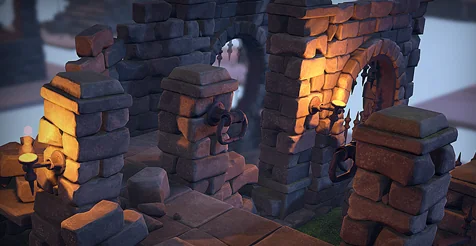
Crumbling Ruins provides a focused environment kit structured through individual ruined stone components and structural fragments. Rather than locking artists into rigid, single-purpose wall runs or fixed room templates, the package operates as a flexible kit of modular meshes intended for fantasy worlds, dungeon interiors, and weathered exterior levels. Game developers can use these assets to establish anything from isolated collapsed archways in an open field to dense, labyrinthine underground corridors filled with decay.
The foundation of the asset set lies in its adaptability. Because ruined structures in nature and fantasy settings undergo irregular weathering, structural failure, and organic settling, static and repetitive models can easily break player immersion. This kit bypasses that limitation by presenting pieces that function as physical building blocks. Developers can assemble custom collapsed chambers, ancient fortifications, fallen pillars, and degraded walkways piece by piece, matching the structural needs of specific level layouts and encounter spaces.
Multi-Angle Usability Across Rotated and Scaled Geometry
A primary technical characteristic of the Crumbling Ruins meshes is that every asset is modeled and surfaced to be fully usable and viewable from any perspective. Traditional game art assets often feature unmodeled backfaces, stretched edge textures, or flat non-rendered surfaces intended to sit flush against an invisible boundary. In contrast, these meshes carry finished detail across all exposed surfaces, removing camera restrictions entirely.
Because the meshes do not suffer from bad angles or unfinished faces, level designers have full clearance to manipulate them freely in three-dimensional space:
Arbitrary Rotation: Meshes can be flipped horizontally, inverted upside down, or angled diagonally to represent dislodged masonry, tumbled lintels, and jagged debris piles without revealing missing polygon caps.
Proportional and Non-Uniform Scaling: Assets can be enlarged to form towering monoliths and load-bearing dungeon foundations, or scaled down to serve as ground scatter, fragmented rubble, and pathway edging.
Compound Clustering: Several distinct meshes can be interpenetrated and clustered together, yielding novel silhouettes and irregular structural footprints that do not reveal repeated asset origins.
This all-angle usability changes how levels are constructed. Instead of requiring distinct meshes for every possible stage of collapse, designers can extract diverse configurations from a modest pool of geometry simply by altering orientation, elevation, and scale.
The Included Demonstration Map and Grouped Mesh Assemblies
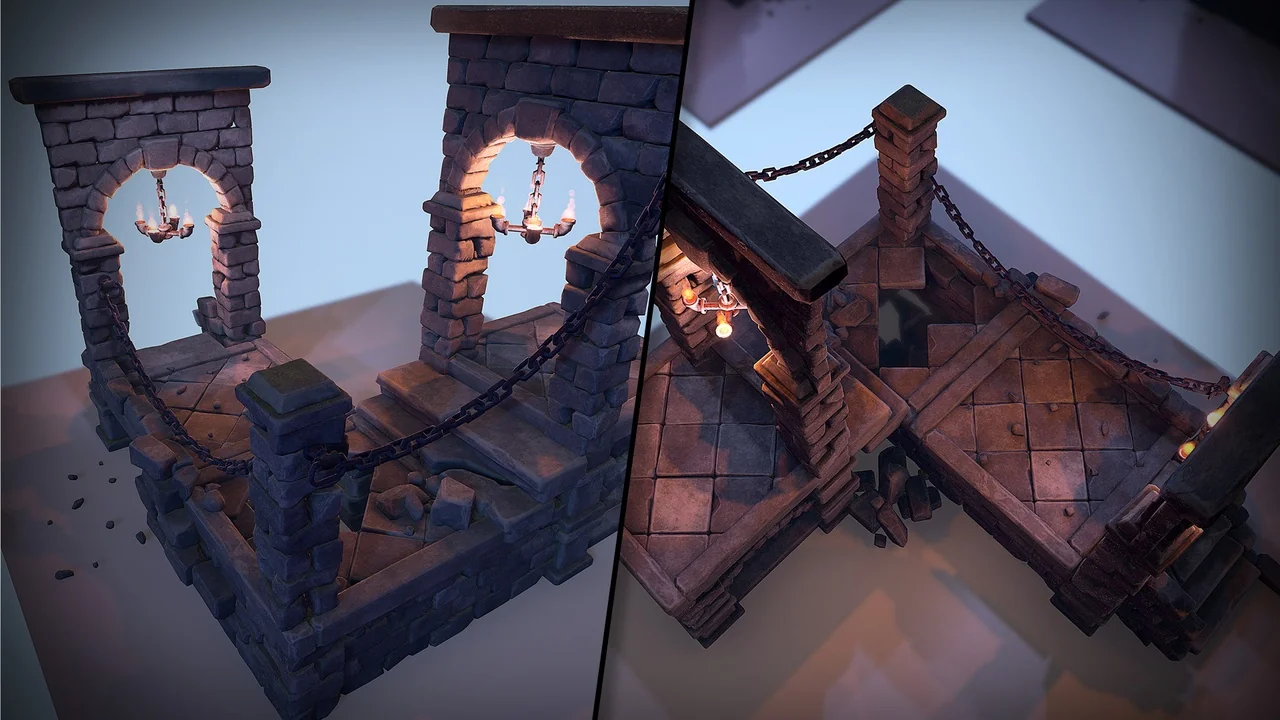
To eliminate the friction of starting in an empty grid space, Crumbling Ruins incorporates a dedicated demonstration map. This secondary map functions both as a showcase for the visual potential of the assets and as an active construction depot for ongoing level creation. Every pre-built ruined structure, arch, and architectural vignette seen in the sample materials is laid out within this environment, showing how individual components interlock to convey structural degradation.
A practical element of this included map is the presence of curated collections of grouped meshes. Instead of forcing level artists to combine single stones and pillars from scratch for every room or corridor, the map provides pre-composed structural clusters. These groupings represent ready-made rubble heaps, broken arch spans, collapsed column arrangements, and wall junctions.
Level designers can select these grouped configurations directly within the editor and copy-paste them straight into production scenes. This workflow drastically cuts down assembly time during greyboxing and initial environment dressing. Designers can drop a fully realized crumbling corner into place with a single operation, immediately establishing a sense of age and wear. Beyond direct placement, these assemblies serve as ideation springboards, illustrating spatial solutions for broken floors, irregular openings, and vertical exploration paths that developers can adapt to fit their own project requirements.
Fantasy and Dungeon Level Construction Workflows
The aesthetic profile of Crumbling Ruins targets fantasy settings, subterranean dungeons, and ancient ruined environments where environmental storytelling relies on historical decay. In games focused on exploration, ruined environments perform essential mechanical duties: they break line-of-sight for combat encounters, supply natural ramps and platforms for vertical traversal, and telegraph structural age without relying on narrative exposition.
When blocking out a dungeon using this modular kit, the designer can establish clear movement vectors while maintaining the visual illusion of chaos. An intact passageway can gradually transition into fractured blocks, forced detours, and partially open ceilings where light penetrates into dark caverns. Because the individual meshes tolerate free scaling and rotation, the designer can dictate the exact degree of navigability, closing off impassable routes with dense rubble banks or opening narrow crouch spaces beneath leaning slabs of rock.
In exterior fantasy levels, the same components can be dispersed across varied terrain elevations. Placing scaled-up ruins against cliffsides or ridge paths allows developers to anchor points of interest across vast landscapes, guiding player attention toward forgotten temples, old outposts, or hidden dungeon entrances embedded into the earth.
Integration Alongside the Modular Mansion Mini Pack
Crumbling Ruins is directly compatible with the Modular Mansion Mini Pack, opening specific architectural workflows that combine civilized grandeur with gradual environmental decay. The Mansion pack supplies more complete, inhabited, or structured architectural elements, while Crumbling Ruins supplies the weathered and ruined counterpart needed to break down those clean silhouettes.
By blending both kits in a unified environment, developers can build scenes that portray progressive dilapidation. A game space might begin in an intact wing of a manor or fortress built with the Modular Mansion Mini Pack, then organically degrade as the player progresses toward neglected basements, breached exterior fortifications, or forgotten underground crypts represented by Crumbling Ruins. This pairing gives world builders a coherent visual language that spans from functional architecture to total structural collapse without requiring custom mesh modification.
Whether used alone to draft atmospheric dungeon ruins or paired with companion kits to show architectural decay over time, the set provides an efficient, omnidirectional toolkit for game environments anchored in exploration and ancient mystery.
 Fantasy
 Fantasy
 Fantasy
 Fantasy