"c68a05d5e51405b3"{"id":"1001871","slug":"combat-systems-constructor","title":"Combat Systems - Constructor","category":"Characters \u0026 Creatures","engine":"4.26+,5.0+","assetVersion":"","engineVersion":"Engine Version: 4.26+,5.0+","tag":"Characters","accent":"blue","visual":"character","summary":"Explore Combat Systems - Constructor, featuring modular animated chassis, varied weapon systems, and Blueprint scripts for assembling custom combat robots.","platform":"Unreal Engine","publishedAt":"2026-10-22T11:13:58.665Z","updatedAt":"2026-10-22T11:13:58.665Z","sourceNotes":[],"fileContents":[],"compatibility":["Unreal Engine","Engine Version: 4.26+,5.0+"],"featuredImage":{"alt":"Combat Systems - Constructor","src":"/wp-content/uploads/published/2026/10/fb18d32f019d-7fd1be55-7392-4109-8a09-027a83a7eca7-edfcb660c7.webp"},"hasDownloadLink":true,"downloads":0,"terms":[{"taxonomy":"category","slug":"characters-and-creatures","name":"Characters \u0026 Creatures"}],"galleryImages":[{"src":"/wp-content/uploads/published/2026/10/618be0d4c9f8-4ca9e08a-04c6-4860-9107-eb15d6bb6e7c-b1505781a6.webp","alt":"Combat Systems - Constructor"},{"src":"/wp-content/uploads/published/2026/10/c81394df3f65-ec9fd26c-7f8d-4c39-922a-83f1c086b879-a8d74cc132.webp","alt":"Combat Systems - Constructor"},{"src":"/wp-content/uploads/published/2026/10/24feaa175a24-78f63893-9fb0-4039-bb92-406796d72c66-97a247d018.webp","alt":"Combat Systems - Constructor"},{"src":"/wp-content/uploads/published/2026/10/dae9802e41c2-4ea08c01-0cfc-4293-bcf6-23ce44ebf109-66bc8789b1.webp","alt":"Combat Systems - Constructor"},{"src":"/wp-content/uploads/published/2026/10/946f7c9c7503-a07f1e7c-26c0-49dd-9326-ca3b7e4c9103-df39039610.webp","alt":"Combat Systems - Constructor"},{"src":"/wp-content/uploads/published/2026/10/a170a2bbfba5-c2a4e843-600b-488c-89f3-14701fd5b67e-38615dea99.webp","alt":"Combat Systems - Constructor"}],"accessPanel":{"kind":"resource","title":"Download this resource","eyebrow":"Free Download","message":"Log in or create a free account to start your download.","fileName":"Combat Systems - Constructor.7z","safetyNote":"Resources are manually reviewed before listing to improve quality and reduce obvious risks.","actionLabel":"Download Free","resourceType":"Resource archive"},"contentHtml":"\u003ch2\u003eAssembling Mechanical Units from Chassis and Weapon Parts\u003c/h2\u003e\u003cp\u003eCombat Systems - Constructor supplies a modular framework of animated composite mechanical parts configured for building custom robotic war machines. Rather than relying on static, single-mesh vehicles, the kit breaks mechanized units down into functional sub-assemblies. Developers can piece together diverse mobile units or stationary defense platforms by matching animated mechanical bases with specific weapon systems.\u003c/p\u003e\u003cp\u003eLocomotion options form the foundational layer of any assembled unit in the package. The modular selection includes four distinct chassis formats:\u003c/p\u003e\u003cul\u003e\u003cli\u003e\u003cstrong\u003eWalker chassis:\u003c/strong\u003e Articulated robotic legs intended for step-based traversal and dynamic bipedal or multiped movement profiles.\u003c/li\u003e\u003cli\u003e\u003cstrong\u003eTank chassis:\u003c/strong\u003e Traditional heavy armored treads built for continuous ground grip and standard armored vehicle behaviors.\u003c/li\u003e\u003cli\u003e\u003cstrong\u003eChassis crawler:\u003c/strong\u003e Alternative tracked or mechanical crawling assemblies suited for rugged surfaces and heavy-duty industrial or military applications.\u003c/li\u003e\u003cli\u003e\u003cstrong\u003eWheeled chassis:\u003c/strong\u003e High-speed tire assemblies tailored for agile recon units, light combat transports, or rapid-response vehicles.\u003c/li\u003e\u003c/ul\u003e\u003cp\u003eEach chassis option relies on dedicated Animation Blueprints to manage movement cycles and mechanical articulations. These sub-assemblies ensure that when a unit traverses a scene, leg joints articulate cleanly, wheels rotate in sync with velocity, and treads maintain mechanical motion, establishing a believable mechanical baseline across varied vehicle architectures.\u003c/p\u003e\u003ch2\u003eBallistic and Directed-Energy Weapon Systems\u003c/h2\u003e\u003cp\u003eOnce a chassis is selected, offensive capabilities are defined through an extensive arsenal of animated weapon attachments. The package incorporates an assortment of conventional ballistic armaments, heavy ordnance launchers, and experimental directed-energy projectors. Each weapon component is isolated as an independent modular part, allowing developers to mount different offensive loadouts onto any compatible chassis or static mount.\u003c/p\u003e\u003cp\u003eFor heavy bombardment and area denial, the package provides dedicated rocket systems alongside heavy armor-piercing artillery. The multiple rocket launcher delivers sustained volleys across wide zones, whereas the standard rocket launcher handles direct, high-impact tactical strikes. For armored vehicle engagements, the cannon tank weapon offers heavy single-shot ballistic fire, paired alongside a specialized tower defense variant engineered for static perimeter security structures.\u003c/p\u003e\u003cp\u003eDirect-fire ballistic options include the automatic cannon and the rapid-fire Gatling gun. These systems supply continuous kinetic fire against moving targets, featuring animated barrels and feed mechanisms that react during firing cycles. Where projects require futuristic or speculative weapon tech, energy armaments expand the kit's functional range:\u003c/p\u003e\u003cul\u003e\u003cli\u003e\u003cstrong\u003eLaser gun:\u003c/strong\u003e Delivers focused, continuous or pulsed energy beams for high-precision targeting.\u003c/li\u003e\u003cli\u003e\u003cstrong\u003eGauss gun:\u003c/strong\u003e Uses electromagnetic propulsion principles to fire high-velocity rounds through target defenses.\u003c/li\u003e\u003cli\u003e\u003cstrong\u003eLightning gun:\u003c/strong\u003e Projects electrical arc discharges to incapacitate or overload enemy mechanical units.\u003c/li\u003e\u003c/ul\u003e\u003ch2\u003eBlueprint Scripts and Combat Unit Generation\u003c/h2\u003e\u003cp\u003eBeyond individual visual assets, Combat Systems - Constructor includes operational Blueprint scripts designed to handle dynamic unit assembly. Instead of manually linking skeletal meshes and animation nodes inside the editor viewport for every encounter, the Blueprint framework can generate a fully functional, ready-made combat unit dynamically.\u003c/p\u003e\u003cp\u003eThis procedural assembly approach takes individual chassis segments and selected armaments, merges their component hierarchies, attaches the required Animation Blueprints, and initializes the unit as an interactive game actor. Once generated, the unit does not remain a stationary display prop. The included scripts enable full player or automated control over the vehicle, allowing it to navigate the level, track opposing forces, aim mounted turrets, and engage hostile targets.\u003c/p\u003e\u003cp\u003eThese Blueprint scripts are explicitly structured to arrange fights between assembled units. Developers can populate an environment with competing factions or opposing robot designs, triggering automated skirmishes to evaluate unit behaviors, damage interactions, and mechanical handling in real time. This interactive loop provides immediate visual feedback on how chassis types perform when confronted with various weapon payloads.\u003c/p\u003e\u003ch2\u003eWeapon Characteristics and Unit-Determined Engagement Ranges\u003c/h2\u003e\u003cp\u003eCombat logic inside the package establishes a clear division of labor between individual weapon components and the overarching combat unit. Every weapon comes equipped with its own distinct characteristics, governing attributes such as rate of fire, barrel animations, and the physical nature of the visual projectile or beam discharge. A Gatling gun cycles differently and outputs fire at a vastly different pacing than a heavy cannon tank turret or an electric lightning gun.\u003c/p\u003e\u003cp\u003eThe range at which an engagement begins is not dictated by the weapon itself. Instead, the distance to the enemy's attack is determined by the unit actor. This architectural design enables significant tactical variety when balancing mechanical encounters:\u003c/p\u003e\u003cul\u003e\u003cli\u003e\u003cstrong\u003eAggressive close-quarters units:\u003c/strong\u003e A walker chassis equipped with a lightning gun can be scripted to close distance rapidly before engaging, holding fire until within point-blank range.\u003c/li\u003e\u003cli\u003e\u003cstrong\u003eLong-range fire support:\u003c/strong\u003e A wheeled or crawler chassis carrying a multiple rocket launcher can be assigned a wide engagement perimeter, initiating salvos from across the environment.\u003c/li\u003e\u003cli\u003e\u003cstrong\u003eDefensive emplacements:\u003c/strong\u003e A stationary tower defense assembly can enforce a fixed perimeter radius, activating its automatic cannon or Gauss gun as soon as opposing units breach its operational boundary.\u003c/li\u003e\u003c/ul\u003e\u003cp\u003eDecoupling weapon behavior from targeting distances gives designers flexibility when configuring artificial intelligence or input schemes. A designer can modify unit sensor boundaries and tactical aggression levels without altering the core firing parameters of the attached weapon asset.\u003c/p\u003e\u003ch2\u003eIntegration with Sci-Fi Environments and Tactical Scenarios\u003c/h2\u003e\u003cp\u003eCombat Systems - Constructor was featured as a Monthly Unreal Engine Sponsored Content product for February 2020. The package does not present itself as a full-fledged, finished strategy game with complete user interfaces, resource economics, and mission progression. Instead, it provides a working example of mechanical opportunities, offering game creators a functional starting point for prototyping custom robot-driven gameplay mechanics.\u003c/p\u003e\u003cp\u003eThe aesthetic and mechanical scope pairs directly with complementary thematic assets, such as the Set Of Sci-Fi Buildings. When combined with modular sci-fi architecture, the mobile tanks, walkers, and tower defense emplacements can populate futuristic bases, planetary outposts, and combat proving grounds. Whether deployed to build tactical skirmish arenas, wave-based defense scenarios, or player-driven mech action games, the constructor handles the technical baseline of modular unit assembly, animation playback, and live weapon combat.\u003c/p\u003e\n\n\u003ch2\u003eMore From The Same Workflow\u003c/h2\u003e\n\u003cul\u003e\n\u003cli\u003e\u003ca href=\"https://3dcghub.com/slice-mesh-shoot-matrix-slow-bullet/\" title=\"Slice Mesh Shoot Matrix Slow Bullet\"\u003eSlice Mesh Shoot Matrix Slow Bullet\u003c/a\u003e\u003c/li\u003e\n\u003cli\u003e\u003ca href=\"https://3dcghub.com/dismemberment-gore-system/\" title=\"Dismemberment Gore System\"\u003eDismemberment Gore System\u003c/a\u003e\u003c/li\u003e\n\u003cli\u003e\u003ca href=\"https://3dcghub.com/cruel-doll/\" title=\"Cruel Doll\"\u003eCruel Doll\u003c/a\u003e\u003c/li\u003e\n\u003cli\u003e\u003ca href=\"https://3dcghub.com/soldier-future-01/\" title=\"Soldier Future 01\"\u003eSoldier Future 01\u003c/a\u003e\u003c/li\u003e\n\u003cli\u003e\u003ca href=\"https://3dcghub.com/cyberpunk-street-boy/\" title=\"Cyberpunk Street Boy\"\u003eCyberpunk Street Boy\u003c/a\u003e\u003c/li\u003e\n\u003c/ul\u003e","contentTextLength":7299,"navigation":{"current":54,"total":3860,"previous":{"id":"1001872","slug":"crumbling-ruins","title":"Crumbling Ruins","category":"Fantasy","platform":"Unreal Engine","updatedAt":"2026-10-22T11:15:05.452Z"},"next":{"id":"1001870","slug":"cinematic-music-pack","title":"Cinematic Music Pack","category":"Music","platform":"Unreal Engine","updatedAt":"2026-10-22T11:13:03.210Z"}},"relatedResources":[{"id":"3514","slug":"slice-mesh-shoot-matrix-slow-bullet","title":"Slice Mesh Shoot Matrix Slow Bullet","category":"Characters \u0026 Creatures","engine":"5.4+","assetVersion":"Engine version: 5.4+","engineVersion":"4.22","tag":"Characters","accent":"blue","visual":"character","summary":"Enhance your Unreal Engine project with advanced mesh slicing, slow-motion bullet effects, and fluid sword combat mechanics. Perfect for action game developers.","platform":"Unreal Engine","publishedAt":"2026-02-09T08:20:19.000Z","updatedAt":"2026-04-19T15:57:37.000Z","sourceNotes":[],"fileContents":[],"compatibility":["Unreal Engine","Engine version: 5.4+"],"featuredImage":{"alt":"Slice Mesh Shoot Matrix Slow Bullet","src":"https://3dcghub.com/wp-content/uploads/2026/02/ca828516-1c64-4160-a24a-2edebe4c8a98.webp"},"hasDownloadLink":true,"downloads":0},{"id":"1001629","slug":"dismemberment-gore-system","title":"Dismemberment Gore System","category":"Characters \u0026 Creatures","engine":"4.21+,5.0+","assetVersion":"","engineVersion":"Engine Version: 4.21+,5.0+","tag":"Characters","accent":"blue","visual":"character","summary":"Explore the Dismemberment Gore System for Unreal Engine, featuring 77 dismemberable parts, dynamic blood masks, shotgun combat, and smart character materials.","platform":"Unreal Engine","publishedAt":"2026-10-13T02:05:54.650Z","updatedAt":"2026-10-13T02:05:54.650Z","sourceNotes":[],"fileContents":[],"compatibility":["Unreal Engine","Engine Version: 4.21+,5.0+"],"featuredImage":{"alt":"Dismemberment Gore System","src":"/wp-content/uploads/published/2026/10/c7e10e24aab5-8c26cff9-1b19-4229-96e3-29b786b2faff-41aebea87f.webp"},"hasDownloadLink":true,"downloads":0},{"id":"1001835","slug":"soldier-future-01","title":"Soldier Future 01","category":"Characters \u0026 Creatures","engine":"4.18+,5.0+","assetVersion":"","engineVersion":"Engine Version: 4.18+,5.0+","tag":"Characters","accent":"blue","visual":"character","summary":"Soldier Future 01 provides a low-poly realistic sci-fi combat character assembled from modular parts, equipped with an automatic weapon and animation blueprint.","platform":"Unreal Engine","publishedAt":"2026-10-21T08:26:14.117Z","updatedAt":"2026-10-21T08:26:14.117Z","sourceNotes":[],"fileContents":[],"compatibility":["Unreal Engine","Engine Version: 4.18+,5.0+"],"featuredImage":{"alt":"Soldier Future 01","src":"/wp-content/uploads/published/2026/10/a7b58c437d4d-ba5b2986-bad8-4bcf-9231-53a880a7afd0-07255488eb.webp"},"hasDownloadLink":true,"downloads":0}]}
Characters
Combat Systems - Constructor
Explore Combat Systems - Constructor, featuring modular animated chassis, varied weapon systems, and Blueprint scripts for assembling custom combat robots.
Assembling Mechanical Units from Chassis and Weapon Parts
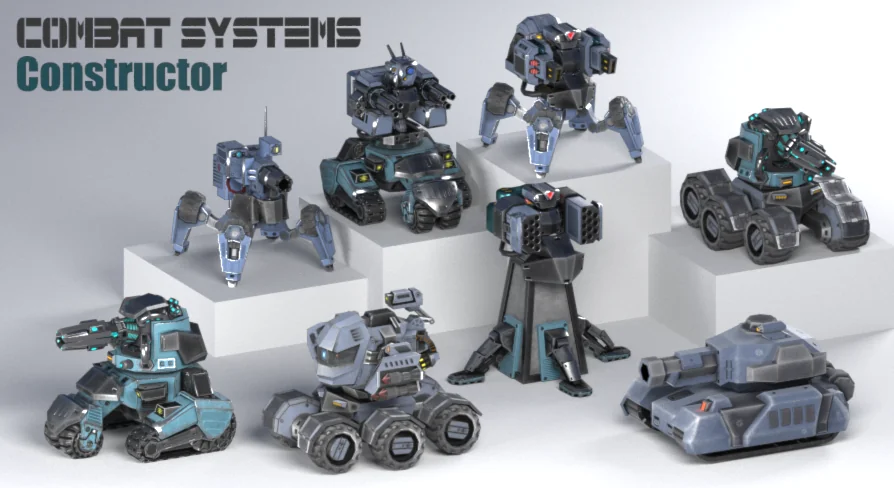
Combat Systems - Constructor supplies a modular framework of animated composite mechanical parts configured for building custom robotic war machines. Rather than relying on static, single-mesh vehicles, the kit breaks mechanized units down into functional sub-assemblies. Developers can piece together diverse mobile units or stationary defense platforms by matching animated mechanical bases with specific weapon systems.
Locomotion options form the foundational layer of any assembled unit in the package. The modular selection includes four distinct chassis formats:
Walker chassis: Articulated robotic legs intended for step-based traversal and dynamic bipedal or multiped movement profiles.
Tank chassis: Traditional heavy armored treads built for continuous ground grip and standard armored vehicle behaviors.
Chassis crawler: Alternative tracked or mechanical crawling assemblies suited for rugged surfaces and heavy-duty industrial or military applications.
Wheeled chassis: High-speed tire assemblies tailored for agile recon units, light combat transports, or rapid-response vehicles.
Each chassis option relies on dedicated Animation Blueprints to manage movement cycles and mechanical articulations. These sub-assemblies ensure that when a unit traverses a scene, leg joints articulate cleanly, wheels rotate in sync with velocity, and treads maintain mechanical motion, establishing a believable mechanical baseline across varied vehicle architectures.
Ballistic and Directed-Energy Weapon Systems
Once a chassis is selected, offensive capabilities are defined through an extensive arsenal of animated weapon attachments. The package incorporates an assortment of conventional ballistic armaments, heavy ordnance launchers, and experimental directed-energy projectors. Each weapon component is isolated as an independent modular part, allowing developers to mount different offensive loadouts onto any compatible chassis or static mount.
For heavy bombardment and area denial, the package provides dedicated rocket systems alongside heavy armor-piercing artillery. The multiple rocket launcher delivers sustained volleys across wide zones, whereas the standard rocket launcher handles direct, high-impact tactical strikes. For armored vehicle engagements, the cannon tank weapon offers heavy single-shot ballistic fire, paired alongside a specialized tower defense variant engineered for static perimeter security structures.
Direct-fire ballistic options include the automatic cannon and the rapid-fire Gatling gun. These systems supply continuous kinetic fire against moving targets, featuring animated barrels and feed mechanisms that react during firing cycles. Where projects require futuristic or speculative weapon tech, energy armaments expand the kit's functional range:
Laser gun: Delivers focused, continuous or pulsed energy beams for high-precision targeting.
Gauss gun: Uses electromagnetic propulsion principles to fire high-velocity rounds through target defenses.
Lightning gun: Projects electrical arc discharges to incapacitate or overload enemy mechanical units.
Blueprint Scripts and Combat Unit Generation
Beyond individual visual assets, Combat Systems - Constructor includes operational Blueprint scripts designed to handle dynamic unit assembly. Instead of manually linking skeletal meshes and animation nodes inside the editor viewport for every encounter, the Blueprint framework can generate a fully functional, ready-made combat unit dynamically.
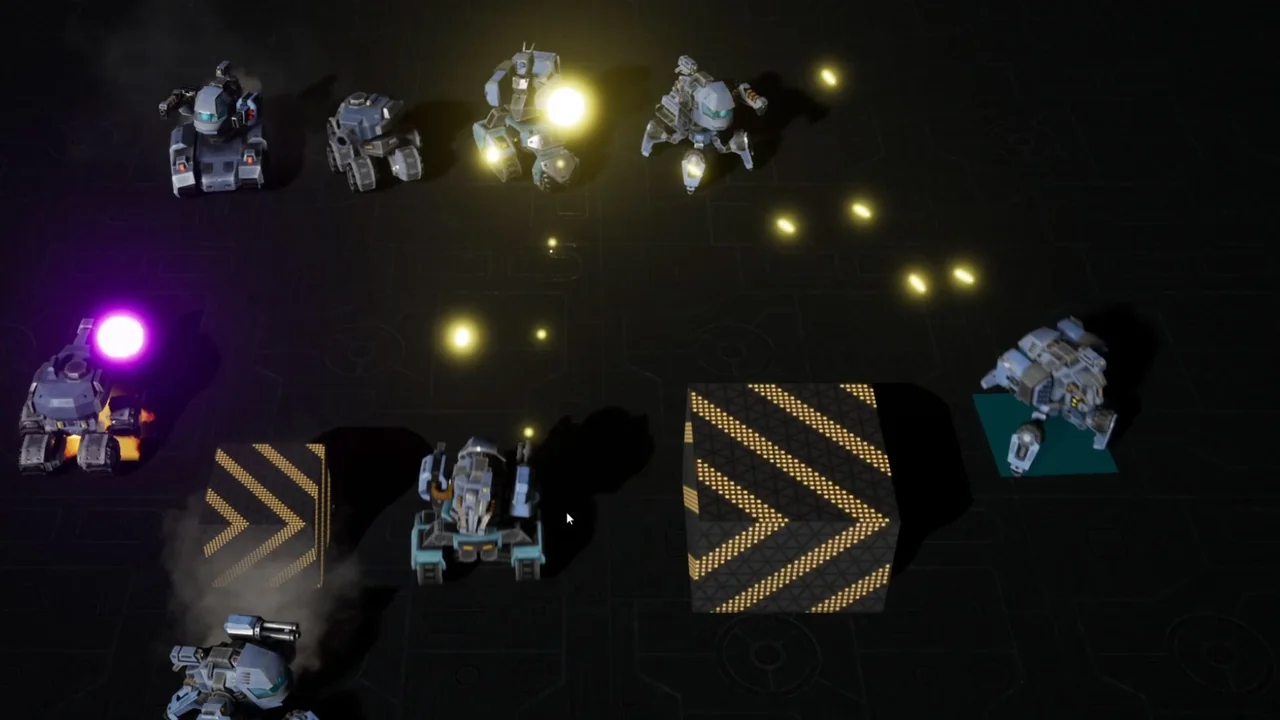
This procedural assembly approach takes individual chassis segments and selected armaments, merges their component hierarchies, attaches the required Animation Blueprints, and initializes the unit as an interactive game actor. Once generated, the unit does not remain a stationary display prop. The included scripts enable full player or automated control over the vehicle, allowing it to navigate the level, track opposing forces, aim mounted turrets, and engage hostile targets.
These Blueprint scripts are explicitly structured to arrange fights between assembled units. Developers can populate an environment with competing factions or opposing robot designs, triggering automated skirmishes to evaluate unit behaviors, damage interactions, and mechanical handling in real time. This interactive loop provides immediate visual feedback on how chassis types perform when confronted with various weapon payloads.
Weapon Characteristics and Unit-Determined Engagement Ranges
Combat logic inside the package establishes a clear division of labor between individual weapon components and the overarching combat unit. Every weapon comes equipped with its own distinct characteristics, governing attributes such as rate of fire, barrel animations, and the physical nature of the visual projectile or beam discharge. A Gatling gun cycles differently and outputs fire at a vastly different pacing than a heavy cannon tank turret or an electric lightning gun.
The range at which an engagement begins is not dictated by the weapon itself. Instead, the distance to the enemy's attack is determined by the unit actor. This architectural design enables significant tactical variety when balancing mechanical encounters:
Aggressive close-quarters units: A walker chassis equipped with a lightning gun can be scripted to close distance rapidly before engaging, holding fire until within point-blank range.
Long-range fire support: A wheeled or crawler chassis carrying a multiple rocket launcher can be assigned a wide engagement perimeter, initiating salvos from across the environment.
Defensive emplacements: A stationary tower defense assembly can enforce a fixed perimeter radius, activating its automatic cannon or Gauss gun as soon as opposing units breach its operational boundary.
Decoupling weapon behavior from targeting distances gives designers flexibility when configuring artificial intelligence or input schemes. A designer can modify unit sensor boundaries and tactical aggression levels without altering the core firing parameters of the attached weapon asset.
Integration with Sci-Fi Environments and Tactical Scenarios
Combat Systems - Constructor was featured as a Monthly Unreal Engine Sponsored Content product for February 2020. The package does not present itself as a full-fledged, finished strategy game with complete user interfaces, resource economics, and mission progression. Instead, it provides a working example of mechanical opportunities, offering game creators a functional starting point for prototyping custom robot-driven gameplay mechanics.
The aesthetic and mechanical scope pairs directly with complementary thematic assets, such as the Set Of Sci-Fi Buildings. When combined with modular sci-fi architecture, the mobile tanks, walkers, and tower defense emplacements can populate futuristic bases, planetary outposts, and combat proving grounds. Whether deployed to build tactical skirmish arenas, wave-based defense scenarios, or player-driven mech action games, the constructor handles the technical baseline of modular unit assembly, animation playback, and live weapon combat.
 Characters
 Characters
 Characters
 Characters