"c14ff6bd758dadb1"{"id":"1001726","slug":"cruel-doll","title":"Cruel Doll","category":"Characters \u0026 Creatures","engine":"4.25+,5.0+","assetVersion":"","engineVersion":"Engine Version: 4.25+,5.0+","tag":"Characters","accent":"blue","visual":"character","summary":"Explore the Cruel Doll character asset, featuring 19 animations, 4K parametric textures, scissor weapon combat, and seamless Epic Skeleton retargeting.","platform":"Unreal Engine","publishedAt":"2026-10-20T02:33:21.246Z","updatedAt":"2026-10-20T02:33:21.246Z","sourceNotes":[],"fileContents":[],"compatibility":["Unreal Engine","Engine Version: 4.25+,5.0+"],"featuredImage":{"alt":"Cruel Doll","src":"/wp-content/uploads/published/2026/10/0d7498df0fc1-5570c5c9-2950-4123-9061-33c81adc1f61-a19fe2f9be.webp"},"hasDownloadLink":true,"downloads":0,"terms":[{"taxonomy":"category","slug":"characters-and-creatures","name":"Characters \u0026 Creatures"}],"galleryImages":[{"src":"/wp-content/uploads/published/2026/10/ae78b774e8e8-65632080-82fb-4798-9c3d-06868650ccab-2fc8974121.webp","alt":"Cruel Doll"},{"src":"/wp-content/uploads/published/2026/10/fde8a7b2f705-a40c1b2e-75ce-4c13-8926-68e896662cbf-e322eb46d0.webp","alt":"Cruel Doll"},{"src":"/wp-content/uploads/published/2026/10/a2b0508df7f7-845c1cb3-e785-4075-8057-381341a03402-3049e3212e.webp","alt":"Cruel Doll"},{"src":"/wp-content/uploads/published/2026/10/d5942790a7d5-34046fd9-5726-48c1-bfa7-bdb39245c669-55573f8b2f.webp","alt":"Cruel Doll"},{"src":"/wp-content/uploads/published/2026/10/30082b308b0f-d643335b-1f66-49ba-a119-c519fe3c0b75-01286fd4e4.webp","alt":"Cruel Doll"},{"src":"/wp-content/uploads/published/2026/10/64b8b5cb1208-1c61ecbb-57b5-4b23-af02-00298078b363-6cbf82b318.webp","alt":"Cruel Doll"},{"src":"/wp-content/uploads/published/2026/10/8808dac93ecc-b66b442e-8621-49b0-89c2-e01a4fedf656-b1ac9a8c69.webp","alt":"Cruel Doll"},{"src":"/wp-content/uploads/published/2026/10/9c3be8c9c973-300a0d49-ede2-4ad2-bfa5-75eca6e595d6-7cc9a76bf8.webp","alt":"Cruel Doll"},{"src":"/wp-content/uploads/published/2026/10/78f70961c87c-2411d471-0136-493c-a6cd-dfae649dd88a-3baee23b43.webp","alt":"Cruel Doll"},{"src":"/wp-content/uploads/published/2026/10/981f6a805725-be2309ba-2530-4164-83f6-c88f776b2cd2-44047f357d.webp","alt":"Cruel Doll"}],"accessPanel":{"kind":"resource","title":"Download this resource","eyebrow":"Free Download","message":"Log in or create a free account to start your download.","fileName":"Content.7z","safetyNote":"Resources are manually reviewed before listing to improve quality and reduce obvious risks.","actionLabel":"Download Free","resourceType":"Resource archive"},"contentHtml":"\u003ch2\u003eStaging Horror Sequences with the Cruel Doll Character\u003c/h2\u003e\u003cp\u003ePacing in horror game development relies heavily on how an antagonist is introduced, observed, and confronted. Cruel Doll is constructed specifically to serve these atmospheric shifts, functioning as a porcelain-like fixture in one moment and an aggressive threat in the next. The base visual presentation leans into an unsettling blend of classical doll aesthetics and violent mechanical corruption, making it suitable for psychological thrillers, haunted environments, and surreal action scenes.\u003c/p\u003e\u003cp\u003eBecause the character includes variable facial expressions and eye states, creators can choreograph tense storytelling beats before any combat occurs. A cinematic scene might open with the doll seated motionlessly in a dimly lit playroom, presenting a polished, ordinary face material. As the player draws near or triggers an event, switching the material properties instantly corrupts the appearance into an evil state, reinforced by toggling visible robotic eyes. This duality gives narrative designers the tools to transition an encounter from quiet dread into immediate danger without swapping out base meshes.\u003c/p\u003e\u003ch2\u003eLocomotion Dynamics and the Cruel Doll Animation Library\u003c/h2\u003e\u003cp\u003eBelievable movement sets a horror antagonist apart from static props, and the nineteen included animations provide a broad motion vocabulary. The locomotion set does not rely on a single traversal loop. Instead, it supplies standard walks and runs alongside alternative variations, enabling developers to alternate between calculated pacing and erratic pursuits based on game state.\u003c/p\u003e\u003cp\u003eThe inclusion of a crawl run introduces distinct tactical possibilities for level design. Rather than relying solely on upright chasing sequences, gameplay scripters can route the character through low obstacles, crawlspaces, under furniture, or through fractured walls. This variation breaks predictable patrol patterns and keeps players off balance. Outside of active pursuit, specific situational motions like the sit pose, standing up, and a dedicated scream state allow for scripted jump scares, environmental discovery moments, and dynamic boss phase transitions.\u003c/p\u003e\u003ch2\u003eArmed Encounters and Scissor Weapon Combat\u003c/h2\u003e\u003cp\u003eCombat sequences require clear readability and visceral feedback, which are supported through the included scissor weapon. Rather than relying on generic melee swings, the package supplies two distinct attack animations that emphasize the weapon's sharp, piercing profile. These paired attack motions allow developers to alternate strike directions, preventing visual fatigue during extended player confrontations.\u003c/p\u003e\u003cp\u003eWhen players fight back, the character's reaction pool handles damage and defeat through specialized motion data. The hit reaction animation establishes clear gameplay feedback upon taking damage, confirming successful hits in rapid combat scenarios. For critical damage states, developers can transition the character into an agony sequence, prolonging tension before triggering either the primary death or alternative death animations. Having multiple death states ensures that repetitive combat encounters do not conclude with identical ragdoll or animation loops, preserving visual variety across game levels.\u003c/p\u003e\u003ch2\u003eParametric Surface Customization and 4K Textures\u003c/h2\u003e\u003cp\u003eVisual variety across levels or enemy tiers is managed through parametric material customization. The entire character is surfaced using 4K resolution textures, retaining clean macro details on clothing weaves, skin surfaces, and mechanical elements even during tight cinematic close-ups. These textures are not locked into a single fixed aesthetic, providing direct control over core appearance variables.\u003c/p\u003e\u003cp\u003eDevelopers can adjust suit colors across the material graph to create visual hierarchy, whether distinguishing standard wandering variants from aggressive elite encounters. The procedural blood controls allow teams to scale gore dynamically. A clean suit can progressively accumulate splatter and arterial staining as an encounter progresses, showing clear wear and violence across multiple stages of gameplay. Combined with the toggle for robotic eyes and the shift between normal and evil face materials, a single character asset can represent multiple distinct entities or evolve dynamically across a narrative arc.\u003c/p\u003e\u003ch2\u003eEpic Skeleton Integration and Project Migration Workflow\u003c/h2\u003e\u003cp\u003ePipeline efficiency determines how quickly an asset can be placed into an active game build. Cruel Doll is fully rigged and ready to operate within modern animation pipelines, mapping directly to the Epic Skeleton. For developers utilizing Unreal Engine 5, the model interfaces cleanly with the IK Retarget system, enabling creators to transfer custom animation libraries, specialized combat sets, or existing locomotion blends directly onto the doll's skeleton without rebuilding rigs from scratch.\u003c/p\u003e\u003cp\u003eThe package is structured to work alongside animation blueprints for responsive state machine blending. To maintain project hygiene and avoid technical conflicts, the recommended workflow is to import the asset package into an empty staging project first before migrating it into your primary production workspace. This isolated migration protects existing project settings, input mappings, and shared asset folders from being inadvertently overwritten by matching file paths. The model also offers cross-compatibility with the Crazy Doctor asset line, allowing teams building medical or institutional horror projects to populate their scenes with stylistically cohesive character rosters.\u003c/p\u003e\u003ch2\u003ePractical Implementation for Horror and Cinematic Teams\u003c/h2\u003e\u003cp\u003eSolo creators and independent studios building survival horror titles benefit most from this package due to its standalone completeness. It bundles the core character model, weapon accessory, full locomotion spread, combat reactions, and adaptable material logic into a single cohesive system. Narrative designers obtain ready-to-render cutscene options through the scream, sit, and face-switch features, while gameplay programmers obtain a functional combatant capable of walking, sprinting, crawling, attacking, and dying right out of the box.\u003c/p\u003e\n\n\u003ch2\u003eMore From The Same Workflow\u003c/h2\u003e\n\u003cul\u003e\n\u003cli\u003e\u003ca href=\"https://3dcghub.com/viking-warriors/\" title=\"Viking Warriors\"\u003eViking Warriors\u003c/a\u003e\u003c/li\u003e\n\u003cli\u003e\u003ca href=\"https://3dcghub.com/cyberpunk-sniper-girl/\" title=\"Cyberpunk Sniper Girl\"\u003eCyberpunk Sniper Girl\u003c/a\u003e\u003c/li\u003e\n\u003cli\u003e\u003ca href=\"https://3dcghub.com/animated-stylized-wizard/\" title=\"Animated Stylized Wizard\"\u003eAnimated Stylized Wizard\u003c/a\u003e\u003c/li\u003e\n\u003cli\u003e\u003ca href=\"https://3dcghub.com/horse-herd/\" title=\"Horse Herd\"\u003eHorse Herd\u003c/a\u003e\u003c/li\u003e\n\u003cli\u003e\u003ca href=\"https://3dcghub.com/modular-soldier-opb-full/\" title=\"Modular Soldier OPB Full\"\u003eModular Soldier OPB Full\u003c/a\u003e\u003c/li\u003e\n\u003c/ul\u003e","contentTextLength":6300,"navigation":{"current":57,"total":3719,"previous":{"id":"1001727","slug":"cyberpunk-sci-fi-environment-cyberpunk-asset-set-cyberpunk-sci-fi-cyber","title":"CyberPunk / Sci-Fi Environment Cyberpunk Asset Set ( CyberPunk Sci-Fi Cyber )","category":"Cyberpunk","platform":"Unreal Engine","updatedAt":"2026-10-20T02:33:57.285Z"},"next":{"id":"1001725","slug":"city-shopping-mall-modular-environment-v-1-5","title":"City Shopping Mall (MODULAR Environment) V 1.5","category":"Interior","platform":"Unreal Engine","updatedAt":"2026-10-20T02:32:02.528Z"}},"relatedResources":[{"id":"1001777","slug":"cyberpunk-street-boy","title":"Cyberpunk Street Boy","category":"Characters \u0026 Creatures","engine":"4.25+,5.0+","assetVersion":"","engineVersion":"Engine Version: 4.25+,5.0+","tag":"Characters","accent":"blue","visual":"character","summary":"Examine Cyberpunk Street Boy, featuring modular cybernetic design, PBR materials, facial morph targets, sword combat, and Animation Blueprint support.","platform":"Unreal Engine","publishedAt":"2026-10-20T03:25:10.457Z","updatedAt":"2026-10-20T03:25:10.457Z","sourceNotes":[],"fileContents":[],"compatibility":["Unreal Engine","Engine Version: 4.25+,5.0+"],"featuredImage":{"alt":"Cyberpunk Street Boy","src":"/wp-content/uploads/published/2026/10/52f458aff286-02fd65ac-9315-4dbb-b5bb-521bead39c80-4b9bde6c52.webp"},"hasDownloadLink":true,"downloads":0},{"id":"1001674","slug":"viking-warriors","title":"Viking Warriors","category":"Characters \u0026 Creatures","engine":"4.19+,5.0+","assetVersion":"","engineVersion":"Engine Version: 4.19+,5.0+","tag":"Characters","accent":"blue","visual":"character","summary":"Viking Warriors brings modular material customization, APEX cloth physics, combat weapons, and seamless Unreal Engine mannequin compatibility into real-time pro","platform":"Unreal Engine","publishedAt":"2026-10-13T15:22:48.715Z","updatedAt":"2026-10-13T15:22:48.715Z","sourceNotes":[],"fileContents":[],"compatibility":["Unreal Engine","Engine Version: 4.19+,5.0+"],"featuredImage":{"alt":"Viking Warriors","src":"/wp-content/uploads/published/2026/10/42eef3ea8f03-e62a40b7-e5d1-408b-80e1-bfb7b5904e73-740805dff2.webp"},"hasDownloadLink":true,"downloads":1},{"id":"1001728","slug":"l-dark-wizard","title":"L: Dark Wizard","category":"Characters \u0026 Creatures","engine":"4.19+,5.0+","assetVersion":"","engineVersion":"Engine Version: 4.19+,5.0+","tag":"Characters","accent":"blue","visual":"character","summary":"Modular lowpoly Gothic female wizard character rigged to Epic Skeleton with 4K PBR textures, ALSV4 testing, dual dress skinning types, and blendshapes.","platform":"Unreal Engine","publishedAt":"2026-10-20T02:34:51.447Z","updatedAt":"2026-10-20T02:34:51.447Z","sourceNotes":[],"fileContents":[],"compatibility":["Unreal Engine","Engine Version: 4.19+,5.0+"],"featuredImage":{"alt":"L: Dark Wizard","src":"/wp-content/uploads/published/2026/10/f6643e916e9e-b085cc89-2fb7-4cd9-8cfa-04b694529a85-c71e601294.webp"},"hasDownloadLink":true,"downloads":0}]}
Characters
Cruel Doll
Explore the Cruel Doll character asset, featuring 19 animations, 4K parametric textures, scissor weapon combat, and seamless Epic Skeleton retargeting.
Staging Horror Sequences with the Cruel Doll Character
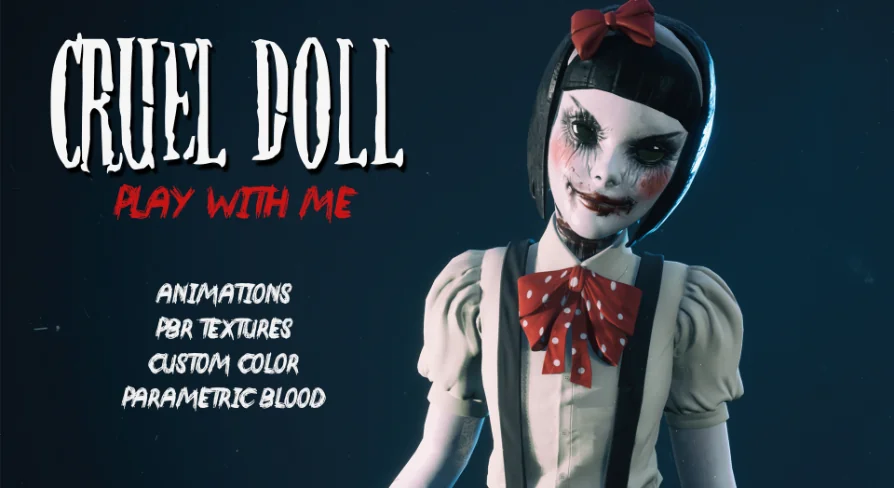
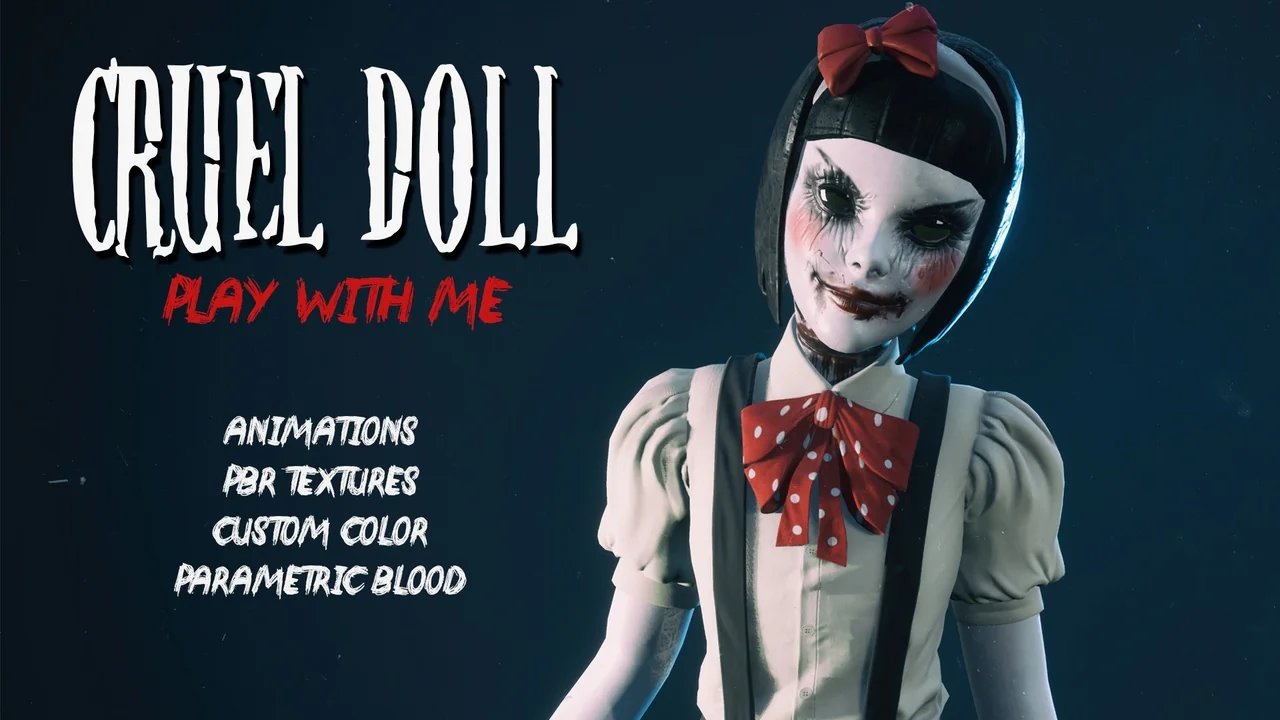
Pacing in horror game development relies heavily on how an antagonist is introduced, observed, and confronted. Cruel Doll is constructed specifically to serve these atmospheric shifts, functioning as a porcelain-like fixture in one moment and an aggressive threat in the next. The base visual presentation leans into an unsettling blend of classical doll aesthetics and violent mechanical corruption, making it suitable for psychological thrillers, haunted environments, and surreal action scenes.
Because the character includes variable facial expressions and eye states, creators can choreograph tense storytelling beats before any combat occurs. A cinematic scene might open with the doll seated motionlessly in a dimly lit playroom, presenting a polished, ordinary face material. As the player draws near or triggers an event, switching the material properties instantly corrupts the appearance into an evil state, reinforced by toggling visible robotic eyes. This duality gives narrative designers the tools to transition an encounter from quiet dread into immediate danger without swapping out base meshes.
Locomotion Dynamics and the Cruel Doll Animation Library
Believable movement sets a horror antagonist apart from static props, and the nineteen included animations provide a broad motion vocabulary. The locomotion set does not rely on a single traversal loop. Instead, it supplies standard walks and runs alongside alternative variations, enabling developers to alternate between calculated pacing and erratic pursuits based on game state.
The inclusion of a crawl run introduces distinct tactical possibilities for level design. Rather than relying solely on upright chasing sequences, gameplay scripters can route the character through low obstacles, crawlspaces, under furniture, or through fractured walls. This variation breaks predictable patrol patterns and keeps players off balance. Outside of active pursuit, specific situational motions like the sit pose, standing up, and a dedicated scream state allow for scripted jump scares, environmental discovery moments, and dynamic boss phase transitions.
Armed Encounters and Scissor Weapon Combat
Combat sequences require clear readability and visceral feedback, which are supported through the included scissor weapon. Rather than relying on generic melee swings, the package supplies two distinct attack animations that emphasize the weapon's sharp, piercing profile. These paired attack motions allow developers to alternate strike directions, preventing visual fatigue during extended player confrontations.
When players fight back, the character's reaction pool handles damage and defeat through specialized motion data. The hit reaction animation establishes clear gameplay feedback upon taking damage, confirming successful hits in rapid combat scenarios. For critical damage states, developers can transition the character into an agony sequence, prolonging tension before triggering either the primary death or alternative death animations. Having multiple death states ensures that repetitive combat encounters do not conclude with identical ragdoll or animation loops, preserving visual variety across game levels.
Parametric Surface Customization and 4K Textures
Visual variety across levels or enemy tiers is managed through parametric material customization. The entire character is surfaced using 4K resolution textures, retaining clean macro details on clothing weaves, skin surfaces, and mechanical elements even during tight cinematic close-ups. These textures are not locked into a single fixed aesthetic, providing direct control over core appearance variables.
Developers can adjust suit colors across the material graph to create visual hierarchy, whether distinguishing standard wandering variants from aggressive elite encounters. The procedural blood controls allow teams to scale gore dynamically. A clean suit can progressively accumulate splatter and arterial staining as an encounter progresses, showing clear wear and violence across multiple stages of gameplay. Combined with the toggle for robotic eyes and the shift between normal and evil face materials, a single character asset can represent multiple distinct entities or evolve dynamically across a narrative arc.
Epic Skeleton Integration and Project Migration Workflow
Pipeline efficiency determines how quickly an asset can be placed into an active game build. Cruel Doll is fully rigged and ready to operate within modern animation pipelines, mapping directly to the Epic Skeleton. For developers utilizing Unreal Engine 5, the model interfaces cleanly with the IK Retarget system, enabling creators to transfer custom animation libraries, specialized combat sets, or existing locomotion blends directly onto the doll's skeleton without rebuilding rigs from scratch.
The package is structured to work alongside animation blueprints for responsive state machine blending. To maintain project hygiene and avoid technical conflicts, the recommended workflow is to import the asset package into an empty staging project first before migrating it into your primary production workspace. This isolated migration protects existing project settings, input mappings, and shared asset folders from being inadvertently overwritten by matching file paths. The model also offers cross-compatibility with the Crazy Doctor asset line, allowing teams building medical or institutional horror projects to populate their scenes with stylistically cohesive character rosters.
Practical Implementation for Horror and Cinematic Teams
Solo creators and independent studios building survival horror titles benefit most from this package due to its standalone completeness. It bundles the core character model, weapon accessory, full locomotion spread, combat reactions, and adaptable material logic into a single cohesive system. Narrative designers obtain ready-to-render cutscene options through the scream, sit, and face-switch features, while gameplay programmers obtain a functional combatant capable of walking, sprinting, crawling, attacking, and dying right out of the box.
 Characters
 Characters
 Characters
 Characters