Three components, a clean first pass
Crest is a class-leading water system authored by professional game developers, and the setup path stays focused on getting water into a scene quickly. Water can be added in minutes with three components: water surface, underwater, and waves. That keeps the first pass practical for artists who need visible results early and for developers who want a working water layer before refining the details.
Sane and balanced defaults help the initial setup hold together without a long tuning session. Several example scenes cover many use cases, so the system can be explored in a context that already demonstrates how the pieces fit together. Detailed help boxes show validation errors directly in the inspector and include fix buttons to guide setup, which makes the workflow feel more like assembly than trial and error. Online documentation with embedded videos adds another layer of support for teams working through the system for the first time.
The system has also been used by many studios for its quality and performance, and it has appeared in several successful games and simulators as well as SIGGRAPH talks. That track record matters because the water setup is not presented as a small effect; it is treated like a production element that has to carry real scenes.
Wave control for oceans, rivers, lakes, and shorelines
The creative side opens up through the wave tools. Crest includes an innovative equalizer-style wave authoring system, with both FFT and Gerstner waves supported. That gives water surfaces a flexible motion vocabulary, whether a scene calls for broad ocean movement or more localized shaping.
Wave spline technology adds detailed control over water simulation across oceans, rivers, lakes, and shorelines. Instead of treating the entire surface the same way, the spline approach gives a more direct way to steer how water behaves in different parts of a level. That is especially useful in scenes where a shoreline, river bend, and open water all need to feel related but not identical.
An input system is included for modifying ocean data such as foam, and it works with mesh, trail, line, and particle renderers. Flow is available for horizontal motion of the water surface, which helps moving water read more clearly in channels and river-style layouts. Foam is also simulated from waves and shorelines, so surface detail can follow the motion already present in the scene rather than being added as an unrelated overlay.
Light, depth, and the underwater transition
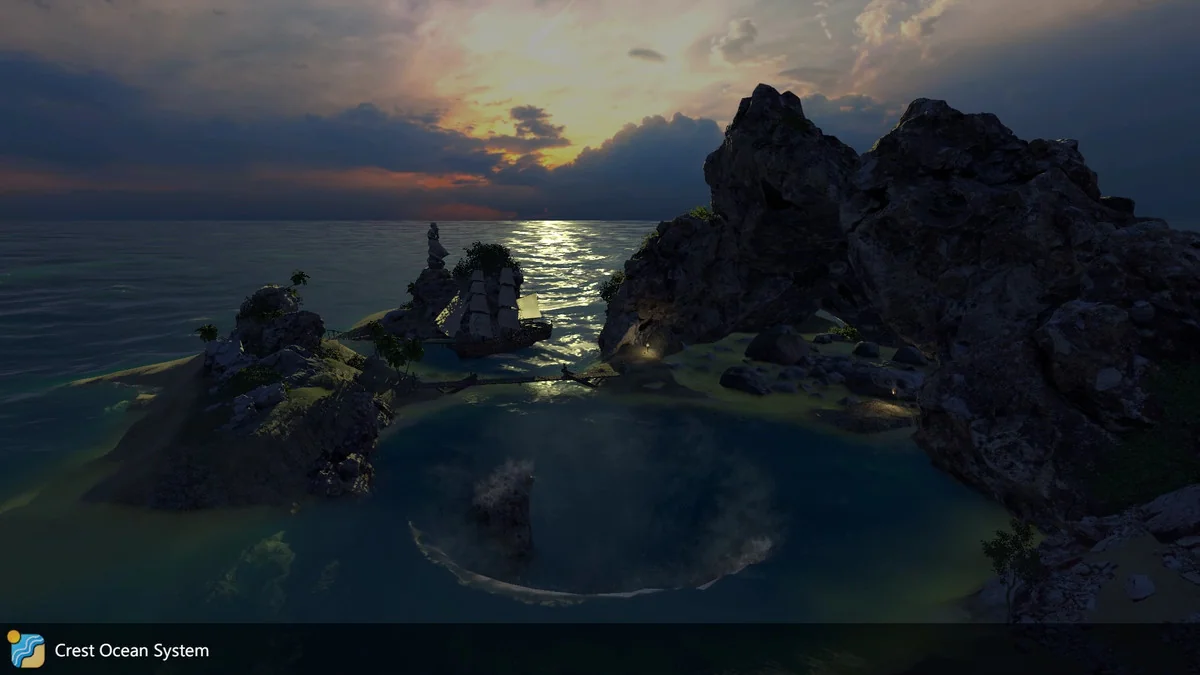
Lighting behavior is handled as part of the water model itself. Simulated light transport includes reflection, refraction, scattering, caustics approximation, and shadowing. Those pieces work together to define how the water surface sits in the scene and how it reacts to the world around it.
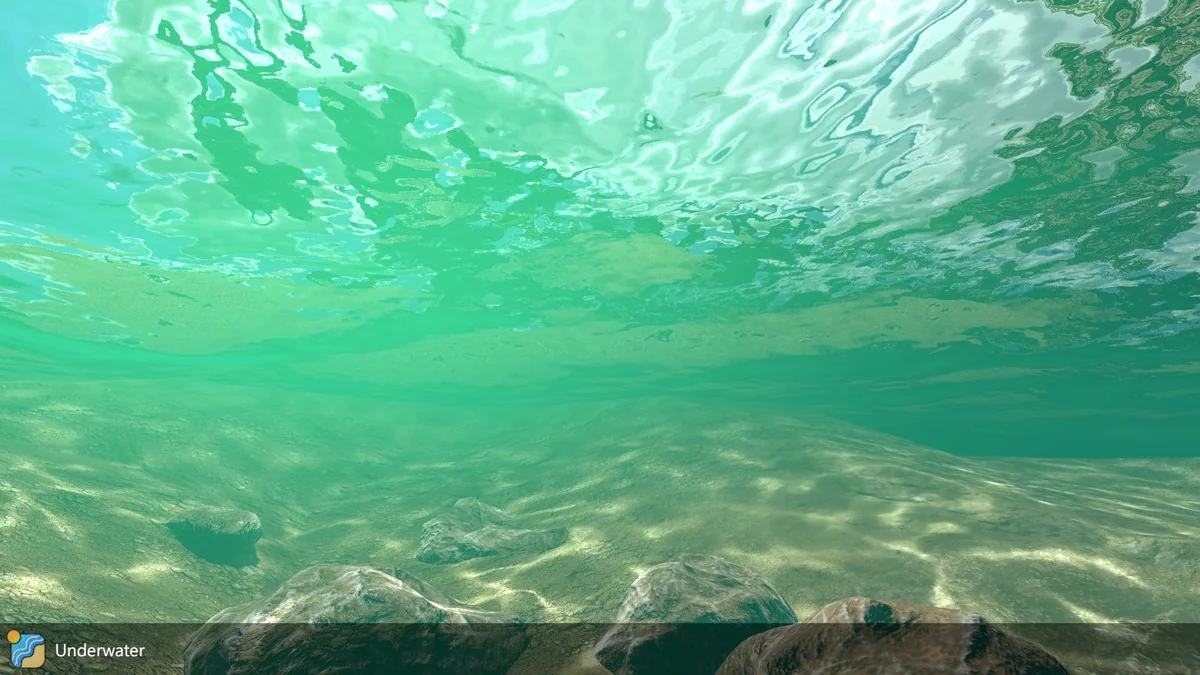
The underwater effect includes partial submersion and a meniscus, which gives the transition between above-water and below-water views a more controlled edge. That can matter in gameplay spaces where the camera crosses the surface frequently, or in visual scenes where the shift between the two states needs to remain readable.
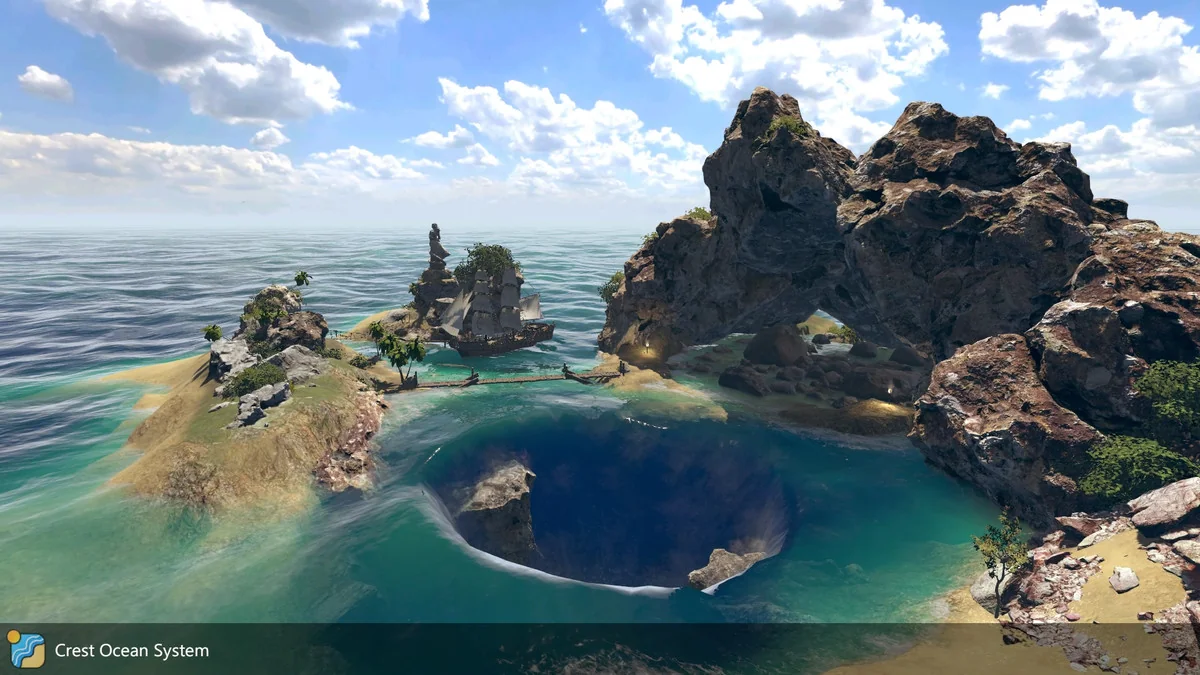
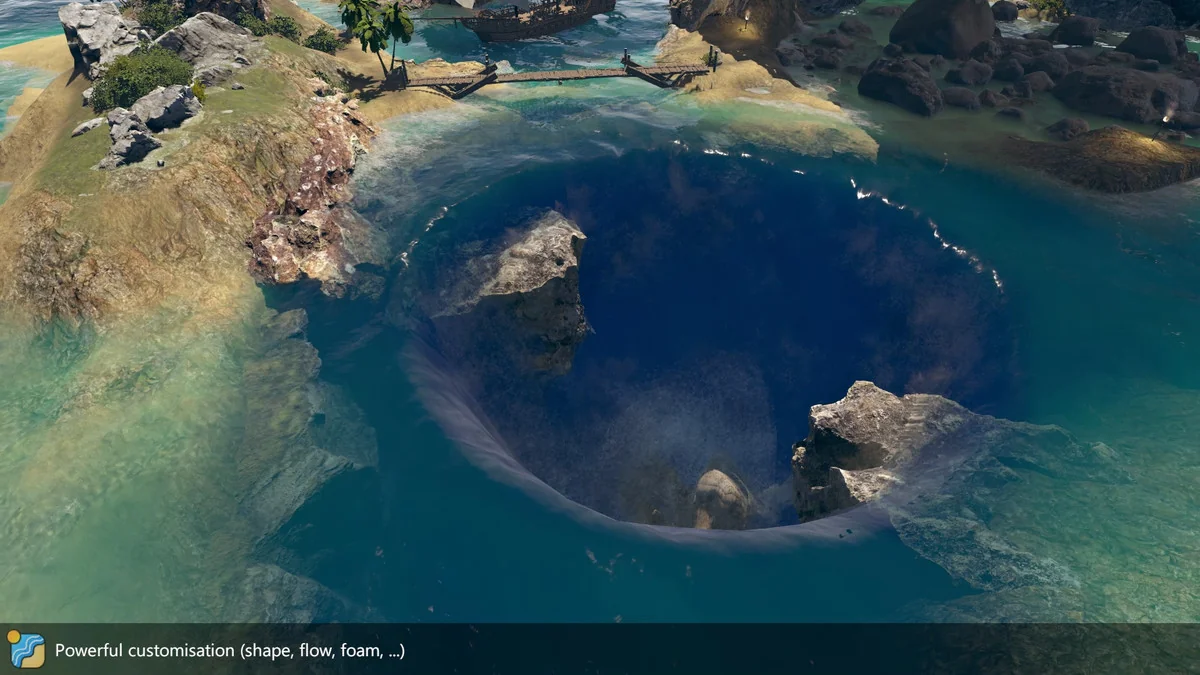
Water volumes can restrict rendering of both the surface and the underwater portion to a given geometry, such as a sphere of water. Surface clipping can carve hulls or caves out of the water surface, which gives more room for shaped environments rather than only open expanses. Crest also provides Shader Graph nodes for applying underwater to transparent objects, extending the underwater treatment beyond opaque materials.
Another useful detail is the ability to apply color onto the ocean surface in a decal-like way. That makes color variation part of the water presentation itself, instead of forcing every surface to share one uniform look.
Interaction, physics, and large-world behavior
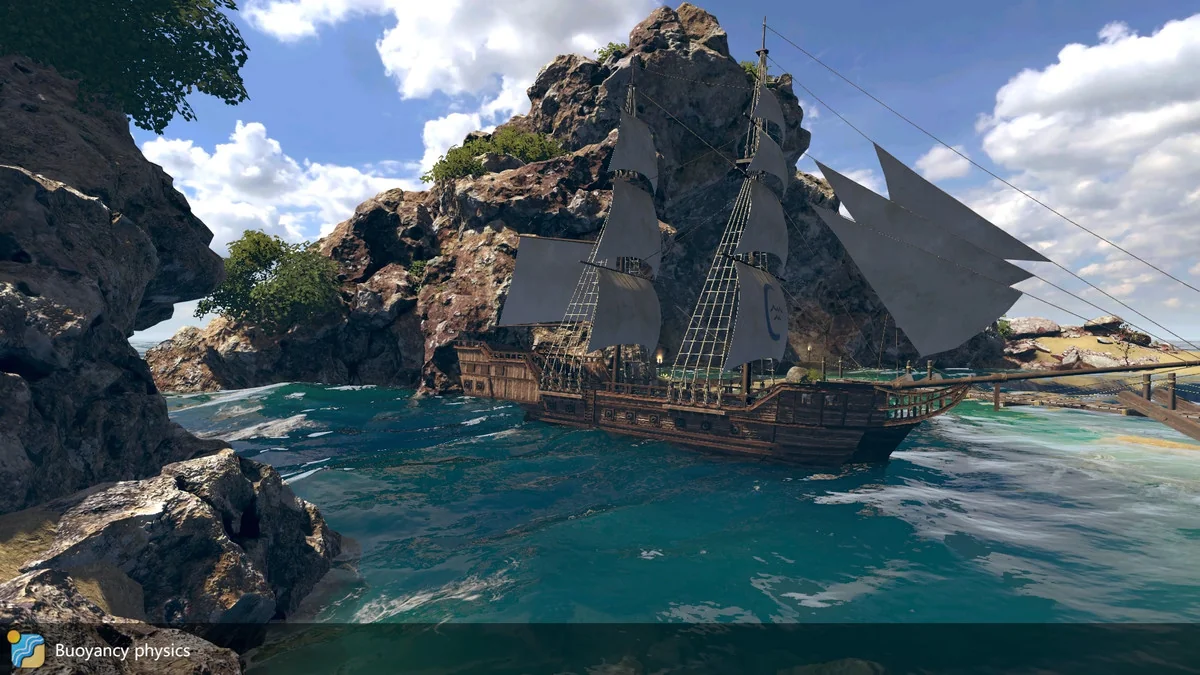
Water interaction is not limited to visuals. Crest lets projects query water displacement through GPU or CPU paths, giving other systems a way to read the surface. The physics interface includes buoyancy implementations and support for Dynamic Water Physics 2, which makes the water surface relevant to floating objects and other physically responsive elements.
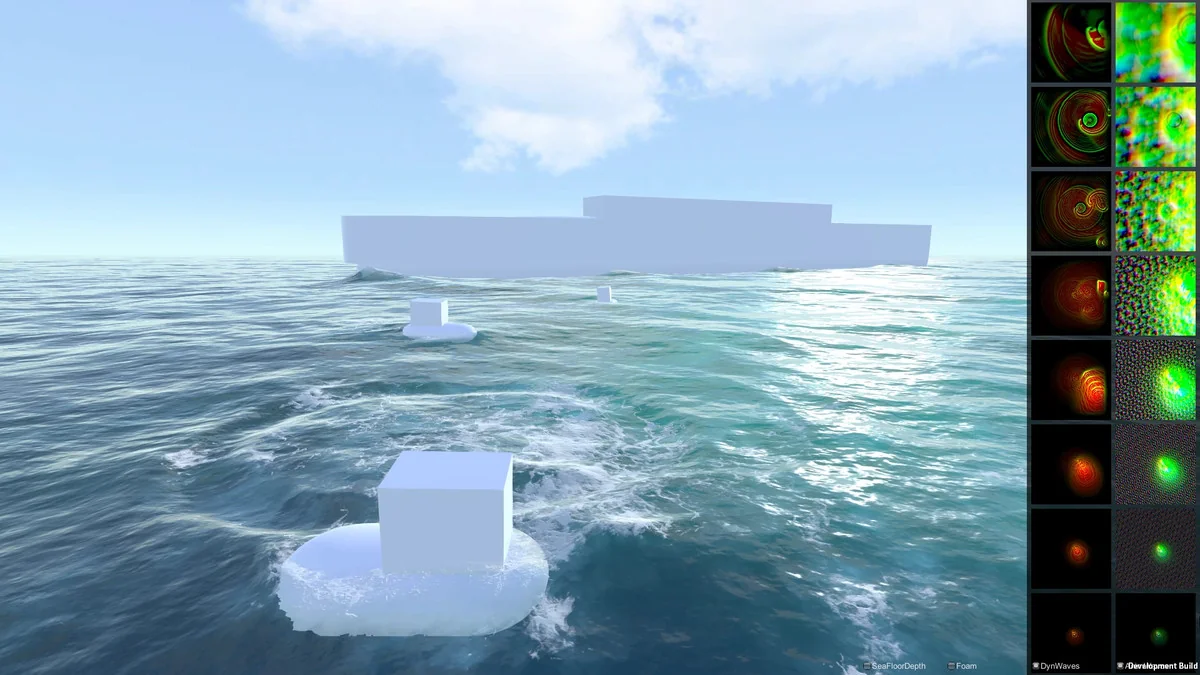
Dynamic wave simulation adds ripple simulation for object-water interaction, including boat wakes. That detail helps moving objects leave visible traces behind them, rather than passing through the water without a response. Shallow water support adds light scattering and wave attenuation, which gives calmer or shallower areas a distinct behavior compared with deeper sections.
Large and open worlds are also part of the picture. A Shifting Origin component is provided for those scenes, and flexible time synchronization supports networking as well as cutscene timelines. Unity Server support is included for authoritative servers, making the water system fit projects where state needs to remain coordinated on the server side, such as MMOs.
Rendering paths and long-term support
Crest 4 is ready for Unity 6 and includes Render Graph and compatibility mode. Rendering support spans Deferred, Forward, Forward+, Perspective, Orthographic, and Stereo (VR/XR), which gives the system room to fit a wide range of camera setups. Planar reflections are included except for VR, adding another layer of surface response where the rendering path allows it.
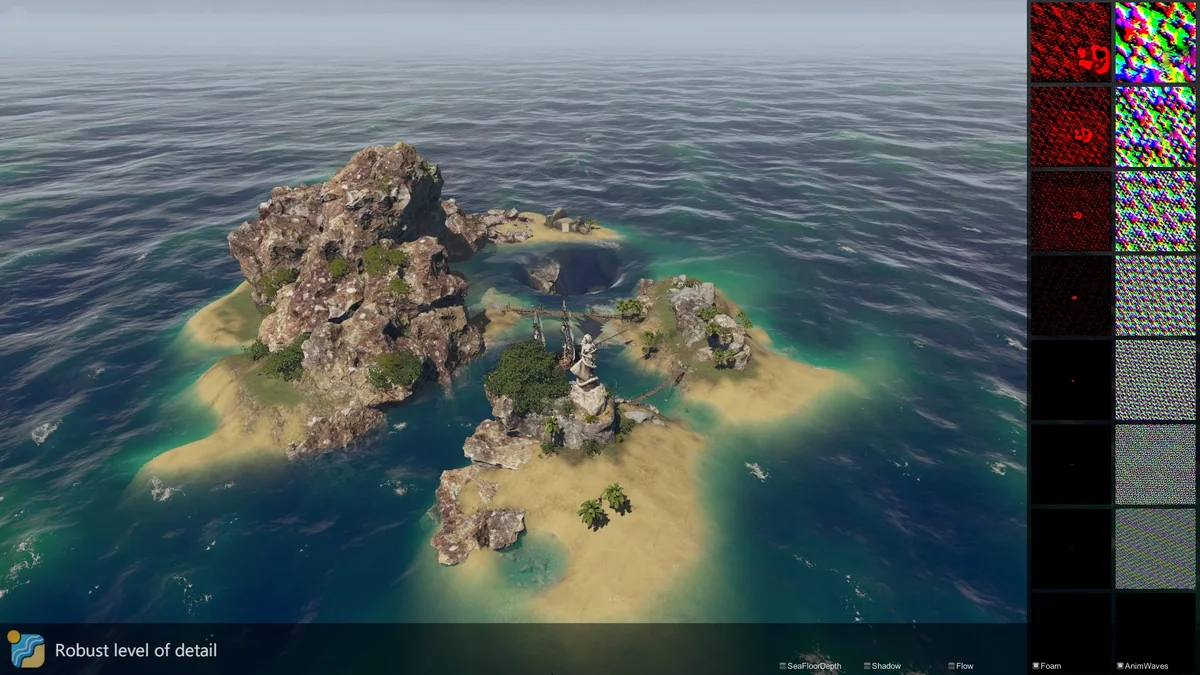
The state-of-the-art LOD system is aimed at class-leading performance, which helps the water stay practical when scenes extend across large distances or need multiple visible water areas at once. Gaia Pro VS integration is also included, giving the system a documented connection point for a broader environment workflow.
Crest 5 is now available, but Crest 4 continues to be supported with bug fixes and minor improvements. That gives existing projects a clear maintenance path while keeping the current feature set available for ongoing production work.
For oceans, rivers, lakes, and shoreline-heavy scenes, the practical value is the combination of quick setup, detailed wave control, underwater treatment, and broad rendering support in one water stack.
Preview Images
Protected download
Access this resource
All resources are 100% manually reviewed to eliminate all risks.