"059e11fbf316ed56"{"id":"1001285","slug":"creating-portal-to-another-reality","title":"Creating Portal To Another Reality","category":"Game Systems","engine":"5.0+","assetVersion":"","engineVersion":"Engine Version: 5.0+","tag":"Game Systems","accent":"blue","visual":"mech","summary":"Explore Creating Portal To Another Reality, a material-driven portal system for seamless world shifts, non-Euclidean spaces, and VR puzzles without teleportatio","platform":"Unreal Engine","publishedAt":"2026-10-01T12:53:49.247Z","updatedAt":"2026-10-01T12:53:49.247Z","sourceNotes":[],"fileContents":[],"compatibility":["Unreal Engine","Engine Version: 5.0+"],"featuredImage":{"alt":"Creating Portal To Another Reality","src":"/wp-content/uploads/published/2026/10/87be95b67b7e-782a43e3-93ff-4466-866f-fd56ad48d620-73752b9395.webp"},"hasDownloadLink":true,"downloads":0,"terms":[{"taxonomy":"category","slug":"game-systems","name":"Game Systems"}],"galleryImages":[{"src":"/wp-content/uploads/published/2026/10/efca95d65f9c-8532b7ab-7fd1-4973-b031-91a282637ab3-e4feb54ec5.webp","alt":"Creating Portal To Another Reality"},{"src":"/wp-content/uploads/published/2026/10/55bd232b0fc9-2d5ee35d-c660-4578-9314-ccfed5040d47-e881e80fae.webp","alt":"Creating Portal To Another Reality"},{"src":"/wp-content/uploads/published/2026/10/e88a1052cdf7-8b4a41ee-7eb4-4bd7-bd24-08f1d00d909f-a8521c92c6.webp","alt":"Creating Portal To Another Reality"},{"src":"/wp-content/uploads/published/2026/10/51dc809e2d24-2e9df8b7-c140-452c-a89b-4726bae5e97e-2c89d9f5fa.webp","alt":"Creating Portal To Another Reality"}],"accessPanel":{"kind":"resource","title":"Download this resource","eyebrow":"Free Download","message":"Log in or create a free account to start your download.","fileName":"Content.7z","safetyNote":"Resources are manually reviewed before listing to improve quality and reduce obvious risks.","actionLabel":"Download Free","resourceType":"Resource archive"},"contentHtml":"\u003cp\u003eConstructing scenes that branch between distinct dimensions, parallel timelines, or distorted architectural spaces often pushes engine performance to its limits. When a project demands smooth transitions between a baseline world and an alternate state—such as viewing the past and future simultaneously or stepping into abstract, non-Euclidean layouts—traditional rendering pipelines can struggle under the weight of redundant scene passes. Creating Portal To Another Reality resolves this friction by approaching dimensional transitions not through spatial displacement, but through precise material and state manipulation.\u003c/p\u003e \u003ch2\u003eMaterial Functions Over SceneCapture and Render Targets\u003c/h2\u003e\n\u003cp\u003eConventional portal mechanics frequently rely on SceneCapture components rendering into dynamic Render Targets. While this technique creates a visual window into a remote location, it introduces severe rendering overhead by effectively drawing the environment multiple times per frame. The performance footprint grows heavier with higher screen resolutions, complex post-processing stacks, and virtual reality displays.\u003c/p\u003e \u003cp\u003eThis system replaces SceneCapture setups entirely. Instead of running a secondary camera pass to project an image onto a plane, the mechanic operates directly through material functions. Pixel handling and surface rendering adapt on the fly, creating clear portal vistas while preserving native scene rendering efficiency. By skipping render targets, developers avoid resolution downgrades, visual latency, and the typical performance hits associated with real-time multi-camera capture.\u003c/p\u003e \u003cp\u003eThe resulting visual output maintains full scene fidelity across boundaries. Because the visual slice relies on shader calculations rather than separate camera projections, geometric detail, lighting responses, and post-process passes stay coherent as players approach or observe a portal threshold from extreme angles.\u003c/p\u003e \u003ch2\u003eProperty Swapping in Place of Spatial Teleportation\u003c/h2\u003e\n\u003cp\u003eA central technical reality of this setup is that characters and objects never actually teleport. When an entity crosses the portal plane, its world coordinates remain unbroken. The engine does not recalculate player transforms, manage camera snaps, or re-instantiate actors across detached map coordinates.\u003c/p\u003e \u003cp\u003eInteractions focus instead on shifting an actor's runtime properties. When crossing a portal threshold, objects and characters modify specific internal attributes:\u003c/p\u003e\n\u003cul\u003e \u003cli\u003e\u003cstrong\u003eVisibility:\u003c/strong\u003e Meshes reveal or hide specific components according to the viewer's active dimensional state.\u003c/li\u003e \u003cli\u003e\u003cstrong\u003eCollision:\u003c/strong\u003e Collision profiles switch dynamically, allowing paths, barriers, and environmental hazards to exist in one reality while remaining completely passable in another.\u003c/li\u003e \u003cli\u003e\u003cstrong\u003eMaterial Assignments:\u003c/strong\u003e Surfaces reassign or blend their visual parameters, transforming appearances instantly without swapping the underlying static or skeletal mesh.\u003c/li\u003e\n\u003c/ul\u003e \u003cp\u003eBecause the physical coordinates do not shift, physics calculations remain stable. Rigid bodies carrying momentum maintain their velocity vectors seamlessly. This approach prevents jitter, physics hitches, or edge-case boundary glitches that often break immersion in physics-heavy games or virtual reality spaces.\u003c/p\u003e \u003ch2\u003eStructuring Dual Worlds, Puzzles, and Non-Euclidean Spaces\u003c/h2\u003e\n\u003cp\u003eThe system performs at its best when constructing twin environments that share the same foundational geometry but diverge in minor environmental details or material treatments. In practical level design, this allows creators to overlay two distinct interpretations of the exact same physical space.\u003c/p\u003e \u003cp\u003eA classic application involves dividing an environment into two temporal phases—a real-time current world alongside a historical or futuristic equivalent. A concrete realization seen in functional demonstrations uses a stark white world mirrored against an overgrown or alternative green world. Walking through a doorway does not load a new zone; it updates surface treatments, reveals hidden architecture, and reorganizes colliders to reflect the chosen state.\u003c/p\u003e \u003cp\u003ePuzzle mechanics naturally benefit from these split-state properties. An obstacle blocking a corridor in the primary reality can be phased out through a portal frame, letting players carry a puzzle piece across boundaries where its physical collision parameters change. Abstract level architecture also becomes viable, giving rise to non-Euclidean layouts where doorways reveal corridors that visually and mechanically contradict standard three-dimensional geometry.\u003c/p\u003e \u003ch2\u003eUnlimited Portals and Expanding Multi-World Networks\u003c/h2\u003e\n\u003cp\u003eEnvironments are not confined to a single doorway connecting two mirrored rooms. Level builders can place an unlimited number of portals within a scene. These portals can be configured to connect directly into the same shared dual world, or each individual portal can be set up to govern its own discrete alternate state.\u003c/p\u003e \u003cp\u003eThis flexibility enables sprawling puzzle networks or layered exploration games. A player might encounter three different doorways in a central hub, with each opening displaying a distinct visual and mechanical layer of the surrounding structure. Because the underlying logic is built on material functions and local property swapping rather than continuous render passes, populating a level with numerous active portals does not cause the linear performance degradation that would cripple a SceneCapture-reliant pipeline.\u003c/p\u003e \u003ch2\u003eProject Compatibility and Practical Integration\u003c/h2\u003e\n\u003cp\u003eThe package integrates cleanly with Blueprint-driven game architectures and operates within virtual reality configurations where high framerates and clean stereo rendering are critical. Projects leveraging procedural workflows—including setups utilizing a Procedural Level Generator—can tie the portal framework into procedural generation logic to dynamically spawn paired spaces, alternate collision pathways, and shifting materials on runtime-generated rooms.\u003c/p\u003e \u003cp\u003eDevelopers crafting narrative-driven puzzle games, dimensional horror experiences, or time-bending adventure titles will find the system suited for scenes where subtle spatial paradoxes drive gameplay. By centering level design on worlds that alter their materials, visibilities, and collision setups rather than relying on heavy spatial teleportation, the system delivers sharp visual transitions while keeping engine overhead tightly contained.\u003c/p\u003e\n\n\u003ch2\u003eRelated Resources Worth Checking\u003c/h2\u003e\n\u003cul\u003e\n\u003cli\u003e\u003ca href=\"https://3dcghub.com/portal-fx/\" title=\"Portal FX\"\u003ePortal FX\u003c/a\u003e\u003c/li\u003e\n\u003cli\u003e\u003ca href=\"https://3dcghub.com/fluid-portal-vfx-pack/\" title=\"Fluid Portal VFX Pack\"\u003eFluid Portal VFX Pack\u003c/a\u003e\u003c/li\u003e\n\u003cli\u003e\u003ca href=\"https://3dcghub.com/advanced-portals-system-vfx/\" title=\"Advanced Portals System VFX\"\u003eAdvanced Portals System VFX\u003c/a\u003e\u003c/li\u003e\n\u003cli\u003e\u003ca href=\"https://3dcghub.com/teleportation-and-portal/\" title=\"Teleportation and Portal\"\u003eTeleportation and Portal\u003c/a\u003e\u003c/li\u003e\n\u003cli\u003e\u003ca href=\"https://3dcghub.com/magic-portal-2d-effects-pack/\" title=\"Magic Portal 2D Effects Pack\"\u003eMagic Portal 2D Effects Pack\u003c/a\u003e\u003c/li\u003e\n\u003c/ul\u003e","contentTextLength":6481,"navigation":{"current":12,"total":3238,"previous":{"id":"1001286","slug":"dynamic-volumetric-sky","title":"Dynamic Volumetric Sky","category":"Game Systems","platform":"Unreal Engine","updatedAt":"2026-10-01T12:55:15.315Z"},"next":{"id":"1001284","slug":"advanced-ai-spawn-system","title":"Advanced AI Spawn System","category":"Game Systems","platform":"Unreal Engine","updatedAt":"2026-10-01T12:53:04.062Z"}},"relatedResources":[{"id":"16619","slug":"portal-fx","title":"Portal FX","category":"Spells \u0026 Combat","engine":"4.27,5.0+","assetVersion":"Engine version: 4.27,5.0+","engineVersion":"4.27","tag":"Spells \u0026 Combat","accent":"blue","visual":"animation","summary":"Portal FX is a versatile collection of 10 Niagara portal effects designed for high customization. With 29 user parameters and Blueprint support, it is ideal for creating dynamic gateways.","platform":"Unreal Engine","publishedAt":"2026-03-12T17:35:36.000Z","updatedAt":"2026-04-19T15:43:44.000Z","sourceNotes":[],"fileContents":[],"compatibility":["Unreal Engine","Engine version: 4.27,5.0+"],"featuredImage":{"alt":"Portal FX","src":"https://3dcghub.com/wp-content/uploads/2026/03/be6976c6-f2ac-4ae8-8016-19b35d59ee8f.webp"},"hasDownloadLink":true,"downloads":0},{"id":"1000603","slug":"fluid-portal-vfx-pack","title":"Fluid Portal VFX Pack","category":"Shaders","engine":"5.3+","assetVersion":"","engineVersion":"Engine Version: 5.3+","tag":"Shaders","accent":"blue","visual":"mech","summary":"Interactive Fluid Portal VFX Pack with 14+ Niagara Fluids effects, customizable portal sets, materials, 4K textures, and a playable Win64 demo.","platform":"Unreal Engine","publishedAt":"2026-07-20T16:20:21.021Z","updatedAt":"2026-07-20T16:20:21.021Z","sourceNotes":[],"fileContents":[],"compatibility":["Unreal Engine","Engine Version: 5.3+"],"featuredImage":{"alt":"Fluid Portal VFX Pack","src":"/wp-content/uploads/published/2026/07/b656f5664f46-54ebd946-c6e0-452f-8bf1-e4b5f0c89b7b-2145f679bc.webp"},"hasDownloadLink":true,"downloads":1},{"id":"16876","slug":"advanced-portals-system-vfx","title":"Advanced Portals System VFX","category":"Transition","engine":"5.0+","assetVersion":"Engine version: 5.0+","engineVersion":"5.0","tag":"Transition","accent":"blue","visual":"city","summary":"Enhance your game environments with the Advanced Portals System VFX, a versatile Niagara-based pack for Unreal Engine 5. Create atmospheric transitions and interdimensional gates for any genre.","platform":"Unreal Engine","publishedAt":"2026-03-12T18:11:26.000Z","updatedAt":"2026-04-19T15:43:41.000Z","sourceNotes":[],"fileContents":[],"compatibility":["Unreal Engine","Engine version: 5.0+"],"featuredImage":{"alt":"Advanced Portals System VFX","src":"https://3dcghub.com/wp-content/uploads/2026/03/327cf063-9e2b-433b-992b-e8faf0c3a79e.webp"},"hasDownloadLink":true,"downloads":2}]}
Game Systems
Creating Portal To Another Reality
Explore Creating Portal To Another Reality, a material-driven portal system for seamless world shifts, non-Euclidean spaces, and VR puzzles without teleportatio
Category:Unreal Engine,Game SystemsPlatform: Unreal EngineEngine Version: 5.0+Published: Oct 1, 2026
Game Systems
Resource overview
Constructing scenes that branch between distinct dimensions, parallel timelines, or distorted architectural spaces often pushes engine performance to its limits. When a project demands smooth transitions between a baseline world and an alternate state—such as viewing the past and future simultaneously or stepping into abstract, non-Euclidean layouts—traditional rendering pipelines can struggle under the weight of redundant scene passes. Creating Portal To Another Reality resolves this friction by approaching dimensional transitions not through spatial displacement, but through precise material and state manipulation.
Material Functions Over SceneCapture and Render Targets
Conventional portal mechanics frequently rely on SceneCapture components rendering into dynamic Render Targets. While this technique creates a visual window into a remote location, it introduces severe rendering overhead by effectively drawing the environment multiple times per frame. The performance footprint grows heavier with higher screen resolutions, complex post-processing stacks, and virtual reality displays.
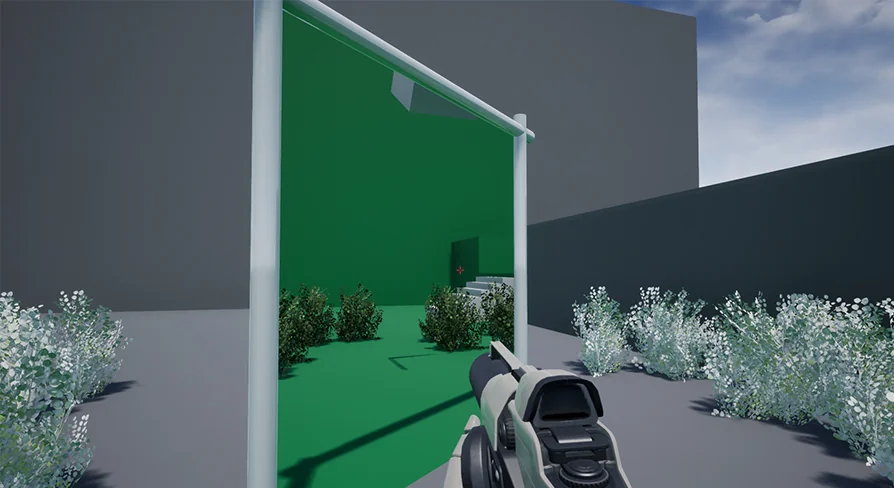
This system replaces SceneCapture setups entirely. Instead of running a secondary camera pass to project an image onto a plane, the mechanic operates directly through material functions. Pixel handling and surface rendering adapt on the fly, creating clear portal vistas while preserving native scene rendering efficiency. By skipping render targets, developers avoid resolution downgrades, visual latency, and the typical performance hits associated with real-time multi-camera capture.
The resulting visual output maintains full scene fidelity across boundaries. Because the visual slice relies on shader calculations rather than separate camera projections, geometric detail, lighting responses, and post-process passes stay coherent as players approach or observe a portal threshold from extreme angles.
Property Swapping in Place of Spatial Teleportation
A central technical reality of this setup is that characters and objects never actually teleport. When an entity crosses the portal plane, its world coordinates remain unbroken. The engine does not recalculate player transforms, manage camera snaps, or re-instantiate actors across detached map coordinates.
Interactions focus instead on shifting an actor's runtime properties. When crossing a portal threshold, objects and characters modify specific internal attributes:
Visibility: Meshes reveal or hide specific components according to the viewer's active dimensional state.
Collision: Collision profiles switch dynamically, allowing paths, barriers, and environmental hazards to exist in one reality while remaining completely passable in another.
Material Assignments: Surfaces reassign or blend their visual parameters, transforming appearances instantly without swapping the underlying static or skeletal mesh.
Because the physical coordinates do not shift, physics calculations remain stable. Rigid bodies carrying momentum maintain their velocity vectors seamlessly. This approach prevents jitter, physics hitches, or edge-case boundary glitches that often break immersion in physics-heavy games or virtual reality spaces.
Structuring Dual Worlds, Puzzles, and Non-Euclidean Spaces
The system performs at its best when constructing twin environments that share the same foundational geometry but diverge in minor environmental details or material treatments. In practical level design, this allows creators to overlay two distinct interpretations of the exact same physical space.
A classic application involves dividing an environment into two temporal phases—a real-time current world alongside a historical or futuristic equivalent. A concrete realization seen in functional demonstrations uses a stark white world mirrored against an overgrown or alternative green world. Walking through a doorway does not load a new zone; it updates surface treatments, reveals hidden architecture, and reorganizes colliders to reflect the chosen state.
Puzzle mechanics naturally benefit from these split-state properties. An obstacle blocking a corridor in the primary reality can be phased out through a portal frame, letting players carry a puzzle piece across boundaries where its physical collision parameters change. Abstract level architecture also becomes viable, giving rise to non-Euclidean layouts where doorways reveal corridors that visually and mechanically contradict standard three-dimensional geometry.
Unlimited Portals and Expanding Multi-World Networks
Environments are not confined to a single doorway connecting two mirrored rooms. Level builders can place an unlimited number of portals within a scene. These portals can be configured to connect directly into the same shared dual world, or each individual portal can be set up to govern its own discrete alternate state.
This flexibility enables sprawling puzzle networks or layered exploration games. A player might encounter three different doorways in a central hub, with each opening displaying a distinct visual and mechanical layer of the surrounding structure. Because the underlying logic is built on material functions and local property swapping rather than continuous render passes, populating a level with numerous active portals does not cause the linear performance degradation that would cripple a SceneCapture-reliant pipeline.
Project Compatibility and Practical Integration
The package integrates cleanly with Blueprint-driven game architectures and operates within virtual reality configurations where high framerates and clean stereo rendering are critical. Projects leveraging procedural workflows—including setups utilizing a Procedural Level Generator—can tie the portal framework into procedural generation logic to dynamically spawn paired spaces, alternate collision pathways, and shifting materials on runtime-generated rooms.
Developers crafting narrative-driven puzzle games, dimensional horror experiences, or time-bending adventure titles will find the system suited for scenes where subtle spatial paradoxes drive gameplay. By centering level design on worlds that alter their materials, visibilities, and collision setups rather than relying on heavy spatial teleportation, the system delivers sharp visual transitions while keeping engine overhead tightly contained.
 Game Systems
 Spells & Combat
 Shaders
 Transition