"7066dd76da796369"{"id":"1000742","slug":"create-a-first-person-shooter-fps-game-in-unreal-engine-5","title":"Create a First Person Shooter (FPS) Game in Unreal Engine 5","category":"Unreal Engine","engine":"File Content: video + English subtitles","assetVersion":"Video Language: English","engineVersion":"File Content: video + English subtitles","tag":"Unreal Engine","accent":"blue","visual":"mech","summary":"A beginner Unreal Engine 5 course covering FPS character movement, enemy AI, timer systems, abandoned environments, and realistic lighting in 3h 22m.","platform":"Unreal Engine","publishedAt":"2026-07-27T11:57:43.213Z","updatedAt":"2026-07-27T11:57:43.213Z","sourceNotes":[],"fileContents":[],"compatibility":["Unreal Engine","Video Language: English","File Content: video + English subtitles"],"featuredImage":{"alt":"Create a First Person Shooter (FPS) Game in Unreal Engine 5","src":"/wp-content/uploads/published/2026/07/00b4a46b8f07-6649245-5dcd-4-d1bc87e858.webp"},"hasDownloadLink":true,"downloads":2,"terms":[{"taxonomy":"category","slug":"tutoriallibrary-unrealengine","name":"Unreal Engine"}],"galleryImages":[],"accessPanel":{"kind":"video-resource","title":"Download this video resource","eyebrow":"Free Download","message":"Log in or create a free account to start your download.","fileName":"Create a First Person Shooter (FPS) Game in Unreal Engine 5.7z","safetyNote":"Resources are manually reviewed before listing to improve quality and reduce obvious risks.","actionLabel":"Download Free","resourceType":"Video download"},"contentHtml":"\u003cp\u003eA first-person shooter project built in Unreal Engine 5 calls on several disciplines at once: interface navigation, character physics, artificial intelligence, and environmental art direction. \u003cem\u003eCreate a First Person Shooter (FPS) Game in Unreal Engine 5\u003c/em\u003e is structured as a single continuous project that touches each of these areas. The workload runs 3 hours and 22 minutes, placing it within reach of developers who want a focused build rather than a sprawling multi-course commitment.\u003c/p\u003e\n\n\u003ch2\u003eCourse Format and Structural Breakdown\u003c/h2\u003e\n\u003cp\u003eThe course was published on July 1, 2025, and is delivered by Nafay Sheikh, who serves as both instructor and provider. Its listed level is Beginner, meaning no prior Unreal Engine experience is assumed. The curriculum is split into two sections: \u003cstrong\u003eIntroduction\u003c/strong\u003e and \u003cstrong\u003eMaking the Game\u003c/strong\u003e. That structure keeps the pacing tight. The opening section handles onboarding and toolset orientation, while the bulk of the runtime is spent inside the active build.\u003c/p\u003e\n\n\u003cp\u003eBecause the two-section structure does not branch into side modules, every lesson feeds directly into the same playable outcome. This makes the material easier to follow as a linear sequence, since a learner is never asked to context-switch between unrelated sample projects.\u003c/p\u003e\n\n\u003ch2\u003eFirst-Person Character Setup and Animation Focus\u003c/h2\u003e\n\u003cp\u003eThe character work begins with foundational engine literacy. Learners are expected to master Unreal Engine 5's interface, viewport navigation, object manipulation, and essential toolset from scratch. Once that baseline is established, the course moves into building a playable first-person character.\u003c/p\u003e\n\n\u003cp\u003eCharacter implementation includes smooth animations for running, jumping, and related first-person motion states. The emphasis on animation smoothness suggests that the character controller is not treated as a bare camera rig. Movement transitions and body-state feedback are part of the delivered result, which matters for an adventure-style FPS where player occupancy of the world needs to feel grounded rather than purely functional.\u003c/p\u003e\n\n\u003ch2\u003eEnemy AI That Chases and Attacks\u003c/h2\u003e\n\u003cp\u003eIntelligent enemies form the second major system in the build. The course implements enemy behavior capable of both chasing and attacking the player. That behavior pair places the project within the action-adventure FPS territory rather than a pure walking simulator or exploration sandbox.\u003c/p\u003e\n\n\u003cp\u003eBy weaving enemy AI into the same project that already covers first-person movement and animation, the course gives learners a compact loop: move, encounter, survive. The AI is framed as part of a dynamic game environment, not an isolated technical demo. That framing implies the enemies are placed and tuned to interact with the same world the player explores.\u003c/p\u003e\n\n\u003ch2\u003eTimer System and Dynamic Game Environment\u003c/h2\u003e\n\u003cp\u003eBeyond character and AI, the project incorporates a timer system. While the course does not specify the exact win or loss conditions tied to that system, its presence points toward time-gated gameplay objectives. A timer system in a first-person adventure context typically supports pressure-based encounters, escape sequences, or survival conditions layered over the exploration.\u003c/p\u003e\n\n\u003cp\u003eThe environment itself is described as a detailed, realistic abandoned setting with realistic lighting. This pushes the project away from placeholder greyboxing and toward mood-driven art direction. Lighting is called out specifically, indicating that visual atmosphere is part of the instructional focus rather than something left entirely to post-build polish.\u003c/p\u003e\n\n\u003ch3\u003eAbandoned Environment as a Teaching Surface\u003c/h3\u003e\n\u003cp\u003eAn abandoned environment is a practical choice for a beginner Unreal Engine 5 course. It allows concentration on aged materials, layered dirt, broken geometry, and light interaction without demanding the pristine surfacing standards of a modern interior scene. The course uses the environment as both a gameplay space for the first-person character and enemy AI encounters and as a lighting exercise where decay and shadow become part of the visual brief.\u003c/p\u003e\n\n\u003ch2\u003eWho This Course Is Built For\u003c/h2\u003e\n\u003cp\u003eThe stated audience includes aspiring game developers, indie creators, and anyone who wants to build games in Unreal Engine 5. There is no prerequisite knowledge listed beyond the beginner-level designation. The compact runtime, two-section curriculum, and single-project format make this a direct fit for someone who wants to move from no Unreal Engine experience to a working FPS adventure prototype without enrolling in a longer multi-track program.\u003c/p\u003e\n\n\u003cp\u003eThe course is positioned to handle the full vertical slice of a small adventure FPS: engine onboarding, first-person character with animation, enemy chase and attack logic, a timer system, and a lit abandoned environment. For a developer who wants to understand how these pieces connect inside a single Unreal Engine 5 project, the material is set up to walk through that pipeline end to end.\u003c/p\u003e\n\n\u003ch2\u003eMore From The Same Workflow\u003c/h2\u003e\n\u003cul\u003e\n\u003cli\u003e\u003ca href=\"https://3dcghub.com/unreal-engine-5-for-beginners-create-your-first-game/\" title=\"Unreal Engine 5 for Beginners - Create your first game\"\u003eUnreal Engine 5 for Beginners - Create your first game\u003c/a\u003e\u003c/li\u003e\n\u003cli\u003e\u003ca href=\"https://3dcghub.com/the-ultimate-guide-to-unreal-engine-5-for-complete-beginners/\" title=\"The Ultimate Guide to Unreal Engine 5 For Complete Beginners\"\u003eThe Ultimate Guide to Unreal Engine 5 For Complete Beginners\u003c/a\u003e\u003c/li\u003e\n\u003cli\u003e\u003ca href=\"https://3dcghub.com/create-zelda-like-skills-with-c-in-unreal-engine-5/\" title=\"Create Zelda-like skills with C++ in unreal engine 5\"\u003eCreate Zelda-like skills with C++ in unreal engine 5\u003c/a\u003e\u003c/li\u003e\n\u003cli\u003e\u003ca href=\"https://3dcghub.com/unreal-engine-5-blueprints-game-developer-masterclass/\" title=\"Unreal Engine 5 - Blueprints Game Developer Masterclass\"\u003eUnreal Engine 5 - Blueprints Game Developer Masterclass\u003c/a\u003e\u003c/li\u003e\n\u003cli\u003e\u003ca href=\"https://3dcghub.com/best-ue5-beginners-course-create-your-first-project/\" title=\"Best UE5 Beginners Course: Create Your First Project\"\u003eBest UE5 Beginners Course: Create Your First Project\u003c/a\u003e\u003c/li\u003e\n\u003c/ul\u003e","contentTextLength":5189,"navigation":{"current":1422,"total":4016,"previous":{"id":"1000743","slug":"environment-design-in-unreal-engine-5-5-from-basics-to-pro","title":"Environment Design in Unreal Engine 5.5 – From Basics to Pro","category":"Unreal Engine","platform":"Unreal Engine","updatedAt":"2026-07-27T12:02:43.552Z"},"next":{"id":"1000741","slug":"real-time-automotive-rendering-1001","title":"Real-Time Automotive Rendering 1001","category":"Unreal Engine","platform":"Unreal Engine","updatedAt":"2026-07-27T11:52:00.768Z"}},"relatedResources":[{"id":"24568","slug":"unreal-engine-5-for-beginners-create-your-first-game","title":"Unreal Engine 5 for Beginners - Create your first game","category":"Unreal Engine","engine":"Video language: English","assetVersion":"Video language: English","engineVersion":"File content: video + supporting files + English subtitles","tag":"Unreal Engine","accent":"blue","visual":"city","summary":"This beginner course walks through Unreal Engine 5 basics, then moves into Blueprints, character animation, UI widgets, and the steps needed to create a real 3D game. It is aimed at beginner game developers who want a practical starting point.","platform":"Unreal Engine","publishedAt":"2026-04-15T13:30:22.000Z","updatedAt":"2026-04-20T06:12:44.000Z","sourceNotes":[],"fileContents":[],"compatibility":["Unreal Engine","Video language: English","File content: video + supporting files + English subtitles"],"featuredImage":{"alt":"Unreal Engine 5 for Beginners - Create your first game","src":"https://3dcghub.com/wp-content/uploads/2026/04/d35b769681b1_5098972_a916_5.webp"},"hasDownloadLink":true,"downloads":0},{"id":"1000791","slug":"unreal-engine-5-chaos-destruction-complete-course","title":"Unreal Engine 5 - Chaos Destruction Complete Course!","category":"Unreal Engine","engine":"File Content: video + English subtitles","assetVersion":"Video Language: English","engineVersion":"File Content: video + English subtitles","tag":"Unreal Engine","accent":"blue","visual":"mech","summary":"A complete UE5 Chaos Destruction course covering fracturing, clusters, fields, Niagara VFX, and FPS shooter mechanics. 5h 29m of training for all levels.","platform":"Unreal Engine","publishedAt":"2026-07-30T12:53:39.502Z","updatedAt":"2026-07-30T12:53:39.502Z","sourceNotes":[],"fileContents":[],"compatibility":["Unreal Engine","Video Language: English","File Content: video + English subtitles"],"featuredImage":{"alt":"Unreal Engine 5 - Chaos Destruction Complete Course!","src":"/wp-content/uploads/published/2026/07/b1ccb61cc408-6517179-31bb-3-f9563adc43.webp"},"hasDownloadLink":true,"downloads":4},{"id":"1000113","slug":"the-ultimate-guide-to-unreal-engine-5-for-complete-beginners","title":"The Ultimate Guide to Unreal Engine 5 For Complete Beginners","category":"Unreal Engine","engine":"File Content: video + English subtitles","assetVersion":"Video Language: English","engineVersion":"File Content: video + English subtitles","tag":"Unreal Engine","accent":"blue","visual":"mech","summary":"Master Unreal Engine 5 by building a first-person platformer. Learn Blueprint Visual Scripting, level design, physics, and UI through hands-on challenges.","platform":"Unreal Engine","publishedAt":"2026-06-08T16:22:45.027Z","updatedAt":"2026-06-08T16:22:45.027Z","sourceNotes":[],"fileContents":[],"compatibility":["Unreal Engine","Video Language: English","File Content: video + English subtitles"],"featuredImage":{"alt":"The Ultimate Guide to Unreal Engine 5 For Complete Beginners","src":"/wp-content/uploads/published/2026/06/9aa36f09b994-4642016-7b3f-8-bbd28ea887.webp"},"hasDownloadLink":true,"downloads":2}]}
Unreal Engine
Create a First Person Shooter (FPS) Game in Unreal Engine 5
A beginner Unreal Engine 5 course covering FPS character movement, enemy AI, timer systems, abandoned environments, and realistic lighting in 3h 22m.
Category:Unreal EnginePlatform: Unreal EngineVideo Language: EnglishFile Content: video + English subtitlesPublished: Jul 27, 2026
Unreal Engine
Resource overview
A first-person shooter project built in Unreal Engine 5 calls on several disciplines at once: interface navigation, character physics, artificial intelligence, and environmental art direction. Create a First Person Shooter (FPS) Game in Unreal Engine 5 is structured as a single continuous project that touches each of these areas. The workload runs 3 hours and 22 minutes, placing it within reach of developers who want a focused build rather than a sprawling multi-course commitment.
Course Format and Structural Breakdown
The course was published on July 1, 2025, and is delivered by Nafay Sheikh, who serves as both instructor and provider. Its listed level is Beginner, meaning no prior Unreal Engine experience is assumed. The curriculum is split into two sections: Introduction and Making the Game. That structure keeps the pacing tight. The opening section handles onboarding and toolset orientation, while the bulk of the runtime is spent inside the active build.
Because the two-section structure does not branch into side modules, every lesson feeds directly into the same playable outcome. This makes the material easier to follow as a linear sequence, since a learner is never asked to context-switch between unrelated sample projects.
First-Person Character Setup and Animation Focus
The character work begins with foundational engine literacy. Learners are expected to master Unreal Engine 5's interface, viewport navigation, object manipulation, and essential toolset from scratch. Once that baseline is established, the course moves into building a playable first-person character.
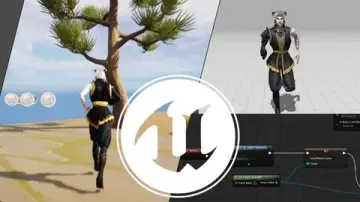
Character implementation includes smooth animations for running, jumping, and related first-person motion states. The emphasis on animation smoothness suggests that the character controller is not treated as a bare camera rig. Movement transitions and body-state feedback are part of the delivered result, which matters for an adventure-style FPS where player occupancy of the world needs to feel grounded rather than purely functional.
Enemy AI That Chases and Attacks
Intelligent enemies form the second major system in the build. The course implements enemy behavior capable of both chasing and attacking the player. That behavior pair places the project within the action-adventure FPS territory rather than a pure walking simulator or exploration sandbox.
By weaving enemy AI into the same project that already covers first-person movement and animation, the course gives learners a compact loop: move, encounter, survive. The AI is framed as part of a dynamic game environment, not an isolated technical demo. That framing implies the enemies are placed and tuned to interact with the same world the player explores.
Timer System and Dynamic Game Environment
Beyond character and AI, the project incorporates a timer system. While the course does not specify the exact win or loss conditions tied to that system, its presence points toward time-gated gameplay objectives. A timer system in a first-person adventure context typically supports pressure-based encounters, escape sequences, or survival conditions layered over the exploration.
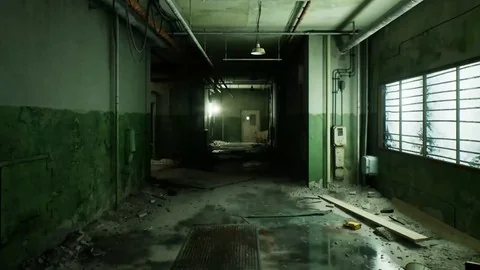
The environment itself is described as a detailed, realistic abandoned setting with realistic lighting. This pushes the project away from placeholder greyboxing and toward mood-driven art direction. Lighting is called out specifically, indicating that visual atmosphere is part of the instructional focus rather than something left entirely to post-build polish.
Abandoned Environment as a Teaching Surface
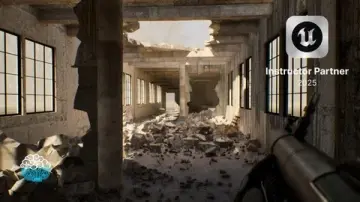
An abandoned environment is a practical choice for a beginner Unreal Engine 5 course. It allows concentration on aged materials, layered dirt, broken geometry, and light interaction without demanding the pristine surfacing standards of a modern interior scene. The course uses the environment as both a gameplay space for the first-person character and enemy AI encounters and as a lighting exercise where decay and shadow become part of the visual brief.
Who This Course Is Built For
The stated audience includes aspiring game developers, indie creators, and anyone who wants to build games in Unreal Engine 5. There is no prerequisite knowledge listed beyond the beginner-level designation. The compact runtime, two-section curriculum, and single-project format make this a direct fit for someone who wants to move from no Unreal Engine experience to a working FPS adventure prototype without enrolling in a longer multi-track program.
The course is positioned to handle the full vertical slice of a small adventure FPS: engine onboarding, first-person character with animation, enemy chase and attack logic, a timer system, and a lit abandoned environment. For a developer who wants to understand how these pieces connect inside a single Unreal Engine 5 project, the material is set up to walk through that pipeline end to end.
 Unreal Engine
 Unreal Engine
 Unreal Engine
 Unreal Engine