"7779633244466edf"{"id":"1003093","slug":"convert-foliage-to-interactive-actors-for-unreal-engine-foliage-plugin","title":"Convert Foliage to Interactive Actors for Unreal Engine (Foliage Plugin)","category":"Engine Tools","engine":"5.6 - 5.7","assetVersion":"Asset Version: 1.7.7","engineVersion":"5.6 - 5.7","tag":"Engine Tools","accent":"blue","visual":"mech","summary":"Convert foliage instances into harvestable, replicated actors featuring Chaos destruction, data table resource management, and automated respawn systems.","platform":"Unreal Engine","indexPolicy":"index","publishedAt":"2026-11-28T10:42:36.595Z","updatedAt":"2026-11-28T10:42:36.595Z","sourceNotes":[],"fileContents":[],"compatibility":["Unreal Engine","Asset Version: 1.7.7","Engine Version: 5.6 - 5.7"],"featuredImage":{"alt":"Convert Foliage to Interactive Actors for Unreal Engine (Foliage Plugin)","src":"/wp-content/uploads/published/2026/11/asset-0-ff65d2d106.webp"},"fileSizeBytes":51657348,"hasDownloadLink":true,"downloads":0,"terms":[{"taxonomy":"category","slug":"engine-tools-tools-and-plugins","name":"Engine Tools"}],"galleryImages":[{"src":"/wp-content/uploads/published/2026/11/asset-1-4164444dad.webp","alt":"Convert Foliage to Interactive Actors for Unreal Engine (Foliage Plugin)"},{"src":"/wp-content/uploads/published/2026/11/asset-2-cf7b06b445.webp","alt":"Convert Foliage to Interactive Actors for Unreal Engine (Foliage Plugin)"},{"src":"/wp-content/uploads/published/2026/11/asset-3-2c310fc8be.webp","alt":"Convert Foliage to Interactive Actors for Unreal Engine (Foliage Plugin)"},{"src":"/wp-content/uploads/published/2026/11/asset-4-6e98cb7ff0.webp","alt":"Convert Foliage to Interactive Actors for Unreal Engine (Foliage Plugin)"}],"accessPanel":{"kind":"resource","title":"Get this resource","safetyNote":"Resources are manually reviewed before listing to improve quality and reduce obvious risks.","fileFormat":".7z","resourceType":"Resource archive","versions":[]},"contentHtml":"\u003ch2\u003eOverview\u003c/h2\u003e\u003cp\u003eThe Foliage Plugin by eelDev is an engine tool designed to convert static foliage instances into interactive, harvestable, and destructible gameplay elements. Compatible with Unreal Engine's native Foliage Tool, Procedural Content Generation (PCG) frameworks, and Instanced Static Meshes (ISM), the tool preserves rendering efficiency by keeping assets instanced until player interaction or damage triggers actor conversion.\u003c/p\u003e\u003cp\u003eThe system accommodates varied harvesting mechanics—from damage-driven tree felling and rock mining to instant collection of consumables such as plants and mushrooms. It features an integrated actor pooling pipeline, server-authoritative replication, asynchronous world-state serialization, and configurable regrowth sequences.\u003c/p\u003e\u003ch2\u003eTechnical Package Breakdown\u003c/h2\u003e\u003cp\u003eDelivered as a 49.3 MB plugin archive (version 1.7.7), the system operates without requiring pre-packaged content assets or sample maps, functioning entirely as an extensible engine framework. Key subsystems include:\u003c/p\u003e\u003cul\u003e\u003cli\u003e\u003cstrong\u003eData-Driven Resource System:\u003c/strong\u003e Manages resource definitions, drop rates, actor class references, damage thresholds, and multi-stage harvesting limits using centralized Data Tables.\u003c/li\u003e\u003cli\u003e\u003cstrong\u003eActor Pooling \u0026amp; Lifecycle Management:\u003c/strong\u003e Recycles foliage actor instances with configurable capacity limits to eliminate frame-time spikes associated with continuous dynamic spawning and garbage collection.\u003c/li\u003e\u003cli\u003e\u003cstrong\u003ePhysics \u0026amp; Chaos Destruction:\u003c/strong\u003e Supports Chaos Geometry Collections and Field System integration, enabling dynamic structural breakdown and customizable physics impulses when foliage items are depleted.\u003c/li\u003e\u003cli\u003e\u003cstrong\u003eAutomated Regrowth \u0026amp; Respawn Pipeline:\u003c/strong\u003e Features distributed multi-frame respawn processing, real-time timer calculations that progress even across server reboots, scaling regrowth animations, proximity-based obstruction checks, and optional stump replacement meshes.\u003c/li\u003e\u003cli\u003e\u003cstrong\u003ePersistence Layer:\u003c/strong\u003e Asynchronous background saving with per-level file partitioning, custom naming overrides, and version validation to ensure world-state preservation between sessions.\u003c/li\u003e\u003c/ul\u003e\u003ch2\u003eEngine Compatibility \u0026amp; Integration Notes\u003c/h2\u003e\u003cp\u003eThe plugin is compatible with Unreal Engine versions 5.6 through 5.7. It fits natively into existing production pipelines using standard foliage placement or algorithmic distribution through PCG graphs.\u003c/p\u003e\u003cp\u003eFor networked environments, the tool executes server-authoritative harvesting with late-join synchronization. Foliage matching relies on transform coordinates and mesh identifiers rather than volatile instance indices, preventing desynchronization across game clients. Network bandwidth is optimized via compact serialization, with an option to toggle physics replication per asset type.\u003c/p\u003e\u003ch2\u003eUse Cases\u003c/h2\u003e\u003cul\u003e\u003cli\u003e\u003cstrong\u003eSurvival \u0026amp; Crafting Environments:\u003c/strong\u003e Dynamic node harvesting where trees, boulders, and flora yield variable materials based on tool requirements and damage types.\u003c/li\u003e\u003cli\u003e\u003cstrong\u003eOpen-World Optimization:\u003c/strong\u003e Rendering large-scale biomes via Instanced Static Meshes while granting real-time interactability only within immediate player influence.\u003c/li\u003e\u003cli\u003e\u003cstrong\u003eDestructible Worlds:\u003c/strong\u003e Implementing large-scale terrain alteration and forest clearing utilizing Chaos fields and physical impulse responses.\u003c/li\u003e\u003cli\u003e\u003cstrong\u003eSynchronized Multiplayer Gathering:\u003c/strong\u003e Shared multiplayer worlds requiring persistent node tracking, late-join state distribution, and timed node regeneration.\u003c/li\u003e\u003c/ul\u003e\n\n\u003ch2\u003eRelated Resources Worth Checking\u003c/h2\u003e\n\u003cul\u003e\n\u003cli\u003e\u003ca href=\"https://3dcghub.com/prismatiscape-interaction-plugin/\" rel=\"noopener noreferrer\"\u003ePrismatiscape Interaction Plugin\u003c/a\u003e\u003c/li\u003e\n\u003cli\u003e\u003ca href=\"https://3dcghub.com/igtoolspp-speedtree-to-pivot-painter-2-0/\" rel=\"noopener noreferrer\"\u003eIGToolsPP: Speedtree to Pivot Painter 2.0\u003c/a\u003e\u003c/li\u003e\n\u003cli\u003e\u003ca href=\"https://3dcghub.com/worldscape-plugin-making-real-planets-and-endless-worlds/\" rel=\"noopener noreferrer\"\u003eWorldScape Plugin - Making real planets and Endless worlds\u003c/a\u003e\u003c/li\u003e\n\u003cli\u003e\u003ca href=\"https://3dcghub.com/uipf-unified-interactive-physical-foliage/\" rel=\"noopener noreferrer\"\u003eUIPF - Unified Interactive Physical Foliage\u003c/a\u003e\u003c/li\u003e\n\u003cli\u003e\u003ca href=\"https://3dcghub.com/shader-world-plugin-procedural-terrain-oceans-foliage-gpu-accelerated/\" rel=\"noopener noreferrer\"\u003eShader World Plugin : Procedural Terrain, Oceans, Foliage, GPU-accelerated\u003c/a\u003e\u003c/li\u003e\n\u003c/ul\u003e","contentTextLength":3610,"navigation":{"current":156,"total":5166,"previous":{"id":"1003094","slug":"village-houses-environment-village-village-house-interior-modular-town","title":"Village Houses Environment ( Village , Village House Interior , Modular Town )","category":"Towns \u0026 Villages","platform":"Unreal Engine","updatedAt":"2026-11-28T10:45:33.024Z"},"next":{"id":"1003092","slug":"signal-flares-fx","title":"Signal Flares FX","category":"Smoke","platform":"Unreal Engine","updatedAt":"2026-11-28T08:39:57.391Z"}},"relatedResources":[{"id":"14707","slug":"uipf-unified-interactive-physical-foliage","title":"UIPF - Unified Interactive Physical Foliage","category":"Engine Tools","engine":"5.3","assetVersion":"","engineVersion":"5.3","tag":"Engine Tools","accent":"blue","visual":"audio","summary":"UIPF - Unified Interactive Physical Foliage provides a high-performance solution for adding realistic interaction to game environments, from swaying grass to bendy plants.","platform":"Unreal Engine","indexPolicy":"noindex","publishedAt":"2026-03-11T19:07:09.000Z","updatedAt":"2026-04-19T15:45:41.000Z","sourceNotes":[],"fileContents":[],"compatibility":["Unreal Engine","Engine version: 5.3"],"featuredImage":{"alt":"UIPF - Unified Interactive Physical Foliage","src":"https://3dcghub.com/wp-content/uploads/2026/03/416e817c-b004-49bf-9a26-9c0ef3ecf7f6.webp"},"fileSizeBytes":1413040483,"hasDownloadLink":true,"downloads":2},{"id":"14365","slug":"prismatiscape-interaction-plugin","title":"Prismatiscape Interaction Plugin","category":"Engine Tools","engine":"5.3 - 5.8","assetVersion":"Asset Version: 1.02.7 - 1.04.01","engineVersion":"5.3 - 5.8","tag":"Engine Tools","accent":"blue","visual":"character","summary":"The Prismatiscape Interaction Plugin provides a robust global shader interaction system for Unreal Engine 5.3+. It utilizes NiagaraGrid2D and Runtime Virtual Textures to create performant wind, water, and foliage simulations.","platform":"Unreal Engine","indexPolicy":"noindex","publishedAt":"2026-03-11T17:47:22.000Z","updatedAt":"2026-11-26T14:09:22.109Z","sourceNotes":[],"fileContents":[],"compatibility":["Unreal Engine","Asset Version: 1.02.7 - 1.04.01","Engine Version: 5.3 - 5.8"],"featuredImage":{"alt":"Prismatiscape Interaction Plugin","src":"https://3dcghub.com/wp-content/uploads/2026/03/44b145e2-909c-4c4e-bf70-1a1fd135c999.webp"},"fileSizeBytes":178967303,"hasDownloadLink":true,"downloads":5},{"id":"14579","slug":"shader-world-plugin-procedural-terrain-oceans-foliage-gpu-accelerated","title":"Shader World Plugin : Procedural Terrain, Oceans, Foliage, GPU-accelerated","category":"Engine Tools","engine":"4.27,5.0 - 5.4","assetVersion":"","engineVersion":"4.27,5.0 - 5.4","tag":"Engine Tools","accent":"blue","visual":"character","summary":"Shader World Plugin offers a high-performance alternative to native Unreal Engine landscapes, utilizing GPU acceleration for real-time world generation. It supports massive scales and is fully editable within packaged games.","platform":"Unreal Engine","indexPolicy":"noindex","publishedAt":"2026-03-11T18:34:57.000Z","updatedAt":"2026-04-19T15:45:44.000Z","sourceNotes":[],"fileContents":[],"compatibility":["Unreal Engine","Engine version: 4.27,5.0 - 5.4"],"featuredImage":{"alt":"Shader World Plugin : Procedural Terrain, Oceans, Foliage, GPU-accelerated","src":"https://3dcghub.com/wp-content/uploads/2026/03/0922900f-bc2e-416c-a177-0cef84bcdbc8.webp"},"fileSizeBytes":2211969193,"hasDownloadLink":true,"downloads":0}]}[{"id":4225,"sourceId":4225,"taxonomyId":4225,"taxonomy":"category","slug":"asset-library","name":"Asset Library","parentId":null,"count":0,"hasChildren":true,"href":"/","seoTitle":"Free Game Assets Library | 3DCGHUB","seoDescription":"Browse free Unreal Engine, Unity, Blender assets and game development tutorials on 3DCGHUB with previews, compatibility notes, and secure downloads.","sitemapEnabled":true,"children":[{"id":4227,"sourceId":4227,"taxonomyId":4227,"taxonomy":"category","slug":"blender-add-ons-plugins","name":"Blender Add-ons \u0026 Plugins","parentId":4225,"count":0,"hasChildren":false,"href":"/category/blender-add-ons-plugins/","seoTitle":"Free Blender Add-ons \u0026 Plugins | 3DCGHUB","seoDescription":"Browse free Blender Add-ons \u0026 Plugins tools for Blender on 3DCGHUB: curated downloads with preview images, compatibility notes and secure download access.","sitemapEnabled":true},{"id":514,"sourceId":514,"taxonomyId":514,"taxonomy":"category","slug":"unity-2","name":"Unity","parentId":4225,"count":0,"hasChildren":true,"href":"/category/unity-2/","seoTitle":"Free Unity Assets | 3DCGHUB","seoDescription":"Browse free Unity resources on 3DCGHUB: curated downloads with preview images, compatibility notes and secure download access.","sitemapEnabled":true,"children":[{"id":523,"sourceId":523,"taxonomyId":523,"taxonomy":"category","slug":"2d","name":"2D","parentId":514,"count":0,"hasChildren":true,"href":"/category/2d/","seoTitle":"Free Unity 2D | 3DCGHUB","seoDescription":"Browse free 2D assets for Unity on 3DCGHUB: curated downloads with preview images, compatibility notes and secure download access.","sitemapEnabled":true},{"id":515,"sourceId":515,"taxonomyId":515,"taxonomy":"category","slug":"3d-unity-2","name":"3D","parentId":514,"count":0,"hasChildren":true,"href":"/category/3d-unity-2/","seoTitle":"Free Unity 3D Assets | 3DCGHUB","seoDescription":"Browse free 3D assets for Unity on 3DCGHUB: curated downloads with preview images, compatibility notes and secure download access.","sitemapEnabled":true},{"id":565,"sourceId":565,"taxonomyId":565,"taxonomy":"category","slug":"add-ons","name":"Add-Ons","parentId":514,"count":0,"hasChildren":false,"href":"/category/add-ons/","seoTitle":"Free Unity Add-Ons | 3DCGHUB","seoDescription":"Browse free Add-Ons assets for Unity on 3DCGHUB: curated downloads with preview images, compatibility notes and secure download access.","sitemapEnabled":true},{"id":529,"sourceId":529,"taxonomyId":529,"taxonomy":"category","slug":"audio-unity-2","name":"Audio","parentId":514,"count":0,"hasChildren":true,"href":"/category/audio-unity-2/","seoTitle":"Free Unity Audio | 3DCGHUB","seoDescription":"Browse free Audio for Unity on 3DCGHUB: curated downloads with preview images, compatibility notes and secure download access.","sitemapEnabled":true},{"id":557,"sourceId":557,"taxonomyId":557,"taxonomy":"category","slug":"templates","name":"Templates","parentId":514,"count":0,"hasChildren":true,"href":"/category/templates/","seoTitle":"Free Unity Templates | 3DCGHUB","seoDescription":"Browse free Unity project templates on 3DCGHUB. Starter kits with previews, compatibility notes, and secure download access.","sitemapEnabled":true},{"id":533,"sourceId":533,"taxonomyId":533,"taxonomy":"category","slug":"tools-unity-2","name":"Tools","parentId":514,"count":0,"hasChildren":true,"href":"/category/tools-unity-2/","sitemapEnabled":true},{"id":554,"sourceId":554,"taxonomyId":554,"taxonomy":"category","slug":"vfx-unity-2","name":"VFX","parentId":514,"count":0,"hasChildren":true,"href":"/category/vfx-unity-2/","seoTitle":"Free Unity VFX | 3DCGHUB","seoDescription":"Browse free VFX for Unity on 3DCGHUB: curated downloads with preview images, compatibility notes and secure download access.","sitemapEnabled":true}]},{"id":511,"sourceId":511,"taxonomyId":511,"taxonomy":"category","slug":"unreal-engine-2","name":"Unreal Engine","parentId":4225,"count":0,"hasChildren":true,"href":"/category/unreal-engine-2/","seoTitle":"Free Unreal Engine Assets | 3DCGHUB","seoDescription":"Browse free Unreal Engine resources on 3DCGHUB: curated downloads with preview images, compatibility notes and secure download access.","sitemapEnabled":true,"children":[{"id":54,"sourceId":54,"taxonomyId":54,"taxonomy":"category","slug":"3d","name":"3D","parentId":511,"count":0,"hasChildren":true,"href":"/category/3d/","seoTitle":"Free Unreal Engine 3D | 3DCGHUB","seoDescription":"Browse free 3D assets for Unreal Engine on 3DCGHUB: curated downloads with preview images, compatibility notes and secure download access.","sitemapEnabled":true},{"id":441,"sourceId":441,"taxonomyId":441,"taxonomy":"category","slug":"animations","name":"Animations","parentId":511,"count":0,"hasChildren":true,"href":"/category/animations/","seoTitle":"Free Unreal Engine Animations | 3DCGHUB","seoDescription":"Browse free Animations for Unreal Engine on 3DCGHUB: curated downloads with preview images, compatibility notes and secure download access.","sitemapEnabled":true},{"id":446,"sourceId":446,"taxonomyId":446,"taxonomy":"category","slug":"audio","name":"Audio","parentId":511,"count":0,"hasChildren":true,"href":"/category/audio/","seoTitle":"Free Unreal Engine Audio Resources | 3DCGHUB","seoDescription":"Browse free Unreal Engine audio resources including sound effects, voices, dialogue, and ambient sounds. Curated free downloads on 3DCGHUB.","sitemapEnabled":true},{"id":466,"sourceId":466,"taxonomyId":466,"taxonomy":"category","slug":"game-systems","name":"Game Systems","parentId":511,"count":0,"hasChildren":true,"href":"/category/game-systems/","seoTitle":"Free Unreal Engine Game Systems | 3DCGHUB","seoDescription":"Browse free Game Systems tools for Unreal Engine on 3DCGHUB: curated downloads with preview images, compatibility notes and secure download access.","sitemapEnabled":true},{"id":478,"sourceId":478,"taxonomyId":478,"taxonomy":"category","slug":"game-templates","name":"Game Templates","parentId":511,"count":0,"hasChildren":true,"href":"/category/game-templates/","seoTitle":"Free Unreal Engine Game Templates | 3DCGHUB","seoDescription":"Browse free Game Templates for Unreal Engine on 3DCGHUB: curated downloads with preview images, compatibility notes and secure download access.","sitemapEnabled":true},{"id":432,"sourceId":432,"taxonomyId":432,"taxonomy":"category","slug":"hdri","name":"HDRI","parentId":511,"count":0,"hasChildren":true,"href":"/category/hdri/","seoTitle":"Free Unreal Engine HDRI | 3DCGHUB","seoDescription":"Browse free Unreal Engine HDRI skies and lighting maps on 3DCGHUB. Environment lighting with previews and secure downloads.","sitemapEnabled":true},{"id":228,"sourceId":228,"taxonomyId":228,"taxonomy":"category","slug":"material-and-textures","name":"Material \u0026 Textures","parentId":511,"count":0,"hasChildren":true,"href":"/category/material-and-textures/","seoTitle":"Free Unreal Engine Material \u0026 Textures | 3DCGHUB","seoDescription":"Browse free Material \u0026 Textures for Unreal Engine on 3DCGHUB: curated downloads with preview images, compatibility notes and secure download access.","sitemapEnabled":true},{"id":298,"sourceId":298,"taxonomyId":298,"taxonomy":"category","slug":"sprites-and-flipbooks","name":"Sprites \u0026 Flipbooks","parentId":511,"count":0,"hasChildren":true,"href":"/category/sprites-and-flipbooks/","seoTitle":"Free Unreal Engine Sprites \u0026 Flipbooks | 3DCGHUB","seoDescription":"Browse free Sprites \u0026 Flipbooks assets for Unreal Engine on 3DCGHUB: curated downloads with preview images, compatibility notes and secure download access.","sitemapEnabled":true},{"id":489,"sourceId":489,"taxonomyId":489,"taxonomy":"category","slug":"tools-and-plugins","name":"Tools \u0026 Plugins","parentId":511,"count":0,"hasChildren":true,"href":"/category/tools-and-plugins/","seoTitle":"Free Unreal Engine Tools \u0026 Plugins | 3DCGHUB","seoDescription":"Browse free Tools \u0026 Plugins for Unreal Engine on 3DCGHUB: curated downloads with preview images, compatibility notes and secure download access.","sitemapEnabled":true},{"id":459,"sourceId":459,"taxonomyId":459,"taxonomy":"category","slug":"ui","name":"UI","parentId":511,"count":0,"hasChildren":true,"href":"/category/ui/","seoTitle":"Free Unreal Engine UI | 3DCGHUB","seoDescription":"Browse free UI for Unreal Engine on 3DCGHUB: curated downloads with preview images, compatibility notes and secure download access.","sitemapEnabled":true},{"id":450,"sourceId":450,"taxonomyId":450,"taxonomy":"category","slug":"vfx","name":"VFX","parentId":511,"count":0,"hasChildren":true,"href":"/category/vfx/","seoTitle":"Free Unreal Engine VFX | 3DCGHUB","seoDescription":"Browse free VFX for Unreal Engine on 3DCGHUB: curated downloads with preview images, compatibility notes and secure download access.","sitemapEnabled":true}]}]},{"id":4222,"sourceId":4222,"taxonomyId":4222,"taxonomy":"category","slug":"tutorial-library","name":"Tutorial Library","parentId":null,"count":0,"hasChildren":false,"href":"/tutorials/","seoTitle":"Free Game Development Tutorial Library | 3DCGHUB","seoDescription":"Browse free game development tutorials for Unreal Engine, Unity, Blender, and more on 3DCGHUB with practical workflows and secure downloads.","sitemapEnabled":true}]
Resource screenshots
1 / 4
Asset drops
Daily Asset Drops
Follow 3DCGHUB on Telegram for daily Unreal, Unity & Blender drops and curated CC0 releases.
The Foliage Plugin by eelDev is an engine tool designed to convert static foliage instances into interactive, harvestable, and destructible gameplay elements. Compatible with Unreal Engine's native Foliage Tool, Procedural Content Generation (PCG) frameworks, and Instanced Static Meshes (ISM), the tool preserves rendering efficiency by keeping assets instanced until player interaction or damage triggers actor conversion.
The system accommodates varied harvesting mechanics—from damage-driven tree felling and rock mining to instant collection of consumables such as plants and mushrooms. It features an integrated actor pooling pipeline, server-authoritative replication, asynchronous world-state serialization, and configurable regrowth sequences.
Technical Package Breakdown
Delivered as a 49.3 MB plugin archive (version 1.7.7), the system operates without requiring pre-packaged content assets or sample maps, functioning entirely as an extensible engine framework. Key subsystems include:
Data-Driven Resource System: Manages resource definitions, drop rates, actor class references, damage thresholds, and multi-stage harvesting limits using centralized Data Tables.
Actor Pooling & Lifecycle Management: Recycles foliage actor instances with configurable capacity limits to eliminate frame-time spikes associated with continuous dynamic spawning and garbage collection.
Physics & Chaos Destruction: Supports Chaos Geometry Collections and Field System integration, enabling dynamic structural breakdown and customizable physics impulses when foliage items are depleted.
Automated Regrowth & Respawn Pipeline: Features distributed multi-frame respawn processing, real-time timer calculations that progress even across server reboots, scaling regrowth animations, proximity-based obstruction checks, and optional stump replacement meshes.
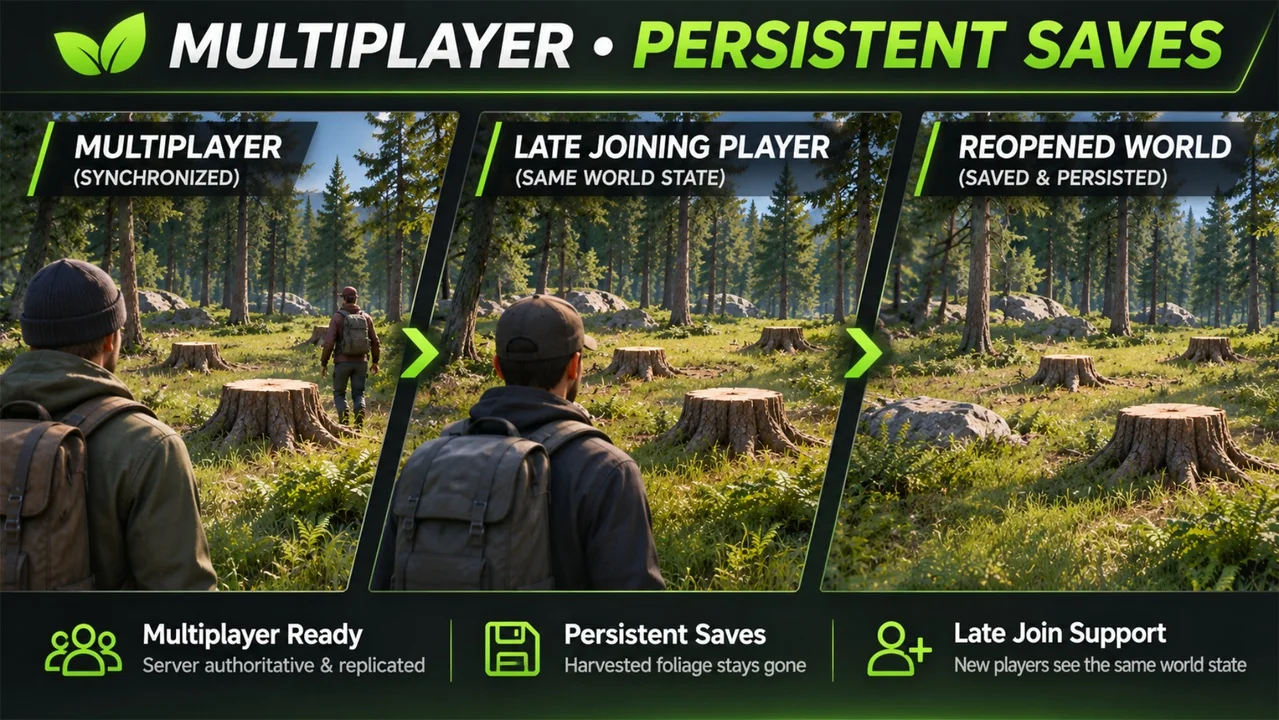
Persistence Layer: Asynchronous background saving with per-level file partitioning, custom naming overrides, and version validation to ensure world-state preservation between sessions.
Engine Compatibility & Integration Notes
The plugin is compatible with Unreal Engine versions 5.6 through 5.7. It fits natively into existing production pipelines using standard foliage placement or algorithmic distribution through PCG graphs.
For networked environments, the tool executes server-authoritative harvesting with late-join synchronization. Foliage matching relies on transform coordinates and mesh identifiers rather than volatile instance indices, preventing desynchronization across game clients. Network bandwidth is optimized via compact serialization, with an option to toggle physics replication per asset type.
Use Cases
Survival & Crafting Environments: Dynamic node harvesting where trees, boulders, and flora yield variable materials based on tool requirements and damage types.
Open-World Optimization: Rendering large-scale biomes via Instanced Static Meshes while granting real-time interactability only within immediate player influence.
Destructible Worlds: Implementing large-scale terrain alteration and forest clearing utilizing Chaos fields and physical impulse responses.
Synchronized Multiplayer Gathering: Shared multiplayer worlds requiring persistent node tracking, late-join state distribution, and timed node regeneration.
 Engine Tools
 Engine Tools
 Engine Tools