"ae2217ad8e73450c"{"id":"1003004","slug":"capoeira-anim-set","title":"Capoeira Anim Set","category":"Combat","engine":"4.18+,5.0+","assetVersion":"","engineVersion":"Engine Version: 4.18+,5.0+","tag":"Combat","accent":"blue","visual":"mech","summary":"Explore the Capoeira Anim Set, featuring 33+ unarmed martial arts animations, attacks, combos, and evasive moves designed for fighting game protagonists.","platform":"Unreal Engine","indexPolicy":"index","publishedAt":"2026-11-25T16:09:21.640Z","updatedAt":"2026-11-25T16:09:21.640Z","sourceNotes":[],"fileContents":[],"compatibility":["Unreal Engine","Engine Version: 4.18+,5.0+"],"featuredImage":{"alt":"Capoeira Anim Set","src":"/wp-content/uploads/published/2026/11/80710c26c311-81341d6b-1414-442c-a698-fad69b2fd355-62b4ef0aa0.webp"},"hasDownloadLink":true,"downloads":0,"terms":[{"taxonomy":"category","slug":"combat","name":"Combat"}],"galleryImages":[{"src":"/wp-content/uploads/published/2026/11/d5de059175cb-282664a4-e9c7-41ef-9231-7e91b5f74cd1-69150d83d6.webp","alt":"Capoeira Anim Set"},{"src":"/wp-content/uploads/published/2026/11/84395731f3a5-450d5f81-3db9-4cf9-9fc5-c38aee975e23-11e1a1adb6.webp","alt":"Capoeira Anim Set"},{"src":"/wp-content/uploads/published/2026/11/16488df2dae0-afe51cb2-d324-4085-9549-864800c36d6e-80266ee11b.webp","alt":"Capoeira Anim Set"},{"src":"/wp-content/uploads/published/2026/11/296b29a7dec6-55049acf-8c11-4445-81f2-1a8d9ab3ffde-f27c3af68b.webp","alt":"Capoeira Anim Set"},{"src":"/wp-content/uploads/published/2026/11/3c9a0c52bea8-d5a7365e-7513-4166-9a01-960e8e24c53b-e3257aa29f.webp","alt":"Capoeira Anim Set"},{"src":"/wp-content/uploads/published/2026/11/286e777a50f0-20b60f3f-23e6-41b6-9452-1f53fae6440a-71a42c13d2.webp","alt":"Capoeira Anim Set"},{"src":"/wp-content/uploads/published/2026/11/2c5a0e153506-36f2caac-dd2a-4f7f-904c-c2b248ce1f37-406afb7252.webp","alt":"Capoeira Anim Set"}],"accessPanel":{"kind":"resource","title":"Get this resource","safetyNote":"Resources are manually reviewed before listing to improve quality and reduce obvious risks.","fileName":"Content.7z","resourceType":"Resource archive","versions":[]},"contentHtml":"\u003ch2\u003eStaging Unarmed Combat Dynamics with Capoeira Anim Set\u003c/h2\u003e\u003cp\u003eHand-to-hand combat in dedicated fighting games demands distinct physical identity, kinetic rhythm, and clear telegraphing. The Capoeira Anim Set provides a specialized movement library tailored directly to this requirement, capturing the flowing, acrobatic discipline of Afro-Brazilian martial arts. Built specifically for an unarmed main character, the package concentrates exclusively on close-quarters combat maneuvers without the inclusion of melee gear, blades, or projectile apparatus. This complete focus on body-driven martial arts ensures that every action stems entirely from the fighter's own momentum, footwork, and physical leverage.\u003c/p\u003e\u003cp\u003eFighting game encounters rely heavily on distinct visual styles to separate characters across a roster. A capoeira-based protagonist brings a sweeping, non-traditional fighting cadence into an arena, leaning on deceptive sweeps, spinning heel strikes, inverted hand placements, and continuous directional momentum. Integrating this animation package allows combat designers to ground a character's offensive tools within this distinct martial arts vocabulary, immediately communicating high agility and unorthodox attack angles to the player through movement alone.\u003c/p\u003e\u003ch2\u003eDeconstructing the Offensive Motions: Attacks and Multi-Hit Combos\u003c/h2\u003e\u003cp\u003eOffensive actions make up the overwhelming majority of the collection, establishing an assertive, forward-driving combat system. Out of the 33+ total motions included in the library, the offensive inventory is partitioned into two distinct categories: 18 standalone attack animations and 9 dedicated combo sequences. This distribution serves two fundamental approaches to combat design within a fighting game framework.\u003c/p\u003e\u003cp\u003eThe 18 single-attack animations represent core building blocks. These individual strikes can be plugged directly into modular action trees, directional button inputs, or branch-on-hit gameplay systems. Designers can treat these discrete clips as neutral pokes, high roundhouses, low sweeping kicks, or launching strikes. Because they exist as independent animations, game mechanics can assign unique frame data, cancel windows, counter-hit states, and pushback values to each individual hit, giving the developer surgical control over the combat flow.\u003c/p\u003e\u003cp\u003eComplementing the single attacks are 9 dedicated combo animations. Rather than requiring combat logic to stitch multiple standalone animations together frame-by-frame, these combo files execute pre-choreographed, continuous strings of momentum. In rhythm-based or traditional fighting engines, these sequences excel as dial-a-combo strings, target combos, or cinematic punish windows when an opponent is left vulnerable. The continuous transitions within these 9 combos preserve the natural, uninterrupted kinetic flow that defines high-level martial arts execution, preventing the awkward snapping that can occur when blending rapidly between disjointed strike clips.\u003c/p\u003e\u003ch2\u003eDefensive Realities and Avoidance in the Capoeira Movement System\u003c/h2\u003e\u003cp\u003eMartial arts choreography is defined as much by how a combatant escapes incoming damage as how they inflict it. In capoeira, static blocking is historically secondary to active evasion, rhythm, and tactical body repositioning. The structural breakdown of the collection directly mirrors this philosophy: it includes 4 avoid animations alongside a single, concise defense animation.\u003c/p\u003e\u003cp\u003eThe emphasis on 4 distinct avoid animations allows developers to build responsive dodge mechanics, side slips, ducking evasions, or back-sways that fit fluidly beneath incoming high strikes or around linear thrusts. Rather than absorbing the kinetic shock of an impact, an agile main character can duck low to the floor or slip off-axis, mirroring the fluid dipping and weaving essential to the martial art. These avoid states function as natural setup windows for counterattacks, allowing players to slip an incoming strike and instantly branch into one of the 18 single attacks or initiate one of the 9 combo sequences.\u003c/p\u003e\u003cp\u003eThe inclusion of a single defense animation serves as the baseline, functional guard state when active evasion fails or when space runs out. By providing one consolidated blocking posture alongside multiple evasive options, the asset encourages a playstyle shaped by agility, precision spacing, and timing-based counters rather than prolonged turtle strategies behind an impenetrable, static guard.\u003c/p\u003e\u003ch2\u003eStructuring the 33+ Animation Pipeline for Combat Controllers\u003c/h2\u003e\u003cp\u003eConnecting these combat assets requires clear logic inside a playable state machine. At the center of the set sits a dedicated idle animation, acting as the neutral baseline from which all offensive and evasive branches originate, and to which all uncompleted actions must eventually return.\u003c/p\u003e\u003cp\u003eBecause the library consists of 33+ clips—split between 18 attacks, 9 combos, 4 avoids, 1 defense, and 1 idle—the state logic can be kept clean, readable, and tightly organized:\u003c/p\u003e\u003cul\u003e\u003cli\u003e\u003cstrong\u003eNeutral Stance:\u003c/strong\u003e The single idle loop acts as the staging ground, anchoring the fighter's base poses and breathing room between exchanges.\u003c/li\u003e\u003cli\u003e\u003cstrong\u003eDirect Offense:\u003c/strong\u003e 18 standalone attacks provide comprehensive coverage for light, medium, and heavy inputs across multiple attack heights.\u003c/li\u003e\u003cli\u003e\u003cstrong\u003eChained Momentum:\u003c/strong\u003e 9 premade combo clips deliver fluid, multi-hit execution without the need for complex, manual animation-stitching algorithms.\u003c/li\u003e\u003cli\u003e\u003cstrong\u003eEvasive Maneuvers:\u003c/strong\u003e 4 avoid clips grant varied defensive mobility, ducking options, or slip-step counters.\u003c/li\u003e\u003cli\u003e\u003cstrong\u003eStatic Mitigation:\u003c/strong\u003e A single defense clip functions as the essential, immediate barrier against incoming offensive pressure.\u003c/li\u003e\u003c/ul\u003e\u003cp\u003eThis distribution makes it simple to map animations directly to standard game controller inputs. Standard button presses can easily draw from the 18 single strikes, while contextual inputs, super meters, or string completions can route directly into the 9 combos. Meanwhile, defensive buttons can toggle between the static guard clip and the directional avoid maneuvers depending on directional inputs or dodge timings.\u003c/p\u003e\u003ch2\u003eFit and Scope for Unarmed Protagonist Projects\u003c/h2\u003e\u003cp\u003eThe Capoeira Anim Set is explicitly tailored for unarmed combat scenarios where a character fights without secondary props, handheld weaponry, or auxiliary gear. By dedicating its entire scope to pure body mechanics, attacks, and combos, the package avoids dilution across unrelated gameplay mechanics like weapon draws, sheathing animations, or item pickups.\u003c/p\u003e\u003cp\u003eFor productions anchored in tournament fighters, arena brawlers, or character-driven action titles where the protagonist relies entirely on their physical mastery, this collection provides an immediate, rhythmically coherent martial arts baseline. The choreography bypasses the standard kickboxing or brawling tropes in favor of dynamic, expressive footwork, offering developers the exact motion resources needed to build an agile, hard-hitting martial artist from the ground up.\u003c/p\u003e\n\n\u003ch2\u003eRelated Resources Worth Checking\u003c/h2\u003e\n\u003cul\u003e\n\u003cli\u003e\u003ca href=\"https://3dcghub.com/rapier-anim-set-2/\" rel=\"noopener noreferrer\"\u003eRapier Anim Set\u003c/a\u003e\u003c/li\u003e\n\u003cli\u003e\u003ca href=\"https://3dcghub.com/paladin-anim-set/\" rel=\"noopener noreferrer\"\u003ePaladin Anim Set\u003c/a\u003e\u003c/li\u003e\n\u003cli\u003e\u003ca href=\"https://3dcghub.com/great-dualblade-animset/\" rel=\"noopener noreferrer\"\u003eGreat DualBlade AnimSet\u003c/a\u003e\u003c/li\u003e\n\u003cli\u003e\u003ca href=\"https://3dcghub.com/script-wizard-anim-set/\" rel=\"noopener noreferrer\"\u003eScript Wizard Anim Set\u003c/a\u003e\u003c/li\u003e\n\u003cli\u003e\u003ca href=\"https://3dcghub.com/succubus-anim-set/\" rel=\"noopener noreferrer\"\u003eSuccubus Anim Set\u003c/a\u003e\u003c/li\u003e\n\u003c/ul\u003e","contentTextLength":7064,"navigation":{"current":40,"total":4964,"previous":{"id":"1003005","slug":"car-configurator-template","title":"Car Configurator Template","category":"Gameplay Features","platform":"Unreal Engine","updatedAt":"2026-11-25T16:11:06.882Z"},"next":{"id":"1003003","slug":"cableway-template","title":"Cableway Template","category":"Vehicles \u0026 Transportation","platform":"Unreal Engine","updatedAt":"2026-11-25T16:08:01.952Z"}},"relatedResources":[{"id":"1002175","slug":"rapier-anim-set-2","title":"Rapier Anim Set","category":"Combat","engine":"4.26+,5.0+","assetVersion":"","engineVersion":"Engine Version: 4.26+,5.0+","tag":"Combat","accent":"blue","visual":"mech","summary":"Rapier Anim Set provides 113 animations and 9 poses tailored for action RPG main characters wielding a rapier and stinger weapon style.","platform":"Unreal Engine","indexPolicy":"index","publishedAt":"2026-10-29T12:03:40.588Z","updatedAt":"2026-10-29T12:03:40.588Z","sourceNotes":[],"fileContents":[],"compatibility":["Unreal Engine","Engine Version: 4.26+,5.0+"],"featuredImage":{"alt":"Rapier Anim Set","src":"/wp-content/uploads/published/2026/10/3a351f45b1bf-4aabcb17-1fc5-4090-9a0c-5d58dd0881c3-32142c854f.webp"},"fileSizeBytes":55018774,"hasDownloadLink":true,"downloads":0},{"id":"1000923","slug":"paladin-anim-set","title":"Paladin Anim Set","category":"Combat","engine":"4.26+,5.0+","assetVersion":"","engineVersion":"Engine Version: 4.26+,5.0+","tag":"Combat","accent":"blue","visual":"mech","summary":"188+ sword-and-shield animations with 9 poses for action RPG paladins. Includes attack, combo, movement, hit reactions, down/death states, and utility clips.","platform":"Unreal Engine","indexPolicy":"index","publishedAt":"2026-08-08T05:09:47.001Z","updatedAt":"2026-08-08T05:09:47.001Z","sourceNotes":[],"fileContents":[],"compatibility":["Unreal Engine","Engine Version: 4.26+,5.0+"],"featuredImage":{"alt":"Paladin Anim Set","src":"/wp-content/uploads/published/2026/08/a9e0d45d3200-bdd345ab-c299-4c62-b369-bccc07e8dd70-a644b7225c.webp"},"fileSizeBytes":57645291,"hasDownloadLink":true,"downloads":6},{"id":"5690","slug":"great-dualblade-animset","title":"Great DualBlade AnimSet","category":"Combat","engine":"4.26+,5.0+","assetVersion":"Engine version: 4.26+,5.0+","engineVersion":"4.18","tag":"Combat","accent":"blue","visual":"animation","summary":"Enhance your game's combat with the Great DualBlade AnimSet. This pack features 84+ high-quality animations designed for fast-paced, dual-wielding characters.","platform":"Unreal Engine","indexPolicy":"noindex","publishedAt":"2026-02-17T16:43:21.000Z","updatedAt":"2026-04-19T15:56:42.000Z","sourceNotes":[],"fileContents":[],"compatibility":["Unreal Engine","Engine version: 4.26+,5.0+"],"featuredImage":{"alt":"Great DualBlade AnimSet","src":"https://3dcghub.com/wp-content/uploads/2026/02/bb6988a6-9484-48e0-82ff-dfeca1355d39.webp"},"fileSizeBytes":51260376,"hasDownloadLink":true,"downloads":12}]}[{"id":4225,"sourceId":4225,"taxonomyId":4225,"taxonomy":"category","slug":"asset-library","name":"Asset Library","parentId":null,"count":4817,"hasChildren":true,"href":"/","seoTitle":"Free Game Assets Library | 3DCGHUB","seoDescription":"Browse free Unreal Engine, Unity, Blender assets and game development tutorials on 3DCGHUB with previews, compatibility notes, and secure downloads.","sitemapEnabled":true,"children":[{"id":4227,"sourceId":4227,"taxonomyId":4227,"taxonomy":"category","slug":"blender-add-ons-plugins","name":"Blender Add-ons \u0026 Plugins","parentId":4225,"count":10,"hasChildren":false,"href":"/category/blender-add-ons-plugins/","seoTitle":"Free Blender Add-ons \u0026 Plugins | 3DCGHUB","seoDescription":"Browse free Blender Add-ons \u0026 Plugins tools for Blender on 3DCGHUB: curated downloads with preview images, compatibility notes and secure download access.","sitemapEnabled":true},{"id":514,"sourceId":514,"taxonomyId":514,"taxonomy":"category","slug":"unity-2","name":"Unity","parentId":4225,"count":453,"hasChildren":true,"href":"/category/unity-2/","seoTitle":"Free Unity Assets | 3DCGHUB","seoDescription":"Browse free Unity resources on 3DCGHUB: curated downloads with preview images, compatibility notes and secure download access.","sitemapEnabled":true,"children":[{"id":523,"sourceId":523,"taxonomyId":523,"taxonomy":"category","slug":"2d","name":"2D","parentId":514,"count":1,"hasChildren":true,"href":"/category/2d/","seoTitle":"Free Unity 2D | 3DCGHUB","seoDescription":"Browse free 2D assets for Unity on 3DCGHUB: curated downloads with preview images, compatibility notes and secure download access.","sitemapEnabled":true},{"id":515,"sourceId":515,"taxonomyId":515,"taxonomy":"category","slug":"3d-unity-2","name":"3D","parentId":514,"count":162,"hasChildren":true,"href":"/category/3d-unity-2/","seoTitle":"Free Unity 3D Assets | 3DCGHUB","seoDescription":"Browse free 3D assets for Unity on 3DCGHUB: curated downloads with preview images, compatibility notes and secure download access.","sitemapEnabled":true},{"id":565,"sourceId":565,"taxonomyId":565,"taxonomy":"category","slug":"add-ons","name":"Add-Ons","parentId":514,"count":2,"hasChildren":false,"href":"/category/add-ons/","seoTitle":"Free Unity Add-Ons | 3DCGHUB","seoDescription":"Browse free Add-Ons assets for Unity on 3DCGHUB: curated downloads with preview images, compatibility notes and secure download access.","sitemapEnabled":true},{"id":529,"sourceId":529,"taxonomyId":529,"taxonomy":"category","slug":"audio-unity-2","name":"Audio","parentId":514,"count":1,"hasChildren":true,"href":"/category/audio-unity-2/","seoTitle":"Free Unity Audio | 3DCGHUB","seoDescription":"Browse free Audio for Unity on 3DCGHUB: curated downloads with preview images, compatibility notes and secure download access.","sitemapEnabled":true},{"id":557,"sourceId":557,"taxonomyId":557,"taxonomy":"category","slug":"templates","name":"Templates","parentId":514,"count":36,"hasChildren":true,"href":"/category/templates/","seoTitle":"Free Unity Templates | 3DCGHUB","seoDescription":"Browse free Unity project templates on 3DCGHUB. Starter kits with previews, compatibility notes, and secure download access.","sitemapEnabled":true},{"id":533,"sourceId":533,"taxonomyId":533,"taxonomy":"category","slug":"tools-unity-2","name":"Tools","parentId":514,"count":0,"hasChildren":true,"href":"/category/tools-unity-2/","sitemapEnabled":true},{"id":554,"sourceId":554,"taxonomyId":554,"taxonomy":"category","slug":"vfx-unity-2","name":"VFX","parentId":514,"count":4,"hasChildren":true,"href":"/category/vfx-unity-2/","seoTitle":"Free Unity VFX | 3DCGHUB","seoDescription":"Browse free VFX for Unity on 3DCGHUB: curated downloads with preview images, compatibility notes and secure download access.","sitemapEnabled":true}]},{"id":511,"sourceId":511,"taxonomyId":511,"taxonomy":"category","slug":"unreal-engine-2","name":"Unreal Engine","parentId":4225,"count":4355,"hasChildren":true,"href":"/category/unreal-engine-2/","seoTitle":"Free Unreal Engine Assets | 3DCGHUB","seoDescription":"Browse free Unreal Engine resources on 3DCGHUB: curated downloads with preview images, compatibility notes and secure download access.","sitemapEnabled":true,"children":[{"id":54,"sourceId":54,"taxonomyId":54,"taxonomy":"category","slug":"3d","name":"3D","parentId":511,"count":2441,"hasChildren":true,"href":"/category/3d/","seoTitle":"Free Unreal Engine 3D | 3DCGHUB","seoDescription":"Browse free 3D assets for Unreal Engine on 3DCGHUB: curated downloads with preview images, compatibility notes and secure download access.","sitemapEnabled":true},{"id":441,"sourceId":441,"taxonomyId":441,"taxonomy":"category","slug":"animations","name":"Animations","parentId":511,"count":269,"hasChildren":true,"href":"/category/animations/","seoTitle":"Free Unreal Engine Animations | 3DCGHUB","seoDescription":"Browse free Animations for Unreal Engine on 3DCGHUB: curated downloads with preview images, compatibility notes and secure download access.","sitemapEnabled":true},{"id":446,"sourceId":446,"taxonomyId":446,"taxonomy":"category","slug":"audio","name":"Audio","parentId":511,"count":63,"hasChildren":true,"href":"/category/audio/","seoTitle":"Free Unreal Engine Audio Resources | 3DCGHUB","seoDescription":"Browse free Unreal Engine audio resources including sound effects, voices, dialogue, and ambient sounds. Curated free downloads on 3DCGHUB.","sitemapEnabled":true},{"id":466,"sourceId":466,"taxonomyId":466,"taxonomy":"category","slug":"game-systems","name":"Game Systems","parentId":511,"count":381,"hasChildren":true,"href":"/category/game-systems/","seoTitle":"Free Unreal Engine Game Systems | 3DCGHUB","seoDescription":"Browse free Game Systems tools for Unreal Engine on 3DCGHUB: curated downloads with preview images, compatibility notes and secure download access.","sitemapEnabled":true},{"id":478,"sourceId":478,"taxonomyId":478,"taxonomy":"category","slug":"game-templates","name":"Game Templates","parentId":511,"count":155,"hasChildren":true,"href":"/category/game-templates/","seoTitle":"Free Unreal Engine Game Templates | 3DCGHUB","seoDescription":"Browse free Game Templates for Unreal Engine on 3DCGHUB: curated downloads with preview images, compatibility notes and secure download access.","sitemapEnabled":true},{"id":432,"sourceId":432,"taxonomyId":432,"taxonomy":"category","slug":"hdri","name":"HDRI","parentId":511,"count":6,"hasChildren":true,"href":"/category/hdri/","seoTitle":"Free Unreal Engine HDRI | 3DCGHUB","seoDescription":"Browse free Unreal Engine HDRI skies and lighting maps on 3DCGHUB. Environment lighting with previews and secure downloads.","sitemapEnabled":true},{"id":228,"sourceId":228,"taxonomyId":228,"taxonomy":"category","slug":"material-and-textures","name":"Material \u0026 Textures","parentId":511,"count":172,"hasChildren":true,"href":"/category/material-and-textures/","seoTitle":"Free Unreal Engine Material \u0026 Textures | 3DCGHUB","seoDescription":"Browse free Material \u0026 Textures for Unreal Engine on 3DCGHUB: curated downloads with preview images, compatibility notes and secure download access.","sitemapEnabled":true},{"id":298,"sourceId":298,"taxonomyId":298,"taxonomy":"category","slug":"sprites-and-flipbooks","name":"Sprites \u0026 Flipbooks","parentId":511,"count":18,"hasChildren":true,"href":"/category/sprites-and-flipbooks/","seoTitle":"Free Unreal Engine Sprites \u0026 Flipbooks | 3DCGHUB","seoDescription":"Browse free Sprites \u0026 Flipbooks assets for Unreal Engine on 3DCGHUB: curated downloads with preview images, compatibility notes and secure download access.","sitemapEnabled":true},{"id":489,"sourceId":489,"taxonomyId":489,"taxonomy":"category","slug":"tools-and-plugins","name":"Tools \u0026 Plugins","parentId":511,"count":390,"hasChildren":true,"href":"/category/tools-and-plugins/","seoTitle":"Free Unreal Engine Tools \u0026 Plugins | 3DCGHUB","seoDescription":"Browse free Tools \u0026 Plugins for Unreal Engine on 3DCGHUB: curated downloads with preview images, compatibility notes and secure download access.","sitemapEnabled":true},{"id":459,"sourceId":459,"taxonomyId":459,"taxonomy":"category","slug":"ui","name":"UI","parentId":511,"count":47,"hasChildren":true,"href":"/category/ui/","seoTitle":"Free Unreal Engine UI | 3DCGHUB","seoDescription":"Browse free UI for Unreal Engine on 3DCGHUB: curated downloads with preview images, compatibility notes and secure download access.","sitemapEnabled":true},{"id":450,"sourceId":450,"taxonomyId":450,"taxonomy":"category","slug":"vfx","name":"VFX","parentId":511,"count":413,"hasChildren":true,"href":"/category/vfx/","seoTitle":"Free Unreal Engine VFX | 3DCGHUB","seoDescription":"Browse free VFX for Unreal Engine on 3DCGHUB: curated downloads with preview images, compatibility notes and secure download access.","sitemapEnabled":true}]}]},{"id":4222,"sourceId":4222,"taxonomyId":4222,"taxonomy":"category","slug":"tutorial-library","name":"Tutorial Library","parentId":null,"count":117,"hasChildren":false,"href":"/tutorials/","seoTitle":"Free Game Development Tutorial Library | 3DCGHUB","seoDescription":"Browse free game development tutorials for Unreal Engine, Unity, Blender, and more on 3DCGHUB with practical workflows and secure downloads.","sitemapEnabled":true}]
Resource screenshots
1 / 7
Asset drops
Daily Asset Drops
Follow 3DCGHUB on Telegram for daily Unreal, Unity & Blender drops and curated CC0 releases.
Resources are manually reviewed before listing to improve quality and reduce obvious risks.
Reviewed archive
Combat
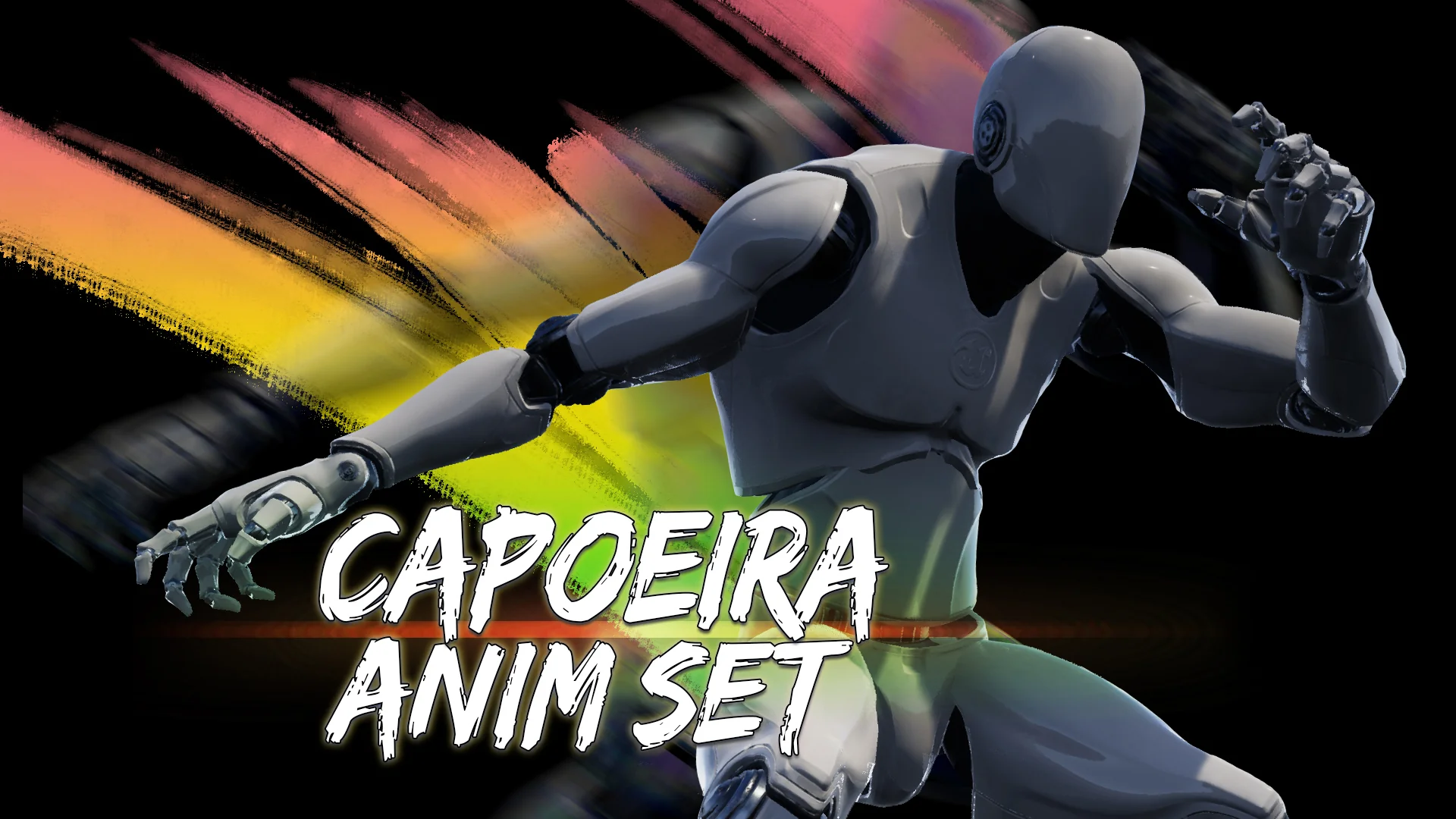
Capoeira Anim Set
Explore the Capoeira Anim Set, featuring 33+ unarmed martial arts animations, attacks, combos, and evasive moves designed for fighting game protagonists.
Staging Unarmed Combat Dynamics with Capoeira Anim Set
Hand-to-hand combat in dedicated fighting games demands distinct physical identity, kinetic rhythm, and clear telegraphing. The Capoeira Anim Set provides a specialized movement library tailored directly to this requirement, capturing the flowing, acrobatic discipline of Afro-Brazilian martial arts. Built specifically for an unarmed main character, the package concentrates exclusively on close-quarters combat maneuvers without the inclusion of melee gear, blades, or projectile apparatus. This complete focus on body-driven martial arts ensures that every action stems entirely from the fighter's own momentum, footwork, and physical leverage.
Fighting game encounters rely heavily on distinct visual styles to separate characters across a roster. A capoeira-based protagonist brings a sweeping, non-traditional fighting cadence into an arena, leaning on deceptive sweeps, spinning heel strikes, inverted hand placements, and continuous directional momentum. Integrating this animation package allows combat designers to ground a character's offensive tools within this distinct martial arts vocabulary, immediately communicating high agility and unorthodox attack angles to the player through movement alone.
Deconstructing the Offensive Motions: Attacks and Multi-Hit Combos
Offensive actions make up the overwhelming majority of the collection, establishing an assertive, forward-driving combat system. Out of the 33+ total motions included in the library, the offensive inventory is partitioned into two distinct categories: 18 standalone attack animations and 9 dedicated combo sequences. This distribution serves two fundamental approaches to combat design within a fighting game framework.
The 18 single-attack animations represent core building blocks. These individual strikes can be plugged directly into modular action trees, directional button inputs, or branch-on-hit gameplay systems. Designers can treat these discrete clips as neutral pokes, high roundhouses, low sweeping kicks, or launching strikes. Because they exist as independent animations, game mechanics can assign unique frame data, cancel windows, counter-hit states, and pushback values to each individual hit, giving the developer surgical control over the combat flow.
Complementing the single attacks are 9 dedicated combo animations. Rather than requiring combat logic to stitch multiple standalone animations together frame-by-frame, these combo files execute pre-choreographed, continuous strings of momentum. In rhythm-based or traditional fighting engines, these sequences excel as dial-a-combo strings, target combos, or cinematic punish windows when an opponent is left vulnerable. The continuous transitions within these 9 combos preserve the natural, uninterrupted kinetic flow that defines high-level martial arts execution, preventing the awkward snapping that can occur when blending rapidly between disjointed strike clips.
Defensive Realities and Avoidance in the Capoeira Movement System
Martial arts choreography is defined as much by how a combatant escapes incoming damage as how they inflict it. In capoeira, static blocking is historically secondary to active evasion, rhythm, and tactical body repositioning. The structural breakdown of the collection directly mirrors this philosophy: it includes 4 avoid animations alongside a single, concise defense animation.
The emphasis on 4 distinct avoid animations allows developers to build responsive dodge mechanics, side slips, ducking evasions, or back-sways that fit fluidly beneath incoming high strikes or around linear thrusts. Rather than absorbing the kinetic shock of an impact, an agile main character can duck low to the floor or slip off-axis, mirroring the fluid dipping and weaving essential to the martial art. These avoid states function as natural setup windows for counterattacks, allowing players to slip an incoming strike and instantly branch into one of the 18 single attacks or initiate one of the 9 combo sequences.
The inclusion of a single defense animation serves as the baseline, functional guard state when active evasion fails or when space runs out. By providing one consolidated blocking posture alongside multiple evasive options, the asset encourages a playstyle shaped by agility, precision spacing, and timing-based counters rather than prolonged turtle strategies behind an impenetrable, static guard.
Structuring the 33+ Animation Pipeline for Combat Controllers
Connecting these combat assets requires clear logic inside a playable state machine. At the center of the set sits a dedicated idle animation, acting as the neutral baseline from which all offensive and evasive branches originate, and to which all uncompleted actions must eventually return.
Because the library consists of 33+ clips—split between 18 attacks, 9 combos, 4 avoids, 1 defense, and 1 idle—the state logic can be kept clean, readable, and tightly organized:
Neutral Stance: The single idle loop acts as the staging ground, anchoring the fighter's base poses and breathing room between exchanges.
Direct Offense: 18 standalone attacks provide comprehensive coverage for light, medium, and heavy inputs across multiple attack heights.
Chained Momentum: 9 premade combo clips deliver fluid, multi-hit execution without the need for complex, manual animation-stitching algorithms.
Evasive Maneuvers: 4 avoid clips grant varied defensive mobility, ducking options, or slip-step counters.
Static Mitigation: A single defense clip functions as the essential, immediate barrier against incoming offensive pressure.
This distribution makes it simple to map animations directly to standard game controller inputs. Standard button presses can easily draw from the 18 single strikes, while contextual inputs, super meters, or string completions can route directly into the 9 combos. Meanwhile, defensive buttons can toggle between the static guard clip and the directional avoid maneuvers depending on directional inputs or dodge timings.
Fit and Scope for Unarmed Protagonist Projects
The Capoeira Anim Set is explicitly tailored for unarmed combat scenarios where a character fights without secondary props, handheld weaponry, or auxiliary gear. By dedicating its entire scope to pure body mechanics, attacks, and combos, the package avoids dilution across unrelated gameplay mechanics like weapon draws, sheathing animations, or item pickups.
For productions anchored in tournament fighters, arena brawlers, or character-driven action titles where the protagonist relies entirely on their physical mastery, this collection provides an immediate, rhythmically coherent martial arts baseline. The choreography bypasses the standard kickboxing or brawling tropes in favor of dynamic, expressive footwork, offering developers the exact motion resources needed to build an agile, hard-hitting martial artist from the ground up.
 Combat
 Combat
 Combat