"07a32e720bd988c8"{"id":"1002466","slug":"bandit","title":"Bandit","category":"Humans","engine":"4.19+,5.0+","assetVersion":"","engineVersion":"Engine Version: 4.19+,5.0+","tag":"Humans","accent":"blue","visual":"mech","summary":"A close look at the low-poly Bandit character model for Unreal Engine, featuring a full face rig, UE4 Epic Skeleton compatibility, and a rigged Peacemaker.","platform":"Unreal Engine","indexPolicy":"index","publishedAt":"2026-11-12T03:05:11.343Z","updatedAt":"2026-11-12T03:05:11.343Z","sourceNotes":[],"fileContents":[],"compatibility":["Unreal Engine","Engine Version: 4.19+,5.0+"],"featuredImage":{"alt":"Bandit","src":"/wp-content/uploads/published/2026/11/3e4327dfa2a7-6e871869-7054-47c6-8bbb-7214b4f0ae5c-a98389a076.webp"},"hasDownloadLink":true,"downloads":0,"terms":[{"taxonomy":"category","slug":"humans","name":"Humans"}],"galleryImages":[{"src":"/wp-content/uploads/published/2026/11/4d07e56c5145-b68838d7-3a2d-49d9-8e62-a97fb201b9ab-4bd958af46.webp","alt":"Bandit"},{"src":"/wp-content/uploads/published/2026/11/b1a0da864b1d-18bfdf77-e7f7-4ced-8da3-9644fd040a6b-5bb1ca1c42.webp","alt":"Bandit"},{"src":"/wp-content/uploads/published/2026/11/a59ab1944383-9db5264f-bbd4-492f-909b-9cb18a45edc1-51be1294f6.webp","alt":"Bandit"},{"src":"/wp-content/uploads/published/2026/11/1049c4b15f78-8f7cb13b-d342-400d-a18c-ea3714b115d2-5ea108c94e.webp","alt":"Bandit"},{"src":"/wp-content/uploads/published/2026/11/c1528b9e6bcc-40c046b3-5ad6-4771-9075-b43540ececfd-ea521c116a.webp","alt":"Bandit"},{"src":"/wp-content/uploads/published/2026/11/3610d67d0d90-e02ec336-4473-4cb5-8eac-f6ed4fafe54b-dc0566e6cf.webp","alt":"Bandit"},{"src":"/wp-content/uploads/published/2026/11/ad2684ccb266-4a5b6fb3-2d62-4202-b05c-ea584c63a00b-6c630e3feb.webp","alt":"Bandit"},{"src":"/wp-content/uploads/published/2026/11/af46c56305ef-8e7a0dfd-b451-416b-ae88-646d45db9c5d-104e694870.webp","alt":"Bandit"},{"src":"/wp-content/uploads/published/2026/11/3410f0b0d8e4-0cd59900-f325-486d-be2a-6e3ad6c2dd82-935242d7f1.webp","alt":"Bandit"},{"src":"/wp-content/uploads/published/2026/11/d1d53fb35a23-9911b93b-825b-4349-b13e-d5cbedc81f8d-1ba9edcf9f.webp","alt":"Bandit"}],"accessPanel":{"kind":"resource","title":"Get this resource","eyebrow":"Free resource","message":"Download this resource in your browser.","fileName":"Content.7z","safetyNote":"Resources are manually reviewed before listing to improve quality and reduce obvious risks.","actionLabel":"Get this resource","resourceType":"Resource archive","versions":[]},"contentHtml":"\u003cp\u003eA realistic Old West scene demands believable frontier characters that can immediately slot into action, dialogue, or environmental interactions. The Bandit model delivers this functional presence as a low-poly female outlaw designed to balance real-time runtime efficiency with high-definition PBR material responses. Driven by the classic cowgirl aesthetic of the American frontier, the character arrives ready for integration into interactive scenes, cinematic vignettes, and combat encounters without requiring extensive manual skeletal rebuilding or material restructuring.\u003c/p\u003e \u003ch2\u003eVisual Identity and Era Styling of the Bandit Model\u003c/h2\u003e\n\u003cp\u003eThe visual foundation of the character reflects a grounded, realistic interpretation of a 19th-century western outlaw. Rather than leaning into hyper-stylized caricature, the proportions, clothing, and overall construction pursue a believable historical flavor. Low-poly topology forms the bedrock of the geometry, ensuring that the model functions smoothly within real-time game engines where polygon budgets must accommodate multiple active characters, dynamic lighting, and complex frontier environments.\u003c/p\u003e\n\u003cp\u003eBy pairing low-poly efficiency with realistic surface detailing, the character works comfortably in a variety of camera perspectives. Third-person tracking cameras catch the full silhouette and costuming details, while tighter dialogue framing takes advantage of the model's facial geometry and material fidelity. The visual balance enables the character to blend cleanly with related character libraries, maintaining structural harmony alongside assets like the semi-realistic female character collection from the Spy Girl line.\u003c/p\u003e \u003ch2\u003eSkeletal Framework, Face Rigging, and Animation Pipelines\u003c/h2\u003e\n\u003cp\u003eCharacter integration lives or dies by its skeletal architecture. The model is structured directly upon the standard UE4 Epic Skeleton hierarchy. Full compatibility with the Epic Skeleton means animators and technical artists do not need to spend days setting up custom retargeting chains or rebuilding joint orientations before testing locomotion. Any standard Unreal Engine animation asset aligned with the UE4 mannequin can map directly to the character's body bones.\u003c/p\u003e\n\u003cp\u003eTo enable rapid deployment into a project scene, three Unreal mannequin animations are included directly for testing purposes. These sample clips provide immediate validation of bone weights, skin deformation, and joint alignment. You can immediately evaluate how the limbs bend, how the hips handle rotational shifts, and how the shoulders deform during standard movement cycles. While custom character-specific performances are left to the animator, the inclusion of an Animation Blueprint setup and functional test animations ensures that the initial mechanical verification phase is virtually instantaneous.\u003c/p\u003e\n\u003cp\u003eBeyond the primary limbs and spine, the character incorporates a dedicated face rig. Many low-poly real-time figures rely on static heads or basic blend shapes, but a fully articulated facial rig expands creative potential significantly. Developers can animate nuanced facial expressions, construct phoneme mouth shapes for lip-sync systems, or design dynamic reaction states during combat and conversations. This internal facial bone structure allows creators to transition the character from background patrol duties to focal narrative roles without switching to a different high-detail cinematic mesh.\u003c/p\u003e \u003ch2\u003ePhysical Asset Construction and Ragdoll Simulation\u003c/h2\u003e\n\u003cp\u003eReal-time realism depends heavily on how a character reacts when kinetic forces take over. The asset comes pre-configured with an Unreal physical asset setup, assigning collision bodies and physics constraints across the skeletal structure. This setup provides instant support for ragdoll simulations when an outlaw takes a fatal hit, falls from a horse, or gets swept up in sudden environmental physics events.\u003c/p\u003e\n\u003cp\u003eThe physical asset configuration handles the core body alongside separate secondary elements. By configuring physical bodies for distinct components, the model avoids the stiff, uniform collapse typical of unfinished ragdolls. The torso, arms, head, and lower limbs react according to assigned constraint angles and mass distributions. This integrated setup bypasses the tedious process of placing capsules, aligning spherical collision bounds, and tuning physics constraints manually inside the engine editor.\u003c/p\u003e \u003ch2\u003eSurface Definition and PBR Material Structure\u003c/h2\u003e\n\u003cp\u003eRealistic visual rendering is anchored by a complete physically based rendering (PBR) texture workflow adhering to metallic and roughness standards. The pack includes texture maps formatted at both 4K and 2K resolutions, offering flexibility depending on platform performance budgets, target screen resolutions, and memory requirements.\u003c/p\u003e\n\u003cp\u003eThe texture suite covers three foundational map types:\u003c/p\u003e\n\u003cul\u003e\n\u003cli\u003e\u003cstrong\u003eAlbedo:\u003c/strong\u003e Delivers base color information stripped of baked lighting, preserving authentic material values across fabrics, leather, and skin.\u003c/li\u003e\n\u003cli\u003e\u003cstrong\u003eNormal:\u003c/strong\u003e Provides high-frequency surface detail, such as seams, folds, and surface imperfections, while preserving low-poly geometry beneath.\u003c/li\u003e\n\u003cli\u003e\u003cstrong\u003eAO / Metallic / Roughness:\u003c/strong\u003e Combines ambient occlusion, metallic response, and micro-surface roughness into an efficient channel-packed asset to optimize texture memory and shader sampling overhead.\u003c/li\u003e\n\u003c/ul\u003e\n\u003cp\u003eThis channel configuration ensures that the character responds accurately to dynamic time-of-day lighting, from harsh desert noon sun to the flickering glow of a campfire or saloon lantern. Roughness values ensure that treated leather shines appropriately while dusty cloth scatters incoming light softly.\u003c/p\u003e \u003ch2\u003eThe Rigged Peacemaker Revolver in the Bandit Equipment Set\u003c/h2\u003e\n\u003cp\u003eA classic frontier outlaw requires authentic period weaponry, and the asset meets this need by including a dedicated model of the iconic Peacemaker revolver. Built to the same realistic visual standard as the character herself, the sidearm matches the aesthetic tone and period accuracy of the Old West setting.\u003c/p\u003e\n\u003cp\u003eCrucially, the revolver is not a static prop fused to the hand or locked into a rigid holster mesh. The weapon features its own independent rig complete with articulated moving parts. This mechanical setup allows technical animators to build realistic handling sequences: the cylinder can rotate during trigger pulls, the hammer can be drawn back before firing, and the loading gate can open to simulate authentic cartridge loading cycles. Having a fully rigged weapon included alongside the character eliminates the need to source, scale, and rig a separate firearm to match the outlaw's combat mechanics.\u003c/p\u003e \u003ch2\u003eProject Readiness and Production Utility\u003c/h2\u003e\n\u003cp\u003eFor studios building third-person shooters, role-playing games, or interactive narrative experiences set against a historic or neo-western frontier, this asset serves as an immediate, production-ready solution. The integration of standard UE4 Epic Skeleton conventions, an onboard face rig, a pre-tuned physics asset, and an articulated sidearm addresses nearly all the mechanical hurdles that typically slow down character implementation. With functional mannequin test clips already in place, the Bandit character can be dropped directly into an active level and pushed through motion sequences within minutes.\u003c/p\u003e\n\n\u003ch2\u003eExplore Similar Assets\u003c/h2\u003e\n\u003cul\u003e\n\u003cli\u003e\u003ca href=\"https://3dcghub.com/modular-bandits-pack/\" rel=\"noopener noreferrer\"\u003eModular Bandits Pack\u003c/a\u003e\u003c/li\u003e\n\u003cli\u003e\u003ca href=\"https://3dcghub.com/regular-male-civilian-character/\" rel=\"noopener noreferrer\"\u003eRegular Male Civilian Character\u003c/a\u003e\u003c/li\u003e\n\u003cli\u003e\u003ca href=\"https://3dcghub.com/samurai-girl-tomoe/\" rel=\"noopener noreferrer\"\u003eSamurai Girl Tomoe\u003c/a\u003e\u003c/li\u003e\n\u003cli\u003e\u003ca href=\"https://3dcghub.com/customizable-school-girls/\" rel=\"noopener noreferrer\"\u003eCustomizable School Girls\u003c/a\u003e\u003c/li\u003e\n\u003cli\u003e\u003ca href=\"https://3dcghub.com/medieval-girl/\" rel=\"noopener noreferrer\"\u003eMedieval Girl\u003c/a\u003e\u003c/li\u003e\n\u003c/ul\u003e","contentTextLength":7378,"navigation":{"current":33,"total":4421,"previous":{"id":"1002467","slug":"barbarian-rpg","title":"Barbarian RPG","category":"Characters \u0026 Creatures","platform":"Unreal Engine","updatedAt":"2026-11-12T03:05:53.821Z"},"next":{"id":"1002465","slug":"assault-character-pack-remastered","title":"Assault Character Pack Remastered","category":"Characters \u0026 Creatures","platform":"Unreal Engine","updatedAt":"2026-11-12T03:04:21.267Z"}},"relatedResources":[{"id":"24931","slug":"modular-bandits-pack","title":"Modular Bandits Pack","category":"Humans","engine":"5.0+","assetVersion":"Engine version: 5.0+","engineVersion":"","tag":"Humans","accent":"blue","visual":"character","summary":"A modular character set with over 400 interchangeable modules and 24 presets gives projects a fast way to shape bandits, soldiers, and other modern combat figures. The pack uses one UE5 skeleton, supports Tall/Masculine body types, and includes bonus weapon...","platform":"Unreal Engine","indexPolicy":"index","publishedAt":"2026-04-17T14:06:19.000Z","updatedAt":"2026-04-20T06:12:35.000Z","sourceNotes":[],"fileContents":[],"compatibility":["Unreal Engine","Engine version: 5.0+"],"featuredImage":{"alt":"Modular Bandits Pack","src":"https://3dcghub.com/wp-content/uploads/2026/04/3560f0420e1e_e8dff1c7-0139-47b4-9622-cea0bf11d010.webp"},"hasDownloadLink":true,"downloads":9},{"id":"1002342","slug":"regular-male-civilian-character","title":"Regular Male Civilian Character","category":"Humans","engine":"4.19+,5.0+","assetVersion":"","engineVersion":"Engine Version: 4.19+,5.0+","tag":"Humans","accent":"blue","visual":"character","summary":"A customizable male civilian character compatible with the Epic skeleton, with five faces, twelve clothing types, three accessories, LODs, and PBR-tagged materi","platform":"Unreal Engine","indexPolicy":"index","publishedAt":"2026-11-06T06:48:46.543Z","updatedAt":"2026-11-06T06:48:46.543Z","sourceNotes":[],"fileContents":[],"compatibility":["Unreal Engine","Engine Version: 4.19+,5.0+"],"featuredImage":{"alt":"Regular Male Civilian Character","src":"/wp-content/uploads/published/2026/11/d6e4f79a6e9c-b67956f8-4470-4c1f-80d0-9a91dd32c434-d811c78525.webp"},"hasDownloadLink":true,"downloads":0},{"id":"1002405","slug":"samurai-girl-tomoe","title":"Samurai Girl Tomoe","category":"Humans","engine":"4.19+,5.0+","assetVersion":"","engineVersion":"Engine Version: 4.19+,5.0+","tag":"Humans","accent":"blue","visual":"mech","summary":"Modular 3D warrior character Samurai Girl Tomoe featuring 52 ARKit blendshapes, 4K packed textures, and an Epic Skeleton rig for action games.","platform":"Unreal Engine","indexPolicy":"index","publishedAt":"2026-11-10T07:07:18.175Z","updatedAt":"2026-11-10T07:07:18.175Z","sourceNotes":[],"fileContents":[],"compatibility":["Unreal Engine","Engine Version: 4.19+,5.0+"],"featuredImage":{"alt":"Samurai Girl Tomoe","src":"/wp-content/uploads/published/2026/11/5c46690700c0-95be6877-7081-4ad3-b57c-fd636373f3cb-40e5943225.webp"},"hasDownloadLink":true,"downloads":0}]}
Humans
Bandit
A close look at the low-poly Bandit character model for Unreal Engine, featuring a full face rig, UE4 Epic Skeleton compatibility, and a rigged Peacemaker.
Category:Unreal Engine,HumansPlatform: Unreal EngineEngine Version: 4.19+,5.0+Published: Nov 12, 2026
Humans
Resource overview
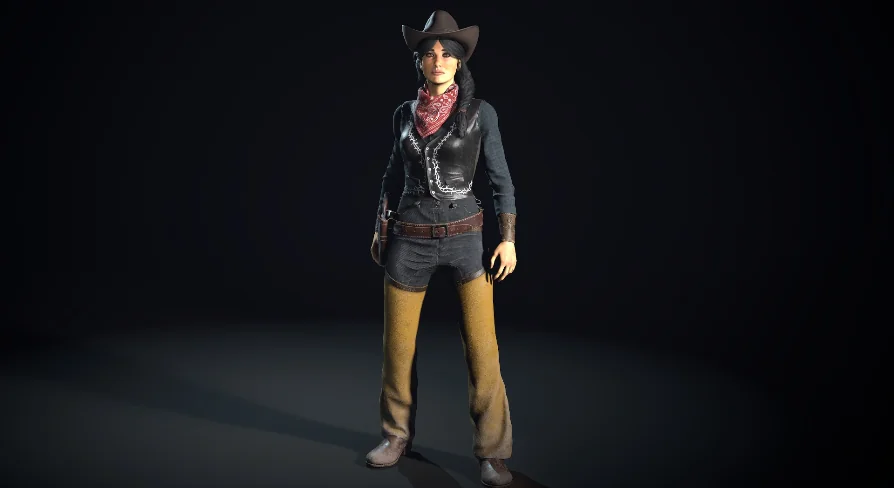
A realistic Old West scene demands believable frontier characters that can immediately slot into action, dialogue, or environmental interactions. The Bandit model delivers this functional presence as a low-poly female outlaw designed to balance real-time runtime efficiency with high-definition PBR material responses. Driven by the classic cowgirl aesthetic of the American frontier, the character arrives ready for integration into interactive scenes, cinematic vignettes, and combat encounters without requiring extensive manual skeletal rebuilding or material restructuring.
Visual Identity and Era Styling of the Bandit Model
The visual foundation of the character reflects a grounded, realistic interpretation of a 19th-century western outlaw. Rather than leaning into hyper-stylized caricature, the proportions, clothing, and overall construction pursue a believable historical flavor. Low-poly topology forms the bedrock of the geometry, ensuring that the model functions smoothly within real-time game engines where polygon budgets must accommodate multiple active characters, dynamic lighting, and complex frontier environments.
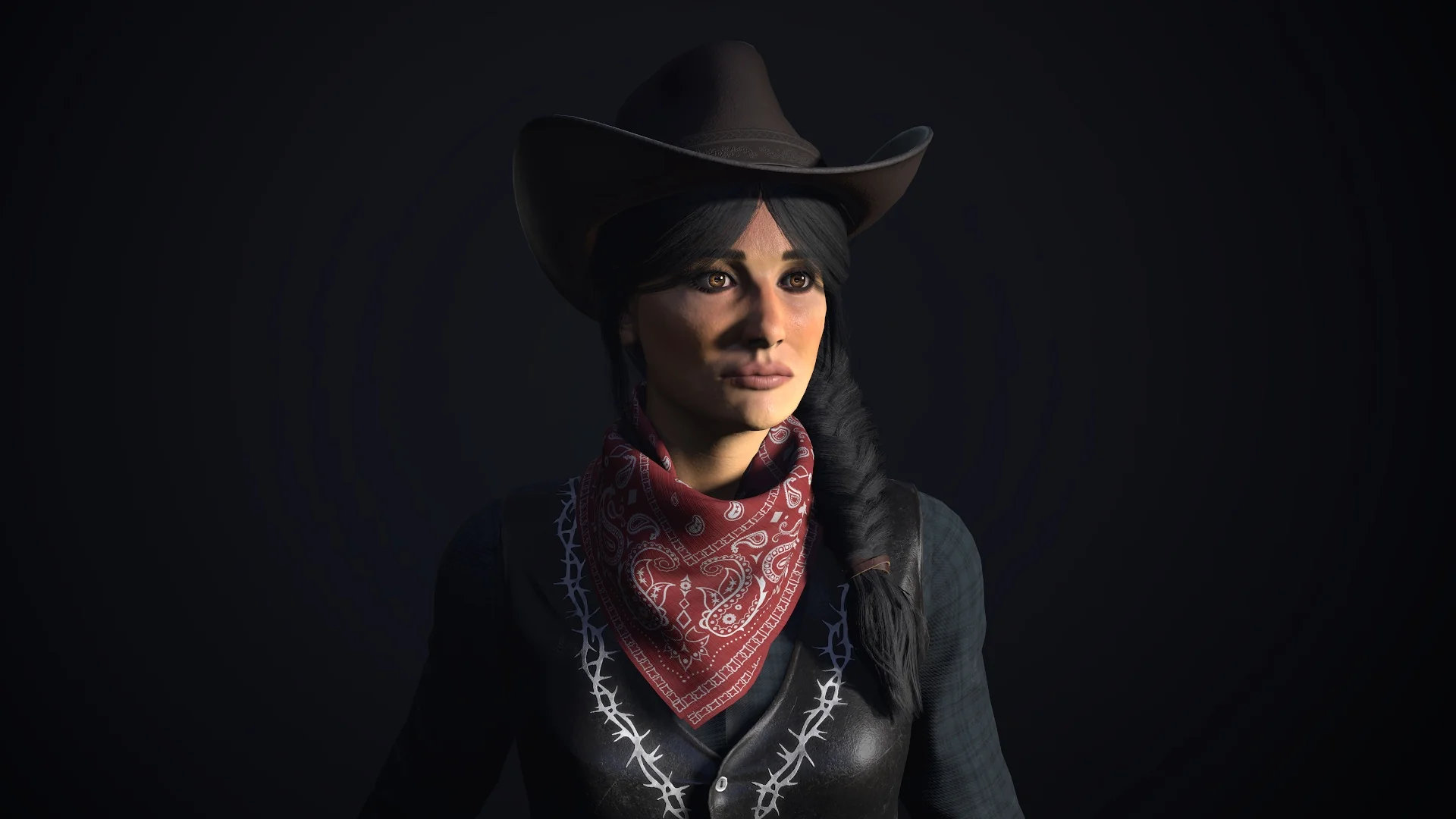
By pairing low-poly efficiency with realistic surface detailing, the character works comfortably in a variety of camera perspectives. Third-person tracking cameras catch the full silhouette and costuming details, while tighter dialogue framing takes advantage of the model's facial geometry and material fidelity. The visual balance enables the character to blend cleanly with related character libraries, maintaining structural harmony alongside assets like the semi-realistic female character collection from the Spy Girl line.
Skeletal Framework, Face Rigging, and Animation Pipelines
Character integration lives or dies by its skeletal architecture. The model is structured directly upon the standard UE4 Epic Skeleton hierarchy. Full compatibility with the Epic Skeleton means animators and technical artists do not need to spend days setting up custom retargeting chains or rebuilding joint orientations before testing locomotion. Any standard Unreal Engine animation asset aligned with the UE4 mannequin can map directly to the character's body bones.
To enable rapid deployment into a project scene, three Unreal mannequin animations are included directly for testing purposes. These sample clips provide immediate validation of bone weights, skin deformation, and joint alignment. You can immediately evaluate how the limbs bend, how the hips handle rotational shifts, and how the shoulders deform during standard movement cycles. While custom character-specific performances are left to the animator, the inclusion of an Animation Blueprint setup and functional test animations ensures that the initial mechanical verification phase is virtually instantaneous.
Beyond the primary limbs and spine, the character incorporates a dedicated face rig. Many low-poly real-time figures rely on static heads or basic blend shapes, but a fully articulated facial rig expands creative potential significantly. Developers can animate nuanced facial expressions, construct phoneme mouth shapes for lip-sync systems, or design dynamic reaction states during combat and conversations. This internal facial bone structure allows creators to transition the character from background patrol duties to focal narrative roles without switching to a different high-detail cinematic mesh.
Physical Asset Construction and Ragdoll Simulation
Real-time realism depends heavily on how a character reacts when kinetic forces take over. The asset comes pre-configured with an Unreal physical asset setup, assigning collision bodies and physics constraints across the skeletal structure. This setup provides instant support for ragdoll simulations when an outlaw takes a fatal hit, falls from a horse, or gets swept up in sudden environmental physics events.
The physical asset configuration handles the core body alongside separate secondary elements. By configuring physical bodies for distinct components, the model avoids the stiff, uniform collapse typical of unfinished ragdolls. The torso, arms, head, and lower limbs react according to assigned constraint angles and mass distributions. This integrated setup bypasses the tedious process of placing capsules, aligning spherical collision bounds, and tuning physics constraints manually inside the engine editor.
Surface Definition and PBR Material Structure
Realistic visual rendering is anchored by a complete physically based rendering (PBR) texture workflow adhering to metallic and roughness standards. The pack includes texture maps formatted at both 4K and 2K resolutions, offering flexibility depending on platform performance budgets, target screen resolutions, and memory requirements.
The texture suite covers three foundational map types:
Albedo: Delivers base color information stripped of baked lighting, preserving authentic material values across fabrics, leather, and skin.
Normal: Provides high-frequency surface detail, such as seams, folds, and surface imperfections, while preserving low-poly geometry beneath.
AO / Metallic / Roughness: Combines ambient occlusion, metallic response, and micro-surface roughness into an efficient channel-packed asset to optimize texture memory and shader sampling overhead.
This channel configuration ensures that the character responds accurately to dynamic time-of-day lighting, from harsh desert noon sun to the flickering glow of a campfire or saloon lantern. Roughness values ensure that treated leather shines appropriately while dusty cloth scatters incoming light softly.
The Rigged Peacemaker Revolver in the Bandit Equipment Set
A classic frontier outlaw requires authentic period weaponry, and the asset meets this need by including a dedicated model of the iconic Peacemaker revolver. Built to the same realistic visual standard as the character herself, the sidearm matches the aesthetic tone and period accuracy of the Old West setting.
Crucially, the revolver is not a static prop fused to the hand or locked into a rigid holster mesh. The weapon features its own independent rig complete with articulated moving parts. This mechanical setup allows technical animators to build realistic handling sequences: the cylinder can rotate during trigger pulls, the hammer can be drawn back before firing, and the loading gate can open to simulate authentic cartridge loading cycles. Having a fully rigged weapon included alongside the character eliminates the need to source, scale, and rig a separate firearm to match the outlaw's combat mechanics.
Project Readiness and Production Utility
For studios building third-person shooters, role-playing games, or interactive narrative experiences set against a historic or neo-western frontier, this asset serves as an immediate, production-ready solution. The integration of standard UE4 Epic Skeleton conventions, an onboard face rig, a pre-tuned physics asset, and an articulated sidearm addresses nearly all the mechanical hurdles that typically slow down character implementation. With functional mannequin test clips already in place, the Bandit character can be dropped directly into an active level and pushed through motion sequences within minutes.
 Humans
 Humans
 Humans
 Humans