"07a32e720bd988c8"{"id":"1002467","slug":"barbarian-rpg","title":"Barbarian RPG","category":"Characters \u0026 Creatures","engine":"4.26+,5.0+","assetVersion":"","engineVersion":"Engine Version: 4.26+,5.0+","tag":"Characters","accent":"blue","visual":"character","summary":"Deploy the Barbarian RPG character featuring an epic skeleton, APEX Cloth physics, removable parts, custom weapon, and complete Animation Blueprint support.","platform":"Unreal Engine","indexPolicy":"index","publishedAt":"2026-11-12T03:05:53.821Z","updatedAt":"2026-11-12T03:05:53.821Z","sourceNotes":[],"fileContents":[],"compatibility":["Unreal Engine","Engine Version: 4.26+,5.0+"],"featuredImage":{"alt":"Barbarian RPG","src":"/wp-content/uploads/published/2026/11/015f0ae4a91f-4cbaea65-66c8-417c-91fc-85565a33c685-6a1448bf0c.webp"},"hasDownloadLink":true,"downloads":0,"terms":[{"taxonomy":"category","slug":"characters-and-creatures","name":"Characters \u0026 Creatures"}],"galleryImages":[{"src":"/wp-content/uploads/published/2026/11/32c623e1caba-9c30c6e9-b504-4e72-9e09-0de4f9bcbc39-12a18ca0cd.webp","alt":"Barbarian RPG"},{"src":"/wp-content/uploads/published/2026/11/304c1d87feda-9e0a92a2-3b46-4785-8aa6-7bd0400bcdd0-1c442c9eb3.webp","alt":"Barbarian RPG"},{"src":"/wp-content/uploads/published/2026/11/af8272014ef0-2b733246-4b94-42b0-8834-3ffadc4a9241-127f91193a.webp","alt":"Barbarian RPG"},{"src":"/wp-content/uploads/published/2026/11/99696e50ef4a-a474892b-0986-4d14-914e-041e998e2771-cdcbbd1a20.webp","alt":"Barbarian RPG"},{"src":"/wp-content/uploads/published/2026/11/5a8bdae427a0-9e647ab2-1e80-4245-88cc-3d25d6f7cc8e-b3c01a5ded.webp","alt":"Barbarian RPG"},{"src":"/wp-content/uploads/published/2026/11/663709a87213-5862d5f9-9e4f-4c10-9f2e-3112bce50d2d-1cee97f717.webp","alt":"Barbarian RPG"},{"src":"/wp-content/uploads/published/2026/11/6769642fd9f7-1407d3d3-1623-4119-a131-972f2144d655-e4708a3754.webp","alt":"Barbarian RPG"}],"accessPanel":{"kind":"resource","title":"Get this resource","eyebrow":"Free resource","message":"Download this resource in your browser.","fileName":"Content.7z","safetyNote":"Resources are manually reviewed before listing to improve quality and reduce obvious risks.","actionLabel":"Get this resource","resourceType":"Resource archive","versions":[]},"contentHtml":"\u003ch2\u003eSetting Up the Barbarian RPG Skeleton and Animation Blueprint\u003c/h2\u003e\n\u003cp\u003eGetting this low-poly fantasy character into an active project starts with its skeletal alignment and animation framework. Because the asset incorporates an epic skeleton, importing the mesh directly links into standard rigging pipelines, bypassing common retargeting hurdles. The package provides a dedicated Animation Blueprint and supporting script logic, which standardizes how states transition between standing, maneuvering, and handling attacks with the bundled weapon.\u003c/p\u003e\n\u003cp\u003eDevelopers integrating the asset can refer directly to the included video tutorial, which walks through the essential setup stages. The tutorial covers the structural links between the epic skeleton and the animation blueprint, ensuring that dynamic input commands properly drive the character's movement blend spaces. Integrating the script components binds the character's core actions to gameplay logic without demanding custom node architectures from scratch.\u003c/p\u003e\n\u003cp\u003eDuring import, mapping the asset to project-wide controls is straightforward due to the clean arrangement of skeletal bones. The presence of the pre-built Animation Blueprint means that state machines, blend nodes, and combat branches are organized from the moment the character files enter the engine content directory. Setting up the animation preview viewport allows immediate verification of root motion behavior, stance transitions, and bone weight distributions across the joints.\u003c/p\u003e \u003ch2\u003eModular Mesh Construction in Barbarian RPG\u003c/h2\u003e\n\u003cp\u003eThe visual profile of the character emphasizes an exaggerated fantasy aesthetic defined by massive physical proportions. Sculpted with huge legs and huge arms, the anatomy communicates brute physical presence suited to close-quarters combat roles. In its baseline configuration, the character features a naked body wrapped with a bandage, maintaining a raw, primitive appearance while keeping polygon budgets restrained under a low-poly framework.\u003c/p\u003e\n\u003cp\u003eModularity is a primary functional advantage of the asset's structural setup. All parts across the character are completely removable. This allows developers to strip down the model to its base naked form or isolate individual sections depending on the game's armor or visual equipment systems. If a project utilizes tiered armor mechanics, removing the bandage or swapping torso, arm, and leg segments can be executed without disturbing the underlying epic skeleton weights.\u003c/p\u003e\n\u003cp\u003eAccompanying the massive character mesh is a big ax, built to match the oversized proportions of the barbarian's hands and arms. Because the weapon is detached from the primary character geometry, it functions as an independent weapon asset that can be socketed directly to the hand bones. Developers can unequip the ax entirely, swap it for alternate weaponry, or script specific combat stances where the weapon moves dynamically in and out of the character's grip.\u003c/p\u003e \u003ch2\u003eConfiguring APEX Cloth Physics on Garment Elements\u003c/h2\u003e\n\u003cp\u003eDynamic movement in the character model is heightened through the inclusion of APEX Cloth physics applied to the bandage and cloth pieces. Rather than relying entirely on rigid bone-weighted deformation, the cloth simulation adds procedural responsiveness to secondary motion. When the character executes heavy swings, sprints, or turns rapidly, the bandage elements react realistically to inertia, gravity, and body collisions.\u003c/p\u003e\n\u003cp\u003eImplementing APEX Cloth within an engine pipeline requires proper collision configuration against the oversized limbs. Because the barbarian possesses enlarged legs and muscular arms, collision volumes on the physics asset must properly mirror the non-standard proportions to prevent cloth penetration. The APEX Cloth parameters govern how freely the fabric drapes, bends, and snaps back against the naked body mesh during extreme movement frames.\u003c/p\u003e\n\u003cp\u003eThis physics layer operates natively alongside the Animation Blueprint. As animations transition from fast attack swings to settled resting poses, the APEX solver calculates the drag and tension of the bandages in real time. The resulting secondary motion prevents the low-poly silhouette from appearing stiff, ensuring that high-intensity combat encounters retain fluid, visually convincing drapery simulation.\u003c/p\u003e \u003ch2\u003eSkeletal Targeting Across Warrior and Creature Animation Sets\u003c/h2\u003e\n\u003cp\u003eBeyond its initial pose structure, the character links extensively with animation packages tailored for combat-heavy gameplay. The epic skeleton backbone allows the barbarian to draw from broad libraries, including direct compatibility pathways with dedicated sets like the 56 Animations For Creatures collection and the comprehensive 92 Animations for Warrior library.\u003c/p\u003e\n\u003cp\u003eThe modular rigging ensures that locomotion, combat strikes, hit reactions, and physical impacts transfer cleanly to the barbarian's frame. While the character's exaggerated proportions—specifically the huge arms and legs—give it an imposing look, the epic skeleton layout keeps bone lengths and orientations compatible with standardized human and humanoid motion data. Attack sweeps created for warrior sets align precisely with the big ax, ensuring hand sockets track accurately through striking arcs without manual socket offsets.\u003c/p\u003e\n\u003cp\u003eLinking into creature animation sets introduces distinct possibilities for non-standard behaviors. Using animations from creature collections can give the barbarian heavy, beast-like charges, grounded roars, and lumbering patrol cycles that complement the hulking character design. The pre-configured Animation Blueprint serves as the control hub where developers can splice warrior attack strings directly into heavy creature movement logic.\u003c/p\u003e \u003ch2\u003eProduction Deployment and Low-Poly Fantasy Roles\u003c/h2\u003e\n\u003cp\u003eThanks to its low-poly specification, the character operates efficiently across a broad range of hardware configurations, making it viable for both dense multiplayer scenes and performance-constrained mobile or indie desktop titles. The combination of optimized geometry, clean topology, and script support allows the asset to serve as a player character, a high-tier enemy boss, or an ambient NPC without introducing heavy draw call overhead.\u003c/p\u003e\n\u003cp\u003eCustomizing the character for specific gameplay encounters relies heavily on the removable nature of the body parts. A developer can deploy multiple variations of the barbarian across a single environment by toggling the bandage mesh, adjusting weapon socket assignments, or layering customized props over the naked base. Because the epic skeleton, weapon sockets, and APEX Cloth physics are already synchronized, maintaining multiple variants across different gameplay stages requires no repetitive rig rebuilding.\u003c/p\u003e\n\u003cp\u003eWith the included video tutorial clarifying initial implementation questions and the Animation Blueprint managing technical locomotion requirements, integration overhead remains low. The Barbarian RPG package provides a practical, customizable asset that balances distinct fantasy art direction with dependable skeletal performance in active production pipelines.\u003c/p\u003e\n\n\u003ch2\u003eContinue Browsing Similar Packs\u003c/h2\u003e\n\u003cul\u003e\n\u003cli\u003e\u003ca href=\"https://3dcghub.com/fantasy-barbarian/\" rel=\"noopener noreferrer\"\u003eFantasy Barbarian\u003c/a\u003e\u003c/li\u003e\n\u003cli\u003e\u003ca href=\"https://3dcghub.com/stylized-forest-animals-rpg-bundle/\" rel=\"noopener noreferrer\"\u003eStylized Forest Animals - RPG Bundle\u003c/a\u003e\u003c/li\u003e\n\u003cli\u003e\u003ca href=\"https://3dcghub.com/modular-wizard/\" rel=\"noopener noreferrer\"\u003eModular Wizard\u003c/a\u003e\u003c/li\u003e\n\u003cli\u003e\u003ca href=\"https://3dcghub.com/mutanthedgehog/\" rel=\"noopener noreferrer\"\u003eMutantHedgehog\u003c/a\u003e\u003c/li\u003e\n\u003cli\u003e\u003ca href=\"https://3dcghub.com/skeleton-pack/\" rel=\"noopener noreferrer\"\u003eSkeleton pack\u003c/a\u003e\u003c/li\u003e\n\u003c/ul\u003e","contentTextLength":7176,"navigation":{"current":32,"total":4421,"previous":{"id":"1002468","slug":"carmel","title":"Carmel","category":"Humans","platform":"Unreal Engine","updatedAt":"2026-11-12T03:08:36.535Z"},"next":{"id":"1002466","slug":"bandit","title":"Bandit","category":"Humans","platform":"Unreal Engine","updatedAt":"2026-11-12T03:05:11.343Z"}},"relatedResources":[{"id":"1002018","slug":"fantasy-barbarian","title":"Fantasy Barbarian","category":"Characters \u0026 Creatures","engine":"4.26+,5.0+","assetVersion":"","engineVersion":"Engine Version: 4.26+,5.0+","tag":"Characters","accent":"blue","visual":"character","summary":"Explore the implementation, fabric simulation, modular clothing toggles, PBR materials, and animation pipeline of the lowpoly Fantasy Barbarian asset.","platform":"Unreal Engine","indexPolicy":"index","publishedAt":"2026-10-26T12:56:46.442Z","updatedAt":"2026-10-26T12:56:46.442Z","sourceNotes":[],"fileContents":[],"compatibility":["Unreal Engine","Engine Version: 4.26+,5.0+"],"featuredImage":{"alt":"Fantasy Barbarian","src":"/wp-content/uploads/published/2026/10/5325a9942648-b6008049-5c3f-4157-b5e8-aec6543e06e6-506d1284fc.webp"},"hasDownloadLink":true,"downloads":0},{"id":"1000890","slug":"stylized-forest-animals-rpg-bundle","title":"Stylized Forest Animals - RPG Bundle","category":"Characters \u0026 Creatures","engine":"4.27,5.0+","assetVersion":"","engineVersion":"Engine Version: 4.27,5.0+","tag":"Characters","accent":"blue","visual":"character","summary":"A stylized forest animal bundle for RPGs with 12 creatures, boss variants, 500+ animations, 100+ custom icons, and 7-11 color variations per animal.","platform":"Unreal Engine","indexPolicy":"index","publishedAt":"2026-08-06T04:29:55.435Z","updatedAt":"2026-08-06T04:29:55.435Z","sourceNotes":[],"fileContents":[],"compatibility":["Unreal Engine","Engine Version: 4.27,5.0+"],"featuredImage":{"alt":"Stylized Forest Animals - RPG Bundle","src":"/wp-content/uploads/published/2026/08/1488a5a702dc-cfea2ec0-1a50-4f8b-9e18-c5933c6b53e8-5cfe2cdd18.webp"},"hasDownloadLink":true,"downloads":1},{"id":"3080","slug":"modular-wizard","title":"Modular Wizard","category":"Characters \u0026 Creatures","engine":"4.26+,5.0+","assetVersion":"Engine version: 4.26+,5.0+","engineVersion":"4.21","tag":"Characters","accent":"blue","visual":"character","summary":"Enhance your RPG with this modular wizard character. Featuring customizable parts, facial expressions, and UE mannequin compatibility for easy integration.","platform":"Unreal Engine","indexPolicy":"noindex","publishedAt":"2026-02-07T16:51:59.000Z","updatedAt":"2026-04-19T15:57:43.000Z","sourceNotes":[],"fileContents":[],"compatibility":["Unreal Engine","Engine version: 4.26+,5.0+"],"featuredImage":{"alt":"Modular Wizard","src":"https://3dcghub.com/wp-content/uploads/2026/02/967d6e30-b781-4770-ba66-1c8dc6cd5e7e.webp"},"hasDownloadLink":true,"downloads":0}]}
Characters
Barbarian RPG
Deploy the Barbarian RPG character featuring an epic skeleton, APEX Cloth physics, removable parts, custom weapon, and complete Animation Blueprint support.
Setting Up the Barbarian RPG Skeleton and Animation Blueprint
Getting this low-poly fantasy character into an active project starts with its skeletal alignment and animation framework. Because the asset incorporates an epic skeleton, importing the mesh directly links into standard rigging pipelines, bypassing common retargeting hurdles. The package provides a dedicated Animation Blueprint and supporting script logic, which standardizes how states transition between standing, maneuvering, and handling attacks with the bundled weapon.
Developers integrating the asset can refer directly to the included video tutorial, which walks through the essential setup stages. The tutorial covers the structural links between the epic skeleton and the animation blueprint, ensuring that dynamic input commands properly drive the character's movement blend spaces. Integrating the script components binds the character's core actions to gameplay logic without demanding custom node architectures from scratch.
During import, mapping the asset to project-wide controls is straightforward due to the clean arrangement of skeletal bones. The presence of the pre-built Animation Blueprint means that state machines, blend nodes, and combat branches are organized from the moment the character files enter the engine content directory. Setting up the animation preview viewport allows immediate verification of root motion behavior, stance transitions, and bone weight distributions across the joints.
Modular Mesh Construction in Barbarian RPG
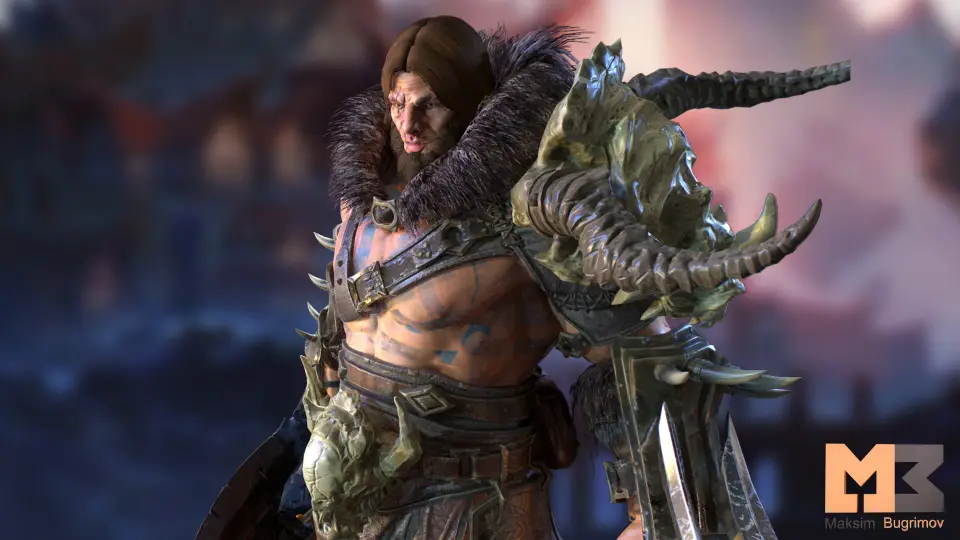
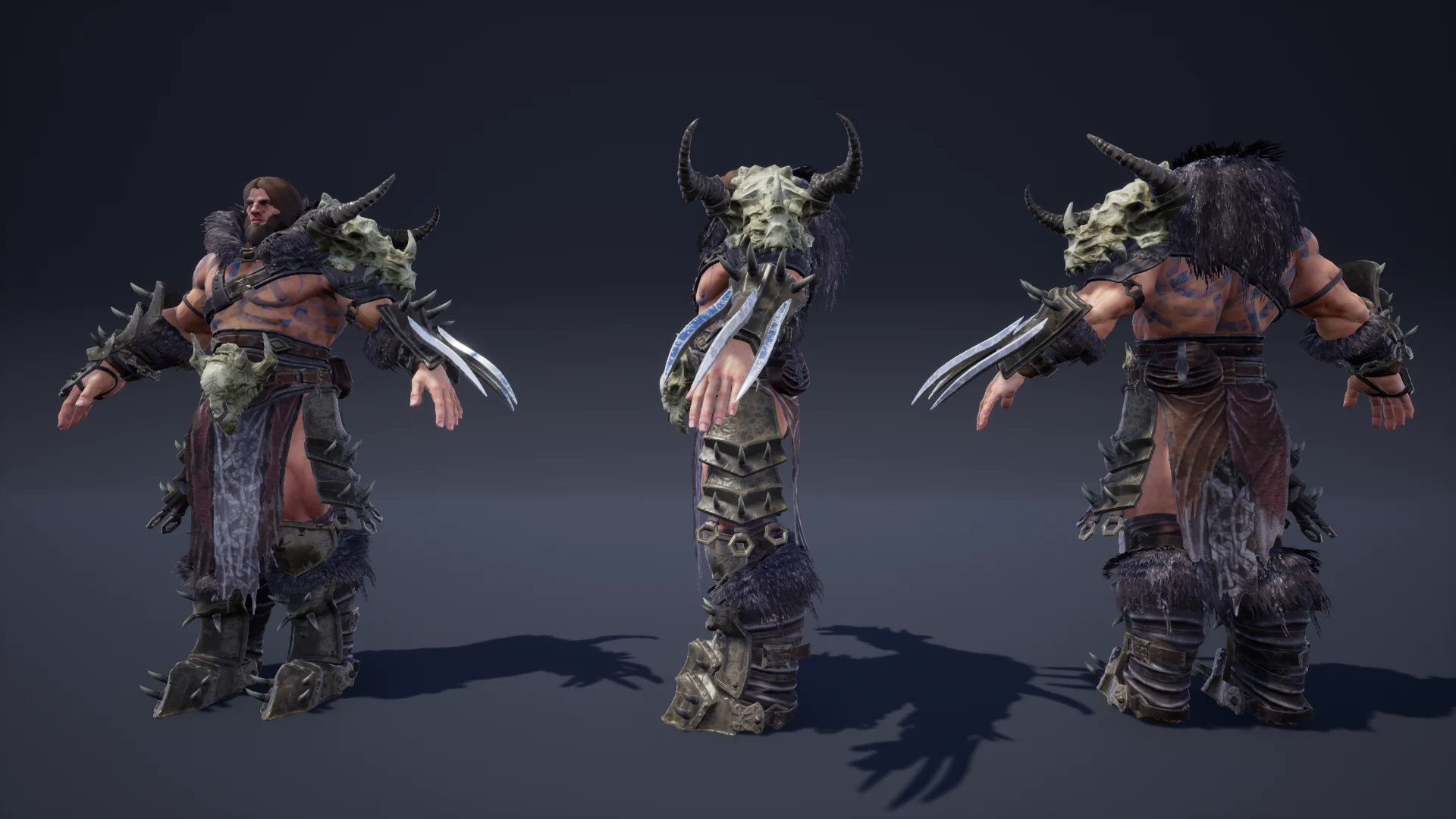
The visual profile of the character emphasizes an exaggerated fantasy aesthetic defined by massive physical proportions. Sculpted with huge legs and huge arms, the anatomy communicates brute physical presence suited to close-quarters combat roles. In its baseline configuration, the character features a naked body wrapped with a bandage, maintaining a raw, primitive appearance while keeping polygon budgets restrained under a low-poly framework.
Modularity is a primary functional advantage of the asset's structural setup. All parts across the character are completely removable. This allows developers to strip down the model to its base naked form or isolate individual sections depending on the game's armor or visual equipment systems. If a project utilizes tiered armor mechanics, removing the bandage or swapping torso, arm, and leg segments can be executed without disturbing the underlying epic skeleton weights.
Accompanying the massive character mesh is a big ax, built to match the oversized proportions of the barbarian's hands and arms. Because the weapon is detached from the primary character geometry, it functions as an independent weapon asset that can be socketed directly to the hand bones. Developers can unequip the ax entirely, swap it for alternate weaponry, or script specific combat stances where the weapon moves dynamically in and out of the character's grip.
Configuring APEX Cloth Physics on Garment Elements
Dynamic movement in the character model is heightened through the inclusion of APEX Cloth physics applied to the bandage and cloth pieces. Rather than relying entirely on rigid bone-weighted deformation, the cloth simulation adds procedural responsiveness to secondary motion. When the character executes heavy swings, sprints, or turns rapidly, the bandage elements react realistically to inertia, gravity, and body collisions.
Implementing APEX Cloth within an engine pipeline requires proper collision configuration against the oversized limbs. Because the barbarian possesses enlarged legs and muscular arms, collision volumes on the physics asset must properly mirror the non-standard proportions to prevent cloth penetration. The APEX Cloth parameters govern how freely the fabric drapes, bends, and snaps back against the naked body mesh during extreme movement frames.
This physics layer operates natively alongside the Animation Blueprint. As animations transition from fast attack swings to settled resting poses, the APEX solver calculates the drag and tension of the bandages in real time. The resulting secondary motion prevents the low-poly silhouette from appearing stiff, ensuring that high-intensity combat encounters retain fluid, visually convincing drapery simulation.
Skeletal Targeting Across Warrior and Creature Animation Sets
Beyond its initial pose structure, the character links extensively with animation packages tailored for combat-heavy gameplay. The epic skeleton backbone allows the barbarian to draw from broad libraries, including direct compatibility pathways with dedicated sets like the 56 Animations For Creatures collection and the comprehensive 92 Animations for Warrior library.
The modular rigging ensures that locomotion, combat strikes, hit reactions, and physical impacts transfer cleanly to the barbarian's frame. While the character's exaggerated proportions—specifically the huge arms and legs—give it an imposing look, the epic skeleton layout keeps bone lengths and orientations compatible with standardized human and humanoid motion data. Attack sweeps created for warrior sets align precisely with the big ax, ensuring hand sockets track accurately through striking arcs without manual socket offsets.
Linking into creature animation sets introduces distinct possibilities for non-standard behaviors. Using animations from creature collections can give the barbarian heavy, beast-like charges, grounded roars, and lumbering patrol cycles that complement the hulking character design. The pre-configured Animation Blueprint serves as the control hub where developers can splice warrior attack strings directly into heavy creature movement logic.
Production Deployment and Low-Poly Fantasy Roles
Thanks to its low-poly specification, the character operates efficiently across a broad range of hardware configurations, making it viable for both dense multiplayer scenes and performance-constrained mobile or indie desktop titles. The combination of optimized geometry, clean topology, and script support allows the asset to serve as a player character, a high-tier enemy boss, or an ambient NPC without introducing heavy draw call overhead.
Customizing the character for specific gameplay encounters relies heavily on the removable nature of the body parts. A developer can deploy multiple variations of the barbarian across a single environment by toggling the bandage mesh, adjusting weapon socket assignments, or layering customized props over the naked base. Because the epic skeleton, weapon sockets, and APEX Cloth physics are already synchronized, maintaining multiple variants across different gameplay stages requires no repetitive rig rebuilding.
With the included video tutorial clarifying initial implementation questions and the Animation Blueprint managing technical locomotion requirements, integration overhead remains low. The Barbarian RPG package provides a practical, customizable asset that balances distinct fantasy art direction with dependable skeletal performance in active production pipelines.
 Characters
 Characters
 Characters
 Characters