"07a32e720bd988c8"{"id":"1002465","slug":"assault-character-pack-remastered","title":"Assault Character Pack Remastered","category":"Characters \u0026 Creatures","engine":"4.26+,5.0+","assetVersion":"","engineVersion":"Engine Version: 4.26+,5.0+","tag":"Characters","accent":"blue","visual":"character","summary":"Detailed technical breakdown of the Assault Character Pack Remastered, featuring 10 skins, 4K PBR textures, 4 LOD levels, and UE4 mannequin rigging.","platform":"Unreal Engine","indexPolicy":"index","publishedAt":"2026-11-12T03:04:21.267Z","updatedAt":"2026-11-12T03:04:21.267Z","sourceNotes":[],"fileContents":[],"compatibility":["Unreal Engine","Engine Version: 4.26+,5.0+"],"featuredImage":{"alt":"Assault Character Pack Remastered","src":"/wp-content/uploads/published/2026/11/aa968b6aeb6c-7016c393-144d-4b6e-9799-0c2008c53ab7-c0f1b08e30.webp"},"hasDownloadLink":true,"downloads":0,"terms":[{"taxonomy":"category","slug":"characters-and-creatures","name":"Characters \u0026 Creatures"}],"galleryImages":[{"src":"/wp-content/uploads/published/2026/11/6013b3363001-71f45d05-2193-4a57-807f-b2812618425a-65c0984704.webp","alt":"Assault Character Pack Remastered"},{"src":"/wp-content/uploads/published/2026/11/4ce8278fd822-a37951a9-ad07-4b38-9943-8bf297161c09-e880788489.webp","alt":"Assault Character Pack Remastered"},{"src":"/wp-content/uploads/published/2026/11/5c5aa3955efe-bb41f916-8b27-4074-bdbe-95895958c5e0-b5f6b60672.webp","alt":"Assault Character Pack Remastered"},{"src":"/wp-content/uploads/published/2026/11/0f138301c640-9ef30da2-fdd6-4fb2-818e-759dd5b287e2-6f72105d20.webp","alt":"Assault Character Pack Remastered"},{"src":"/wp-content/uploads/published/2026/11/239f0aad33d6-ac4e3ce9-a7d4-4901-b01a-fb6170052eb7-e1d3bdbb95.webp","alt":"Assault Character Pack Remastered"},{"src":"/wp-content/uploads/published/2026/11/d561aeb88bd5-5149ae0e-008a-4594-9fd0-8c36818b77dc-70da985119.webp","alt":"Assault Character Pack Remastered"},{"src":"/wp-content/uploads/published/2026/11/b37380b238d0-18df8dc3-a3fc-477d-952a-abe0b6d5bc41-c052c9b191.webp","alt":"Assault Character Pack Remastered"},{"src":"/wp-content/uploads/published/2026/11/ae79e942481d-d5749d65-426b-454c-b90c-ce01f9090060-99e78bad1f.webp","alt":"Assault Character Pack Remastered"},{"src":"/wp-content/uploads/published/2026/11/e7cc37cc01e2-9e9be5dd-f4ef-41d8-a2e4-a8879244f49b-8e391a3ff8.webp","alt":"Assault Character Pack Remastered"},{"src":"/wp-content/uploads/published/2026/11/0739f66fa8c9-5feeeb8d-14e7-431d-be96-16b055e5a019-df9b7449fc.webp","alt":"Assault Character Pack Remastered"}],"accessPanel":{"kind":"resource","title":"Get this resource","eyebrow":"Free resource","message":"Download this resource in your browser.","fileName":"Content.7z","safetyNote":"Resources are manually reviewed before listing to improve quality and reduce obvious risks.","actionLabel":"Get this resource","resourceType":"Resource archive","versions":[]},"contentHtml":"\u003cp\u003eModern tactical games rely heavily on character assets that can fluidly inhabit dense urban warfare, frigid wilderness operations, and high-intensity close-quarters engagements without breaking visual coherence or engine performance. Assault Character Pack Remastered delivers a modular visual library built specifically to meet these operational environments, providing realistic soldier archetypes tailored for modern PC, console, and mobile rendering targets.\u003c/p\u003e \u003ch2\u003eTactical Visual Variations Across the Assault Character Roster\u003c/h2\u003e\n\u003cp\u003eUniformity and specialization are both crucial when populating military and tactical scenarios. The collection incorporates ten distinct skin configurations designed to cover a broad spectrum of combat conditions, team divisions, and operational roles:\u003c/p\u003e\n\u003cul\u003e \u003cli\u003e\u003cstrong\u003eMercenary:\u003c/strong\u003e Rugged, contractor-styled combat outfitting suited for privatized security operations or rogue faction scenarios.\u003c/li\u003e \u003cli\u003e\u003cstrong\u003eMilitary:\u003c/strong\u003e Standardized modern infantry camouflage suited to conventional armed forces encounters in mixed terrain.\u003c/li\u003e \u003cli\u003e\u003cstrong\u003eSWAT:\u003c/strong\u003e Dark, urban-oriented tactical tactical apparel built for close-quarters room clearing and law enforcement settings.\u003c/li\u003e \u003cli\u003e\u003cstrong\u003eDelta Force:\u003c/strong\u003e Specialized tier-one operator outfitting adapted for covert operations and precision raids.\u003c/li\u003e \u003cli\u003e\u003cstrong\u003eNorth Soldier:\u003c/strong\u003e Temperate and cold-climate camouflage suited for woodland, taiga, and northern tactical operational theaters.\u003c/li\u003e \u003cli\u003e\u003cstrong\u003eArctic:\u003c/strong\u003e High-contrast white and winter camouflage configured specifically for sub-zero, snow-covered mountain and tundra environments.\u003c/li\u003e \u003cli\u003e\u003cstrong\u003eRed:\u003c/strong\u003e Bold, high-visibility team-colored combat gear that serves multiplayer faction recognition, specialized squad leaders, or training exercises.\u003c/li\u003e \u003cli\u003e\u003cstrong\u003eGreen Army Man:\u003c/strong\u003e A distinct visual nod to classic combat figurines, useful for alternative game modes, toy-soldier combat themes, or stylized skirmish maps.\u003c/li\u003e \u003cli\u003e\u003cstrong\u003eGolden Man:\u003c/strong\u003e A metallic reward finish fitting for high-tier unlockable achievements, VIP gameplay targets, or specialized vanity configurations.\u003c/li\u003e \u003cli\u003e\u003cstrong\u003eImpostor:\u003c/strong\u003e A deceptive thematic variant built for asymmetric gameplay modes, undercover operatives, or rogue-agent scenario mechanics.\u003c/li\u003e\n\u003c/ul\u003e\n\u003cp\u003eHaving ten varied skins allows teams to populate both allied and hostile fireteams while keeping character silhouettes consistent across different biomes. Whether designing a realistic search-and-seizure mission using SWAT gear or dropping a customized fireteam into snowdrifts with the Arctic setup, the character variants cover standard tactical requirements alongside specialized, non-standard match modes.\u003c/p\u003e \u003ch2\u003eRemastered Material Workflows and High-Resolution Texture Passes\u003c/h2\u003e\n\u003cp\u003eSurface definition relies on a modern Physically Based Shading (PBS) texture workflow calibrated for the standard Metallic setup across Unreal Engine 4 and Unreal Engine 5. Textures are delivered at 4K resolution, capturing fine micro-details in ballistic nylon, matte helmet surfaces, tactical webbing, and weapon harnesses. Each visual variant is defined by dedicated channels:\u003c/p\u003e\n\u003cul\u003e \u003cli\u003e\u003cstrong\u003eAlbedo:\u003c/strong\u003e High-fidelity diffuse base color containing clean chromatic details without baked-in light.\u003c/li\u003e \u003cli\u003e\u003cstrong\u003eMetallic:\u003c/strong\u003e Precision masking that separates non-conductive tactical fabrics from metallic buckles, rings, and hardware mounts.\u003c/li\u003e \u003cli\u003e\u003cstrong\u003eRoughness:\u003c/strong\u003e Granular surface response maps differentiating dull synthetic vest pouches from polished visor surfaces and treated leather.\u003c/li\u003e \u003cli\u003e\u003cstrong\u003eNormal Map:\u003c/strong\u003e Detailed tangent-space height data conveying seams, reinforced stitching, fabric weave, and hard-surface bevels.\u003c/li\u003e \u003cli\u003e\u003cstrong\u003eAmbient Occlusion:\u003c/strong\u003e Contact-shadow data baked specifically to accentuate recessed pockets, strapping overlaps, and equipment folds.\u003c/li\u003e\n\u003c/ul\u003e\n\u003cp\u003eTo avoid the excessive performance overhead that commonly accompanies multiple high-resolution skins, the shader architecture relies on optimized material instances. These instances leverage tiled detail textures, injecting extra micro-scale detail when the camera closes in during tight third-person over-the-shoulder perspectives. This ensures cloth fibers and equipment textures remain crisp in cutscenes or close inspections without forcing distinct unshared textures for every tiny uniform element.\u003c/p\u003e \u003ch2\u003eSkeletal Alignment with the Standard Mannequin Hierarchy\u003c/h2\u003e\n\u003cp\u003eIntegration speed often hinges on how well a custom mesh conforms to existing project animation systems. The character is rigged directly to the standard UE4 Mannequin Skeleton. It retains the original joint counts, bone orientations, and core technical functions of the standard mannequin, preventing unexpected deformities during retargeting.\u003c/p\u003e\n\u003cp\u003eWhile the internal bone count and structural naming conventions match the default skeleton, the physical proportions have been tailored specifically to align with the realistic anatomical volume of a modern soldier. This proportion adjustment ensures that tactical vests, leg pouches, and helmet fixtures deform naturally during high-impact movement without stretching or collapsing along the shoulders and pelvis.\u003c/p\u003e\n\u003cp\u003eBecause the asset utilizes the standard mannequin hierarchy, it pairs directly with existing Animation Blueprints, weapon aim offsets, locomotion blend spaces, and inverse kinematics setups configured for third-person templates. Locomotion libraries, crouching systems, prone transitions, and tactical reload sequences created for the base mannequin can be mapped immediately to the model. Note that dedicated motion files or locomotion clips are not bundled with the pack, allowing developers to plug in whatever custom or standard animation sets their specific gameplay requires.\u003c/p\u003e \u003ch2\u003eLOD Reduction Curves Across Target Hardware Platforms\u003c/h2\u003e\n\u003cp\u003eManaging geometry across multiple combatants in high-framerate shooters demands strict polygonal optimization. The models feature four meticulously planned Levels of Detail (LODs) that reduce geometric density by roughly half at each transition boundary:\u003c/p\u003e\n\u003cul\u003e \u003cli\u003e\u003cstrong\u003eLOD0 (23,532 triangles):\u003c/strong\u003e The primary high-density mesh, configured for hero characters, direct third-person player views, and close-range cinematics where gear folds and silhouette accuracy matter most.\u003c/li\u003e \u003cli\u003e\u003cstrong\u003eLOD1 (11,774 triangles):\u003c/strong\u003e The intermediate level, suited to standard combat distances where small hardware buckles can shed geometry without visible pop-in.\u003c/li\u003e \u003cli\u003e\u003cstrong\u003eLOD2 (5,907 triangles):\u003c/strong\u003e An aggressive mid-distance reduction suitable for flanking squads, distant snipers, or dense multiplayer encounters with many on-screen actors.\u003c/li\u003e \u003cli\u003e\u003cstrong\u003eLOD3 (3,098 triangles):\u003c/strong\u003e An ultra-lightweight polygonal silhouette tailored for long-range sightlines, massive background units, or the strict performance budgets required by mobile platforms.\u003c/li\u003e\n\u003c/ul\u003e\n\u003cp\u003eThe step from 23,532 down to 3,098 triangles maintains the unmistakable silhouette of a kitted operator while shedding expensive edge loops in the extremities. This steep, predictable reduction path enables projects targeting PC, high-end consoles, or constrained mobile architectures to maintain solid framerates during intense firefights.\u003c/p\u003e \u003ch2\u003eTechnical Deployment for Shooter Projects\u003c/h2\u003e\n\u003cp\u003eTeams building tactical shooters, battle royales, or squad-based combat simulations require scalable assets that drop into standard development pipelines without manual skeleton re-authoring. With native UE4 mannequin rigging, an optimized master material instance pipeline, 4K PBR surfaces, and four-tier LOD progression, this package serves as a reliable, production-ready foundation for combatant visual setups.\u003c/p\u003e\n\n\u003ch2\u003eContinue Browsing Similar Packs\u003c/h2\u003e\n\u003cul\u003e\n\u003cli\u003e\u003ca href=\"https://3dcghub.com/sci-fi-assault-trooper/\" rel=\"noopener noreferrer\"\u003eSci-Fi Assault Trooper\u003c/a\u003e\u003c/li\u003e\n\u003cli\u003e\u003ca href=\"https://3dcghub.com/samurai-remastered/\" rel=\"noopener noreferrer\"\u003eSamurai Remastered\u003c/a\u003e\u003c/li\u003e\n\u003cli\u003e\u003ca href=\"https://3dcghub.com/android-robot/\" rel=\"noopener noreferrer\"\u003eAndroid Robot\u003c/a\u003e\u003c/li\u003e\n\u003cli\u003e\u003ca href=\"https://3dcghub.com/pigman/\" rel=\"noopener noreferrer\"\u003ePigman\u003c/a\u003e\u003c/li\u003e\n\u003cli\u003e\u003ca href=\"https://3dcghub.com/crocodile/\" rel=\"noopener noreferrer\"\u003eCROCODILE\u003c/a\u003e\u003c/li\u003e\n\u003c/ul\u003e","contentTextLength":7393,"navigation":{"current":34,"total":4421,"previous":{"id":"1002466","slug":"bandit","title":"Bandit","category":"Humans","platform":"Unreal Engine","updatedAt":"2026-11-12T03:05:11.343Z"},"next":{"id":"2773","slug":"modular-military-character","title":"Modular Military Character","category":"Humans","platform":"Unreal Engine","updatedAt":"2026-11-11T20:59:38.386Z"}},"relatedResources":[{"id":"3398","slug":"sci-fi-assault-trooper","title":"Sci-Fi Assault Trooper","category":"Characters \u0026 Creatures","engine":"4.26,5.0+","assetVersion":"Engine version: 4.26,5.0+","engineVersion":"4.22","tag":"Characters","accent":"blue","visual":"character","summary":"Enhance your futuristic project with the Sci-Fi Assault Trooper pack. Features 10 modular meshes, male and female soldiers, and customizable materials.","platform":"Unreal Engine","indexPolicy":"noindex","publishedAt":"2026-02-09T07:00:56.000Z","updatedAt":"2026-04-19T15:57:39.000Z","sourceNotes":[],"fileContents":[],"compatibility":["Unreal Engine","Engine version: 4.26,5.0+"],"featuredImage":{"alt":"Sci-Fi Assault Trooper","src":"https://3dcghub.com/wp-content/uploads/2026/02/578e5358-c676-457f-b5e4-9b852865255f.webp"},"hasDownloadLink":true,"downloads":2},{"id":"1000668","slug":"samurai-remastered","title":"Samurai Remastered","category":"Characters \u0026 Creatures","engine":"5.0+","assetVersion":"","engineVersion":"Engine Version: 5.0+","tag":"Characters","accent":"blue","visual":"character","summary":"Samurai Remastered is a low poly modular 3D asset with multiple meshes, skins, rigged Epic skeleton, katana weapon, and animation blueprint for Unreal Engine pr","platform":"Unreal Engine","indexPolicy":"index","publishedAt":"2026-07-22T08:07:12.518Z","updatedAt":"2026-07-22T08:07:12.518Z","sourceNotes":[],"fileContents":[],"compatibility":["Unreal Engine","Engine Version: 5.0+"],"featuredImage":{"alt":"Samurai Remastered","src":"/wp-content/uploads/published/2026/07/759dc3e83478-9e17de12-1611-482e-96d3-764ff2f646b8-591732d38e.webp"},"hasDownloadLink":true,"downloads":1},{"id":"1002378","slug":"android-robot","title":"Android Robot","category":"Characters \u0026 Creatures","engine":"4.17+,5.0+","assetVersion":"","engineVersion":"Engine Version: 4.17+,5.0+","tag":"Characters","accent":"blue","visual":"character","summary":"Examine the technical details of the Android Robot, featuring three LOD levels, four 4K PBR texture sets, full skeletal rigging, and sixteen animations.","platform":"Unreal Engine","indexPolicy":"index","publishedAt":"2026-11-10T03:54:44.127Z","updatedAt":"2026-11-10T03:54:44.127Z","sourceNotes":[],"fileContents":[],"compatibility":["Unreal Engine","Engine Version: 4.17+,5.0+"],"featuredImage":{"alt":"Android Robot","src":"/wp-content/uploads/published/2026/11/e52ed5e4e773-5786987b-f513-4126-ac35-0fbf86d982e0-165186e3c3.webp"},"hasDownloadLink":true,"downloads":0}]}
Characters
Assault Character Pack Remastered
Detailed technical breakdown of the Assault Character Pack Remastered, featuring 10 skins, 4K PBR textures, 4 LOD levels, and UE4 mannequin rigging.
Modern tactical games rely heavily on character assets that can fluidly inhabit dense urban warfare, frigid wilderness operations, and high-intensity close-quarters engagements without breaking visual coherence or engine performance. Assault Character Pack Remastered delivers a modular visual library built specifically to meet these operational environments, providing realistic soldier archetypes tailored for modern PC, console, and mobile rendering targets.
Tactical Visual Variations Across the Assault Character Roster
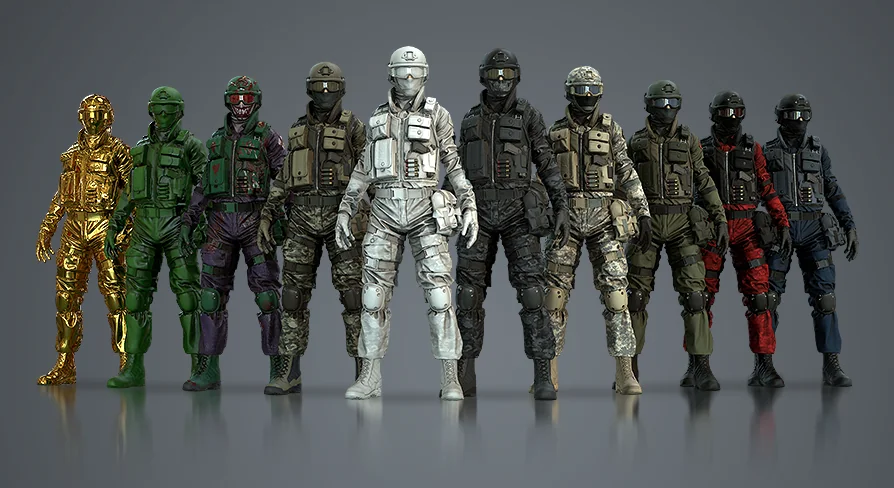
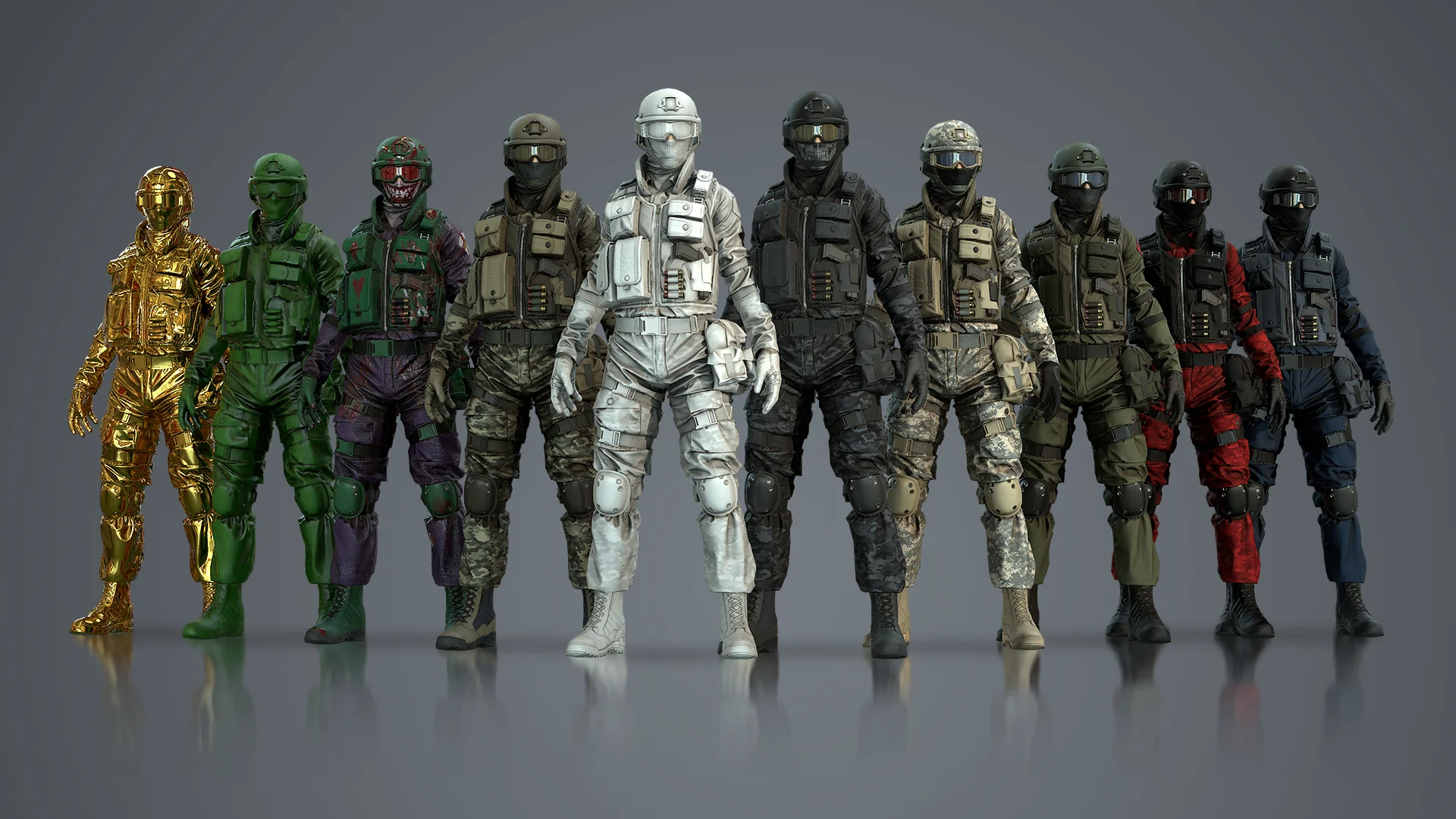
Uniformity and specialization are both crucial when populating military and tactical scenarios. The collection incorporates ten distinct skin configurations designed to cover a broad spectrum of combat conditions, team divisions, and operational roles:
Mercenary: Rugged, contractor-styled combat outfitting suited for privatized security operations or rogue faction scenarios.
Military: Standardized modern infantry camouflage suited to conventional armed forces encounters in mixed terrain.
SWAT: Dark, urban-oriented tactical tactical apparel built for close-quarters room clearing and law enforcement settings.
Delta Force: Specialized tier-one operator outfitting adapted for covert operations and precision raids.
North Soldier: Temperate and cold-climate camouflage suited for woodland, taiga, and northern tactical operational theaters.
Arctic: High-contrast white and winter camouflage configured specifically for sub-zero, snow-covered mountain and tundra environments.
Red: Bold, high-visibility team-colored combat gear that serves multiplayer faction recognition, specialized squad leaders, or training exercises.
Green Army Man: A distinct visual nod to classic combat figurines, useful for alternative game modes, toy-soldier combat themes, or stylized skirmish maps.
Golden Man: A metallic reward finish fitting for high-tier unlockable achievements, VIP gameplay targets, or specialized vanity configurations.
Impostor: A deceptive thematic variant built for asymmetric gameplay modes, undercover operatives, or rogue-agent scenario mechanics.
Having ten varied skins allows teams to populate both allied and hostile fireteams while keeping character silhouettes consistent across different biomes. Whether designing a realistic search-and-seizure mission using SWAT gear or dropping a customized fireteam into snowdrifts with the Arctic setup, the character variants cover standard tactical requirements alongside specialized, non-standard match modes.
Remastered Material Workflows and High-Resolution Texture Passes
Surface definition relies on a modern Physically Based Shading (PBS) texture workflow calibrated for the standard Metallic setup across Unreal Engine 4 and Unreal Engine 5. Textures are delivered at 4K resolution, capturing fine micro-details in ballistic nylon, matte helmet surfaces, tactical webbing, and weapon harnesses. Each visual variant is defined by dedicated channels:
Albedo: High-fidelity diffuse base color containing clean chromatic details without baked-in light.
Metallic: Precision masking that separates non-conductive tactical fabrics from metallic buckles, rings, and hardware mounts.
Roughness: Granular surface response maps differentiating dull synthetic vest pouches from polished visor surfaces and treated leather.
Normal Map: Detailed tangent-space height data conveying seams, reinforced stitching, fabric weave, and hard-surface bevels.
Ambient Occlusion: Contact-shadow data baked specifically to accentuate recessed pockets, strapping overlaps, and equipment folds.
To avoid the excessive performance overhead that commonly accompanies multiple high-resolution skins, the shader architecture relies on optimized material instances. These instances leverage tiled detail textures, injecting extra micro-scale detail when the camera closes in during tight third-person over-the-shoulder perspectives. This ensures cloth fibers and equipment textures remain crisp in cutscenes or close inspections without forcing distinct unshared textures for every tiny uniform element.
Skeletal Alignment with the Standard Mannequin Hierarchy
Integration speed often hinges on how well a custom mesh conforms to existing project animation systems. The character is rigged directly to the standard UE4 Mannequin Skeleton. It retains the original joint counts, bone orientations, and core technical functions of the standard mannequin, preventing unexpected deformities during retargeting.
While the internal bone count and structural naming conventions match the default skeleton, the physical proportions have been tailored specifically to align with the realistic anatomical volume of a modern soldier. This proportion adjustment ensures that tactical vests, leg pouches, and helmet fixtures deform naturally during high-impact movement without stretching or collapsing along the shoulders and pelvis.
Because the asset utilizes the standard mannequin hierarchy, it pairs directly with existing Animation Blueprints, weapon aim offsets, locomotion blend spaces, and inverse kinematics setups configured for third-person templates. Locomotion libraries, crouching systems, prone transitions, and tactical reload sequences created for the base mannequin can be mapped immediately to the model. Note that dedicated motion files or locomotion clips are not bundled with the pack, allowing developers to plug in whatever custom or standard animation sets their specific gameplay requires.
LOD Reduction Curves Across Target Hardware Platforms
Managing geometry across multiple combatants in high-framerate shooters demands strict polygonal optimization. The models feature four meticulously planned Levels of Detail (LODs) that reduce geometric density by roughly half at each transition boundary:
LOD0 (23,532 triangles): The primary high-density mesh, configured for hero characters, direct third-person player views, and close-range cinematics where gear folds and silhouette accuracy matter most.
LOD1 (11,774 triangles): The intermediate level, suited to standard combat distances where small hardware buckles can shed geometry without visible pop-in.
LOD2 (5,907 triangles): An aggressive mid-distance reduction suitable for flanking squads, distant snipers, or dense multiplayer encounters with many on-screen actors.
LOD3 (3,098 triangles): An ultra-lightweight polygonal silhouette tailored for long-range sightlines, massive background units, or the strict performance budgets required by mobile platforms.
The step from 23,532 down to 3,098 triangles maintains the unmistakable silhouette of a kitted operator while shedding expensive edge loops in the extremities. This steep, predictable reduction path enables projects targeting PC, high-end consoles, or constrained mobile architectures to maintain solid framerates during intense firefights.
Technical Deployment for Shooter Projects
Teams building tactical shooters, battle royales, or squad-based combat simulations require scalable assets that drop into standard development pipelines without manual skeleton re-authoring. With native UE4 mannequin rigging, an optimized master material instance pipeline, 4K PBR surfaces, and four-tier LOD progression, this package serves as a reliable, production-ready foundation for combatant visual setups.
 Characters
 Characters
 Characters
 Characters