"d037b61901c110d2"{"id":"1002651","slug":"atlantis-ruins-37-assets","title":"Atlantis Ruins / 37 Assets","category":"Historical","engine":"5.0+","assetVersion":"","engineVersion":"Engine Version: 5.0+","tag":"Historical","accent":"blue","visual":"mech","summary":"Build sunken environments with this 37-asset PBR kit of Atlantis ruins, featuring modular walls, pillars, statues, and coral optimized for Lumen.","platform":"Unreal Engine","indexPolicy":"index","publishedAt":"2026-11-16T21:50:54.415Z","updatedAt":"2026-11-16T21:50:54.415Z","sourceNotes":[],"fileContents":[],"compatibility":["Unreal Engine","Engine Version: 5.0+"],"featuredImage":{"alt":"Atlantis Ruins / 37 Assets","src":"/wp-content/uploads/published/2026/11/89d9b4d49cbb-8e63686d-d113-4505-9457-c3165d3c1527-84e9c93a58.webp"},"fileSizeBytes":3522300557,"hasDownloadLink":true,"downloads":0,"terms":[{"taxonomy":"category","slug":"historical","name":"Historical"}],"galleryImages":[{"src":"/wp-content/uploads/published/2026/11/5d8f4a2288ae-19591c03-53db-4cae-b2cb-bcb2769b5116-51eca4f514.webp","alt":"Atlantis Ruins / 37 Assets"},{"src":"/wp-content/uploads/published/2026/11/50c71a30d200-5b239c51-c7ed-416d-b3f0-fdb9c815c64c-a1f7381ecd.webp","alt":"Atlantis Ruins / 37 Assets"},{"src":"/wp-content/uploads/published/2026/11/dce3eec70ec2-914baef7-fa1e-4097-8a0c-b97b24b4f9bb-18d716e60d.webp","alt":"Atlantis Ruins / 37 Assets"},{"src":"/wp-content/uploads/published/2026/11/3d80d1f49d20-deb209e5-4734-4acf-8d00-2efc2b62b9bb-b6320598f8.webp","alt":"Atlantis Ruins / 37 Assets"},{"src":"/wp-content/uploads/published/2026/11/ecc1354daccb-eab4c9c3-acec-4419-a781-1251a1a93bf5-19b09b69d5.webp","alt":"Atlantis Ruins / 37 Assets"},{"src":"/wp-content/uploads/published/2026/11/6f0df443f27e-24254401-70b2-4791-ba51-729811c46c3c-7701472fc2.webp","alt":"Atlantis Ruins / 37 Assets"},{"src":"/wp-content/uploads/published/2026/11/ad2df587266c-1d98cf56-a616-49a1-81e0-8945339c5bc5-b0b7d106b6.webp","alt":"Atlantis Ruins / 37 Assets"},{"src":"/wp-content/uploads/published/2026/11/9fbc23779ec3-8c4c9bd1-1344-47d4-b2b1-4f9322142438-2d4d89550d.webp","alt":"Atlantis Ruins / 37 Assets"},{"src":"/wp-content/uploads/published/2026/11/0e1cb11db910-e14a7b89-74c8-4b99-924e-3d5b4c3913de-013726a3ee.webp","alt":"Atlantis Ruins / 37 Assets"},{"src":"/wp-content/uploads/published/2026/11/19d805b117b0-7107cd40-f8b9-4fcf-a1f6-19ad8b9b2922-61f2c59aa3.webp","alt":"Atlantis Ruins / 37 Assets"}],"accessPanel":{"kind":"resource","title":"Get this resource","eyebrow":"Free resource","message":"Download this resource in your browser.","fileName":"Content.7z","safetyNote":"Resources are manually reviewed before listing to improve quality and reduce obvious risks.","actionLabel":"Get this resource","resourceType":"Resource archive","versions":[]},"contentHtml":"\u003cp\u003eThe Atlantis Ruins collection gathers 37 modular and decorative assets designed to construct submerged environments within a dedicated PBR pipeline. Tailored to represent an ancient civilization submerged beneath the sea, the pack balances photorealistic fidelity with lowpoly performance. By uniting structural masonry such as modular walls, window pieces, and structural pillars with organic marine elements like coral growths and sculpted statues, the package provides the building blocks needed to lay out underwater ocean levels. Whether configured as compact sunken chambers or expansive seabed ruins, these assets bridge structural architectural design and environmental decay, offering assets that adapt to both high-end AAA productions and performance-constrained real-time projects.\u003c/p\u003e \u003ch2\u003eAssembling Sunken Architecture with Atlantis Modular Components\u003c/h2\u003e\n\u003cp\u003eModular level design underpins the construction of ancient underwater architecture. The architectural elements in this 37-asset kit rely on standardized proportions across wall sections, window openings, and support pillars. Modular wall pieces establish the primary boundaries of submerged chambers, ceremonial halls, corridors, and exterior courtyards. Because these wall segments are designed to snap and align across consistent grids, designers can assemble layouts of varying heights and footprints without relying on one-off bespoke architectural meshes.\u003c/p\u003e\n\u003cp\u003eIntegrated window segments introduce structural variation into extended wall runs. These apertures provide framing for ocean vistas, allowing players to look out into deep water, rocky trenches, or adjoining courtyards. From an environmental storytelling standpoint, window segments allow external marine surroundings to interact visually with interior spaces. Load-bearing pillars provide vertical presence, defining vaulted halls, temple colonnades, and perimeter walkways. Intact pillars reinforce the monumental scale characteristic of ancient monumental architecture, while fractured or toppled variations serve as ruined props that show centuries of collapse. The cohesion among walls, windows, and pillars allows for the rapid staging of multi-level underwater architecture that retains architectural consistency across varied room layouts.\u003c/p\u003e \u003ch2\u003eDetailing Ancient Ruins with Weathered Statues and Coral Formations\u003c/h2\u003e\n\u003cp\u003eSunken architecture submerged within an ocean environment naturally reflects both cultural heritage and biological takeover. Within this kit, sculpted statues introduce figurative art into the angular, modular stone surfaces. These statues act as monumental focal points, ideal for placement in central shrines, temple apses, grand entryways, or scattered as toppled relics across the seabed floor. Their presence immediately signals the identity of an ancient culture, turning generic stone chambers into intentional cultural ruins. The surfaces of these statues display the physical erosion expected from prolonged exposure to salt water and ocean currents.\u003c/p\u003e\n\u003cp\u003eTo contrast with the carved masonry, the kit integrates organic coral formations that cluster against stone faces. In genuine marine environments, man-made masonry quickly transforms into artificial reefs, and the inclusion of coral models allows level designers to mirror this process directly. Coral clusters can be dressed around the plinths of statues, rooted into cracks along modular walls, or wrapped across collapsed pillar segments. This dynamic pairing between rigid architectural lines and flourishing sea growth creates environmental authenticity. The organic silhouettes of the coral break up repetitive geometric seams, anchoring the ancient ruins firmly into their underwater ecosystem.\u003c/p\u003e \u003ch2\u003ePBR Material Workflow and Lowpoly Assets Optimization\u003c/h2\u003e\n\u003cp\u003eThe collection is authored entirely within a physically based rendering framework, ensuring that surface properties respond accurately under changing light conditions. Subaquatic settings demand careful handling of material values, as water absorbs, scatters, and alters how light interacts with stone and organic matter. The PBR maps for these 37 assets convey the dampness, calcification, mineral staining, and micro-surface textures typical of submerged rock and marine sediment. Surface roughness and albedo maps are calibrated to prevent overly reflective or unnaturally dull surfaces, maintaining believable photorealistic qualities whether illuminated by caustic reflections or soft ambient ocean glow.\u003c/p\u003e\n\u003cp\u003eDespite this photorealistic surface fidelity, the geometry of each model remains strictly lowpoly. Managing polygon density is critical in underwater scenes, where real-time rendering budgets are frequently consumed by volumetric fog passes, underwater post-processing, light scattering, and particle effects. The optimized lowpoly topology ensures that the assets can be instanced across broad levels without causing vertex bottlenecks or degrading frame rate stability. This balance between high-end visual output and strict lowpoly optimization makes the assets viable for AAA-quality visual benchmarks as well as performance-focused, optimized game projects that operate within tight hardware limitations.\u003c/p\u003e \u003ch2\u003eIlluminating Underwater Ruins with Dynamic Lumen Lighting\u003c/h2\u003e\n\u003cp\u003eLighting an underwater level introduces intricate illumination challenges, particularly when using dynamic global illumination systems such as Lumen. Light filtering down from the ocean surface softens rapidly as it penetrates the water column, scattering into indirect bounce that fills submerged spaces. The assets in this collection are built to support clean indirect lighting bounces under dynamic Lumen lighting. Clean geometric topology and accurate normal information ensure that diffuse light bounces naturally off stone walls, pillar shafts, and floor planes without generating noisy indirect artifacts or irregular shading seams.\u003c/p\u003e\n\u003cp\u003eWindow openings and collapsed ceiling structures play a direct role in underwater lighting setups. By incorporating open window frames into wall assemblies, designers enable directional light shafts and caustic projections to pass into interior chambers, illuminating statues and coral growths resting inside. Indirect light then rebounds off the weathered stone surfaces, providing soft, ambient fill into darkened corners and recessed alcoves. Because the PBR materials feature realistic albedo values, indirect illumination retains appropriate bounce color without over-brightening enclosed spaces or failing to register in shadowed areas. This compatibility with dynamic lighting workflows gives level artists reliable visual consistency across deep marine environments.\u003c/p\u003e \u003ch2\u003eConstructing Level Environments Across Deep Ocean Settings\u003c/h2\u003e\n\u003cp\u003eDeploying this 37-asset kit across a project allows level artists to build diverse aquatic scenarios, from focused interior underwater crypts to vast, open-sea ruins scattered across continental shelves. The modular nature of the walls, pillars, and window elements supports rapid level layout, allowing designers to block out traversal paths, secret underwater passages, or wide ceremonial courtyards with equal ease. The inclusion of decorative statues and organic coral props enables continuous visual pacing, breaking up long navigational corridors with distinct points of visual interest.\u003c/p\u003e\n\u003cp\u003eBecause every asset shares a unified PBR material treatment and an ancient, ruined visual identity, individual components can be combined and reconfigured repeatedly without breaking world coherence. Level creators can dress fallen pillars alongside modular walls to represent sudden seismic destruction, or position intact columns and statues in sheltered grottos that appear preserved from ocean currents. Combining modular efficiency with lowpoly optimization ensures that whether an environment is suited to quiet exploration, underwater action, or narrative cinematic sequences, the scene remains visually photorealistic, performant, and structurally cohesive.\u003c/p\u003e\n\n\u003ch2\u003eExplore Similar Assets\u003c/h2\u003e\n\u003cul\u003e\n\u003cli\u003e\u003ca href=\"https://3dcghub.com/vp-temples-of-cambodia-ruins-exterior-and-interior/\" rel=\"noopener noreferrer\"\u003e[VP] Temples of Cambodia - Ruins exterior and interior\u003c/a\u003e\u003c/li\u003e\n\u003cli\u003e\u003ca href=\"https://3dcghub.com/ancient-mayan-ruins/\" rel=\"noopener noreferrer\"\u003eAncient Mayan Ruins\u003c/a\u003e\u003c/li\u003e\n\u003cli\u003e\u003ca href=\"https://3dcghub.com/roman-volcanic-temple-ancient-medieval-village-greek-buildings-city-street/\" rel=\"noopener noreferrer\"\u003eRoman Volcanic Temple ( Ancient Medieval Village Greek Buildings City Street )\u003c/a\u003e\u003c/li\u003e\n\u003cli\u003e\u003ca href=\"https://3dcghub.com/modular-ancient-ruins/\" rel=\"noopener noreferrer\"\u003eModular Ancient Ruins\u003c/a\u003e\u003c/li\u003e\n\u003cli\u003e\u003ca href=\"https://3dcghub.com/roman-temple-ruins-roman-temple-ruins-historical-building-building-rome/\" rel=\"noopener noreferrer\"\u003eRoman Temple Ruins ( Roman Temple Ruins Historical Building Building Rome )\u003c/a\u003e\u003c/li\u003e\n\u003c/ul\u003e","contentTextLength":8237,"navigation":{"current":38,"total":4611,"previous":{"id":"1002652","slug":"basin-swamp-habitat-brush","title":"Basin Swamp Habitat Brush","category":"Forest \u0026 Jungle","platform":"Unreal Engine","updatedAt":"2026-11-16T21:51:27.105Z"},"next":{"id":"1002650","slug":"ancient-constructions-and-platforms","title":"Ancient Constructions and Platforms","category":"Historical","platform":"Unreal Engine","updatedAt":"2026-11-16T21:49:47.514Z"}},"relatedResources":[{"id":"1001076","slug":"vp-temples-of-cambodia-ruins-exterior-and-interior","title":"[VP] Temples of Cambodia - Ruins exterior and interior","category":"Historical","engine":"5.1+","assetVersion":"","engineVersion":"Engine Version: 5.1+","tag":"Historical","accent":"blue","visual":"mech","summary":"A UE5 virtual production set with 225+ assets, photogrammetry meshes, Lumen and Nanite, and interior/exterior temple ruins for cinematic shoots.","platform":"Unreal Engine","indexPolicy":"index","publishedAt":"2026-09-04T15:20:59.646Z","updatedAt":"2026-09-04T15:20:59.646Z","sourceNotes":[],"fileContents":[],"compatibility":["Unreal Engine","Engine Version: 5.1+"],"featuredImage":{"alt":"[VP] Temples of Cambodia - Ruins exterior and interior","src":"/wp-content/uploads/published/2026/09/e98d07773c31-d1d31c30-c89a-4b52-b9d5-3b0aea0c63b8-bbd1ec4a04.webp"},"fileSizeBytes":8822060633,"hasDownloadLink":true,"downloads":2},{"id":"25055","slug":"ancient-mayan-ruins","title":"Ancient Mayan Ruins","category":"Historical","engine":"5.2+","assetVersion":"Engine version: 5.2+","engineVersion":"5.2","tag":"Historical","accent":"blue","visual":"city","summary":"Ancient Mayan Ruins brings together weathered stone architecture, ruined temple forms, and jungle atmosphere in a compact environment. It fits historical and adventure scenes that need a clear ancient identity without a large level footprint.","platform":"Unreal Engine","indexPolicy":"index","publishedAt":"2026-04-18T16:36:05.000Z","updatedAt":"2026-04-20T06:12:33.000Z","sourceNotes":[],"fileContents":[],"compatibility":["Unreal Engine","Engine version: 5.2+"],"featuredImage":{"alt":"Ancient Mayan Ruins","src":"https://3dcghub.com/wp-content/uploads/2026/04/c004353b90eb_f01535e2-4bc8-4d12-bf45-2cb3c0a2f2ae.webp"},"fileSizeBytes":100000000,"hasDownloadLink":true,"downloads":1},{"id":"8425","slug":"roman-volcanic-temple-ancient-medieval-village-greek-buildings-city-street","title":"Roman Volcanic Temple ( Ancient Medieval Village Greek Buildings City Street )","category":"Historical","engine":"5.0+","assetVersion":"Engine version: 5.0+","engineVersion":"5.0","tag":"Historical","accent":"blue","visual":"city","summary":"Create breathtaking historical landscapes with this professional environment pack. Featuring 178 unique meshes and advanced modular tools, it is perfectly optimized for modern game engines.","platform":"Unreal Engine","indexPolicy":"noindex","publishedAt":"2026-02-23T17:15:27.000Z","updatedAt":"2026-04-19T15:55:27.000Z","sourceNotes":[],"fileContents":[],"compatibility":["Unreal Engine","Engine version: 5.0+"],"featuredImage":{"alt":"Roman Volcanic Temple ( Ancient Medieval Village Greek Buildings City Street )","src":"https://3dcghub.com/wp-content/uploads/2026/02/8467189c-8385-4dbb-8cdb-da000bb759bb.webp"},"fileSizeBytes":1528000905,"hasDownloadLink":true,"downloads":0}]}
Resource screenshots
1 / 10
Historical
Atlantis Ruins / 37 Assets
Build sunken environments with this 37-asset PBR kit of Atlantis ruins, featuring modular walls, pillars, statues, and coral optimized for Lumen.
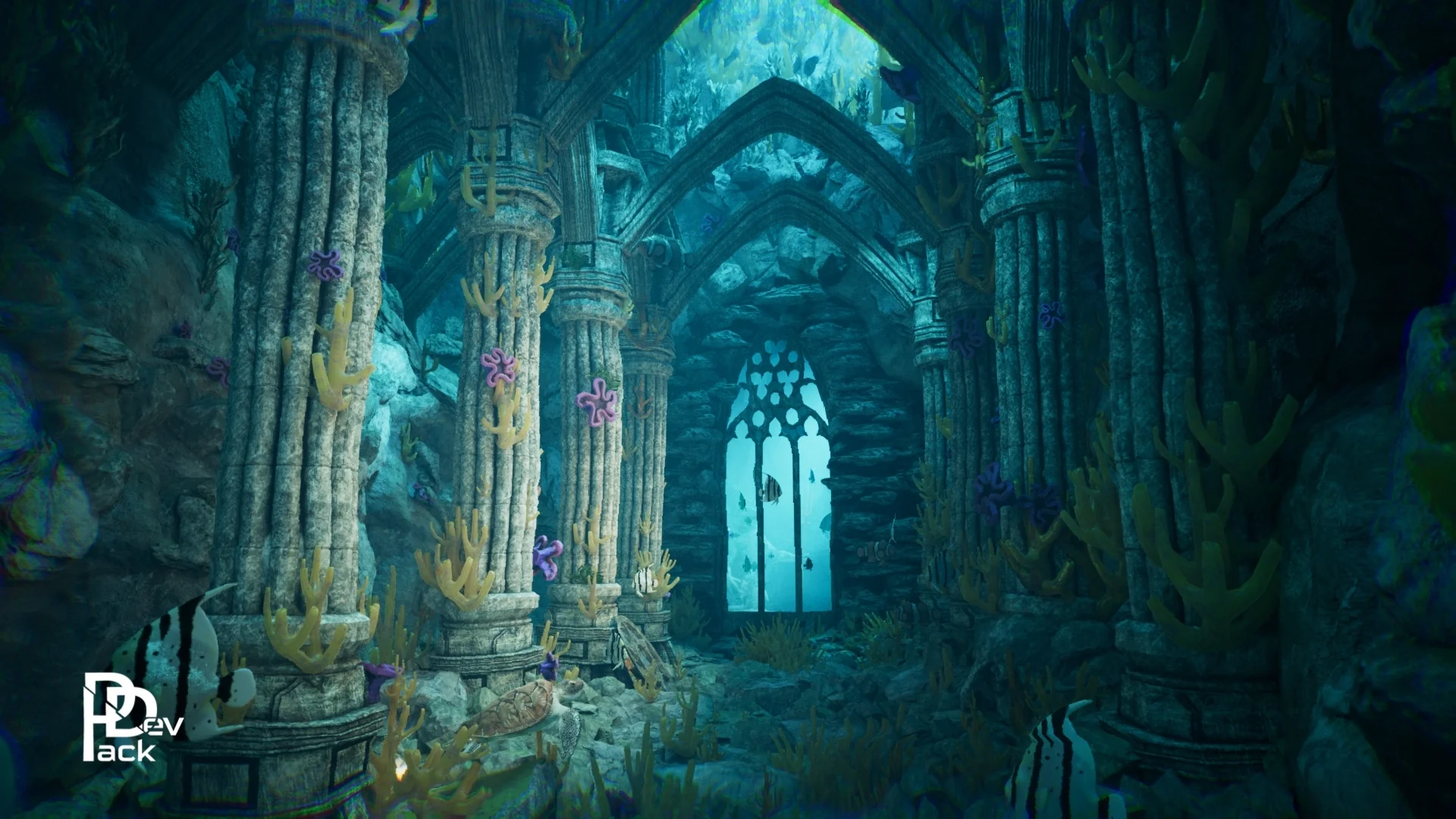
The Atlantis Ruins collection gathers 37 modular and decorative assets designed to construct submerged environments within a dedicated PBR pipeline. Tailored to represent an ancient civilization submerged beneath the sea, the pack balances photorealistic fidelity with lowpoly performance. By uniting structural masonry such as modular walls, window pieces, and structural pillars with organic marine elements like coral growths and sculpted statues, the package provides the building blocks needed to lay out underwater ocean levels. Whether configured as compact sunken chambers or expansive seabed ruins, these assets bridge structural architectural design and environmental decay, offering assets that adapt to both high-end AAA productions and performance-constrained real-time projects.
Assembling Sunken Architecture with Atlantis Modular Components
Modular level design underpins the construction of ancient underwater architecture. The architectural elements in this 37-asset kit rely on standardized proportions across wall sections, window openings, and support pillars. Modular wall pieces establish the primary boundaries of submerged chambers, ceremonial halls, corridors, and exterior courtyards. Because these wall segments are designed to snap and align across consistent grids, designers can assemble layouts of varying heights and footprints without relying on one-off bespoke architectural meshes.
Integrated window segments introduce structural variation into extended wall runs. These apertures provide framing for ocean vistas, allowing players to look out into deep water, rocky trenches, or adjoining courtyards. From an environmental storytelling standpoint, window segments allow external marine surroundings to interact visually with interior spaces. Load-bearing pillars provide vertical presence, defining vaulted halls, temple colonnades, and perimeter walkways. Intact pillars reinforce the monumental scale characteristic of ancient monumental architecture, while fractured or toppled variations serve as ruined props that show centuries of collapse. The cohesion among walls, windows, and pillars allows for the rapid staging of multi-level underwater architecture that retains architectural consistency across varied room layouts.
Detailing Ancient Ruins with Weathered Statues and Coral Formations
Sunken architecture submerged within an ocean environment naturally reflects both cultural heritage and biological takeover. Within this kit, sculpted statues introduce figurative art into the angular, modular stone surfaces. These statues act as monumental focal points, ideal for placement in central shrines, temple apses, grand entryways, or scattered as toppled relics across the seabed floor. Their presence immediately signals the identity of an ancient culture, turning generic stone chambers into intentional cultural ruins. The surfaces of these statues display the physical erosion expected from prolonged exposure to salt water and ocean currents.
To contrast with the carved masonry, the kit integrates organic coral formations that cluster against stone faces. In genuine marine environments, man-made masonry quickly transforms into artificial reefs, and the inclusion of coral models allows level designers to mirror this process directly. Coral clusters can be dressed around the plinths of statues, rooted into cracks along modular walls, or wrapped across collapsed pillar segments. This dynamic pairing between rigid architectural lines and flourishing sea growth creates environmental authenticity. The organic silhouettes of the coral break up repetitive geometric seams, anchoring the ancient ruins firmly into their underwater ecosystem.
PBR Material Workflow and Lowpoly Assets Optimization
The collection is authored entirely within a physically based rendering framework, ensuring that surface properties respond accurately under changing light conditions. Subaquatic settings demand careful handling of material values, as water absorbs, scatters, and alters how light interacts with stone and organic matter. The PBR maps for these 37 assets convey the dampness, calcification, mineral staining, and micro-surface textures typical of submerged rock and marine sediment. Surface roughness and albedo maps are calibrated to prevent overly reflective or unnaturally dull surfaces, maintaining believable photorealistic qualities whether illuminated by caustic reflections or soft ambient ocean glow.
Despite this photorealistic surface fidelity, the geometry of each model remains strictly lowpoly. Managing polygon density is critical in underwater scenes, where real-time rendering budgets are frequently consumed by volumetric fog passes, underwater post-processing, light scattering, and particle effects. The optimized lowpoly topology ensures that the assets can be instanced across broad levels without causing vertex bottlenecks or degrading frame rate stability. This balance between high-end visual output and strict lowpoly optimization makes the assets viable for AAA-quality visual benchmarks as well as performance-focused, optimized game projects that operate within tight hardware limitations.
Illuminating Underwater Ruins with Dynamic Lumen Lighting
Lighting an underwater level introduces intricate illumination challenges, particularly when using dynamic global illumination systems such as Lumen. Light filtering down from the ocean surface softens rapidly as it penetrates the water column, scattering into indirect bounce that fills submerged spaces. The assets in this collection are built to support clean indirect lighting bounces under dynamic Lumen lighting. Clean geometric topology and accurate normal information ensure that diffuse light bounces naturally off stone walls, pillar shafts, and floor planes without generating noisy indirect artifacts or irregular shading seams.
Window openings and collapsed ceiling structures play a direct role in underwater lighting setups. By incorporating open window frames into wall assemblies, designers enable directional light shafts and caustic projections to pass into interior chambers, illuminating statues and coral growths resting inside. Indirect light then rebounds off the weathered stone surfaces, providing soft, ambient fill into darkened corners and recessed alcoves. Because the PBR materials feature realistic albedo values, indirect illumination retains appropriate bounce color without over-brightening enclosed spaces or failing to register in shadowed areas. This compatibility with dynamic lighting workflows gives level artists reliable visual consistency across deep marine environments.
Constructing Level Environments Across Deep Ocean Settings
Deploying this 37-asset kit across a project allows level artists to build diverse aquatic scenarios, from focused interior underwater crypts to vast, open-sea ruins scattered across continental shelves. The modular nature of the walls, pillars, and window elements supports rapid level layout, allowing designers to block out traversal paths, secret underwater passages, or wide ceremonial courtyards with equal ease. The inclusion of decorative statues and organic coral props enables continuous visual pacing, breaking up long navigational corridors with distinct points of visual interest.
Because every asset shares a unified PBR material treatment and an ancient, ruined visual identity, individual components can be combined and reconfigured repeatedly without breaking world coherence. Level creators can dress fallen pillars alongside modular walls to represent sudden seismic destruction, or position intact columns and statues in sheltered grottos that appear preserved from ocean currents. Combining modular efficiency with lowpoly optimization ensures that whether an environment is suited to quiet exploration, underwater action, or narrative cinematic sequences, the scene remains visually photorealistic, performant, and structurally cohesive.
 Historical
 Historical
 Historical