"6ac84fdb0bd06614"{"id":"1001226","slug":"advanced-locomotion-system-v4","title":"Advanced Locomotion System V4","category":"Action-Adventure","engine":"5.0+","assetVersion":"","engineVersion":"Engine Version: 5.0+","tag":"Action-Adventure","accent":"blue","visual":"animation","summary":"Technical breakdown of Advanced Locomotion System V4 for Unreal Engine 4, covering curve-driven movement, layered AnimBP logic, and dynamic mantling.","platform":"Unreal Engine","publishedAt":"2026-09-21T03:20:36.125Z","updatedAt":"2026-09-21T03:20:36.125Z","sourceNotes":[],"fileContents":[],"compatibility":["Unreal Engine","Engine Version: 5.0+"],"featuredImage":{"alt":"Advanced Locomotion System V4","src":"/wp-content/uploads/published/2026/09/51c36ad1f441-ab404707-41ee-416b-828a-8d4b1f1bf80d-f9556d70e9.webp"},"hasDownloadLink":true,"downloads":0,"terms":[{"taxonomy":"category","slug":"action-adventure","name":"Action-Adventure"}],"galleryImages":[{"src":"/wp-content/uploads/published/2026/09/a1dbc48af575-2516294e-c4e7-4791-b3bb-89db3dcc4fed-005fa61d53.webp","alt":"Advanced Locomotion System V4"},{"src":"/wp-content/uploads/published/2026/09/61fb84e1f3ef-7d2f7309-7c47-4f01-921c-bf16daf65319-bae81a7ae1.webp","alt":"Advanced Locomotion System V4"},{"src":"/wp-content/uploads/published/2026/09/03dbfdd567c7-dbc9790a-9429-4dc7-b834-d810268b8a23-f6d64cfc75.webp","alt":"Advanced Locomotion System V4"},{"src":"/wp-content/uploads/published/2026/09/3c99c34d0443-7889ec0f-5741-4ed8-9a23-5bedf0ef114d-e177c0649b.webp","alt":"Advanced Locomotion System V4"},{"src":"/wp-content/uploads/published/2026/09/9d7d6d0a613c-3663e86a-c6a8-4b5c-bf0e-36bf8de6acb0-1ee944b38b.webp","alt":"Advanced Locomotion System V4"},{"src":"/wp-content/uploads/published/2026/09/cf739bcef2c5-d17f1fcd-239f-4fa5-8f07-45dae0b189ad-6e8d13847f.webp","alt":"Advanced Locomotion System V4"},{"src":"/wp-content/uploads/published/2026/09/56c6ec08fe7f-c4c4d52d-dd85-4994-811e-88ca82bf1d0c-5238f541d7.webp","alt":"Advanced Locomotion System V4"},{"src":"/wp-content/uploads/published/2026/09/2792aea33d1a-76527f9e-c7d2-479f-aac2-be9110272669-2c23f3b169.webp","alt":"Advanced Locomotion System V4"},{"src":"/wp-content/uploads/published/2026/09/5d20fdf90df0-f97400ed-635c-4b2a-a2a2-e7c0f110d312-d57013937b.webp","alt":"Advanced Locomotion System V4"},{"src":"/wp-content/uploads/published/2026/09/c5d01c97302d-c62ae16f-48d5-47e8-8869-0edc76744fa2-336e180995.webp","alt":"Advanced Locomotion System V4"}],"accessPanel":{"kind":"resource","title":"Download this resource","eyebrow":"Free Download","message":"Log in or create a free account to start your download.","fileName":"Content.7z","safetyNote":"Resources are manually reviewed before listing to improve quality and reduce obvious risks.","actionLabel":"Download Free","resourceType":"Resource archive"},"contentHtml":"\u003cp\u003eA character navigating terrain through Advanced Locomotion System V4 exhibits fluid, continuous momentum governed by procedural calculations and timing curves rather than pre-baked displacement tracks. Standard movement across ground surfaces operates without root motion. Instead, code execution dictates position, momentum, and direction updates in real time, leaving rolling as the solitary action handled through root motion displacement. This architectural split changes how a character reacts to input, maintaining immediate responsiveness at the controller level while feeding precise kinematic data directly into the animation pipeline.\u003c/p\u003e \u003cp\u003eImplementing this framework requires deliberate technical investment. It is not designed as a plug-and-play solution, and working within its node graphs presents immediate friction for developers unfamiliar with Unreal Engine 4. The asset expects an established understanding of technical animation logic, blueprint communication, and state evaluation before any adjustments to character behaviors or gameplay extensions can be made safely.\u003c/p\u003e \u003ch2\u003eCurve-Driven Movement Inside the Base_Character Blueprint\u003c/h2\u003e \u003cp\u003eAt the center of character execution rests the Base_Character blueprint. This core blueprint handles positional updates, input translation, and physical presence using a curve-driven logic structure. Curves handle transitions between movement speeds, acceleration curves, and rotational targets. Because the character relies on code-driven execution for running, walking, stopping, and turning, movement states do not suffer from the synchronization drifting often encountered when blending arbitrary root motion clips.\u003c/p\u003e \u003cp\u003eThe code-driven rotational model updates the character mesh orientation in alignment with movement states, input vectors, and gaze targets. Directional shifts respond dynamically to instantaneous acceleration values. Because curves govern the interpolation curves for velocity and rotational rate, movement stops, starts, and sharp reversals preserve physical weight. The framework allows adjustments to velocity boundaries and responsiveness curves straight within the blueprint logic, establishing a predictable bridge between raw input and physical displacement.\u003c/p\u003e \u003ch2\u003eData-Driven AnimBP Layering and Locomotion Features\u003c/h2\u003e \u003cp\u003eAnimation processing is driven by a data-driven animation blueprint structured around an extensive layering system. Traditional animation pipelines frequently rely on separate, isolated state transitions and vast animation asset libraries to support different movement states. Here, the system isolates movement mechanics into logical layers, enabling character variation and gameplay states to be introduced without generating huge libraries of bespoke animation assets.\u003c/p\u003e \u003cp\u003eLocomotion blending uses runtime data parameters to mix basic poses, strides, and directional shifts cleanly. Within this data-driven structure, several specialized procedural sub-features refine character poses:\u003c/p\u003e \u003cul\u003e \u003cli\u003e\u003cstrong\u003eAdditive leaning:\u003c/strong\u003e Applies procedural lean offsets across the character spine in direct response to acceleration, deceleration, and rotational velocity changes.\u003c/li\u003e \u003cli\u003e\u003cstrong\u003eSprint impulse:\u003c/strong\u003e Triggers physical push-off and transition curves to visually ground acceleration when shifting into high-velocity movement.\u003c/li\u003e \u003cli\u003e\u003cstrong\u003eLand prediction:\u003c/strong\u003e Traces the downward trajectory before impact, blending anticipatory compression poses prior to touching the surface.\u003c/li\u003e \u003cli\u003e\u003cstrong\u003eTurn and rotate in place:\u003c/strong\u003e Evaluates look angles against current actor rotation, firing precise curve-driven turn sequences when view angles exceed set limits while standing stationary.\u003c/li\u003e \u003cli\u003e\u003cstrong\u003eFoot IK:\u003c/strong\u003e Adjusts leg bones and foot angles against uneven collision geometry using inverse kinematics, maintaining realistic contact with non-flat terrain.\u003c/li\u003e\n\u003c/ul\u003e \u003cp\u003eThese sub-systems operate in concert through the layered animation graph, evaluating continuously to stack fine procedural details atop foundational movement clips.\u003c/p\u003e \u003ch2\u003eDynamic Mantling Geometry Tracing and Curve Alignment\u003c/h2\u003e \u003cp\u003eTraversing obstacles relies on a fully dynamic mantling system built without fixed placement markers or hand-placed climbing volumes. When approaching an obstacle, the character fires simple collision traces outward and downward to detect ledge geometry, surface clearance, and step heights. If the traced environment satisfies the mantling conditions, the system initiates the climb dynamically regardless of whether the target object is a simple box, an uneven wall, or a piece of industrial geometry.\u003c/p\u003e \u003cp\u003eSmooth spatial translation during the mantle is calculated using curve assets. Rather than playing a static climbing montage that might clip into high ledges or hover above low perches, the system samples alignment curves to interpolate both location and rotation from the character's initial contact point up to the final resting surface. This balance of simple trace checks and curve-driven positioning ensures transitions onto diverse geometry remain physically aligned and visually stable throughout the entire climb.\u003c/p\u003e \u003ch2\u003eExperimental Camera State Machines and Seamless Ragdoll Blending\u003c/h2\u003e \u003cp\u003eBeyond locomotion and environmental traversal, the framework incorporates secondary utilities designed to extend character presentation. An experimental camera system relies on an animation instance to tap directly into state machine functionality. By utilizing animation states, blending graphs, and animation curves to drive camera offsets, field of view, and tracking lag, the system achieves fine-grained camera adjustments without requiring separate hardcoded camera manager logic for every gameplay context.\u003c/p\u003e \u003cp\u003ePhysics interactions include a functional ragdoll blending pipeline. When transitioning into a ragdoll state, the character transfers control from kinematic bone transforms to active physical simulation. The recovery logic facilitates seamless blending directly back from ragdoll physics into active locomotion states, bridging the simulated ragdoll pose smoothly back into the animation graph when the character stands up.\u003c/p\u003e \u003ch2\u003eBlueprint Competency and Unreal Engine Technical Demands\u003c/h2\u003e \u003cp\u003eThe operational depth of Advanced Locomotion System V4 requires deliberate planning before integration into active projects. Because logic is distributed across complex blueprint graphs, animation state machines, math nodes, and curve evaluations, altering base functionality demands familiarity with how Unreal Engine 4 handles character movement components and pose layering. Developers attempting to drop the system into a project without understanding these underlying mechanics will face significant configuration challenges.\u003c/p\u003e \u003cp\u003eFor development teams possessing the required foundation in blueprints and animation graphs, the framework offers an organized baseline. It removes the necessity of assembling curve-driven movement, dynamic ledge mantling, predictive landing, and layered locomotion graphs from scratch, providing a structured blueprint architecture that unifies movement code and animation execution.\u003c/p\u003e\n\n\u003ch2\u003eContinue Browsing Similar Packs\u003c/h2\u003e\n\u003cul\u003e\n\u003cli\u003e\u003ca href=\"https://3dcghub.com/hyper-multiplayer-survival-template-pro-mst-v4/\" title=\"Hyper Multiplayer Survival Template Pro [MST] V4\"\u003eHyper Multiplayer Survival Template Pro [MST] V4\u003c/a\u003e\u003c/li\u003e\n\u003cli\u003e\u003ca href=\"https://3dcghub.com/hyper-multiplayer-survival-template-plus-mst-v4/\" title=\"Hyper Multiplayer Survival Template Plus [MST] v4\"\u003eHyper Multiplayer Survival Template Plus [MST] v4\u003c/a\u003e\u003c/li\u003e\n\u003cli\u003e\u003ca href=\"https://3dcghub.com/asc-teuthisan/\" title=\"ASC Teuthisan\"\u003eASC Teuthisan\u003c/a\u003e\u003c/li\u003e\n\u003cli\u003e\u003ca href=\"https://3dcghub.com/platformer-template-2-5d-kit/\" title=\"Platformer Template - 2.5D Kit\"\u003ePlatformer Template - 2.5D Kit\u003c/a\u003e\u003c/li\u003e\n\u003cli\u003e\u003ca href=\"https://3dcghub.com/point-and-click-adventure-toolkit/\" title=\"Point and Click Adventure Toolkit\"\u003ePoint and Click Adventure Toolkit\u003c/a\u003e\u003c/li\u003e\n\u003c/ul\u003e","contentTextLength":7172,"navigation":{"current":13,"total":3181,"previous":{"id":"1001227","slug":"animation-ecosystem-for-game-development","title":"Animation Ecosystem for Game Development","category":"Action-Adventure","platform":"Unreal Engine","updatedAt":"2026-09-21T03:23:50.196Z"},"next":{"id":"1001225","slug":"asc-teuthisan","title":"ASC Teuthisan","category":"Action-Adventure","platform":"Unreal Engine","updatedAt":"2026-09-21T03:17:46.654Z"}},"relatedResources":[{"id":"1001152","slug":"hyper-multiplayer-survival-template-pro-mst-v4","title":"Hyper Multiplayer Survival Template Pro [MST] V4","category":"Action-Adventure","engine":"5.3+","assetVersion":"","engineVersion":"Engine Version: 5.3+","tag":"Action-Adventure","accent":"blue","visual":"mech","summary":"Explore Hyper Multiplayer Survival Template Pro [MST] V4, a fully replicated Unreal Engine framework for open-world, co-op PvE, and survival projects.","platform":"Unreal Engine","publishedAt":"2026-09-10T17:56:18.119Z","updatedAt":"2026-09-10T17:56:18.119Z","sourceNotes":[],"fileContents":[],"compatibility":["Unreal Engine","Engine Version: 5.3+"],"featuredImage":{"alt":"Hyper Multiplayer Survival Template Pro [MST] V4","src":"/wp-content/uploads/published/2026/09/6060550226b8-0f2946eb-0653-4ed7-a160-e35859e9e5e9-61232ad933.webp"},"hasDownloadLink":true,"downloads":1},{"id":"1001151","slug":"hyper-multiplayer-survival-template-plus-mst-v4","title":"Hyper Multiplayer Survival Template Plus [MST] v4","category":"Action-Adventure","engine":"5.4+","assetVersion":"","engineVersion":"Engine Version: 5.4+","tag":"Action-Adventure","accent":"blue","visual":"mech","summary":"Explore Hyper Multiplayer Survival Template Plus v4, featuring replicated base building, landscape tools, inventory, crafting, and modular Unreal Engine systems","platform":"Unreal Engine","publishedAt":"2026-09-10T15:52:12.318Z","updatedAt":"2026-09-10T15:52:12.318Z","sourceNotes":[],"fileContents":[],"compatibility":["Unreal Engine","Engine Version: 5.4+"],"featuredImage":{"alt":"Hyper Multiplayer Survival Template Plus [MST] v4","src":"/wp-content/uploads/published/2026/09/6998f3fa0308-de2368c5-543b-49ea-adad-ee13b3d478ed-563273f35a.webp"},"hasDownloadLink":true,"downloads":1},{"id":"1001236","slug":"easy-locomotion-toolkit","title":"Easy Locomotion Toolkit","category":"Action-Adventure","engine":"5.0+","assetVersion":"","engineVersion":"Engine Version: 5.0+","tag":"Action-Adventure","accent":"blue","visual":"animation","summary":"A component-based Unreal Engine framework featuring modular locomotion calculations, datatable animset swapping, and structure-driven replication.","platform":"Unreal Engine","publishedAt":"2026-09-21T03:46:32.498Z","updatedAt":"2026-09-21T03:46:32.498Z","sourceNotes":[],"fileContents":[],"compatibility":["Unreal Engine","Engine Version: 5.0+"],"featuredImage":{"alt":"Easy Locomotion Toolkit","src":"/wp-content/uploads/published/2026/09/1c39ce837155-999607d8-b0a8-4400-a6a4-e5ddd2c06569-2ec6a33aef.webp"},"hasDownloadLink":true,"downloads":0}]}
Action-Adventure
Advanced Locomotion System V4
Technical breakdown of Advanced Locomotion System V4 for Unreal Engine 4, covering curve-driven movement, layered AnimBP logic, and dynamic mantling.
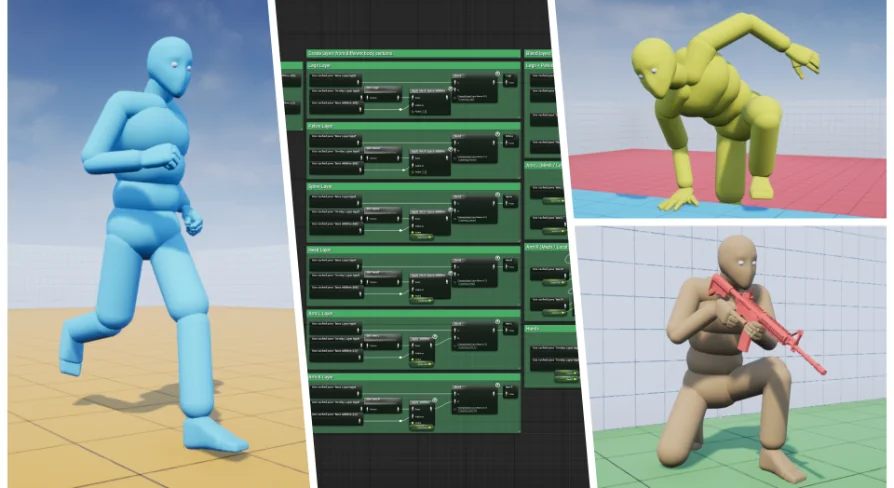
A character navigating terrain through Advanced Locomotion System V4 exhibits fluid, continuous momentum governed by procedural calculations and timing curves rather than pre-baked displacement tracks. Standard movement across ground surfaces operates without root motion. Instead, code execution dictates position, momentum, and direction updates in real time, leaving rolling as the solitary action handled through root motion displacement. This architectural split changes how a character reacts to input, maintaining immediate responsiveness at the controller level while feeding precise kinematic data directly into the animation pipeline.
Implementing this framework requires deliberate technical investment. It is not designed as a plug-and-play solution, and working within its node graphs presents immediate friction for developers unfamiliar with Unreal Engine 4. The asset expects an established understanding of technical animation logic, blueprint communication, and state evaluation before any adjustments to character behaviors or gameplay extensions can be made safely.
Curve-Driven Movement Inside the Base_Character Blueprint
At the center of character execution rests the Base_Character blueprint. This core blueprint handles positional updates, input translation, and physical presence using a curve-driven logic structure. Curves handle transitions between movement speeds, acceleration curves, and rotational targets. Because the character relies on code-driven execution for running, walking, stopping, and turning, movement states do not suffer from the synchronization drifting often encountered when blending arbitrary root motion clips.
The code-driven rotational model updates the character mesh orientation in alignment with movement states, input vectors, and gaze targets. Directional shifts respond dynamically to instantaneous acceleration values. Because curves govern the interpolation curves for velocity and rotational rate, movement stops, starts, and sharp reversals preserve physical weight. The framework allows adjustments to velocity boundaries and responsiveness curves straight within the blueprint logic, establishing a predictable bridge between raw input and physical displacement.
Data-Driven AnimBP Layering and Locomotion Features
Animation processing is driven by a data-driven animation blueprint structured around an extensive layering system. Traditional animation pipelines frequently rely on separate, isolated state transitions and vast animation asset libraries to support different movement states. Here, the system isolates movement mechanics into logical layers, enabling character variation and gameplay states to be introduced without generating huge libraries of bespoke animation assets.
Locomotion blending uses runtime data parameters to mix basic poses, strides, and directional shifts cleanly. Within this data-driven structure, several specialized procedural sub-features refine character poses:
Additive leaning: Applies procedural lean offsets across the character spine in direct response to acceleration, deceleration, and rotational velocity changes.
Sprint impulse: Triggers physical push-off and transition curves to visually ground acceleration when shifting into high-velocity movement.
Land prediction: Traces the downward trajectory before impact, blending anticipatory compression poses prior to touching the surface.
Turn and rotate in place: Evaluates look angles against current actor rotation, firing precise curve-driven turn sequences when view angles exceed set limits while standing stationary.
Foot IK: Adjusts leg bones and foot angles against uneven collision geometry using inverse kinematics, maintaining realistic contact with non-flat terrain.
These sub-systems operate in concert through the layered animation graph, evaluating continuously to stack fine procedural details atop foundational movement clips.
Dynamic Mantling Geometry Tracing and Curve Alignment
Traversing obstacles relies on a fully dynamic mantling system built without fixed placement markers or hand-placed climbing volumes. When approaching an obstacle, the character fires simple collision traces outward and downward to detect ledge geometry, surface clearance, and step heights. If the traced environment satisfies the mantling conditions, the system initiates the climb dynamically regardless of whether the target object is a simple box, an uneven wall, or a piece of industrial geometry.
Smooth spatial translation during the mantle is calculated using curve assets. Rather than playing a static climbing montage that might clip into high ledges or hover above low perches, the system samples alignment curves to interpolate both location and rotation from the character's initial contact point up to the final resting surface. This balance of simple trace checks and curve-driven positioning ensures transitions onto diverse geometry remain physically aligned and visually stable throughout the entire climb.
Experimental Camera State Machines and Seamless Ragdoll Blending
Beyond locomotion and environmental traversal, the framework incorporates secondary utilities designed to extend character presentation. An experimental camera system relies on an animation instance to tap directly into state machine functionality. By utilizing animation states, blending graphs, and animation curves to drive camera offsets, field of view, and tracking lag, the system achieves fine-grained camera adjustments without requiring separate hardcoded camera manager logic for every gameplay context.
Physics interactions include a functional ragdoll blending pipeline. When transitioning into a ragdoll state, the character transfers control from kinematic bone transforms to active physical simulation. The recovery logic facilitates seamless blending directly back from ragdoll physics into active locomotion states, bridging the simulated ragdoll pose smoothly back into the animation graph when the character stands up.
Blueprint Competency and Unreal Engine Technical Demands
The operational depth of Advanced Locomotion System V4 requires deliberate planning before integration into active projects. Because logic is distributed across complex blueprint graphs, animation state machines, math nodes, and curve evaluations, altering base functionality demands familiarity with how Unreal Engine 4 handles character movement components and pose layering. Developers attempting to drop the system into a project without understanding these underlying mechanics will face significant configuration challenges.
For development teams possessing the required foundation in blueprints and animation graphs, the framework offers an organized baseline. It removes the necessity of assembling curve-driven movement, dynamic ledge mantling, predictive landing, and layered locomotion graphs from scratch, providing a structured blueprint architecture that unifies movement code and animation execution.
 Action-Adventure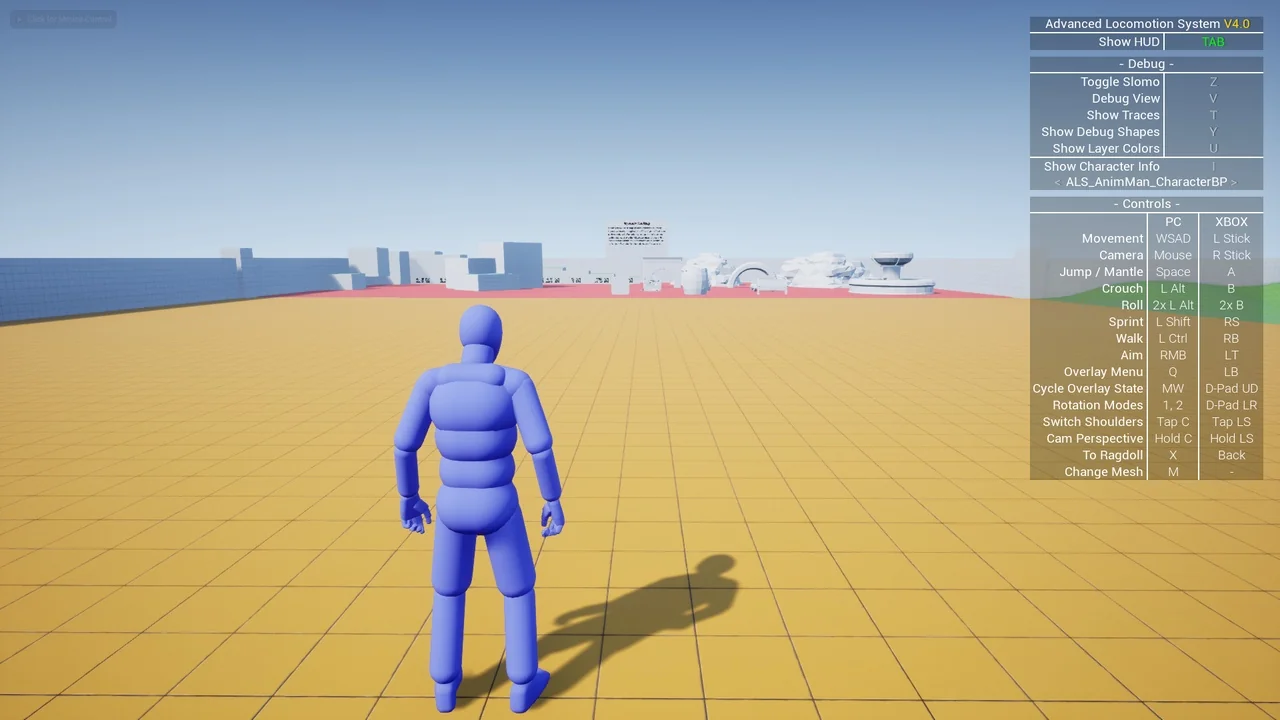
![Hyper Multiplayer Survival Template Pro [MST] V4](/wp-content/uploads/published/2026/09/6060550226b8-0f2946eb-0653-4ed7-a160-e35859e9e5e9-61232ad933.webp) Action-Adventure
Action-Adventure![Hyper Multiplayer Survival Template Plus [MST] v4](/wp-content/uploads/published/2026/09/6998f3fa0308-de2368c5-543b-49ea-adad-ee13b3d478ed-563273f35a.webp) Action-Adventure
Action-Adventure Action-Adventure