"86b16d92241b24ea"{"id":"1002689","slug":"2-in-1-nanite-environment-bundle-1","title":"2 in 1 Nanite Environment Bundle 1","category":"Mountain","engine":"5.3+","assetVersion":"","engineVersion":"Engine Version: 5.3+","tag":"Mountain","accent":"blue","visual":"city","summary":"Explore the 2 in 1 Nanite Environment Bundle 1, featuring high-poly Nanite natural foliage, volcanic terrain, Alembic lava, and VDB smoke for Unreal Engine.","platform":"Unreal Engine","indexPolicy":"index","publishedAt":"2026-11-17T18:10:46.912Z","updatedAt":"2026-11-17T18:10:46.912Z","sourceNotes":[],"fileContents":[],"compatibility":["Unreal Engine","Engine Version: 5.3+"],"featuredImage":{"alt":"2 in 1 Nanite Environment Bundle 1","src":"/wp-content/uploads/published/2026/11/742187bb2ca2-cbf83677-a4d9-47a6-bf93-2ec5648775b9-a64c51bd7d.webp"},"hasDownloadLink":true,"downloads":0,"terms":[{"taxonomy":"category","slug":"mountain","name":"Mountain"}],"galleryImages":[{"src":"/wp-content/uploads/published/2026/11/1d30fb70faa5-c3a378d0-6489-429d-a822-894b741a7e46-64dbd15dcb.webp","alt":"2 in 1 Nanite Environment Bundle 1"},{"src":"/wp-content/uploads/published/2026/11/662a86a0c485-ecc758b0-209f-4d84-aa92-460ab39b00a6-dcaf535f78.webp","alt":"2 in 1 Nanite Environment Bundle 1"},{"src":"/wp-content/uploads/published/2026/11/fd43d104eaaf-2e3588b1-b576-4bb0-b28a-629da89ace86-627f0c8e4c.webp","alt":"2 in 1 Nanite Environment Bundle 1"},{"src":"/wp-content/uploads/published/2026/11/9c954b09240f-1222cd32-0586-4a53-915e-1937a4d45469-1f0e30c31c.webp","alt":"2 in 1 Nanite Environment Bundle 1"},{"src":"/wp-content/uploads/published/2026/11/39b22a472754-9143f33f-d4c4-41a9-a1d3-38e3db9c0aa8-53df6c3a33.webp","alt":"2 in 1 Nanite Environment Bundle 1"},{"src":"/wp-content/uploads/published/2026/11/215fc21ce9f7-e09c0f98-a19b-4c10-9f66-395e0eda5de9-0808e557ab.webp","alt":"2 in 1 Nanite Environment Bundle 1"},{"src":"/wp-content/uploads/published/2026/11/025bd03179b1-285c7473-d7f1-472f-be4f-58fb61c90359-8c2706738c.webp","alt":"2 in 1 Nanite Environment Bundle 1"},{"src":"/wp-content/uploads/published/2026/11/d0bd777743fc-ed86e4df-dbe1-4f41-99b3-3bf306c30e44-7ebfefed8b.webp","alt":"2 in 1 Nanite Environment Bundle 1"},{"src":"/wp-content/uploads/published/2026/11/1cc5769a6b5e-f8aec992-eef1-47ea-b1ac-400908d627fb-5d6d3705dc.webp","alt":"2 in 1 Nanite Environment Bundle 1"},{"src":"/wp-content/uploads/published/2026/11/7e5ca2ef29bc-a55bb65a-9011-4888-8a5d-e011ffa9da3a-86d2c9ba8e.webp","alt":"2 in 1 Nanite Environment Bundle 1"}],"accessPanel":{"kind":"resource","title":"Get this resource","safetyNote":"Resources are manually reviewed before listing to improve quality and reduce obvious risks.","fileName":"Content.7z","resourceType":"Resource archive","versions":[]},"contentHtml":"\u003ch2\u003eConfiguring Nanite Meshes and High-Poly Terrain Pipelines\u003c/h2\u003e\n\u003cp\u003eIntegrating dense natural scenes into modern production starts with the deployment of high-fidelity geometry. Working with this package requires activating Unreal Engine 5's core virtualization systems to accommodate meshes sculpted with extreme geometric detail. Because the foliage and rock formations rely on high-poly Nanite technology, the engine handles geometry streaming automatically, removing traditional polygon budget restrictions from level assemblies.\u003c/p\u003e\n\u003cp\u003ePreparing a level begins by establishing a scene scale that supports both immediate foreground elements and distant vistas. When populating large maps, Nanite trees, bushes, and rock faces can be staged directly into the level viewport without manually generating simplified lower-detail variants. The underlying meshes are structured for projects that demand the highest detail levels achievable on current-generation hardware, targeting cinematic sequences, virtual production backdrops, and high-end game development.\u003c/p\u003e \u003ch2\u003eConstructing Lush Biomes with the 2 in 1 Nanite Environment Assets\u003c/h2\u003e\n\u003cp\u003eThe first primary component of the collection focuses on lush wilderness and dense natural scenery. This portion provides a full complement of organic assets intended to form complete outdoor locations:\u003c/p\u003e\n\u003cul\u003e\n\u003cli\u003eHigh-poly Nanite trees designed to hold structural clarity at both camera-facing distances and broad horizon scales.\u003c/li\u003e\n\u003cli\u003eUndergrowth vegetation, including multiple varieties of grass and dense bushes that integrate across uneven ground.\u003c/li\u003e\n\u003cli\u003eRugged rock formations and vertical cliff structures that anchor steep hillsides or forest clearings.\u003c/li\u003e\n\u003cli\u003eExpansive distant mountains that establish background depth for expansive landscape compositions.\u003c/li\u003e\n\u003c/ul\u003e\n\u003cp\u003eAssembling these components allows creators to construct layered temperate or jungle environments. Setting up a level typically starts with placing the distant mountain ranges to define the perimeter of the horizon. From there, massive cliff meshes create topographical breaks, valleys, and riverbeds. Ground surfaces are dressed with high-poly rock clusters, while dense carpets of grass and clusters of bushes break up soil lines. Placing hero trees along primary viewing angles completes the natural canopy, generating rich light occlusion through the canopy overhead.\u003c/p\u003e \u003ch2\u003eDeploying Volcanic Landscapes and Rugged Formations\u003c/h2\u003e\n\u003cp\u003eThe companion half of the package shifts away from vibrant flora toward severe, scorched geology. Designed to build dramatic volcanic regions, hellish expanses, and fire-scorched peaks, this set provides a broad array of craggy landforms:\u003c/p\u003e\n\u003cul\u003e\n\u003cli\u003eDetailed volcanic peaks and craters that shape active or dormant eruption sites.\u003c/li\u003e\n\u003cli\u003eSharp, jagged cliffs that exhibit harsh geological fracturing.\u003c/li\u003e\n\u003cli\u003eWeathered volcanic rocks and broken stone fragments for ground scattering.\u003c/li\u003e\n\u003cli\u003eSpecialized volcanic terrain formations structured to simulate cooled basalt flows and rugged ash fields.\u003c/li\u003e\n\u003c/ul\u003e\n\u003cp\u003eThese assets give level designers the pieces needed to shift a production from peaceful nature to hostile, unstable topographies. The geological assets can be aggregated to build steep volcanic calderas, narrow mountain passes surrounded by jagged stone, or barren badlands swept by smoke. Because these stone pieces also utilize the Nanite pipeline, their micro-surface textures and sharp fractures remain crisp even when the camera frames close macro details during cinematic shots.\u003c/p\u003e \u003ch2\u003eSimulating Volcanic Activity with Alembic Lava and VDB Volumes\u003c/h2\u003e\n\u003cp\u003eActive volcanic scenes require motion and volumetric density that static meshes cannot supply on their own. To address this, the volcanic components incorporate dynamic Alembic lava flows alongside OpenVDB eruption effects. These elements supply the intense fire, smoke, and molten material associated with live tectonic events.\u003c/p\u003e\n\u003cp\u003eThe dynamic lava is driven via pre-calculated Alembic geometry caches. Rather than relying on simple scrolling surface textures across flat geometry, the Alembic files capture changing fluid shapes as molten rock cascades down gullies and across terrain planes. Complementing the lava, VDB volumetric sequences provide rolling smoke plumes and eruption clouds rising from crater rims or fissured earth.\u003c/p\u003e\n\u003cp\u003eWorking with these dynamic formats requires an understanding of their underlying technical architecture:\u003c/p\u003e\n\u003cul\u003e\n\u003cli\u003eThe geometry caches and VDB volumetric effects are separate technologies, not Niagara particle systems.\u003c/li\u003e\n\u003cli\u003eBecause they do not run through real-time particle frameworks, these effects do not calculate dynamic collisions or interact with pawns, characters, or surrounding terrain props during gameplay.\u003c/li\u003e\n\u003cli\u003eAlembic caches play back fixed geometric transformations, ensuring predictable, repeatable animation loops for cinematics.\u003c/li\u003e\n\u003cli\u003eThe OpenVDB volumetric sequences require Unreal Engine 5.3 or higher to render natively inside the engine viewport.\u003c/li\u003e\n\u003c/ul\u003e \u003ch2\u003eLumen Illumination and Engine Compatibility Standards\u003c/h2\u003e\n\u003cp\u003eLighting high-density biomes and dark volcanic craters demands an active global illumination solution. The collection is engineered to leverage Lumen for Unreal Engine 5.1 and above. When Lumen is active, light bounces naturally through the intricate branches of Nanite trees and catches the rough edges of deep cliff crevices. In volcanic zones, emissive materials associated with molten flows project indirect lighting across the surrounding rock faces, casting harsh, high-contrast red and orange bounces into shadowy ravines.\u003c/p\u003e\n\u003cp\u003eTo deploy this collection successfully, projects must adhere to distinct engine threshold baselines:\u003c/p\u003e\n\u003cul\u003e\n\u003cli\u003eNanite mesh virtualization functions across Unreal Engine 5.1 and all newer updates.\u003c/li\u003e\n\u003cli\u003eLumen dynamic global illumination and reflections require Unreal Engine 5.1 or later.\u003c/li\u003e\n\u003cli\u003eThe OpenVDB atmospheric and eruption sequences strictly require Unreal Engine 5.3 or above to function.\u003c/li\u003e\n\u003c/ul\u003e\n\u003cp\u003eManaging rendering quality for VDB smoke and eruption plumes involves fine-tuning volumetric step sizes and lighting samples within the engine's post-process volumes and console variables. Balancing these settings ensures the smoke maintains realistic internal shadowing from the burning lava below while preserving interactive viewport framerates during shot staging.\u003c/p\u003e \u003ch2\u003eProduction Alignment and Scene Staging\u003c/h2\u003e\n\u003cp\u003eThe pairing of lush greenery with violent volcanic destruction offers rare flexibility across cinematics and high-fidelity world building. Storyboards transitioning from peaceful wilderness into active tectonic disaster zones can share an identical structural standard, maintaining uniform fidelity across differing biomes. Using pre-cached Alembic flows alongside static Nanite meshes ensures that cinematic artists achieve consistent visual behavior on every render frame without running unpredictable runtime simulations.\u003c/p\u003e\n\n\u003ch2\u003eExplore Similar Assets\u003c/h2\u003e\n\u003cul\u003e\n\u003cli\u003e\u003ca href=\"https://3dcghub.com/arctic-cliffs/\" rel=\"noopener noreferrer\"\u003eArctic Cliffs\u003c/a\u003e\u003c/li\u003e\n\u003cli\u003e\u003ca href=\"https://3dcghub.com/natural-wonders-mojave/\" rel=\"noopener noreferrer\"\u003eNatural Wonders - Mojave\u003c/a\u003e\u003c/li\u003e\n\u003cli\u003e\u003ca href=\"https://3dcghub.com/nanite-highland-hills/\" rel=\"noopener noreferrer\"\u003eNANITE HIGHLAND HILLS\u003c/a\u003e\u003c/li\u003e\n\u003cli\u003e\u003ca href=\"https://3dcghub.com/mountain-ancient-mountain-mount-shrine-mountain-environment/\" rel=\"noopener noreferrer\"\u003eMountain (Ancient Mountain, Mount, Shrine, Mountain Environment)\u003c/a\u003e\u003c/li\u003e\n\u003cli\u003e\u003ca href=\"https://3dcghub.com/environments-bundle-6-maps/\" rel=\"noopener noreferrer\"\u003eEnvironments Bundle 6 Maps\u003c/a\u003e\u003c/li\u003e\n\u003c/ul\u003e","contentTextLength":6927,"navigation":{"current":50,"total":4661,"previous":{"id":"1002690","slug":"scans-ruined-crypt","title":"[SCANS] Ruined Crypt","category":"Medieval","platform":"Unreal Engine","updatedAt":"2026-11-17T18:13:41.276Z"},"next":{"id":"1002688","slug":"scrubby-flatwoods-habitat-brush","title":"Scrubby Flatwoods Habitat Brush","category":"Forest \u0026 Jungle","platform":"Unreal Engine","updatedAt":"2026-11-16T22:45:18.155Z"}},"relatedResources":[{"id":"1001501","slug":"arctic-cliffs","title":"Arctic Cliffs","category":"Mountain","engine":"5.3+","assetVersion":"","engineVersion":"Engine Version: 5.3+","tag":"Mountain","accent":"blue","visual":"mech","summary":"Build polar environments in Unreal Engine 5 with Nanite ice meshes, RVT snow blending, SingleLayerWater ocean systems, and Niagara-driven buoyancy.","platform":"Unreal Engine","indexPolicy":"index","publishedAt":"2026-10-09T07:29:09.683Z","updatedAt":"2026-10-09T07:29:09.683Z","sourceNotes":[],"fileContents":[],"compatibility":["Unreal Engine","Engine Version: 5.3+"],"featuredImage":{"alt":"Arctic Cliffs","src":"/wp-content/uploads/published/2026/10/42bf47bcf18c-dd16f4ca-fe96-41a8-837d-7a75ea8cc396-28b685bba6.webp"},"fileSizeBytes":2642407159,"hasDownloadLink":true,"downloads":1},{"id":"1000435","slug":"natural-wonders-mojave","title":"Natural Wonders - Mojave","category":"Mountain","engine":"5.3+","assetVersion":"","engineVersion":"Engine Version: 5.3+","tag":"Mountain","accent":"blue","visual":"mech","summary":"Natural Wonders - Mojave delivers 25 Nanite desert terrain meshes with 4K textures, swappable cliff layers, and volumetric clouds for Unreal Engine 5.0–5.4.","platform":"Unreal Engine","indexPolicy":"index","publishedAt":"2026-07-10T22:18:48.473Z","updatedAt":"2026-07-10T22:18:48.473Z","sourceNotes":[],"fileContents":[],"compatibility":["Unreal Engine","Engine Version: 5.3+"],"featuredImage":{"alt":"Natural Wonders - Mojave","src":"/wp-content/uploads/published/2026/07/01b91fc21f7d-8749bf87-84b8-4ff9-a7ae-2475cb200c70-1e3b809673.webp"},"fileSizeBytes":3741053340,"hasDownloadLink":true,"downloads":2},{"id":"1000434","slug":"nanite-highland-hills","title":"NANITE HIGHLAND HILLS","category":"Mountain","engine":"5.2+","assetVersion":"","engineVersion":"Engine Version: 5.2+","tag":"Mountain","accent":"blue","visual":"mech","summary":"Nanite Highland Hills provides ten high-poly terrain meshes at roughly 15 million triangles each, built for Unreal Engine 5.2–5.8 Nanite workflows.","platform":"Unreal Engine","indexPolicy":"index","publishedAt":"2026-07-10T20:23:51.695Z","updatedAt":"2026-07-10T20:23:51.695Z","sourceNotes":[],"fileContents":[],"compatibility":["Unreal Engine","Engine Version: 5.2+"],"featuredImage":{"alt":"NANITE HIGHLAND HILLS","src":"/wp-content/uploads/published/2026/07/02bf7051df97-4bcc7d73-f73b-4526-8fe8-064ebd6a3195-240d795f24.webp"},"fileSizeBytes":5244798671,"hasDownloadLink":true,"downloads":2}]}
Resource screenshots
1 / 10
Join our channel
Follow 3DCGHUB on Telegram for new resource drops, migration updates, and community notices.
Configuring Nanite Meshes and High-Poly Terrain Pipelines
Integrating dense natural scenes into modern production starts with the deployment of high-fidelity geometry. Working with this package requires activating Unreal Engine 5's core virtualization systems to accommodate meshes sculpted with extreme geometric detail. Because the foliage and rock formations rely on high-poly Nanite technology, the engine handles geometry streaming automatically, removing traditional polygon budget restrictions from level assemblies.
Preparing a level begins by establishing a scene scale that supports both immediate foreground elements and distant vistas. When populating large maps, Nanite trees, bushes, and rock faces can be staged directly into the level viewport without manually generating simplified lower-detail variants. The underlying meshes are structured for projects that demand the highest detail levels achievable on current-generation hardware, targeting cinematic sequences, virtual production backdrops, and high-end game development.
Constructing Lush Biomes with the 2 in 1 Nanite Environment Assets
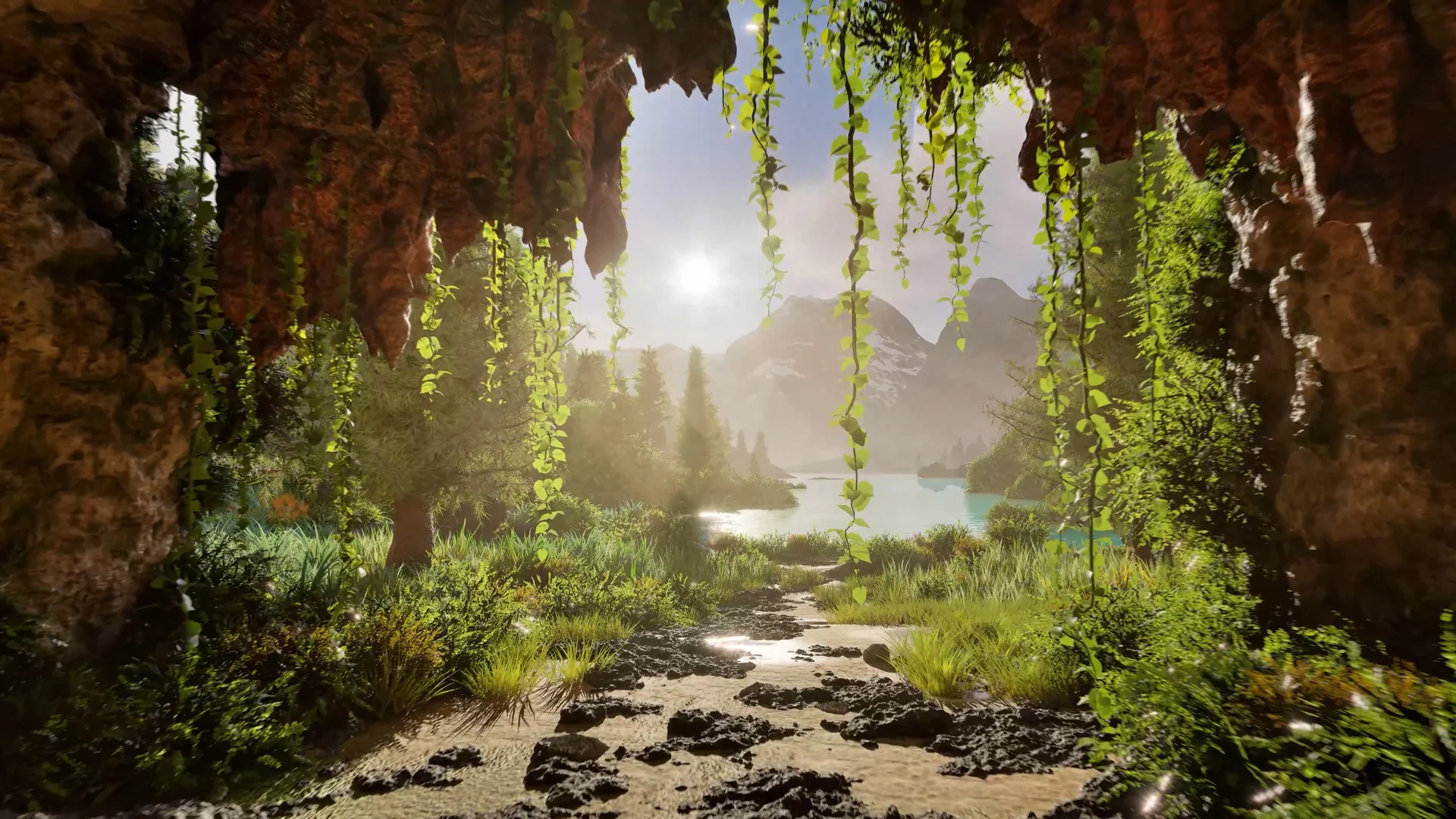
The first primary component of the collection focuses on lush wilderness and dense natural scenery. This portion provides a full complement of organic assets intended to form complete outdoor locations:
High-poly Nanite trees designed to hold structural clarity at both camera-facing distances and broad horizon scales.
Undergrowth vegetation, including multiple varieties of grass and dense bushes that integrate across uneven ground.
Rugged rock formations and vertical cliff structures that anchor steep hillsides or forest clearings.
Expansive distant mountains that establish background depth for expansive landscape compositions.
Assembling these components allows creators to construct layered temperate or jungle environments. Setting up a level typically starts with placing the distant mountain ranges to define the perimeter of the horizon. From there, massive cliff meshes create topographical breaks, valleys, and riverbeds. Ground surfaces are dressed with high-poly rock clusters, while dense carpets of grass and clusters of bushes break up soil lines. Placing hero trees along primary viewing angles completes the natural canopy, generating rich light occlusion through the canopy overhead.
Deploying Volcanic Landscapes and Rugged Formations
The companion half of the package shifts away from vibrant flora toward severe, scorched geology. Designed to build dramatic volcanic regions, hellish expanses, and fire-scorched peaks, this set provides a broad array of craggy landforms:
Detailed volcanic peaks and craters that shape active or dormant eruption sites.
Sharp, jagged cliffs that exhibit harsh geological fracturing.
Weathered volcanic rocks and broken stone fragments for ground scattering.
Specialized volcanic terrain formations structured to simulate cooled basalt flows and rugged ash fields.
These assets give level designers the pieces needed to shift a production from peaceful nature to hostile, unstable topographies. The geological assets can be aggregated to build steep volcanic calderas, narrow mountain passes surrounded by jagged stone, or barren badlands swept by smoke. Because these stone pieces also utilize the Nanite pipeline, their micro-surface textures and sharp fractures remain crisp even when the camera frames close macro details during cinematic shots.
Simulating Volcanic Activity with Alembic Lava and VDB Volumes
Active volcanic scenes require motion and volumetric density that static meshes cannot supply on their own. To address this, the volcanic components incorporate dynamic Alembic lava flows alongside OpenVDB eruption effects. These elements supply the intense fire, smoke, and molten material associated with live tectonic events.
The dynamic lava is driven via pre-calculated Alembic geometry caches. Rather than relying on simple scrolling surface textures across flat geometry, the Alembic files capture changing fluid shapes as molten rock cascades down gullies and across terrain planes. Complementing the lava, VDB volumetric sequences provide rolling smoke plumes and eruption clouds rising from crater rims or fissured earth.
Working with these dynamic formats requires an understanding of their underlying technical architecture:
The geometry caches and VDB volumetric effects are separate technologies, not Niagara particle systems.
Because they do not run through real-time particle frameworks, these effects do not calculate dynamic collisions or interact with pawns, characters, or surrounding terrain props during gameplay.
Alembic caches play back fixed geometric transformations, ensuring predictable, repeatable animation loops for cinematics.
The OpenVDB volumetric sequences require Unreal Engine 5.3 or higher to render natively inside the engine viewport.
Lumen Illumination and Engine Compatibility Standards
Lighting high-density biomes and dark volcanic craters demands an active global illumination solution. The collection is engineered to leverage Lumen for Unreal Engine 5.1 and above. When Lumen is active, light bounces naturally through the intricate branches of Nanite trees and catches the rough edges of deep cliff crevices. In volcanic zones, emissive materials associated with molten flows project indirect lighting across the surrounding rock faces, casting harsh, high-contrast red and orange bounces into shadowy ravines.
To deploy this collection successfully, projects must adhere to distinct engine threshold baselines:
Nanite mesh virtualization functions across Unreal Engine 5.1 and all newer updates.
Lumen dynamic global illumination and reflections require Unreal Engine 5.1 or later.
The OpenVDB atmospheric and eruption sequences strictly require Unreal Engine 5.3 or above to function.
Managing rendering quality for VDB smoke and eruption plumes involves fine-tuning volumetric step sizes and lighting samples within the engine's post-process volumes and console variables. Balancing these settings ensures the smoke maintains realistic internal shadowing from the burning lava below while preserving interactive viewport framerates during shot staging.
Production Alignment and Scene Staging
The pairing of lush greenery with violent volcanic destruction offers rare flexibility across cinematics and high-fidelity world building. Storyboards transitioning from peaceful wilderness into active tectonic disaster zones can share an identical structural standard, maintaining uniform fidelity across differing biomes. Using pre-cached Alembic flows alongside static Nanite meshes ensures that cinematic artists achieve consistent visual behavior on every render frame without running unpredictable runtime simulations.
 Mountain
 Mountain
 Mountain