"86b16d92241b24ea"{"id":"1002690","slug":"scans-ruined-crypt","title":"[SCANS] Ruined Crypt","category":"Medieval","engine":"5.0+","assetVersion":"Asset Version: 1.3","engineVersion":"Engine Version: 5.0+","tag":"Medieval","accent":"blue","visual":"mech","summary":"Explore [SCANS] Ruined Crypt, featuring 170+ photogrammetry assets, Lumen and static lighting setups, PCG forest tools, and high-performance UE4/UE5 workflows.","platform":"Unreal Engine","indexPolicy":"index","publishedAt":"2026-11-17T18:13:41.276Z","updatedAt":"2026-11-17T18:13:41.276Z","sourceNotes":[],"fileContents":[],"compatibility":["Unreal Engine","Asset Version: 1.3","Engine Version: 5.0+"],"featuredImage":{"alt":"[SCANS] Ruined Crypt","src":"/wp-content/uploads/published/2026/11/0b8bcf4d25b9-e6033687-b716-427b-a5cf-2b0348902c54-1c0ee781ed.webp"},"hasDownloadLink":true,"downloads":0,"terms":[{"taxonomy":"category","slug":"medieval","name":"Medieval"}],"galleryImages":[{"src":"/wp-content/uploads/published/2026/11/6ede36f4e674-ff344ed8-4d3c-49a8-8724-d82132acb6ff-1d8e39c6e3.webp","alt":"[SCANS] Ruined Crypt"},{"src":"/wp-content/uploads/published/2026/11/76c308845793-eba7c193-bc51-45fc-a299-b88cf8eccbdd-14ba50ac4a.webp","alt":"[SCANS] Ruined Crypt"},{"src":"/wp-content/uploads/published/2026/11/4907b6225497-69becabd-d7b5-438e-94cd-0ddb31d3fbf2-d4d28b1768.webp","alt":"[SCANS] Ruined Crypt"},{"src":"/wp-content/uploads/published/2026/11/dd0ee05b6989-1df92108-f5f8-4697-90c9-2e077c365d6d-6c12d8c7b9.webp","alt":"[SCANS] Ruined Crypt"},{"src":"/wp-content/uploads/published/2026/11/033419e4f0dc-8c5f6d9f-fe2c-4e4f-9631-0f508c5da64b-40287b1e92.webp","alt":"[SCANS] Ruined Crypt"},{"src":"/wp-content/uploads/published/2026/11/ec72534188e7-78b1d362-99fe-4d8e-9843-f235ab2feecb-c590f59b52.webp","alt":"[SCANS] Ruined Crypt"},{"src":"/wp-content/uploads/published/2026/11/fe965696fe21-e8738b3e-032d-44e5-b1e0-550a9790c7eb-a9b0b34b83.webp","alt":"[SCANS] Ruined Crypt"},{"src":"/wp-content/uploads/published/2026/11/b152649b66a1-c177a521-b3d7-49d5-ba51-e9724c884d3d-24af7605bc.webp","alt":"[SCANS] Ruined Crypt"},{"src":"/wp-content/uploads/published/2026/11/690e872d7e52-5123cd72-be24-40e4-aac3-7c2f2a36a32f-11a8308f92.webp","alt":"[SCANS] Ruined Crypt"},{"src":"/wp-content/uploads/published/2026/11/9819a203535f-79c4aef0-170e-492f-822e-a29d82485cfc-90987c9615.webp","alt":"[SCANS] Ruined Crypt"}],"accessPanel":{"kind":"resource","title":"Get this resource","safetyNote":"Resources are manually reviewed before listing to improve quality and reduce obvious risks.","fileName":"Content.7z","resourceType":"Resource archive","versions":[]},"contentHtml":"\u003ch2\u003eAssembling the Ruined Crypt with Level Instances and PCG Systems\u003c/h2\u003e\n\u003cp\u003eDeploying historical stone structures in an interactive environment demands a balance between modular layout speed and natural, irregular ruin placement. The asset kit provides over 170 individual assets intended for erecting structural ruins alongside their surrounding forest landscapes. Builders can assemble complex arrangements of abandoned chapel walls, sunken crypt passageways, tombstone clusters, and crumbling castle ramparts without having to sculpt unique rock faces or hand-stitch broken masonry from raw components.\u003c/p\u003e\n\u003cp\u003eTo accelerate spatial layout, the package incorporates a set of pre-configured level instances delivered in its post-release updates. These instances group structural pieces, ruined arches, and floor rubble into cohesive architectural vignettes. Rather than placing individual floor slabs, damaged columns, and wall chunks piece by piece, level instances can be dropped into empty levels to establish focal landmarks rapidly. This layout methodology maintains visual consistency across larger level maps, allowing level designers to iterate on encounter spaces, dungeon entries, and cemetery perimeters in minutes.\u003c/p\u003e\n\u003cp\u003eBeyond static hand-placed elements, the package incorporates a simple Procedural Content Generation (PCG) framework designed specifically for forest expansion. The surrounding dark woods, roots, soil scatter, and vegetative overgrowth require wide coverage that would otherwise demand substantial manual labor. The PCG system automates the distribution of organic foliage, tree roots, and environmental ground dressing around the stone foundations, bridging the gap between manufactured architecture and unchecked wilderness. Through this procedural tooling, creators can expand deep swamp clearings and dense woods surrounding the central crypt complex while preserving natural asset spacing.\u003c/p\u003e \u003ch2\u003eDual-Pipeline Lighting Scenarios in UE4 and UE5\u003c/h2\u003e\n\u003cp\u003eEngine transitions present distinct rendering challenges, particularly regarding how indirect lighting and soft shadows are resolved. This asset collection addresses the generational split by providing native support across both Unreal Engine 4 and Unreal Engine 5. Rather than forcing an all-or-nothing approach to modern global illumination, the environment delivers two parallel lighting pipeline versions: one constructed for traditional static light baking and one engineered around dynamic Lumen global illumination.\u003c/p\u003e\n\u003cp\u003eFor projects reliant on static lighting, lightmap UVs and precomputed bake setups remain fully functional. This enables development pipelines targeting hardware profiles where dynamic global illumination is prohibitively expensive to maintain high visual fidelity through precalculated bounce light, soft ambient occlusion, and sharp contact shadows. The static pipeline allows classic level baking without requiring asset rework or extensive material tweaking.\u003c/p\u003e\n\u003cp\u003eIn modern production branches utilizing Unreal Engine 5, the environment runs through a dynamic lighting scenario optimized for Lumen. Real-time indirect bounces react immediately to shifting sun angles, destroyed ceilings, and newly placed architectural blocks. To expand the tonal range of cinematic presentations, an alternative night lighting scenario is also included as part of the delivered updates. This night setup shifts the color temperature and exposure to highlight cold stone surfaces, deep dungeon shadows, and the eerie ambiance of a forgotten graveyard. Both walkthrough and flythrough demonstrations showcase how the scene handles wide exterior vistas and occluded crypt chambers under these lighting conditions.\u003c/p\u003e \u003ch2\u003eSurface Detail Across Photogrammetry SCANS and Structural Elements\u003c/h2\u003e\n\u003cp\u003eVisual authenticity in ruined architecture hinges on capturing genuine erosion patterns, broken corners, and complex surface displacement. The models within the pack are built directly from photogrammetry scans, transferring the real-world micro-detail of aged stonework into engine-ready geometry. The structural roster covers broken and intact stone blocks, cracked archways, ruined chapel walls, dungeon partitions, soil mounds, and weathered tombstones.\u003c/p\u003e\n\u003cp\u003eBecause the surfaces derive from high-resolution reality capture, the textures and surface normal distributions reflect authentic geological and historical wear. Weathered stone shows the natural fracturing caused by moisture and freeze-thaw cycles, while subterranean components feature deep root intrusions and accumulated dirt. Roots wrap organically across stone plinths and floor fragments, grounding the buildings into the soil of a forgotten forest or murky swamp. This photorealistic scan quality serves fantasy, medieval, and gothic horror settings, ensuring that close-up player inspection does not reveal flat, synthetic surface definitions.\u003c/p\u003e\n\u003cp\u003eThe asset count extends beyond simple masonry to furnish complete scenes. By mixing broken tombs, structural foundation stones, and twisted surface roots, scene builders can establish environmental storytelling that conveys long periods of decay. The scanned assets capture the tactile roughness of carved stone markers, overgrown steps leading underground, and broken vault ceilings open to the weather above.\u003c/p\u003e \u003ch2\u003eBenchmark Performance and Scalability Optimization\u003c/h2\u003e\n\u003cp\u003eDeploying scanned geometry often carries the risk of excessive vertex densities and unoptimized draw calls. This package implements real-time optimization measures across its 170+ meshes to ensure smooth runtime performance in active game scenarios. In standardized performance benchmarks running on High scalability settings at full high-definition resolution (1080p), the complete environment maintains a target framerate of 160 frames per second.\u003c/p\u003e\n\u003cp\u003eThe benchmark test was conducted on a reference workstation featuring an AMD Ryzen 9 processor, an NVIDIA GeForce RTX 4080 graphics processing unit, 64 gigabytes of system RAM, and solid-state storage. These performance figures demonstrate that the asset pack is tuned for gameplay application rather than being confined solely to offline rendering or non-interactive portfolio captures. The assets are structured to manage geometry throughput effectively while retaining the silhouette clarity needed for photorealistic presentation.\u003c/p\u003e\n\u003cp\u003ePerformance consistency is further validated through dedicated flythrough and walkthrough demonstration setups. These interactive test tracks stress-test camera movement through high-density root clusters, extensive foliage spans, and narrow, shadow-heavy crypt tunnels. By proving stability across these varied viewpoints, the package offers a predictable performance profile for production teams building real-time interactive titles.\u003c/p\u003e \u003ch2\u003eTechnical Integration, Audio, and Asset Lineage\u003c/h2\u003e\n\u003cp\u003eA production environment requires supportive systems to integrate smoothly into a larger development workflow. The package includes professional workflow components such as ambient audio elements, custom visual effects (VFX), and comprehensive technical documentation. The included documentation provides detailed instructions on handling the dual static and Lumen pipelines, leveraging level instances for rapid assembly, and configuring the procedural generation parameters for foliage expansion.\u003c/p\u003e\n\u003cp\u003eRegarding its asset origin, this collection shares its component models with another package: Medieval Fantasy Ruins - Dark Forest Environment. The release is structured as a standalone, budget-conscious option targeted specifically at users seeking the ruined crypt and stone structural assets without requiring extraneous components from the larger forest suite. Production teams or solo developers who already possess the original Medieval Fantasy Ruins package already have access to these exact assets and do not require this focused release.\u003c/p\u003e\n\u003cp\u003eFor teams beginning a new project focused on subterranean crypts, ruined medieval outposts, or dark fantasy dungeons, the package functions as a self-contained, production-ready starting point. With delivered roadmap features—including the night lighting scenario, modular level instances, and PCG forest tooling—the collection arrives fully updated, documented, and configured for immediate deployment across Unreal Engine 4 and Unreal Engine 5.\u003c/p\u003e\n\n\u003ch2\u003eExplore Similar Assets\u003c/h2\u003e\n\u003cul\u003e\n\u003cli\u003e\u003ca href=\"https://3dcghub.com/medieval-fantasy-ruins-dark-forest-environment/\" rel=\"noopener noreferrer\"\u003eMedieval Fantasy Ruins - Dark Forest Environment\u003c/a\u003e\u003c/li\u003e\n\u003cli\u003e\u003ca href=\"https://3dcghub.com/modular-medieval-town-docks-medieval-town-medieval-village-town-village/\" rel=\"noopener noreferrer\"\u003eModular Medieval Town, Docks (Medieval Town, Medieval Village, Town, Village)\u003c/a\u003e\u003c/li\u003e\n\u003cli\u003e\u003ca href=\"https://3dcghub.com/stylized-village-village-stylized-village-stylized-town-medieval-village/\" rel=\"noopener noreferrer\"\u003eStylized Village (Village, Stylized Village, Stylized Town, Medieval Village)\u003c/a\u003e\u003c/li\u003e\n\u003cli\u003e\u003ca href=\"https://3dcghub.com/medieval-village-environment/\" rel=\"noopener noreferrer\"\u003eMedieval Village Environment\u003c/a\u003e\u003c/li\u003e\n\u003cli\u003e\u003ca href=\"https://3dcghub.com/lordenfel-castles-and-dungeons-rpg-pack/\" rel=\"noopener noreferrer\"\u003eLordenfel: Castles \u0026amp; Dungeons RPG pack\u003c/a\u003e\u003c/li\u003e\n\u003c/ul\u003e","contentTextLength":8571,"navigation":{"current":49,"total":4661,"previous":{"id":"1002691","slug":"abandoned-hospital-46-assets","title":"Abandoned Hospital / 46+ Assets","category":"Interior","platform":"Unreal Engine","updatedAt":"2026-11-17T18:14:57.653Z"},"next":{"id":"1002689","slug":"2-in-1-nanite-environment-bundle-1","title":"2 in 1 Nanite Environment Bundle 1","category":"Mountain","platform":"Unreal Engine","updatedAt":"2026-11-17T18:10:46.912Z"}},"relatedResources":[{"id":"27172","slug":"medieval-fantasy-ruins-dark-forest-environment","title":"Medieval Fantasy Ruins - Dark Forest Environment","category":"Medieval","engine":"5.4+","assetVersion":"Engine version: 5.4+","engineVersion":"","tag":"Medieval","accent":"blue","visual":"city","summary":"This environment package gives dark fantasy projects a ready-made foundation of ruins, forest atmosphere, and dungeon spaces. Its two lighting scenarios and UE5-focused rebuilds make it useful for scenes that need a moody, believable backdrop.","platform":"Unreal Engine","indexPolicy":"index","publishedAt":"2026-04-21T15:06:52.000Z","updatedAt":"2026-11-14T10:16:15.890Z","sourceNotes":[],"fileContents":[],"compatibility":["Unreal Engine","Engine version: 5.4+"],"featuredImage":{"alt":"Medieval Fantasy Ruins - Dark Forest Environment","src":"https://3dcghub.com/wp-content/uploads/2026/04/7c6c817f53df_64665e7e-05cd-4ee7-9b62-b484ab0e85fb.webp"},"fileSizeBytes":10266003559,"hasDownloadLink":true,"downloads":3},{"id":"1002709","slug":"medieval-houses-modular-vol-2","title":"Medieval Houses Modular Vol 2","category":"Medieval","engine":"5.0+","assetVersion":"","engineVersion":"Engine Version: 5.0+","tag":"Medieval","accent":"blue","visual":"mech","summary":"Build enterable medieval settlements with over 200 modular meshes, 16 pre-made building levels, master materials, and 73 landscape nature assets.","platform":"Unreal Engine","indexPolicy":"index","publishedAt":"2026-11-17T18:40:09.851Z","updatedAt":"2026-11-17T18:40:09.851Z","sourceNotes":[],"fileContents":[],"compatibility":["Unreal Engine","Engine Version: 5.0+"],"featuredImage":{"alt":"Medieval Houses Modular Vol 2","src":"/wp-content/uploads/published/2026/11/0d7c9d420802-78f1ca82-9f02-47ad-b8e1-796301d98b94-f5d9c0613e.webp"},"hasDownloadLink":true,"downloads":0},{"id":"1000721","slug":"modular-medieval-town-docks-medieval-town-medieval-village-town-village","title":"Modular Medieval Town, Docks (Medieval Town, Medieval Village, Town, Village)","category":"Medieval","engine":"5.3+","assetVersion":"","engineVersion":"Engine Version: 5.3+","tag":"Medieval","accent":"blue","visual":"mech","summary":"A modular medieval town and docks environment for Unreal Engine 5.3 with 323 meshes, enterable furnished buildings, Nanite foliage, VFX, and Lumen support.","platform":"Unreal Engine","indexPolicy":"index","publishedAt":"2026-07-26T12:57:47.702Z","updatedAt":"2026-07-26T12:57:47.702Z","sourceNotes":[],"fileContents":[],"compatibility":["Unreal Engine","Engine Version: 5.3+"],"featuredImage":{"alt":"Modular Medieval Town, Docks (Medieval Town, Medieval Village, Town, Village)","src":"/wp-content/uploads/published/2026/07/067f38254eaf-8a9d01b4-c6a8-4614-aca4-315e195a5b12-22f24b8584.webp"},"fileSizeBytes":5037047982,"hasDownloadLink":true,"downloads":2}]}
Resource screenshots
1 / 10
Join our channel
Follow 3DCGHUB on Telegram for new resource drops, migration updates, and community notices.
Assembling the Ruined Crypt with Level Instances and PCG Systems
Deploying historical stone structures in an interactive environment demands a balance between modular layout speed and natural, irregular ruin placement. The asset kit provides over 170 individual assets intended for erecting structural ruins alongside their surrounding forest landscapes. Builders can assemble complex arrangements of abandoned chapel walls, sunken crypt passageways, tombstone clusters, and crumbling castle ramparts without having to sculpt unique rock faces or hand-stitch broken masonry from raw components.
To accelerate spatial layout, the package incorporates a set of pre-configured level instances delivered in its post-release updates. These instances group structural pieces, ruined arches, and floor rubble into cohesive architectural vignettes. Rather than placing individual floor slabs, damaged columns, and wall chunks piece by piece, level instances can be dropped into empty levels to establish focal landmarks rapidly. This layout methodology maintains visual consistency across larger level maps, allowing level designers to iterate on encounter spaces, dungeon entries, and cemetery perimeters in minutes.
Beyond static hand-placed elements, the package incorporates a simple Procedural Content Generation (PCG) framework designed specifically for forest expansion. The surrounding dark woods, roots, soil scatter, and vegetative overgrowth require wide coverage that would otherwise demand substantial manual labor. The PCG system automates the distribution of organic foliage, tree roots, and environmental ground dressing around the stone foundations, bridging the gap between manufactured architecture and unchecked wilderness. Through this procedural tooling, creators can expand deep swamp clearings and dense woods surrounding the central crypt complex while preserving natural asset spacing.
Dual-Pipeline Lighting Scenarios in UE4 and UE5
Engine transitions present distinct rendering challenges, particularly regarding how indirect lighting and soft shadows are resolved. This asset collection addresses the generational split by providing native support across both Unreal Engine 4 and Unreal Engine 5. Rather than forcing an all-or-nothing approach to modern global illumination, the environment delivers two parallel lighting pipeline versions: one constructed for traditional static light baking and one engineered around dynamic Lumen global illumination.
For projects reliant on static lighting, lightmap UVs and precomputed bake setups remain fully functional. This enables development pipelines targeting hardware profiles where dynamic global illumination is prohibitively expensive to maintain high visual fidelity through precalculated bounce light, soft ambient occlusion, and sharp contact shadows. The static pipeline allows classic level baking without requiring asset rework or extensive material tweaking.
In modern production branches utilizing Unreal Engine 5, the environment runs through a dynamic lighting scenario optimized for Lumen. Real-time indirect bounces react immediately to shifting sun angles, destroyed ceilings, and newly placed architectural blocks. To expand the tonal range of cinematic presentations, an alternative night lighting scenario is also included as part of the delivered updates. This night setup shifts the color temperature and exposure to highlight cold stone surfaces, deep dungeon shadows, and the eerie ambiance of a forgotten graveyard. Both walkthrough and flythrough demonstrations showcase how the scene handles wide exterior vistas and occluded crypt chambers under these lighting conditions.
Surface Detail Across Photogrammetry SCANS and Structural Elements
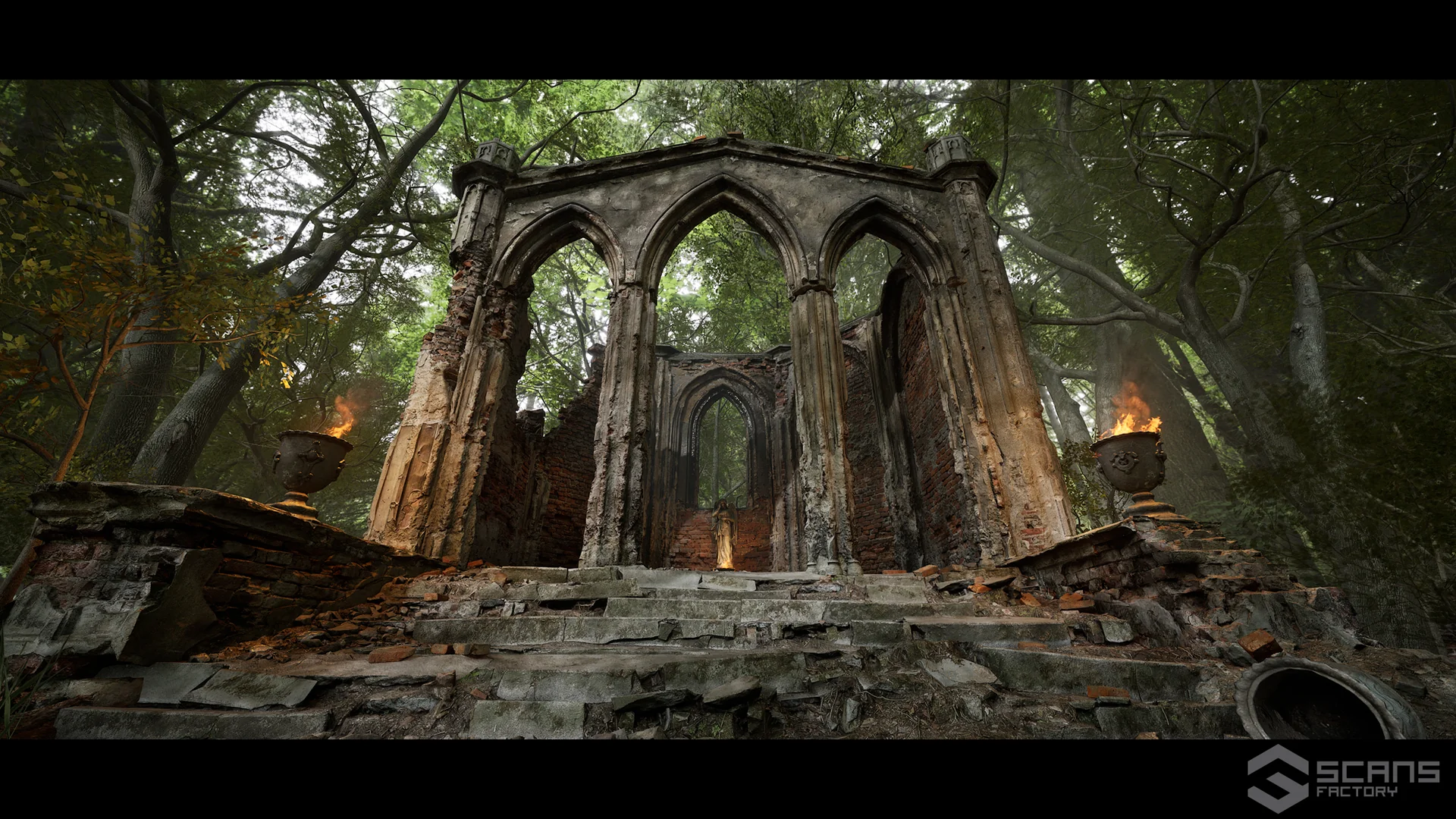
Visual authenticity in ruined architecture hinges on capturing genuine erosion patterns, broken corners, and complex surface displacement. The models within the pack are built directly from photogrammetry scans, transferring the real-world micro-detail of aged stonework into engine-ready geometry. The structural roster covers broken and intact stone blocks, cracked archways, ruined chapel walls, dungeon partitions, soil mounds, and weathered tombstones.
Because the surfaces derive from high-resolution reality capture, the textures and surface normal distributions reflect authentic geological and historical wear. Weathered stone shows the natural fracturing caused by moisture and freeze-thaw cycles, while subterranean components feature deep root intrusions and accumulated dirt. Roots wrap organically across stone plinths and floor fragments, grounding the buildings into the soil of a forgotten forest or murky swamp. This photorealistic scan quality serves fantasy, medieval, and gothic horror settings, ensuring that close-up player inspection does not reveal flat, synthetic surface definitions.
The asset count extends beyond simple masonry to furnish complete scenes. By mixing broken tombs, structural foundation stones, and twisted surface roots, scene builders can establish environmental storytelling that conveys long periods of decay. The scanned assets capture the tactile roughness of carved stone markers, overgrown steps leading underground, and broken vault ceilings open to the weather above.
Benchmark Performance and Scalability Optimization
Deploying scanned geometry often carries the risk of excessive vertex densities and unoptimized draw calls. This package implements real-time optimization measures across its 170+ meshes to ensure smooth runtime performance in active game scenarios. In standardized performance benchmarks running on High scalability settings at full high-definition resolution (1080p), the complete environment maintains a target framerate of 160 frames per second.
The benchmark test was conducted on a reference workstation featuring an AMD Ryzen 9 processor, an NVIDIA GeForce RTX 4080 graphics processing unit, 64 gigabytes of system RAM, and solid-state storage. These performance figures demonstrate that the asset pack is tuned for gameplay application rather than being confined solely to offline rendering or non-interactive portfolio captures. The assets are structured to manage geometry throughput effectively while retaining the silhouette clarity needed for photorealistic presentation.
Performance consistency is further validated through dedicated flythrough and walkthrough demonstration setups. These interactive test tracks stress-test camera movement through high-density root clusters, extensive foliage spans, and narrow, shadow-heavy crypt tunnels. By proving stability across these varied viewpoints, the package offers a predictable performance profile for production teams building real-time interactive titles.
Technical Integration, Audio, and Asset Lineage
A production environment requires supportive systems to integrate smoothly into a larger development workflow. The package includes professional workflow components such as ambient audio elements, custom visual effects (VFX), and comprehensive technical documentation. The included documentation provides detailed instructions on handling the dual static and Lumen pipelines, leveraging level instances for rapid assembly, and configuring the procedural generation parameters for foliage expansion.
Regarding its asset origin, this collection shares its component models with another package: Medieval Fantasy Ruins - Dark Forest Environment. The release is structured as a standalone, budget-conscious option targeted specifically at users seeking the ruined crypt and stone structural assets without requiring extraneous components from the larger forest suite. Production teams or solo developers who already possess the original Medieval Fantasy Ruins package already have access to these exact assets and do not require this focused release.
For teams beginning a new project focused on subterranean crypts, ruined medieval outposts, or dark fantasy dungeons, the package functions as a self-contained, production-ready starting point. With delivered roadmap features—including the night lighting scenario, modular level instances, and PCG forest tooling—the collection arrives fully updated, documented, and configured for immediate deployment across Unreal Engine 4 and Unreal Engine 5.
 Medieval
 Medieval
 Medieval