"73928542c8be4971"{"id":"1002691","slug":"abandoned-hospital-46-assets","title":"Abandoned Hospital / 46+ Assets","category":"Interior","engine":"5.0+","assetVersion":"","engineVersion":"Engine Version: 5.0+","tag":"Interior","accent":"blue","visual":"mech","summary":"Construct photorealistic horror environments with the Abandoned Hospital asset pack, featuring 46+ modular, low-poly props optimized for Lumen and PBR pipelines","platform":"Unreal Engine","indexPolicy":"index","publishedAt":"2026-11-17T18:14:57.653Z","updatedAt":"2026-11-17T18:14:57.653Z","sourceNotes":[],"fileContents":[],"compatibility":["Unreal Engine","Engine Version: 5.0+"],"featuredImage":{"alt":"Abandoned Hospital / 46+ Assets","src":"/wp-content/uploads/published/2026/11/2ea7498395df-dd0d054a-297a-4f2e-869e-b8506cb4a74f-be2bb6f574.webp"},"hasDownloadLink":true,"downloads":0,"terms":[{"taxonomy":"category","slug":"interior","name":"Interior"}],"galleryImages":[{"src":"/wp-content/uploads/published/2026/11/db5bfdf7425d-584b91ce-38d4-4a1f-b7c5-ac4a66fda155-d366bdd12b.webp","alt":"Abandoned Hospital / 46+ Assets"},{"src":"/wp-content/uploads/published/2026/11/132c6c911cb9-2e6b8fcb-2863-4101-bfd2-43b42d73b319-fcb540bf09.webp","alt":"Abandoned Hospital / 46+ Assets"},{"src":"/wp-content/uploads/published/2026/11/d9fc2e1d2748-3ee6d94f-182a-4505-8563-a7a8eb2d871e-cfd3647abc.webp","alt":"Abandoned Hospital / 46+ Assets"},{"src":"/wp-content/uploads/published/2026/11/a07f2f4933cc-bf8332e7-b491-414b-bd82-4a256bb9e1fa-ff8a19bb34.webp","alt":"Abandoned Hospital / 46+ Assets"},{"src":"/wp-content/uploads/published/2026/11/a49380789e18-fea21c62-ef52-4b2f-9b21-e681bffc4f0c-7182f5d31d.webp","alt":"Abandoned Hospital / 46+ Assets"},{"src":"/wp-content/uploads/published/2026/11/3dfe30f28e06-1bd86d5e-f43d-4bba-a661-80f68f079546-8cd1c8455a.webp","alt":"Abandoned Hospital / 46+ Assets"},{"src":"/wp-content/uploads/published/2026/11/f8cc8ab046c2-d56824ca-6fd4-42e5-a758-79d8973e0fc6-d2598c0f96.webp","alt":"Abandoned Hospital / 46+ Assets"},{"src":"/wp-content/uploads/published/2026/11/28cc30e37365-11b63db9-ef9c-46aa-9a98-8d5496745d1a-4ec782a9ef.webp","alt":"Abandoned Hospital / 46+ Assets"},{"src":"/wp-content/uploads/published/2026/11/e45c636af8a9-26066d84-4ff6-4bcf-b7db-7dffd41727f4-bbb428b4a2.webp","alt":"Abandoned Hospital / 46+ Assets"},{"src":"/wp-content/uploads/published/2026/11/988945eb67ec-7fce7e2a-1642-4082-9ff1-a78a7b3cf01b-42b76451b0.webp","alt":"Abandoned Hospital / 46+ Assets"}],"accessPanel":{"kind":"resource","title":"Get this resource","safetyNote":"Resources are manually reviewed before listing to improve quality and reduce obvious risks.","fileName":"Content.7z","resourceType":"Resource archive","versions":[]},"contentHtml":"\u003cp\u003eShadowed hallways littered with garbage, peeling finishes, exposed brick, and shattered fixtures establish an immediate sense of desolation before any active gameplay encounter unfolds. In interior level design, environmental storytelling depends heavily on physical indicators of decay, institutional neglect, and architectural deterioration. When building medical wards, triage rooms, or forgotten clinics, worldbuilders require assets that communicate rot and disruption while maintaining clean computational overhead. The collection of 46+ assets provides the necessary set dressing to transform sterile rooms into believable zones of long-term abandonment, offering a cohesive visual framework tailored specifically for ruined interior scenarios.\u003c/p\u003e \u003ch2\u003eStructuring Ruined Interior Spaces in the Abandoned Hospital Environment\u003c/h2\u003e\n\u003cp\u003eAssembling a convincing interior level requires distinct transitions between operational order and chaotic collapse. Within an abandoned hospital setting, rooms cannot simply look vacant; they must look interrupted and degraded over time. The modular assembly characteristics of this 46+ prop package permit level designers to construct contiguous spaces ranging from narrow examination chambers and cluttered nursing stations to sprawling, decrepit wards.\u003c/p\u003e\n\u003cp\u003eBy organizing ruined props around logical architectural layouts, developers can guide player navigation through subtle barriers and focal points. Piles of garbage, broken interior elements, and overturned medical equipment can be deployed to block corridors, direct foot traffic through compromised doorways, or frame specific eerie vistas. Because the assets are built with modular flexibility in mind, scenes can scale from compact, claustrophobic puzzle rooms to extensive institutional complexes without visual repetition breaking the sense of place.\u003c/p\u003e \u003ch2\u003eMaterial Authenticity Across Decayed Brick and Medical Surfaces\u003c/h2\u003e\n\u003cp\u003eThe visual impact of any dilapidated facility rests on material credibility. A medical facility is defined by specific industrial finishes—enameled fixtures, clinical equipment, masonry foundations, and painted brick walls. When these surfaces decay, they produce complex interactions of peeling paint, moisture damage, rust, and particulate buildup. The package adheres strictly to a physically based rendering (PBR) pipeline, capturing the photorealistic nuances required to make degraded surfaces tactile and convincing.\u003c/p\u003e\n\u003cp\u003ePBR material definitions ensure that light reacts accurately across disparate surface states. A weathered brick wall absorbs and scatters illumination differently than a rusted medical cabinet or a shattered piece of clinical apparatus. This realism is essential when evoking the eerie atmosphere central to horror productions. By mapping authentic surface roughness, metallic properties, and surface variations, these props ground the scene in physical reality, allowing the environmental decay to carry narrative weight rather than feeling like arbitrary surface noise.\u003c/p\u003e \u003ch2\u003eManaging Performance Across 46+ Assets in Real-Time Pipelines\u003c/h2\u003e\n\u003cp\u003eBalancing high visual fidelity against tight runtime constraints represents a primary challenge in real-time environment production. High-density scenes featuring scattered garbage, broken partitions, and multi-layered medical clutter can easily inflate polygon budgets and draw calls if the underlying geometry is unmanaged. This asset package reconciles that friction by utilizing lowpoly geometry optimized directly for performance-sensitive productions.\u003c/p\u003e\n\u003cp\u003eThe models are authored to deliver AAA-quality presentation while remaining viable for projects with aggressive optimization targets. Through efficient topology and clean geometric construction, the meshes preserve their silhouette integrity and structural detail from both close inspection and medium level distances. This dual focus makes the kit equally suitable for high-end cinematic sequences that demand photorealism and runtime environments where frame-rate stability is non-negotiable. Developers can populate densely layered, ruined rooms without compromising hardware headroom.\u003c/p\u003e \u003ch2\u003eLighting Dynamic Decay with Lumen in Abandoned Hospital Rooms\u003c/h2\u003e\n\u003cp\u003eAtmospheric horror is largely dictated by how light penetrates and falls off within an enclosed space. With integrated support for dynamic lighting systems such as Lumen, these hospital assets react naturally to complex real-time illumination. In an interior space with blown-out windows, flickering emergency fixtures, or weak flashlight beams, indirect global illumination plays a massive role in setting an eerie tone.\u003c/p\u003e\n\u003cp\u003eLumen calculates diffuse interreflections across surfaces, meaning that light bouncing off a ruined red brick wall will cast subtle warm secondary light onto adjacent medical props and debris. Conversely, recessed corners, broken wall cavities, and piles of discarded garbage receive deep, natural contact shadows that heighten tension and spatial depth. Because the PBR materials accurately reflect specular and diffuse energy, lighting designers can use high-contrast setups to accentuate the texture of broken surfaces, deep rust, and accumulated grime across every room.\u003c/p\u003e \u003ch2\u003eDeploying Medical Props for Environmental Storytelling\u003c/h2\u003e\n\u003cp\u003eA ruined hospital functions best when the environment suggests what happened during its final hours of operation. The props in this collection enable environmental artists to layer spaces chronologically, establishing a baseline of institutional medical care that was subsequently overtaken by panic, neglect, or structural collapse. Arranging broken clinical props alongside scattered garbage establishes immediate narrative tension without relying on explicit exposition.\u003c/p\u003e\n\u003cp\u003eBecause the 46+ assets share a unified artistic execution and surface quality, newly constructed rooms feel internally consistent. Designers can distribute ruined items to suggest hastily abandoned triage posts, vandalized administrative offices, or decayed storage wings where dampness and time have eroded the masonry. The consistency of the lowpoly, optimized meshes ensures that whether an artist is building an expansive multiplayer arena or a tight single-player horror sequence, the setting remains visually unified, highly responsive to lighting, and performant under production loads.\u003c/p\u003e\n\n\u003ch2\u003eContinue Browsing Similar Packs\u003c/h2\u003e\n\u003cul\u003e\n\u003cli\u003e\u003ca href=\"https://3dcghub.com/abandoned-swimming-pool-environment-abandoned-building-pool-apocalyptic-swim/\" rel=\"noopener noreferrer\"\u003eAbandoned Swimming Pool Environment ( Abandoned Building Pool Apocalyptic Swim )\u003c/a\u003e\u003c/li\u003e\n\u003cli\u003e\u003ca href=\"https://3dcghub.com/modular-hospital-abandoned-hospital-horror-hospital-modular-hospital-asylum/\" rel=\"noopener noreferrer\"\u003eModular Hospital (Abandoned Hospital, Horror Hospital, Modular Hospital, Asylum)\u003c/a\u003e\u003c/li\u003e\n\u003cli\u003e\u003ca href=\"https://3dcghub.com/modular-hospital-abandoned-hospital-horror-hospital-modular-hospital-asylum-2/\" rel=\"noopener noreferrer\"\u003eModular Hospital (Abandoned Hospital, Horror Hospital, Modular Hospital, Asylum)\u003c/a\u003e\u003c/li\u003e\n\u003cli\u003e\u003ca href=\"https://3dcghub.com/operating-room-pack/\" rel=\"noopener noreferrer\"\u003eOperating Room Pack\u003c/a\u003e\u003c/li\u003e\n\u003cli\u003e\u003ca href=\"https://3dcghub.com/apocalyptic-hospital/\" rel=\"noopener noreferrer\"\u003eApocalyptic Hospital\u003c/a\u003e\u003c/li\u003e\n\u003c/ul\u003e","contentTextLength":6603,"navigation":{"current":42,"total":4655,"previous":{"id":"1002692","slug":"abandoned-lighthouse-island-modular-environment-pack","title":"Abandoned Lighthouse Island – Modular Environment Pack","category":"Island","platform":"Unreal Engine","updatedAt":"2026-11-17T18:16:43.073Z"},"next":{"id":"1002690","slug":"scans-ruined-crypt","title":"[SCANS] Ruined Crypt","category":"Medieval","platform":"Unreal Engine","updatedAt":"2026-11-17T18:13:41.276Z"}},"relatedResources":[{"id":"8767","slug":"abandoned-swimming-pool-environment-abandoned-building-pool-apocalyptic-swim","title":"Abandoned Swimming Pool Environment ( Abandoned Building Pool Apocalyptic Swim )","category":"Interior","engine":"5.3+","assetVersion":"Engine version: 5.3+","engineVersion":"4.27","tag":"Interior","accent":"blue","visual":"city","summary":"Create hauntingly beautiful post-apocalyptic scenes with the Abandoned Swimming Pool Environment. This pack features 146 unique meshes and a powerful modular building tool for game developers.","platform":"Unreal Engine","indexPolicy":"noindex","publishedAt":"2026-02-25T17:55:28.000Z","updatedAt":"2026-11-14T10:16:26.605Z","sourceNotes":[],"fileContents":[],"compatibility":["Unreal Engine","Engine version: 5.3+"],"featuredImage":{"alt":"Abandoned Swimming Pool Environment ( Abandoned Building Pool Apocalyptic Swim )","src":"https://3dcghub.com/wp-content/uploads/2026/02/8e808dcc-707e-414f-90df-1daf72426425.webp"},"fileSizeBytes":3225344185,"hasDownloadLink":true,"downloads":1},{"id":"8497","slug":"modular-hospital-abandoned-hospital-horror-hospital-modular-hospital-asylum","title":"Modular Hospital (Abandoned Hospital, Horror Hospital, Modular Hospital, Asylum)","category":"Horror","engine":"5.1+","assetVersion":"Engine version: 5.1+","engineVersion":"5.1","tag":"Horror","accent":"blue","visual":"city","summary":"Create chilling and hyper-realistic horror environments with this fully modular hospital kit. Optimized for Unreal Engine 5, it features Nanite assets and Lumen lighting for professional game development.","platform":"Unreal Engine","indexPolicy":"noindex","publishedAt":"2026-02-23T17:35:33.000Z","updatedAt":"2026-11-14T10:16:33.371Z","sourceNotes":[],"fileContents":[],"compatibility":["Unreal Engine","Engine version: 5.1+"],"featuredImage":{"alt":"Modular Hospital (Abandoned Hospital, Horror Hospital, Modular Hospital, Asylum)","src":"https://3dcghub.com/wp-content/uploads/2026/02/4eda0abe-06ef-49c9-ae17-7f2158663cb6.webp"},"fileSizeBytes":1900785415,"hasDownloadLink":true,"downloads":4},{"id":"1001411","slug":"modular-hospital-abandoned-hospital-horror-hospital-modular-hospital-asylum-2","title":"Modular Hospital (Abandoned Hospital, Horror Hospital, Modular Hospital, Asylum)","category":"3D","engine":"5.1+","assetVersion":"","engineVersion":"Engine Version: 5.1+","tag":"3D","accent":"blue","visual":"mech","summary":"Build high-detail horror interiors with the Modular Hospital kit for Unreal Engine 5.0+, featuring Nanite meshes, Lumen lighting, and hand-drawn decals.","platform":"Unreal Engine","indexPolicy":"index","publishedAt":"2026-10-05T06:17:50.999Z","updatedAt":"2026-10-05T06:17:50.999Z","sourceNotes":[],"fileContents":[],"compatibility":["Unreal Engine","Engine Version: 5.1+"],"featuredImage":{"alt":"Modular Hospital (Abandoned Hospital, Horror Hospital, Modular Hospital, Asylum)","src":"/wp-content/uploads/published/2026/10/5a48fd47168b-a5cf3498-91db-40a5-84cc-57cd340cf6f2-664c3f9395.webp"},"fileSizeBytes":1900785415,"hasDownloadLink":true,"downloads":1}]}
Resource screenshots
1 / 10
Join our channel
Follow 3DCGHUB on Telegram for new resource drops, migration updates, and community notices.
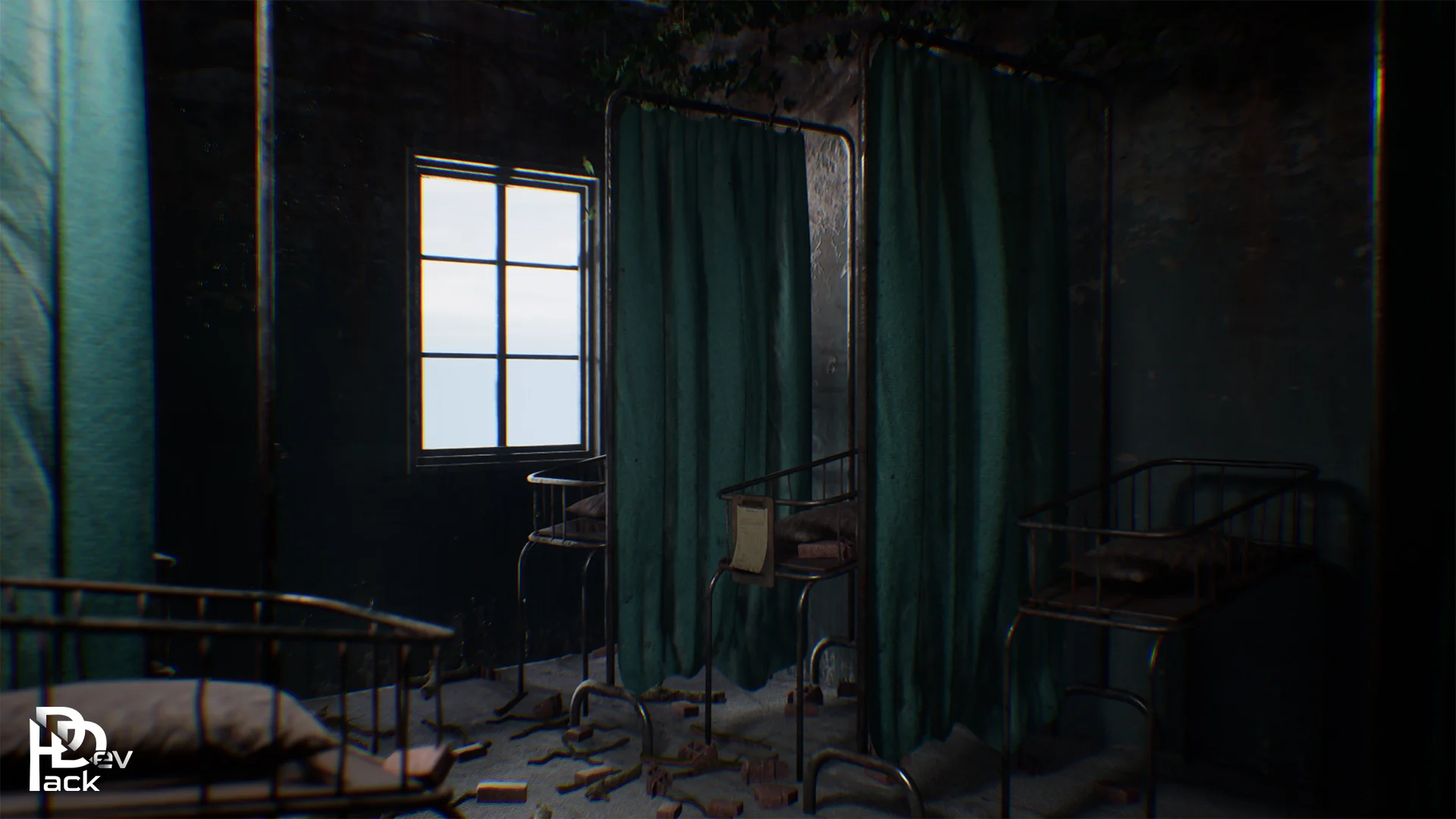
Shadowed hallways littered with garbage, peeling finishes, exposed brick, and shattered fixtures establish an immediate sense of desolation before any active gameplay encounter unfolds. In interior level design, environmental storytelling depends heavily on physical indicators of decay, institutional neglect, and architectural deterioration. When building medical wards, triage rooms, or forgotten clinics, worldbuilders require assets that communicate rot and disruption while maintaining clean computational overhead. The collection of 46+ assets provides the necessary set dressing to transform sterile rooms into believable zones of long-term abandonment, offering a cohesive visual framework tailored specifically for ruined interior scenarios.
Structuring Ruined Interior Spaces in the Abandoned Hospital Environment
Assembling a convincing interior level requires distinct transitions between operational order and chaotic collapse. Within an abandoned hospital setting, rooms cannot simply look vacant; they must look interrupted and degraded over time. The modular assembly characteristics of this 46+ prop package permit level designers to construct contiguous spaces ranging from narrow examination chambers and cluttered nursing stations to sprawling, decrepit wards.
By organizing ruined props around logical architectural layouts, developers can guide player navigation through subtle barriers and focal points. Piles of garbage, broken interior elements, and overturned medical equipment can be deployed to block corridors, direct foot traffic through compromised doorways, or frame specific eerie vistas. Because the assets are built with modular flexibility in mind, scenes can scale from compact, claustrophobic puzzle rooms to extensive institutional complexes without visual repetition breaking the sense of place.
Material Authenticity Across Decayed Brick and Medical Surfaces
The visual impact of any dilapidated facility rests on material credibility. A medical facility is defined by specific industrial finishes—enameled fixtures, clinical equipment, masonry foundations, and painted brick walls. When these surfaces decay, they produce complex interactions of peeling paint, moisture damage, rust, and particulate buildup. The package adheres strictly to a physically based rendering (PBR) pipeline, capturing the photorealistic nuances required to make degraded surfaces tactile and convincing.
PBR material definitions ensure that light reacts accurately across disparate surface states. A weathered brick wall absorbs and scatters illumination differently than a rusted medical cabinet or a shattered piece of clinical apparatus. This realism is essential when evoking the eerie atmosphere central to horror productions. By mapping authentic surface roughness, metallic properties, and surface variations, these props ground the scene in physical reality, allowing the environmental decay to carry narrative weight rather than feeling like arbitrary surface noise.
Managing Performance Across 46+ Assets in Real-Time Pipelines
Balancing high visual fidelity against tight runtime constraints represents a primary challenge in real-time environment production. High-density scenes featuring scattered garbage, broken partitions, and multi-layered medical clutter can easily inflate polygon budgets and draw calls if the underlying geometry is unmanaged. This asset package reconciles that friction by utilizing lowpoly geometry optimized directly for performance-sensitive productions.
The models are authored to deliver AAA-quality presentation while remaining viable for projects with aggressive optimization targets. Through efficient topology and clean geometric construction, the meshes preserve their silhouette integrity and structural detail from both close inspection and medium level distances. This dual focus makes the kit equally suitable for high-end cinematic sequences that demand photorealism and runtime environments where frame-rate stability is non-negotiable. Developers can populate densely layered, ruined rooms without compromising hardware headroom.
Lighting Dynamic Decay with Lumen in Abandoned Hospital Rooms
Atmospheric horror is largely dictated by how light penetrates and falls off within an enclosed space. With integrated support for dynamic lighting systems such as Lumen, these hospital assets react naturally to complex real-time illumination. In an interior space with blown-out windows, flickering emergency fixtures, or weak flashlight beams, indirect global illumination plays a massive role in setting an eerie tone.
Lumen calculates diffuse interreflections across surfaces, meaning that light bouncing off a ruined red brick wall will cast subtle warm secondary light onto adjacent medical props and debris. Conversely, recessed corners, broken wall cavities, and piles of discarded garbage receive deep, natural contact shadows that heighten tension and spatial depth. Because the PBR materials accurately reflect specular and diffuse energy, lighting designers can use high-contrast setups to accentuate the texture of broken surfaces, deep rust, and accumulated grime across every room.
Deploying Medical Props for Environmental Storytelling
A ruined hospital functions best when the environment suggests what happened during its final hours of operation. The props in this collection enable environmental artists to layer spaces chronologically, establishing a baseline of institutional medical care that was subsequently overtaken by panic, neglect, or structural collapse. Arranging broken clinical props alongside scattered garbage establishes immediate narrative tension without relying on explicit exposition.
Because the 46+ assets share a unified artistic execution and surface quality, newly constructed rooms feel internally consistent. Designers can distribute ruined items to suggest hastily abandoned triage posts, vandalized administrative offices, or decayed storage wings where dampness and time have eroded the masonry. The consistency of the lowpoly, optimized meshes ensures that whether an artist is building an expansive multiplayer arena or a tight single-player horror sequence, the setting remains visually unified, highly responsive to lighting, and performant under production loads.
 Interior
 Horror
 3D