"6ac84fdb0bd06614"{"id":"27901","slug":"stylized-village-village-stylized-village-stylized-town-medieval-village","title":"Stylized Village (Village, Stylized Village, Stylized Town, Medieval Village)","category":"Medieval","engine":"5.1+","assetVersion":"Engine version: 5.1+","engineVersion":"5.0","tag":"Medieval","accent":"blue","visual":"city","summary":"Stylized Village places a complete fantasy settlement into a larger island setting rather than isolating a few buildings on a test map. It combines a main town, docks, forests, foliage, stylized VFX, and 248 meshes in a UE5-focused environment that suits re...","platform":"Unreal Engine","publishedAt":"2026-04-30T06:08:49.000Z","updatedAt":"2026-04-30T06:08:50.000Z","sourceNotes":[],"fileContents":[],"compatibility":["Unreal Engine","Engine version: 5.1+"],"featuredImage":{"alt":"Stylized Village (Village, Stylized Village, Stylized Town, Medieval Village)","src":"https://3dcghub.com/wp-content/uploads/2026/04/be4ffe5a20de_7e422236-7fcc-408e-8a70-e7fb8686fbf1.webp"},"hasDownloadLink":true,"downloads":0,"terms":[{"taxonomy":"category","slug":"medieval","name":"Medieval"},{"taxonomy":"post_tag","slug":"environment","name":"Environment"},{"taxonomy":"post_tag","slug":"unreal-engine-5","name":"Unreal Engine 5"},{"taxonomy":"post_tag","slug":"weapons","name":"Weapons"}],"galleryImages":[{"src":"https://3dcghub.com/wp-content/uploads/2026/04/0c1dac63c55c_bd3c96f8-058b-4678-8511-9d953f528d1e.webp","alt":"Stylized Village (Village, Stylized Village, Stylized Town, Medieval Village)"},{"src":"https://3dcghub.com/wp-content/uploads/2026/04/8aaf836bca28_8b4c9321-d8ff-4344-b4f5-fcd82ca7eea5.webp","alt":"Stylized Village (Village, Stylized Village, Stylized Town, Medieval Village)"},{"src":"https://3dcghub.com/wp-content/uploads/2026/04/02866c2b3702_1157fa21-9c44-43a2-9c30-aab7d4501da0.webp","alt":"Stylized Village (Village, Stylized Village, Stylized Town, Medieval Village)"},{"src":"https://3dcghub.com/wp-content/uploads/2026/04/73bc91e94b42_0c4c2fb2-3811-4776-a930-7a465ae217be.webp","alt":"Stylized Village (Village, Stylized Village, Stylized Town, Medieval Village)"},{"src":"https://3dcghub.com/wp-content/uploads/2026/04/bdbe984714d6_e21fcc6f-e440-478c-9bcb-a0894b60cfee.webp","alt":"Stylized Village (Village, Stylized Village, Stylized Town, Medieval Village)"},{"src":"https://3dcghub.com/wp-content/uploads/2026/04/15e104deb7a3_889b2c47-a023-4216-8e1f-2d955834bf2e.webp","alt":"Stylized Village (Village, Stylized Village, Stylized Town, Medieval Village)"},{"src":"https://3dcghub.com/wp-content/uploads/2026/04/ac554a1adef9_a519729f-e824-4441-9979-81f93e8dc254.webp","alt":"Stylized Village (Village, Stylized Village, Stylized Town, Medieval Village)"},{"src":"https://3dcghub.com/wp-content/uploads/2026/04/8caece9edb51_18682d61-0165-41fe-93d1-e7547ff501da.webp","alt":"Stylized Village (Village, Stylized Village, Stylized Town, Medieval Village)"},{"src":"https://3dcghub.com/wp-content/uploads/2026/04/7832bf827b14_8fccd767-1d19-4493-a1fa-868487d303be.webp","alt":"Stylized Village (Village, Stylized Village, Stylized Town, Medieval Village)"}],"accessPanel":{"kind":"resource","title":"Access this resource","eyebrow":"Free Download","message":"Log in or create a free account to start your download.","fileName":"Content.7z","safetyNote":"All resources are 100% manually reviewed to eliminate all risks.","actionLabel":"Download Free","resourceType":"Resource archive"},"contentHtml":"\u003cp\u003eStylized Village behaves like a finished playable space first and a collection of art pieces second. Instead of centering on a single street or a small demo square, it spreads its stylized medieval setting across a 1x1 km island, giving the environment room to shift between town spaces, shoreline areas, and more whimsical natural zones. That scale makes it easier to picture in an actual project pipeline, where teams often need an environment that can support movement, exploration, and scene variation without starting from a blank map.\u003c/p\u003e \u003cp\u003eThe package is made specifically for Unreal Engine 5, with support for Lumen and Nanite in Unreal Engine 5.0+. The stated goal is not a prototype or a technical demonstration, but a fully realized game environment. In production terms, that puts it in the category of a level foundation: something a team can evaluate not just for isolated props, but for how it holds up as a broader world space.\u003c/p\u003e \u003ch2\u003eStylized Village as a 1x1 KM island environment\u003c/h2\u003e\n\u003cp\u003eThe strongest practical detail here is the island layout. A 1x1 km environment changes how an art pack fits into workflow. It can function as a playable map base, a hub-like village zone, or a broader scene where different visual regions are already established. That is a different role from a prop set or a small showcase level. It means environment work can begin from an existing world structure with terrain, settlement areas, and themed natural spaces already in place.\u003c/p\u003e \u003cp\u003eThe village setting is not limited to one mood or one district. The environment includes serene forests, a vibrant main town, peaceful seaside docks, and a whimsical mushroom forest. Those biomes give the map a clearer internal rhythm. Forested areas support quieter traversal or scenic framing, the central town provides a denser architectural focal point, the docks introduce water-facing composition and harbor activity, and the mushroom forest pushes the package further into fantasy territory.\u003c/p\u003e \u003cp\u003eThat spread is useful in real production because scene variety often drives how often a level remains visually interesting. When a single environment can move between settlement, shoreline, and magical woodland spaces, it gives designers and artists more range without forcing a hard style break between areas.\u003c/p\u003e \u003ch2\u003e248 meshes and the structure of the Stylized Town\u003c/h2\u003e\n\u003cp\u003eStylized Village includes 248 meshes for building fantastical stylized worlds. That number matters because it places the asset somewhere between a minimal scene kit and a broad environment library. A mesh count at this scale suggests the environment is not relying on only a handful of repeated landmark pieces. It is intended to assemble a fuller world with enough variety to support the island, town, and surrounding biomes.\u003c/p\u003e \u003cp\u003eThe tag set around the environment points toward the kind of spaces those meshes help form: village, town, house, market, castle, farm, dock, harbor, forest, lake, and island. Taken together, those terms frame the scene as a stylized medieval world with both civic and natural components. It is not only a rural cluster of homes, and it is not only a wilderness environment. The package sits in the middle, where architecture, terrain, shoreline, and fantasy dressing work together.\u003c/p\u003e \u003cp\u003eBecause the environment is described as game ready, those meshes fit best in workflows where teams need a playable art space rather than a concept blockout. A project at vertical slice stage, a prototype that needs presentable art, or a team assembling a stylized adventure map would be closer to the intended use than a purely technical test scene.\u003c/p\u003e \u003ch2\u003eFoliage, magical mushrooms, and stylized VFX\u003c/h2\u003e\n\u003cp\u003eA large part of the environment’s identity comes from the non-architectural content. The foliage set is described as diverse, ranging from crafted trees to magical mushrooms. That pushes the world beyond a basic medieval town layout and into a more fantasy-led presentation. The mushroom forest in particular gives the island a distinctive biome that contrasts with the more grounded town and dock spaces.\u003c/p\u003e \u003cp\u003eFor production, foliage usually determines whether an environment feels sparse or complete. Trees help define silhouette and scale. Ground cover and themed growth help separate one biome from another. In Stylized Village, the inclusion of both standard natural elements and more whimsical mushroom forms suggests the environment is built to support magical scenes as comfortably as conventional forested areas.\u003c/p\u003e \u003cp\u003eThe included stylized VFX reinforce that same direction. The package contains a collection of visual effects that ranges from fireplace VFX to magical mushroom kingdom butterflies. This is one of the more useful details for teams evaluating scene readiness. Effects like fire and ambient fantasy motion often make the difference between a static environment and one that feels inhabited or reactive on screen.\u003c/p\u003e \u003cp\u003eFireplace VFX naturally suit homes, gathering points, and town interiors or exteriors, while butterfly effects support the softer fantasy mood of the mushroom-themed areas. Since the VFX collection is presented as reusable across stylized projects, it also has value beyond this single map if a team is working within a consistent visual style.\u003c/p\u003e \u003ch2\u003eUE5, Lumen, Nanite, and where this fits in production\u003c/h2\u003e\n\u003cp\u003eThis environment was made specifically for UE5 to enhance visuals and performance, and it supports both Lumen and Nanite for Unreal Engine 5.0+. That compatibility places it clearly in a modern Unreal workflow. It is meant for teams working inside UE5 rather than trying to bridge multiple engines or older rendering paths.\u003c/p\u003e \u003cp\u003eIn practice, that makes Stylized Village a better fit for projects that want a polished stylized world with current Unreal rendering features already in the picture. Since the package is framed as more than a prototype or tech demo, it works best when the need is not simply to inspect assets one by one, but to drop into a broad environment and start shaping gameplay, cinematics, or presentation inside a cohesive scene.\u003c/p\u003e \u003cp\u003eThe combination of a 1x1 km island, multiple biomes, a main town, docks, foliage, and VFX gives it a clear place in the production stack. It can serve as a ready-made environment base for a fantasy game level, a hub settlement with surrounding exploration space, or a showcase scene where a stylized medieval world needs to feel complete quickly.\u003c/p\u003e \u003cp\u003eIf the main question is whether this is only a visual sample or a usable level foundation, the clearest takeaway is the scale and completeness: a UE5 game-ready island environment with town, forests, docks, mushroom biome, 248 meshes, foliage, and stylized VFX already working together.\u003c/p\u003e\n\n\u003ch2\u003eExplore Similar Assets\u003c/h2\u003e\n\u003cul\u003e\n\u003cli\u003e\u003ca href=\"https://3dcghub.com/post-apocalyptic-melee-weapons/\" title=\"Post Apocalyptic Melee Weapons\"\u003ePost Apocalyptic Melee Weapons\u003c/a\u003e\u003c/li\u003e\n\u003cli\u003e\u003ca href=\"https://3dcghub.com/stylized-staves-rpg-weapons/\" title=\"Stylized Staves – RPG Weapons\"\u003eStylized Staves – RPG Weapons\u003c/a\u003e\u003c/li\u003e\n\u003c/ul\u003e\n\n\u003ch2\u003eAsset Gallery\u003c/h2\u003e","contentTextLength":6750,"navigation":{"current":1349,"total":3181,"previous":{"id":"8380","slug":"church-cathedral-interior-environment-church-cathedral-interior-historical","title":"Church / Cathedral Interior Environment ( Church Cathedral Interior Historical )","category":"Historical","platform":"Unreal Engine","updatedAt":"2026-04-30T06:33:41.000Z"},"next":{"id":"27889","slug":"stylized-waterways","title":"Stylized Waterways","category":"Forest \u0026 Jungle","platform":"Unreal Engine","updatedAt":"2026-04-30T06:01:33.000Z"}},"relatedResources":[{"id":"1000721","slug":"modular-medieval-town-docks-medieval-town-medieval-village-town-village","title":"Modular Medieval Town, Docks (Medieval Town, Medieval Village, Town, Village)","category":"Medieval","engine":"5.3+","assetVersion":"","engineVersion":"Engine Version: 5.3+","tag":"Medieval","accent":"blue","visual":"mech","summary":"A modular medieval town and docks environment for Unreal Engine 5.3 with 323 meshes, enterable furnished buildings, Nanite foliage, VFX, and Lumen support.","platform":"Unreal Engine","publishedAt":"2026-07-26T12:57:47.702Z","updatedAt":"2026-07-26T12:57:47.702Z","sourceNotes":[],"fileContents":[],"compatibility":["Unreal Engine","Engine Version: 5.3+"],"featuredImage":{"alt":"Modular Medieval Town, Docks (Medieval Town, Medieval Village, Town, Village)","src":"/wp-content/uploads/published/2026/07/067f38254eaf-8a9d01b4-c6a8-4614-aca4-315e195a5b12-22f24b8584.webp"},"hasDownloadLink":true,"downloads":1},{"id":"1000643","slug":"medieval-nordic-village-environment-medieval-exterior-interior-modular-pbr","title":"Medieval Nordic Village Environment (Medieval, Exterior, Interior, Modular, PBR)","category":"Medieval","engine":"5.0+","assetVersion":"","engineVersion":"Engine Version: 5.0+","tag":"Medieval","accent":"blue","visual":"city","summary":"A Viking-era Nordic village pack with 164 fully modular meshes, detailed interiors, fence blueprints, Niagara effects, and Lumen and Nanite support for Unreal E","platform":"Unreal Engine","publishedAt":"2026-07-21T17:35:03.057Z","updatedAt":"2026-07-21T17:35:03.057Z","sourceNotes":[],"fileContents":[],"compatibility":["Unreal Engine","Engine Version: 5.0+"],"featuredImage":{"alt":"Medieval Nordic Village Environment (Medieval, Exterior, Interior, Modular, PBR)","src":"/wp-content/uploads/published/2026/07/0f91ee80dc88-aad1c27d-aa9c-4352-860c-46ab770fba09-40f3e919eb.webp"},"hasDownloadLink":true,"downloads":0},{"id":"9216","slug":"medieval-village-environment","title":"Medieval Village Environment","category":"Medieval","engine":"5.2+","assetVersion":"Engine version: 5.2+","engineVersion":"","tag":"Medieval","accent":"blue","visual":"city","summary":"Create stunning historical scenes with the Medieval Village Environment. This comprehensive pack includes buildings, props, and foliage for high-quality game development.","platform":"Unreal Engine","publishedAt":"2026-03-01T15:26:01.000Z","updatedAt":"2026-04-19T15:51:17.000Z","sourceNotes":[],"fileContents":[],"compatibility":["Unreal Engine","Engine version: 5.2+"],"featuredImage":{"alt":"Medieval Village Environment","src":"https://3dcghub.com/wp-content/uploads/2026/03/59b85599-ce49-493d-bd98-9580557e53d4.webp"},"hasDownloadLink":true,"downloads":1}]}
Medieval
Stylized Village (Village, Stylized Village, Stylized Town, Medieval Village)
Stylized Village places a complete fantasy settlement into a larger island setting rather than isolating a few buildings on a test map. It combines a main town, docks, forests, foliage, stylized VFX, and 248 meshes in a UE5-focused environment that suits re...
Stylized Village behaves like a finished playable space first and a collection of art pieces second. Instead of centering on a single street or a small demo square, it spreads its stylized medieval setting across a 1x1 km island, giving the environment room to shift between town spaces, shoreline areas, and more whimsical natural zones. That scale makes it easier to picture in an actual project pipeline, where teams often need an environment that can support movement, exploration, and scene variation without starting from a blank map.
The package is made specifically for Unreal Engine 5, with support for Lumen and Nanite in Unreal Engine 5.0+. The stated goal is not a prototype or a technical demonstration, but a fully realized game environment. In production terms, that puts it in the category of a level foundation: something a team can evaluate not just for isolated props, but for how it holds up as a broader world space.
Stylized Village as a 1x1 KM island environment
The strongest practical detail here is the island layout. A 1x1 km environment changes how an art pack fits into workflow. It can function as a playable map base, a hub-like village zone, or a broader scene where different visual regions are already established. That is a different role from a prop set or a small showcase level. It means environment work can begin from an existing world structure with terrain, settlement areas, and themed natural spaces already in place.
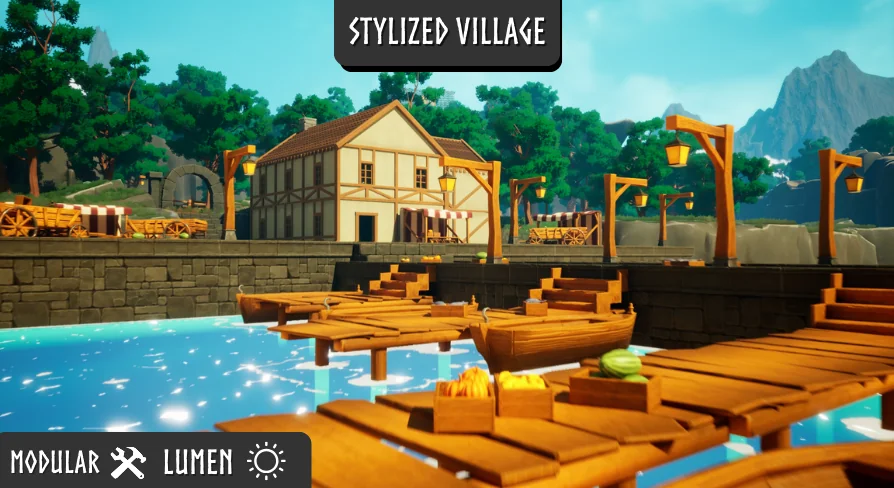
The village setting is not limited to one mood or one district. The environment includes serene forests, a vibrant main town, peaceful seaside docks, and a whimsical mushroom forest. Those biomes give the map a clearer internal rhythm. Forested areas support quieter traversal or scenic framing, the central town provides a denser architectural focal point, the docks introduce water-facing composition and harbor activity, and the mushroom forest pushes the package further into fantasy territory.
That spread is useful in real production because scene variety often drives how often a level remains visually interesting. When a single environment can move between settlement, shoreline, and magical woodland spaces, it gives designers and artists more range without forcing a hard style break between areas.
248 meshes and the structure of the Stylized Town
Stylized Village includes 248 meshes for building fantastical stylized worlds. That number matters because it places the asset somewhere between a minimal scene kit and a broad environment library. A mesh count at this scale suggests the environment is not relying on only a handful of repeated landmark pieces. It is intended to assemble a fuller world with enough variety to support the island, town, and surrounding biomes.
The tag set around the environment points toward the kind of spaces those meshes help form: village, town, house, market, castle, farm, dock, harbor, forest, lake, and island. Taken together, those terms frame the scene as a stylized medieval world with both civic and natural components. It is not only a rural cluster of homes, and it is not only a wilderness environment. The package sits in the middle, where architecture, terrain, shoreline, and fantasy dressing work together.
Because the environment is described as game ready, those meshes fit best in workflows where teams need a playable art space rather than a concept blockout. A project at vertical slice stage, a prototype that needs presentable art, or a team assembling a stylized adventure map would be closer to the intended use than a purely technical test scene.
Foliage, magical mushrooms, and stylized VFX
A large part of the environment’s identity comes from the non-architectural content. The foliage set is described as diverse, ranging from crafted trees to magical mushrooms. That pushes the world beyond a basic medieval town layout and into a more fantasy-led presentation. The mushroom forest in particular gives the island a distinctive biome that contrasts with the more grounded town and dock spaces.
For production, foliage usually determines whether an environment feels sparse or complete. Trees help define silhouette and scale. Ground cover and themed growth help separate one biome from another. In Stylized Village, the inclusion of both standard natural elements and more whimsical mushroom forms suggests the environment is built to support magical scenes as comfortably as conventional forested areas.
The included stylized VFX reinforce that same direction. The package contains a collection of visual effects that ranges from fireplace VFX to magical mushroom kingdom butterflies. This is one of the more useful details for teams evaluating scene readiness. Effects like fire and ambient fantasy motion often make the difference between a static environment and one that feels inhabited or reactive on screen.
Fireplace VFX naturally suit homes, gathering points, and town interiors or exteriors, while butterfly effects support the softer fantasy mood of the mushroom-themed areas. Since the VFX collection is presented as reusable across stylized projects, it also has value beyond this single map if a team is working within a consistent visual style.
UE5, Lumen, Nanite, and where this fits in production
This environment was made specifically for UE5 to enhance visuals and performance, and it supports both Lumen and Nanite for Unreal Engine 5.0+. That compatibility places it clearly in a modern Unreal workflow. It is meant for teams working inside UE5 rather than trying to bridge multiple engines or older rendering paths.
In practice, that makes Stylized Village a better fit for projects that want a polished stylized world with current Unreal rendering features already in the picture. Since the package is framed as more than a prototype or tech demo, it works best when the need is not simply to inspect assets one by one, but to drop into a broad environment and start shaping gameplay, cinematics, or presentation inside a cohesive scene.
The combination of a 1x1 km island, multiple biomes, a main town, docks, foliage, and VFX gives it a clear place in the production stack. It can serve as a ready-made environment base for a fantasy game level, a hub settlement with surrounding exploration space, or a showcase scene where a stylized medieval world needs to feel complete quickly.
If the main question is whether this is only a visual sample or a usable level foundation, the clearest takeaway is the scale and completeness: a UE5 game-ready island environment with town, forests, docks, mushroom biome, 248 meshes, foliage, and stylized VFX already working together.
 Medieval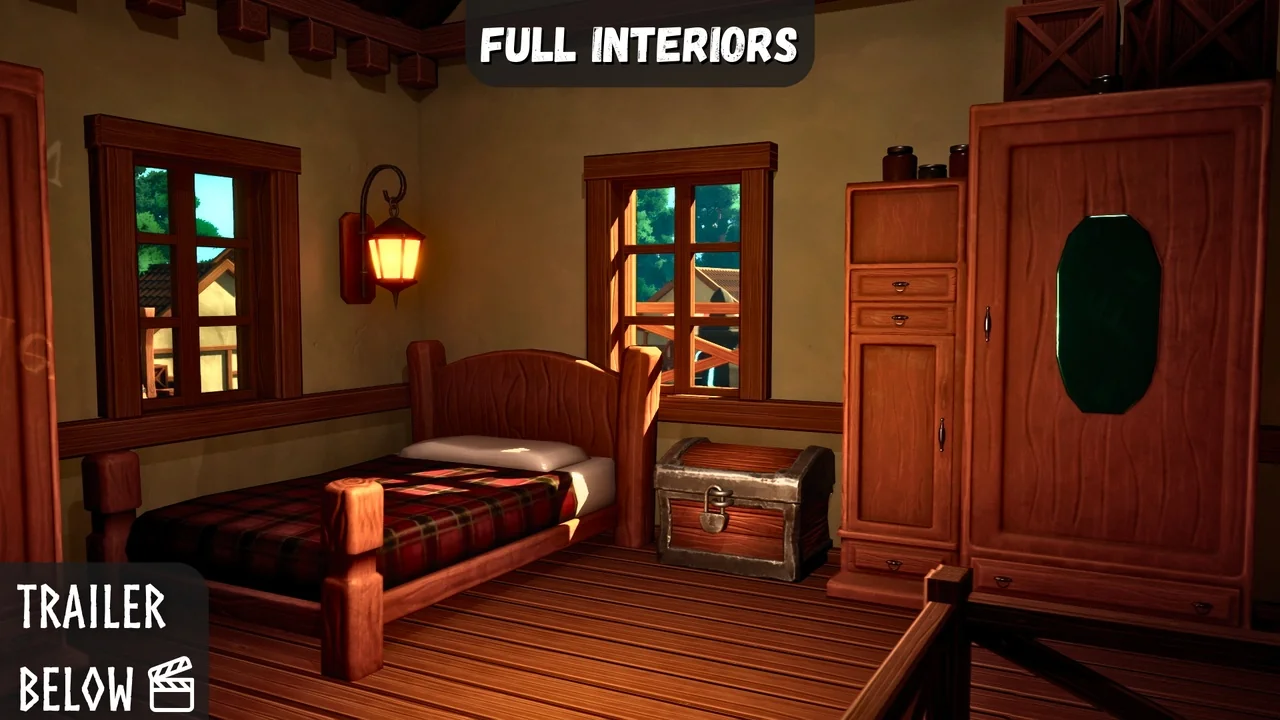
 Medieval
 Medieval
 Medieval