"7e6fc58c410f2894"{"id":"1000434","slug":"nanite-highland-hills","title":"NANITE HIGHLAND HILLS","category":"Mountain","engine":"5.2+","assetVersion":"","engineVersion":"Engine Version: 5.2+","tag":"Mountain","accent":"blue","visual":"mech","summary":"Nanite Highland Hills provides ten high-poly terrain meshes at roughly 15 million triangles each, built for Unreal Engine 5.2–5.8 Nanite workflows.","platform":"Unreal Engine","publishedAt":"2026-07-10T20:23:51.695Z","updatedAt":"2026-07-10T20:23:51.695Z","sourceNotes":[],"fileContents":[],"compatibility":["Unreal Engine","Engine Version: 5.2+"],"featuredImage":{"alt":"NANITE HIGHLAND HILLS","src":"/wp-content/uploads/published/2026/07/02bf7051df97-4bcc7d73-f73b-4526-8fe8-064ebd6a3195-240d795f24.webp"},"hasDownloadLink":true,"downloads":2,"terms":[{"taxonomy":"category","slug":"mountain","name":"Mountain"}],"galleryImages":[{"src":"/wp-content/uploads/published/2026/07/c381bf5b75d2-448addc7-930a-4bd5-9d63-5ae79b7b52ba-f157b6c85f.webp","alt":"NANITE HIGHLAND HILLS"},{"src":"/wp-content/uploads/published/2026/07/4ebd6db8767d-b64c2253-ba20-451b-8ea6-8e323f55bbde-059c89f18f.webp","alt":"NANITE HIGHLAND HILLS"},{"src":"/wp-content/uploads/published/2026/07/1fb1bb847ab5-a3412e8a-c6f1-441d-b030-114407b58db3-bdbc4f7ce3.webp","alt":"NANITE HIGHLAND HILLS"},{"src":"/wp-content/uploads/published/2026/07/533db984ead8-31689bfc-b8cd-4b64-8d2b-37d838f7d555-45b9fd7ca3.webp","alt":"NANITE HIGHLAND HILLS"},{"src":"/wp-content/uploads/published/2026/07/e4709eb4cbb1-710ab0da-5104-4ba2-af95-13c1b4f425d9-5652297a9d.webp","alt":"NANITE HIGHLAND HILLS"},{"src":"/wp-content/uploads/published/2026/07/00079ee725e1-28030ac6-d816-4d6a-8ef4-18b111a6bd3b-9e8b8a42d4.webp","alt":"NANITE HIGHLAND HILLS"},{"src":"/wp-content/uploads/published/2026/07/d918da83e086-bab102ed-5780-4562-89ac-fd27d0ba7a82-58d847a53f.webp","alt":"NANITE HIGHLAND HILLS"},{"src":"/wp-content/uploads/published/2026/07/605286ba489c-6d96af5a-6b76-481a-a7c3-6ed8db8c2c0a-44d108655b.webp","alt":"NANITE HIGHLAND HILLS"},{"src":"/wp-content/uploads/published/2026/07/210ffe8a4286-c3b47703-b3f9-4b85-8035-6d4ac1f6e87c-a4825d4824.webp","alt":"NANITE HIGHLAND HILLS"},{"src":"/wp-content/uploads/published/2026/07/5e94386fb7da-90819ddf-cd6f-459f-b502-e7588772abda-a2c76e51ac.webp","alt":"NANITE HIGHLAND HILLS"}],"accessPanel":{"kind":"resource","title":"Download this resource","eyebrow":"Free Download","message":"Log in or create a free account to start your download.","fileName":"Content.7z","safetyNote":"Resources are manually reviewed before listing to improve quality and reduce obvious risks.","actionLabel":"Download Free","resourceType":"Resource archive"},"contentHtml":"\u003cp\u003eDropping a mountain range or a mossy ridge into the background of a scene usually means balancing mesh density against frame budgets. NANITE HIGHLAND HILLS approaches that trade-off from the opposite direction: each of its ten static meshes carries roughly 15 million triangles, and the entire collection is built to feed straight into Unreal Engine's Nanite virtualized geometry pipeline. Instead of baking detail into normal maps and hoping the silhouette holds up at distance, the asset hands Nanite the raw density to stream and cull on the fly.\u003c/p\u003e \u003ch2\u003eHigh-poly meshes built for Nanite consumption\u003c/h2\u003e \u003cp\u003eThe core proposition is density. Every piece in the set sits at or above 15 million triangles, placing these meshes firmly in the high-poly category rather than game-ready low-poly with baked maps. Nanite is not an optional enhancement here; it is the intended rendering path. Without Nanite enabled, meshes of this weight would be impractical for real-time use. With it, the geometry负荷 detaljnog surfacining—surface micro-relief, ridge lines, ground undulation—stays intact without relying on secondary textures to fake depth.\u003c/p\u003e \u003cp\u003eThat density supports the stated goal of forming interesting backgrounds for games and films. Background terrain often suffers first when optimization kicks in, losing silhouette fidelity and surface character. By keeping the source geometry heavy, the set preserves the kind of visual weight that distant hills and highland plateaus need to read convincingly against a skybox or as part of a larger vista.\u003c/p\u003e \u003ch3\u003eFlattened edges and modular placement\u003c/h3\u003e \u003cp\u003eThe meshes include flattened edges, a practical detail for level assembly. Flat contact zones mean adjacent pieces can sit edge-to-edge without visible seams or z-fighting along shared boundaries. In a terrain kit built for backgrounds, this matters because the pieces are likely to be arranged in clusters—stringing ridges together, building out a valley wall, or extending a hillside across a map's perimeter.\u003c/p\u003e \u003cp\u003eThe set contains 10 pieces total, placing it in a focused modular bracket rather than a sprawling environment library. Each piece is a standalone static mesh, so placement follows standard Unreal Engine workflow: drag into the scene, align the flattened edges with neighboring geometry, and let Nanite handle the per-frame LOD work internally. The modular tag associated with the asset reflects this kit-of-parts approach, even though the pieces are high-density backdrops rather than interior architecture or prop clutter.\u003c/p\u003e \u003ch2\u003eDemo and overview levels included\u003c/h2\u003e \u003cp\u003eThe pack ships with two reference maps: a demo level and an overview level. The demo level reproduces the scenes shown in the promotional screenshots, which gives a direct look at how the meshes are intended to be arranged, lit, and framed within a larger composition. For a team evaluating the asset, that demo functions as both a quality check and a placement guide—confirming what 15 million triangles per mesh actually looks like once Nanite is processing it in-engine.\u003c/p\u003e \u003cp\u003eAn overview level is also included, separate from the demo. This type of map typically lays out individual pieces in isolation, making it easier to scan mesh variety, compare shapes, and decide which hill or ridge form fits a particular section of a project's terrain. With 10 pieces to choose from, an overview layout keeps the selection process visual rather than requiring each asset to be dragged into a blank scene for inspection.\u003c/p\u003e \u003ch2\u003eSurface detail and stylistic range\u003c/h2\u003e \u003cp\u003eThe asset's tags point to a broad thematic footprint: highland, mossy, grassland, mountain, valley, hill, terrain, and nature anchor it in realistic outdoor geography, while tags like post-apocalyptic, medieval, fantasy, sci-fi, and ancient suggest the terrain is intended to sit behind multiple visual settings rather than one prescribed art direction. Ground, background, and landscape tags reinforce the background-formation purpose stated in the description.\u003c/p\u003e \u003cp\u003eDetailed surface is listed as a core feature, and at 15 million triangles per mesh that detail is structural rather than painted on. The geometry itself carries surface variation—meaning the micro-relief reads from multiple viewing angles without relying on a single baked normal map applied to a flat plane. For film use especially, where camera angles are not locked to a gameplay path, geometry-based surface detail survives wider framing and off-axis shots that would expose texture-only solutions.\u003c/p\u003e \u003ch2\u003eEngine compatibility and version baseline\u003c/h2\u003e \u003cp\u003eNANITE HIGHLAND HILLS is compatible with Unreal Engine versions 5.2 through 5.8. Nanite was introduced in the initial Unreal Engine 5 release, and the 5.2+ range places this asset squarely within the mature phase of the Nanite pipeline, where virtualized geometry handling, streaming, and visibility culling are established features rather than experimental ones. The project files are structured for this engine generation, and the meshes are marked Nanite-ready from the outset.\u003c/p\u003e \u003cp\u003eVersion 1.0 of the asset was released on July 7, 2023.\u003c/p\u003e \u003ch2\u003ePutting the pieces to work\u003c/h2\u003e \u003cp\u003eIn practice, the workflow for this set is fairly direct. Import the project files into a Nanite-enabled Unreal Engine 5.2–5.8 environment, enable Nanite on the static meshes if the import process does not do so by default, and use the overview level to select which of the 10 pieces fits the scene's needs. Arrange the meshes using their flattened edges for seamless joins—whether building a highland backdrop for a medieval village, a mossy valley behind a sci-fi outpost, or a mountain ridge framing a post-apocalyptic landscape.\u003c/p\u003e \u003cp\u003eThe demo level serves as a starting reference for lighting and composition, showing the terrain in its intended context. From there, the pieces can be repositioned into a new scene while retaining the dense surface detail that defines the set. The 15-million-triangle budget is per mesh, so a full level built from multiple pieces aggregates substantial geometry—but Nanite's per-pixel triangle culling ensures only visible detail reaches the GPU, keeping the real-time cost tied to screen coverage rather than raw triangle count.\u003c/p\u003e \u003ch2\u003eThe strongest takeaway for teams\u003c/h2\u003e \u003cp\u003eFor production teams working in Unreal Engine 5.2 or higher with Nanite enabled, NANITE HIGHLAND HILLS eliminates the low-to-high bake step for background terrain entirely. The meshes arrive already heavy, with flattened edges for joining and a demo level confirming placement and render quality. Ten pieces is a focused kit—enough to build out a ridge line or a valley wall without overwhelming the asset browser, and the per-mesh triangle count means silhouette and surface fidelity are locked into the geometry itself rather than dependent on secondary normal map detail.\u003c/p\u003e\n\n\u003ch2\u003eExplore Similar Assets\u003c/h2\u003e\n\u003cul\u003e\n\u003cli\u003e\u003ca href=\"https://3dcghub.com/brushify-moorlands-pack/\" title=\"Brushify - Moorlands Pack\"\u003eBrushify - Moorlands Pack\u003c/a\u003e\u003c/li\u003e\n\u003cli\u003e\u003ca href=\"https://3dcghub.com/natural-wonders-the-alps/\" title=\"Natural Wonders - The Alps\"\u003eNatural Wonders - The Alps\u003c/a\u003e\u003c/li\u003e\n\u003cli\u003e\u003ca href=\"https://3dcghub.com/scans-lost-temple-cave/\" title=\"[SCANS] Lost Temple Cave\"\u003e[SCANS] Lost Temple Cave\u003c/a\u003e\u003c/li\u003e\n\u003cli\u003e\u003ca href=\"https://3dcghub.com/stylized-castle-ruins/\" title=\"Stylized Castle Ruins\"\u003eStylized Castle Ruins\u003c/a\u003e\u003c/li\u003e\n\u003cli\u003e\u003ca href=\"https://3dcghub.com/volcano-land-environment-w-terrain-scatter-tool-exterior-natural-vfx/\" title=\"Volcano Land Environment w/ Terrain Scatter Tool (Exterior, Natural, VFX)\"\u003eVolcano Land Environment w/ Terrain Scatter Tool (Exterior, Natural, VFX)\u003c/a\u003e\u003c/li\u003e\n\u003c/ul\u003e","contentTextLength":6922,"navigation":{"current":1323,"total":3618,"previous":{"id":"1000435","slug":"natural-wonders-mojave","title":"Natural Wonders - Mojave","category":"Mountain","platform":"Unreal Engine","updatedAt":"2026-07-10T22:18:48.473Z"},"next":{"id":"1000433","slug":"modular-medieval-asset-pack-low-poly-buildings-street-assets-by-drcg","title":"Modular Medieval Asset Pack (Low Poly, Buildings, Street Assets by DrCG)","category":"Towns \u0026 Villages","platform":"Unreal Engine","updatedAt":"2026-07-10T20:02:37.352Z"}},"relatedResources":[{"id":"1001501","slug":"arctic-cliffs","title":"Arctic Cliffs","category":"Mountain","engine":"5.3+","assetVersion":"","engineVersion":"Engine Version: 5.3+","tag":"Mountain","accent":"blue","visual":"mech","summary":"Build polar environments in Unreal Engine 5 with Nanite ice meshes, RVT snow blending, SingleLayerWater ocean systems, and Niagara-driven buoyancy.","platform":"Unreal Engine","publishedAt":"2026-10-09T07:29:09.683Z","updatedAt":"2026-10-09T07:29:09.683Z","sourceNotes":[],"fileContents":[],"compatibility":["Unreal Engine","Engine Version: 5.3+"],"featuredImage":{"alt":"Arctic Cliffs","src":"/wp-content/uploads/published/2026/10/42bf47bcf18c-dd16f4ca-fe96-41a8-837d-7a75ea8cc396-28b685bba6.webp"},"hasDownloadLink":true,"downloads":0},{"id":"1000435","slug":"natural-wonders-mojave","title":"Natural Wonders - Mojave","category":"Mountain","engine":"5.3+","assetVersion":"","engineVersion":"Engine Version: 5.3+","tag":"Mountain","accent":"blue","visual":"mech","summary":"Natural Wonders - Mojave delivers 25 Nanite desert terrain meshes with 4K textures, swappable cliff layers, and volumetric clouds for Unreal Engine 5.0–5.4.","platform":"Unreal Engine","publishedAt":"2026-07-10T22:18:48.473Z","updatedAt":"2026-07-10T22:18:48.473Z","sourceNotes":[],"fileContents":[],"compatibility":["Unreal Engine","Engine Version: 5.3+"],"featuredImage":{"alt":"Natural Wonders - Mojave","src":"/wp-content/uploads/published/2026/07/01b91fc21f7d-8749bf87-84b8-4ff9-a7ae-2475cb200c70-1e3b809673.webp"},"hasDownloadLink":true,"downloads":2},{"id":"1000943","slug":"brushify-grasslands-pack","title":"Brushify - Grasslands Pack","category":"Mountain","engine":"4.27,5.0+","assetVersion":"","engineVersion":"Engine Version: 4.27,5.0+","tag":"Mountain","accent":"blue","visual":"mech","summary":"Ready-made grassland environment for UE5 with Nanite and Lumen, alpha brushes, distance meshes, procedural rock spawners, and an 11-biome landscape auto materia","platform":"Unreal Engine","publishedAt":"2026-08-13T03:46:52.840Z","updatedAt":"2026-08-13T03:46:52.840Z","sourceNotes":[],"fileContents":[],"compatibility":["Unreal Engine","Engine Version: 4.27,5.0+"],"featuredImage":{"alt":"Brushify - Grasslands Pack","src":"/wp-content/uploads/published/2026/08/68ad5e690040-5a03b7b8-d70f-42be-9844-be6366ac7dd1-689593a1ed.webp"},"hasDownloadLink":true,"downloads":2}]}
Mountain
NANITE HIGHLAND HILLS
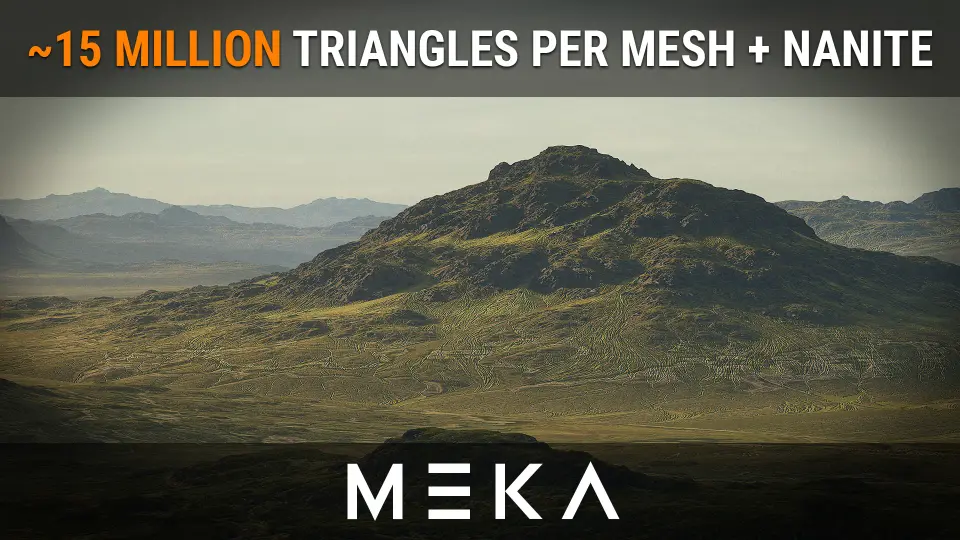
Nanite Highland Hills provides ten high-poly terrain meshes at roughly 15 million triangles each, built for Unreal Engine 5.2–5.8 Nanite workflows.
Dropping a mountain range or a mossy ridge into the background of a scene usually means balancing mesh density against frame budgets. NANITE HIGHLAND HILLS approaches that trade-off from the opposite direction: each of its ten static meshes carries roughly 15 million triangles, and the entire collection is built to feed straight into Unreal Engine's Nanite virtualized geometry pipeline. Instead of baking detail into normal maps and hoping the silhouette holds up at distance, the asset hands Nanite the raw density to stream and cull on the fly.
High-poly meshes built for Nanite consumption
The core proposition is density. Every piece in the set sits at or above 15 million triangles, placing these meshes firmly in the high-poly category rather than game-ready low-poly with baked maps. Nanite is not an optional enhancement here; it is the intended rendering path. Without Nanite enabled, meshes of this weight would be impractical for real-time use. With it, the geometry负荷 detaljnog surfacining—surface micro-relief, ridge lines, ground undulation—stays intact without relying on secondary textures to fake depth.
That density supports the stated goal of forming interesting backgrounds for games and films. Background terrain often suffers first when optimization kicks in, losing silhouette fidelity and surface character. By keeping the source geometry heavy, the set preserves the kind of visual weight that distant hills and highland plateaus need to read convincingly against a skybox or as part of a larger vista.
Flattened edges and modular placement
The meshes include flattened edges, a practical detail for level assembly. Flat contact zones mean adjacent pieces can sit edge-to-edge without visible seams or z-fighting along shared boundaries. In a terrain kit built for backgrounds, this matters because the pieces are likely to be arranged in clusters—stringing ridges together, building out a valley wall, or extending a hillside across a map's perimeter.
The set contains 10 pieces total, placing it in a focused modular bracket rather than a sprawling environment library. Each piece is a standalone static mesh, so placement follows standard Unreal Engine workflow: drag into the scene, align the flattened edges with neighboring geometry, and let Nanite handle the per-frame LOD work internally. The modular tag associated with the asset reflects this kit-of-parts approach, even though the pieces are high-density backdrops rather than interior architecture or prop clutter.
Demo and overview levels included
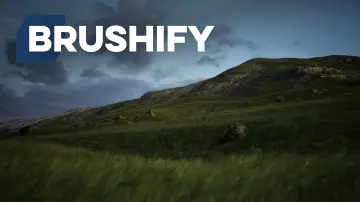
The pack ships with two reference maps: a demo level and an overview level. The demo level reproduces the scenes shown in the promotional screenshots, which gives a direct look at how the meshes are intended to be arranged, lit, and framed within a larger composition. For a team evaluating the asset, that demo functions as both a quality check and a placement guide—confirming what 15 million triangles per mesh actually looks like once Nanite is processing it in-engine.
An overview level is also included, separate from the demo. This type of map typically lays out individual pieces in isolation, making it easier to scan mesh variety, compare shapes, and decide which hill or ridge form fits a particular section of a project's terrain. With 10 pieces to choose from, an overview layout keeps the selection process visual rather than requiring each asset to be dragged into a blank scene for inspection.
Surface detail and stylistic range
The asset's tags point to a broad thematic footprint: highland, mossy, grassland, mountain, valley, hill, terrain, and nature anchor it in realistic outdoor geography, while tags like post-apocalyptic, medieval, fantasy, sci-fi, and ancient suggest the terrain is intended to sit behind multiple visual settings rather than one prescribed art direction. Ground, background, and landscape tags reinforce the background-formation purpose stated in the description.
Detailed surface is listed as a core feature, and at 15 million triangles per mesh that detail is structural rather than painted on. The geometry itself carries surface variation—meaning the micro-relief reads from multiple viewing angles without relying on a single baked normal map applied to a flat plane. For film use especially, where camera angles are not locked to a gameplay path, geometry-based surface detail survives wider framing and off-axis shots that would expose texture-only solutions.
Engine compatibility and version baseline
NANITE HIGHLAND HILLS is compatible with Unreal Engine versions 5.2 through 5.8. Nanite was introduced in the initial Unreal Engine 5 release, and the 5.2+ range places this asset squarely within the mature phase of the Nanite pipeline, where virtualized geometry handling, streaming, and visibility culling are established features rather than experimental ones. The project files are structured for this engine generation, and the meshes are marked Nanite-ready from the outset.
Version 1.0 of the asset was released on July 7, 2023.
Putting the pieces to work
In practice, the workflow for this set is fairly direct. Import the project files into a Nanite-enabled Unreal Engine 5.2–5.8 environment, enable Nanite on the static meshes if the import process does not do so by default, and use the overview level to select which of the 10 pieces fits the scene's needs. Arrange the meshes using their flattened edges for seamless joins—whether building a highland backdrop for a medieval village, a mossy valley behind a sci-fi outpost, or a mountain ridge framing a post-apocalyptic landscape.
The demo level serves as a starting reference for lighting and composition, showing the terrain in its intended context. From there, the pieces can be repositioned into a new scene while retaining the dense surface detail that defines the set. The 15-million-triangle budget is per mesh, so a full level built from multiple pieces aggregates substantial geometry—but Nanite's per-pixel triangle culling ensures only visible detail reaches the GPU, keeping the real-time cost tied to screen coverage rather than raw triangle count.
The strongest takeaway for teams
For production teams working in Unreal Engine 5.2 or higher with Nanite enabled, NANITE HIGHLAND HILLS eliminates the low-to-high bake step for background terrain entirely. The meshes arrive already heavy, with flattened edges for joining and a demo level confirming placement and render quality. Ten pieces is a focused kit—enough to build out a ridge line or a valley wall without overwhelming the asset browser, and the per-mesh triangle count means silhouette and surface fidelity are locked into the geometry itself rather than dependent on secondary normal map detail.
 Mountain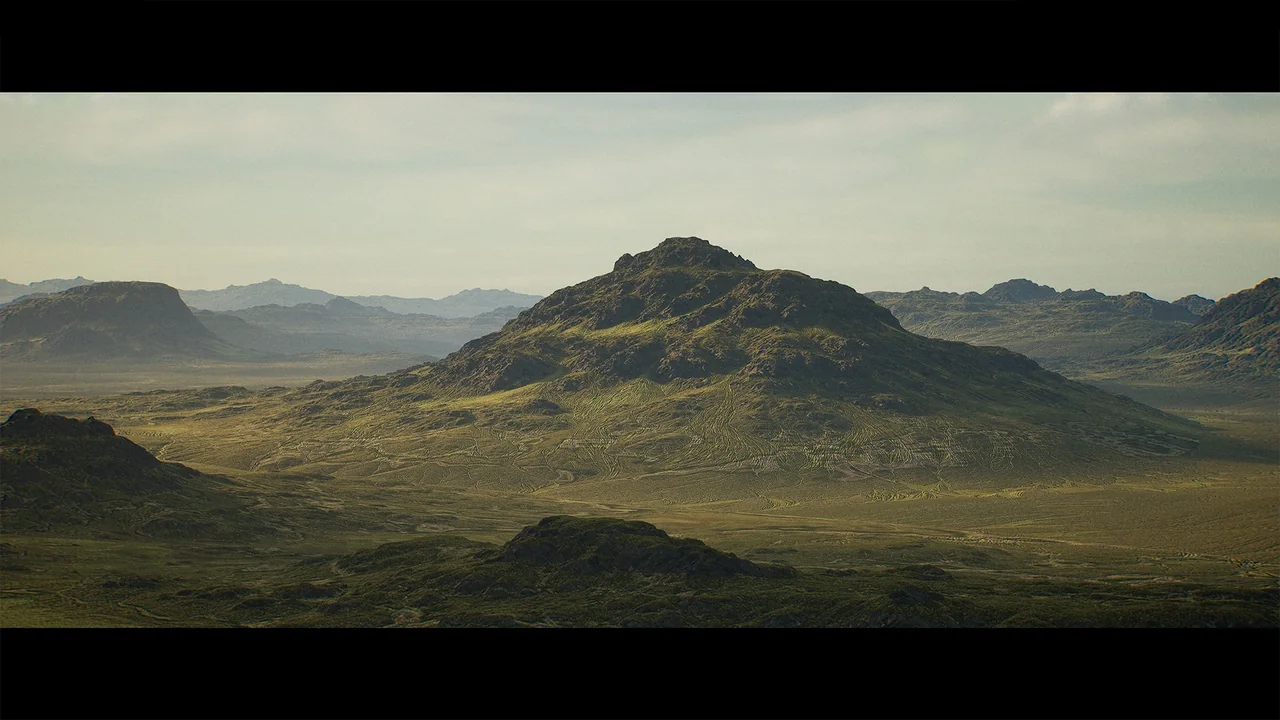
 Mountain
 Mountain
 Mountain