"7b46a695175d8694"{"id":"1000033","slug":"working-night-vision-goggles","title":"Working Night Vision Goggles","category":"Gameplay Features","engine":"4.27,5.0+","assetVersion":"","engineVersion":"4.27,5.0+","tag":"Gameplay Features","accent":"blue","visual":"mech","summary":"Working Night Vision Goggles combines night, thermal, and FLIR vision with a laser designator, plus a tactical helmet and country flags.","platform":"Unreal Engine","publishedAt":"2026-05-21T09:41:07.954Z","updatedAt":"2026-05-21T09:41:07.954Z","sourceNotes":[],"fileContents":[],"compatibility":["Unreal Engine","Engine version: 4.27,5.0+"],"featuredImage":{"alt":"Working Night Vision Goggles","src":"/wp-content/uploads/published/2026/05/e1148ed3e237-51eeb853-a558-47a4-b347-132365f9c162-7b512e67c6.webp"},"hasDownloadLink":true,"downloads":0,"terms":[{"taxonomy":"category","slug":"gameplay-features","name":"Gameplay Features"}],"galleryImages":[{"src":"/wp-content/uploads/published/2026/05/51eb1ea69b26-46bfa938-2dcb-4a0d-b1ec-d6f8652c391e-62d7c24574.webp","alt":"Working Night Vision Goggles"},{"src":"/wp-content/uploads/published/2026/05/c4effeba528f-d6bf99dd-6c9a-4e7e-a363-c0657a250cab-1c87bc4a4e.webp","alt":"Working Night Vision Goggles"},{"src":"/wp-content/uploads/published/2026/05/4c96053ea9ea-6f4a2cd5-8da5-424e-bb43-884a354ed6fa-e8b957e70e.webp","alt":"Working Night Vision Goggles"},{"src":"/wp-content/uploads/published/2026/05/25a37ed85e81-d45534af-46c9-4b3b-82e8-a098ba651692-89da1d12df.webp","alt":"Working Night Vision Goggles"},{"src":"/wp-content/uploads/published/2026/05/bbf51724b43a-0ca28005-3a9d-4c57-8ff6-63a6d47f7627-c178781a3c.webp","alt":"Working Night Vision Goggles"},{"src":"/wp-content/uploads/published/2026/05/37756c730258-92734a21-252c-47ba-b0a2-ceb4619750ac-b8496f0cc7.webp","alt":"Working Night Vision Goggles"},{"src":"/wp-content/uploads/published/2026/05/803836c4248c-9ab51053-1ef7-46bc-8ed4-a846d1410cbd-aef45243fe.webp","alt":"Working Night Vision Goggles"},{"src":"/wp-content/uploads/published/2026/05/1db15c783d3f-a24a34fb-4814-4015-afc3-33be5b68613c-240ea9bfde.webp","alt":"Working Night Vision Goggles"},{"src":"/wp-content/uploads/published/2026/05/639da694eb85-24eedfa3-fe49-4694-90cc-819975f7d61e-86dfc74149.webp","alt":"Working Night Vision Goggles"},{"src":"/wp-content/uploads/published/2026/05/a6a232acc667-52f3da4b-6bbe-43f9-8d38-6ff1298cb902-221d3fca66.webp","alt":"Working Night Vision Goggles"}],"accessPanel":{"kind":"resource","title":"Access this resource","eyebrow":"Free Download","message":"Log in or create a free account to start your download.","fileName":"WorkingNightVisionGoggles.7z","safetyNote":"Resources are manually reviewed before listing to improve quality and reduce obvious risks.","actionLabel":"Download Free","resourceType":"Resource archive"},"contentHtml":"\u003cp\u003eMilitary scenes, tactical training setups, and night operations are the clearest fit for Working Night Vision Goggles. This is not framed as a simple wearable model. Its core purpose is functional viewing, with working night vision, thermal vision, and FLIR vision, plus the ability to call indirect artillery fire through a laser designator.\u003c/p\u003e\u003cp\u003eThat combination gives the package a very specific role inside a project. It suits situations where a character needs to observe, identify, and mark targets instead of only wearing military gear for appearance. The package also extends beyond the goggles themselves by including a high quality tactical ballistic helmet, visual variations for that helmet, and national flag options that can be applied to it.\u003c/p\u003e\u003ch2\u003eNight operations that need more than a helmet prop\u003c/h2\u003e\u003cp\u003eThe strongest use case here is any scene where vision modes are part of the action. Night vision is the obvious starting point, but the package also includes thermal and FLIR vision. Those three viewing modes place it in projects where visibility changes the way a sequence plays out, whether that is a patrol, a reconnaissance scene, a target search, or a darker environment where standard viewing would not be enough.\u003c/p\u003e\u003cp\u003eBecause the package is driven by working vision modes, it has a practical value for first-person or character-based setups where the player or viewer is expected to switch perception and react to what they see. The description also points to realistic and blueprint-oriented usage through its tags, which helps define the kind of project this belongs to: one that cares about operational behavior, not just surface detail.\u003c/p\u003e\u003cp\u003eThe laser designator adds another layer to that. Instead of limiting the asset to observation, it supports a direct action: calling indirect artillery fire. That makes the package especially relevant for military scenarios where identification and designation are linked. A creator building a scene around forward observation, support coordination, or target marking would have an immediately concrete reason to use this instead of a passive character accessory.\u003c/p\u003e\u003ch2\u003eThermal, FLIR, and laser designator in the same setup\u003c/h2\u003e\u003cp\u003eThe inclusion of thermal vision and FLIR vision alongside standard night vision broadens the package's range while keeping it tightly focused on the same tactical theme. These are different ways of reading a scene, and having all three named together suggests a setup that can support several operational moods inside one project.\u003c/p\u003e\u003cp\u003eNight vision fits darkness-first situations. Thermal and FLIR fit scenes where heat-based or alternate visual interpretation is part of the intended experience. Even without expanding beyond the stated features, that gives creators room to stage different types of encounters and different visual perspectives around the same character equipment.\u003c/p\u003e\u003cp\u003eThe laser designator is equally important because it ties the viewing systems to a battlefield response. This turns the package into more than a visual effect set. A character can observe through the goggles, identify what matters, and then call indirect artillery fire. For projects that want a direct link between what the player sees and what the player triggers, that is the package's clearest defining feature.\u003c/p\u003e\u003cp\u003eThere is a practical consistency in that design. The viewing modes support perception. The designator supports target marking. The artillery call supports action at range. Everything listed points in the same direction.\u003c/p\u003e\u003ch2\u003eThe tactical ballistic helmet included with Working Night Vision Goggles\u003c/h2\u003e\u003cp\u003eThe project also includes a high quality tactical ballistic helmet. This helps because it keeps the presentation of the goggles tied to a complete headgear setup rather than leaving creators to supply a matching helmet on their own. For character-focused military scenes, that helps preserve a unified look between the functional optics and the rest of the equipment.\u003c/p\u003e\u003cp\u003eThree helmet skin variations are included: woodland, black, and desert. Those options cover distinct visual contexts without drifting away from the same tactical identity. Woodland suits greener or forest-oriented scenes. Black works for darker or more neutral setups. Desert supports arid or sand-toned environments. The package stays within a military visual language while still offering variation across mission styles and map settings.\u003c/p\u003e\u003cp\u003eThat the goggles and helmet are built from scratch. That is a concrete point about how these pieces were made, and it helps define the package as a custom-built set rather than a mix of borrowed parts. For creators who want the helmet and goggles to read as a matched package, that built-from-scratch approach is one of the more notable details included here.\u003c/p\u003e\u003ch2\u003eHelmet flags for 35+ countries\u003c/h2\u003e\u003cp\u003eFlags for more than 35 countries are included and can be applied on the helmet. This is a straightforward but useful addition for teams that need visible national identification in their characters without changing the core gear itself. It is a practical customization layer placed on top of the ballistic helmet rather than a separate asset category.\u003c/p\u003e\u003cp\u003eIn scene terms, those flags can help distinguish units, represent a specific national force, or simply give a squad more identity while keeping the same helmet model in use. Since the flags are applied on the helmet, they fit naturally into the rest of the character presentation instead of feeling detached from it.\u003c/p\u003e\u003cp\u003eThis detail also reinforces the package's likely role in modern military or paramilitary setups. The asset stays focused on vision systems and headgear, and the country flags serve that focus by making the same core equipment easier to adapt across different faction or nationality contexts.\u003c/p\u003e\u003ch2\u003eDemo pawn integration and custom character use\u003c/h2\u003e\u003cp\u003eCustom character integration is included in the demo pawn, with an instruction note attached to that process. That places the package in a practical workflow context: it is not only meant to be viewed in isolation, but also integrated into a character setup. The mention of a demo pawn indicates that the project provides a working context for how the system is meant to be used.\u003c/p\u003e\u003cp\u003eFor developers building tactical characters, this is one of the more useful pieces of information because it points to actual implementation rather than only presentation. The package acknowledges character integration directly, which fits the overall identity of the asset as a functional system with wearable components.\u003c/p\u003e\u003cp\u003eA playable demo version and a breakdown video are also part of the material around the project. Those details support the package's hands-on character. The project is presented as something that can be tried and examined in action, which matches the nature of features like vision modes and a laser designator. Systems like these are most meaningful when seen operating within a character and scene context.\u003c/p\u003e\u003ch2\u003eWhere this fits best\u003c/h2\u003e\u003cp\u003eWorking Night Vision Goggles makes the most sense for creators building realistic military scenes, night combat sequences, reconnaissance moments, or character-driven tactical projects that need active vision modes and target designation. The included helmet, the woodland, black, and desert variations, and the country flags help round out the visual side, while the working night, thermal, and FLIR vision systems define the package's real purpose.\u003c/p\u003e\u003cp\u003eTeams that need a military headgear setup with operational viewing modes will get the clearest benefit here, especially if their project also needs laser-based indirect artillery calling and a custom character integration path through the included demo pawn.\u003c/p\u003e\n\n\u003ch2\u003eMore From The Same Workflow\u003c/h2\u003e\n\u003cul\u003e\n\u003cli\u003e\u003ca href=\"https://3dcghub.com/advanced-night-vision/\" title=\"Advanced Night Vision\"\u003eAdvanced Night Vision\u003c/a\u003e\u003c/li\u003e\n\u003cli\u003e\u003ca href=\"https://3dcghub.com/driveable-vehicle-attack-submarine/\" title=\"Driveable Vehicle : Attack Submarine\"\u003eDriveable Vehicle : Attack Submarine\u003c/a\u003e\u003c/li\u003e\n\u003cli\u003e\u003ca href=\"https://3dcghub.com/ia-scatter/\" title=\"ia scatter\"\u003eia scatter\u003c/a\u003e\u003c/li\u003e\n\u003cli\u003e\u003ca href=\"https://3dcghub.com/advanced-spline-mesh-analysis-tool/\" title=\"Advanced Spline Mesh Analysis Tool\"\u003eAdvanced Spline Mesh Analysis Tool\u003c/a\u003e\u003c/li\u003e\n\u003cli\u003e\u003ca href=\"https://3dcghub.com/freeflow-combat/\" title=\"Freeflow Combat\"\u003eFreeflow Combat\u003c/a\u003e\u003c/li\u003e\n\u003c/ul\u003e","contentTextLength":7748,"navigation":{"current":1591,"total":3481,"previous":{"id":"1000034","slug":"zombie-hazmat","title":"Zombie - Hazmat","category":"Characters \u0026 Creatures","platform":"Unreal Engine","updatedAt":"2026-05-21T09:43:51.218Z"},"next":{"id":"1000032","slug":"vdb-cloud-and-fog-pack-1","title":"VDB Cloud \u0026 Fog Pack 1","category":"Weather","platform":"Unreal Engine","updatedAt":"2026-05-21T08:56:43.608Z"}},"relatedResources":[{"id":"17015","slug":"advanced-night-vision","title":"Advanced Night Vision","category":"Variety","engine":"4.27,5.0+","assetVersion":"Engine version: 4.27,5.0+","engineVersion":"4.24","tag":"Variety","accent":"blue","visual":"luts","summary":"Enhance your project's atmosphere with Advanced Night Vision, a high-quality post-process material featuring modular customization and object highlighting capabilities.","platform":"Unreal Engine","publishedAt":"2026-03-13T13:28:21.000Z","updatedAt":"2026-04-19T15:43:38.000Z","sourceNotes":[],"fileContents":[],"compatibility":["Unreal Engine","Engine version: 4.27,5.0+"],"featuredImage":{"alt":"Advanced Night Vision","src":"https://3dcghub.com/wp-content/uploads/2026/03/ed66d7f0-f96c-4d81-b9e4-fc69089d4ae1.webp"},"hasDownloadLink":true,"downloads":0},{"id":"1001035","slug":"hyper-time-manager-system-v4","title":"Hyper Time Manager System v4","category":"Gameplay Features","engine":"5.7+","assetVersion":"Asset Version: v4","engineVersion":"Engine Version: 5.7+","tag":"Gameplay Features","accent":"blue","visual":"mech","summary":"Hyper Time Manager System v4 centralizes in-game time in the GameState, syncing NPC schedules, day-night cycles, and world events with Blueprint, multiplayer-re","platform":"Unreal Engine","publishedAt":"2026-08-25T11:24:46.098Z","updatedAt":"2026-08-25T11:24:46.098Z","sourceNotes":[],"fileContents":[],"compatibility":["Unreal Engine","Asset Version: v4","Engine Version: 5.7+"],"featuredImage":{"alt":"Hyper Time Manager System v4","src":"/wp-content/uploads/published/2026/08/0c6d2b9b85f3-d2a03156-4b13-4068-b29a-47eca06cd2d2-7cea1ff9c1.webp"},"hasDownloadLink":true,"downloads":2},{"id":"1000966","slug":"stationary-weapon-ciws","title":"Stationary weapon : CIWS","category":"Gameplay Features","engine":"5.1+","assetVersion":"","engineVersion":"Engine Version: 5.1+","tag":"Gameplay Features","accent":"blue","visual":"mech","summary":"Fully working stationary CIWS anti-air turret with player or AI control, an all-in-one Blueprint, and a destroyed version. Includes demo V.1.0 and custom charac","platform":"Unreal Engine","publishedAt":"2026-08-15T11:38:12.595Z","updatedAt":"2026-08-15T11:38:12.595Z","sourceNotes":[],"fileContents":[],"compatibility":["Unreal Engine","Engine Version: 5.1+"],"featuredImage":{"alt":"Stationary weapon : CIWS","src":"/wp-content/uploads/published/2026/08/9d9b34593d3e-45d1c995-e50f-4b4f-b2a0-acb6b4fb8c75-9d1b537ee5.webp"},"hasDownloadLink":true,"downloads":0}]}
Gameplay Features
Working Night Vision Goggles
Working Night Vision Goggles combines night, thermal, and FLIR vision with a laser designator, plus a tactical helmet and country flags.
Military scenes, tactical training setups, and night operations are the clearest fit for Working Night Vision Goggles. This is not framed as a simple wearable model. Its core purpose is functional viewing, with working night vision, thermal vision, and FLIR vision, plus the ability to call indirect artillery fire through a laser designator.
That combination gives the package a very specific role inside a project. It suits situations where a character needs to observe, identify, and mark targets instead of only wearing military gear for appearance. The package also extends beyond the goggles themselves by including a high quality tactical ballistic helmet, visual variations for that helmet, and national flag options that can be applied to it.
Night operations that need more than a helmet prop
The strongest use case here is any scene where vision modes are part of the action. Night vision is the obvious starting point, but the package also includes thermal and FLIR vision. Those three viewing modes place it in projects where visibility changes the way a sequence plays out, whether that is a patrol, a reconnaissance scene, a target search, or a darker environment where standard viewing would not be enough.
Because the package is driven by working vision modes, it has a practical value for first-person or character-based setups where the player or viewer is expected to switch perception and react to what they see. The description also points to realistic and blueprint-oriented usage through its tags, which helps define the kind of project this belongs to: one that cares about operational behavior, not just surface detail.
The laser designator adds another layer to that. Instead of limiting the asset to observation, it supports a direct action: calling indirect artillery fire. That makes the package especially relevant for military scenarios where identification and designation are linked. A creator building a scene around forward observation, support coordination, or target marking would have an immediately concrete reason to use this instead of a passive character accessory.
Thermal, FLIR, and laser designator in the same setup
The inclusion of thermal vision and FLIR vision alongside standard night vision broadens the package's range while keeping it tightly focused on the same tactical theme. These are different ways of reading a scene, and having all three named together suggests a setup that can support several operational moods inside one project.
Night vision fits darkness-first situations. Thermal and FLIR fit scenes where heat-based or alternate visual interpretation is part of the intended experience. Even without expanding beyond the stated features, that gives creators room to stage different types of encounters and different visual perspectives around the same character equipment.
The laser designator is equally important because it ties the viewing systems to a battlefield response. This turns the package into more than a visual effect set. A character can observe through the goggles, identify what matters, and then call indirect artillery fire. For projects that want a direct link between what the player sees and what the player triggers, that is the package's clearest defining feature.
There is a practical consistency in that design. The viewing modes support perception. The designator supports target marking. The artillery call supports action at range. Everything listed points in the same direction.
The tactical ballistic helmet included with Working Night Vision Goggles
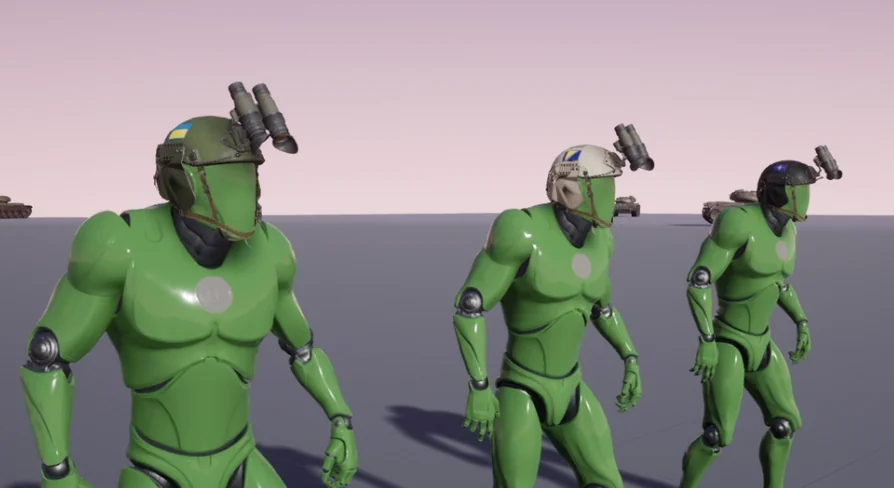
The project also includes a high quality tactical ballistic helmet. This helps because it keeps the presentation of the goggles tied to a complete headgear setup rather than leaving creators to supply a matching helmet on their own. For character-focused military scenes, that helps preserve a unified look between the functional optics and the rest of the equipment.
Three helmet skin variations are included: woodland, black, and desert. Those options cover distinct visual contexts without drifting away from the same tactical identity. Woodland suits greener or forest-oriented scenes. Black works for darker or more neutral setups. Desert supports arid or sand-toned environments. The package stays within a military visual language while still offering variation across mission styles and map settings.
That the goggles and helmet are built from scratch. That is a concrete point about how these pieces were made, and it helps define the package as a custom-built set rather than a mix of borrowed parts. For creators who want the helmet and goggles to read as a matched package, that built-from-scratch approach is one of the more notable details included here.
Helmet flags for 35+ countries
Flags for more than 35 countries are included and can be applied on the helmet. This is a straightforward but useful addition for teams that need visible national identification in their characters without changing the core gear itself. It is a practical customization layer placed on top of the ballistic helmet rather than a separate asset category.
In scene terms, those flags can help distinguish units, represent a specific national force, or simply give a squad more identity while keeping the same helmet model in use. Since the flags are applied on the helmet, they fit naturally into the rest of the character presentation instead of feeling detached from it.
This detail also reinforces the package's likely role in modern military or paramilitary setups. The asset stays focused on vision systems and headgear, and the country flags serve that focus by making the same core equipment easier to adapt across different faction or nationality contexts.
Demo pawn integration and custom character use
Custom character integration is included in the demo pawn, with an instruction note attached to that process. That places the package in a practical workflow context: it is not only meant to be viewed in isolation, but also integrated into a character setup. The mention of a demo pawn indicates that the project provides a working context for how the system is meant to be used.
For developers building tactical characters, this is one of the more useful pieces of information because it points to actual implementation rather than only presentation. The package acknowledges character integration directly, which fits the overall identity of the asset as a functional system with wearable components.
A playable demo version and a breakdown video are also part of the material around the project. Those details support the package's hands-on character. The project is presented as something that can be tried and examined in action, which matches the nature of features like vision modes and a laser designator. Systems like these are most meaningful when seen operating within a character and scene context.
Where this fits best
Working Night Vision Goggles makes the most sense for creators building realistic military scenes, night combat sequences, reconnaissance moments, or character-driven tactical projects that need active vision modes and target designation. The included helmet, the woodland, black, and desert variations, and the country flags help round out the visual side, while the working night, thermal, and FLIR vision systems define the package's real purpose.
Teams that need a military headgear setup with operational viewing modes will get the clearest benefit here, especially if their project also needs laser-based indirect artillery calling and a custom character integration path through the included demo pawn.
 Gameplay Features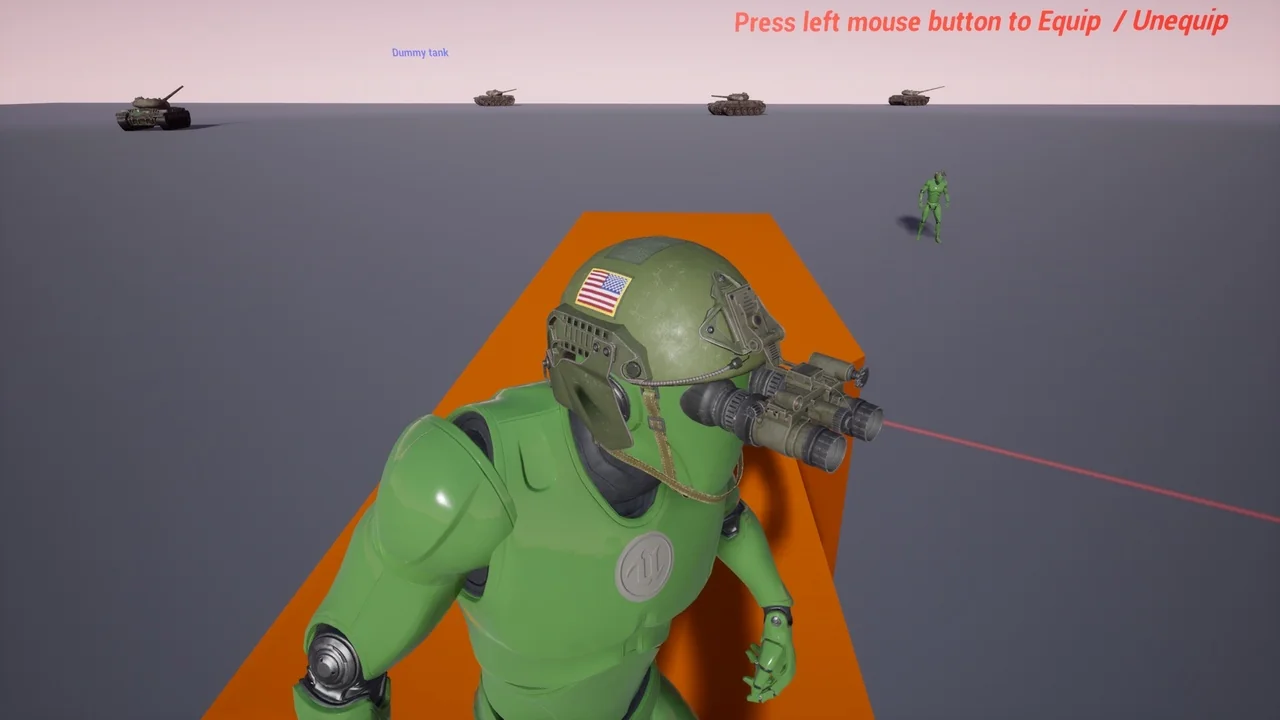
 Variety
 Gameplay Features
 Gameplay Features