"efaa631e936fd3ee"{"id":"1002271","slug":"wolf-male","title":"Wolf - Male","category":"Animals","engine":"5.1+","assetVersion":"","engineVersion":"Engine Version: 5.1+","tag":"Animals","accent":"blue","visual":"mech","summary":"Detailed breakdown of the Wolf - Male asset, featuring a 57-bone rig, 14,500 tris, 4 LODs, mobile mesh, 4K PBR textures, and over 100 animations.","platform":"Unreal Engine","publishedAt":"2026-10-29T16:30:16.430Z","updatedAt":"2026-10-29T16:30:16.430Z","sourceNotes":[],"fileContents":[],"compatibility":["Unreal Engine","Engine Version: 5.1+"],"featuredImage":{"alt":"Wolf - Male","src":"/wp-content/uploads/published/2026/10/fcdd77531c39-3d432fed-181d-4620-96a6-19eecca547b3-67b1abb765.webp"},"hasDownloadLink":true,"downloads":0,"terms":[{"taxonomy":"category","slug":"animals","name":"Animals"}],"galleryImages":[{"src":"/wp-content/uploads/published/2026/10/c97076514afa-370d8a95-5ce5-4a74-969a-91c48810a7bd-d5f8725364.webp","alt":"Wolf - Male"},{"src":"/wp-content/uploads/published/2026/10/1ed7c91afb18-a273355e-7336-43bf-9ab8-56596f746c51-5f8139b361.webp","alt":"Wolf - Male"},{"src":"/wp-content/uploads/published/2026/10/d94b46503d6f-d9d94c73-66bc-4d4d-8ff7-890b3beb92c4-c82b5b6fae.webp","alt":"Wolf - Male"},{"src":"/wp-content/uploads/published/2026/10/f5bc1fdf9e39-18d590d2-a937-459f-a034-c5fe47e2bfbe-a7fba95792.webp","alt":"Wolf - Male"},{"src":"/wp-content/uploads/published/2026/10/a784a1fe04d4-9c8a6b05-db8f-48a8-aadf-df7197ced2ea-46f7fecd72.webp","alt":"Wolf - Male"},{"src":"/wp-content/uploads/published/2026/10/7bcfb4fdb061-bbd3323f-4272-407b-aadb-f709982e068d-1cdeb92e82.webp","alt":"Wolf - Male"},{"src":"/wp-content/uploads/published/2026/10/9a8e3d4ee64e-28faec2b-830d-4b7a-8601-046f4dd02e5d-de205fee68.webp","alt":"Wolf - Male"},{"src":"/wp-content/uploads/published/2026/10/11f385ad8a42-5179eaeb-1d3b-4c71-999b-fba356f76105-2671c738fa.webp","alt":"Wolf - Male"},{"src":"/wp-content/uploads/published/2026/10/2f10337945de-90f42972-e01f-48d2-8037-b2d43b42373a-10b40241ff.webp","alt":"Wolf - Male"},{"src":"/wp-content/uploads/published/2026/10/a367145595e2-19d2251a-4b58-4cfc-84cc-e1b19baf93ee-502c4192e4.webp","alt":"Wolf - Male"}],"accessPanel":{"kind":"resource","title":"Download this resource","eyebrow":"Free Download","message":"Log in or create a free account to start your download.","fileName":"Content.7z","safetyNote":"Resources are manually reviewed before listing to improve quality and reduce obvious risks.","actionLabel":"Download Free","resourceType":"Resource archive"},"contentHtml":"\u003cp\u003eDeep forest settings, tundra survival games, and open-world wilderness landscapes rely heavily on natural wildlife to establish tension and environmental scale. Bringing a believable quadruped predator into these spaces requires both anatomical fidelity and a locomotion set wide enough to cover ambient wandering, hunting, and direct combat. The Wolf - Male asset provides a realistic canine representation structured specifically for technical deployment across interactive environments, pairing multiple geometry tiers with an exhaustive animation library.\u003c/p\u003e\u003ch2\u003e14,500 Tris Base Mesh, 4 Levels of LODs, and Mobile Optimization\u003c/h2\u003e\u003cp\u003eThe primary mesh for the male wolf sits at 14,500 triangles, striking an even balance between visual silhouette definition and runtime efficiency. This density captures the muscular anatomy of the shoulders, haunches, head, and paws without inflating memory costs in crowded scenes. For projects scaling across varied hardware targets or large wilderness environments where multiple pack members might be visible at a distance, the asset includes four configured levels of details (LODs) ready for use right out of the box.\u003c/p\u003e\u003cp\u003eFor mobile development or platforms with tightly constrained vertex budgets, a dedicated low-poly alternative is included. This standalone mobile model drops the triangle count significantly down to 2,800 triangles while maintaining the overall form, skeletal rigging, and movement capabilities of the full-resolution mesh. Having both a 14,500-triangle standard model with four automated LOD steps and a dedicated 2,800-triangle variant gives technical artists clear control over performance budgets across desktop, console, and mobile pipelines.\u003c/p\u003e\u003ch2\u003e4096x4096 PBR Texture Channels and Alpha Mask Options\u003c/h2\u003e\u003cp\u003eSurface detail across the model is driven by a full set of 4096x4096 high-resolution texture maps configured for physically based rendering. The texture package includes an albedo map with an integrated alpha mask, a packed ambient occlusion / metallic / roughness map, and a tangent-space normal map. These textures bring out the dense fur texture, skin undertones, and directional coat patterns necessary for close-up encounters or cinematic sequences.\u003c/p\u003e\u003cp\u003eFur rendering needs can vary dramatically depending on the rendering engine, platform constraints, and shader pipelines. To address this, the asset provides both an alpha-masked model variation for hair cards and cutout shading, as well as an alternate model without alpha channels. This dual approach allows developers to avoid transparency sorting issues or overdraw penalties on weaker rendering hardware by swapping to the non-alpha version, or to leverage the alpha map for softer fur outlines when rendering overhead permits.\u003c/p\u003e\u003ch2\u003e57-Bone Rigging and Directional Locomotion Coverage\u003c/h2\u003e\u003cp\u003eAt the center of the asset is a 57-bone skeletal rig engineered to handle quadruped movement smoothly across various gaits and rapid changes of direction. The animation set encompasses over 100 individual animations, supplied in both in-place (IP) and root motion (RM) variants to suit different gameplay and character controller architectures. The root motion tracks are fully customized and verified functional, allowing realistic displacement directly driven by the skeletal root.\u003c/p\u003e\u003cp\u003eLocomotion covers every essential pacing step a wolf requires in the wild:\u003c/p\u003e\u003cul\u003e\u003cli\u003e\u003cstrong\u003eWalk:\u003c/strong\u003e Directional walking clips covering forward, left, right, backward, backward-left, and backward-right vectors.\u003c/li\u003e\u003cli\u003e\u003cstrong\u003eTrot:\u003c/strong\u003e Intermediate travel movement with forward, left, and right directional clips.\u003c/li\u003e\u003cli\u003e\u003cstrong\u003eRun and Fast Run:\u003c/strong\u003e Standard hunting gallop alongside a dedicated fast sprint, both featuring forward, left, and right trajectories.\u003c/li\u003e\u003cli\u003e\u003cstrong\u003eCrouch Movement:\u003c/strong\u003e Stalking locomotion covering forward, left, right, backward, and diagonal backward angles, alongside dedicated crouch idles and turning variations.\u003c/li\u003e\u003cli\u003e\u003cstrong\u003eSwimming:\u003c/strong\u003e Full aquatic capability including water entry, forward propulsion, left and right adjustments, and backward paddle states.\u003c/li\u003e\u003cli\u003e\u003cstrong\u003eTurning:\u003c/strong\u003e Standard directional turns to the left and right, alongside fast 180-degree pivot turns for rapid target reacquisition.\u003c/li\u003e\u003c/ul\u003e\u003ch2\u003e15-Stage Jump Sequences and Environmental Interaction\u003c/h2\u003e\u003cp\u003eTraversing uneven wilderness terrain requires more than a simple single-frame leap. The asset incorporates an advanced 15-stage jump system designed to handle complex vertical navigation, ledges, and multi-height terrain transitions. This sequence splits the jumping action into distinct modular segments that state machines can blend between dynamically.\u003c/p\u003e\u003cp\u003eThe jump stages break down across specific phases:\u003c/p\u003e\u003cul\u003e\u003cli\u003e\u003cstrong\u003eTakeoff:\u003c/strong\u003e Neutral jump start, forward jump start, and stationary place launch.\u003c/li\u003e\u003cli\u003e\u003cstrong\u003eAscent:\u003c/strong\u003e Dedicated fly-up arcs with both neutral vertical and forward-moving variants.\u003c/li\u003e\u003cli\u003e\u003cstrong\u003eApex:\u003c/strong\u003e Horizontal flight animation representing mid-air glide.\u003c/li\u003e\u003cli\u003e\u003cstrong\u003eDescent:\u003c/strong\u003e Low-altitude downward arcs, high-altitude drop animations, and forward-angled descent variations.\u003c/li\u003e\u003cli\u003e\u003cstrong\u003eImpact and Recovery:\u003c/strong\u003e Ground contact clips for neutral landings, forward momentum landings, and stationary place landing.\u003c/li\u003e\u003cli\u003e\u003cstrong\u003eLedge Handling:\u003c/strong\u003e Fall edge states, edge hook reactions, and ledge climb animations for clambering over obstacles.\u003c/li\u003e\u003c/ul\u003e\u003cp\u003eComplementing this modular jumping system are standard single-clip jumps covering running leaps, stationary jumps, and standard forward bounds, giving developers options for either lightweight athletic movement or granular physics-based traversal.\u003c/p\u003e\u003ch2\u003eBehavioral Routines, Pack Life, and Combat States\u003c/h2\u003e\u003cp\u003eBeyond high-speed chases and pathfinding, a believable creature needs passive, atmospheric behaviors. The asset includes seven distinct idle variations alongside extended behavioral routines. These routines are structured with customized beginning, cyclical loop, and ending segments, enabling seamless transitions in and out of resting states.\u003c/p\u003e\u003cp\u003eResting states feature standard lying positions, belly-down lying variations, deep sleep, and belly sleep, all split cleanly across initiation, loop, and exit clips. Survival behaviors cover eating, meat tearing, drinking, digging (start, loop, and end), ear scratching, and defecation, as well as sitting postures and iconic vocalizations like howling. When threatened or engaging prey, the wolf transitions into combat with multiple attack choices (biting, moving bites, frontal snaps, lateral strikes, and jumping lunges). Damage reactions account for frontal, middle, and rear impacts, concluding with directional left and right death states to handle hostile encounters convincingly.\u003c/p\u003e\n\n\u003ch2\u003eRelated Resources Worth Checking\u003c/h2\u003e\n\u003cul\u003e\n\u003cli\u003e\u003ca href=\"https://3dcghub.com/wild-boar-male/\" title=\"Wild Boar - Male\"\u003eWild Boar - Male\u003c/a\u003e\u003c/li\u003e\n\u003cli\u003e\u003ca href=\"https://3dcghub.com/puppy-shepherd/\" title=\"Puppy - Shepherd\"\u003ePuppy - Shepherd\u003c/a\u003e\u003c/li\u003e\n\u003cli\u003e\u003ca href=\"https://3dcghub.com/fox-family/\" title=\"Fox - Family\"\u003eFox - Family\u003c/a\u003e\u003c/li\u003e\n\u003cli\u003e\u003ca href=\"https://3dcghub.com/suburbs-vol-5-around-the-house-retro-nanite-and-low-poly/\" title=\"Suburbs VOL.5 - Around the House Retro (Nanite and Low Poly)\"\u003eSuburbs VOL.5 - Around the House Retro (Nanite and Low Poly)\u003c/a\u003e\u003c/li\u003e\n\u003cli\u003e\u003ca href=\"https://3dcghub.com/rog-creatures-wolf/\" title=\"ROG Creatures: Wolf\"\u003eROG Creatures: Wolf\u003c/a\u003e\u003c/li\u003e\n\u003c/ul\u003e","contentTextLength":6627,"navigation":{"current":14,"total":4209,"previous":{"id":"1002272","slug":"wooden-doors-modular-sounds","title":"Wooden Doors. Modular Sounds.","category":"Sound Effects","platform":"Unreal Engine","updatedAt":"2026-10-29T16:31:11.516Z"},"next":{"id":"1002270","slug":"winsome-girl","title":"Winsome Girl","category":"Humans","platform":"Unreal Engine","updatedAt":"2026-10-29T16:29:50.361Z"}},"relatedResources":[{"id":"1002267","slug":"wild-boar-male","title":"Wild Boar - Male","category":"Animals","engine":"5.1+","assetVersion":"","engineVersion":"Engine Version: 5.1+","tag":"Animals","accent":"blue","visual":"mech","summary":"Detailed male wild boar 3D asset featuring 46 bones, 4 LOD levels, mobile mesh variation, 4K PBR textures, and over 70 root motion and in-place animations.","platform":"Unreal Engine","publishedAt":"2026-10-29T16:28:20.261Z","updatedAt":"2026-10-29T16:28:20.261Z","sourceNotes":[],"fileContents":[],"compatibility":["Unreal Engine","Engine Version: 5.1+"],"featuredImage":{"alt":"Wild Boar - Male","src":"/wp-content/uploads/published/2026/10/6e25d69ffb61-bb11756f-f545-40bd-b2d7-17b91c7a3ff6-8bd20b7e76.webp"},"hasDownloadLink":true,"downloads":0},{"id":"1000961","slug":"puppy-shepherd","title":"Puppy - Shepherd","category":"Animals","engine":"5.0+","assetVersion":"","engineVersion":"Engine Version: 5.0+","tag":"Animals","accent":"blue","visual":"mech","summary":"Rigged shepherd puppy model for real-time projects, with 75 animations, 4 LODs, 2048x2048 PBR textures, a mobile-friendly mesh, and dog accessories.","platform":"Unreal Engine","publishedAt":"2026-08-14T15:44:12.217Z","updatedAt":"2026-08-14T15:44:12.217Z","sourceNotes":[],"fileContents":[],"compatibility":["Unreal Engine","Engine Version: 5.0+"],"featuredImage":{"alt":"Puppy - Shepherd","src":"https://media.fab.com/image_previews/gallery_images/81eb8820-5970-4299-a319-1b9a5ed0d172/e16e67cf-7836-42c4-aa57-a6ead5d11b88.png"},"hasDownloadLink":true,"downloads":1},{"id":"1000991","slug":"fox-family","title":"Fox - Family","category":"Animals","engine":"5.1+","assetVersion":"","engineVersion":"Engine Version: 5.1+","tag":"Animals","accent":"blue","visual":"mech","summary":"Realistic adult fox and fox cub 3D models with 57 bones, 4 LOD levels, 4096x4096 PBR textures, and 100+ animations for game projects and mobile.","platform":"Unreal Engine","publishedAt":"2026-08-18T06:46:26.547Z","updatedAt":"2026-08-18T06:46:26.547Z","sourceNotes":[],"fileContents":[],"compatibility":["Unreal Engine","Engine Version: 5.1+"],"featuredImage":{"alt":"Fox - Family","src":"/wp-content/uploads/published/2026/08/36141dc051df-684b259c-f2d7-41a0-b9de-d83f7da92619-4125ca1483.webp"},"hasDownloadLink":true,"downloads":0}]}
Animals
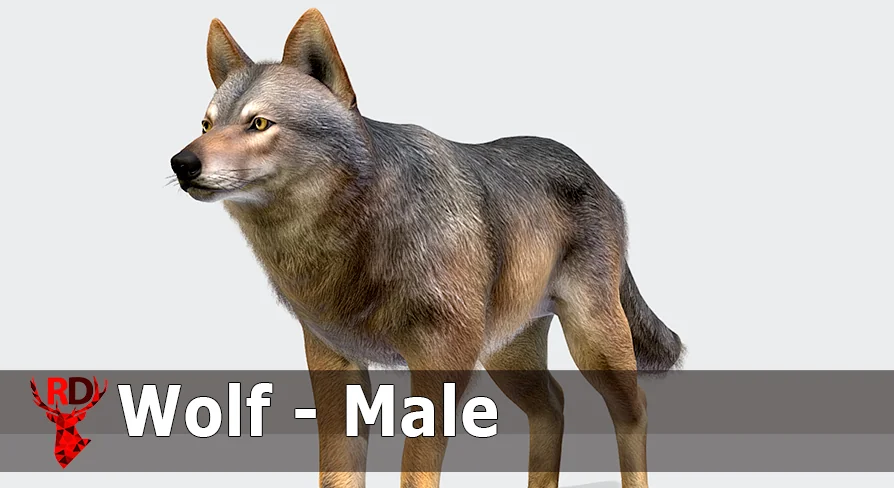
Wolf - Male
Detailed breakdown of the Wolf - Male asset, featuring a 57-bone rig, 14,500 tris, 4 LODs, mobile mesh, 4K PBR textures, and over 100 animations.
Category:Unreal Engine,AnimalsPlatform: Unreal EngineEngine Version: 5.1+Published: Oct 29, 2026
Animals
Resource overview
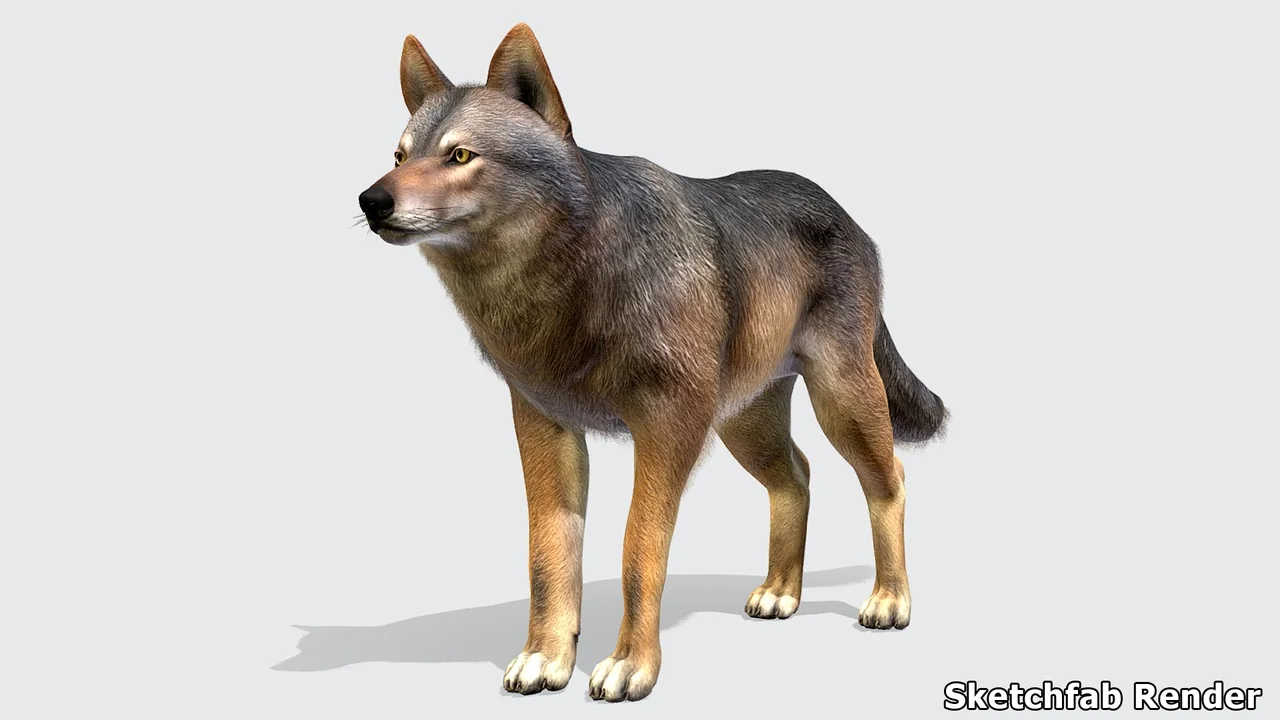
Deep forest settings, tundra survival games, and open-world wilderness landscapes rely heavily on natural wildlife to establish tension and environmental scale. Bringing a believable quadruped predator into these spaces requires both anatomical fidelity and a locomotion set wide enough to cover ambient wandering, hunting, and direct combat. The Wolf - Male asset provides a realistic canine representation structured specifically for technical deployment across interactive environments, pairing multiple geometry tiers with an exhaustive animation library.
14,500 Tris Base Mesh, 4 Levels of LODs, and Mobile Optimization
The primary mesh for the male wolf sits at 14,500 triangles, striking an even balance between visual silhouette definition and runtime efficiency. This density captures the muscular anatomy of the shoulders, haunches, head, and paws without inflating memory costs in crowded scenes. For projects scaling across varied hardware targets or large wilderness environments where multiple pack members might be visible at a distance, the asset includes four configured levels of details (LODs) ready for use right out of the box.
For mobile development or platforms with tightly constrained vertex budgets, a dedicated low-poly alternative is included. This standalone mobile model drops the triangle count significantly down to 2,800 triangles while maintaining the overall form, skeletal rigging, and movement capabilities of the full-resolution mesh. Having both a 14,500-triangle standard model with four automated LOD steps and a dedicated 2,800-triangle variant gives technical artists clear control over performance budgets across desktop, console, and mobile pipelines.
4096x4096 PBR Texture Channels and Alpha Mask Options
Surface detail across the model is driven by a full set of 4096x4096 high-resolution texture maps configured for physically based rendering. The texture package includes an albedo map with an integrated alpha mask, a packed ambient occlusion / metallic / roughness map, and a tangent-space normal map. These textures bring out the dense fur texture, skin undertones, and directional coat patterns necessary for close-up encounters or cinematic sequences.
Fur rendering needs can vary dramatically depending on the rendering engine, platform constraints, and shader pipelines. To address this, the asset provides both an alpha-masked model variation for hair cards and cutout shading, as well as an alternate model without alpha channels. This dual approach allows developers to avoid transparency sorting issues or overdraw penalties on weaker rendering hardware by swapping to the non-alpha version, or to leverage the alpha map for softer fur outlines when rendering overhead permits.
57-Bone Rigging and Directional Locomotion Coverage
At the center of the asset is a 57-bone skeletal rig engineered to handle quadruped movement smoothly across various gaits and rapid changes of direction. The animation set encompasses over 100 individual animations, supplied in both in-place (IP) and root motion (RM) variants to suit different gameplay and character controller architectures. The root motion tracks are fully customized and verified functional, allowing realistic displacement directly driven by the skeletal root.
Locomotion covers every essential pacing step a wolf requires in the wild:
Trot: Intermediate travel movement with forward, left, and right directional clips.
Run and Fast Run: Standard hunting gallop alongside a dedicated fast sprint, both featuring forward, left, and right trajectories.
Crouch Movement: Stalking locomotion covering forward, left, right, backward, and diagonal backward angles, alongside dedicated crouch idles and turning variations.
Swimming: Full aquatic capability including water entry, forward propulsion, left and right adjustments, and backward paddle states.
Turning: Standard directional turns to the left and right, alongside fast 180-degree pivot turns for rapid target reacquisition.
15-Stage Jump Sequences and Environmental Interaction
Traversing uneven wilderness terrain requires more than a simple single-frame leap. The asset incorporates an advanced 15-stage jump system designed to handle complex vertical navigation, ledges, and multi-height terrain transitions. This sequence splits the jumping action into distinct modular segments that state machines can blend between dynamically.
The jump stages break down across specific phases:
Takeoff: Neutral jump start, forward jump start, and stationary place launch.
Ascent: Dedicated fly-up arcs with both neutral vertical and forward-moving variants.
Descent: Low-altitude downward arcs, high-altitude drop animations, and forward-angled descent variations.
Impact and Recovery: Ground contact clips for neutral landings, forward momentum landings, and stationary place landing.
Ledge Handling: Fall edge states, edge hook reactions, and ledge climb animations for clambering over obstacles.
Complementing this modular jumping system are standard single-clip jumps covering running leaps, stationary jumps, and standard forward bounds, giving developers options for either lightweight athletic movement or granular physics-based traversal.
Behavioral Routines, Pack Life, and Combat States
Beyond high-speed chases and pathfinding, a believable creature needs passive, atmospheric behaviors. The asset includes seven distinct idle variations alongside extended behavioral routines. These routines are structured with customized beginning, cyclical loop, and ending segments, enabling seamless transitions in and out of resting states.
Resting states feature standard lying positions, belly-down lying variations, deep sleep, and belly sleep, all split cleanly across initiation, loop, and exit clips. Survival behaviors cover eating, meat tearing, drinking, digging (start, loop, and end), ear scratching, and defecation, as well as sitting postures and iconic vocalizations like howling. When threatened or engaging prey, the wolf transitions into combat with multiple attack choices (biting, moving bites, frontal snaps, lateral strikes, and jumping lunges). Damage reactions account for frontal, middle, and rear impacts, concluding with directional left and right death states to handle hostile encounters convincingly.
 Animals