"7ad89cffa44984cf"{"id":"1002566","slug":"warrior-maiden","title":"Warrior Maiden","category":"Characters \u0026 Creatures","engine":"5.0+","assetVersion":"","engineVersion":"Engine Version: 5.0+","tag":"Characters","accent":"blue","visual":"character","summary":"Examine the Warrior Maiden low-poly realistic female character, featuring 17 combat animations, two skins, 4K textures, and 61k triangles for RPGs.","platform":"Unreal Engine","indexPolicy":"index","publishedAt":"2026-11-13T12:12:45.731Z","updatedAt":"2026-11-13T12:12:45.731Z","sourceNotes":[],"fileContents":[],"compatibility":["Unreal Engine","Engine Version: 5.0+"],"featuredImage":{"alt":"Warrior Maiden","src":"/wp-content/uploads/published/2026/11/b6da87ab81a4-d5c22ae6-d182-4183-9df3-22e3a38df8ee-0296ddbbc8.webp"},"hasDownloadLink":true,"downloads":0,"terms":[{"taxonomy":"category","slug":"characters-and-creatures","name":"Characters \u0026 Creatures"}],"galleryImages":[{"src":"/wp-content/uploads/published/2026/11/b3866033e693-d44784c6-96b5-417d-882e-e9a7ec25084f-0441d87118.webp","alt":"Warrior Maiden"},{"src":"/wp-content/uploads/published/2026/11/5e109c0ac28e-cae44c36-6d56-4a40-8e45-c3116e3c4c29-279d6190ba.webp","alt":"Warrior Maiden"},{"src":"/wp-content/uploads/published/2026/11/83e21b1b5c50-211915b5-8952-4454-9dcb-e9ef9d6c34d2-f2bcfdf035.webp","alt":"Warrior Maiden"},{"src":"/wp-content/uploads/published/2026/11/f48c0c7c9846-7b3db778-b03a-4bd6-9569-b74f5a260c9c-bde4b05c62.webp","alt":"Warrior Maiden"},{"src":"/wp-content/uploads/published/2026/11/2fe4a3a56e6c-875c94dd-485a-49eb-96a2-5e0ad987bb99-fca48ad029.webp","alt":"Warrior Maiden"},{"src":"/wp-content/uploads/published/2026/11/8178816e5157-01254408-4209-4a96-8695-122d0f22e4d7-e6bb61ea14.webp","alt":"Warrior Maiden"},{"src":"/wp-content/uploads/published/2026/11/bbef64233de1-51ce753f-6b1e-4936-88c7-91a0d6424745-e410668958.webp","alt":"Warrior Maiden"},{"src":"/wp-content/uploads/published/2026/11/26f4c6488bed-c9913fbb-d526-4cfd-9cc0-8c927a48f492-41b7c8882d.webp","alt":"Warrior Maiden"},{"src":"/wp-content/uploads/published/2026/11/7b49be1df715-df6a6ab7-6920-42a4-84e7-25ee4e6031f5-fbae8dfbe0.webp","alt":"Warrior Maiden"},{"src":"/wp-content/uploads/published/2026/11/03da67a53cd1-a105c4b7-98bb-40ba-b180-527083ff4de7-fba410925c.webp","alt":"Warrior Maiden"}],"accessPanel":{"kind":"resource","title":"Get this resource","eyebrow":"Free resource","message":"Download this resource in your browser.","fileName":"Content.7z","safetyNote":"Resources are manually reviewed before listing to improve quality and reduce obvious risks.","actionLabel":"Get this resource","resourceType":"Resource archive","versions":[]},"contentHtml":"\u003ch2\u003eRPG Combat Scenarios and the Warrior Maiden Mesh\u003c/h2\u003e\n\u003cp\u003eThird-person action role-playing games, medieval dungeon crawlers, and tactical combat encounters depend on character meshes that hold up under close camera inspection without exhausting the engine's polygon budget. Warrior Maiden enters this space as a realistic female combatant model, balancing visual fidelity with standard real-time performance requirements.\u003c/p\u003e\n\u003cp\u003eThe mesh geometry is shaped by a total of 61,631 triangles, resolved across 34,532 faces and 37,135 vertices. That density provides enough geometric support to define curved armor pieces, articulation around elbows and knees, and distinct facial contours without relying solely on normal map baking to suggest volume. Because the model is structured specifically as a low-poly character, edge loops are positioned to preserve anatomical proportions during extreme combat postures, preventing pinching at joints during weapon swings and rolling dodges.\u003c/p\u003e\n\u003cp\u003eIn third-person melee projects, camera proximity during executing strikes or parry maneuvers often exposes the shortcuts taken on lower-tier character meshes. With more than 37,000 vertices allocated across the character and her equipped armor, silhouette breakdown along shoulders and limbs remains minimal, maintaining visual immersion during intense fight sequences.\u003c/p\u003e \u003ch2\u003eLocomotion and Battle States in the Warrior Maiden Motion Library\u003c/h2\u003e\n\u003cp\u003ePre-rigged characters are only as effective as the motion sets that accompany them. Rather than requiring external retargeting steps before testing initial gameplay loops, this character includes a suite of 17 dedicated animations covering core locomotion, basic combat interaction, and state transitions.\u003c/p\u003e\n\u003cp\u003eThe locomotion package provides paired variations for almost every movement direction, allowing developers to set up responsive directional blend spaces within an animation blueprint. The collection contains:\u003c/p\u003e\n\u003cul\u003e \u003cli\u003eTwo walk cycles for grounded pacing\u003c/li\u003e \u003cli\u003eTwo run cycles to support sprint transitions\u003c/li\u003e \u003cli\u003eTwo left strafe animations\u003c/li\u003e \u003cli\u003eTwo right strafe animations\u003c/li\u003e \u003cli\u003eTwo jump animations to handle vertical clearance\u003c/li\u003e \u003cli\u003eTwo idle variations to break up visual repetition while standing\u003c/li\u003e\n\u003c/ul\u003e\n\u003cp\u003eHaving duplicate variations for strafing and standard movement simplifies the process of building natural, asymmetrical locomotion systems. In an action RPG setup, blending between slightly different run or strafe clips keeps the fighter from looking robotic during extended tracking around an opponent.\u003c/p\u003e\n\u003cp\u003eFor active combat sequences, the motion set incorporates two attack animations, one block state, and two distinct death clips. The two attack cycles allow for a straightforward two-hit combo chain, while the blocking pose provides an immediate defensive state for shield-and-sword or parry mechanics. The dual death animations allow combat encounters to conclude without every defeated enemy collapsing along an identical trajectory, helping encounter designers maintain combat variety across skirmishes.\u003c/p\u003e \u003ch2\u003eTexture Mapping Pipeline and Dual Skin Variations\u003c/h2\u003e\n\u003cp\u003eVisual customizability and texture memory management represent critical considerations when instantiating characters in multi-actor scenes. The texturing pipeline for this model uses physically based rendering maps authored primarily at 4096 resolution, paired with a 2000 map. This scale preserves fine surface nuances across armor plating, fabric undergarments, and skin pores.\u003c/p\u003e\n\u003cp\u003eMemory budgets vary significantly depending on whether a character functions as a main playable hero, a companion, or an elite battlefield adversary. To accommodate different hardware constraints, the texture maps allow reduction down to 1024 resolution. Downscaling to 1024 significantly lowers VRAM footprints, which becomes critical when multiple instances of the model appear simultaneously on screen or when running inside memory-constrained target platforms.\u003c/p\u003e\n\u003cp\u003eThe character includes two complete skin variations. These alternate appearances enable immediate visual differentiation without demanding external texture editing. A developer can deploy one skin for standard player progression and reserve the alternate skin for an elite variant, an adversarial boss encounter, or a specialized faction uniform.\u003c/p\u003e \u003ch2\u003eShader Configuration and Two-Sided Polygon Display\u003c/h2\u003e\n\u003cp\u003eRealistic character designs that incorporate layered armor, belts, straps, and flowing garments frequently feature thin geometry shells. For this model, using a shader configured with a two-sided display of polygons is desirable to render all surfaces correctly.\u003c/p\u003e\n\u003cp\u003eStandard real-time game shaders routinely cull backfaces by default to conserve rendering cycles. However, on garments, hanging strap ends, and edge trimmings, single-layer geometry often leaves the underside of the polygon exposed to the camera as the character runs, jumps, or tumbles. Enabling two-sided rendering within the material domain ensures that the internal surfaces of these mesh elements do not disappear or flicker during rapid camera movements and dynamic character turns.\u003c/p\u003e\n\u003cp\u003eConfiguring a two-sided material graph resolves potential clipping and backface artifacts across the armor and clothing layers. This setup guarantees that whether viewed from high isometric camera angles or tight over-the-shoulder perspectives, the warrior's protective gear retains consistent visual solidity across all 17 animation cycles.\u003c/p\u003e \u003ch2\u003eTarget Implementations for Indie Combat Systems\u003c/h2\u003e\n\u003cp\u003eThe technical parameters of the asset align closely with modern real-time action titles, particularly those running third-person melee frameworks or modular RPG scripts. The inclusion of rigging, an animation blueprint structure, scripted support, and compatibility with the Butcher ecosystem reduces technical setup overhead before reaching playable prototyping stages.\u003c/p\u003e\n\u003cp\u003eIndie developers, solo programmers, and small technical art teams building fantasy combat games benefit most from this package. Because the mesh brings together realistic low-poly optimization, full rigging, ready-to-use directional animations, and scale-friendly 4K PBR textures with dual skins, it bypasses the asset-assembly bottleneck and delivers a functional, armed fighter ready for immediate combat testing.\u003c/p\u003e\n\n\u003ch2\u003eMore From The Same Workflow\u003c/h2\u003e\n\u003cul\u003e\n\u003cli\u003e\u003ca href=\"https://3dcghub.com/warrior-hero/\" rel=\"noopener noreferrer\"\u003eWarrior Hero\u003c/a\u003e\u003c/li\u003e\n\u003cli\u003e\u003ca href=\"https://3dcghub.com/apache-warrior-1/\" rel=\"noopener noreferrer\"\u003eApache Warrior 1\u003c/a\u003e\u003c/li\u003e\n\u003cli\u003e\u003ca href=\"https://3dcghub.com/viking-warriors/\" rel=\"noopener noreferrer\"\u003eViking Warriors\u003c/a\u003e\u003c/li\u003e\n\u003cli\u003e\u003ca href=\"https://3dcghub.com/samurai-warriors/\" rel=\"noopener noreferrer\"\u003eSamurai Warriors\u003c/a\u003e\u003c/li\u003e\n\u003cli\u003e\u003ca href=\"https://3dcghub.com/light-warrior/\" rel=\"noopener noreferrer\"\u003eLight Warrior\u003c/a\u003e\u003c/li\u003e\n\u003c/ul\u003e","contentTextLength":6301,"navigation":{"current":11,"total":4499,"previous":{"id":"1002567","slug":"workout-set","title":"Workout Set","category":"Characters \u0026 Creatures","platform":"Unreal Engine","updatedAt":"2026-11-13T12:14:09.185Z"},"next":{"id":"1002565","slug":"shirtless-zombies-pack","title":"Shirtless Zombies Pack","category":"Characters \u0026 Creatures","platform":"Unreal Engine","updatedAt":"2026-11-13T11:59:25.402Z"}},"relatedResources":[{"id":"1002265","slug":"warrior-hero","title":"Warrior Hero","category":"Characters \u0026 Creatures","engine":"5.0+","assetVersion":"","engineVersion":"Engine Version: 5.0+","tag":"Characters","accent":"blue","visual":"character","summary":"A modular stylized medieval character featuring 4K AORM textures, 4 LOD stages, a Control Rig, Animation Blueprints, and separate armor components.","platform":"Unreal Engine","indexPolicy":"index","publishedAt":"2026-10-29T16:27:35.145Z","updatedAt":"2026-10-29T16:27:35.145Z","sourceNotes":[],"fileContents":[],"compatibility":["Unreal Engine","Engine Version: 5.0+"],"featuredImage":{"alt":"Warrior Hero","src":"/wp-content/uploads/published/2026/10/63b5bd5dcd22-e1c7d3fd-1c2b-414f-9bcd-db5505dff4c8-85da5ab7de.webp"},"hasDownloadLink":true,"downloads":0},{"id":"27038","slug":"apache-warrior-1","title":"Apache Warrior 1","category":"Characters \u0026 Creatures","engine":"5.0+","assetVersion":"Engine version: 5.0+","engineVersion":"","tag":"Characters","accent":"blue","visual":"character","summary":"Apache Warrior 1 combines an Epic Skeleton setup with 14 extra tail bones, 52 facial blendshapes, and modular mesh parts. Its material set and PBR textures give the character a direct path from assembly to rendering.","platform":"Unreal Engine","indexPolicy":"index","publishedAt":"2026-04-21T07:14:09.000Z","updatedAt":"2026-04-21T07:14:10.000Z","sourceNotes":[],"fileContents":[],"compatibility":["Unreal Engine","Engine version: 5.0+"],"featuredImage":{"alt":"Apache Warrior 1","src":"https://3dcghub.com/wp-content/uploads/2026/04/b4a6a7ad59ad_212004c9-3106-4a58-bf51-6ca664afc1b0.webp"},"hasDownloadLink":true,"downloads":0},{"id":"1001674","slug":"viking-warriors","title":"Viking Warriors","category":"Characters \u0026 Creatures","engine":"4.19+,5.0+","assetVersion":"","engineVersion":"Engine Version: 4.19+,5.0+","tag":"Characters","accent":"blue","visual":"character","summary":"Viking Warriors brings modular material customization, APEX cloth physics, combat weapons, and seamless Unreal Engine mannequin compatibility into real-time pro","platform":"Unreal Engine","indexPolicy":"index","publishedAt":"2026-10-13T15:22:48.715Z","updatedAt":"2026-10-13T15:22:48.715Z","sourceNotes":[],"fileContents":[],"compatibility":["Unreal Engine","Engine Version: 4.19+,5.0+"],"featuredImage":{"alt":"Viking Warriors","src":"/wp-content/uploads/published/2026/10/42eef3ea8f03-e62a40b7-e5d1-408b-80e1-bfb7b5904e73-740805dff2.webp"},"hasDownloadLink":true,"downloads":1}]}
Characters
Warrior Maiden
Examine the Warrior Maiden low-poly realistic female character, featuring 17 combat animations, two skins, 4K textures, and 61k triangles for RPGs.
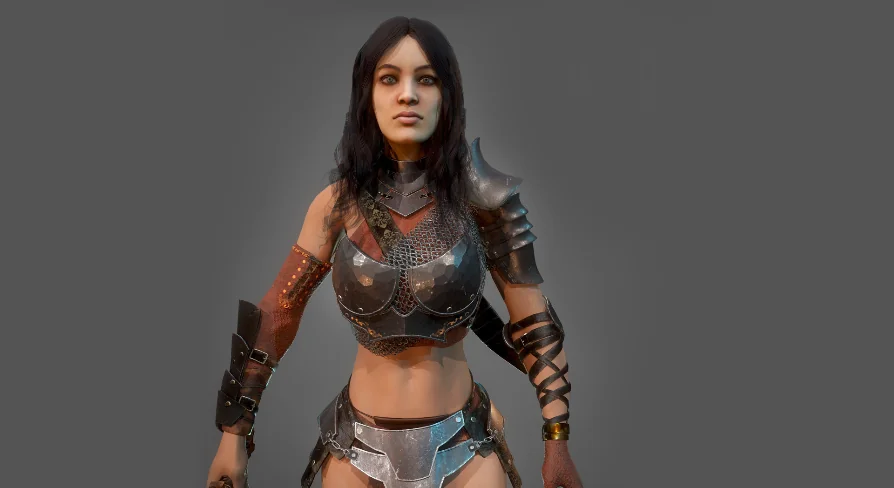
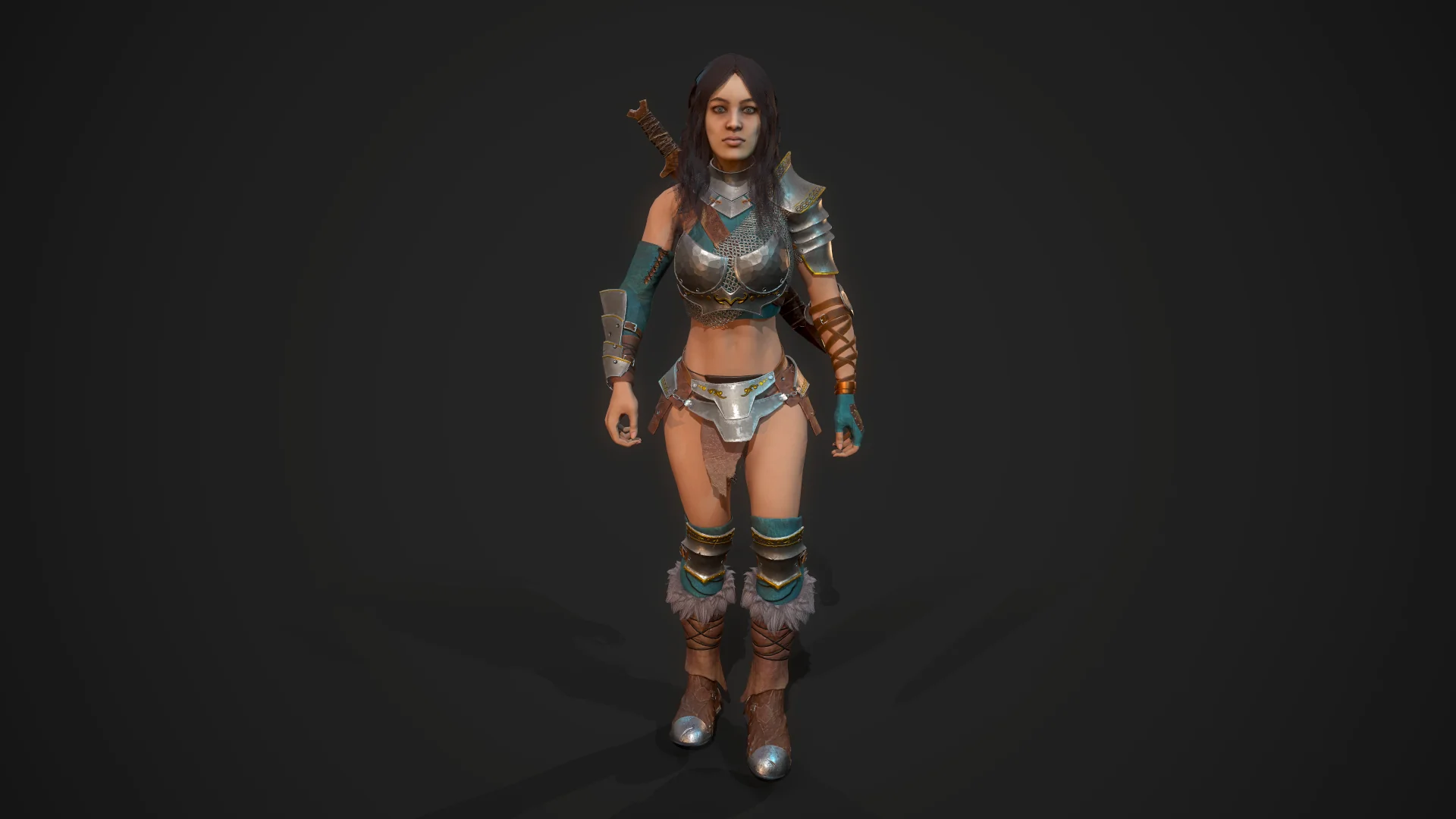
Third-person action role-playing games, medieval dungeon crawlers, and tactical combat encounters depend on character meshes that hold up under close camera inspection without exhausting the engine's polygon budget. Warrior Maiden enters this space as a realistic female combatant model, balancing visual fidelity with standard real-time performance requirements.
The mesh geometry is shaped by a total of 61,631 triangles, resolved across 34,532 faces and 37,135 vertices. That density provides enough geometric support to define curved armor pieces, articulation around elbows and knees, and distinct facial contours without relying solely on normal map baking to suggest volume. Because the model is structured specifically as a low-poly character, edge loops are positioned to preserve anatomical proportions during extreme combat postures, preventing pinching at joints during weapon swings and rolling dodges.
In third-person melee projects, camera proximity during executing strikes or parry maneuvers often exposes the shortcuts taken on lower-tier character meshes. With more than 37,000 vertices allocated across the character and her equipped armor, silhouette breakdown along shoulders and limbs remains minimal, maintaining visual immersion during intense fight sequences.
Locomotion and Battle States in the Warrior Maiden Motion Library
Pre-rigged characters are only as effective as the motion sets that accompany them. Rather than requiring external retargeting steps before testing initial gameplay loops, this character includes a suite of 17 dedicated animations covering core locomotion, basic combat interaction, and state transitions.
The locomotion package provides paired variations for almost every movement direction, allowing developers to set up responsive directional blend spaces within an animation blueprint. The collection contains:
Two walk cycles for grounded pacing
Two run cycles to support sprint transitions
Two left strafe animations
Two right strafe animations
Two jump animations to handle vertical clearance
Two idle variations to break up visual repetition while standing
Having duplicate variations for strafing and standard movement simplifies the process of building natural, asymmetrical locomotion systems. In an action RPG setup, blending between slightly different run or strafe clips keeps the fighter from looking robotic during extended tracking around an opponent.
For active combat sequences, the motion set incorporates two attack animations, one block state, and two distinct death clips. The two attack cycles allow for a straightforward two-hit combo chain, while the blocking pose provides an immediate defensive state for shield-and-sword or parry mechanics. The dual death animations allow combat encounters to conclude without every defeated enemy collapsing along an identical trajectory, helping encounter designers maintain combat variety across skirmishes.
Texture Mapping Pipeline and Dual Skin Variations
Visual customizability and texture memory management represent critical considerations when instantiating characters in multi-actor scenes. The texturing pipeline for this model uses physically based rendering maps authored primarily at 4096 resolution, paired with a 2000 map. This scale preserves fine surface nuances across armor plating, fabric undergarments, and skin pores.
Memory budgets vary significantly depending on whether a character functions as a main playable hero, a companion, or an elite battlefield adversary. To accommodate different hardware constraints, the texture maps allow reduction down to 1024 resolution. Downscaling to 1024 significantly lowers VRAM footprints, which becomes critical when multiple instances of the model appear simultaneously on screen or when running inside memory-constrained target platforms.
The character includes two complete skin variations. These alternate appearances enable immediate visual differentiation without demanding external texture editing. A developer can deploy one skin for standard player progression and reserve the alternate skin for an elite variant, an adversarial boss encounter, or a specialized faction uniform.
Shader Configuration and Two-Sided Polygon Display
Realistic character designs that incorporate layered armor, belts, straps, and flowing garments frequently feature thin geometry shells. For this model, using a shader configured with a two-sided display of polygons is desirable to render all surfaces correctly.
Standard real-time game shaders routinely cull backfaces by default to conserve rendering cycles. However, on garments, hanging strap ends, and edge trimmings, single-layer geometry often leaves the underside of the polygon exposed to the camera as the character runs, jumps, or tumbles. Enabling two-sided rendering within the material domain ensures that the internal surfaces of these mesh elements do not disappear or flicker during rapid camera movements and dynamic character turns.
Configuring a two-sided material graph resolves potential clipping and backface artifacts across the armor and clothing layers. This setup guarantees that whether viewed from high isometric camera angles or tight over-the-shoulder perspectives, the warrior's protective gear retains consistent visual solidity across all 17 animation cycles.
Target Implementations for Indie Combat Systems
The technical parameters of the asset align closely with modern real-time action titles, particularly those running third-person melee frameworks or modular RPG scripts. The inclusion of rigging, an animation blueprint structure, scripted support, and compatibility with the Butcher ecosystem reduces technical setup overhead before reaching playable prototyping stages.
Indie developers, solo programmers, and small technical art teams building fantasy combat games benefit most from this package. Because the mesh brings together realistic low-poly optimization, full rigging, ready-to-use directional animations, and scale-friendly 4K PBR textures with dual skins, it bypasses the asset-assembly bottleneck and delivers a functional, armed fighter ready for immediate combat testing.
 Characters
 Characters
 Characters
 Characters