"7ad89cffa44984cf"{"id":"1002565","slug":"shirtless-zombies-pack","title":"Shirtless Zombies Pack","category":"Characters \u0026 Creatures","engine":"4.26+,5.0+","assetVersion":"","engineVersion":"Engine Version: 4.26+,5.0+","tag":"Characters","accent":"blue","visual":"character","summary":"Shirtless Zombies Pack features five modular undead characters with UE4/UE5 skeletons, dismemberment meshes, Control Rig setups, and 4K PBR textures.","platform":"Unreal Engine","indexPolicy":"index","publishedAt":"2026-11-13T11:59:25.402Z","updatedAt":"2026-11-13T11:59:25.402Z","sourceNotes":[],"fileContents":[],"compatibility":["Unreal Engine","Engine Version: 4.26+,5.0+"],"featuredImage":{"alt":"Shirtless Zombies Pack","src":"/wp-content/uploads/published/2026/11/5378bd8b9f58-0fef6305-cb91-497e-871f-87c1549945aa-164a583c93.webp"},"hasDownloadLink":true,"downloads":0,"terms":[{"taxonomy":"category","slug":"characters-and-creatures","name":"Characters \u0026 Creatures"}],"galleryImages":[{"src":"/wp-content/uploads/published/2026/11/2517f52636cf-f17d44d0-4017-4ee8-a45f-b27e77541566-343e0de526.webp","alt":"Shirtless Zombies Pack"},{"src":"/wp-content/uploads/published/2026/11/60caef6bed40-a91be707-9757-43de-98eb-9ca123e9533d-7a35eb86ad.webp","alt":"Shirtless Zombies Pack"},{"src":"/wp-content/uploads/published/2026/11/ff7b828a95b0-19f30b8b-acf7-42f7-808f-ce044eda4191-b691864d8a.webp","alt":"Shirtless Zombies Pack"},{"src":"/wp-content/uploads/published/2026/11/38f66dfadb19-02a9555e-ed45-435a-805b-d8fa8951fd5e-a5b72c1663.webp","alt":"Shirtless Zombies Pack"},{"src":"/wp-content/uploads/published/2026/11/f91c1411ce1a-b99e23da-2015-42ed-80dd-7ba11a2aaaa2-4b2f5928d7.webp","alt":"Shirtless Zombies Pack"},{"src":"/wp-content/uploads/published/2026/11/599731422234-feb49f68-13a1-4a22-a152-a902b951b4e9-e19bf43d7e.webp","alt":"Shirtless Zombies Pack"},{"src":"/wp-content/uploads/published/2026/11/4ed629391832-5bb0d999-553d-4957-8397-0710c8ea2cfb-8e96fa30c8.webp","alt":"Shirtless Zombies Pack"},{"src":"/wp-content/uploads/published/2026/11/969a0c7627c4-60bd02f5-f170-43f5-b805-f7105f9c410c-de46edd4c5.webp","alt":"Shirtless Zombies Pack"},{"src":"/wp-content/uploads/published/2026/11/e1aae9a0e27d-d75b989f-c64a-40d5-89b7-08e7d675e242-7f909d76f9.webp","alt":"Shirtless Zombies Pack"},{"src":"/wp-content/uploads/published/2026/11/421f61876a62-124f4af2-abaa-4eb8-b0a6-9f04f21e62a8-391777b8cd.webp","alt":"Shirtless Zombies Pack"}],"accessPanel":{"kind":"resource","title":"Get this resource","eyebrow":"Free resource","message":"Download this resource in your browser.","fileName":"Content.7z","safetyNote":"Resources are manually reviewed before listing to improve quality and reduce obvious risks.","actionLabel":"Get this resource","resourceType":"Resource archive","versions":[]},"contentHtml":"\u003ch2\u003eDeploying Shirtless Zombies Across Epic UE4 and UE5 Skeletons\u003c/h2\u003e\u003cp\u003eBuilding convincing undead combat encounters often stalls on skeletal inconsistencies and retargeting mismatches. Standardizing enemy meshes against standard engine rigs eliminates the friction of rigging characters from scratch or remapping animation data across incompatible hierarchies.\u003c/p\u003e\u003cp\u003eThe Shirtless Zombies Pack resolves this pipeline bottleneck by providing five distinct male zombie characters, designated from V1 through V5, natively rigged and skinned to both the UE4 and UE5 Epic Skeletons. By including project files configured for both engine generations, the collection allows developers to plug the models into existing movement graphs, combat systems, and AI routines without manual retargeting steps. Both skeletal hierarchies follow standard bone naming conventions, preserving compatibility with native animation nodes, ragdoll physical assets, and the Modular Zombie Male ecosystem.\u003c/p\u003e\u003ch2\u003eDismemberment Mechanics and Mesh Structure Options\u003c/h2\u003e\u003cp\u003eMelee and ballistic combat in horror titles frequently relies on direct visual feedback, requiring character meshes that can either sustain high-performance crowd rendering or separate into pieces upon taking damage.\u003c/p\u003e\u003cp\u003eEvery zombie model in the collection is supplied in two mesh formats to address these divergent operational needs. The first variant is a unified One Mesh setup, intended for standard locomotion, ambient encounters, and scenes where character integrity remains intact. The second variant isolates individual body parts into separated sub-meshes designed specifically for dismemberment mechanics. In the included body parts Blueprint, a basic dismemberment response is wired to left-click input, demonstrating how limb detachment can be integrated with weapon trace hits or explosive events in a gameplay scenario.\u003c/p\u003e\u003ch2\u003eVisual Variety and PBR Texturing in the Shirtless Zombies Pack\u003c/h2\u003e\u003cp\u003eHorror games quickly lose tension when enemy crowds display cloned surfaces, making procedural or multi-material skin variation an essential asset for scene fidelity.\u003c/p\u003e\u003cp\u003eSurface variation is addressed through a modular material system covering both bare flesh and ragged garments. Each of the five zombie characters comes equipped with three distinct body materials, composed of two bloody surface treatments and one burned variant, resulting in 15 unique skin appearances across the set. Clothing options follow a similar visual logic with 10 total garment materials, evenly split between five bloody and five burned themes. All textures are delivered as physically based rendering (PBR) assets authored at 4K resolution, capturing torn muscle, visceral stains, and charred flesh in close proximity. These high-resolution texture maps can be downscaled within the engine to conserve texture memory during large-scale horde sequences.\u003c/p\u003e\u003ch2\u003eFacial Morph Targets and Glowing Eyes Controls\u003c/h2\u003e\u003cp\u003eNighttime environments and dark indoor corridors demand readable monster silhouettes, where subtle facial shapes and expressive lighting cues help telegraph aggression.\u003c/p\u003e\u003cp\u003eTo elevate creature expressiveness during close-quarters combat or cutscenes, the meshes feature dedicated morph targets for an Open Mouth configuration and an Angry expression. These blend shapes allow developers to synchronize jaw movements with biting attacks or configure snarling expressions during search states. Complementing the facial deformation is an integrated glowing eyes feature. Controlled directly through a designated Blueprint variable, the eye illumination can be dialed in or disabled depending on whether an encounter calls for eerie supernatural highlights or grounded, realistic infection aesthetics.\u003c/p\u003e\u003ch2\u003eControl Rig Integration and In-Editor Animation Workflows\u003c/h2\u003e\u003cp\u003eIterating on unique zombie behaviors often requires animators to adjust poses and tweak procedural feet placement directly in the editor viewport rather than relying solely on external digital content creation software.\u003c/p\u003e\u003cp\u003eThe package supplies three specialized rigs that expand in-engine authoring capabilities. For runtime stance adaptation, CR_Zombie_BB_BasicFootIK serves as a basic foot inverse kinematics rig, implemented directly inside the example Blueprints to ground characters firmly against uneven landscape geometry. For posing and keyframing custom locomotion or death sequences inside the engine, CR_Zombie_BB_Body provides a comprehensive Control Rig tailored for editor-based animation creation. Retargeting existing animation sequences onto the characters is handled by the dedicated IK_Zombie_BB rig. Third-party motion sequences, such as the combat maneuvers from the Zombie Basic - MoCap Pack seen in preview demonstrations, are not included in the asset files, making this IK retargeting rig the designated tool for transferring outside animation libraries onto the meshes.\u003c/p\u003e\u003ch2\u003eBlueprint Implementation and Mesh LOD Scaling\u003c/h2\u003e\u003cp\u003eEfficient performance scaling requires balancing high-fidelity hero models against strict vertex limits when rendering multiple combatants simultaneously.\u003c/p\u003e\u003cp\u003eThe unified One Mesh character variants are configured with three distinct levels of detail (LODs) to maintain stable framerates across varying camera distances. LOD0 delivers full geometric detail at roughly 7,100 vertices for close encounters, LOD1 cuts the geometry down to around 3,500 vertices for mid-distance combat, and LOD2 reduces the mesh to approximately 2,000 vertices for distant horde elements. Sample Blueprints built upon the Epic Third Person Example provide functional templates that expose variables for body and cloth material swapping, morph target intensity, and glowing eye parameters in real time. These modular controls make the package an immediate fit for survival horror prototypes, third-person shooter waves, and underground dungeon crawlers requiring adaptable, combat-ready infected humanoids.\u003c/p\u003e\n\n\u003ch2\u003eRelated Resources Worth Checking\u003c/h2\u003e\n\u003cul\u003e\n\u003cli\u003e\u003ca href=\"https://3dcghub.com/polygon-city-zombies-low-poly-urban-zombie-character-pack/\" rel=\"noopener noreferrer\"\u003ePOLYGON - City Zombies - Low Poly Urban Zombie Character Pack\u003c/a\u003e\u003c/li\u003e\n\u003cli\u003e\u003ca href=\"https://3dcghub.com/npc-zombies/\" rel=\"noopener noreferrer\"\u003eNPC Zombies\u003c/a\u003e\u003c/li\u003e\n\u003cli\u003e\u003ca href=\"https://3dcghub.com/cartoon-zombies-pack/\" rel=\"noopener noreferrer\"\u003eCartoon Zombies (Pack)\u003c/a\u003e\u003c/li\u003e\n\u003cli\u003e\u003ca href=\"https://3dcghub.com/toony-tiny-zombies/\" rel=\"noopener noreferrer\"\u003eToony Tiny Zombies\u003c/a\u003e\u003c/li\u003e\n\u003cli\u003e\u003ca href=\"https://3dcghub.com/zombie-army-soldier/\" rel=\"noopener noreferrer\"\u003eZombie - Army Soldier\u003c/a\u003e\u003c/li\u003e\n\u003c/ul\u003e","contentTextLength":6031,"navigation":{"current":12,"total":4499,"previous":{"id":"1002566","slug":"warrior-maiden","title":"Warrior Maiden","category":"Characters \u0026 Creatures","platform":"Unreal Engine","updatedAt":"2026-11-13T12:12:45.731Z"},"next":{"id":"1002564","slug":"sci-fi-gastaroid-queen","title":"SCI FI: GASTAROID QUEEN","category":"Game Development Resource","platform":"Unreal Engine","updatedAt":"2026-11-13T11:56:42.214Z"}},"relatedResources":[{"id":"1002560","slug":"polygon-city-zombies-low-poly-urban-zombie-character-pack","title":"POLYGON - City Zombies - Low Poly Urban Zombie Character Pack","category":"Characters \u0026 Creatures","engine":"4.26+,5.0+","assetVersion":"","engineVersion":"Engine Version: 4.26+,5.0+","tag":"Characters","accent":"blue","visual":"character","summary":"Explore the POLYGON - City Zombies low-poly character collection featuring 50 infected civilian models, props, and stylized horror assets for urban scenes.","platform":"Unreal Engine","indexPolicy":"index","publishedAt":"2026-11-13T10:56:06.391Z","updatedAt":"2026-11-13T10:56:06.391Z","sourceNotes":[],"fileContents":[],"compatibility":["Unreal Engine","Engine Version: 4.26+,5.0+"],"featuredImage":{"alt":"POLYGON - City Zombies - Low Poly Urban Zombie Character Pack","src":"/wp-content/uploads/published/2026/11/686e9ad2da3f-5cd8c2c9-e48b-4dde-b764-d745cace947f-0b86ed6881.webp"},"hasDownloadLink":true,"downloads":0},{"id":"1002335","slug":"npc-zombies","title":"NPC Zombies","category":"Characters \u0026 Creatures","engine":"4.16+,5.0+","assetVersion":"","engineVersion":"Engine Version: 4.16+,5.0+","tag":"Characters","accent":"blue","visual":"character","summary":"NPC Zombies gives horror scenes Zombie Man and Zombie Woman as animated NPC characters with simple animations,.max rig source files, and lowpoly-realistic tags","platform":"Unreal Engine","indexPolicy":"index","publishedAt":"2026-11-06T06:39:53.860Z","updatedAt":"2026-11-06T06:39:53.860Z","sourceNotes":[],"fileContents":[],"compatibility":["Unreal Engine","Engine Version: 4.16+,5.0+"],"featuredImage":{"alt":"NPC Zombies","src":"/wp-content/uploads/published/2026/11/d02aefd69737-29bbaa93-24aa-4764-8ce1-f10fbdf4dea0-be8939a943.webp"},"hasDownloadLink":true,"downloads":0},{"id":"1001622","slug":"cartoon-zombies-pack","title":"Cartoon Zombies (Pack)","category":"Characters \u0026 Creatures","engine":"4.18+,5.0+","assetVersion":"","engineVersion":"Engine Version: 4.18+,5.0+","tag":"Characters","accent":"blue","visual":"character","summary":"Explore Cartoon Zombies (Pack) for mobile games and fantasy horror projects, featuring lowpoly characters compatible with 56 Animations For Creatures.","platform":"Unreal Engine","indexPolicy":"index","publishedAt":"2026-10-13T01:53:49.828Z","updatedAt":"2026-10-13T01:53:49.828Z","sourceNotes":[],"fileContents":[],"compatibility":["Unreal Engine","Engine Version: 4.18+,5.0+"],"featuredImage":{"alt":"Cartoon Zombies (Pack)","src":"/wp-content/uploads/published/2026/10/f0cf6260b47b-e6203bcf-4879-4017-8327-62b05d57c93c-82adc7c50d.webp"},"hasDownloadLink":true,"downloads":0}]}
Characters
Shirtless Zombies Pack
Shirtless Zombies Pack features five modular undead characters with UE4/UE5 skeletons, dismemberment meshes, Control Rig setups, and 4K PBR textures.
Deploying Shirtless Zombies Across Epic UE4 and UE5 Skeletons
Building convincing undead combat encounters often stalls on skeletal inconsistencies and retargeting mismatches. Standardizing enemy meshes against standard engine rigs eliminates the friction of rigging characters from scratch or remapping animation data across incompatible hierarchies.
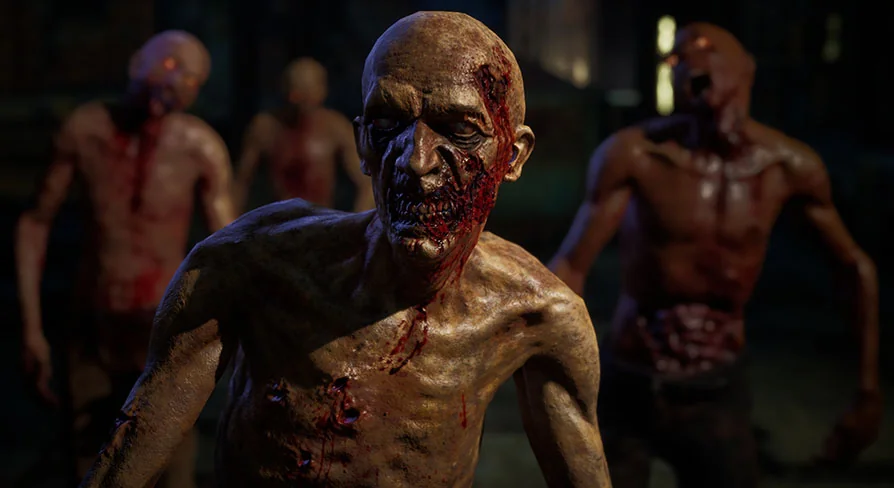
The Shirtless Zombies Pack resolves this pipeline bottleneck by providing five distinct male zombie characters, designated from V1 through V5, natively rigged and skinned to both the UE4 and UE5 Epic Skeletons. By including project files configured for both engine generations, the collection allows developers to plug the models into existing movement graphs, combat systems, and AI routines without manual retargeting steps. Both skeletal hierarchies follow standard bone naming conventions, preserving compatibility with native animation nodes, ragdoll physical assets, and the Modular Zombie Male ecosystem.
Dismemberment Mechanics and Mesh Structure Options
Melee and ballistic combat in horror titles frequently relies on direct visual feedback, requiring character meshes that can either sustain high-performance crowd rendering or separate into pieces upon taking damage.
Every zombie model in the collection is supplied in two mesh formats to address these divergent operational needs. The first variant is a unified One Mesh setup, intended for standard locomotion, ambient encounters, and scenes where character integrity remains intact. The second variant isolates individual body parts into separated sub-meshes designed specifically for dismemberment mechanics. In the included body parts Blueprint, a basic dismemberment response is wired to left-click input, demonstrating how limb detachment can be integrated with weapon trace hits or explosive events in a gameplay scenario.
Visual Variety and PBR Texturing in the Shirtless Zombies Pack
Horror games quickly lose tension when enemy crowds display cloned surfaces, making procedural or multi-material skin variation an essential asset for scene fidelity.
Surface variation is addressed through a modular material system covering both bare flesh and ragged garments. Each of the five zombie characters comes equipped with three distinct body materials, composed of two bloody surface treatments and one burned variant, resulting in 15 unique skin appearances across the set. Clothing options follow a similar visual logic with 10 total garment materials, evenly split between five bloody and five burned themes. All textures are delivered as physically based rendering (PBR) assets authored at 4K resolution, capturing torn muscle, visceral stains, and charred flesh in close proximity. These high-resolution texture maps can be downscaled within the engine to conserve texture memory during large-scale horde sequences.
Facial Morph Targets and Glowing Eyes Controls
Nighttime environments and dark indoor corridors demand readable monster silhouettes, where subtle facial shapes and expressive lighting cues help telegraph aggression.
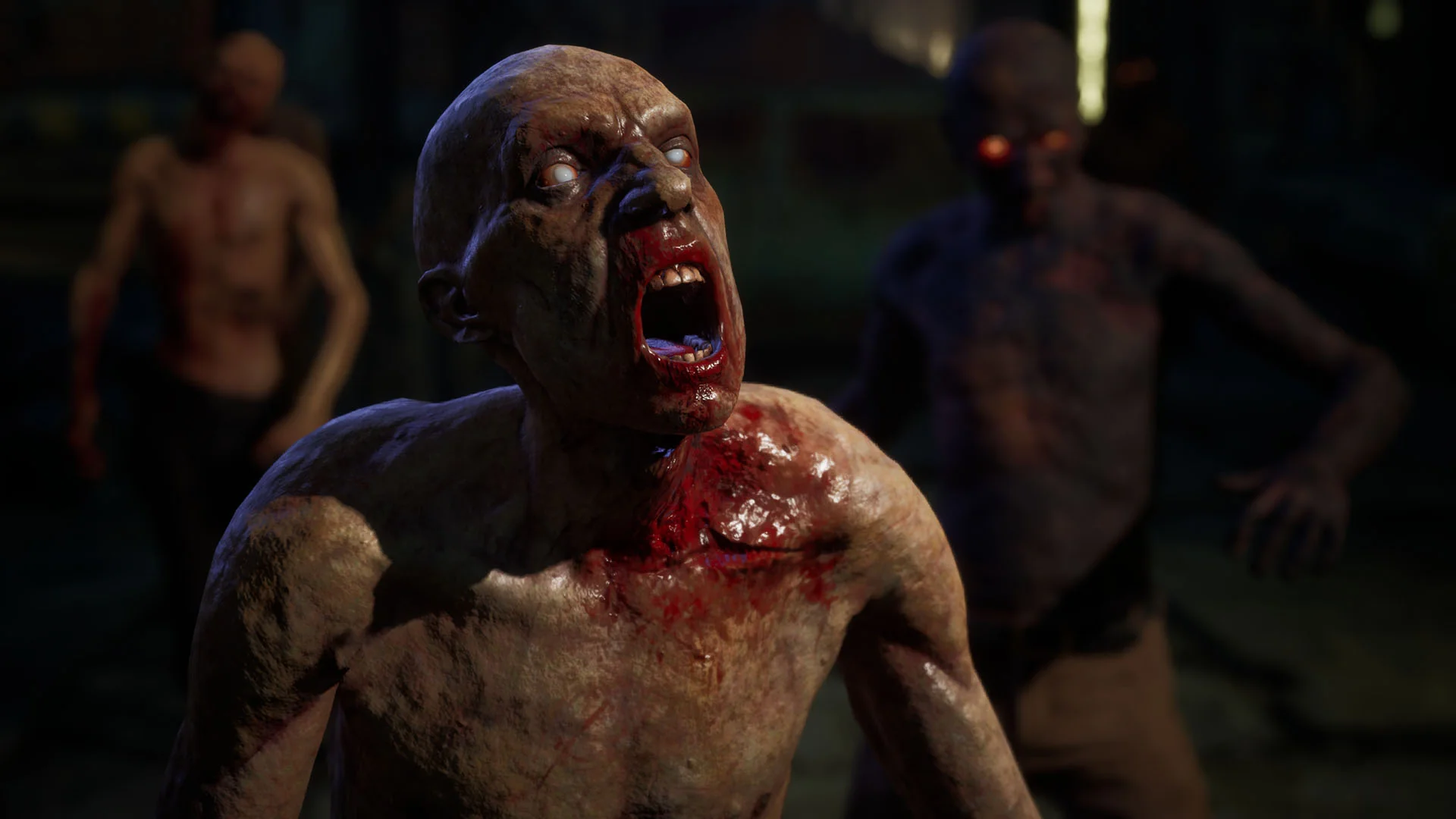
To elevate creature expressiveness during close-quarters combat or cutscenes, the meshes feature dedicated morph targets for an Open Mouth configuration and an Angry expression. These blend shapes allow developers to synchronize jaw movements with biting attacks or configure snarling expressions during search states. Complementing the facial deformation is an integrated glowing eyes feature. Controlled directly through a designated Blueprint variable, the eye illumination can be dialed in or disabled depending on whether an encounter calls for eerie supernatural highlights or grounded, realistic infection aesthetics.
Control Rig Integration and In-Editor Animation Workflows
Iterating on unique zombie behaviors often requires animators to adjust poses and tweak procedural feet placement directly in the editor viewport rather than relying solely on external digital content creation software.
The package supplies three specialized rigs that expand in-engine authoring capabilities. For runtime stance adaptation, CR_Zombie_BB_BasicFootIK serves as a basic foot inverse kinematics rig, implemented directly inside the example Blueprints to ground characters firmly against uneven landscape geometry. For posing and keyframing custom locomotion or death sequences inside the engine, CR_Zombie_BB_Body provides a comprehensive Control Rig tailored for editor-based animation creation. Retargeting existing animation sequences onto the characters is handled by the dedicated IK_Zombie_BB rig. Third-party motion sequences, such as the combat maneuvers from the Zombie Basic - MoCap Pack seen in preview demonstrations, are not included in the asset files, making this IK retargeting rig the designated tool for transferring outside animation libraries onto the meshes.
Blueprint Implementation and Mesh LOD Scaling
Efficient performance scaling requires balancing high-fidelity hero models against strict vertex limits when rendering multiple combatants simultaneously.
The unified One Mesh character variants are configured with three distinct levels of detail (LODs) to maintain stable framerates across varying camera distances. LOD0 delivers full geometric detail at roughly 7,100 vertices for close encounters, LOD1 cuts the geometry down to around 3,500 vertices for mid-distance combat, and LOD2 reduces the mesh to approximately 2,000 vertices for distant horde elements. Sample Blueprints built upon the Epic Third Person Example provide functional templates that expose variables for body and cloth material swapping, morph target intensity, and glowing eye parameters in real time. These modular controls make the package an immediate fit for survival horror prototypes, third-person shooter waves, and underground dungeon crawlers requiring adaptable, combat-ready infected humanoids.
 Characters
 Characters
 Characters
 Characters