"82ee98b2ee2793f1"{"id":"1002448","slug":"underwater-life","title":"Underwater Life","category":"Characters \u0026 Creatures","engine":"4.19+,5.0+","assetVersion":"","engineVersion":"Engine Version: 4.19+,5.0+","tag":"Characters","accent":"blue","visual":"character","summary":"Underwater Life packs 48 rigged, animated salt and freshwater species plus rocks, corals and plants for building aquatic scenes in Unreal Engine.","platform":"Unreal Engine","indexPolicy":"index","publishedAt":"2026-11-10T18:49:19.494Z","updatedAt":"2026-11-10T18:49:19.494Z","sourceNotes":[],"fileContents":[],"compatibility":["Unreal Engine","Engine Version: 4.19+,5.0+"],"featuredImage":{"alt":"Underwater Life","src":"/wp-content/uploads/published/2026/11/a194b6d2ec0c-2ce8d570-77a6-4ffe-abfc-1e3d498de8a4-f72c5e526c.webp"},"hasDownloadLink":true,"downloads":0,"terms":[{"taxonomy":"category","slug":"characters-and-creatures","name":"Characters \u0026 Creatures"}],"galleryImages":[{"src":"/wp-content/uploads/published/2026/11/a39416a313fc-9f4d7406-6aec-4437-bbb0-0a88f98d97ce-c2a89144ac.webp","alt":"Underwater Life"},{"src":"/wp-content/uploads/published/2026/11/0359eb1fcd19-2b105127-358e-41f3-8bc1-e53cac6f826d-3c129a4404.webp","alt":"Underwater Life"},{"src":"/wp-content/uploads/published/2026/11/a77767fac4b5-2d352c60-6591-4871-aae5-67bbd8652afc-fd5f9cf22e.webp","alt":"Underwater Life"},{"src":"/wp-content/uploads/published/2026/11/833c2a619124-eba1fdc9-c143-439c-ad8e-aceb70dfcf82-7d182c0949.webp","alt":"Underwater Life"},{"src":"/wp-content/uploads/published/2026/11/c6c9a535a3bf-8d8724de-dd5d-4787-8077-cb6937273407-bbd5ef9509.webp","alt":"Underwater Life"},{"src":"/wp-content/uploads/published/2026/11/06b8f9108938-900c1f50-6507-4695-9c76-a93e345f9979-fb243a73b2.webp","alt":"Underwater Life"},{"src":"/wp-content/uploads/published/2026/11/b31ad46ba328-8339a9cb-57e0-4244-9981-7f6cf8ac2b6f-cb73d08a8a.webp","alt":"Underwater Life"},{"src":"/wp-content/uploads/published/2026/11/cd23a190b856-524e5bd1-21e0-4542-ab47-62d0bdf5610d-c3b704d5f2.webp","alt":"Underwater Life"},{"src":"/wp-content/uploads/published/2026/11/569baa4406e2-eb0c15ca-9a34-4000-8e23-74abafd8c123-8910b43a81.webp","alt":"Underwater Life"},{"src":"/wp-content/uploads/published/2026/11/a86398bc8748-fdca3991-2f61-4c0c-8ee8-172c41f61289-a37b999a06.webp","alt":"Underwater Life"}],"accessPanel":{"kind":"resource","title":"Get this resource","eyebrow":"Free resource","message":"Download this resource in your browser.","fileName":"Content.7z","safetyNote":"Resources are manually reviewed before listing to improve quality and reduce obvious risks.","actionLabel":"Get this resource","resourceType":"Resource archive","versions":[]},"contentHtml":"\u003cp\u003eReef drop-offs, lakebeds, aquarium tanks, flooded ruins, open-ocean traversal sequences — the hard part of any aquatic scene is rarely the water shader. It is populating the space with creatures that move believably and environments that read as a living seabed rather than an empty blue box. Underwater Life approaches that problem as a single package: 48 animal species drawn from both salt and fresh water, all rigged and animated, with landscape rocks, corals and plants bundled in so a scene can be dressed without hunting for separate environment assets.\u003c/p\u003e \u003ch2\u003eWhat the 48 species actually cover\u003c/h2\u003e \u003cp\u003eThe species count is the headline figure, and it is deliberately split across two habitats. Salt water and fresh water species sit in the same collection, which matters more than it first appears. A single project might need a coastal scene, a river sequence and an interior tank, and having both biomes represented in one rigged set means the creatures stay visually and technically consistent across all three. Mixing packs from different creators usually produces a visible mismatch in animation style and rig behaviour; here the two habitat groups share the same animation foundation by design.\u003c/p\u003e \u003cp\u003eEvery one of those species is rigged and animated — not modelled in a static pose and left for the user to rig. That distinction shapes how quickly the package can be put to work. There is no separate rigging pass, no retargeting experiment, and no need to source a swimming animation library that may not match the mesh.\u003c/p\u003e \u003ch2\u003eWhy uniform animations carry the Underwater Life set\u003c/h2\u003e \u003cp\u003eUniform animations for consistency is the phrase that defines how this package behaves in practice. Instead of each creature carrying bespoke, individually authored motion, the set is structured through a shared animation structure. The practical consequences are worth spelling out.\u003c/p\u003e \u003cp\u003eFirst, scenes with many species look like they belong together. A school of small fish crossing in front of a larger predator reads as one ecosystem rather than a collage of unrelated assets. Second, tuning becomes predictable: adjusting how a creature moves in one place carries over in spirit to the rest of the set, because the underlying animation logic does not change from species to species. Third, and most useful for anyone assembling a scene under time pressure, every animal in the package is ready to drop in immediately — the uniform approach removes the per-asset inspection that usually eats the first hour of working with a new creature pack.\u003c/p\u003e \u003cp\u003eThe associated animation blueprint ties into this. Rather than treating each fish as an isolated animated mesh, the package is set up so animation is handled through a blueprint-driven system, matching the script and animation blueprint tags the collection is filed under. For scene builders, that means creatures can be placed and driven within a familiar Unreal workflow instead of requiring hand-placed animation tracks for every instance.\u003c/p\u003e \u003ch2\u003eRocks, corals and plants as scene scaffolding\u003c/h2\u003e \u003cp\u003eCreatures alone do not make an underwater environment. The additional landscape rock assets, corals and plants are what let a scene reach something presentable quickly. These are not incidental extras bolted onto an animal pack; they are the pieces that give the animals somewhere to be.\u003c/p\u003e \u003cp\u003eLandscape rocks handle the ground layer — the seabed structure that grounds a scene and gives the camera something to move past. Corals add the mid-ground silhouette that makes a reef read as a reef. Plants fill the remaining space and break up open water. Working from these three categories, a passable underwater scene can be assembled in a single session: lay down rock, place coral clusters, scatter plants, then populate with species from the 48-strong set.\u003c/p\u003e \u003cp\u003eBecause these environment pieces ship alongside the animals, scale and visual tone are already in the same family. That is a quieter advantage than the species count but just as practical — sourcing corals from one pack and fish from another frequently produces creatures that look oversized or undersized against their surroundings.\u003c/p\u003e \u003ch2\u003eBuilding a quick underwater scene end to end\u003c/h2\u003e \u003cp\u003eThe stated intent behind the package is to let a scene be created quickly and then adapted to whatever project it lands in. Following that through, the workflow splits into a few clear stages.\u003c/p\u003e \u003cp\u003eStart with terrain and dressing: the rock assets establish the floor, corals and plants add vertical interest and cover. Then bring in the animals. Because every species is rigged, animated and driven through the uniform animation setup, this stage is placement rather than setup — choosing which of the 48 species belong in the shot and where. Salt water species suit reef and ocean scenes; fresh water species suit rivers, lakes and enclosed water. Having both in one package means a single project spanning multiple aquatic locations does not need a second creature library.\u003c/p\u003e \u003cp\u003eThe animation blueprint layer comes into its own here. Scenes that need many creatures moving at once benefit from a system-level approach to animation rather than per-instance handling, and that is what the blueprint setup provides. Script-driven behaviour, indicated by the script tag, points the same direction: the package is intended to function as a working system inside a project, not just a folder of meshes.\u003c/p\u003e \u003ch2\u003eWhere Underwater Life fits in a project\u003c/h2\u003e \u003cp\u003eThe realistic styling and the ocean-and-underwater tagging place this collection in projects that aim for a naturalistic look rather than a stylised one. Documentary-style sequences, environmental showcases, educational or simulation content touching on marine and freshwater ecology, and game levels that include underwater traversal all sit comfortably within what the package provides.\u003c/p\u003e \u003cp\u003eVersion support starting at 4.19 and extending to 5.0+ widens that fit further, covering projects that have not yet moved to the newer engine line as well as those that have. Compatibility with Animal Pack Ultra is worth noting for anyone already working within that ecosystem, since it signals the package is meant to slot into an existing animal pipeline rather than stand alone.\u003c/p\u003e \u003cp\u003eWhere the collection is less suited is in projects needing highly specific, individually authored creature performances — a hero fish with bespoke motion, for instance. The uniform animation approach is the package's strength for crowd-like populations and its limitation for one-off character work.\u003c/p\u003e \u003cp\u003eFor environment artists, technical artists and level designers who need an aquatic scene populated and dressed without building a creature library from scratch, the combination is straightforward: 48 rigged species across two water types, consistent animation across all of them, a blueprint-driven animation system, and the rocks, corals and plants needed to make the space around them believable. The preview video remains the fastest way to judge whether the visual style matches a given project before committing.\u003c/p\u003e\n\n\u003ch2\u003eMore From The Same Workflow\u003c/h2\u003e\n\u003cul\u003e\n\u003cli\u003e\u003ca href=\"https://3dcghub.com/underwater-odyssey/\" rel=\"noopener noreferrer\"\u003eUnderwater odyssey\u003c/a\u003e\u003c/li\u003e\n\u003cli\u003e\u003ca href=\"https://3dcghub.com/forest-golems/\" rel=\"noopener noreferrer\"\u003eForest Golems\u003c/a\u003e\u003c/li\u003e\n\u003cli\u003e\u003ca href=\"https://3dcghub.com/fish-a-i-fish-school-system-v2/\" rel=\"noopener noreferrer\"\u003eFish A.I - Fish School System V2\u003c/a\u003e\u003c/li\u003e\n\u003cli\u003e\u003ca href=\"https://3dcghub.com/daily-life-ai/\" rel=\"noopener noreferrer\"\u003eDaily Life AI\u003c/a\u003e\u003c/li\u003e\n\u003cli\u003e\u003ca href=\"https://3dcghub.com/scary-shark-assets/\" rel=\"noopener noreferrer\"\u003eScary Shark Assets\u003c/a\u003e\u003c/li\u003e\n\u003c/ul\u003e","contentTextLength":7077,"navigation":{"current":2,"total":4372,"previous":{"id":"1002449","slug":"dragon-knight","title":"Dragon Knight","category":"Humans","platform":"Unreal Engine","updatedAt":"2026-11-10T18:54:05.186Z"},"next":{"id":"1002447","slug":"tropical-fish","title":"Tropical Fish","category":"Towns \u0026 Villages","platform":"Unreal Engine","updatedAt":"2026-11-10T18:48:29.929Z"}},"relatedResources":[{"id":"1000900","slug":"underwater-odyssey","title":"Underwater odyssey","category":"Characters \u0026 Creatures","engine":"4.26+,5.0+","assetVersion":"","engineVersion":"Engine Version: 4.26+,5.0+","tag":"Characters","accent":"blue","visual":"character","summary":"Underwater odyssey brings a lowpoly fantasy crew—captain, sailors, diver—plus a big ship and bathyscaphe, with 56 creature animations.","platform":"Unreal Engine","indexPolicy":"index","publishedAt":"2026-08-06T05:02:54.022Z","updatedAt":"2026-08-06T05:02:54.022Z","sourceNotes":[],"fileContents":[],"compatibility":["Unreal Engine","Engine Version: 4.26+,5.0+"],"featuredImage":{"alt":"Underwater odyssey","src":"/wp-content/uploads/published/2026/08/ced42c084e6c-fdb70e23-72ba-4fa7-9e03-7261c6e95629-721df3fc9c.webp"},"hasDownloadLink":true,"downloads":1},{"id":"2436","slug":"forest-golems","title":"Forest Golems","category":"Characters \u0026 Creatures","engine":"4.27,5.0+","assetVersion":"Engine version: 4.27,5.0+","engineVersion":"5.2","tag":"Characters","accent":"blue","visual":"character","summary":"Bring your game worlds to life with the Forest Golem asset pack. Featuring realistic, toon, and poly art styles with high-quality animations and textures.","platform":"Unreal Engine","indexPolicy":"index","publishedAt":"2026-02-07T09:50:16.000Z","updatedAt":"2026-04-19T15:58:02.000Z","sourceNotes":[],"fileContents":[],"compatibility":["Unreal Engine","Engine version: 4.27,5.0+"],"featuredImage":{"alt":"Forest Golems","src":"https://3dcghub.com/wp-content/uploads/2026/02/c6849508-6bf7-485f-9aed-03c0ed80775b.webp"},"hasDownloadLink":true,"downloads":1},{"id":"2419","slug":"fish-a-i-fish-school-system-v2","title":"Fish A.I - Fish School System V2","category":"Characters \u0026 Creatures","engine":"4.26+,5.0+","assetVersion":"Engine version: 4.26+,5.0+","engineVersion":"4.25","tag":"Characters","accent":"blue","visual":"character","summary":"Enhance your Unreal Engine projects with Fish School System V2. Use Niagara AI for optimized, high-performance fish schools with smart avoidance and custom beha","platform":"Unreal Engine","indexPolicy":"index","publishedAt":"2026-02-07T09:45:03.000Z","updatedAt":"2026-04-19T15:58:02.000Z","sourceNotes":[],"fileContents":[],"compatibility":["Unreal Engine"],"featuredImage":{"alt":"Fish A.I - Fish School System V2","src":"https://3dcghub.com/wp-content/uploads/2026/02/0b459325-d208-4f41-9e67-3dca98335a59.webp"},"hasDownloadLink":true,"downloads":0}]}
Characters
Underwater Life
Underwater Life packs 48 rigged, animated salt and freshwater species plus rocks, corals and plants for building aquatic scenes in Unreal Engine.
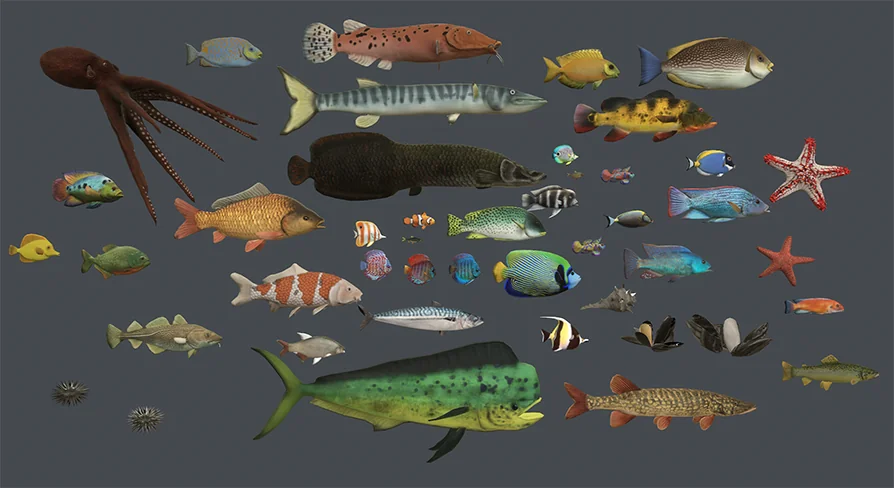
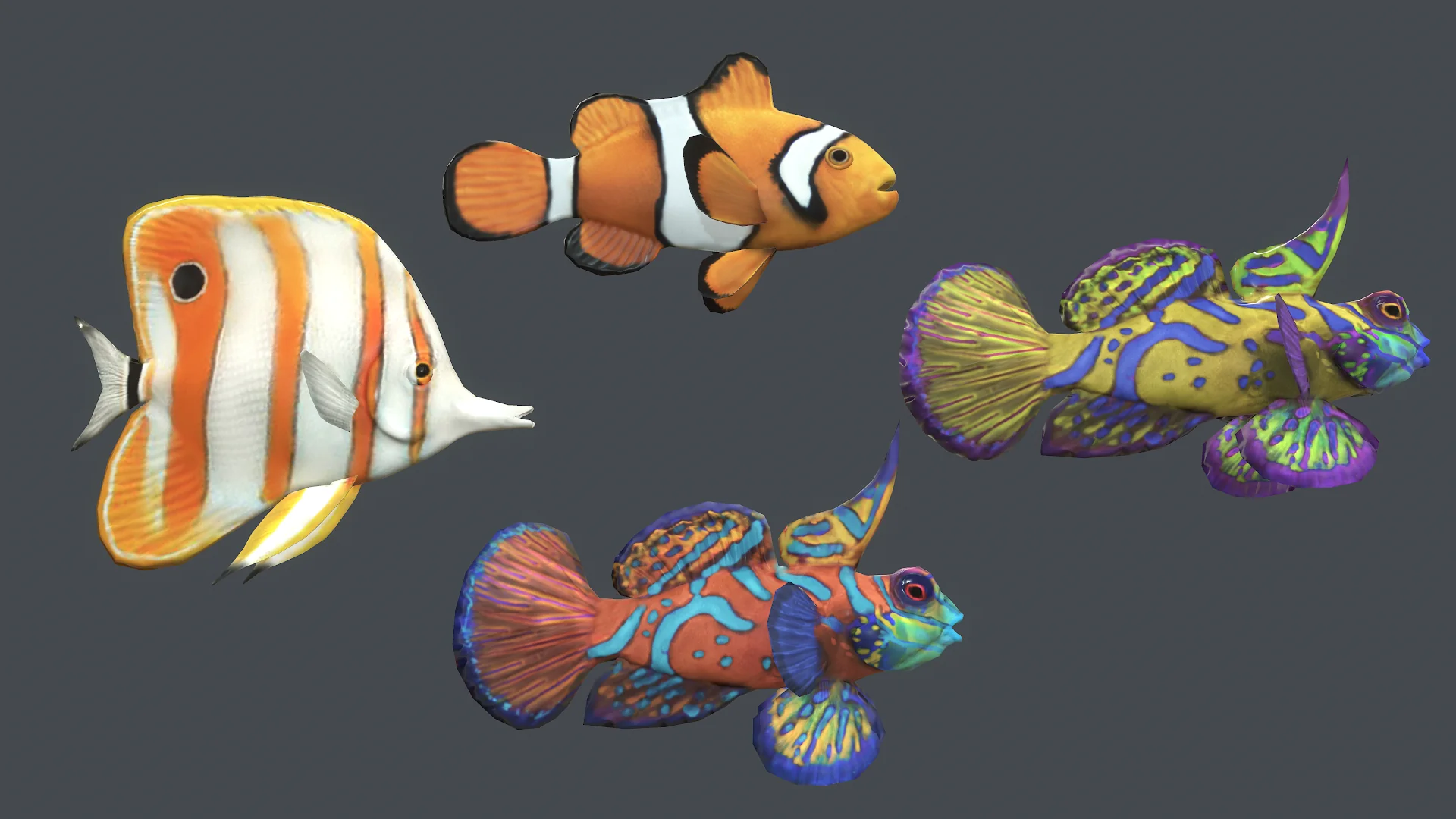
Reef drop-offs, lakebeds, aquarium tanks, flooded ruins, open-ocean traversal sequences — the hard part of any aquatic scene is rarely the water shader. It is populating the space with creatures that move believably and environments that read as a living seabed rather than an empty blue box. Underwater Life approaches that problem as a single package: 48 animal species drawn from both salt and fresh water, all rigged and animated, with landscape rocks, corals and plants bundled in so a scene can be dressed without hunting for separate environment assets.
What the 48 species actually cover
The species count is the headline figure, and it is deliberately split across two habitats. Salt water and fresh water species sit in the same collection, which matters more than it first appears. A single project might need a coastal scene, a river sequence and an interior tank, and having both biomes represented in one rigged set means the creatures stay visually and technically consistent across all three. Mixing packs from different creators usually produces a visible mismatch in animation style and rig behaviour; here the two habitat groups share the same animation foundation by design.
Every one of those species is rigged and animated — not modelled in a static pose and left for the user to rig. That distinction shapes how quickly the package can be put to work. There is no separate rigging pass, no retargeting experiment, and no need to source a swimming animation library that may not match the mesh.
Why uniform animations carry the Underwater Life set
Uniform animations for consistency is the phrase that defines how this package behaves in practice. Instead of each creature carrying bespoke, individually authored motion, the set is structured through a shared animation structure. The practical consequences are worth spelling out.
First, scenes with many species look like they belong together. A school of small fish crossing in front of a larger predator reads as one ecosystem rather than a collage of unrelated assets. Second, tuning becomes predictable: adjusting how a creature moves in one place carries over in spirit to the rest of the set, because the underlying animation logic does not change from species to species. Third, and most useful for anyone assembling a scene under time pressure, every animal in the package is ready to drop in immediately — the uniform approach removes the per-asset inspection that usually eats the first hour of working with a new creature pack.
The associated animation blueprint ties into this. Rather than treating each fish as an isolated animated mesh, the package is set up so animation is handled through a blueprint-driven system, matching the script and animation blueprint tags the collection is filed under. For scene builders, that means creatures can be placed and driven within a familiar Unreal workflow instead of requiring hand-placed animation tracks for every instance.
Rocks, corals and plants as scene scaffolding
Creatures alone do not make an underwater environment. The additional landscape rock assets, corals and plants are what let a scene reach something presentable quickly. These are not incidental extras bolted onto an animal pack; they are the pieces that give the animals somewhere to be.
Landscape rocks handle the ground layer — the seabed structure that grounds a scene and gives the camera something to move past. Corals add the mid-ground silhouette that makes a reef read as a reef. Plants fill the remaining space and break up open water. Working from these three categories, a passable underwater scene can be assembled in a single session: lay down rock, place coral clusters, scatter plants, then populate with species from the 48-strong set.
Because these environment pieces ship alongside the animals, scale and visual tone are already in the same family. That is a quieter advantage than the species count but just as practical — sourcing corals from one pack and fish from another frequently produces creatures that look oversized or undersized against their surroundings.
Building a quick underwater scene end to end
The stated intent behind the package is to let a scene be created quickly and then adapted to whatever project it lands in. Following that through, the workflow splits into a few clear stages.
Start with terrain and dressing: the rock assets establish the floor, corals and plants add vertical interest and cover. Then bring in the animals. Because every species is rigged, animated and driven through the uniform animation setup, this stage is placement rather than setup — choosing which of the 48 species belong in the shot and where. Salt water species suit reef and ocean scenes; fresh water species suit rivers, lakes and enclosed water. Having both in one package means a single project spanning multiple aquatic locations does not need a second creature library.
The animation blueprint layer comes into its own here. Scenes that need many creatures moving at once benefit from a system-level approach to animation rather than per-instance handling, and that is what the blueprint setup provides. Script-driven behaviour, indicated by the script tag, points the same direction: the package is intended to function as a working system inside a project, not just a folder of meshes.
Where Underwater Life fits in a project
The realistic styling and the ocean-and-underwater tagging place this collection in projects that aim for a naturalistic look rather than a stylised one. Documentary-style sequences, environmental showcases, educational or simulation content touching on marine and freshwater ecology, and game levels that include underwater traversal all sit comfortably within what the package provides.
Version support starting at 4.19 and extending to 5.0+ widens that fit further, covering projects that have not yet moved to the newer engine line as well as those that have. Compatibility with Animal Pack Ultra is worth noting for anyone already working within that ecosystem, since it signals the package is meant to slot into an existing animal pipeline rather than stand alone.
Where the collection is less suited is in projects needing highly specific, individually authored creature performances — a hero fish with bespoke motion, for instance. The uniform animation approach is the package's strength for crowd-like populations and its limitation for one-off character work.
For environment artists, technical artists and level designers who need an aquatic scene populated and dressed without building a creature library from scratch, the combination is straightforward: 48 rigged species across two water types, consistent animation across all of them, a blueprint-driven animation system, and the rocks, corals and plants needed to make the space around them believable. The preview video remains the fastest way to judge whether the visual style matches a given project before committing.
 Characters
 Characters
 Characters
 Characters