"031373f479d9561a"{"id":"1000262","slug":"daily-life-ai","title":"Daily Life AI","category":"Animations","engine":"4.26+,5.0+","assetVersion":"","engineVersion":"Engine Version: 4.26+,5.0+","tag":"Animations","accent":"blue","visual":"animation","summary":"An implementation guide to Daily Life AI, detailing its day/night cycle, behavior tree structure, hunger system, and drag-and-drop NPC routines.","platform":"Unreal Engine","publishedAt":"2026-06-30T23:06:12.448Z","updatedAt":"2026-06-30T23:06:12.448Z","sourceNotes":[],"fileContents":[],"compatibility":["Unreal Engine","Engine Version: 4.26+,5.0+"],"featuredImage":{"alt":"Daily Life AI","src":"/wp-content/uploads/published/2026/06/e147817c5ccf-a6a6198d-7c5a-4d60-bd9f-d08e7df2d365-79bd7785fd.webp"},"hasDownloadLink":true,"downloads":1,"terms":[{"taxonomy":"category","slug":"animations-game-systems","name":"Animations"}],"galleryImages":[{"src":"/wp-content/uploads/published/2026/06/004f94d5f526-4c622165-c156-49d7-8be2-e3543c263c03-f09763b6d9.webp","alt":"Daily Life AI"},{"src":"/wp-content/uploads/published/2026/06/1b1b79535c66-8889c5a3-6ea7-4dd3-88ff-6d71a4d78a40-7133e3e2d6.webp","alt":"Daily Life AI"},{"src":"/wp-content/uploads/published/2026/06/ce2be7b4d0da-49f08a76-0925-447a-bb34-5c4b732f3268-60880f78ef.webp","alt":"Daily Life AI"},{"src":"/wp-content/uploads/published/2026/06/cc5dd240657c-e68d64bf-b06a-4cff-86a8-62b0c1100342-1070a06d82.webp","alt":"Daily Life AI"},{"src":"/wp-content/uploads/published/2026/06/c4cfe26d1533-49f4100f-8445-4378-b8d1-260232835e3c-fa56b0a470.webp","alt":"Daily Life AI"},{"src":"/wp-content/uploads/published/2026/06/7fa545bde8c7-87e197ed-243a-4594-bd92-b9af14f5105b-055c1311ef.webp","alt":"Daily Life AI"},{"src":"/wp-content/uploads/published/2026/06/a07f98a7c7d2-3e3ba3a8-070b-4e94-a6d4-fc68e4594742-3c4e199a83.webp","alt":"Daily Life AI"},{"src":"/wp-content/uploads/published/2026/06/65dbe874b28f-3eb20878-1281-4135-aa0f-3514f4bb6636-7344b848e8.webp","alt":"Daily Life AI"},{"src":"/wp-content/uploads/published/2026/06/096f9e0206ab-dad72cf9-5a36-4cec-a4c1-c2329b195ae1-d0c220afd2.webp","alt":"Daily Life AI"},{"src":"/wp-content/uploads/published/2026/06/eb5511db5c93-97d250e2-fa73-4c0a-9409-ce32329ecca5-510d845589.webp","alt":"Daily Life AI"}],"accessPanel":{"kind":"resource","title":"Download this resource","eyebrow":"Free Download","message":"Log in or create a free account to start your download.","fileName":"Daily Life AI.7z","safetyNote":"Resources are manually reviewed before listing to improve quality and reduce obvious risks.","actionLabel":"Download Free","resourceType":"Resource archive"},"contentHtml":"Environments in role-playing games require active populations to feel believable and lived-in. Daily Life AI addresses this core development need by providing a framework where non-player characters autonomously transition between tasks. Instead of remaining static or pacing aimlessly, characters operate on an overarching day/night cycle that dictates their current priorities and actions. This underlying logic is designed to handle the foundational routines of a settlement or city, saving development teams the extensive time required to script individual daily schedules from scratch. By hooking directly into the time of day, the system seamlessly shifts NPCs from active daytime roles to evening routines without requiring manual triggers or complex timeline sequencing. \u003ch3\u003eCore Daily Routines and the Hunger System\u003c/h3\u003e The system categorizes NPC activity into four primary behavioral states: Work, Sleep, Relax, and Eat. The Work state allows developers to define specific hours of the day when an NPC must report to a designated location to perform their job. Once the shift concludes, or if no work is currently assigned, the behavior tree evaluates the character's other needs. The Sleep state provides structured downtime for the population. Developers can assign a specific bed to an individual character, and the AI will automatically navigate to that assigned location during their designated sleeping hours. When characters are neither working nor sleeping, the system defaults to the Relax state. In this mode, NPCs actively seek out ways to occupy their time using the surrounding environment. They will locate chairs to sit on, find walls to lean against, or naturally congregate to hang around with other NPCs in the vicinity. Recently, the framework was updated to include a dedicated hunger system, introducing the Eat state. This state tracks the character's needs, prompting them to break from their current routine to actively search for food within the environment. This adds an additional layer of unpredictability and realism to their daily schedules, ensuring characters do not rigidly adhere to a work-and-sleep loop if their survival needs are not met. \u003ch3\u003eDrag-and-Drop Implementation and Pathfinding\u003c/h3\u003e Integrating these routines into a level is shaped by a drag-and-drop workflow. This approach allows level designers to populate a scene and get basic schedules running quickly, requiring only fundamental knowledge to establish the initial setup. The movement and pathfinding rely on standard navigation mechanics, routing characters across the environment's nav-mesh. Recent updates to the package specifically addressed and resolved previous issues with the showcase map's nav-mesh, ensuring smooth traversal when characters calculate paths to their beds, workstations, or food sources. Underneath the drag-and-drop simplicity, the scheduling logic is driven by a straightforward behavior tree. Because the behavior tree is kept intentionally simple, it serves as an accessible foundation for teams who need to expand the system with more complex, project-specific logic. It visualizes the decision-making process, showing exactly how an NPC prioritizes hunger over work, or sleep over relaxation. \u003ch3\u003ePrototyping with Interactable Actors and Animations\u003c/h3\u003e To facilitate environmental interactions, the pack includes seven distinct interactable actors. These actors serve as the connection points for the AI, dictating where and how an NPC can sit, lean, or perform a task. Developers can use these seven actors as immediate prototyping tools or use them as functional templates to create an unlimited number of custom interactable objects tailored to their specific world design. The framework supports any type of character model and animation set, allowing teams to seamlessly integrate their own proprietary assets. For immediate testing out of the box, six custom animations are provided, giving developers clear visual feedback when setting up the initial logic and testing the interaction points. To assist with the setup process, the package includes a dedicated showcase map serving as an implementation example designed by JmannDX. Accompanying this showcase are specific tutorials designed to ease the onboarding process. These tutorials focus on the most common customization needs: adding unique animated interactions and integrating custom character models into the existing AI routines. \u003ch3\u003eSystem Scope and Expansion Requirements\u003c/h3\u003e While the system provides a comprehensive suite of civilian behaviors, its scope is strictly focused on non-violent daily routines. The pack does not include any combat logic or fighting mechanics. Developers building action-RPGs or games requiring hostile encounters will need to implement their own custom combat systems or integrate third-party combat solutions from the marketplace alongside this daily routine framework. Because the system is fundamentally designed to be expanded upon, it is highly recommended that users possess a basic understanding of artificial intelligence and animation principles before attempting to heavily modify the core behavior tree. This foundational knowledge ensures that any new branches or custom states a developer adds will integrate smoothly with the existing day/night cycle and the newly implemented hunger mechanics.\n\n\u003ch2\u003eRelated Resources Worth Checking\u003c/h2\u003e\n\u003cul\u003e\n\u003cli\u003e\u003ca href=\"https://3dcghub.com/npc-ai-queuing-system/\" title=\"NPC AI Queuing System\"\u003eNPC AI Queuing System\u003c/a\u003e\u003c/li\u003e\n\u003cli\u003e\u003ca href=\"https://3dcghub.com/birds/\" title=\"Birds\"\u003eBirds\u003c/a\u003e\u003c/li\u003e\n\u003cli\u003e\u003ca href=\"https://3dcghub.com/athena-ai-a-utility-ai-framework-v2/\" title=\"Athena AI: A Utility AI Framework - V2\"\u003eAthena AI: A Utility AI Framework - V2\u003c/a\u003e\u003c/li\u003e\n\u003cli\u003e\u003ca href=\"https://3dcghub.com/advanced-flock-system-multithreaded-fish-ai-and-reactive-school-behavior/\" title=\"Advanced Flock System – Multithreaded Fish AI and Reactive School Behavior\"\u003eAdvanced Flock System – Multithreaded Fish AI and Reactive School Behavior\u003c/a\u003e\u003c/li\u003e\n\u003cli\u003e\u003ca href=\"https://3dcghub.com/runtime-metahuman-lip-sync-ai-for-npcs-cc4-genesis-arkit-and-more/\" title=\"Runtime MetaHuman Lip Sync (AI for NPCs) (+ CC4, Genesis, ARKit, and more)\"\u003eRuntime MetaHuman Lip Sync (AI for NPCs) (+ CC4, Genesis, ARKit, and more)\u003c/a\u003e\u003c/li\u003e\n\u003c/ul\u003e","contentTextLength":5572,"navigation":{"current":1088,"total":3223,"previous":{"id":"1000263","slug":"succubus-lucia","title":"Succubus Lucia","category":"Humans","platform":"Unreal Engine","updatedAt":"2026-06-30T23:11:00.933Z"},"next":{"id":"1000261","slug":"battle-and-wounds-sound-pack","title":"Battle \u0026 Wounds Sound Pack","category":"Sound Effects","platform":"Unreal Engine","updatedAt":"2026-06-30T23:00:08.105Z"}},"relatedResources":[{"id":"1000083","slug":"npc-ai-queuing-system","title":"NPC AI Queuing System","category":"Gameplay Features","engine":"Engine Version: 4.26+,5.0+","assetVersion":"Engine Version: 4.26+,5.0+","engineVersion":"","tag":"Gameplay Features","accent":"blue","visual":"mech","summary":"A Blueprint-based NPC queuing system for smooth pedestrian behavior, spline routes, behavior tree logic, debug tools, and quick scene setup.","platform":"Unreal Engine","publishedAt":"2026-06-05T16:06:07.049Z","updatedAt":"2026-06-05T16:06:07.049Z","sourceNotes":[],"fileContents":[],"compatibility":["Unreal Engine","Engine Version: 4.26+,5.0+"],"featuredImage":{"alt":"NPC AI Queuing System","src":"/wp-content/uploads/published/2026/06/2fce6ebe6d61-050ebb3a-f89b-44e9-8982-9b4b5c0267ab-85fbd54aad.webp"},"hasDownloadLink":true,"downloads":0},{"id":"1001231","slug":"demonstrating-animation-blueprints-and-ai-for-gameplay-designers","title":"Demonstrating Animation Blueprints and AI for Gameplay Designers","category":"Action-Adventure","engine":"5.0+","assetVersion":"","engineVersion":"Engine Version: 5.0+","tag":"Action-Adventure","accent":"blue","visual":"animation","summary":"Explore the connection between Animation Blueprints, behavior trees, montages, and basic enemy character AI for gameplay designers.","platform":"Unreal Engine","publishedAt":"2026-09-21T03:35:26.508Z","updatedAt":"2026-09-21T03:35:26.508Z","sourceNotes":[],"fileContents":[],"compatibility":["Unreal Engine","Engine Version: 5.0+"],"featuredImage":{"alt":"Demonstrating Animation Blueprints and AI for Gameplay Designers","src":"/wp-content/uploads/published/2026/09/17ead882c717-6d1822dd-94f6-42cb-bab3-18f794094846-660798aead.webp"},"hasDownloadLink":true,"downloads":0},{"id":"1606","slug":"birds","title":"Birds","category":"Animals","engine":"4.18","assetVersion":"","engineVersion":"4.18","tag":"Animals","accent":"blue","visual":"character","summary":"Bring your game worlds to life with a realistic bird AI system. Features Crow, Pigeon, and Seagull models with 87 animations and advanced behavior trees.","platform":"Unreal Engine","publishedAt":"2026-02-06T20:03:18.000Z","updatedAt":"2026-04-19T15:58:07.000Z","sourceNotes":[],"fileContents":[],"compatibility":["Unreal Engine"],"featuredImage":{"alt":"Birds","src":"https://3dcghub.com/wp-content/uploads/2026/02/f4ed63d8-94fc-474e-9ae2-b40d120daacf.webp"},"hasDownloadLink":true,"downloads":0}]}
Animations
Daily Life AI
An implementation guide to Daily Life AI, detailing its day/night cycle, behavior tree structure, hunger system, and drag-and-drop NPC routines.
Category:Unreal Engine,AnimationsPlatform: Unreal EngineEngine Version: 4.26+,5.0+Published: Jun 30, 2026
Animations
Resource overview
Environments in role-playing games require active populations to feel believable and lived-in. Daily Life AI addresses this core development need by providing a framework where non-player characters autonomously transition between tasks. Instead of remaining static or pacing aimlessly, characters operate on an overarching day/night cycle that dictates their current priorities and actions. This underlying logic is designed to handle the foundational routines of a settlement or city, saving development teams the extensive time required to script individual daily schedules from scratch. By hooking directly into the time of day, the system seamlessly shifts NPCs from active daytime roles to evening routines without requiring manual triggers or complex timeline sequencing.
Core Daily Routines and the Hunger System
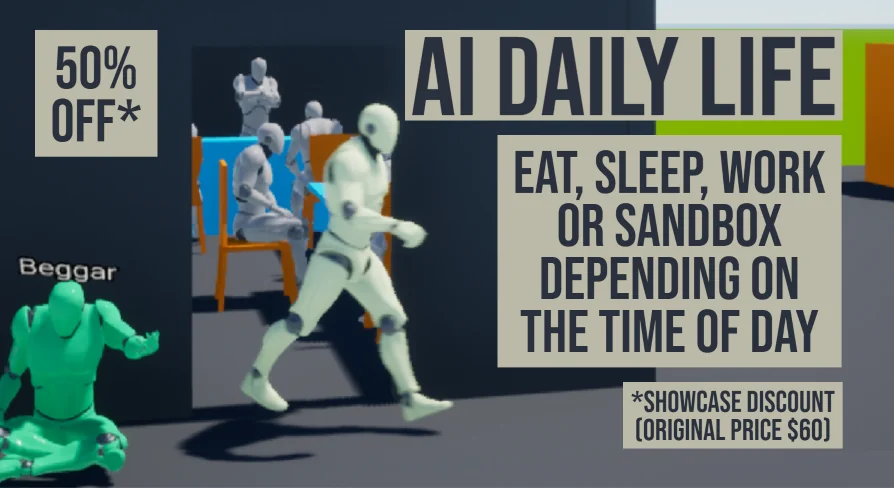
The system categorizes NPC activity into four primary behavioral states: Work, Sleep, Relax, and Eat. The Work state allows developers to define specific hours of the day when an NPC must report to a designated location to perform their job. Once the shift concludes, or if no work is currently assigned, the behavior tree evaluates the character's other needs. The Sleep state provides structured downtime for the population. Developers can assign a specific bed to an individual character, and the AI will automatically navigate to that assigned location during their designated sleeping hours. When characters are neither working nor sleeping, the system defaults to the Relax state. In this mode, NPCs actively seek out ways to occupy their time using the surrounding environment. They will locate chairs to sit on, find walls to lean against, or naturally congregate to hang around with other NPCs in the vicinity. Recently, the framework was updated to include a dedicated hunger system, introducing the Eat state. This state tracks the character's needs, prompting them to break from their current routine to actively search for food within the environment. This adds an additional layer of unpredictability and realism to their daily schedules, ensuring characters do not rigidly adhere to a work-and-sleep loop if their survival needs are not met.
Drag-and-Drop Implementation and Pathfinding
Integrating these routines into a level is shaped by a drag-and-drop workflow. This approach allows level designers to populate a scene and get basic schedules running quickly, requiring only fundamental knowledge to establish the initial setup. The movement and pathfinding rely on standard navigation mechanics, routing characters across the environment's nav-mesh. Recent updates to the package specifically addressed and resolved previous issues with the showcase map's nav-mesh, ensuring smooth traversal when characters calculate paths to their beds, workstations, or food sources. Underneath the drag-and-drop simplicity, the scheduling logic is driven by a straightforward behavior tree. Because the behavior tree is kept intentionally simple, it serves as an accessible foundation for teams who need to expand the system with more complex, project-specific logic. It visualizes the decision-making process, showing exactly how an NPC prioritizes hunger over work, or sleep over relaxation.
Prototyping with Interactable Actors and Animations
To facilitate environmental interactions, the pack includes seven distinct interactable actors. These actors serve as the connection points for the AI, dictating where and how an NPC can sit, lean, or perform a task. Developers can use these seven actors as immediate prototyping tools or use them as functional templates to create an unlimited number of custom interactable objects tailored to their specific world design. The framework supports any type of character model and animation set, allowing teams to seamlessly integrate their own proprietary assets. For immediate testing out of the box, six custom animations are provided, giving developers clear visual feedback when setting up the initial logic and testing the interaction points. To assist with the setup process, the package includes a dedicated showcase map serving as an implementation example designed by JmannDX. Accompanying this showcase are specific tutorials designed to ease the onboarding process. These tutorials focus on the most common customization needs: adding unique animated interactions and integrating custom character models into the existing AI routines.
System Scope and Expansion Requirements
While the system provides a comprehensive suite of civilian behaviors, its scope is strictly focused on non-violent daily routines. The pack does not include any combat logic or fighting mechanics. Developers building action-RPGs or games requiring hostile encounters will need to implement their own custom combat systems or integrate third-party combat solutions from the marketplace alongside this daily routine framework. Because the system is fundamentally designed to be expanded upon, it is highly recommended that users possess a basic understanding of artificial intelligence and animation principles before attempting to heavily modify the core behavior tree. This foundational knowledge ensures that any new branches or custom states a developer adds will integrate smoothly with the existing day/night cycle and the newly implemented hunger mechanics.
 Animations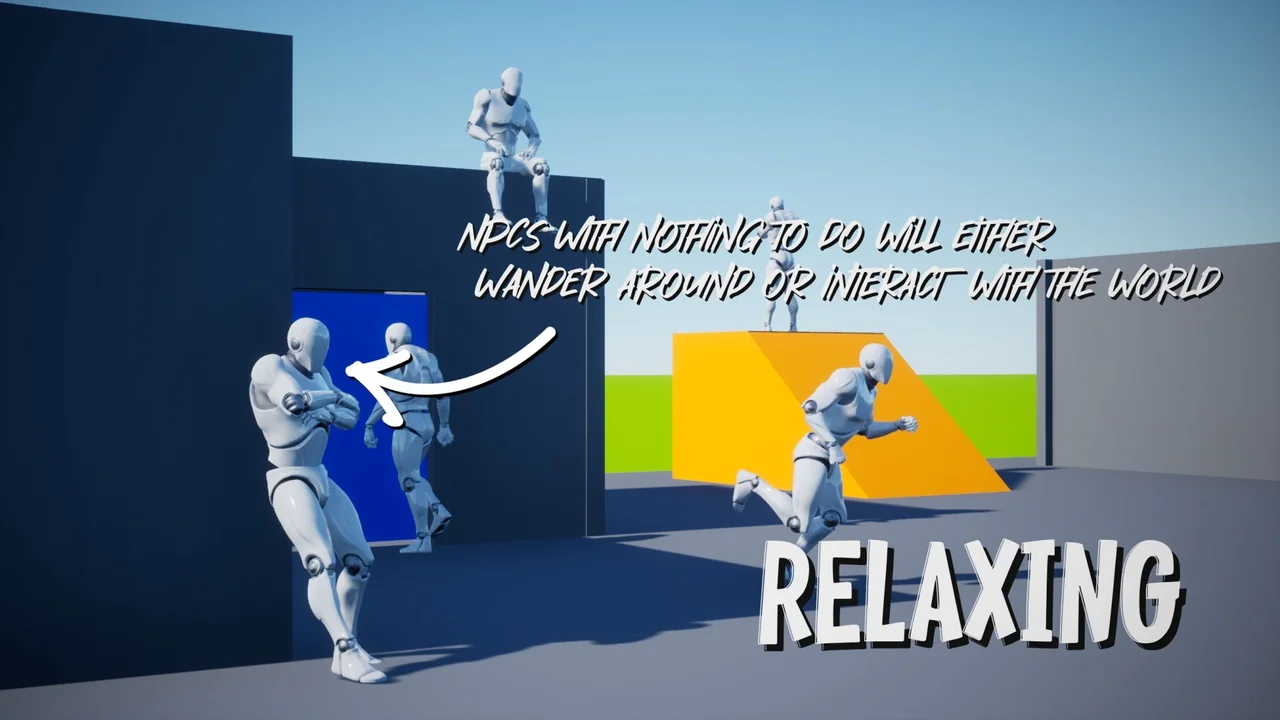
 Gameplay Features
 Action-Adventure
 Animals