"82ee98b2ee2793f1"{"id":"1002447","slug":"tropical-fish","title":"Tropical Fish","category":"Towns \u0026 Villages","engine":"4.25+,5.0+","assetVersion":"","engineVersion":"Engine Version: 4.25+,5.0+","tag":"Towns \u0026 Villages","accent":"blue","visual":"mech","summary":"A technical look at the Tropical Fish package, featuring 28 species animated through material shaders for underwater, village, and ocean environments.","platform":"Unreal Engine","indexPolicy":"index","publishedAt":"2026-11-10T18:48:29.929Z","updatedAt":"2026-11-10T18:48:29.929Z","sourceNotes":[],"fileContents":[],"compatibility":["Unreal Engine","Engine Version: 4.25+,5.0+"],"featuredImage":{"alt":"Tropical Fish","src":"/wp-content/uploads/published/2026/11/66dd8607dd6b-c12c8040-4b9e-4217-bc5f-c01d514f2c45-15ecf7b3f9.webp"},"hasDownloadLink":true,"downloads":0,"terms":[{"taxonomy":"category","slug":"towns-and-villages","name":"Towns \u0026 Villages"}],"galleryImages":[{"src":"/wp-content/uploads/published/2026/11/c7b7a785bbad-cd395edd-52ee-43f6-8b01-a4a200625cfc-dee23cb2d5.webp","alt":"Tropical Fish"},{"src":"/wp-content/uploads/published/2026/11/bc0c3c5bbd39-dc444718-04fa-4d5b-bd94-1332ab9ad0b6-23360c4486.webp","alt":"Tropical Fish"},{"src":"/wp-content/uploads/published/2026/11/8d445e804bfc-6bc077b2-6a9b-49e0-92e0-25e8d869978d-3fa3e2ed6b.webp","alt":"Tropical Fish"},{"src":"/wp-content/uploads/published/2026/11/f4deccd6ef8b-7d0bcfb1-b6ad-4d0b-8f05-6da7dd92eb14-adbac986c5.webp","alt":"Tropical Fish"}],"accessPanel":{"kind":"resource","title":"Get this resource","eyebrow":"Free resource","message":"Download this resource in your browser.","fileName":"Content.7z","safetyNote":"Resources are manually reviewed before listing to improve quality and reduce obvious risks.","actionLabel":"Get this resource","resourceType":"Resource archive","versions":[]},"contentHtml":"\u003ch2\u003eDeploying Tropical Fish via Material Animation\u003c/h2\u003e\u003cp\u003eWorking with marine life in real-time environments often introduces an immediate trade-off between visual density and computational overhead. When scenes demand high volumes of aquatic life, traditional skeletal rigs with complex bone hierarchies and skin deformers can quickly consume CPU budgets. The Tropical Fish asset approaches underwater movement from an entirely different angle by utilizing static meshes whose swimming motion is executed directly inside the material shader.\u003c/p\u003e\u003cp\u003eBecause the swimming dynamics occur within the material rather than through an external animation sequence applied to a skeletal rig, implementation in a project begins with standard static mesh placement. Setting up these models avoids the typical pipeline steps of importing skeletal skeletons, generating physics assets, or configuring animation blueprints. The mesh geometry remains static in terms of transform data, while the material drives vertex displacement across the fish body to generate natural undulation, tail fin oscillation, and fluid directional swimming movement.\u003c/p\u003e\u003cp\u003eThis material-driven technique shifts the transformation calculations straight to the GPU. For developers designing dense aquatic scenes, this means individual fish can be deployed as standard static mesh actors or combined within instancing frameworks. By offloading deformer logic to shader instructions, projects maintain high framerates even when staging crowded reefs, bustling ocean floors, or shallow lagoon waters where dozens of sea creatures must move simultaneously.\u003c/p\u003e\u003ch2\u003eOrganizing 28 Distinct Fish Species across Aquatic Scenes\u003c/h2\u003e\u003cp\u003eA frequent challenge when building marine biomes is visual repetition. Populating a coral bank or open sea shelf with only two or three silhouette varieties causes scenes to look artificial and stagnant. The Tropical Fish package addresses ecological density by including 28 different species of fish native to underwater ecosystems. Having access to 28 discrete variations provides the necessary variety to populate diverse marine niches without relying on visible asset reuse.\u003c/p\u003e\u003cp\u003eOrganizing these 28 varieties across a scene allows artists to establish ecological zoning within an underwater level. Specific forms can be grouped around intricate reef formations, while other profiles are positioned in sunlit surface water or drifting past submerged terrain. Because each of the 28 species exists as an individual static mesh with its dedicated material setup, structuring their distribution is straightforward:\u003c/p\u003e\u003cul\u003e\u003cli\u003eDemersal and benthic varieties can be placed directly adjacent to seafloor rock formations and coral clusters.\u003c/li\u003e\u003cli\u003eMid-water swimmers can be grouped into loosely spaced cruising bands that patrol open underwater corridors.\u003c/li\u003e\u003cli\u003eSurface-oriented species can be distributed throughout shallow depths, catching direct light passes near the water line.\u003c/li\u003e\u003c/ul\u003e\u003cp\u003eDistributing this variety across village coastlines, tropical lagoons, and open ocean expanses creates an authentic sense of living biodiversity. Rather than spotting repeated shapes, the player encounters varied contours, fin structures, and swimming profiles across different water volumes.\u003c/p\u003e\u003ch2\u003eFlocking Integration and Motion Dynamics\u003c/h2\u003e\u003cp\u003eWhile the internal swimming articulation is calculated through the material, broad spatial movement through the world requires pathing or flocking logic. In demonstration media, the Tropical Fish meshes are paired with Advanced Flock Systems to govern group navigation, schooling behaviors, and obstacle avoidance. This combination establishes a clear separation of concerns in the development pipeline: the material handles anatomical deformation, while the flocking system handles global vector translation.\u003c/p\u003e\u003cp\u003eWhen combined with an algorithmic flocking tool like Advanced Flock Systems, static mesh fish become autonomous agents. The flocking controller manages velocity, target attraction, separation distances, and boundary limits. As the actor moves through three-dimensional space along its flocking path, the material shader continuously provides the rhythmic swimming locomotion. This division prevents the need to sync skeletal playback rates to actor speed, streamlining collective schooling effects.\u003c/p\u003e\u003cp\u003eSchooling behaviors elevate the immersion of both tranquil underwater shallows and vast ocean vistas. Deploying several species within coordinated flocking groups lets developers simulate predatory scatter reactions, circling behaviors around sunken obstacles, and sweeping migrations across maritime levels. Because the core assets are static meshes, instanced flocking systems can handle large agent counts without triggering skeletal skinning bottlenecks.\u003c/p\u003e\u003ch2\u003eStylistic Range across Lowpoly, Stylized, and Realistic Aesthetics\u003c/h2\u003e\u003cp\u003eVisual targets in aquatic game development range widely, from crisp low-poly exploratory titles to grounded, high-fidelity marine simulations. The Tropical Fish package bridges these categories, carrying attributes that align with lowpoly, stylized, and realistic rendering pipelines. This flexibility enables the models to integrate cleanly into multiple art directions without clashing with neighboring environmental art.\u003c/p\u003e\u003cp\u003eIn low-poly and stylized productions, such as stylized tropical island projects or village waterways, the clean silhouettes of the 28 species read immediately from distance. The material-driven motion imparts fluid vitality without requiring hyper-dense wireframes, maintaining stylistic harmony with simplified coastal architecture or stylized terrain assets. The motion feels natural and dynamic, preventing the stiff gliding that often plagues low-poly fish assets lacking dedicated animation assets.\u003c/p\u003e\u003cp\u003eFor projects pursuing a realistic aesthetic, the anatomical accuracy of the 28 underwater species provides the necessary anatomical realism. The static mesh profiles capture the authentic forms, fin balances, and physical proportions of genuine tropical species. Under realistic water shaders with caustic projections, light scattering, and depth fog, the material-based deformation blends into the visual effects stack to yield convincing underwater wildlife.\u003c/p\u003e\u003ch2\u003eEnvironmental Contexts and System Compatibility\u003c/h2\u003e\u003cp\u003eThe operational scope of the Tropical Fish asset extends across several environmental themes, including open ocean trenches, coastal village canals, tropical islands, and dedicated underwater levels. In coastal village environments, shallow water features often expose wildlife to direct top-down player scrutiny from piers, boats, or walkways. The fluid material movement keeps the fish lively and believable even when viewed from above the water surface.\u003c/p\u003e\u003cp\u003eFrom a platform and pipeline standpoint, the asset indicates compatibility with Bike One environments. Incorporating wildlife into vehicle or transit-focused scenes introduces biological life to surrounding natural canals, beachside paths, and bridges, transforming static environmental water planes into reactive biomes.\u003c/p\u003e\u003cp\u003eDeploying the package into a production pipeline involves placing the static meshes into designated water volumes, assigning the corresponding animated materials, and linking them to pathing curves or procedural flocking systems. With 28 distinct species operating entirely on lightweight material animation, the asset delivers an efficient, highly versatile foundation for real-time marine scenes.\u003c/p\u003e\n\n\u003ch2\u003eContinue Browsing Similar Packs\u003c/h2\u003e\n\u003cul\u003e\n\u003cli\u003e\u003ca href=\"https://3dcghub.com/stylized-castle-environment-stylized-stronghold-castle-land-fort-castle-3d/\" rel=\"noopener noreferrer\"\u003eStylized Castle Environment ( Stylized Stronghold Castle Land Fort Castle 3D )\u003c/a\u003e\u003c/li\u003e\n\u003cli\u003e\u003ca href=\"https://3dcghub.com/medieval-fantasy-buildings/\" rel=\"noopener noreferrer\"\u003eMedieval Fantasy Buildings\u003c/a\u003e\u003c/li\u003e\n\u003cli\u003e\u003ca href=\"https://3dcghub.com/wooden-houses/\" rel=\"noopener noreferrer\"\u003eWooden houses\u003c/a\u003e\u003c/li\u003e\n\u003cli\u003e\u003ca href=\"https://3dcghub.com/modular-neighborhood-pack/\" rel=\"noopener noreferrer\"\u003eModular Neighborhood Pack\u003c/a\u003e\u003c/li\u003e\n\u003cli\u003e\u003ca href=\"https://3dcghub.com/barnyard-megapack-barn-barn-props-farm-environment/\" rel=\"noopener noreferrer\"\u003eBarnyard Megapack (Barn, Barn Props, Farm Environment)\u003c/a\u003e\u003c/li\u003e\n\u003c/ul\u003e","contentTextLength":7619,"navigation":{"current":3,"total":4372,"previous":{"id":"1002448","slug":"underwater-life","title":"Underwater Life","category":"Characters \u0026 Creatures","platform":"Unreal Engine","updatedAt":"2026-11-10T18:49:19.494Z"},"next":{"id":"1002446","slug":"scary-shark-assets","title":"Scary Shark Assets","category":"Characters \u0026 Creatures","platform":"Unreal Engine","updatedAt":"2026-11-10T18:47:32.151Z"}},"relatedResources":[{"id":"1002217","slug":"stylized-castle-environment-stylized-stronghold-castle-land-fort-castle-3d","title":"Stylized Castle Environment ( Stylized Stronghold Castle Land Fort Castle 3D )","category":"Towns \u0026 Villages","engine":"4.26+,5.0+","assetVersion":"","engineVersion":"Engine Version: 4.26+,5.0+","tag":"Towns \u0026 Villages","accent":"blue","visual":"city","summary":"Examine the Stylized Castle Environment, featuring 65 game-ready assets, controllable material instances, an example level, and ULAT integration.","platform":"Unreal Engine","indexPolicy":"index","publishedAt":"2026-10-29T15:16:14.320Z","updatedAt":"2026-10-29T15:16:14.320Z","sourceNotes":[],"fileContents":[],"compatibility":["Unreal Engine","Engine Version: 4.26+,5.0+"],"featuredImage":{"alt":"Stylized Castle Environment ( Stylized Stronghold Castle Land Fort Castle 3D )","src":"/wp-content/uploads/published/2026/10/980e9ec7d05e-2ae86f75-1e0e-43f8-a30f-9e3630659f52-ccd4bad820.webp"},"hasDownloadLink":true,"downloads":1},{"id":"1002325","slug":"medieval-fantasy-buildings","title":"Medieval Fantasy Buildings","category":"Towns \u0026 Villages","engine":"4.26+,5.0+","assetVersion":"","engineVersion":"Engine Version: 4.26+,5.0+","tag":"Towns \u0026 Villages","accent":"blue","visual":"mech","summary":"Medieval Fantasy Buildings is a PBR asset pack with 4K textures, AAA assets, animations, unique VFX and SFX, and VR, PC, and console use.","platform":"Unreal Engine","indexPolicy":"index","publishedAt":"2026-11-06T06:30:44.639Z","updatedAt":"2026-11-06T06:30:44.639Z","sourceNotes":[],"fileContents":[],"compatibility":["Unreal Engine","Engine Version: 4.26+,5.0+"],"featuredImage":{"alt":"Medieval Fantasy Buildings","src":"/wp-content/uploads/published/2026/11/10380fa732f4-a5f7ea92-fa49-4fb2-ae24-bdf2153c1a7d-b37dc60133.webp"},"hasDownloadLink":true,"downloads":0},{"id":"1001774","slug":"wooden-houses","title":"Wooden houses","category":"Towns \u0026 Villages","engine":"4.26+,5.0+","assetVersion":"","engineVersion":"Engine Version: 4.26+,5.0+","tag":"Towns \u0026 Villages","accent":"blue","visual":"mech","summary":"Modular wooden houses built for game environments, featuring interior-ready modules, layered tileable materials, LODs, collisions, and lightmaps.","platform":"Unreal Engine","indexPolicy":"index","publishedAt":"2026-10-20T03:23:02.608Z","updatedAt":"2026-10-20T03:23:02.608Z","sourceNotes":[],"fileContents":[],"compatibility":["Unreal Engine","Engine Version: 4.26+,5.0+"],"featuredImage":{"alt":"Wooden houses","src":"/wp-content/uploads/published/2026/10/5d0eed1b5e10-fe8726a9-4cbe-455c-b6b8-0c99e0bbca36-90577ffa2e.webp"},"hasDownloadLink":true,"downloads":0}]}
Towns & Villages
Tropical Fish
A technical look at the Tropical Fish package, featuring 28 species animated through material shaders for underwater, village, and ocean environments.
Working with marine life in real-time environments often introduces an immediate trade-off between visual density and computational overhead. When scenes demand high volumes of aquatic life, traditional skeletal rigs with complex bone hierarchies and skin deformers can quickly consume CPU budgets. The Tropical Fish asset approaches underwater movement from an entirely different angle by utilizing static meshes whose swimming motion is executed directly inside the material shader.
Because the swimming dynamics occur within the material rather than through an external animation sequence applied to a skeletal rig, implementation in a project begins with standard static mesh placement. Setting up these models avoids the typical pipeline steps of importing skeletal skeletons, generating physics assets, or configuring animation blueprints. The mesh geometry remains static in terms of transform data, while the material drives vertex displacement across the fish body to generate natural undulation, tail fin oscillation, and fluid directional swimming movement.
This material-driven technique shifts the transformation calculations straight to the GPU. For developers designing dense aquatic scenes, this means individual fish can be deployed as standard static mesh actors or combined within instancing frameworks. By offloading deformer logic to shader instructions, projects maintain high framerates even when staging crowded reefs, bustling ocean floors, or shallow lagoon waters where dozens of sea creatures must move simultaneously.
Organizing 28 Distinct Fish Species across Aquatic Scenes
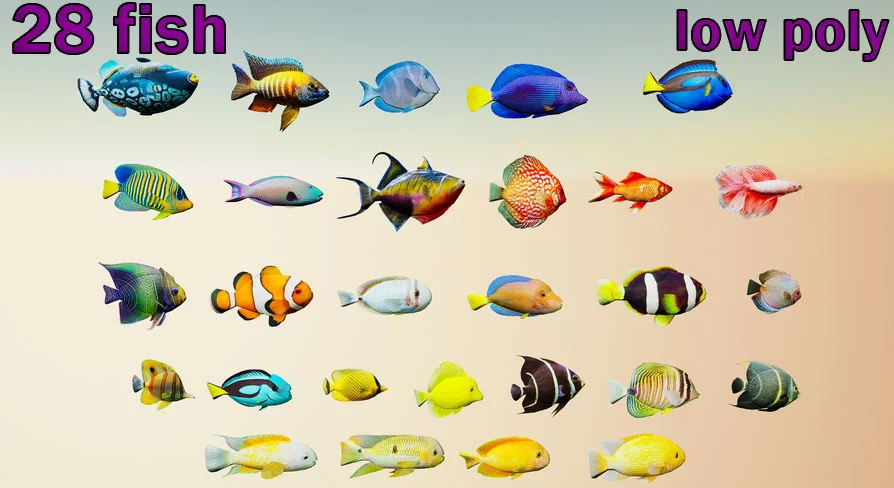
A frequent challenge when building marine biomes is visual repetition. Populating a coral bank or open sea shelf with only two or three silhouette varieties causes scenes to look artificial and stagnant. The Tropical Fish package addresses ecological density by including 28 different species of fish native to underwater ecosystems. Having access to 28 discrete variations provides the necessary variety to populate diverse marine niches without relying on visible asset reuse.
Organizing these 28 varieties across a scene allows artists to establish ecological zoning within an underwater level. Specific forms can be grouped around intricate reef formations, while other profiles are positioned in sunlit surface water or drifting past submerged terrain. Because each of the 28 species exists as an individual static mesh with its dedicated material setup, structuring their distribution is straightforward:
Demersal and benthic varieties can be placed directly adjacent to seafloor rock formations and coral clusters.
Mid-water swimmers can be grouped into loosely spaced cruising bands that patrol open underwater corridors.
Surface-oriented species can be distributed throughout shallow depths, catching direct light passes near the water line.
Distributing this variety across village coastlines, tropical lagoons, and open ocean expanses creates an authentic sense of living biodiversity. Rather than spotting repeated shapes, the player encounters varied contours, fin structures, and swimming profiles across different water volumes.
Flocking Integration and Motion Dynamics
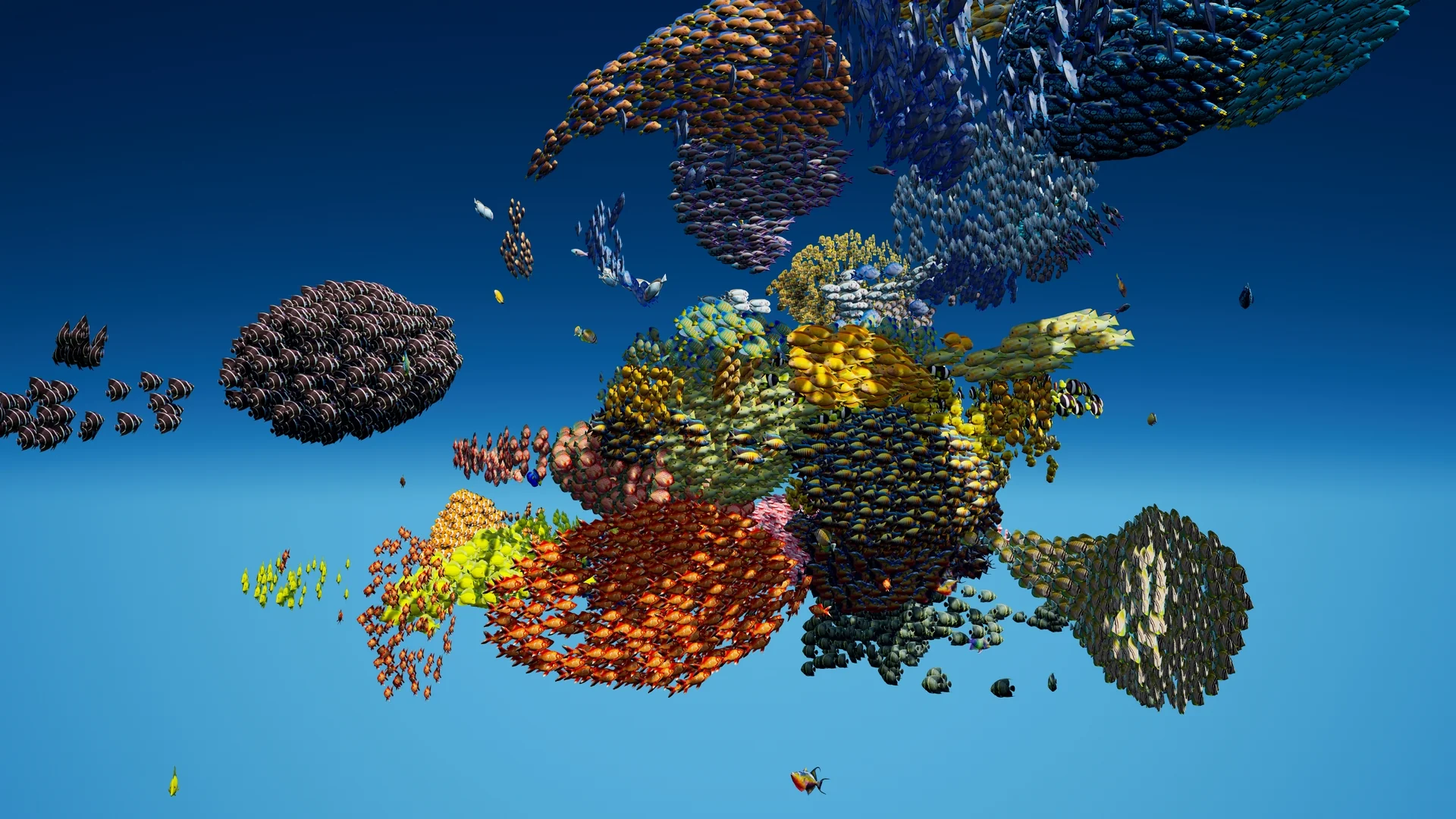
While the internal swimming articulation is calculated through the material, broad spatial movement through the world requires pathing or flocking logic. In demonstration media, the Tropical Fish meshes are paired with Advanced Flock Systems to govern group navigation, schooling behaviors, and obstacle avoidance. This combination establishes a clear separation of concerns in the development pipeline: the material handles anatomical deformation, while the flocking system handles global vector translation.
When combined with an algorithmic flocking tool like Advanced Flock Systems, static mesh fish become autonomous agents. The flocking controller manages velocity, target attraction, separation distances, and boundary limits. As the actor moves through three-dimensional space along its flocking path, the material shader continuously provides the rhythmic swimming locomotion. This division prevents the need to sync skeletal playback rates to actor speed, streamlining collective schooling effects.
Schooling behaviors elevate the immersion of both tranquil underwater shallows and vast ocean vistas. Deploying several species within coordinated flocking groups lets developers simulate predatory scatter reactions, circling behaviors around sunken obstacles, and sweeping migrations across maritime levels. Because the core assets are static meshes, instanced flocking systems can handle large agent counts without triggering skeletal skinning bottlenecks.
Stylistic Range across Lowpoly, Stylized, and Realistic Aesthetics
Visual targets in aquatic game development range widely, from crisp low-poly exploratory titles to grounded, high-fidelity marine simulations. The Tropical Fish package bridges these categories, carrying attributes that align with lowpoly, stylized, and realistic rendering pipelines. This flexibility enables the models to integrate cleanly into multiple art directions without clashing with neighboring environmental art.
In low-poly and stylized productions, such as stylized tropical island projects or village waterways, the clean silhouettes of the 28 species read immediately from distance. The material-driven motion imparts fluid vitality without requiring hyper-dense wireframes, maintaining stylistic harmony with simplified coastal architecture or stylized terrain assets. The motion feels natural and dynamic, preventing the stiff gliding that often plagues low-poly fish assets lacking dedicated animation assets.
For projects pursuing a realistic aesthetic, the anatomical accuracy of the 28 underwater species provides the necessary anatomical realism. The static mesh profiles capture the authentic forms, fin balances, and physical proportions of genuine tropical species. Under realistic water shaders with caustic projections, light scattering, and depth fog, the material-based deformation blends into the visual effects stack to yield convincing underwater wildlife.
Environmental Contexts and System Compatibility
The operational scope of the Tropical Fish asset extends across several environmental themes, including open ocean trenches, coastal village canals, tropical islands, and dedicated underwater levels. In coastal village environments, shallow water features often expose wildlife to direct top-down player scrutiny from piers, boats, or walkways. The fluid material movement keeps the fish lively and believable even when viewed from above the water surface.
From a platform and pipeline standpoint, the asset indicates compatibility with Bike One environments. Incorporating wildlife into vehicle or transit-focused scenes introduces biological life to surrounding natural canals, beachside paths, and bridges, transforming static environmental water planes into reactive biomes.
Deploying the package into a production pipeline involves placing the static meshes into designated water volumes, assigning the corresponding animated materials, and linking them to pathing curves or procedural flocking systems. With 28 distinct species operating entirely on lightweight material animation, the asset delivers an efficient, highly versatile foundation for real-time marine scenes.
 Towns & Villages
 Towns & Villages
 Towns & Villages
 Towns & Villages