"c68a05d5e51405b3"{"id":"1000701","slug":"troll-collection","title":"Troll Collection","category":"Characters \u0026 Creatures","engine":"5.0+","assetVersion":"","engineVersion":"Engine Version: 5.0+","tag":"Characters","accent":"blue","visual":"character","summary":"Three rigged fantasy trolls (Two-headed, Cave, Cyclops) with Epic Skeleton, Live Link Face blendshapes, modular mesh parts, PBR 4K textures, and multiple skins.","platform":"Unreal Engine","publishedAt":"2026-07-24T00:07:22.674Z","updatedAt":"2026-07-24T00:07:22.674Z","sourceNotes":[],"fileContents":[],"compatibility":["Unreal Engine","Engine Version: 5.0+"],"featuredImage":{"alt":"Troll Collection","src":"/wp-content/uploads/published/2026/07/b92b856d89b8-c4754f68-5fbc-414d-8e45-47b64dc8b2a0-bb13ae0960.webp"},"hasDownloadLink":true,"downloads":0,"terms":[{"taxonomy":"category","slug":"characters-and-creatures","name":"Characters \u0026 Creatures"}],"galleryImages":[{"src":"/wp-content/uploads/published/2026/07/9708c6a4205e-a377e422-ec41-4668-854c-2f0591a90ab8-63e8594351.webp","alt":"Troll Collection"},{"src":"/wp-content/uploads/published/2026/07/2aa96e5296a7-e1b66803-3335-4996-a017-9883f02065a3-88cccce673.webp","alt":"Troll Collection"},{"src":"/wp-content/uploads/published/2026/07/bd14ce28a6f0-b3058ee6-1e71-4b39-8509-e3103237f9fa-1253429b86.webp","alt":"Troll Collection"},{"src":"/wp-content/uploads/published/2026/07/8dc74ac154a6-42840c0f-c479-4936-be55-a6ef043dc924-1d77fc4f0b.webp","alt":"Troll Collection"},{"src":"/wp-content/uploads/published/2026/07/f4840f9eaf92-b71c0432-a24c-4ebc-8473-39619b204dd3-c40f01db36.webp","alt":"Troll Collection"},{"src":"/wp-content/uploads/published/2026/07/b075027bf105-4701ce1e-5bfc-4fa2-9be6-70429f7a40ae-4a2a510fc6.webp","alt":"Troll Collection"},{"src":"/wp-content/uploads/published/2026/07/254058ab0260-4ae3689c-042a-42b3-8302-632490563b44-b6d935b16b.webp","alt":"Troll Collection"},{"src":"/wp-content/uploads/published/2026/07/0c10f599956b-58843d76-4917-48fd-9ce1-4ed864514b2c-54bda97617.webp","alt":"Troll Collection"},{"src":"/wp-content/uploads/published/2026/07/4a564a178311-6ad5e914-a9b9-4c7f-bde9-f2e7e63b4cdd-19aea95fba.webp","alt":"Troll Collection"},{"src":"/wp-content/uploads/published/2026/07/9d333bfe85d3-7f565921-4c66-4b1e-8e1b-e34a13bd536e-0b6d9158bb.webp","alt":"Troll Collection"}],"accessPanel":{"kind":"resource","title":"Download this resource","eyebrow":"Free Download","message":"Log in or create a free account to start your download.","fileName":"Content.7z","safetyNote":"Resources are manually reviewed before listing to improve quality and reduce obvious risks.","actionLabel":"Download Free","resourceType":"Resource archive"},"contentHtml":"\u003cp\u003ePopulating a fantasy environment with convincing enemy creatures usually means juggling separate rigs, mismatched texture pipelines, and inflexible mesh topology that cannot be adjusted per scene. The Troll Collection works against that friction by delivering three creatures that share the same skeletal framework, the same PBR texture standard, and the same modular construction logic. A project can drop any of the three trolls into an Unreal scene and expect a consistent animation blueprint workflow, facial control through Live Link Face, and parts that can be removed or added without breaking the rig.\u003c/p\u003e \u003ch2\u003eThree creatures built on the Epic Skeleton\u003c/h2\u003e \u003cp\u003eEvery troll in the collection is rigged with the Epic Skeleton, which keeps animation retargeting and motion transfer predictable across the pack. The creatures also carry additional bones beyond the base rig, giving animators extra articulation points where the default skeleton would fall short.\u003c/p\u003e \u003cp\u003eThe package contains the Two-headed Troll, the Cave Troll, and the Cyclops. The Cave Troll ships with two distinct skin variants—Cave Troll and Ice Troll—so a single asset can cover both a rocky underground setting and a frozen environment without rebuilding materials. The Two-headed Troll goes further with three separate skins, widening the range of visual variety from one mesh. The Cyclops does not list alternate skins, but it includes physically simulated cloth, making it the only creature in the pack with a dynamic cloth component.\u003c/p\u003e \u003ch3\u003eFacial expressions and Live Link Face blendshapes\u003c/h3\u003e \u003cp\u003eEach creature includes Live Link Face blendshapes, also referred to as morph targets or facial expressions, so the faces can be driven by iOS面部捕捉 or by manual morph target animation. The blendshape counts differ per creature, reflecting the complexity of each face. The Two-headed Troll carries 103 Live Link Face blendshapes, the highest count in the pack. The Cave Troll includes 52, while the Cyclops has 43. Because all three share the same facial pipeline, a production can apply a consistent capture workflow across the trio rather than building bespoke setups per character.\u003c/p\u003e \u003ch2\u003eTexture pipelines and material setup\u003c/h2\u003e \u003cp\u003eAll three characters use PBR textures stored as TGA files, with every texture set authored at 4096 × 4096. The texture sets correspond to the modular parts of each model, so individual mesh sections can carry their own dedicated 4K textures rather than sharing a single map across the whole body.\u003c/p\u003e \u003cp\u003eThe material counts scale with each creature’s complexity:\u003c/p\u003e \u003cul\u003e\n\u003cli\u003e\u003cstrong\u003eTwo-headed Troll:\u003c/strong\u003e 6 texture sets, 13 materials, 10 material instances, 53 textures in total.\u003c/li\u003e\n\u003cli\u003e\u003cstrong\u003eCave Troll:\u003c/strong\u003e 5 texture sets, 11 materials, 3 material instances, 45 textures in total.\u003c/li\u003e\n\u003cli\u003e\u003cstrong\u003eCyclops:\u003c/strong\u003e 6 texture sets, 6 materials, 2 material instances, 42 textures in total.\u003c/li\u003e\n\u003c/ul\u003e \u003cp\u003eMaterial instances are used across all three, allowing artists to tweak surface parameters without editing the parent material directly. This setup keeps iterations local to each variant, which is useful when distinguishing the Cave Troll from the Ice Troll or when adjusting the Two-headed Troll across its three skins.\u003c/p\u003e \u003ch2\u003eModular mesh parts and per-creature topology\u003c/h2\u003e \u003cp\u003eSeparated mesh parts are a core structural feature of the collection. Each troll is built modular, meaning parts can be added or removed as needed. This applies to armor and equipment as well as body sections, letting a production strip a character down for a specific shot or load only the components required by a scene.\u003c/p\u003e \u003ch3\u003eTwo-headed Troll mesh counts\u003c/h3\u003e \u003cp\u003eThe Two-headed Troll character mesh sits at 12,657 faces, 12,189 vertices, and 24,200 triangles. Its accompanying equipment mesh adds another 9,893 faces, 10,151 vertices, and 18,793 triangles. Combined, the two meshes give this creature the heftiest equipment payload in the pack, which aligns with its three-skin system—more visual variants benefit from more geometry to dress them.\u003c/p\u003e \u003ch3\u003eCave Troll mesh and weapon\u003c/h3\u003e \u003cp\u003eThe Cave Troll body carries 27,667 faces, 26,540 vertices, and 52,031 triangles, making it the second-densest character mesh in the collection. Its weapon, the Stone Axe, is a comparatively light prop at 1,824 faces, 1,639 vertices, and 3,274 triangles. The Stone Axe geometry stays low enough that it can be attached or swapped without significantly burdening the scene.\u003c/p\u003e \u003ch3\u003eCyclops mesh and weapon plus cloth\u003c/h3\u003e \u003cp\u003eThe Cyclops is the most geometry-intensive character, with 38,486 faces, 34,777 vertices, and 65,056 triangles. Its weapon, the Wooden club, is the lightest prop in the pack: 1,391 faces, 1,313 vertices, and 2,622 triangles. The physically simulated cloth on the Cyclops adds another layer of motion behavior that the other two trolls do not have, separating it visually during gameplay or cinematic sequences.\u003c/p\u003e \u003ch2\u003eWhere the troll collection fits in a production\u003c/h2\u003e \u003cp\u003eBecause all three characters share Epic Skeleton rigging, they can share or retarget animation assets produced for that skeleton. A team building a fantasy combat scene can animate the Cave Troll swinging the Stone Axe, then apply compatible motion data to the Two-headed Troll or the Cyclops without rebuilding the rig. The Live Link Face blendshapes open the same door for facial performance—captured expressions can drive any of the three faces, with the Two-headed Troll offering the broadest morph target range at 103 shapes.\u003c/p\u003e \u003cp\u003eThe modular construction also serves encounter design. A cave environment can spawn a Cave Troll with minimal equipment, while a boss-tier encounter can load the same character with full parts plus the Ice Troll skin for a visually different variant. The Cyclops, with its cloth simulation, suits open-air scenes where the cloth motion will read clearly, while the Two-headed Troll’s three skins give a production multiple antagonist looks from a single asset.\u003c/p\u003e \u003cp\u003eProductions that need multiple rigged enemy creatures, consistent PBR texturing, and facial capture readiness will get the most use out of this collection. The shared skeleton, modular parts, and material instance workflow keep the three trolls interoperable within an Unreal pipeline rather than treating each as an isolated model.\u003c/p\u003e\n\n\u003ch2\u003eMore From The Same Workflow\u003c/h2\u003e\n\u003cul\u003e\n\u003cli\u003e\u003ca href=\"https://3dcghub.com/infinite-characters-collection-over-230-characters-extra-stigma-studios/\" title=\"Infinite Characters Collection – Over 230 Characters + Extra | STIGMA STUDIOS\"\u003eInfinite Characters Collection – Over 230 Characters + Extra | STIGMA STUDIOS\u003c/a\u003e\u003c/li\u003e\n\u003cli\u003e\u003ca href=\"https://3dcghub.com/butterflies-collection-bp-niagara-ai/\" title=\"Butterflies Collection (BP, Niagara + AI)\"\u003eButterflies Collection (BP, Niagara + AI)\u003c/a\u003e\u003c/li\u003e\n\u003cli\u003e\u003ca href=\"https://3dcghub.com/modular-orcs-and-troll-metahuman/\" title=\"Modular Orcs \u0026amp; Troll - Metahuman\"\u003eModular Orcs \u0026amp; Troll - Metahuman\u003c/a\u003e\u003c/li\u003e\n\u003cli\u003e\u003ca href=\"https://3dcghub.com/super-pack-of-skeletons/\" title=\"Super pack of skeletons\"\u003eSuper pack of skeletons\u003c/a\u003e\u003c/li\u003e\n\u003cli\u003e\u003ca href=\"https://3dcghub.com/fps-devices/\" title=\"FPS Devices\"\u003eFPS Devices\u003c/a\u003e\u003c/li\u003e\n\u003c/ul\u003e","contentTextLength":6320,"navigation":{"current":1302,"total":3860,"previous":{"id":"1000702","slug":"ue-camping-equipment","title":"UE Camping Equipment","category":"Furniture \u0026 Fixtures","platform":"Unreal Engine","updatedAt":"2026-07-24T00:16:19.949Z"},"next":{"id":"1000700","slug":"trash-set-2","title":"Trash Set.2","category":"Trashyard","platform":"Unreal Engine","updatedAt":"2026-07-24T00:01:13.253Z"}},"relatedResources":[{"id":"1000184","slug":"infinite-characters-collection-over-230-characters-extra-stigma-studios","title":"Infinite Characters Collection – Over 230 Characters + Extra | STIGMA STUDIOS","category":"Characters \u0026 Creatures","engine":"4.27,5.0+","assetVersion":"","engineVersion":"Engine Version: 4.27,5.0+","tag":"Characters","accent":"blue","visual":"character","summary":"A massive Unreal Engine character collection with over 230 characters, armor, weapons, material variants, and ongoing future updates.","platform":"Unreal Engine","publishedAt":"2026-06-21T17:34:28.433Z","updatedAt":"2026-08-23T13:14:17.209Z","sourceNotes":[],"fileContents":[],"compatibility":["Unreal Engine","Engine Version: 4.27,5.0+"],"featuredImage":{"alt":"Infinite Characters Collection – Over 230 Characters + Extra | STIGMA STUDIOS","src":"/wp-content/uploads/published/2026/06/26476fb360bb-f2bcdade-6b80-4803-903a-68e84d350b6b-f00df84586.webp"},"hasDownloadLink":true,"downloads":16},{"id":"1840","slug":"butterflies-collection-bp-niagara-ai","title":"Butterflies Collection (BP, Niagara + AI)","category":"Characters \u0026 Creatures","engine":"4.26+,5.0+","assetVersion":"Engine version: 4.26+,5.0+","engineVersion":"4.24","tag":"Characters","accent":"blue","visual":"character","summary":"Enhance your Unreal Engine projects with this low-poly butterfly collection. Features Niagara particles and AI-driven blueprints for realistic environments.","platform":"Unreal Engine","publishedAt":"2026-02-06T22:06:39.000Z","updatedAt":"2026-04-19T15:58:28.000Z","sourceNotes":[],"fileContents":[],"compatibility":["Unreal Engine","Engine version: 4.26+,5.0+"],"featuredImage":{"alt":"Butterflies Collection (BP, Niagara + AI)","src":"https://3dcghub.com/wp-content/uploads/2026/02/07c4998f-4ec9-4ca5-bf6f-7f76e6aade95.webp"},"hasDownloadLink":true,"downloads":0},{"id":"1000313","slug":"modular-orcs-and-troll-metahuman","title":"Modular Orcs \u0026 Troll - Metahuman","category":"Characters \u0026 Creatures","engine":"5.6+","assetVersion":"","engineVersion":"Engine Version: 5.6+","tag":"Characters","accent":"blue","visual":"character","summary":"Explore the technical setup of this modular creature package, featuring MetaHuman topology integration, parametric clothing, and UE4 skeleton compatibility.","platform":"Unreal Engine","publishedAt":"2026-07-04T16:12:06.006Z","updatedAt":"2026-07-04T16:12:06.006Z","sourceNotes":[],"fileContents":[],"compatibility":["Unreal Engine","Engine Version: 5.6+"],"featuredImage":{"alt":"Modular Orcs \u0026 Troll - Metahuman","src":"/wp-content/uploads/published/2026/07/1435db0a56bc-b76a920a-21e4-48df-bb84-5f8421721c86-fcb39d7bc0.webp"},"hasDownloadLink":true,"downloads":3}]}
Characters
Troll Collection
Three rigged fantasy trolls (Two-headed, Cave, Cyclops) with Epic Skeleton, Live Link Face blendshapes, modular mesh parts, PBR 4K textures, and multiple skins.
Populating a fantasy environment with convincing enemy creatures usually means juggling separate rigs, mismatched texture pipelines, and inflexible mesh topology that cannot be adjusted per scene. The Troll Collection works against that friction by delivering three creatures that share the same skeletal framework, the same PBR texture standard, and the same modular construction logic. A project can drop any of the three trolls into an Unreal scene and expect a consistent animation blueprint workflow, facial control through Live Link Face, and parts that can be removed or added without breaking the rig.
Three creatures built on the Epic Skeleton
Every troll in the collection is rigged with the Epic Skeleton, which keeps animation retargeting and motion transfer predictable across the pack. The creatures also carry additional bones beyond the base rig, giving animators extra articulation points where the default skeleton would fall short.
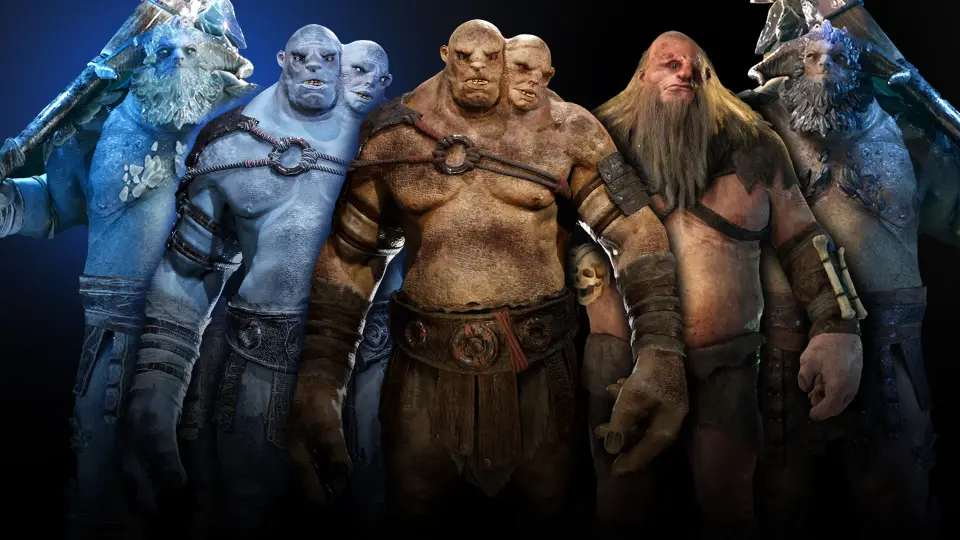
The package contains the Two-headed Troll, the Cave Troll, and the Cyclops. The Cave Troll ships with two distinct skin variants—Cave Troll and Ice Troll—so a single asset can cover both a rocky underground setting and a frozen environment without rebuilding materials. The Two-headed Troll goes further with three separate skins, widening the range of visual variety from one mesh. The Cyclops does not list alternate skins, but it includes physically simulated cloth, making it the only creature in the pack with a dynamic cloth component.
Facial expressions and Live Link Face blendshapes
Each creature includes Live Link Face blendshapes, also referred to as morph targets or facial expressions, so the faces can be driven by iOS面部捕捉 or by manual morph target animation. The blendshape counts differ per creature, reflecting the complexity of each face. The Two-headed Troll carries 103 Live Link Face blendshapes, the highest count in the pack. The Cave Troll includes 52, while the Cyclops has 43. Because all three share the same facial pipeline, a production can apply a consistent capture workflow across the trio rather than building bespoke setups per character.
Texture pipelines and material setup
All three characters use PBR textures stored as TGA files, with every texture set authored at 4096 × 4096. The texture sets correspond to the modular parts of each model, so individual mesh sections can carry their own dedicated 4K textures rather than sharing a single map across the whole body.
The material counts scale with each creature’s complexity:
Two-headed Troll: 6 texture sets, 13 materials, 10 material instances, 53 textures in total.
Cave Troll: 5 texture sets, 11 materials, 3 material instances, 45 textures in total.
Cyclops: 6 texture sets, 6 materials, 2 material instances, 42 textures in total.
Material instances are used across all three, allowing artists to tweak surface parameters without editing the parent material directly. This setup keeps iterations local to each variant, which is useful when distinguishing the Cave Troll from the Ice Troll or when adjusting the Two-headed Troll across its three skins.
Modular mesh parts and per-creature topology
Separated mesh parts are a core structural feature of the collection. Each troll is built modular, meaning parts can be added or removed as needed. This applies to armor and equipment as well as body sections, letting a production strip a character down for a specific shot or load only the components required by a scene.
Two-headed Troll mesh counts
The Two-headed Troll character mesh sits at 12,657 faces, 12,189 vertices, and 24,200 triangles. Its accompanying equipment mesh adds another 9,893 faces, 10,151 vertices, and 18,793 triangles. Combined, the two meshes give this creature the heftiest equipment payload in the pack, which aligns with its three-skin system—more visual variants benefit from more geometry to dress them.
Cave Troll mesh and weapon
The Cave Troll body carries 27,667 faces, 26,540 vertices, and 52,031 triangles, making it the second-densest character mesh in the collection. Its weapon, the Stone Axe, is a comparatively light prop at 1,824 faces, 1,639 vertices, and 3,274 triangles. The Stone Axe geometry stays low enough that it can be attached or swapped without significantly burdening the scene.
Cyclops mesh and weapon plus cloth
The Cyclops is the most geometry-intensive character, with 38,486 faces, 34,777 vertices, and 65,056 triangles. Its weapon, the Wooden club, is the lightest prop in the pack: 1,391 faces, 1,313 vertices, and 2,622 triangles. The physically simulated cloth on the Cyclops adds another layer of motion behavior that the other two trolls do not have, separating it visually during gameplay or cinematic sequences.
Where the troll collection fits in a production
Because all three characters share Epic Skeleton rigging, they can share or retarget animation assets produced for that skeleton. A team building a fantasy combat scene can animate the Cave Troll swinging the Stone Axe, then apply compatible motion data to the Two-headed Troll or the Cyclops without rebuilding the rig. The Live Link Face blendshapes open the same door for facial performance—captured expressions can drive any of the three faces, with the Two-headed Troll offering the broadest morph target range at 103 shapes.
The modular construction also serves encounter design. A cave environment can spawn a Cave Troll with minimal equipment, while a boss-tier encounter can load the same character with full parts plus the Ice Troll skin for a visually different variant. The Cyclops, with its cloth simulation, suits open-air scenes where the cloth motion will read clearly, while the Two-headed Troll’s three skins give a production multiple antagonist looks from a single asset.
Productions that need multiple rigged enemy creatures, consistent PBR texturing, and facial capture readiness will get the most use out of this collection. The shared skeleton, modular parts, and material instance workflow keep the three trolls interoperable within an Unreal pipeline rather than treating each as an isolated model.
 Characters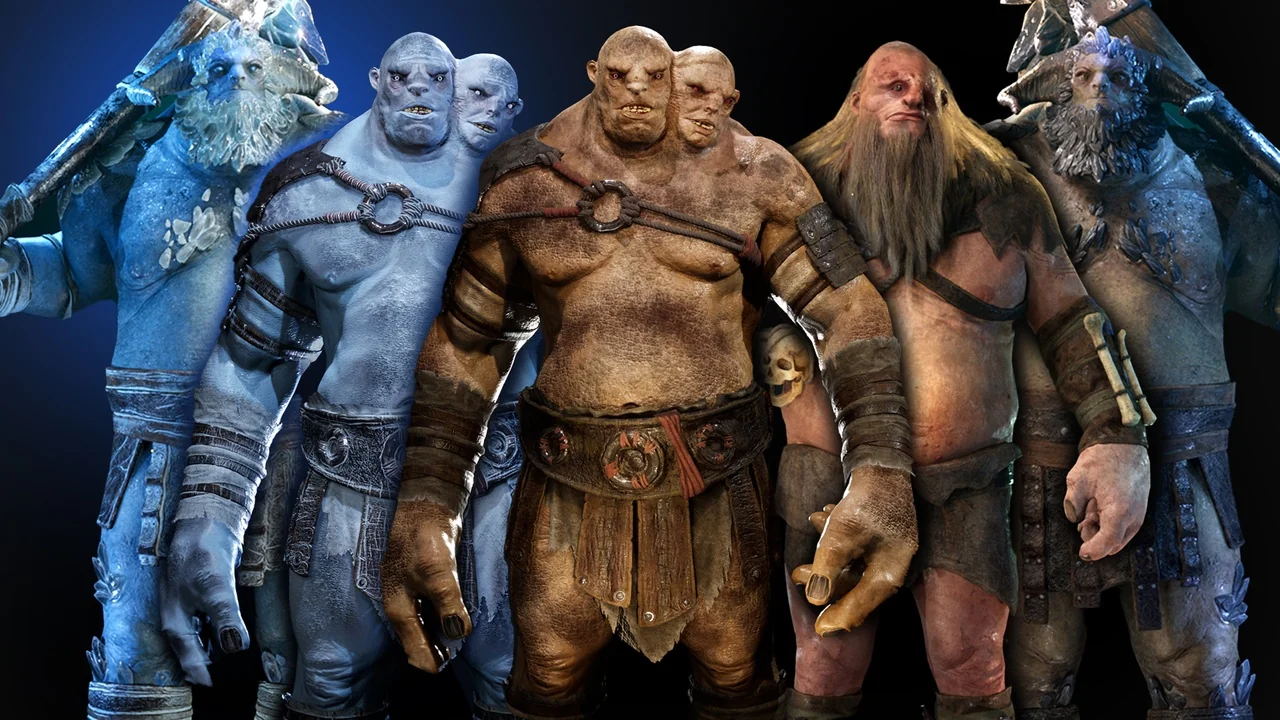
 Characters
 Characters
 Characters