"c68a05d5e51405b3"{"id":"1000106","slug":"super-pack-of-skeletons","title":"Super pack of skeletons","category":"Characters \u0026 Creatures","engine":"Engine Version: 4.26+,5.0+","assetVersion":"Engine Version: 4.26+,5.0+","engineVersion":"","tag":"Characters","accent":"blue","visual":"character","summary":"A skeleton character collection for Unreal workflows, featuring multiple undead variants, Epic Skeleton rigging, custom tissue physics, and detailed texture set","platform":"Unreal Engine","publishedAt":"2026-06-07T16:30:49.830Z","updatedAt":"2026-06-07T16:30:49.830Z","sourceNotes":[],"fileContents":[],"compatibility":["Unreal Engine","Engine Version: 4.26+,5.0+"],"featuredImage":{"alt":"Super pack of skeletons","src":"/wp-content/uploads/published/2026/06/450b7a609c00-eee2705a-70e9-473d-bfff-921ba59aead6-6ea6af8489.webp"},"hasDownloadLink":true,"downloads":3,"terms":[{"taxonomy":"category","slug":"characters-and-creatures","name":"Characters \u0026 Creatures"}],"galleryImages":[{"src":"/wp-content/uploads/published/2026/06/271fc244f8b0-174c8d7d-8744-4302-adeb-8dc09420e940-a8ebaf2170.webp","alt":"Super pack of skeletons"},{"src":"/wp-content/uploads/published/2026/06/80c1d0eb5f4a-8642f125-09f4-45f8-9b29-472d22e61338-6ec35a68ee.webp","alt":"Super pack of skeletons"},{"src":"/wp-content/uploads/published/2026/06/3ccddf2be5a2-809d9c21-bec1-4e45-9308-ddee2cb139f1-1f9c5e29b2.webp","alt":"Super pack of skeletons"},{"src":"/wp-content/uploads/published/2026/06/18e8b23f3b8f-c4e17b1c-37a7-4f45-8e82-8e091ba0e3d4-caf78d213d.webp","alt":"Super pack of skeletons"},{"src":"/wp-content/uploads/published/2026/06/00ff32309952-bdf14d04-deaa-416b-b412-c0ea7939a0a6-02c519f824.webp","alt":"Super pack of skeletons"},{"src":"/wp-content/uploads/published/2026/06/4120a6c1fc9f-47d773a0-b497-45ca-9785-4501fd304420-5d5bb38c1b.webp","alt":"Super pack of skeletons"},{"src":"/wp-content/uploads/published/2026/06/49a9813a52d2-a70cb916-6b51-410e-bacb-0b96a7361371-17e1301011.webp","alt":"Super pack of skeletons"},{"src":"/wp-content/uploads/published/2026/06/afa3162a17ba-3bc3d7d1-2a9f-42e4-8ffb-3dbd7d1397d9-d677225505.webp","alt":"Super pack of skeletons"},{"src":"/wp-content/uploads/published/2026/06/4660977ec67d-8f247e45-c51b-4b6d-88ab-af80ca8f64e6-6532e4bc41.webp","alt":"Super pack of skeletons"},{"src":"/wp-content/uploads/published/2026/06/146dca9c1e0c-9dff264b-0508-4c29-bef8-5b5bca1fe770-61cd954f3e.webp","alt":"Super pack of skeletons"}],"accessPanel":{"kind":"resource","title":"Access this resource","eyebrow":"Free Download","message":"Log in or create a free account to start your download.","fileName":"Content.7z","safetyNote":"Resources are manually reviewed before listing to improve quality and reduce obvious risks.","actionLabel":"Download Free","resourceType":"Resource archive"},"contentHtml":"\u003cp\u003eDark fantasy battlefields, haunted ruins, cursed dungeons, and necromantic strongholds all benefit from a character set that can fill a scene with distinct undead silhouettes instead of repeating the same figure. Super pack of skeletons gathers multiple skeleton models assembled from different assets, giving artists and developers a ready mix of enemy types and visual roles that can be spread across horror and medieval fantasy environments.\u003c/p\u003e\n\u003cp\u003eThe collection spans straightforward skeletal fighters and a more elaborate necromancer, which makes it useful for scenes that need both rank-and-file undead presence and a stronger focal character. Tags associated with the pack point toward horror, evil, undead, fantasy, medieval, reaper, monster, archer, animated, rigged, realistic, lowpoly, and animation blueprint use, all of which helps place the pack within gameplay-oriented character work rather than static decoration alone.\u003c/p\u003e \u003ch2\u003eUndead variety inside Super pack of skeletons\u003c/h2\u003e\n\u003cp\u003eThe set includes Skeleton 5, Skeleton Crossbowman, Skeleton warrior 3, Skeleton warrior 2, Skeleton warrior 1, and Necromancer. That spread gives the pack a practical range for encounter design and scene composition. A crossbowman can read clearly as a ranged threat, while the warrior variants can fill melee roles or simply create visual density in background staging. The necromancer stands apart as the most materially complex character in the set, making it a natural fit for a commanding or ritual-focused presence.\u003c/p\u003e\n\u003cp\u003eBecause the models are assembled from different assets, the collection does not read like a single repeated mesh copied over and over. That matters when building undead factions or layered battlefield scenes, where variation in armor, pose identity, and character type helps maintain interest. Even without adding extra creatures, the mix of warriors, a crossbowman, and a necromancer already suggests a small hierarchy inside the undead group.\u003c/p\u003e\n\u003cp\u003eFor environment storytelling, this kind of spread can support several moods. A ruined courtyard can be guarded by warrior types, a wall walk can hold the crossbowman, and an inner chamber can center the necromancer. The resource is equally suited to a direct combat setup or a slower atmospheric arrangement where skeletons remain as looming presences in a space shaped by fear, death, and ritual.\u003c/p\u003e \u003ch2\u003eEpic Skeleton rigging and customized tissue physics\u003c/h2\u003e\n\u003cp\u003eAll models use an Epic Skeleton and customized tissue physics. Those two details define a lot of the pack’s practical identity. The shared skeleton approach helps keep the collection aligned as a character set rather than a group of unrelated one-offs. For a developer, that means the pack is oriented toward a consistent character pipeline. For an artist, it means the undead cast can feel like part of the same world and system even when each variant serves a different visual purpose.\u003c/p\u003e\n\u003cp\u003eThe mention of customized tissue physics adds another layer to the presentation. Skeleton characters can look very different depending on how secondary motion is handled, especially when cloth, hanging elements, or attached tissue-like forms are involved. Here, the inclusion of customized tissue physics suggests motion detail that can push the characters beyond bare-bones silhouettes and toward something more unsettling. In horror or necromancer-themed scenes, small moving details often do a lot of the atmosphere work.\u003c/p\u003e\n\u003cp\u003eTags such as rigged, animated, script, and animation blueprint reinforce that this is not just a sculptural pack of undead figures. It sits in a space where characters are expected to function within gameplay or animated scene setups. That makes the pack suitable for projects that need enemies with a clear runtime presence rather than only decorative props.\u003c/p\u003e \u003ch2\u003eTexture density across Skeleton warrior, Crossbowman, and Necromancer\u003c/h2\u003e\n\u003cp\u003eTexture and material allocation varies across the included characters, and those differences help show where visual emphasis has been placed.\u003c/p\u003e\n\u003cul\u003e\n\u003cli\u003eSkeleton 5 includes a 4096x4096 texture pack, 7 materials, and 27 textures.\u003c/li\u003e\n\u003cli\u003eSkeleton Crossbowman includes 4096x4096 and 2048x2048 textures, 9 materials, and 27 textures.\u003c/li\u003e\n\u003cli\u003eSkeleton warrior 3 includes 4096x4096 and 2048x2048 textures, 7 materials, and 25 textures.\u003c/li\u003e\n\u003cli\u003eSkeleton warrior 2 includes 4096x4096 and 2048x2048 textures, 8 materials, and 28 textures.\u003c/li\u003e\n\u003cli\u003eSkeleton warrior 1 includes a 4096x4096 texture pack, 8 materials, and 32 textures.\u003c/li\u003e\n\u003cli\u003eNecromancer includes a 4096x4096 texture pack, 30 materials, and 85 textures, with three skins.\u003c/li\u003e\n\u003c/ul\u003e\n\u003cp\u003eThose numbers make the necromancer the clear standout in terms of surface complexity. With 30 materials and 85 textures, plus three skins, it carries much more variation than the skeleton fighters. In a practical art setup, that makes the necromancer a strong choice when a project needs a centerpiece undead character with more visual richness or alternate looks.\u003c/p\u003e\n\u003cp\u003eThe skeleton fighters are lighter by comparison, but still distinct from one another. Material counts ranging from 7 to 9 and texture counts between 25 and 32 keep them substantial enough for close-to-mid scene use while preserving separation between each variant. The crossbowman’s own material count and mixed 4096x4096 plus 2048x2048 textures help define it as more than a simple weapon swap. Across the warrior variants, the differences in material and texture totals suggest that each one contributes its own surface arrangement rather than acting as a duplicate.\u003c/p\u003e\n\u003cp\u003eFor anyone staging a full undead group, this distribution is useful. The more numerous skeleton fighters can fill the body of an encounter, while the necromancer can anchor the composition visually. That kind of internal balance is often what makes a character pack more usable in practice: one set supplies supporting enemies and a more heavily detailed figure gives the scene or gameplay beat a recognizable leader.\u003c/p\u003e \u003ch2\u003eWhere the pack fits: horror, fantasy, medieval, undead encounters\u003c/h2\u003e\n\u003cp\u003eThe thematic tags place this collection firmly in horror and fantasy territory, with medieval and undead elements at the front. That gives it a clear creative lane. It fits crypt raids, plague-ridden villages, battlefield aftermath scenes, cursed catacombs, necromancer boss areas, and reaper-themed worlds where skeletal characters need to feel at home rather than imported from a different aesthetic.\u003c/p\u003e\n\u003cp\u003eThe pack also bridges a few visual tones at once. Horror and evil point toward darker presentation, while fantasy and medieval keep the models grounded in a recognizable genre framework. Archer and necromancer tags broaden encounter possibilities beyond simple melee swarms. Realistic and lowpoly appearing together suggest a resource aimed at functional production use while still keeping a believable character identity.\u003c/p\u003e\n\u003cp\u003eBecause the collection includes multiple roles, it can support both gameplay function and environmental storytelling. A hallway lined with skeleton warriors tells one story. A chamber where a necromancer is framed by lesser skeletons tells another. A battlement defended by a crossbowman shifts the visual rhythm again. The pack’s strength lies in giving those scene beats a single undead roster to draw from.\u003c/p\u003e \u003ch2\u003eUnreal Engine 5 use with an Unreal Engine 4 skeleton structure\u003c/h2\u003e\n\u003cp\u003eThere is one pipeline note that should be kept in mind. The model is loaded and works in Unreal Engine 5, but the skeleton has a structure from Unreal Engine 4. That point is specifically called out as something to be careful about and consider.\u003c/p\u003e\n\u003cp\u003eFor teams already working in Unreal, that means the pack has a clear functional destination while also carrying an important rig-structure detail that should not be overlooked during setup. Since all models use an Epic Skeleton, the collection is still coherent as a group, but the Unreal Engine 4 skeleton structure is the practical detail most likely to affect how a project approaches implementation.\u003c/p\u003e\n\u003cp\u003eAs a fit-for-project choice, Super pack of skeletons works best when a scene or game needs an undead cast with several combat identities, a stronger necromancer presence, and a unified rigging approach. The pack is especially well suited to horror, fantasy, and medieval settings where skeleton warriors and ranged undead can support the larger role of a more elaborate necromancer character.\u003c/p\u003e\n\n\u003ch2\u003eContinue Browsing Similar Packs\u003c/h2\u003e\n\u003cul\u003e\n\u003cli\u003e\u003ca href=\"https://3dcghub.com/modular-skeleton-mage/\" title=\"Modular Skeleton Mage\"\u003eModular Skeleton Mage\u003c/a\u003e\u003c/li\u003e\n\u003cli\u003e\u003ca href=\"https://3dcghub.com/realistic-base-skeleton/\" title=\"Realistic Base Skeleton\"\u003eRealistic Base Skeleton\u003c/a\u003e\u003c/li\u003e\n\u003cli\u003e\u003ca href=\"https://3dcghub.com/eggo-the-talking-egg-face-morphs-epic-skeleton-skins-and-ultimate-material/\" title=\"Eggo the Talking Egg, face morphs, epic skeleton, skins and ultimate material\"\u003eEggo the Talking Egg, face morphs, epic skeleton, skins and ultimate material\u003c/a\u003e\u003c/li\u003e\n\u003cli\u003e\u003ca href=\"https://3dcghub.com/etasphera17/\" title=\"Etasphera17\"\u003eEtasphera17\u003c/a\u003e\u003c/li\u003e\n\u003cli\u003e\u003ca href=\"https://3dcghub.com/cosmo-trooper/\" title=\"Cosmo Trooper\"\u003eCosmo Trooper\u003c/a\u003e\u003c/li\u003e\n\u003c/ul\u003e","contentTextLength":8454,"navigation":{"current":1898,"total":3860,"previous":{"id":"1000107","slug":"swampy-industrial-zone","title":"Swampy industrial zone","category":"Apocalyptic / Post-apocalyptic","platform":"Unreal Engine","updatedAt":"2026-06-07T16:48:55.437Z"},"next":{"id":"1000105","slug":"stylized-pirate-port-city-modular-pirate-port-city-modular-dock-pirate-city","title":"Stylized Pirate Port City Modular ( Pirate Port City Modular Dock Pirate City )","category":"Fantasy","platform":"Unreal Engine","updatedAt":"2026-06-07T16:18:40.463Z"}},"relatedResources":[{"id":"2296","slug":"etasphera17","title":"Etasphera17","category":"Characters \u0026 Creatures","engine":"4.26+,5.0+","assetVersion":"Engine version: 4.26+,5.0+","engineVersion":"4.18","tag":"Characters","accent":"blue","visual":"character","summary":"Discover Etasphera17, a versatile low poly android character for RPG, FPS, and strategy games. Features 4K textures, rigging, and modular design for developers.","platform":"Unreal Engine","publishedAt":"2026-02-07T08:58:13.000Z","updatedAt":"2026-04-19T15:58:03.000Z","sourceNotes":[],"fileContents":[],"compatibility":["Unreal Engine","Engine version: 4.26+,5.0+"],"featuredImage":{"alt":"Etasphera17","src":"https://3dcghub.com/wp-content/uploads/2026/02/3f0cab86-b767-43af-b749-b371aefa5f92.webp"},"hasDownloadLink":true,"downloads":1},{"id":"3068","slug":"modular-skeleton-mage","title":"Modular Skeleton Mage","category":"Characters \u0026 Creatures","engine":"4.26+,5.0+","assetVersion":"Engine version: 4.26+,5.0+","engineVersion":"4.18","tag":"Characters","accent":"blue","visual":"character","summary":"Discover the Modular Skeleton Mage for game development. Features 4K PBR textures, Epic Skeleton rigging, and modular parts for ultimate fantasy character custo","platform":"Unreal Engine","publishedAt":"2026-02-07T16:47:43.000Z","updatedAt":"2026-04-19T15:57:43.000Z","sourceNotes":[],"fileContents":[],"compatibility":["Unreal Engine","Engine version: 4.26+,5.0+"],"featuredImage":{"alt":"Modular Skeleton Mage","src":"https://3dcghub.com/wp-content/uploads/2026/02/00116c23-212e-401b-bc9a-7e90437a3d01.webp"},"hasDownloadLink":true,"downloads":1},{"id":"24908","slug":"realistic-base-skeleton","title":"Realistic Base Skeleton","category":"Characters \u0026 Creatures","engine":"4.26+,5.0+","assetVersion":"Engine version: 4.26+,5.0+","engineVersion":"","tag":"Characters","accent":"blue","visual":"character","summary":"Realistic Base Skeleton supports both animation and prop workflows with a rigged Epic skeleton setup. The updated version adds x-ray visibility, separable body parts, and multiple texture variations for different scene states.","platform":"Unreal Engine","publishedAt":"2026-04-17T12:07:16.000Z","updatedAt":"2026-04-20T06:12:36.000Z","sourceNotes":[],"fileContents":[],"compatibility":["Unreal Engine","Engine version: 4.26+,5.0+"],"featuredImage":{"alt":"Realistic Base Skeleton","src":"https://3dcghub.com/wp-content/uploads/2026/04/042747b0d662_b7255164-629b-4690-91c7-7a1d9efdb1e8.webp"},"hasDownloadLink":true,"downloads":0}]}
Characters
Super pack of skeletons
A skeleton character collection for Unreal workflows, featuring multiple undead variants, Epic Skeleton rigging, custom tissue physics, and detailed texture set
Dark fantasy battlefields, haunted ruins, cursed dungeons, and necromantic strongholds all benefit from a character set that can fill a scene with distinct undead silhouettes instead of repeating the same figure. Super pack of skeletons gathers multiple skeleton models assembled from different assets, giving artists and developers a ready mix of enemy types and visual roles that can be spread across horror and medieval fantasy environments.
The collection spans straightforward skeletal fighters and a more elaborate necromancer, which makes it useful for scenes that need both rank-and-file undead presence and a stronger focal character. Tags associated with the pack point toward horror, evil, undead, fantasy, medieval, reaper, monster, archer, animated, rigged, realistic, lowpoly, and animation blueprint use, all of which helps place the pack within gameplay-oriented character work rather than static decoration alone.
Undead variety inside Super pack of skeletons
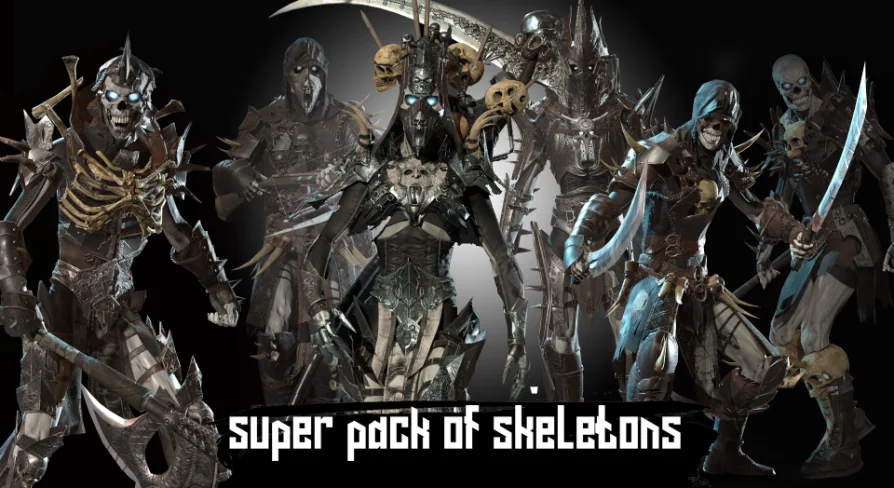
The set includes Skeleton 5, Skeleton Crossbowman, Skeleton warrior 3, Skeleton warrior 2, Skeleton warrior 1, and Necromancer. That spread gives the pack a practical range for encounter design and scene composition. A crossbowman can read clearly as a ranged threat, while the warrior variants can fill melee roles or simply create visual density in background staging. The necromancer stands apart as the most materially complex character in the set, making it a natural fit for a commanding or ritual-focused presence.
Because the models are assembled from different assets, the collection does not read like a single repeated mesh copied over and over. That matters when building undead factions or layered battlefield scenes, where variation in armor, pose identity, and character type helps maintain interest. Even without adding extra creatures, the mix of warriors, a crossbowman, and a necromancer already suggests a small hierarchy inside the undead group.
For environment storytelling, this kind of spread can support several moods. A ruined courtyard can be guarded by warrior types, a wall walk can hold the crossbowman, and an inner chamber can center the necromancer. The resource is equally suited to a direct combat setup or a slower atmospheric arrangement where skeletons remain as looming presences in a space shaped by fear, death, and ritual.
Epic Skeleton rigging and customized tissue physics
All models use an Epic Skeleton and customized tissue physics. Those two details define a lot of the pack’s practical identity. The shared skeleton approach helps keep the collection aligned as a character set rather than a group of unrelated one-offs. For a developer, that means the pack is oriented toward a consistent character pipeline. For an artist, it means the undead cast can feel like part of the same world and system even when each variant serves a different visual purpose.
The mention of customized tissue physics adds another layer to the presentation. Skeleton characters can look very different depending on how secondary motion is handled, especially when cloth, hanging elements, or attached tissue-like forms are involved. Here, the inclusion of customized tissue physics suggests motion detail that can push the characters beyond bare-bones silhouettes and toward something more unsettling. In horror or necromancer-themed scenes, small moving details often do a lot of the atmosphere work.
Tags such as rigged, animated, script, and animation blueprint reinforce that this is not just a sculptural pack of undead figures. It sits in a space where characters are expected to function within gameplay or animated scene setups. That makes the pack suitable for projects that need enemies with a clear runtime presence rather than only decorative props.
Texture density across Skeleton warrior, Crossbowman, and Necromancer
Texture and material allocation varies across the included characters, and those differences help show where visual emphasis has been placed.
Skeleton 5 includes a 4096x4096 texture pack, 7 materials, and 27 textures.
Skeleton Crossbowman includes 4096x4096 and 2048x2048 textures, 9 materials, and 27 textures.
Skeleton warrior 3 includes 4096x4096 and 2048x2048 textures, 7 materials, and 25 textures.
Skeleton warrior 2 includes 4096x4096 and 2048x2048 textures, 8 materials, and 28 textures.
Skeleton warrior 1 includes a 4096x4096 texture pack, 8 materials, and 32 textures.
Necromancer includes a 4096x4096 texture pack, 30 materials, and 85 textures, with three skins.
Those numbers make the necromancer the clear standout in terms of surface complexity. With 30 materials and 85 textures, plus three skins, it carries much more variation than the skeleton fighters. In a practical art setup, that makes the necromancer a strong choice when a project needs a centerpiece undead character with more visual richness or alternate looks.
The skeleton fighters are lighter by comparison, but still distinct from one another. Material counts ranging from 7 to 9 and texture counts between 25 and 32 keep them substantial enough for close-to-mid scene use while preserving separation between each variant. The crossbowman’s own material count and mixed 4096x4096 plus 2048x2048 textures help define it as more than a simple weapon swap. Across the warrior variants, the differences in material and texture totals suggest that each one contributes its own surface arrangement rather than acting as a duplicate.
For anyone staging a full undead group, this distribution is useful. The more numerous skeleton fighters can fill the body of an encounter, while the necromancer can anchor the composition visually. That kind of internal balance is often what makes a character pack more usable in practice: one set supplies supporting enemies and a more heavily detailed figure gives the scene or gameplay beat a recognizable leader.
Where the pack fits: horror, fantasy, medieval, undead encounters
The thematic tags place this collection firmly in horror and fantasy territory, with medieval and undead elements at the front. That gives it a clear creative lane. It fits crypt raids, plague-ridden villages, battlefield aftermath scenes, cursed catacombs, necromancer boss areas, and reaper-themed worlds where skeletal characters need to feel at home rather than imported from a different aesthetic.
The pack also bridges a few visual tones at once. Horror and evil point toward darker presentation, while fantasy and medieval keep the models grounded in a recognizable genre framework. Archer and necromancer tags broaden encounter possibilities beyond simple melee swarms. Realistic and lowpoly appearing together suggest a resource aimed at functional production use while still keeping a believable character identity.
Because the collection includes multiple roles, it can support both gameplay function and environmental storytelling. A hallway lined with skeleton warriors tells one story. A chamber where a necromancer is framed by lesser skeletons tells another. A battlement defended by a crossbowman shifts the visual rhythm again. The pack’s strength lies in giving those scene beats a single undead roster to draw from.
Unreal Engine 5 use with an Unreal Engine 4 skeleton structure
There is one pipeline note that should be kept in mind. The model is loaded and works in Unreal Engine 5, but the skeleton has a structure from Unreal Engine 4. That point is specifically called out as something to be careful about and consider.
For teams already working in Unreal, that means the pack has a clear functional destination while also carrying an important rig-structure detail that should not be overlooked during setup. Since all models use an Epic Skeleton, the collection is still coherent as a group, but the Unreal Engine 4 skeleton structure is the practical detail most likely to affect how a project approaches implementation.
As a fit-for-project choice, Super pack of skeletons works best when a scene or game needs an undead cast with several combat identities, a stronger necromancer presence, and a unified rigging approach. The pack is especially well suited to horror, fantasy, and medieval settings where skeleton warriors and ranged undead can support the larger role of a more elaborate necromancer character.
 Characters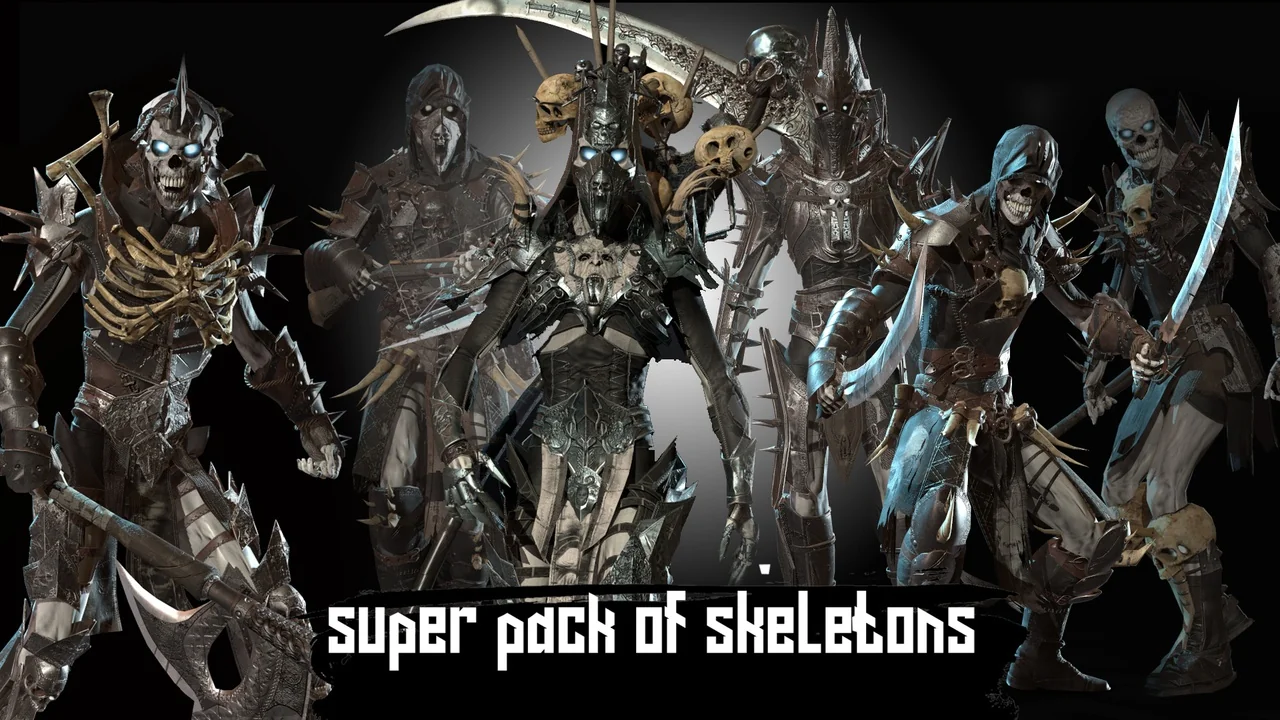
 Characters
 Characters
 Characters