"c68a05d5e51405b3"{"id":"1000700","slug":"trash-set-2","title":"Trash Set.2","category":"Trashyard","engine":"4.26+,5.0+","assetVersion":"","engineVersion":"Engine Version: 4.26+,5.0+","tag":"Trashyard","accent":"blue","visual":"mech","summary":"PBR low-poly trash and garbage collection for game engines and renderers. Includes dumpsters, bins, bottles, and food fragments for realistic scenes.","platform":"Unreal Engine","publishedAt":"2026-07-24T00:01:13.253Z","updatedAt":"2026-07-24T00:01:13.253Z","sourceNotes":[],"fileContents":[],"compatibility":["Unreal Engine","Engine Version: 4.26+,5.0+"],"featuredImage":{"alt":"Trash Set.2","src":"/wp-content/uploads/published/2026/07/bc5acc044324-61ec9d30-38c0-45dc-8f2d-d3bb6afeeb34-6cb4298d88.webp"},"hasDownloadLink":true,"downloads":0,"terms":[{"taxonomy":"category","slug":"trashyard","name":"Trashyard"}],"galleryImages":[{"src":"/wp-content/uploads/published/2026/07/cd7dff5a057b-bc753d1e-27c5-4e81-800d-a4faa7ea0818-2ba80d6624.webp","alt":"Trash Set.2"},{"src":"/wp-content/uploads/published/2026/07/2ec4be4ea871-15fbc026-bb9d-4b60-96a5-aca60bd85a1e-55daee758e.webp","alt":"Trash Set.2"},{"src":"/wp-content/uploads/published/2026/07/b7f5e1e40891-da1a15b3-3937-47bd-bf72-2f9966e95208-02acaae40f.webp","alt":"Trash Set.2"},{"src":"/wp-content/uploads/published/2026/07/cac27bfeb588-e0b61e1c-538d-4ef1-89a8-a9ef4ab19731-01acd46e4c.webp","alt":"Trash Set.2"},{"src":"/wp-content/uploads/published/2026/07/6b136a1c12d7-0d7f2b65-674b-4cfd-add7-0d7c511e4ed2-53bf9f7c10.webp","alt":"Trash Set.2"},{"src":"/wp-content/uploads/published/2026/07/60a7465d8783-24864fc9-017f-4f95-98de-e63c218eb08c-3ca594c6f8.webp","alt":"Trash Set.2"},{"src":"/wp-content/uploads/published/2026/07/e7a2f654da21-060d64c2-0647-4c75-b686-9bc2f83cb491-b947b82c2e.webp","alt":"Trash Set.2"},{"src":"/wp-content/uploads/published/2026/07/49b38c8b105a-97044d26-c7c6-4ccb-8213-613211bcd810-68da81a6f1.webp","alt":"Trash Set.2"},{"src":"/wp-content/uploads/published/2026/07/48ac3da159b1-25586492-b84c-4131-a716-c707628dbb21-f3f1614f9f.webp","alt":"Trash Set.2"}],"accessPanel":{"kind":"resource","title":"Download this resource","eyebrow":"Free Download","message":"Log in or create a free account to start your download.","fileName":"Content.7z","safetyNote":"Resources are manually reviewed before listing to improve quality and reduce obvious risks.","actionLabel":"Download Free","resourceType":"Resource archive"},"contentHtml":"\u003cp\u003eScattered litter, overstuffed dumpsters, and discarded bottles do more than fill empty space in a digital environment. They anchor a scene in a specific register of reality, signaling everyday use, neglect, or abandonment. Trash Set.2 is a prop collection based on that role, providing the individual pieces needed to make urban alleys, office corners, or exterior lots feel occupied rather than sterile.\u003c/p\u003e\n\n\n\u003ch2\u003eCore Purpose Behind Trash Set.2\u003c/h2\u003e\n\n\u003cp\u003eThe collection is presented as a high-quality model intended for game engines and any rendering engines. That phrasing matters because it sets a broad compatibility expectation. Rather than being locked to one specific pipeline, the assets are positioned to work across real-time and offline workflows alike.\u003c/p\u003e\n\n\u003cp\u003eThe stated goal is atmospheric. The creator frames the set as a tool to achieve atmosphere in projects, which lines up with how trash props function visually. A clean street reads as staged. A street with scattered fragments, tipped cans, and weathered dumpsters reads as lived-in. Trash Set.2 exists to push scenes toward the second category.\u003c/p\u003e\n\n\u003cp\u003eThe set is flagged as suitable for games, cinematics, and any other projects. That range covers both real-time interactive work and pre-rendered or linear content. Developers working in either pipeline can treat the props as environment dressing without needing to repurpose assets built for a different context.\u003c/p\u003e\n\n\u003ch2\u003eProp Categories and Keyword Coverage\u003c/h2\u003e\n\n\u003cp\u003eThe tags attached to Trash Set.2 provide a concrete picture of what the set contains. Not just one monolithic object, the package spans a range of trash-related props that can be placed individually across a scene.\u003c/p\u003e\n\n\u003cp\u003eThe keyword list includes \u003cstrong\u003ePBR\u003c/strong\u003e, \u003cstrong\u003eJunk\u003c/strong\u003e, \u003cstrong\u003eBucket\u003c/strong\u003e, \u003cstrong\u003eLowpoly\u003c/strong\u003e, \u003cstrong\u003eDumpster\u003c/strong\u003e, \u003cstrong\u003eLitter\u003c/strong\u003e, \u003cstrong\u003eTrash\u003c/strong\u003e, \u003cstrong\u003eGarbage\u003c/strong\u003e, \u003cstrong\u003eCan\u003c/strong\u003e, \u003cstrong\u003eRealistic\u003c/strong\u003e, \u003cstrong\u003eTrashcan\u003c/strong\u003e, \u003cstrong\u003eFragment\u003c/strong\u003e, \u003cstrong\u003eBottle\u003c/strong\u003e, and \u003cstrong\u003eFood\u003c/strong\u003e. Read together, these tags sketch the shape of the collection.\u003c/p\u003e\n\n\u003cp\u003eLarge containers form one tier. Dumpsters and trashcans serve as the anchor pieces, the kind of props that sit against walls or in dedicated enclosure areas. Buckets and cans fall into a similar functional group but at a smaller scale, useful for corners, closets, or maintenance areas.\u003c/p\u003e\n\n\u003cp\u003eScattered debris forms another tier. Litter, fragments, bottles, and food-related items cover the ground-level detail that makes a space look used. These are the pieces placed near doorways, around benches, or piled against curbs to break up clean surfaces and add visual noise.\u003c/p\u003e\n\n\u003cp\u003eThe \u003cstrong\u003eLowpoly\u003c/strong\u003e tag indicates that the geometry is kept efficient, which aligns with the game-engine focus. The \u003cstrong\u003ePBR\u003c/strong\u003e tag indicates that the materials follow a physically based rendering workflow, meaning the surfaces respond to light in a way that holds up under closer inspection in both real-time and rendered cinematic frames.\u003c/p\u003e\n\n\n\u003cp\u003eThe \u003cstrong\u003eRealistic\u003c/strong\u003e tag reinforces the intended look. Combined with PBR, it signals that the props are meant to read as believable trash rather than stylized or cartoonish clutter. The surface treatment aims for the kind of grime, denting, and discoloration that real containers and discarded items accumulate.\u003c/p\u003e\n\n\n\u003ch2\u003eHow the Props Behave in a Scene\u003c/h2\u003e\n\n\u003cp\u003eTrash props are primarily behavioral elements. They communicate history. A dumpster tilted slightly or a trashcan with a dented lid suggests interaction. A pile of fragments and bottles suggests activity that happened before the camera arrived. Trash Set.2 provides the raw material for that kind of environmental storytelling.\u003c/p\u003e\n\n\u003cp\u003eBecause the set includes both large containers and small scattered items, it supports layering. A dumpster can occupy a back corner while individual bottles and fragments spread outward across the ground. That combination prevents litter from looking uniformly distributed, which is a common issue when only one type of prop is available.\u003c/p\u003e\n\n\u003cp\u003eThe inclusion of food-related items alongside bottles and cans broadens the narrative range. A scene can suggest a single meal discarded on a bench, a pile of party debris, or long-term dumping depending on how the pieces are arranged and combined.\u003c/p\u003e\n\n\u003ch3\u003ePBR Materials and Visual Fidelity\u003c/h3\u003e\n\n\u003cp\u003ePhysically based rendering is the backbone of how these props are meant to be displayed. PBR workflows rely on accurate material properties, such as roughness and metalness, to ensure surfaces react predictably to lighting. For trash props, that matters in specific ways. Metal dumpsters need to catch and reflect light differently than plastic buckets. Glass bottles need transparency and specular response. Food packaging needs surface variation that reads as a printed label or coated paper rather than flat color.\u003c/p\u003e\n\n\n\u003ch2\u003eWhere Trash Set.2 Fits in Production\u003c/h2\u003e\n\n\u003cp\u003eThe set is explicitly tied to games and cinematics, but the wording extends to any other projects. That open framing means the props can serve as background dressing in interactive environments, set extension in rendered sequences, or supplementary detail in architectural visualization scenes that need to feel less curated.\u003c/p\u003e\n\n\u003cp\u003eFor game developers, the low-poly designation is the relevant technical signal. It indicates the geometry is built with performance in mind, which matters when multiple instances of bottles, cans, and fragments are scattered across a level. Efficient mesh density allows the props to be used in quantity without creating a bottleneck.\u003c/p\u003e\n\n\u003cp\u003eFor cinematic work, the PBR and Realistic tags are the relevant signals. Even if the base geometry is low-poly, the materials and surface treatment are intended to meet the visual standard expected in rendered frames. That makes the set viable as a background dressing layer in shots where the camera maintains some distance from the props.\u003c/p\u003e\n\n\u003cp\u003eEditor notes link the set with a Detective Office Kit environment. That compatibility note points toward how the props are intended to be deployed. A detective office, or the exterior spaces around one, often needs signs of disarray or neglected routine. Trash props support that mood directly, whether placed in alley entrances, near back doors, or inside scenes that need to feel unkempt rather than pristine.\u003c/p\u003e\n\n\n\u003ch2\u003eProject Scale and Placement Strategy\u003c/h2\u003e\n\n\u003cp\u003eTrash Set.2 operates at the environment-dressing layer rather than as a hero prop. The dumpsters, trashcans, and buckets are large enough to serve as secondary elements that define space, but the real value comes from combining them with the smaller fragments and bottles.\u003c/p\u003e\n\n\u003cp\u003eIn practice, the larger containers establish where trash collects. Dumpsters define alley corners. Trashcans define frequently used areas. Buckets can suggest cleaning, maintenance, or makeshift storage. Once those anchor pieces are placed, the scattered items—litter, fragments, bottles, and food-related objects—fill in around them to create natural accumulation patterns.\u003c/p\u003e\n\n\n\u003cp\u003eThis layered approach prevents the common problem of trash looking sprinkled rather than gathered. Real waste clusters. It piles against barriers, collects in corners, and spreads outward from containers. By providing both the containers and the scattered debris, the set allows artists to build those patterns rather than faking them with a single prop type.\u003c/p\u003e\n\n\u003ch2\u003eWho Benefits from This Collection\u003c/h2\u003e\n\n\u003cp\u003eTeams building urban or interior environments that need signs of use are the primary audience. The set fits detective, noir, or investigative scenes where atmosphere depends on slight disorder. It also suits any project where clean architectural geometry needs to be broken up with everyday props that signal human presence or neglect.\u003c/p\u003e\n\n\u003cp\u003eBecause the assets are positioned for both game engines and rendering engines, the set serves developers working in real-time pipelines and artists working in rendered cinematic or visualization workflows without requiring separate asset purchases for each context.\u003c/p\u003e\n\n\u003cp\u003eThe combination of PBR materials, realistic surface treatment, low-poly geometry, and a prop range that covers containers through scattered debris makes Trash Set.2 a practical dressing kit for any scene that needs to feel used rather than assembled.\u003c/p\u003e\n\n\u003ch2\u003eExplore Similar Assets\u003c/h2\u003e\n\u003cul\u003e\n\u003cli\u003e\u003ca href=\"https://3dcghub.com/industry-props-pack-5/\" title=\"Industry Props Pack 5\"\u003eIndustry Props Pack 5\u003c/a\u003e\u003c/li\u003e\n\u003cli\u003e\u003ca href=\"https://3dcghub.com/fishing-village/\" title=\"Fishing Village\"\u003eFishing Village\u003c/a\u003e\u003c/li\u003e\n\u003cli\u003e\u003ca href=\"https://3dcghub.com/hand-to-hand-set/\" title=\"Hand to Hand set\"\u003eHand to Hand set\u003c/a\u003e\u003c/li\u003e\n\u003cli\u003e\u003ca href=\"https://3dcghub.com/street-creator-set/\" title=\"Street Creator Set\"\u003eStreet Creator Set\u003c/a\u003e\u003c/li\u003e\n\u003cli\u003e\u003ca href=\"https://3dcghub.com/modular-wooden-set/\" title=\"Modular Wooden Set\"\u003eModular Wooden Set\u003c/a\u003e\u003c/li\u003e\n\u003c/ul\u003e","contentTextLength":8067,"navigation":{"current":1303,"total":3860,"previous":{"id":"1000701","slug":"troll-collection","title":"Troll Collection","category":"Characters \u0026 Creatures","platform":"Unreal Engine","updatedAt":"2026-07-24T00:07:22.674Z"},"next":{"id":"1000699","slug":"toolshed-combo-prop-pack-vol-1-6","title":"Toolshed - COMBO Prop Pack (VOL 1-6)","category":"Hardware","platform":"Unreal Engine","updatedAt":"2026-07-23T23:53:28.594Z"}},"relatedResources":[{"id":"1001347","slug":"garbage-and-debris-vol-1-by-unimodels","title":"Garbage and Debris Vol. 1 by Unimodels","category":"Trashyard","engine":"4.18+,5.0+","assetVersion":"","engineVersion":"Engine Version: 4.18+,5.0+","tag":"Trashyard","accent":"blue","visual":"mech","summary":"Garbage and Debris Vol. 1 by Unimodels delivers 52 photoscanned trash assets and 3 tiled dirt materials optimized for light baking and real-time performance.","platform":"Unreal Engine","publishedAt":"2026-10-04T10:10:57.586Z","updatedAt":"2026-10-04T10:10:57.586Z","sourceNotes":[],"fileContents":[],"compatibility":["Unreal Engine","Engine Version: 4.18+,5.0+"],"featuredImage":{"alt":"Garbage and Debris Vol. 1 by Unimodels","src":"/wp-content/uploads/published/2026/10/a5d4bcfbb697-c87cf08a-02ae-4dad-a636-1a91cd89ed08-1e585be53b.webp"},"hasDownloadLink":true,"downloads":1},{"id":"1001472","slug":"trash-vol-1-city-streets-nanite-and-low-poly-versions","title":"Trash VOL.1 - City Streets (Nanite and Low Poly Versions)","category":"Trashyard","engine":"5.1+","assetVersion":"","engineVersion":"Engine Version: 5.1+","tag":"Trashyard","accent":"blue","visual":"city","summary":"Examine Trash VOL.1 - City Streets, featuring 300 Nanite and low-poly meshes, 4K RMAO textures, custom branding, and Unreal Engine Lumen support.","platform":"Unreal Engine","publishedAt":"2026-10-08T08:24:01.253Z","updatedAt":"2026-10-08T08:24:01.253Z","sourceNotes":[],"fileContents":[],"compatibility":["Unreal Engine","Engine Version: 5.1+"],"featuredImage":{"alt":"Trash VOL.1 - City Streets (Nanite and Low Poly Versions)","src":"/wp-content/uploads/published/2026/10/7f1bd73b760f-91f75056-4bad-41e2-a9dc-08955bd55e6b-5ea8ee19a4.webp"},"hasDownloadLink":true,"downloads":0},{"id":"1000979","slug":"barricades-pack","title":"Barricades Pack","category":"Trashyard","engine":"4.26+,5.0+","assetVersion":"","engineVersion":"Engine Version: 4.26+,5.0+","tag":"Trashyard","accent":"blue","visual":"mech","summary":"A versatile set of customizable low-poly barricades for game environments. Combine parts to create unique defensive setups suited to survival, zombie, and apoca","platform":"Unreal Engine","publishedAt":"2026-08-18T05:55:25.363Z","updatedAt":"2026-08-18T05:55:25.363Z","sourceNotes":[],"fileContents":[],"compatibility":["Unreal Engine","Engine Version: 4.26+,5.0+"],"featuredImage":{"alt":"Barricades Pack","src":"/wp-content/uploads/published/2026/08/198b66993d70-6c1071b0-47e4-4e3e-ac5a-22e36d8cd366-061749439b.webp"},"hasDownloadLink":true,"downloads":0}]}
Trashyard
Trash Set.2
PBR low-poly trash and garbage collection for game engines and renderers. Includes dumpsters, bins, bottles, and food fragments for realistic scenes.
Scattered litter, overstuffed dumpsters, and discarded bottles do more than fill empty space in a digital environment. They anchor a scene in a specific register of reality, signaling everyday use, neglect, or abandonment. Trash Set.2 is a prop collection based on that role, providing the individual pieces needed to make urban alleys, office corners, or exterior lots feel occupied rather than sterile.
Core Purpose Behind Trash Set.2
The collection is presented as a high-quality model intended for game engines and any rendering engines. That phrasing matters because it sets a broad compatibility expectation. Rather than being locked to one specific pipeline, the assets are positioned to work across real-time and offline workflows alike.
The stated goal is atmospheric. The creator frames the set as a tool to achieve atmosphere in projects, which lines up with how trash props function visually. A clean street reads as staged. A street with scattered fragments, tipped cans, and weathered dumpsters reads as lived-in. Trash Set.2 exists to push scenes toward the second category.
The set is flagged as suitable for games, cinematics, and any other projects. That range covers both real-time interactive work and pre-rendered or linear content. Developers working in either pipeline can treat the props as environment dressing without needing to repurpose assets built for a different context.
Prop Categories and Keyword Coverage
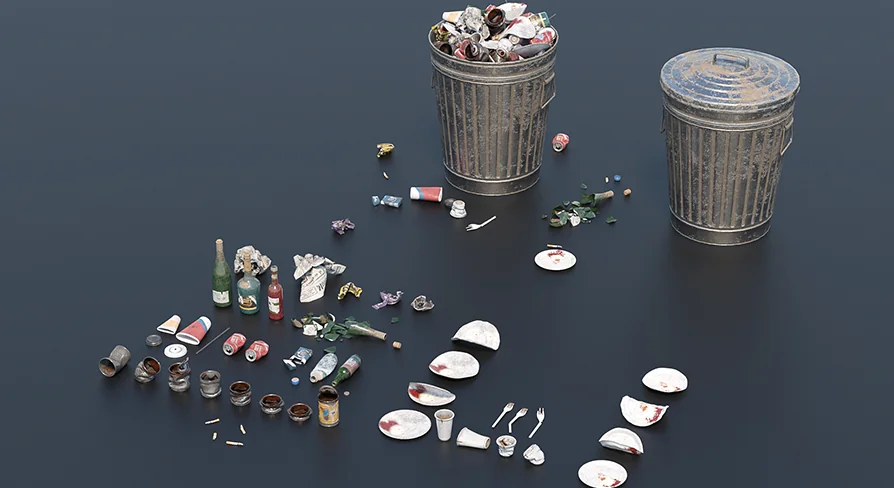
The tags attached to Trash Set.2 provide a concrete picture of what the set contains. Not just one monolithic object, the package spans a range of trash-related props that can be placed individually across a scene.
The keyword list includes PBR, Junk, Bucket, Lowpoly, Dumpster, Litter, Trash, Garbage, Can, Realistic, Trashcan, Fragment, Bottle, and Food. Read together, these tags sketch the shape of the collection.
Large containers form one tier. Dumpsters and trashcans serve as the anchor pieces, the kind of props that sit against walls or in dedicated enclosure areas. Buckets and cans fall into a similar functional group but at a smaller scale, useful for corners, closets, or maintenance areas.
Scattered debris forms another tier. Litter, fragments, bottles, and food-related items cover the ground-level detail that makes a space look used. These are the pieces placed near doorways, around benches, or piled against curbs to break up clean surfaces and add visual noise.
The Lowpoly tag indicates that the geometry is kept efficient, which aligns with the game-engine focus. The PBR tag indicates that the materials follow a physically based rendering workflow, meaning the surfaces respond to light in a way that holds up under closer inspection in both real-time and rendered cinematic frames.
The Realistic tag reinforces the intended look. Combined with PBR, it signals that the props are meant to read as believable trash rather than stylized or cartoonish clutter. The surface treatment aims for the kind of grime, denting, and discoloration that real containers and discarded items accumulate.
How the Props Behave in a Scene
Trash props are primarily behavioral elements. They communicate history. A dumpster tilted slightly or a trashcan with a dented lid suggests interaction. A pile of fragments and bottles suggests activity that happened before the camera arrived. Trash Set.2 provides the raw material for that kind of environmental storytelling.
Because the set includes both large containers and small scattered items, it supports layering. A dumpster can occupy a back corner while individual bottles and fragments spread outward across the ground. That combination prevents litter from looking uniformly distributed, which is a common issue when only one type of prop is available.
The inclusion of food-related items alongside bottles and cans broadens the narrative range. A scene can suggest a single meal discarded on a bench, a pile of party debris, or long-term dumping depending on how the pieces are arranged and combined.
PBR Materials and Visual Fidelity
Physically based rendering is the backbone of how these props are meant to be displayed. PBR workflows rely on accurate material properties, such as roughness and metalness, to ensure surfaces react predictably to lighting. For trash props, that matters in specific ways. Metal dumpsters need to catch and reflect light differently than plastic buckets. Glass bottles need transparency and specular response. Food packaging needs surface variation that reads as a printed label or coated paper rather than flat color.
Where Trash Set.2 Fits in Production
The set is explicitly tied to games and cinematics, but the wording extends to any other projects. That open framing means the props can serve as background dressing in interactive environments, set extension in rendered sequences, or supplementary detail in architectural visualization scenes that need to feel less curated.
For game developers, the low-poly designation is the relevant technical signal. It indicates the geometry is built with performance in mind, which matters when multiple instances of bottles, cans, and fragments are scattered across a level. Efficient mesh density allows the props to be used in quantity without creating a bottleneck.
For cinematic work, the PBR and Realistic tags are the relevant signals. Even if the base geometry is low-poly, the materials and surface treatment are intended to meet the visual standard expected in rendered frames. That makes the set viable as a background dressing layer in shots where the camera maintains some distance from the props.
Editor notes link the set with a Detective Office Kit environment. That compatibility note points toward how the props are intended to be deployed. A detective office, or the exterior spaces around one, often needs signs of disarray or neglected routine. Trash props support that mood directly, whether placed in alley entrances, near back doors, or inside scenes that need to feel unkempt rather than pristine.
Project Scale and Placement Strategy
Trash Set.2 operates at the environment-dressing layer rather than as a hero prop. The dumpsters, trashcans, and buckets are large enough to serve as secondary elements that define space, but the real value comes from combining them with the smaller fragments and bottles.
In practice, the larger containers establish where trash collects. Dumpsters define alley corners. Trashcans define frequently used areas. Buckets can suggest cleaning, maintenance, or makeshift storage. Once those anchor pieces are placed, the scattered items—litter, fragments, bottles, and food-related objects—fill in around them to create natural accumulation patterns.
This layered approach prevents the common problem of trash looking sprinkled rather than gathered. Real waste clusters. It piles against barriers, collects in corners, and spreads outward from containers. By providing both the containers and the scattered debris, the set allows artists to build those patterns rather than faking them with a single prop type.
Who Benefits from This Collection
Teams building urban or interior environments that need signs of use are the primary audience. The set fits detective, noir, or investigative scenes where atmosphere depends on slight disorder. It also suits any project where clean architectural geometry needs to be broken up with everyday props that signal human presence or neglect.
Because the assets are positioned for both game engines and rendering engines, the set serves developers working in real-time pipelines and artists working in rendered cinematic or visualization workflows without requiring separate asset purchases for each context.
The combination of PBR materials, realistic surface treatment, low-poly geometry, and a prop range that covers containers through scattered debris makes Trash Set.2 a practical dressing kit for any scene that needs to feel used rather than assembled.
 Trashyard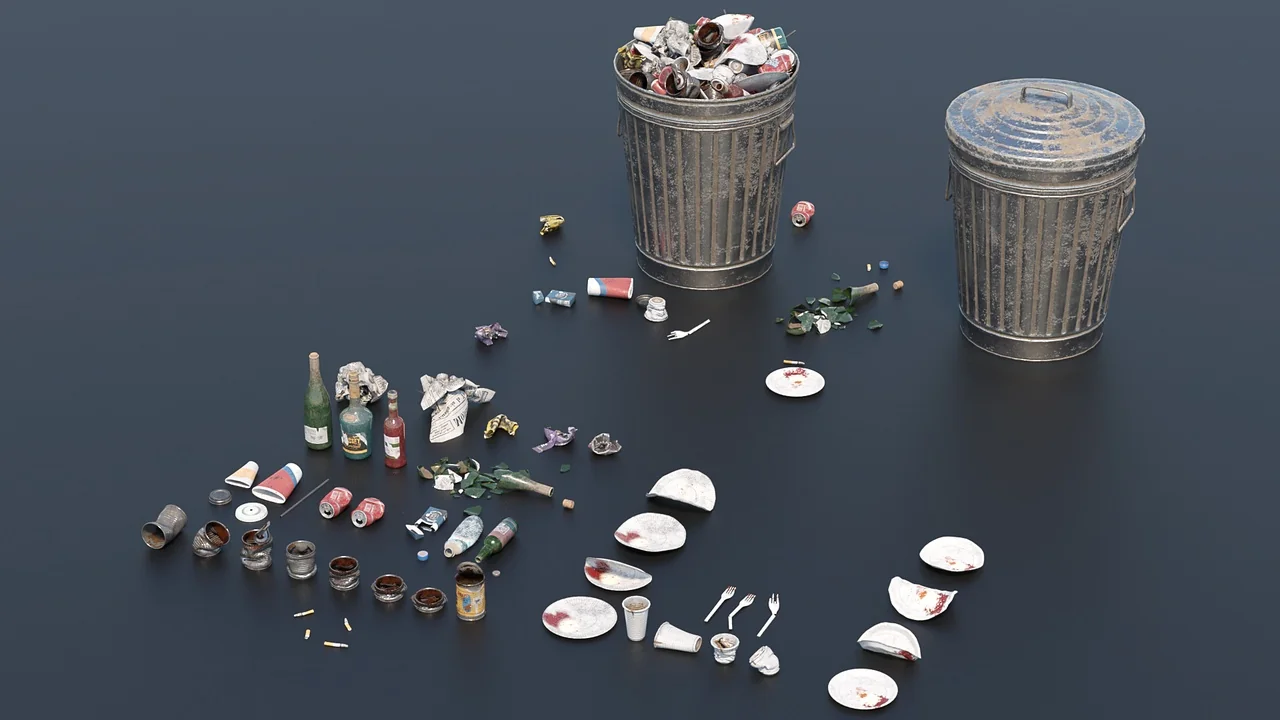
 Trashyard
 Trashyard
 Trashyard