"a338a1d501976271"{"id":"1001347","slug":"garbage-and-debris-vol-1-by-unimodels","title":"Garbage and Debris Vol. 1 by Unimodels","category":"Trashyard","engine":"4.18+,5.0+","assetVersion":"","engineVersion":"Engine Version: 4.18+,5.0+","tag":"Trashyard","accent":"blue","visual":"mech","summary":"Garbage and Debris Vol. 1 by Unimodels delivers 52 photoscanned trash assets and 3 tiled dirt materials optimized for light baking and real-time performance.","platform":"Unreal Engine","publishedAt":"2026-10-04T10:10:57.586Z","updatedAt":"2026-10-04T10:10:57.586Z","sourceNotes":[],"fileContents":[],"compatibility":["Unreal Engine","Engine Version: 4.18+,5.0+"],"featuredImage":{"alt":"Garbage and Debris Vol. 1 by Unimodels","src":"/wp-content/uploads/published/2026/10/a5d4bcfbb697-c87cf08a-02ae-4dad-a636-1a91cd89ed08-1e585be53b.webp"},"hasDownloadLink":true,"downloads":0,"terms":[{"taxonomy":"category","slug":"trashyard","name":"Trashyard"}],"galleryImages":[{"src":"/wp-content/uploads/published/2026/10/d9921a0d3c11-f4fd6353-2f27-47dc-8196-c38e9f3be55d-2162bdb157.webp","alt":"Garbage and Debris Vol. 1 by Unimodels"},{"src":"/wp-content/uploads/published/2026/10/4d34d5e42f3b-63ad92e6-96b8-44ac-b1bc-785c017041fa-4c5c0ce049.webp","alt":"Garbage and Debris Vol. 1 by Unimodels"},{"src":"/wp-content/uploads/published/2026/10/49c3df766a64-8f67bf5d-fa51-421e-b855-482c281599f0-73b28af811.webp","alt":"Garbage and Debris Vol. 1 by Unimodels"},{"src":"/wp-content/uploads/published/2026/10/2fa7621f737b-512e1af5-9c35-41e5-b15b-2ea32f269c24-8153cc11a3.webp","alt":"Garbage and Debris Vol. 1 by Unimodels"},{"src":"/wp-content/uploads/published/2026/10/ece5fa8d0179-0f7c0575-cd16-4e58-9c87-aeb75dbc7220-4fc30b13fb.webp","alt":"Garbage and Debris Vol. 1 by Unimodels"},{"src":"/wp-content/uploads/published/2026/10/fc442b5522ae-17755e8d-f737-48a2-a332-7d7131fd13f7-a0bf64f29b.webp","alt":"Garbage and Debris Vol. 1 by Unimodels"},{"src":"/wp-content/uploads/published/2026/10/6f3a4ca32317-1cd7c24a-282b-4229-a5f4-5ec3e15ee288-c6f1e21674.webp","alt":"Garbage and Debris Vol. 1 by Unimodels"},{"src":"/wp-content/uploads/published/2026/10/d9a3e34468c1-b7caa74f-e06f-482e-90b5-1699476096b4-0eab3e205f.webp","alt":"Garbage and Debris Vol. 1 by Unimodels"},{"src":"/wp-content/uploads/published/2026/10/3d85731444d9-e94c1715-da1f-4903-bdf1-d3040f4a4b15-4c800cd676.webp","alt":"Garbage and Debris Vol. 1 by Unimodels"},{"src":"/wp-content/uploads/published/2026/10/af6540dc9599-b67838b9-5c14-4bb3-8ecb-af1c8cfaa0b5-319a80b53b.webp","alt":"Garbage and Debris Vol. 1 by Unimodels"}],"accessPanel":{"kind":"resource","title":"Download this resource","eyebrow":"Free Download","message":"Log in or create a free account to start your download.","fileName":"Content.7z","safetyNote":"Resources are manually reviewed before listing to improve quality and reduce obvious risks.","actionLabel":"Download Free","resourceType":"Resource archive"},"contentHtml":"\u003ch2\u003eIntegrating 52 Photoscanned Trash and Garbage Assets into Scene Layouts\u003c/h2\u003e\n\u003cp\u003ePopulating a believable real-time environment requires breaking visual repetition through authentic real-world wear. Garbage and Debris Vol. 1 provides 52 distinct photoscanned trash and garbage assets designed to sit directly on surfaces, settle into room corners, and detail floor planes. Because the geometry derives from photographic scans, the physical silhouettes capture the natural crumpling, tearing, and compression characteristic of discarded materials. These irregular contours eliminate the rigid, synthetic edges often produced by traditional hand-modeling.\u003c/p\u003e\n\u003cp\u003ePlacing these pieces into an active level begins with scattering strategies. Individual props can be grouped around trash receptacles, clustered along baseboards, or strewn across open floors to indicate abandoned or neglected spaces. The visual fidelity of scanned physical trash—such as folded paper, packaging, and discarded debris—offers immediate narrative clues about human presence and activity without requiring customized hero props for background clutter.\u003c/p\u003e \u003ch2\u003eSurface Layering with Tiled Materials for Dirt and Debris Scenarios\u003c/h2\u003e\n\u003cp\u003eWhile discrete prop meshes establish physical volume, realistic environmental deterioration demands a cohesive ground treatment. The collection includes three tiled materials specifically crafted to establish scenarios of dirt and garbage. These materials provide broad surface coverage, functioning either as foundational ground layers or as blendable surface textures.\u003c/p\u003e\n\u003cp\u003eApplying the tiled materials across floor surfaces establishes the underlying grime that anchors loose objects to the world. A bare, clean floor beneath scattered debris immediately breaks visual cohesion; integrating the tiled dirt textures underneath the 52 individual props connects the objects to the environment. The tiled maps can be painted onto landscape meshes, mapped directly across modular floor pieces, or combined using vertex color blending to transition naturally from well-kept corridors to heavily soiled zones.\u003c/p\u003e \u003ch2\u003eValidating Light Baking and Optimal Performance\u003c/h2\u003e\n\u003cp\u003ePhotoscanned geometry frequently introduces unpredictable vertex densities and messy UV coordinates, which can derail project performance if left unrefined. In this package, all 52 objects have been modeled and tested specifically to ensure perfect light baking and optimal performance during runtime execution.\u003c/p\u003e\n\u003cp\u003eLight baking depends entirely on clean, non-overlapping secondary UV channels with appropriate texel padding. Without correct lightmap parameters, static lighting bakes generate dark splotches, light leaks, and severe shadow bleeding around small, complex geometries like crinkled garbage. The meshes here feature clean unwraps that bake smoothly under static lighting setups, casting accurate contact shadows onto surrounding surfaces without generating visual artifacts.\u003c/p\u003e\n\u003cp\u003eRuntime efficiency requires strict polygon and draw call management. The assets undergo optimization to eliminate redundant geometry while preserving the essential high-frequency details captured by the original scans. This balance allows level designers to instance dozens of debris items across a single room without triggering frame drops or exceeding memory budgets.\u003c/p\u003e \u003ch2\u003eCorporate Wear and Office Vol. 1 Compatibility\u003c/h2\u003e\n\u003cp\u003eThe collection integrates directly with Office Vol. 1 – Complete Corporate Interior, creating an immediate visual contrast between sterile office architecture and unmanaged clutter. Modern workplace environments contain numerous zones where trash naturally accumulates, including breakrooms, print stations, maintenance closets, and under-desk footwells.\u003c/p\u003e\n\u003cp\u003eCombining the polished architectural elements of the corporate interior with the 52 debris props allows developers to adjust the timeline and condition of the space. A pristine corporate floor plan can be converted into an after-hours cleaning phase, an office undergoing renovation, or a ransacked, abandoned facility. The three tiled dirt materials can be layered onto the office flooring tiles or industrial carpets, grounding the scattered litter within the corporate setting.\u003c/p\u003e \u003ch2\u003eProduction Readiness for Real-Time Set Dressing\u003c/h2\u003e\n\u003cp\u003eSet dressing remains one of the most time-consuming stages of level construction. Building convincing trash and grime from scratch requires extensive reference gathering, manual modeling of complex organic shapes, and careful UV unwrapping to prevent engine errors. By providing 52 tested meshes alongside three coordinated materials, this collection functions as a self-contained toolkit for environmental grunge.\u003c/p\u003e\n\u003cp\u003eThe assets drop into active production pipelines with verified stability. Whether lighting is handled through precomputed static lightmaps or contemporary dynamic pipelines, the clean mesh structure and calibrated surfaces maintain their visual integrity across various lighting conditions, ensuring consistent results from rapid layout prototyping through final level polish.\u003c/p\u003e\n\n\u003ch2\u003eRelated Resources Worth Checking\u003c/h2\u003e\n\u003cul\u003e\n\u003cli\u003e\u003ca href=\"https://3dcghub.com/horror-and-decay-vol-2-urban-debris/\" title=\"Horror and Decay VOL.2 - Urban Debris\"\u003eHorror and Decay VOL.2 - Urban Debris\u003c/a\u003e\u003c/li\u003e\n\u003cli\u003e\u003ca href=\"https://3dcghub.com/trash-set-2/\" title=\"Trash Set.2\"\u003eTrash Set.2\u003c/a\u003e\u003c/li\u003e\n\u003cli\u003e\u003ca href=\"https://3dcghub.com/landscaping-vines-1/\" title=\"Livingroom Vol. 1 by Unimodels\"\u003eLivingroom Vol. 1 by Unimodels\u003c/a\u003e\u003c/li\u003e\n\u003cli\u003e\u003ca href=\"https://3dcghub.com/fishing-village/\" title=\"Fishing Village\"\u003eFishing Village\u003c/a\u003e\u003c/li\u003e\n\u003cli\u003e\u003ca href=\"https://3dcghub.com/rubble-and-debris-modular-set/\" title=\"Rubble and Debris - Modular Set\"\u003eRubble and Debris - Modular Set\u003c/a\u003e\u003c/li\u003e\n\u003c/ul\u003e","contentTextLength":5167,"navigation":{"current":55,"total":3338,"previous":{"id":"1001348","slug":"goblin-sword-shield-animset","title":"Goblin Sword Shield AnimSet","category":"Combat","platform":"Unreal Engine","updatedAt":"2026-10-04T10:17:26.298Z"},"next":{"id":"1001346","slug":"garage-pack","title":"Garage Pack","category":"Industrial","platform":"Unreal Engine","updatedAt":"2026-10-04T10:09:57.157Z"}},"relatedResources":[{"id":"12331","slug":"horror-and-decay-vol-2-urban-debris","title":"Horror and Decay VOL.2 - Urban Debris","category":"Building \u0026 Human-made","engine":"4.26+,5.0+","assetVersion":"Engine version: 4.26+,5.0+","engineVersion":"4.19","tag":"Building","accent":"blue","visual":"luts","summary":"Enhance your game environments with Horror and Decay VOL.2 - Urban Debris. This collection offers high-quality, realistic assets designed for professional game development in Unreal Engine.","platform":"Unreal Engine","publishedAt":"2026-03-07T12:16:27.000Z","updatedAt":"2026-04-19T15:47:59.000Z","sourceNotes":[],"fileContents":[],"compatibility":["Unreal Engine","Engine version: 4.26+,5.0+"],"featuredImage":{"alt":"Horror and Decay VOL.2 - Urban Debris","src":"https://3dcghub.com/wp-content/uploads/2026/03/c75cf398-628d-4eee-82dc-2e4462d9c306.webp"},"hasDownloadLink":true,"downloads":0},{"id":"1000700","slug":"trash-set-2","title":"Trash Set.2","category":"Trashyard","engine":"4.26+,5.0+","assetVersion":"","engineVersion":"Engine Version: 4.26+,5.0+","tag":"Trashyard","accent":"blue","visual":"mech","summary":"PBR low-poly trash and garbage collection for game engines and renderers. Includes dumpsters, bins, bottles, and food fragments for realistic scenes.","platform":"Unreal Engine","publishedAt":"2026-07-24T00:01:13.253Z","updatedAt":"2026-07-24T00:01:13.253Z","sourceNotes":[],"fileContents":[],"compatibility":["Unreal Engine","Engine Version: 4.26+,5.0+"],"featuredImage":{"alt":"Trash Set.2","src":"/wp-content/uploads/published/2026/07/bc5acc044324-61ec9d30-38c0-45dc-8f2d-d3bb6afeeb34-6cb4298d88.webp"},"hasDownloadLink":true,"downloads":0},{"id":"1331","slug":"landscaping-vines-1","title":"Livingroom Vol. 1 by Unimodels","category":"Buildings \u0026 Architecture","engine":"5.1+","assetVersion":"Engine version: 5.1+","engineVersion":"5.1","tag":"Buildings","accent":"blue","visual":"city","summary":"Enhance your architectural projects with realistic landscaping vines. Features Pivot Painter 2.0 and Nanite support for lifelike movement and performance.","platform":"Unreal Engine","publishedAt":"2026-02-06T17:52:33.000Z","updatedAt":"2026-04-19T15:58:11.000Z","sourceNotes":[],"fileContents":[],"compatibility":["Unreal Engine","Engine version: 5.1+"],"featuredImage":{"alt":"Livingroom Vol. 1 by Unimodels","src":"https://3dcghub.com/wp-content/uploads/2026/02/0cc2c22c-2820-4719-a7f9-fc8bf151a5e9.png"},"hasDownloadLink":true,"downloads":0}]}
Trashyard
Garbage and Debris Vol. 1 by Unimodels
Garbage and Debris Vol. 1 by Unimodels delivers 52 photoscanned trash assets and 3 tiled dirt materials optimized for light baking and real-time performance.
Category:Unreal Engine,TrashyardPlatform: Unreal EngineEngine Version: 4.18+,5.0+Published: Oct 4, 2026
Trashyard
Resource overview
Integrating 52 Photoscanned Trash and Garbage Assets into Scene Layouts
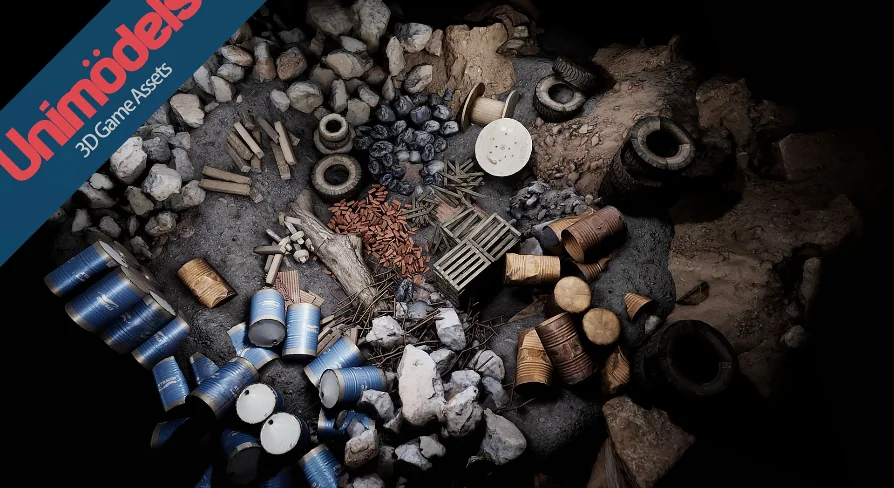
Populating a believable real-time environment requires breaking visual repetition through authentic real-world wear. Garbage and Debris Vol. 1 provides 52 distinct photoscanned trash and garbage assets designed to sit directly on surfaces, settle into room corners, and detail floor planes. Because the geometry derives from photographic scans, the physical silhouettes capture the natural crumpling, tearing, and compression characteristic of discarded materials. These irregular contours eliminate the rigid, synthetic edges often produced by traditional hand-modeling.
Placing these pieces into an active level begins with scattering strategies. Individual props can be grouped around trash receptacles, clustered along baseboards, or strewn across open floors to indicate abandoned or neglected spaces. The visual fidelity of scanned physical trash—such as folded paper, packaging, and discarded debris—offers immediate narrative clues about human presence and activity without requiring customized hero props for background clutter.
Surface Layering with Tiled Materials for Dirt and Debris Scenarios
While discrete prop meshes establish physical volume, realistic environmental deterioration demands a cohesive ground treatment. The collection includes three tiled materials specifically crafted to establish scenarios of dirt and garbage. These materials provide broad surface coverage, functioning either as foundational ground layers or as blendable surface textures.
Applying the tiled materials across floor surfaces establishes the underlying grime that anchors loose objects to the world. A bare, clean floor beneath scattered debris immediately breaks visual cohesion; integrating the tiled dirt textures underneath the 52 individual props connects the objects to the environment. The tiled maps can be painted onto landscape meshes, mapped directly across modular floor pieces, or combined using vertex color blending to transition naturally from well-kept corridors to heavily soiled zones.
Validating Light Baking and Optimal Performance
Photoscanned geometry frequently introduces unpredictable vertex densities and messy UV coordinates, which can derail project performance if left unrefined. In this package, all 52 objects have been modeled and tested specifically to ensure perfect light baking and optimal performance during runtime execution.
Light baking depends entirely on clean, non-overlapping secondary UV channels with appropriate texel padding. Without correct lightmap parameters, static lighting bakes generate dark splotches, light leaks, and severe shadow bleeding around small, complex geometries like crinkled garbage. The meshes here feature clean unwraps that bake smoothly under static lighting setups, casting accurate contact shadows onto surrounding surfaces without generating visual artifacts.
Runtime efficiency requires strict polygon and draw call management. The assets undergo optimization to eliminate redundant geometry while preserving the essential high-frequency details captured by the original scans. This balance allows level designers to instance dozens of debris items across a single room without triggering frame drops or exceeding memory budgets.
Corporate Wear and Office Vol. 1 Compatibility
The collection integrates directly with Office Vol. 1 – Complete Corporate Interior, creating an immediate visual contrast between sterile office architecture and unmanaged clutter. Modern workplace environments contain numerous zones where trash naturally accumulates, including breakrooms, print stations, maintenance closets, and under-desk footwells.
Combining the polished architectural elements of the corporate interior with the 52 debris props allows developers to adjust the timeline and condition of the space. A pristine corporate floor plan can be converted into an after-hours cleaning phase, an office undergoing renovation, or a ransacked, abandoned facility. The three tiled dirt materials can be layered onto the office flooring tiles or industrial carpets, grounding the scattered litter within the corporate setting.
Production Readiness for Real-Time Set Dressing
Set dressing remains one of the most time-consuming stages of level construction. Building convincing trash and grime from scratch requires extensive reference gathering, manual modeling of complex organic shapes, and careful UV unwrapping to prevent engine errors. By providing 52 tested meshes alongside three coordinated materials, this collection functions as a self-contained toolkit for environmental grunge.
The assets drop into active production pipelines with verified stability. Whether lighting is handled through precomputed static lightmaps or contemporary dynamic pipelines, the clean mesh structure and calibrated surfaces maintain their visual integrity across various lighting conditions, ensuring consistent results from rapid layout prototyping through final level polish.
 Trashyard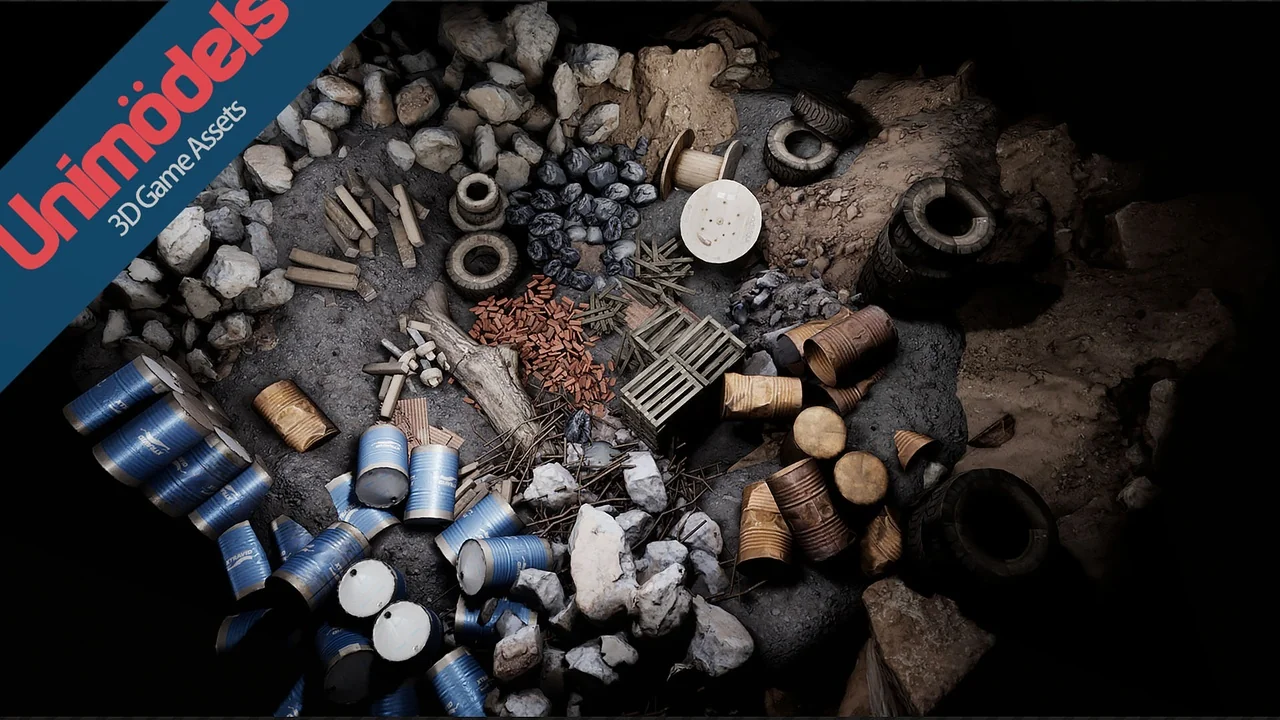
 Building
 Trashyard
 Buildings